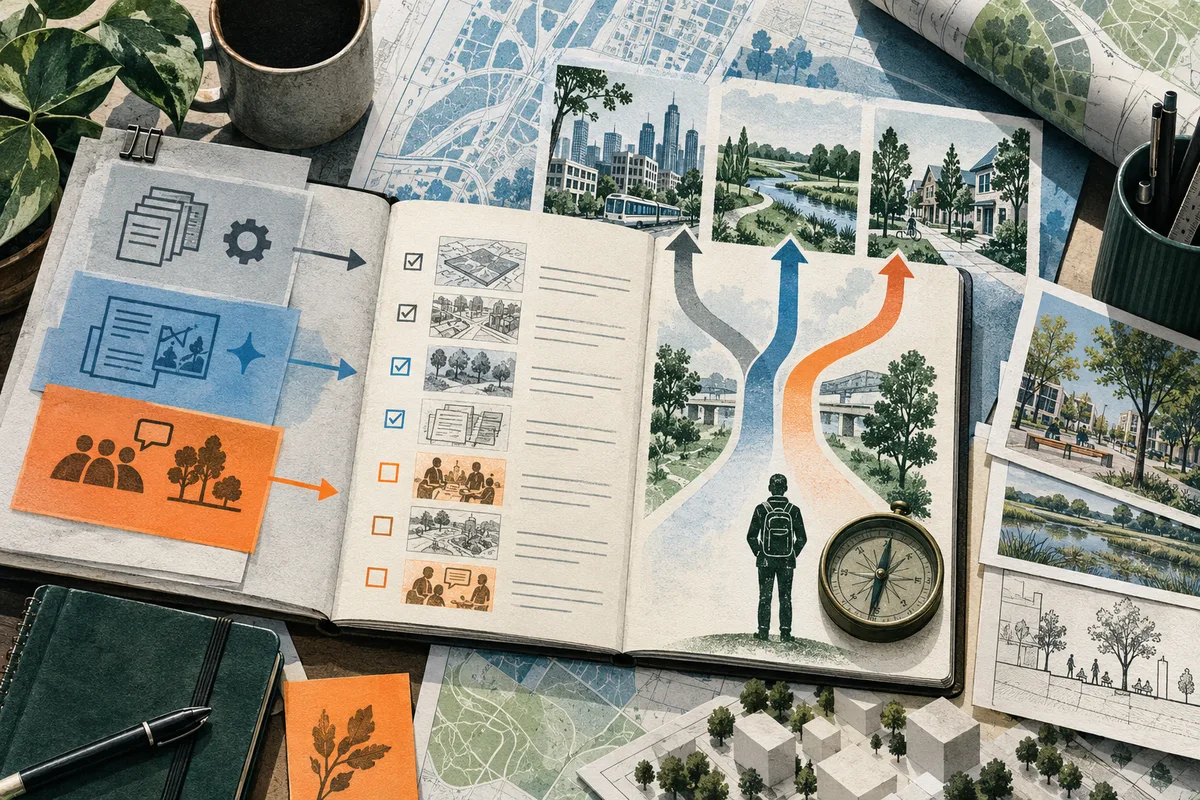
The 2026 APA Trend Report treats AI as a reason to rethink entry-level planning work, not as evidence that new planners will disappear. It recommends responsible tool use and making room for early-career perspectives. The report does not measure planner-specific adoption, hiring, or displacement, so use it to guide questions about tasks, supervision, and learning rather than to make a career decision on its own.
What kind of claim is the 2026 report making?
The 2026 Trend Report for Planners is a foresight document: it asks planners to prepare for trends and uncertainty. Its AI and entry-level discussion is a professional argument for changing junior roles, not a forecast that planning graduates will lose jobs. This matters if you are weighing planning study, a first role, or a concern to raise with a manager. Foresight can guide questions without measuring outcomes.
The American Planning Association (APA) published the fifth report with the Lincoln Institute of Land Policy on January 28, 2026. It describes more than 100 trends identified by APA’s foresight team and community, grouped into “Act Now,” “Prepare,” and “Learn and Watch” timeframes. APA says foresight is not prediction; it examines drivers of change, preparation, and when action may be warranted. The report is a map for attention, not a labor-market forecast. [2026 Trend Report for Planners]
In an interview about the report, APA’s chief foresight and knowledge officer says many customary entry-level tasks can be done by AI and argues that teams should rethink junior work. She sees an opportunity to bring early-career perspectives into planning and support learning across experience levels. The interview clarifies the recommendation; it is not a study of hiring, adoption, or job loss. [2026 Trend Report]
The practical question is not whether the report proves entry-level planners will disappear. It does not. Ask instead what should replace learning and participation supplied by customary starter tasks if tools take on some of that work. Use the report to start a role or education conversation, not to conclude planning has no entry path.
What does the report ask planning teams to change?
APA's proposal is to redesign entry-level planning work, not simply to add an AI tool to the old task list. In the March 2026 Booked on Planning interview, Petra Hurtado, APA's Chief Foresight and Knowledge Officer, says many customary starter tasks can now be done by AI. She argues that this creates an opportunity to rethink what junior positions ask people to do: bring newer perspectives into planning, question inherited processes, and learn alongside experienced colleagues while using tools responsibly. The 2026 Trend Report for Planners frames that discussion as preparation for change, not a staffing forecast. Hurtado's reasoning begins with a professional concern about legacy processes. She says some established approaches do not help communities improve, and describes early-career planners as able to notice and question things differently. Her recommendation is that teams create avenues for them to voice opinions and challenge routine ways of working. This is not a claim that youth alone supplies better judgment, nor that experience has become less useful. In the interview, she explicitly values combining experience with outside-the-box thinking, presenting that combination as a possible source of innovation. A junior planner's contribution, on this account, should not be limited to completing assigned production more quickly. The interview also gives this redesign a reciprocal learning dimension. Hurtado describes reverse mentoring: newcomers learn from experienced planners how to do the work, while experienced staff learn how newer colleagues approach the world and familiar tasks. Tool fluency may let a newcomer contribute earlier by helping a team reconsider a process. A host mentions an intern experimenting with a chatbot for preliminary historic-preservation questions; this illustrates a possibility, not routine municipal adoption or a tested workflow. The distinction between task capability and workforce change is essential. Saying that AI can perform some customary tasks does not establish that it performs them accurately under local rules, that a planning office has adopted it, that a job has been redesigned, or that fewer people will be hired. The interview is an explanation of APA's professional view, not a survey of junior planners, a count of employer plans, or a study measuring displacement. Responsible use still requires deciding what work is suitable, how to check it, and who is accountable. That leaves a practical question for a team considering the report's recommendation: who benefits when routine work changes, and what happens to the time released? If a junior can contribute a fresh perspective, learn under guidance, and take on meaningful work, redesign may widen participation. If starter assignments disappear without replacement learning and feedback, the entry role could become thinner. These are plausible outcomes to examine, not findings the interview measured. The report and its foresight lead give planning teams a reason to discuss role design; they do not say how many positions will change. For an applicant or early-career planner, the useful follow-up is to ask which responsibilities may shift, what meaningful work a junior will own, and who will provide guidance as the team changes.
Which parts of Planner I work can change, and which remain accountable?
APA’s “Planner I / Assistant Planner” profile describes entry-level planning as professional work involving judgment under considerable immediate supervision. Its duties mix information preparation with interpretation and contact: a Planner I may gather statistical data, prepare reports and maps, review development proposals against codes and plans, help evaluate rezonings or permits, explain regulations to the public, coordinate community review, resolve resident questions, and conduct field assessments. This profile makes the occupation harder to summarize with a single exposure label. Some components are repeatable and document-heavy; others depend on applying rules to a particular proposal, explaining consequences, or resolving questions in context. The profile is a representative description, not a record of how any current office uses AI, and it was updated in May 2021. Consider an example: a Planner I is helping prepare a review of a development proposal. An approved AI tool might help organize supplied documents, produce a first-pass summary, or draft a plain-language outline. Those are illustrative possibilities, not observed planning-sector uses or proof of reliable performance. The planner still needs to check that the source records are complete and accurately represented, identify what the summary leaves uncertain, and compare the proposal with the applicable local code and plan. APA’s profile explicitly includes review for conformance, evaluation of proposals, detailed reports to government bodies, and the ability to apply ordinances and codes to field conditions. A polished draft cannot establish that a site condition was observed correctly, that a rule applies as summarized, or that relevant context has not been omitted. The work therefore includes both producing material and deciding whether it is fit to inform a public process. That distinction locates accountability without claiming that any task is immune to change. If a tool prepares more of the first draft, staff still need a defined reviewer who can trace claims to records, correct errors, and explain uncertainty before a recommendation reaches a decision body. When a resident asks how a regulation applies to a specific proposal, a planner must understand the governing rule and communicate its practical meaning; APA lists public information, citizen and customer issues, community coordination, and public presentations among the role’s functions. Field assessment likewise connects written material to conditions on a particular site. AI assistance could change how these duties are prepared or supported, but the available profile does not measure that change or specify which office would adopt a tool. The Bureau of Labor Statistics’ “Urban and Regional Planners” overview separately describes planners’ work developing plans and programs for land and physical facilities, and notes that planners may travel to proposed sites. It supplies occupational context, not evidence about automation. For an applicant or employee, useful questions are concrete: Which recurring tasks are tool-assisted here? Who reviews generated summaries or drafts? What records must be checked, and what decisions remain assigned to staff? Those answers reveal more about a particular role than its title alone.
Sources: Planner I / Assistant Planner; Urban and Regional Planners
Why does changing starter work matter for the learning rung?
Entry-level planning tasks can produce useful work and teach the person doing them. Gathering data, preparing a map or report, and supporting a development review bring a newcomer into contact with records, rules, sites, and questions that need explanation. If tools take over some preparation, the question is whether a new planner still gets supervised chances to understand how evidence becomes a recommendation. This is an interpretation of APA’s role profiles, not a learning outcome measured by APA or an AI study.
The American Planning Association’s Planner I / Assistant Planner profile describes an entry-level professional role with considerable immediate supervision. Its typical functions span data collection, maps and reports, proposal review against codes and plans, field assessments, and communication with community groups and the public. The list shows why routine preparation and judgment can sit within one job: a report may start with organizing information, then require someone to notice what is missing, connect a rule to a site, or explain an implication. The profile does not say AI performs these tasks or that employers have changed them. It helps identify where workflow changes could also affect practice opportunities.
APA’s role profiles suggest a possible progression. The Planning Intern description includes data preparation, land-record searches, fieldwork, maps, reports, meeting support, and presentations, while noting that tasks and supervision vary considerably. Planner I adds professional duties and judgment under close supervision. Planner II work is more specialized, with somewhat less immediate supervision, although senior planners still review it closely. Together, these descriptions illustrate a path from supported contact with planning material toward more independent application. They are representative profiles, not a universal sequence at every employer.
That path could be disrupted if a tool produces an initial summary, map, or draft before a junior worker has learned to make one. Time saved might create room for site visits, code interpretation, or public-facing work, but this benefit is not automatic. If the junior sees only a polished output, without its sources, corrections, or reasoning, there may be less practice spotting a bad record or explaining why a proposal conflicts with a rule. This is a plausible mechanism inferred from the listed duties and supervision; the profiles do not test whether AI reduces learning or show that a decline has occurred.
Someone assessing a first role, internship, or redesign can check whether the learning loop remains visible. Ask who reviews tool-assisted work, whether the junior sees and discusses edits, and whether assignments still involve field conditions, community questions, and source records. Ask what responsibility is expected to grow: can the worker progress from assembling material toward checking its meaning, applying rules, and presenting findings with supervision? These questions concern the actual role, not a guarantee that its title includes training.
Progression may matter as much as the share of tasks that look automatable on paper. A role with fewer manual drafts could still teach well if review is instructive and meaningful assignments remain. APA’s profiles cannot establish conditions at a particular office. They do suggest what to examine: supervision, feedback, contact with sites and communities, and a clear next responsibility. If routine work changes, those parts of the learning rung need deliberate attention.
Sources: Planner I / Assistant Planner; Planning Intern; Planner II
What do we know about planning-sector use today?
The evidence is limited: the American Planning Association (APA) says relatively few planners routinely apply AI, but its Foresight page gives no sample, date range, or adoption percentage. That is a qualitative characterization, not a measure of how common use is across planning offices, which tasks are involved, or whether entry-level staffing has changed. The page also describes APA’s Artificial Intelligence in Planning Use Cases Database as an effort to map applications in the United States and internationally and identify which planning areas are adopting them. A mapping effort shows that APA is collecting examples to examine emerging patterns; it does not establish how representative those examples are or how often tools are used in ordinary work. The supported conclusion is therefore narrow: APA identifies real-world use while characterizing routine application as limited, without quantifying either. The page supports neither broad adoption nor no adoption. Capability and adoption answer different questions. In the Booked on Planning interview, APA Chief Foresight and Knowledge Officer Petra Hurtado says many customary entry-level tasks can be done by AI and argues that teams should rethink junior roles, include newcomers’ perspectives, and combine technical and human skills. This describes possible task capability and a recommended response. It does not say how many offices have installed tools, which workflows they authorize, or whether use has reduced hiring. Read alongside APA’s Foresight overview, the interview suggests a gap between tasks that may be technically feasible and routine use in professional settings. Neither source measures that gap or explains its size. A use case, a pilot, a routine workflow, and a staffing consequence should not be treated as the same stage. An office might test a tool on a narrow task without approving it for sensitive records; an approved tool might be used occasionally without changing who prepares or reviews work. Even routine use would not by itself show that a job has been redesigned or removed. APA’s database is intended to map applications and adoption patterns, but the overview does not report representative findings. For someone considering a planning role, the practical question is local: does this office permit and routinely use a tool for the tasks I would perform, what information may be entered, and who checks the result before it informs a report or public decision? Ask whether its use changes the assignment, reviewer responsibility, or time for supervised work. Stronger profession-wide evidence would pair dated, representative employer surveys with actual workflows and safeguards, then compare entry-level postings and responsibilities over time. Procurement or policy records could document formal decisions, but would need to connect to actual use and task changes before supporting an employment conclusion. Until then, APA’s overview is a reason to ask specific questions about an office, not a basis for a numerical adoption claim or a prediction about junior jobs.
Sources: Foresight; 2026 Trend Report
What can occupation-wide demand data tell a new planner?
The U.S. Bureau of Labor Statistics projects urban and regional planner employment to grow 4 percent from 2025 to 2035, with about 3,200 openings per year on average. That is a national demand baseline, not an entry-level hiring forecast or an estimate of AI's effect. APA presents the 2026 Trend Report for Planners as foresight for preparing amid uncertainty, not a prediction of a particular employment outcome. Its discussion of changing junior work is therefore not evidence that planning graduates will lose jobs; equally, positive occupation-wide growth cannot show that junior positions will remain unchanged.
The BLS projection covers the occupation as a whole, across career stages and reasons for openings. Many annual openings are expected to replace workers who transfer to other occupations or leave the labor force, including through retirement. An opening is not necessarily a newly created job, and the national total does not show who qualifies, how many applicants compete, or what share an employer assigns to entry-level candidates. It gives scale and direction at the occupation level. It cannot say whether a particular graduate will find a first role, whether an office will hire next year, or whether its routine duties are being reorganized around software.
BLS attributes expected demand to demographic, transportation, and environmental changes; revitalization and population growth; housing and transport systems; and infrastructure development, including roads, sewer systems, parks, and schools. It also notes that government budgets can affect public-sector employment because projects depend on available funds. So “4 percent growth” is not a guarantee. A municipality's hiring may still depend on its budget, project pipeline, and local conditions. BLS points readers to state and area data because a national projection does not describe every local labor market equally.
These figures do not settle how work is distributed between experienced and new planners. Employment might grow overall while employers alter the number or content of junior roles. Routine tasks might also change while organizations retain supervised work through which newcomers learn to check evidence, interpret local rules, and explain decisions. That is an interpretation of how role design could interact with demand, not a BLS finding. The projection does not track task-level AI use, entry-level vacancies, or workplace learning, so it cannot distinguish these paths.
If you are considering planning study or a first position, use the projection to put APA's concern in context, not to dismiss it. BLS does not project occupation-wide disappearance through 2035; it does not show that entry routes are secure or that AI has no effect. Before committing time or tuition, check requirements and openings where you could realistically work, using state or area data and current employer postings. Ask whether a role offers supervised responsibility and feedback, not only whether its title is “planner.” Budgets, credentials, salary needs, and family or health constraints shape what is workable. APA raises a role-design question; BLS supplies a broad U.S. demand baseline. Neither source alone answers what will happen to a new planner in a particular office.
Sources: Urban and Regional Planners; 2026 Trend Report for Planners
What does the young-worker signal add, and what can it not prove?
Stanford’s August 2026 working paper, “Canaries in the Coal Mine? Six Facts about the Recent Employment Effects of Artificial Intelligence,” adds a reason to take entry routes seriously. Using high-frequency ADP payroll records covering millions of U.S. workers through June 2026, the researchers report that employment among 22–25-year-olds in AI-exposed occupations stood 19 percent below the path it would have followed had it kept pace with less-exposed peers. The gap was mainly associated with reduced hiring, rather than increased separations. This is a comparison with a counterfactual trajectory, not a claim that 19 percent of young workers were laid off or that any individual faces a 19 percent chance of losing a job.
That distinction matters for a prospective planner. Stanford reports no evidence of widespread economy-wide displacement, and says experienced workers did not show a comparable gap. It also finds declines concentrated in occupations where AI use primarily substitutes for human tasks, while employment was flat or rising where use primarily complements work, especially for experienced employees. Those are broad patterns across occupations. The analysis does not identify planning as a group, tell us whether planning employers changed hiring, or show that AI caused a particular office’s decision. Its age band is not a synonym for “entry-level”: workers can enter or change occupations at other ages, and young workers may already have experience.
The authors explicitly characterize their results as early descriptive indicators, not causal estimates. Several limits should stay beside the striking number. The patterns attenuate when the analysis controls for education; some divergent trends began before generative AI; and the relationship is more pronounced in ADP’s sample than in national survey benchmarks, although the authors note some evidence of consistent patterns in government administrative data. Those limits mean the 19 percent figure is a warning signal to monitor, not a measured AI effect on planners.
The comparison with the U.S. Bureau of Labor Statistics’ “Urban and Regional Planners” outlook clarifies why neither source settles the local decision. BLS projects total U.S. planner employment to grow 4 percent from 2025 to 2035 and estimates about 3,200 openings a year on average. They are not divided by career stage and do not estimate AI’s effect. Many projected openings reflect workers transferring occupations or leaving the labor force; public budgets can also affect government employment. Positive total growth can coexist with a harder first step for newcomers, just as a difficult entry market does not establish that the occupation is shrinking. Stanford offers a nearer-term, age-specific signal across exposed occupations; BLS offers a longer-range national outlook for planners. Their populations, periods, and questions differ, so they are not opposing verdicts.
The Stanford result supports attention to hiring and supervision, not a prediction that planners will be displaced. The evidence that would materially change this reading is repeated, planner-specific data linking actual tool adoption and task redesign with entry-level hiring, separations, and opportunities for supervised practice over time. Until those measures exist, someone weighing planning can monitor local vacancies and ask how junior staff learn when routine preparation changes. That is a proportionate response to a concerning cross-occupation signal without treating it as a forecast for one profession or one person.
Sources: Canaries in the Coal Mine? Six Facts about the Recent Employment Effects of Artificial Intelligence; Urban and Regional Planners
How should a prospective or early-career planner choose a next step?
Do not make a costly education or career decision from the 2026 APA Trend Report alone. It raises a question about how planning teams may redesign entry-level work; it does not tell an individual which move will pay off. Compare the actual role or program: recurring tasks, credential requirements, review process, learning opportunities, and local conditions. Then test one bounded, approved tool-assisted workflow while keeping source checking and supervised judgment in view. A small trial can inform a decision without turning a broad foresight report into a personal employment prediction.
If you already work in planning, start with a precise task, such as organizing source material or preparing a first draft of a routine document. Use an approved tool only if workplace rules permit it and the information is appropriate to enter. Check its output against authoritative records, note corrections and review needs,. This is a practical experiment, not a guarantee or tested intervention. The American Planning Association’s Planner I profile describes document work alongside proposal review, public information, coordination, and field assessment. Learn how a changed task connects to your own job; do not assume every office uses the same workflow.
Bring the results to a manager and ask what responsibility could expand if preparation becomes easier. Ask who confirms the information, checks its application to local rules and conditions, and explains implications to decision-makers or community members. Ask which task you could own next with feedback,. The APA Planner I profile describes considerable immediate supervision, making the substance of review relevant to development. Tool use that removes practice without replacing it may leave a gap. That is a reason to discuss role design, not evidence that such a gap has occurred.
If you are entering the field, compare education and experience with requirements where you hope to work. The Bureau of Labor Statistics’ Occupational Outlook Handbook describes a bachelor’s degree as typical entry education for urban and regional planners, while employers may set their own requirements. Check local credential rules and target job postings before paying for a degree or assuming a short course is enough. The APA Planning Intern profile says internships can provide practical contact with planning through data, maps, reports, fieldwork, meeting support, and presentations. It also says tasks, hours, supervision, and specialization vary. Ask whether a particular internship or project offers feedback, exposure to local rules and conditions,.
A course may teach a specific approved tool, but completion alone does not establish workplace readiness or replace a required credential. A degree can provide broader study and structured practice, but takes more time and money. Compare options by prerequisites, depth, feedback, signaling value, schedule, and cost. For AI use in planning, begin with data literacy, domain knowledge, evaluation, and verification. Building AI products or pursuing machine-learning engineering is a different goal with different technical prerequisites. The report does not choose your goal.
If considering a larger change, first test an adjacent move rather than presuming it is safer. GIS, community engagement, housing, transportation, or policy experience might transfer to a local role, depending on duties and requirements. Compare actual openings, pay needs, location, and credential gaps. BLS projects U.S. urban and regional planner employment to grow 4 percent from 2025 to 2035, with about 3,200 annual openings on average. These national, occupation-wide figures do not isolate entry-level hiring, a city, or an AI effect. Use them as context for further checking, not a promise of access or a reason to ignore financial constraints.
Before committing, write down your salary floor, feasible study hours, location limits, caregiving duties, health needs, and tolerance for tuition or debt. Ask an employer or program: What information may not be entered into an AI tool? Who reviews assisted work? Which decisions remain accountable to staff? What independent task will a beginner take on after feedback? Answers can show whether changed production comes with a credible learning path. If unclear, seek clarification or compare another option. A reversible workflow trial and concrete supervision conversation are more proportionate first moves than a field switch or purchase driven solely by the APA report.
Sources: Urban and Regional Planners; Planner I / Assistant Planner; Planning Intern
What is the report's supported verdict—and what should I ask next?
The 2026 APA Trend Report argues that entry-level planning work should evolve as AI takes on customary tasks; it does not establish that entry-level planners are disappearing. It is not a hiring forecast or evidence of adoption by a particular office. The caveat is practical: redesign preserves an entry route only if employers provide meaningful assignments, supervision, and local openings. APA’s Planner I / Assistant Planner profile describes professional judgment under considerable immediate supervision, making the quality of work and review relevant alongside the job title. The broader young-worker signal does not settle the planning question. Canaries in the Coal Mine? reports that employment among 22–25-year-olds in AI-exposed occupations stood 19 percent below a comparison path, mainly through reduced hiring. Its authors call this descriptive rather than causal, and do not estimate planning-sector effects. The verdict could change with planner-specific evidence linking AI adoption and task redesign to hiring, separations, and supervised learning over time. Ask a manager, interviewer, or program lead: “If routine report or data preparation is increasingly tool-assisted here, which supervised task will I own to learn code interpretation, field judgment, or public explanation, and who will review it?” The free task checker maps duties to task-level change-pressure signals, not a validated displacement probability. If you need to compare paths against salary, location, or training time, the career roadmap is another option. Neither product is required by the report.
Sources: Planner I / Assistant Planner; Canaries in the Coal Mine? Six Facts about the Recent Employment Effects of Artificial Intelligence
Sources and notes
- 2026 Trend Report for Planners
Supports the report’s publication details, foresight purpose, and framing as preparation for uncertainty.
- 2026 Trend Report
Supports APA’s explanation of the entry-level work concern and proposed role redesign.
- Planner I / Assistant Planner
Supports the description of entry-level planning duties, judgment, and considerable supervision.
- Planning Intern
Supports the varied tasks and learning circumstances described for planning internships.
- Planner II
Supports the illustrative progression from supervised entry-level work to more specialized duties.
- Urban and Regional Planners
Supports national occupation-wide U.S. employment projections, openings, and demand context.
- Foresight
Supports APA’s qualitative characterization of routine AI use and its use-case mapping effort.
- Canaries in the Coal Mine? Six Facts about the Recent Employment Effects of Artificial Intelligence
Supports the reported young-worker comparison and its stated descriptive, noncausal limitations.
Apply this to your own work
See the whole job market at once.
Explore which occupations AI may reshape, then turn the signal into a practical response.
Explore the job map