
2026 U.S. worker surveys document AI use across listed activities, varied self-reported time effects, and some tasks reportedly handled by AI after being delegated to another person. These measures describe different experiences and cannot be pooled into a takeover rate. They do not establish measured net productivity, whole-job displacement, or an individual’s odds of losing work. Use them to choose a recurring task to observe under your workplace’s actual rules and conditions.
What do 2026 U.S. worker task surveys show?
The 2026 U.S. worker surveys show AI assistance and reports of work changing hands, but they do not establish that whole occupations have been taken over or give an individual odds of losing a job. They ask different questions: whether workers used AI for listed activities, how much time they believe it saved, what share of selected tasks AI performed, and whether AI now handles work once given to another person. Those findings should be read separately, not pooled into a single takeover rate.
For reach, the Census Bureau’s “About a Third of Workers Who Used AI in the Last Week Said They Completed Tasks One to Two Hours Faster” reports use across an 11-activity frame. The Epoch AI/Ipsos task survey instead asks about involvement in ten selected activities, including reported task share and prior delegation. Broader adoption indices and worker-perception surveys measure still different things: adoption thresholds, views of work quality or career benefit, and concern about replacement. Each can describe a real signal, but none is interchangeable with observed job separations or an occupation-wide outcome.
Some respondents do report that AI handles tasks formerly assigned to coworkers or contractors. That is evidence of reported task reallocation and should not be erased by calling every use mere assistance. It also does not by itself show that a position disappeared: a survey response about an activity does not count jobs, hours, layoffs, or labor demand. Taken together, these surveys support a measured conclusion about current use and task change, not full occupational takeover. Their practical value is to identify which work activities deserve closer inspection; they cannot convert a task signal into a personal displacement forecast.
Sources: About a Third of Workers Who Used AI in the Last Week Said They Completed Tasks One to Two Hours Faster; Polling on AI usage: July 2026 AI at work; AI at work: how AI is changing everyday job tasks; Economic Well-Being of U.S. Households in 2025: Employment and Job Quality; What Work Does Generative AI Do?; Workers’ Perspectives on Artificial Intelligence: Productivity Gains and Job-loss Fears; Use of Gen AI in the Workplace and the Value of Access to Training
How broadly did the March Census survey register any workplace use?
The Census Bureau’s “About a Third of Workers Who Used AI in the Last Week Said They Completed Tasks One to Two Hours Faster” puts reported workplace use at about 56% of U.S. workers for at least one of 11 listed job activities in March 2026. This is an any-use estimate: a worker qualifies by reporting AI use for one or more activities on the list. The result therefore answers how many workers crossed that threshold, not how often they used AI, how much of their work it handled, or how central it was to their job.
The activity list makes the estimate more concrete than a general question about whether someone uses AI at work. It spans routine digital work and includes searching for information, writing, generating ideas, summarizing material, and administrative activities among the common reported uses. These examples show that reported use reaches familiar work processes rather than a single specialized occupation. But the headline percentage does not say that every listed activity is equally common, that every worker used several activities, or that AI performed each activity from start to finish. The unit remains the worker who reported at least one listed use.
That distinction matters because a broad reach figure can sound like a measure of intensity when it is not. A person who used AI once for a narrow step and a person who uses it repeatedly across several activities both count toward the any-use share. The estimate does not separate those patterns by itself. Nor does appearing on the list establish that AI output was accepted, accurate, or consequential; the reach question records reported use, not the quality or result of that use. The survey is thus useful for locating how far workplace experimentation or use had spread across workers, while leaving its depth and effects to other questions.
The 11 activities also provide a boundary around what was counted. The finding should be described as use for at least one of the survey’s listed activities, not as evidence that 56% of workers use AI for every kind of task or that the same share applies to every occupation. A task list can include activities that occur in many jobs, yet workers’ actual mix of duties differs. The aggregate gives a national worker-level snapshot; it does not reconstruct any one respondent’s full workday or the distribution of use within each profession.
The reported percentage reflects the Census survey’s weighting and its March 2026 measurement, with an update to weights noted by the Bureau. According to the Census article, the revised estimates shifted somewhat, while the statistical-test conclusions did not change. That revision is relevant context for a precise reading: the published value is an estimate shaped by survey design and weighting rather than a direct count of every U.S. worker. It does not alter the definition of the headline measure, which remains use on at least one of the 11 activities. The note signals that the exact estimate can move with the survey’s weighting procedure; it does not turn that movement into evidence of a sudden change in workplace behavior, nor does it change what respondents were asked to report.
The activity pattern helps interpret the reach measure without turning it into a claim about replacement. Search, writing, idea generation, summarizing, and administration are recognizable categories where AI may contribute a step to a larger piece of work. The survey’s any-use result alone cannot establish whether the contribution was a draft, a search aid, a transformation of existing material, or a completed deliverable. Those differences are precisely why the activity names should be retained when describing the result: they tell readers what kind of work people reported involving AI, but do not specify the depth of that involvement.
A careful summary is therefore: in March 2026, about 56% of U.S. workers reported AI use for at least one of 11 Census-listed job activities, with common reports including information search, writing, ideas, summaries, and administration. The breadth is meaningful as a measure of reported reach. It should not be restated as a share of tasks automated, a count of jobs changed, or a measure of how intensively workers depend on AI. Those are different outcomes and require evidence beyond this threshold.
What does the Census time question establish?
The Census Bureau’s “About a Third of Workers Who Used AI in the Last Week Said They Completed Tasks One to Two Hours Faster” measures workers’ remembered estimate of how many additional hours they would have needed to finish their work without AI. It is a retrospective counterfactual: the respondent compares the observed week with an imagined version in which AI was absent. The question therefore records perceived time difference, not time measured by an observer or a controlled comparison. Its value is that it asks users to quantify their own experience rather than merely say whether AI feels helpful.
The reported answers are distributed across several categories. Among workers who reported using AI at work in the last week, 25% said they would have needed less than one additional hour; 31% chose one to two hours; 15% chose three to four hours; and another 15% chose more than four hours. Ten percent said AI saved no time, while 4% said using it required additional time. These results show that reported experience is not uniform: some users perceive substantial time avoided, many report smaller amounts, and a minority report no saving or a time cost. The headline’s ‘about a third’ refers specifically to the one-to-two-hour response category, not to every user who reported any positive saving.
The wording matters because ‘additional hours’ asks what would have been required without AI, not how much faster a particular AI-assisted task ran on a stopwatch. A respondent may be summarizing a varied workweek, drawing on a salient task, or estimating a difference that was never separately timed. The response does not reveal which activity generated the estimate, how many tasks contributed, or whether the respondent used the same reference point as another worker. The categories make subjective estimates comparable in broad bands, but the estimate remains a person’s recollection and judgment about a counterfactual workweek.
The Census article also reports a specific reference window: respondents who said they used AI at work in the last week answered how many additional hours they would have needed to finish their work without AI. That timing anchors the estimate in recent use, but it does not mean that every reported hour maps to a task performed during one clearly bounded session. Work may include multiple activities and interruptions, and a respondent can only estimate the alternative after the fact. The wording asks about the respondent’s work as a whole, so the answer should not be silently reinterpreted as an average saving per task, per AI interaction, or per day.
The category pattern also prevents a simple reading of AI use as successful time reduction. The 10% reporting no time saved and 4% reporting additional time are part of the same recent-user group from which the positive estimates come. These answers could reflect different work, tools, usage patterns, or judgments, but the reported categories do not identify which explanation applies. What they establish directly is the spread of self-assessed outcomes. In particular, the positive response bands should not be generalized to every worker who has tried AI or treated as evidence that a user’s time-saving estimate is dependable for a different task or workplace.
That distinction also defines what the result can establish. It is evidence that workers perceive a difference in the time required to complete their work, and the size of that perceived difference varies. It is not a measured productivity effect: the survey does not experimentally assign AI access, record equivalent work completed with and without it, or independently verify task quality. Nor does the answer calculate net hours in a workweek by accounting for all task stages and other work. A reported avoided hour cannot by itself tell us whether total output rose, whether the saved time went to another task, or whether any organizational labor need changed.
Self-reports still have a useful place in the evidence. Workers experience the workflow and can report whether a tool seems to change how long their work takes; a measured trial may miss informal use or work that is difficult to time. Here, the distribution itself is informative because it preserves variation instead of treating AI use as equivalent to a time gain. The Census result supports a bounded conclusion: recent users often perceive some time difference, but the answer is an estimate of additional hours in a remembered no-AI scenario. It describes reported experience and motivates more direct measurement; it does not establish that AI caused a specific productivity gain for each respondent.
What exactly did the July task instrument sample and ask?
Epoch AI’s “Polling on AI usage: July 2026, AI at work” documents a survey conducted with Ipsos on KnowledgePanel, a probability-based online panel recruited through address-based sampling. Fieldwork ran July 10–19, 2026, and the analyzed sample contained 1,103 employed U.S. adults. To qualify, respondents had to be employed or self-employed, either full time or part time. Epoch says the results were weighted to represent the U.S. employed adult population age 18 and older using Census benchmarks. This makes the intended population clear: estimates describe employed adults nationally, not all adults, all workers worldwide, or a probability sample of occupations.
The panel design is relevant to how the findings should be read. Address-based recruitment gives people a route into the panel that does not depend solely on volunteering for an AI poll, and probability sampling can reduce self-selection compared with an open opt-in survey. Weighting then adjusts the analyzed responses toward population benchmarks. Neither step turns a respondent’s account into an observed work record: the task and experience answers remain self-reports, and weighting cannot correct every difference between an answer and the underlying event. Epoch reports 90% Wilson score confidence intervals calculated using effective sample sizes that account for unequal weights. Those intervals describe sampling uncertainty around weighted proportions; they do not encompass every possible source of measurement or reporting error.
The instrument’s task list was built from O*NET version 30.3, the U.S. Department of Labor’s occupational database. Epoch selected ten intermediate work activities from O*NET’s 332-item intermediate-activity layer, intended to offer detail that can be shared across jobs. It combined those activities with national employment data, using May 2025 Bureau of Labor Statistics Occupational Employment and Wage Statistics to weight O*NET task ratings by how common activities were across the U.S. workforce. The selection allowed up to two items from an activity family, excluded medical activities, and focused on knowledge-work activities where AI services could plausibly be used.
The list was not selected by ranking tasks for predicted AI exposure or observed AI use. Epoch says four activities were excluded and replaced with the next-ranked options: executing financial transactions, internal coordination or communicating about operational plans, training others, and purchasing. Respondents saw the selected task labels verbatim. This construction gives the survey a common vocabulary and a deliberate knowledge-work focus, while bounding what its answers cover. Ten shared activities make cross-job questioning feasible, but they cannot represent every responsibility in every occupation or the full mixture of digital, interpersonal, physical, and accountable work that an individual does.
The questionnaire proceeded through eligibility and task relevance rather than asking every respondent to describe every listed activity. Questions about individual activities were asked only when a respondent said the activity was a regular part of the job. The survey covered AI services used, work tasks done with AI, frequency, employer-provided subscriptions, and how much of each selected task respondents said AI did. It also asked how long they had used AI for those activities, time spent on the task currently and before AI, time spent interacting with AI, editing of AI output, and whether AI had taken over tasks previously assigned to contractors or coworkers. These modules create several distinct observations about workers’ accounts, not a single measure of automation.
Some follow-ups had narrower denominators. Questions about time using AI for a task, time spent on it, and editing were asked for no more than five AI-assisted tasks per respondent. When more than five tasks qualified, Epoch randomly selected a subset while retaining tasks where respondents said AI did most or all of the work. A randomly selected 10% of respondents who used AI for work received an open-ended version of the work-task question rather than the structured version. In addition, some questions were limited to people who said they had used an AI service in the past week. Consequently, a chart or statistic from one module may reflect a subset of the 1,103 respondents or selected tasks; the total sample size should not be mistaken for the denominator of every result.
The instrument’s design makes its central contribution legible: it asks employed U.S. adults about a defined set of recurring knowledge-work activities, then separates whether AI is used from reported frequency, task share, timing, editing, and earlier human assignment. Probability recruitment and population weighting improve the basis for describing this target population compared with an unstructured opt-in poll. Still, a respondent determines whether an activity is regular, recalls prior work, and estimates AI’s role. The survey offers a structured account of reported task experience, with sampling intervals and a transparent frame; it does not independently inspect work products or establish what AI can perform autonomously across the labor market.
How much of a selected task do workers say AI performs?
Epoch AI’s “AI at work: how AI is changing everyday job tasks” adds a measure of involvement to a simple use/no-use answer: for a selected activity that was regular work, respondents estimated whether AI did a part, most, or all of it. The broad pattern was that AI more often assisted with only part of a task than performed most or all. In the activity-level comparison, the highest reported rate of AI doing most or all was for designing computer systems or software, at 10%; for each of the other measured activities it was below 7%. The result makes clear that reported use across a task list does not usually mean the system performs the bulk of that activity. It also identifies a narrower group of tasks where workers describe a much larger AI contribution.
Those percentages have a different denominator from the survey’s task-use rates. A use rate asks how many workers who regularly perform an activity report any AI involvement. The task-share result concerns the extent AI performs within AI-assisted activities. For example, Epoch reports that 57% of workers who perform system or software design use AI to some extent, while 10% report that it performs most or all of that activity. These figures are compatible: some users may rely on AI for a limited stage, and the larger-use group remains a subset of activity performers. The 10% therefore should not be read as 10% of all work in software design, a share of workers in a software occupation, or the proportion of software design jobs automated. The survey’s shared activities cut across occupations, and the measure attaches to the activity as respondents experience it.
The useful comparison is between extent of involvement and reported time outcome. Among AI-assisted tasks where respondents said AI did part of the work, 37% were reported to take less time. When respondents said AI did most or all, 53% were reported to take less time. More extensive AI performance was therefore associated with a higher frequency of reported time savings in this survey. The figures describe the share of tasks in each involvement group for which workers reported a shorter duration; they are not hours saved, average duration reductions, or a combined productivity estimate. Their denominators are task reports in the two involvement categories, not every worker or every task in the economy.
The comparison is not one-sided. Roughly one in six AI-assisted tasks took longer, and Epoch reports that this share was similar whether AI did part or most or all of the task. A stronger reported AI contribution and a greater frequency of time savings can coexist with a meaningful incidence of longer tasks. This pattern matters because a task-share category is not a verdict on whether the whole workflow improved. It records the respondent’s judgment about the part AI performed, while the time outcome records whether the task took less or more time than before. The relationship is informative precisely because it leaves room for outcomes to differ at a similar level of AI involvement.
Epoch describes the relationship as an association and gives plausible alternatives rather than a single causal account. A larger AI contribution could itself reduce task time. Workers could also assign more work to AI when they expect a time benefit, or the tasks that AI handles especially well could be overrepresented in the high-involvement category. The survey does not distinguish these explanations. Nor does the reported category certify that AI completed a task independently: “most or all” is the worker’s estimate of how much AI performed, not an external audit of quality, reliability, or accountability. The extent measure is closer to substantial task substitution than an any-use checkbox, but it remains a report about a task in context.
That boundary makes the percentages useful for comparison, not for a universal rule to maximize AI’s share. A worker can reasonably take the result as evidence that more extensive reported involvement coincided with more frequent reported time savings in the sampled activities. They cannot infer that increasing AI’s share will cause their own task to become faster, that the savings will be the same in a different workflow, or that the pattern applies to every duty within an occupation. The report does not test an intervention that assigns different shares of identical work to AI, and its measured activities do not exhaust the work people do.
For a practical reading, separate three questions when looking at an activity: whether AI is used at all, how much of that activity the worker says it performs, and whether the task is reported to take less or more time. The survey shows these are related but non-equivalent descriptions. A frequent-use activity need not be mostly performed by AI; a task where AI does most or all is not guaranteed to take less time; and a shorter reported duration does not by itself establish the quality or wider value of the result. Keeping the measures side by side preserves what the evidence adds: task share helps distinguish limited assistance from extensive involvement, while the time comparison shows how often workers report different duration outcomes within those involvement groups. The evidence supports a conditional observation about current reports, not a forecast for a worker, role, or employer.
What does prior delegation reveal about task reallocation?
Epoch AI’s “AI at work: how AI is changing everyday job tasks” asks a narrower question than whether a respondent uses AI: does AI now handle mostly all or all of a task that the respondent or their team previously delegated to a coworker or contractor? One in five employed adults—20% of respondents—said yes for at least one of the ten selected activities. The result identifies reported movement in a specific handoff: work that used to go to another person is now, in the respondent’s account, handled mostly or entirely by AI. It is a task-allocation signal with a prior human reference point, not simply another measure of AI adoption.
The reported cases appeared across all ten activities. Analyzing data was the most commonly named, at 7.1% of respondents; reading work documents followed at 5.7%, and maintaining records at 5.3%. These are respondent shares naming an activity that met the prior-delegation and mostly-or-all threshold. They are not percentages of data-analysis, reading, or recordkeeping tasks across the economy. Nor do the three activity figures add up to the 20% total: a respondent may report more than one activity, and the headline counts people with at least one qualifying activity. The figures show that task reassignment is not confined to one kind of work, while preserving the survey’s actual unit of observation.
This threshold distinguishes the item from ordinary AI use and from the reported-share comparison. A person may use AI to draft part of a document without saying it now handles most or all of work previously assigned to another person. Conversely, someone can report that AI now handles most or all of a previously delegated activity even though the survey does not establish how many times the handoff occurred or how much of the person’s working time it represented. The 20% estimate describes people reporting at least one qualifying change, not the portion of all work transferred from humans to AI. The prior human handoff makes the result more concrete than a generic use response, but it does not turn the estimate into a count of replaced workers.
What changed according to the answer is who receives or performs a bounded piece of work in the respondent’s workflow. The survey does not follow the coworker or contractor who previously received it. It does not ask whether that person lost a client, retained other assignments, shifted to different duties, reduced hours, or left employment. It also does not record the organization’s staffing levels before and after the transfer. Those are distinct outcomes that would require employment or administrative records, or longitudinal evidence about the affected workers and firms. The survey’s respondent can report that a handoff changed; they cannot report the complete labor-market consequence unless separately measured.
That separation does not make the finding trivial. A task previously assigned to a person and now mostly or fully assigned to AI is a real reported change in task routing, and it may matter to the contractor or coworker who used to do that work. It can be an early labor-process signal: organizations may be changing how pieces of work are distributed before any employment outcome appears in a survey of current workers. But “may” is the limit. The result cannot establish that such a later change occurred, how often a task transfer reduced paid work, or whether the organization used any time or cost difference to alter staffing. It supports taking task reallocation seriously without treating it as proof of displacement.
The distinction is especially important when interpreting the phrase “one in five.” It refers to employed respondents who reported at least one such transfer among the selected activities. It does not mean one in five U.S. jobs has been eliminated, that one fifth of workers’ tasks moved to AI, or that one fifth of contractors or coworkers lost work. The sample’s employment status and the item’s framing concern people currently in work, while the outcomes of former task recipients are not observed. The estimate therefore supplies evidence of reported substitution at the task level but no rate of separation, unemployment, reduced hours, or lower labor demand.
A grounded conclusion is that some workers report AI taking on tasks their teams had once routed to contractors or coworkers, with data analysis the most frequently named activity in this measure. That is narrower and more consequential than any-use evidence, yet it remains distinct from an employment count. To establish displacement would require evidence about what happened to the people and paid positions connected to those handoffs, as well as whether changes persisted and spread. Until then, the survey documents a change in reported task allocation and leaves its employment consequences open. That is enough to recognize that work is being reassigned in some settings, but not enough to infer what happened to the person previously assigned the work.
Sources: AI at work: how AI is changing everyday job tasks
What can output editing tell us about review work?
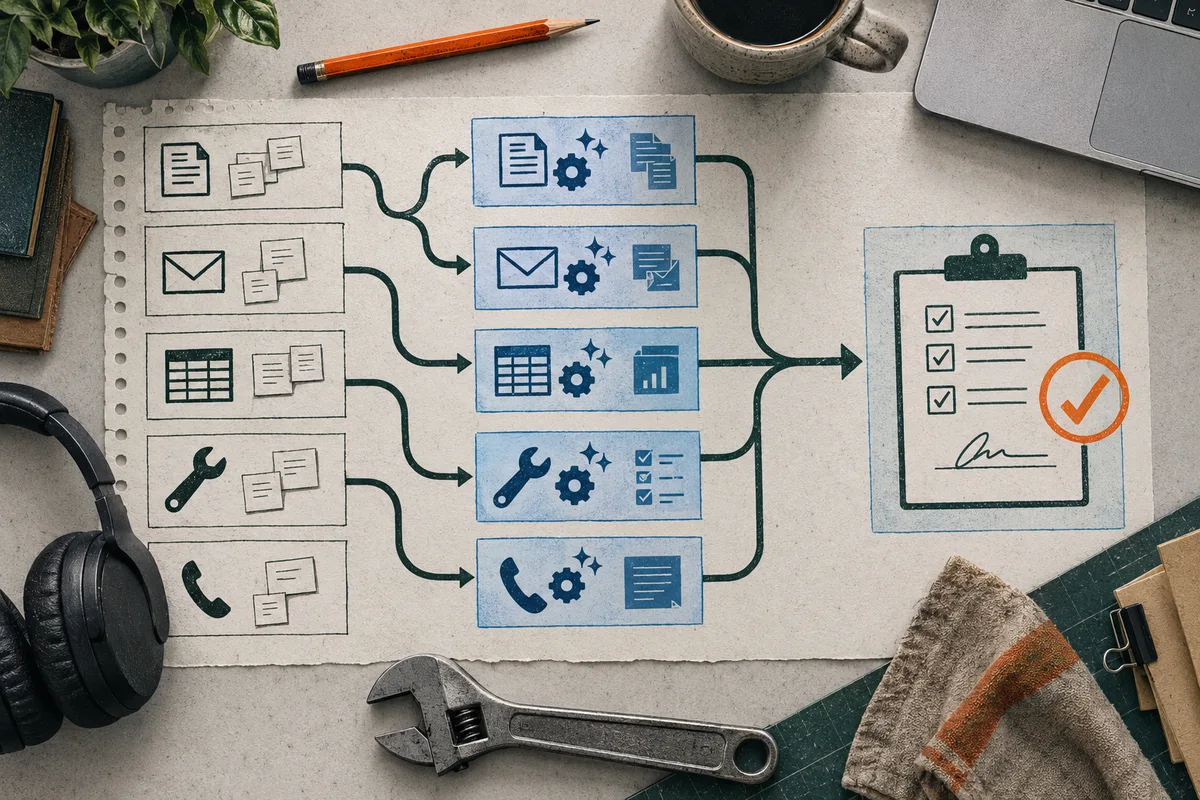
Epoch AI’s “AI at work: how AI is changing everyday job tasks” records whether workers edited AI output while using it on selected work activities. That answer tells us something about the interaction: some outputs were changed before the worker treated the task as done. It does not tell us whether editing was extensive, whether the first answer was correct, or how much checking remained. Editing frequency is therefore evidence that generated material often entered a human workflow, not a measure of the quality-control burden attached to that workflow.
The distinction matters because an edit can serve several purposes. A worker may alter wording to match a house style, supply context omitted from a draft, correct a factual or numerical error, change the structure, or reject the result and start again. These actions have different implications for reliability and time. A light style adjustment can leave the substantive answer untouched; a seemingly small correction may fix the one error that would have caused a serious downstream problem. A binary report that output was edited cannot distinguish either case, and an unedited output does not establish that it was checked and found accurate.
Nor does editing capture the whole review sequence. Someone might compare a generated summary with its source documents, test a formula against known cases, verify claims before forwarding a draft, or ask a colleague to approve a recommendation without changing the text itself. Conversely, text can be revised for preference or presentation without any deliberate verification of its claims. Review may occur before, during, or after editing, and responsibility for the final decision can remain with the worker even when the wording is unchanged. The survey’s editing item does not record these steps or identify who accepted accountability for the output.
A hypothetical example shows why the distinction is useful. Imagine an analyst asks a system to summarize a policy document. Replacing a phrase with the organization’s preferred terminology counts as editing, but says little about whether the summary preserved an exception in the source. The analyst could make no textual change after comparing every sentence with the document, or could forward an unchanged summary without noticing that exception. In each case, the edit indicator alone points in the wrong direction if treated as a correctness score. The decisive question is what the worker checked against what standard, not simply whether the wording changed.
For a worker evaluating an AI-assisted task, a more informative record would separate the stages: what the tool produced, what the person changed, what they independently checked, what they accepted or rejected, and who approved the result for use. Where practical, logging review time and the kinds of errors found would add evidence about effort and risk. That is a useful workflow practice, but it is not a finding measured by Epoch’s survey. The published editing result supplies a signal that outputs are being modified in use; it cannot quantify the additional review work or establish that edited outputs are safer than untouched ones.
There are benign and troubling explanations for either response. No reported edit could mean the output was already suitable, that the worker accepted it because the task was low stakes, or that a mistake went unnoticed. Editing could reflect careful correction, routine personalization, or repeated repair of weak output. Without an independent comparison between outputs and task requirements, and without observing the review process, the survey cannot choose among these explanations. It also cannot infer that more editing means more exposure or less automation: editing may be part of a productive assisted workflow, but the measure does not show whether the final task was reliable or how much human effort it required.
The defensible conclusion is narrow but relevant: editing reports contact with and modification of AI output, not the amount or effectiveness of human checking. It should be read alongside task involvement and time reports as a separate feature of use. To judge review burden in a particular job, a worker or employer would need evidence about verification steps, correction rates, consequences of errors, and responsibility for approval. Epoch’s survey does not provide that audit, so editing incidence should not be converted into a claim that human oversight has disappeared or that it is sufficient.
How do broader worker perceptions differ from task reports?
The Federal Reserve’s “Economic Well-Being of U.S. Households in 2025: Employment and Job Quality” adds a broader question to task-level reports: how do workers think generative AI is affecting their work and prospects? In the SHED, one in four workers said they had used generative AI as part of their job in the prior month. Among those users, 81% agreed that it saves them time; 52% said it improves quality, and 55% said it enables new tasks. These are user perceptions, not instrumented productivity measures. The differing shares also show that workers can see several possible benefits without all reporting each one.
The denominators change the picture. Across all workers, 44% agreed AI would save time in their job, compared with 25% who reported using it in the prior month. For quality and new tasks, the reported agreement was lower: 25% of all workers agreed AI could improve quality and 29% that it could enable new tasks. Those population-wide views include nonusers, who may be judging a technology they have not used in their own job. Among users, reported time savings were especially common, while positive views about quality and new tasks were still closer to a majority than a consensus. These distinctions help explain why SHED’s broad perception measures will not match a task survey’s account of what happened during a particular activity.
The career answers also resist a simple optimism-versus-fear reading. Overall, 20% of workers agreed that having AI available would improve their career, and 20% agreed they worried it would replace their job. Among prior-month users, career-improvement agreement was 33%, while replacement concern was 18%; nonusers were less positive about career prospects. In other words, positive and negative expectations coexist in the worker population, with the balance differing between people who report use and those who do not. Neither answer is a record of a promotion, redundancy, or future employment outcome.
The age patterns in SHED further caution against treating a worker’s perception as a direct proxy for exposure. Workers ages 30–44 reported the highest recent use, at 31%, while those ages 18–29 reported 20%. The youngest group was also slightly more likely to say they worried about replacement than to say AI would improve their career, 23% versus 19%. These are group-level responses and do not explain why the difference appears. They do show that greater familiarity, expected benefit, and anxiety need not line up in a single direction, and that an aggregate worker average can conceal different experiences.
The Boston Fed study “Workers’ Perspectives on Artificial Intelligence: Productivity Gains and Job-loss Fears” follows perceptions in two December waves of the New York Fed’s Survey of Consumer Expectations, with approximately 1,300 U.S. household heads in each wave. It finds that concern about losing one’s own job because of AI rose from 5% in December 2024 to just over 10% in December 2025. A broader composite—workers worried about job loss or lower wages, considering other opportunities while saying they could not adapt—rose from about 11% to 18%. These measures capture reported expectations at two points, not observed separations or a forecast that a respondent will lose work.
The relationship with perceived productivity was not a straight line. In the Boston Fed analysis, workers who strongly disagreed that AI had made them more productive and those who strongly agreed reported relatively low estimated job-loss concern, around 6.4% and 6.1%, respectively. The highest estimated concern, 21.2%, appeared among workers who felt neutral about productivity gains. The neutral group also had the highest estimated rate of reporting new, unmanageable work expectations, at 19%. These regression estimates control for characteristics including income, geography, industry, age, education, and gender, but remain associations between reported experiences; they do not establish that neutral productivity perceptions cause anxiety.
The contrast suggests a possible pattern in worker experience: strong perceived gains may coincide with a sense of contribution, while little perceived benefit can mean limited integration of AI into a role. The uncertain middle may be especially uncomfortable when workers are using AI or seeing tasks shift but do not feel more productive. That interpretation is consistent with the study’s descriptive results, but it is not the only explanation. Differences in jobs, expectations, or access can shape both productivity reports and concern, and the analysis cannot show which mechanism produced the pattern.
Read together, SHED and the Boston Fed analysis add something task surveys cannot: workers’ expectations and felt experience. SHED shows that perceived time, quality, new-task, and career benefits are reported alongside replacement concern; the Boston Fed shows that concern rose across its two waves and varied with perceived productivity. This does not contradict task-level findings about use or reported time. It answers another question: whether workers experience the change as beneficial, worrying, or both. Perceptions are not performance audits, and anxiety is not evidence that displacement has occurred, but both matter to how people understand the changes they encounter at work.
For interpreting one’s own situation, these surveys support a modest practical judgment: a worker’s sense that AI saves time and their concern about future work are separate observations worth tracking, not a contradiction to resolve by choosing one as the truth. A reported benefit does not certify job security; worry does not establish an impending loss. The evidence is most useful as context for asking what is changing in a person’s tasks, what outcomes they can verify, and whether new expectations are arriving with the tool. It cannot turn population perceptions into an individual risk estimate or tell a particular worker which career move to make.
Sources: Economic Well-Being of U.S. Households in 2025: Employment and Job Quality; Workers’ Perspectives on Artificial Intelligence: Productivity Gains and Job-loss Fears
What do adoption indices add, and why do units matter?
The St. Louis Fed’s “What Work Does Generative AI Do?” shows why adoption figures need their unit and cutoff beside them. Its occupation index asks whether reported AI use spans at least 20% of an occupation’s detailed tasks; its task index asks what share of workers report AI use for a particular task. Across nearly 14,000 Real-Time Population Survey respondents in four waves from August 2025 through May 2026, more than 80% of occupations crossed the 20% occupation threshold, while more than 40% of detailed tasks crossed the 20% worker-use threshold. These are counts of categories passing a defined cutoff, not estimates that the same share of workers or work hours uses AI. The low threshold detects reach: an occupation may qualify through use across a fifth of its task set, and a task may qualify when a fifth of workers report using AI on it.
The majority figures sharpen that distinction. The St. Louis Fed reports that 40% of occupations reached majority adoption, while fewer than 3% of detailed tasks did. These results can coexist because “majority” is applied to different units. For an occupation, the index aggregates its listed tasks; for an individual task, the index counts workers reporting use on that named activity. A broad occupation can therefore cross its threshold through adoption spread across several activities, even when no individual activity is used by most workers. The occupation figure does not mean most workers in those occupations use AI for most of their working hours, and the task figure does not show how much of a task AI performs. Keeping the denominator attached prevents a broad distribution across job families from being mistaken for saturation of specific work.
The contrast is useful as a map of where current reported use has spread, but it is not a ranking of which jobs are disappearing. An occupation-level index can identify job families where workers report use across a substantial portion of listed activities; it cannot show whether that use is occasional, central to production, or capable of replacing a worker’s contribution. A task-level adoption threshold narrows the observation to a defined activity but still counts reported use rather than autonomous completion or the share of its labor performed by a system. Neither index alone measures task quality, review demands, paid hours, headcount, or employer decisions. The figures thus add distributional detail to surveys asking only whether a worker used AI, while remaining separate from evidence about task performance or displacement.
The St. Louis Fed also finds a positive but incomplete relationship between exposure classifications and adoption. More exposed tasks and occupations tend to show more adoption in its comparison, yet the relationship accounts for only about half of the variation in worker-level adoption. Exposure therefore helps locate plausible areas of use but does not determine whether workers have adopted AI in each setting. The remaining variation should not be assigned one assumed cause: access, task frequency, workplace rules, reporting differences, and other conditions may matter, and this comparison does not isolate their effects. For a worker, an exposure label is a prompt to inspect the work involved, not a substitute for asking what is actually being done with AI in their organization.
The Federal Reserve’s “Use of Gen AI in the Workplace and the Value of Access to Training” adds workplace conditions that adoption indices cannot supply. Drawing on supplemental November 2025 Survey of Consumer Expectations responses, it documents that access to workplace AI tools and training varies, including a significant share of employers providing neither, while many workers say AI training is important. This evidence makes unequal opportunity to try tools and learn about them visible in the same broad labor context. It does not establish that workers without access have tasks that AI cannot assist with, or that those with access use it effectively. Tool availability and reported interest in training describe conditions and attitudes, not capability or outcomes.
Read together, the two Federal Reserve and St. Louis Fed sources suggest a practical sequence for interpreting a low adoption signal. First ask what the index counted: occupation categories, task categories, or people. Then ask whether the relevant tool is available and authorized in the worker’s setting, and whether instruction exists. The access and training responses cannot explain the St. Louis Fed’s occupation-task gap because the surveys do not link each respondent’s access to those index outcomes. Nor do they show that access caused use or that training raises productivity, adoption, or employment. They do make clear why a population adoption rate should not be read as pure evidence of task suitability or worker preference: reported use occurs within uneven institutional conditions.
This distinction changes the career implication in a restrained way. A high occupation index is a reason to examine which duties are seeing experimentation, especially recurring digital activities, but it does not justify abandoning a field. A low task index does not guarantee protection: current use can lag technical capability, approved access, or employer adoption, and a snapshot is not an endpoint. For an individual decision, the sharper question is whether a recurring task in one’s own role is changing, what the worker still judges or verifies, and whether there is a legitimate way to learn the relevant tools. Where access or training is missing, the immediate constraint may be organizational rather than a signal to pay for a course or change careers. That is an inference from the measures’ different scopes, not a causal finding in either study.
The indices are most useful when treated as separate layers. Exposure describes applicability under a classification; adoption records reported use at a specified unit and threshold; access and training indicate whether workers say workplace resources are available or valued. None alone measures reliable autonomous performance, nor do these sources combine into a personal probability of job loss. Their combined value is to narrow the next inquiry: use broad occupational patterns to choose where to look, task-level measures to identify activities, then local evidence to decide whether and how to experiment. Because reported adoption can remain shallow today while changing later, the worker’s own task observation should be revisited as tools, rules, and workflows evolve.
Sources: What Work Does Generative AI Do?; Use of Gen AI in the Workplace and the Value of Access to Training
What is the proportionate next action?
Choose one recurring task you can observe safely under your employer’s rules. For a week or a few comparable instances, note what the task requires, whether an approved AI tool is available, what it handles, and where your judgment, checking, or responsibility remains. Also note practical constraints: access, training time, workload, and whether experimenting could expose sensitive information. This small record is more useful than turning an occupation-level index into a personal verdict; one task cannot represent the whole role, but it can show what is changing in a concrete workflow.
If you want a structured next step, the free task checker at /ai-job-risk-checker offers transparent task-level change-pressure signals and first actions. It is not a validated probability that you will be displaced. The optional paid career roadmap compares scenarios and constraints and can organize a 30/60/90-day plan; it does not guarantee employment or income. First use the task observation to decide whether you need an upgrade in your current role, a nearby move, or simply more evidence. Check my task exposure. Keep the record factual rather than scoring yourself: compare the task’s input, output, time, and review steps across instances, and mark what you could not verify. If the tool is unavailable or prohibited, record that too; absence of workplace use under those conditions is not evidence that you lack interest or that the task is immune to change. Revisit the same task after access, policy, or workflow changes.
Questions readers ask
Do worker surveys show how much time AI saves?
They ask different questions. The Census Bureau asks recent users to estimate how much additional time they would have needed without AI; Epoch AI/Ipsos asks about reported time effects on selected AI-assisted tasks; Federal Reserve surveys ask whether workers agree that AI saves time. These are worker reports, not timed, quality-adjusted comparisons of complete workflows.
Does a worker reporting that AI handles a previously delegated task mean someone lost a job?
No. The Epoch AI/Ipsos survey records reports about selected tasks previously delegated to a coworker or contractor. It indicates reported task reallocation, but does not track the other person’s hours, employment, or job separation.
Sources and notes
- About a Third of Workers Who Used AI in the Last Week Said They Completed Tasks One to Two Hours Faster
March 2026 HTOPS estimates workplace AI use across 11 job activities and asks recent users for an additional-hours counterfactual; revised weights changed estimates somewhat but not statistical-test conclusions.
- Polling on AI usage: July 2026 AI at work
Epoch AI/Ipsos instrument, sample frame, field dates, weights, and task questions underlying July 2026 estimates.
- AI at work: how AI is changing everyday job tasks
July 2026 worker-reported AI task involvement, task performance share, time effects, output editing, and tasks previously delegated to coworkers or contractors across ten selected knowledge-work activities.
- Economic Well-Being of U.S. Households in 2025: Employment and Job Quality
SHED estimates workplace generative-AI use and worker views of time, quality, new tasks, career benefit and replacement concern, with distinct worker and user denominators.
- What Work Does Generative AI Do?
RPS task- and occupation-level reported-adoption indices across four waves and their imperfect relationship with exposure classifications.
- Workers’ Perspectives on Artificial Intelligence: Productivity Gains and Job-loss Fears
Two SCE special-module waves compare reported task substitution, perceived productivity and job-loss concern among U.S. household heads; concern varies across groups and rises between waves.
- Use of Gen AI in the Workplace and the Value of Access to Training
November 2025 SCE supplemental responses document variation in workplace tool/training access and worker valuation of training.
Apply this to your own work
See the whole job market at once.
Explore which occupations AI may reshape, then turn the signal into a practical response.
Explore the job map