Yes, AI adoption can change parts of project coordination, especially the preparation of information: drafting a plan outline, turning meeting notes into proposed actions, or summarizing approved status records. A controlled project-planning study found better performance with generative AI on two bounded exercises, while a separate workplace experiment found less email time among tool users but no detected change in task quantity or composition from individual access. Neither result shows that AI can own stakeholder commitments, resolve conflicts, or replace project managers. For a U.S. project-management specialist, the proportionate next move is to test one reversible, information-heavy task with an approved tool, check the output against source records, and compare total preparation plus review effort. Treat this as workflow evidence, not a personal job-loss forecast.
Which coordination tasks are easiest to change first?
Start with the work that turns known information into a usable draft. A project manager might ask an approved tool to organize meeting notes into proposed actions, create a first-pass status summary from a project record, or format an update for different audiences. The result can save typing and sorting, but it is still a draft: the owner, date, dependency, decision, and risk must match the record before anyone acts on it.
This distinction fits the actual occupation. The U.S. Bureau of Labor Statistics says project management specialists develop plans, assign responsibilities, confer with staff to resolve problems, monitor costs and milestones, approve plan changes, and produce project documents. Those duties combine document work with monitoring, judgment, and authority. A draft can assist the document step; it does not itself establish that a milestone is truly at risk or that a proposed change has been approved.
A 2025 controlled experiment gives direct but bounded evidence. Researchers assigned project-management novices and professionals to work with or without generative AI on a case about introducing an IT ticket system. Participants completed a stakeholder analysis and identified work packages across project phases. Among the 113 people who completed the study, AI-assisted groups scored higher on the measured quality tasks and reported higher subjective success. The treatment mostly used an older general-purpose chat system. This supports help with structured planning exercises; it does not test ongoing team coordination, real project records, or authority to commit resources.
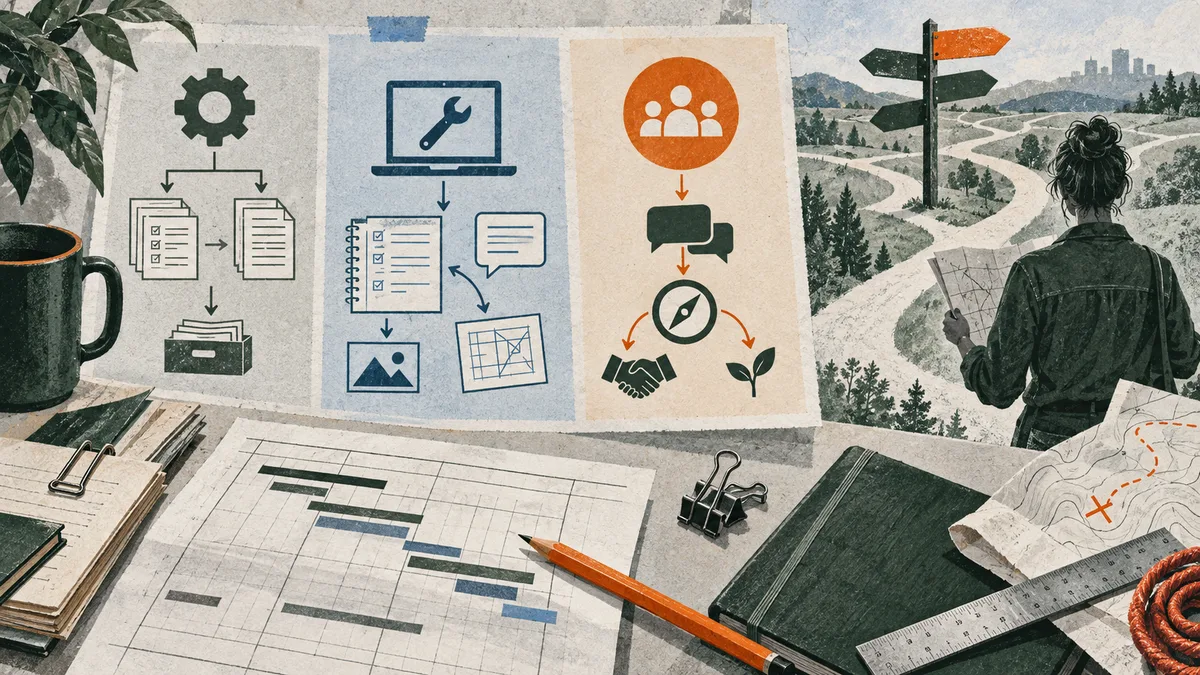
A useful way to inspect your own work is to split coordination into four links: capture and formatting, interpretation, negotiation, and accountable follow-through. This is a practical framework for the reader, not a measured research taxonomy. AI may help with the first link and offer candidate patterns for the second. Incomplete records, two stakeholders describing different commitments, or a schedule change with budget consequences require a person to establish context and decide what is true. The more an output changes someone’s obligations, the less suitable it is for unchecked automation.
For one week, list recurring coordination artifacts and note their source of truth, how often you correct them, and whether an error could create a commitment. Choose a low-consequence output with a clear record behind it. Compare manual preparation time with assisted drafting plus verification. If checking takes as long as writing, or if the source is unreliable, the apparent automation opportunity may not be a useful one.
Sources: Project Management Specialists, Occupational Outlook Handbook; Bridging the Expertise Gap: The Role of Generative AI in Supporting Project Planning Tasks for Novices and Professionals
Does faster coordination mean project managers are being replaced?
No. Evidence that a tool improves a planning exercise or reduces time spent on email does not establish that an employer has removed project-management work or cut staffing because of AI. Capability, employee use, organization-wide adoption, demand, and displacement are different observations. Moving from one to another requires evidence about what employers actually changed and why.
The distinction is visible in a field experiment published by the American Economic Association. Across 66 firms, 7,137 knowledge workers were randomly selected for access to a generative tool integrated into applications for email, meetings, and writing. In the second half of the six-month experiment, the 80% of treated workers who used the tool spent two fewer hours per week on email and reduced work outside regular hours. The researchers did not detect changes in the quantity or composition of workers’ tasks resulting from individual-level access. This is stronger evidence about workplace use than a survey of intentions, but it is not a project-manager-specific study and does not show what firms would do after redesigning a whole workflow.
The International Labour Organization’s June 2026 review synthesizes experiments, firm data, platform studies, and worker and firm surveys across several countries. It describes productivity gains as real but uneven and often unverified; it also says reported time savings have not yet translated into higher measured output, earnings, or employment in the evidence reviewed. The review identifies changes in work organization, coordination, autonomy, and job quality as important. This complicates a simple story in either direction: saved time is not proof of better project outcomes, but limited observed displacement in the reviewed evidence is not a guarantee about any particular employer or future period.
U.S. occupational demand is a separate signal. BLS projects 7% employment growth for project management specialists from 2025 to 2035, with about 76,500 openings a year on average. Its projection is based on overall labor-market expectations, not a causal estimate of AI’s effect. It cannot tell an individual whether their organization will change its staffing, specialty, or workload. Use it as broad U.S. context, not as a reason to dismiss a local change or to assume a role is protected.
The fair comparison is manual preparation of a coordination artifact versus AI-assisted preparation with a person checking the source and owning the final communication. It is not a contest between a project manager and a fully autonomous project-management system. A local pilot can show whether preparation time falls, whether review effort rises, whether information is missed, and whether saved time goes toward resolving dependencies or simply creates more reporting. Those observations describe one workflow; a displacement claim would require evidence of actual job redesign or staffing changes.
Sources: Bridging the Expertise Gap: The Role of Generative AI in Supporting Project Planning Tasks for Novices and Professionals; Shifting Work Patterns with Generative AI; The impact of GenAI on jobs, productivity and work organization: a review of the empirical evidence
What is a proportionate next move inside the role?
Begin with a bounded upgrade in the current job rather than a career pivot based on exposure alone. Pick one repeated, low-risk artifact, such as a draft action list from approved meeting notes. Keep a manual baseline for the same kind of work. During a short trial, record preparation time, review time, factual corrections, missing items, and whether the final version helps colleagues take the right next step. Use only a tool and data flow your employer has approved; project notes can contain confidential client, personnel, or commercial information.
The test should preserve accountability. Ask the tool to distinguish explicit decisions from suggestions and unresolved questions, then verify each proposed action against the notes and project record. Do not let a polished summary turn an assumption into a deadline or an unapproved idea into a commitment. If an error could affect scope, budget, safety, a client promise, or someone’s workload, keep the decision and release of the update with the responsible person. The point is to learn where assistance helps, not to delegate responsibility by default.
Compare three practical responses in order. First, upgrade the current workflow if the pilot reduces total effort or improves clarity without adding unacceptable risk. Second, consider an adjacent move only if your existing strengths—such as domain knowledge, stakeholder work, or delivery oversight—fit a role with a better task mix and credible local opportunities. Third, consider a larger retraining path only after checking prerequisites, cost, time, salary needs, location, health, and family constraints. The studies above do not establish that project managers should become software or machine-learning specialists.
If the pilot fails, that is useful information. Poor records, frequent exceptions, expensive verification, or a team that does not trust the output may outweigh drafting speed. Revise the process, choose another task, or stop. If your employer is changing the job itself, ask what decisions remain yours, how success will be measured, who checks the system’s output, and whether time savings mean fewer tasks or a wider workload. Those answers are more relevant to your next move than an occupation-level exposure label.
The verdict is that AI adoption can change the information-preparation layer of project coordination, while current evidence does not show that this automatically removes the role. The strongest exception is a workplace that integrates reliable systems with authoritative project data and redesigns responsibilities at team level; the experiments cited here do not settle what happens in that setting. For now, test one reversible task, measure the whole handoff including checking, and reassess based on your actual workload and constraints. A task checker can help organize exposure signals, but its result is not a validated probability of displacement. A personalized roadmap can compare stay-and-redesign, adjacent, and larger-change scenarios without guaranteeing employment or income.
Sources: Project Management Specialists, Occupational Outlook Handbook; Bridging the Expertise Gap: The Role of Generative AI in Supporting Project Planning Tasks for Novices and Professionals; Shifting Work Patterns with Generative AI
Questions readers ask
Which project-management coordination task should I test with AI first?
Choose a recurring, information-heavy draft with an approved source of truth and low consequences if corrected before release, such as organizing meeting notes into proposed actions. Verify owners, dates, dependencies, and commitments, then compare drafting time plus checking time with your manual baseline.
Sources and notes
- Project Management Specialists, Occupational Outlook Handbook
Supports the described U.S. project-specialist duties and the separate 2025–2035 occupational projection; it does not attribute that outlook to AI.
- Bridging the Expertise Gap: The Role of Generative AI in Supporting Project Planning Tasks for Novices and Professionals
Supports the bounded finding that AI-assisted participants performed better on two controlled project-planning exercises, with important limits on real-world generalization.
- Shifting Work Patterns with Generative AI
Supports field-experiment results on email time and the absence of detected task quantity or composition shifts from individual access across participating knowledge workers.
- The impact of GenAI on jobs, productivity and work organization: a review of the empirical evidence
Supports the cross-occupation synthesis on uneven productivity evidence, limited large-scale displacement in reviewed studies, and work-organization changes.
Apply this to your own work
See the whole job market at once.
Explore which occupations AI may reshape, then turn the signal into a practical response.
Explore the job map