
AI task automation can thin the entry-level learning ladder in insurance claims when it removes intake, document sorting, routine estimates, and file-note work without replacing the supervised practice those tasks provide. Those tasks are not valuable because repetition is inherently educational; they become educational when a novice must inspect evidence, apply policy rules, explain a decision, receive correction, and see what happens next. Current U.S. evidence documents selected AI use and a broad projected decline in claims occupations, but it does not show that AI has already eliminated entry-level claims jobs or quantify a worker's displacement risk. The most realistic replacement is a paid, supervised learning system: structured claim-file exercises, independent first attempts, comparison with AI suggestions and experienced reviewers, feedback, exception handling, and gradual authority. A course or claims designation can supply policy and technical foundations; it cannot replace varied case exposure, feedback, accountability, or a job. Before paying for long training or leaving insurance, ask how a particular employer replaces the learning function of work it automates.
The entry-level claims question is about practice, not just job counts
For a new U.S. claims worker, the important comparison is not a simple contest between a person and a machine. It is a comparison between two ways to become competent: learn through supervised handling of smaller claims, or enter a workflow where software performs more of the routine work and the employer deliberately supplies another route to practice. The second arrangement can be better if it gives novices earlier access to varied cases, visible reasoning, careful feedback, and safe opportunities to make decisions. It can be worse if the novice only clears exceptions without understanding why a case entered that queue. The question for a job seeker is therefore practical: what work will I do, what reasoning will I learn, and who will review it? A role title or a claim that a carrier is “AI enabled” cannot answer those questions by itself.
The U.S. Bureau of Labor Statistics describes the existing ladder in concrete terms. At the beginning of their careers, claims adjusters, appraisers, examiners, and investigators work on small claims under experienced workers; as they learn investigation and settlement, they receive larger and more complex claims. BLS says a high school diploma is typically enough for entry-level adjuster, examiner, or investigator roles, though some jobs prefer a degree or insurance experience. This describes an occupational pathway, not a guarantee that every employer offers a strong apprenticeship or that every novice sees every task. Still, it identifies what an automated workflow could interrupt: the gradual sequence from smaller decisions to greater complexity under supervision. [BLS occupational profile](https://www.bls.gov/ooh/Business-and-Financial/Claims-adjusters-appraisers-examiners-and-investigators.htm)
There are at least three separate questions hidden in “AI is changing claims.” First, capability: can software classify a document, summarize a file, estimate visible damage, or suggest a next step? Second, use: does a particular insurer employ such a system, and on which line, team, claim type, or stage? Third, labor effect: did a process change alter hiring, training, staffing, case assignments, or employment? Evidence for one does not prove the others. A tool demonstration is not a deployment report. A survey response about current use is not proof of autonomous decisions. A forecast about an occupational group is not a count of jobs removed by AI. A careful career decision keeps each question separate.
This article focuses on U.S. claims adjusters, examiners, and adjacent early-career claims work because that is the population covered by the main official labor sources. State licensing, insurance line, employer size, catastrophe activity, and field versus desk work can make a specific route quite different. Health claims adjudication is not the same workflow as auto physical damage or property loss adjustment. A worker with a salary floor, caregiving responsibilities, disability-related constraints, or little ability to relocate may reasonably prefer a lower-cost internal upgrade to a broad career change. No evidence here can select a career for an individual. It can help them ask whether a role still teaches the capabilities needed for its next level.
The useful unit of analysis is the learning function of a task. Transcribing an intake form can teach which facts matter only if the trainee understands why the questions are asked and gets corrections when details are missing. Drafting a file note can build chronology and evidentiary discipline if a reviewer explains what is material and what is inference. Reviewing a repair estimate can teach scope and pricing when it is compared with photos, policy conditions, local repair context, and an experienced appraiser's judgment. If software performs the keystrokes but exposes its reasoning and supports deliberate comparison, the learning may survive. If it removes both the work and the explanation, it may remove a rung from the ladder. That is a design risk, not a measured rate of job loss.
Sources: Claims Adjusters, Appraisers, Examiners, and Investigators: Occupational Outlook Handbook; O*NET OnLine: Claims Adjusters, Examiners, and Investigators; Artificial Intelligence: Insurance Topics
Which parts of a claims file are most exposed, and why?
The parts of claims work most exposed to automation are often recognizable by their inputs and outputs: repeatable data entry, routing, document classification, field extraction, routine correspondence, file summaries, and estimates built from well-defined evidence. In a first notice of loss, for example, a system might extract a date, address, vehicle identifier, reported damage, and contact details from a form or message, then place the file in a queue. In a document-heavy health workflow, software may organize submitted records or surface policy language. In auto damage, image analysis may help estimate visible repair costs. These functions concern task capability and workflow fit. Whether an insurer uses them at meaningful scale, and whether they replace a human task or change its sequence, are separate empirical questions.
O*NET's occupation profile lists work activities including verifying records, estimating costs, maintaining claim files, interviewing claimants or witnesses, resolving customer problems, negotiating settlements, and preparing investigatory documents. Its work-context profile also describes decision-making, accuracy, public contact, and conflict as features of the occupation. The underlying work-context ratings come from job-incumbent responses; O*NET's occupation update record dates this category to 2022. The public summary does not show the respondent count for each rating, and the broad occupation combines different lines and settings. Treat these as a dated occupational description, not a measure of any one worker's day or of AI susceptibility. [O*NET occupation profile](https://www.onetonline.org/link/summary/13-1031.00) and [O*NET update record](https://www.onetcenter.org/dataUpdates/occupations/13-1031.00)
A practical exposure test asks four questions about each task. Is the information already digital or easy to digitize? Is there a stable rule or reference for the desired result? Can a reviewer verify the output without repeating most of the work? What happens when the system is wrong? A routine document-routing action with clear categories and an easy correction path may be a plausible early automation target. A coverage decision involving inconsistent dates, exclusions, ambiguous language, disputed facts, or an emotionally difficult conversation has higher context and consequence costs. That does not make it impossible to assist with software. It changes what acceptable use requires: provenance, policy grounding, human review where appropriate, documented uncertainty, and a route to correct the file.
The National Association of Insurance Commissioners says insurers use AI in multiple areas, including claims handling and fraud detection. It gives examples such as chatbots for common questions and using photos and historical data to estimate repair costs or assess damage. The NAIC also cautions that generated information can sound accurate while being wrong and says important decisions require careful review. This is useful regulatory orientation: it describes types of possible and actual functions at a high level. It does not establish how widely each function is deployed, its performance for a particular insurer, or how many workers it replaces. A job seeker should ask about the team's own workflow rather than infer adoption from sector-wide descriptions. [NAIC AI overview](https://content.naic.org/insurance-topics/artificial-intelligence)
The distinction between “routine” and “complex” is not always visible at intake. A claim can arrive with a neat form and later reveal inconsistent evidence, an excluded cause, a prior loss, a disputed repair scope, a vulnerable claimant, or a need for specialist inspection. A system that makes the initial file look complete may still miss why a document conflicts with another source. The novice who learned only to accept a complete-looking packet may be less ready to recognize a hidden exception. This is why escalation quality matters. Automation can reduce clerical effort while increasing the value of noticing what does not fit. It can also reduce the amount of ordinary case volume through which a worker once learned what “does not fit” looks like. Which effect dominates depends on system reliability, workflow design, supervision, and the mix of cases.
Sources: O*NET OnLine: Claims Adjusters, Examiners, and Investigators; Artificial Intelligence: Insurance Topics; Health Insurance Artificial Intelligence/Machine Learning Survey Results; 2025 Health Artificial Intelligence (AI)/Machine Learning (ML) Survey Analysis; O*NET Occupation Data Updates: Claims Adjusters, Examiners, and Investigators
How can routine work teach claims judgment?
Routine tasks do not teach judgment merely by being routine. They teach when they put a learner in contact with evidence, standards, consequences, and feedback. A new worker who enters dates into a system may learn to notice a timeline that does not make sense, but only if someone explains why the discrepancy matters and what to do next. A person who prepares a payment summary may learn how a deductible affects the amount owed if they reconcile the calculation with the policy and see a reviewer catch an error. Repetition builds familiarity; explanation and correction help turn familiarity into a transferable rule. Remove the keystroke while keeping the evidence and reasoning visible, and the task may still teach. Remove the whole encounter and no course can reproduce that experience automatically.
Consider the small-claim progression BLS describes. A novice might start with a simple file, collect missing information, create a chronology, compare the reported loss with available documentation, identify the relevant policy section, and draft a recommendation for review. An experienced colleague might then ask why a particular fact is material, point out an unsupported conclusion, or explain why the claim must be escalated. The sequence works because the learner attempts a bounded decision before authority grows. It is not the low dollar value itself that teaches; it is the combination of manageable stakes, real evidence, a standard to apply, feedback from someone with experience, and a next case that is slightly more demanding.
If software collects documents, extracts dates, fills a chronology, and drafts a summary, the trainee can still work on what those steps used to expose: missing evidence, contradictions, policy questions, and unsupported conclusions. A reviewer can choose selected files for comparison and explain which difference changes the next action. This turns clerical repetition into verification and interpretation, but it is not automatically equivalent to broad case exposure. Learners still need varied examples and enough visibility into outcomes to recognize exceptions later.
O*NET's task list suggests several distinct learning functions that an employer could intentionally preserve. A file note can teach evidence chronology and the boundary between fact and assumption. A claimant call can teach how to ask neutral follow-up questions, listen for a missing detail, and explain next steps without promising coverage. A payment calculation can teach the relationship between estimates, deductibles, limits, and documented decisions. A fraud indicator can teach how to separate a signal that warrants investigation from an accusation. A reserve entry can teach how new information changes an estimate of future cost. A negotiation can teach how to explain a supported position and respond when the other party offers contrary evidence. These functions require domain standards and review; a generic “AI skills” course does not supply them.
The management choice is whether time saved becomes capacity for instruction or only a faster closure target. Selected cases can be used for a novice's first assessment, a short comparison, and reviewer feedback; that requires protected reviewer time and authorized, privacy-safe examples. Without those resources and a way to increase case complexity, a workflow may transfer risk to novices instead of developing them. This is a design inference from the supervised progression BLS describes, not a measured effect of claims automation.
The hiring implication is specific: ask what a trainee personally decides, what software prepares, and what a reviewer checks. Ask how assignments progress and what supports a move to broader authority. These questions reveal whether routine work has been replaced with a meaningful learning route; they apply to rules engines, outsourced processing, and templates as well as generative AI.
Sources: Claims Adjusters, Appraisers, Examiners, and Investigators: Occupational Outlook Handbook; O*NET OnLine: Claims Adjusters, Examiners, and Investigators
How far has AI moved from capability to claims-team adoption?
Public evidence supports a measured answer: insurers report AI activity in some operations, including claims-related functions, but the sources do not establish universal adoption or a sector-wide replacement of claims staff. The distinction matters because capability can be technically plausible long before an employer builds a production workflow around it. A pilot may not become a live service. A live tool may support triage but not adjudication. An automated extraction may reduce a manual step while leaving decisions and customer contact with a claims professional. An adoption claim should identify the population, time period, function, and stage of deployment before it is used to make a career recommendation.
The NAIC's 2025 Health Insurance AI/ML survey is a direct source on reported AI/ML activity, but its scope is limited to responding health insurers and does not represent every U.S. insurance line. The accompanying memo's 36 percent figure is not an AI/ML adoption measure: it appears in a discussion of insurers' disclosures about non-FCRA data use across grouped functions, one of which is claims adjudication. It cannot support a claim that 36 percent used AI operationally, nor a claims-only rate or estimate of autonomous claims systems. The survey report separately presents insurer-reported AI/ML activity and stages of deployment; that evidence supports only the narrower conclusion that some responding health insurers reported activity, not a workforce or job-replacement conclusion. [NAIC survey report](https://content.naic.org/sites/default/files/inline-files/Health%20Survey%20Report%20-%20FINAL%205.9.25.pdf) and [survey analysis memo](https://content.naic.org/sites/default/files/inline-files/Health%20Survey%20Memo%20to%20BDAIWG%2005092025%20-%20Final_1.pdf)
The survey is valuable because it reports insurer responses and governance practices, not because it measures workforce effects. It does not tell us which tasks in each claim were handled by software, how many files were affected, how reliable the systems were, whether work shifted to other employees, whether headcount changed, or whether new entrants received less training. It is also limited to health insurance and reflects the respondents and survey period. Self-reported operational activity is evidence of reported activity, not independent verification of every system's performance. A worker in auto or homeowners claims should not treat the health-insurer figures as a local forecast for their employer.
The NAIC's public AI overview describes image-based damage estimation and claim processing as use areas, while noting human review and insurer responsibility under applicable insurance rules. Its value is in identifying a real workflow context and regulatory concern. The page does not offer a representative adoption rate or causal labor study. Its language that AI is more likely to support workers than replace them should not be read as a guarantee about any particular job. Career decisions should rely on the employer's staffing and training evidence, not an institution's broad characterization of expected industry direction. A regulator can establish what it is monitoring; it cannot, through that overview alone, establish the number of junior roles retained.
The NAIC model bulletin on AI use and the subsequent development of an evaluation tool for regulators also make governance part of the work context. Insurers remain responsible for compliance and consumer protection when using tools. But regulation should not be romanticized as a shield for jobs or interpreted as a rule that a human must personally perform every task. Governance can involve documentation, testing, oversight, risk management, and procedures for correction. Those responsibilities create knowledge requirements in organizations, but they do not guarantee that every claims team will hire junior employees to fulfill them. A novice should learn the applicable employer process and state requirements instead of assuming that “human oversight” means hands-on apprenticeship is preserved.
For an individual evaluating a job, an adoption interview can be more informative than broad industry news. Ask which claim stages use automated extraction, summaries, estimates, triage, or recommendations; whether the system is in production or being tested; who corrects errors; how exceptions are routed; and what a trainee is expected to verify personally. Ask what types of files a new employee sees and whether they can review the outcome of cases after escalation. Seek a concrete description of progression and feedback rather than a promise that the organization is innovative. These answers reveal capability, adoption, and learning structure separately, which is what the decision requires.
If an employer cannot answer because a system is confidential or still under evaluation, uncertainty remains. That is not evidence of concealed displacement. The applicant can still compare the quality of supervision, the variety of work, the licensing support, and whether skills transfer to other claim settings. If the role depends on a single narrow workflow with little explanation, that may be a weaker learning environment even without AI. If the role has a strong review culture and case progression, automated tools may become part of a rich training process. The observable design, rather than an adoption headline, is the useful signal.
Sources: Artificial Intelligence: Insurance Topics; Health Insurance Artificial Intelligence/Machine Learning Survey Results; 2025 Health Artificial Intelligence (AI)/Machine Learning (ML) Survey Analysis
Does task automation mean the entry-level job ladder is already disappearing?
No available evidence here establishes that AI has already removed the entry-level claims ladder across the United States. There is evidence of plausible task automation, insurer-reported use in selected functions, and a BLS forecast of declining employment in the grouped occupation. Those signals warrant attention, but they do not identify AI as the cause of the projected decline, isolate entry-level openings, or tell us how an individual worker's role will change. The most accurate position is neither “nothing will change” nor “claims trainees are already being eliminated.” It is that employers may redesign workflows, the occupation faces a projected contraction from multiple forces, and the training consequences need to be evaluated locally.
BLS projects employment for claims adjusters, appraisers, examiners, and investigators to fall 6 percent from 2025 to 2035, from 389,700 to 367,900. It projects about 21,600 openings a year over that decade, which it expects to arise from replacement needs as workers transfer occupations or leave the labor force. BLS says technology may automate some tasks, including evaluating damage photos and estimating claim amounts. But the projection combines multiple occupations and does not attribute the forecasted decline to AI. It does not distinguish junior from experienced workers, insurance lines, or regional labor markets. The data are a labor outlook, not an observed count of AI-caused job losses. [BLS outlook and projections](https://www.bls.gov/ooh/Business-and-Financial/Claims-adjusters-appraisers-examiners-and-investigators.htm)
The coexistence of a projected decline and annual replacement openings is not contradictory. A shrinking occupation can still have openings because people retire, leave, or move to other work. At the same time, openings across the whole decade do not assure that a particular employer will recruit trainees, that vacancies will exist in a given state, or that a new worker will meet licensing and experience requirements. “There will be openings” is not a hiring guarantee. “Employment will decline” is not a prediction that every current worker will be displaced. Both figures describe the occupation at an aggregate level and should be used to justify careful research, not a personal probability.
Other public signals complicate any single-cause narrative. Claims demand can vary with insured losses, litigation, insurer business models, consolidation, regulation, interest rates, and the mix of work handled internally or by vendors. New tools may lower the cost of processing some files, potentially changing capacity or staffing; they can also make it feasible to handle more cases or create new review and exception work. A BLS forecast that mentions technology does not separate these forces. A vendor case study, meanwhile, might show what a particular system was built to do but not the net employment effect across an industry. A credible answer must keep the explanation proportionate to the underlying measure.
The McKinsey article on talent development offers a useful employer-side argument: as AI takes on execution, entry roles could be redesigned around supervising and improving outputs, with intentional coaching and comparison between a junior worker's independent analysis and a tool's answer. It also describes a real-estate example and refers to clinical research on how comparison can affect learning. This is a proposal and cross-industry illustration, not a claims-industry labor study. It shows one plausible response to task change, not that insurers have adopted it at scale or that the approach guarantees skill development. Its value for this article is conceptual: employers can either remove novice practice or redesign it deliberately. [McKinsey talent-development discussion](https://www.mckinsey.com/capabilities/people-and-organization/our-insights/building-expertise-in-the-age-of-ai-who-trains-the-next-generation)
A simple model clarifies the pipeline question. A junior role is sustainable when it creates value for the employer now and builds capability for later work. Routine files may be economically useful because they need processing; they may also be useful training cases because their rules are visible and feedback is frequent. If automation reduces both the labor need and the learning opportunity, the employer must decide whether it values a future pipeline enough to fund a different learning design. It might assign supervised exception review, use paired work, create case simulations, or hire fewer trainees and train them more intensively. The evidence does not establish which choice insurers will make. That decision belongs to employer strategy and should be tested with current job descriptions and conversations.
For a candidate, a pathway is more credible when it has observable features: paid training, named reviewer roles, a progression of file complexity, clear authority limits, review of written reasoning, a way to correct mistakes, and exposure to different case outcomes. A role that lists AI tools but says nothing about these features has not shown how it will replace learning. Conversely, a job that relies on manual intake is not automatically a strong apprenticeship if workers are measured only on speed and receive little coaching. Assess the opportunity on the training architecture, not whether its tools sound traditional or modern.
Sources: Claims Adjusters, Appraisers, Examiners, and Investigators: Occupational Outlook Handbook; Rethinking talent development in the age of AI
What human review and accountability still require a learner to understand
A basic claim review can be taught as a chain of accountable reasoning. What is reported to have happened? Which facts come from which source? What remains unverified? Which policy terms or procedural rules govern the next step? What evidence supports a coverage or amount recommendation? What alternative explanation fits the file? Is the conclusion inside the worker's authority? What needs a specialist, supervisor, or formal escalation? The answers depend on line of insurance, jurisdiction, employer process, and claim facts. The chain is not a universal legal checklist. It is a teaching scaffold that keeps a trainee from treating an output as a decision without inspecting its basis.
BLS describes claims professionals as deciding whether a policy covers a loss and how much an insurer should pay, investigating possible fraud, communicating with claimants and others, negotiating settlements, and authorizing payments. It also notes that the details differ by insurance type: property and casualty workers need to understand repair and construction costs, while health claims work involves different judgments about treatments. This occupational description points to varied domain knowledge and financial consequences, but it does not state that every adjuster holds final authority or that the same review standard applies in every state. A learner must know the employer's limits and referral paths rather than assuming the job title confers decision power.
When software prepares a draft, the trainee should be able to distinguish a factual extraction from an interpretation. “The estimate lists a replacement panel” is a report about a document. “The policy covers replacement” is a conclusion requiring policy and fact analysis. “The claimant did not provide the requested record” may be true in the file but needs a reliable chronology and an understanding of the request. In a medical claim, summarizing a record is different from deciding medical necessity. In a property claim, identifying visible damage is different from determining cause, scope, coverage, and settlement. Training that blurs these levels teaches overconfidence. Training that labels each inference lets a reviewer focus on the step where judgment entered.
The NAIC's AI overview states that insurers remain responsible for compliance with insurance laws, standards, and consumer-protection requirements, including fairness and accuracy. Its model-bulletin work and evaluation-tool development reflect regulatory attention to governance and risk mitigation. This does not mean a junior claims worker is personally responsible for system design or that a human must redo every automated action. It does mean a worker should learn the employer's process for documenting tool use, checking source information, identifying problems, routing high-consequence exceptions, and escalating consumer-impacting errors. Governance is part of the operating environment, but the exact obligations depend on the insurer, state, product, and role.
A review step can become ceremonial when source records are hidden or throughput is the only rewarded result. Training alone cannot fix those incentives. A workable control makes the reviewer able to inspect the record, name uncertainty, and route a consequential conflict to someone with authority. Supervisors can sample accepted and overridden suggestions to find recurring errors. These are proposed practices, not evidence that every organization uses them.
Claims work also involves people dealing with damaged property, medical bills, lost income, or uncertainty about next steps. Workers need to gather facts, explain requests, and avoid promising decisions beyond their authority. BLS and O*NET describe communication and negotiation among claims activities; a tool may draft a letter, but the worker must confirm it fits the file and applicable process. Feedback on staged or approved conversations can address this distinct skill without requiring a novice to make unsupported coverage promises.
Sources: Claims Adjusters, Appraisers, Examiners, and Investigators: Occupational Outlook Handbook; O*NET OnLine: Claims Adjusters, Examiners, and Investigators; Artificial Intelligence: Insurance Topics
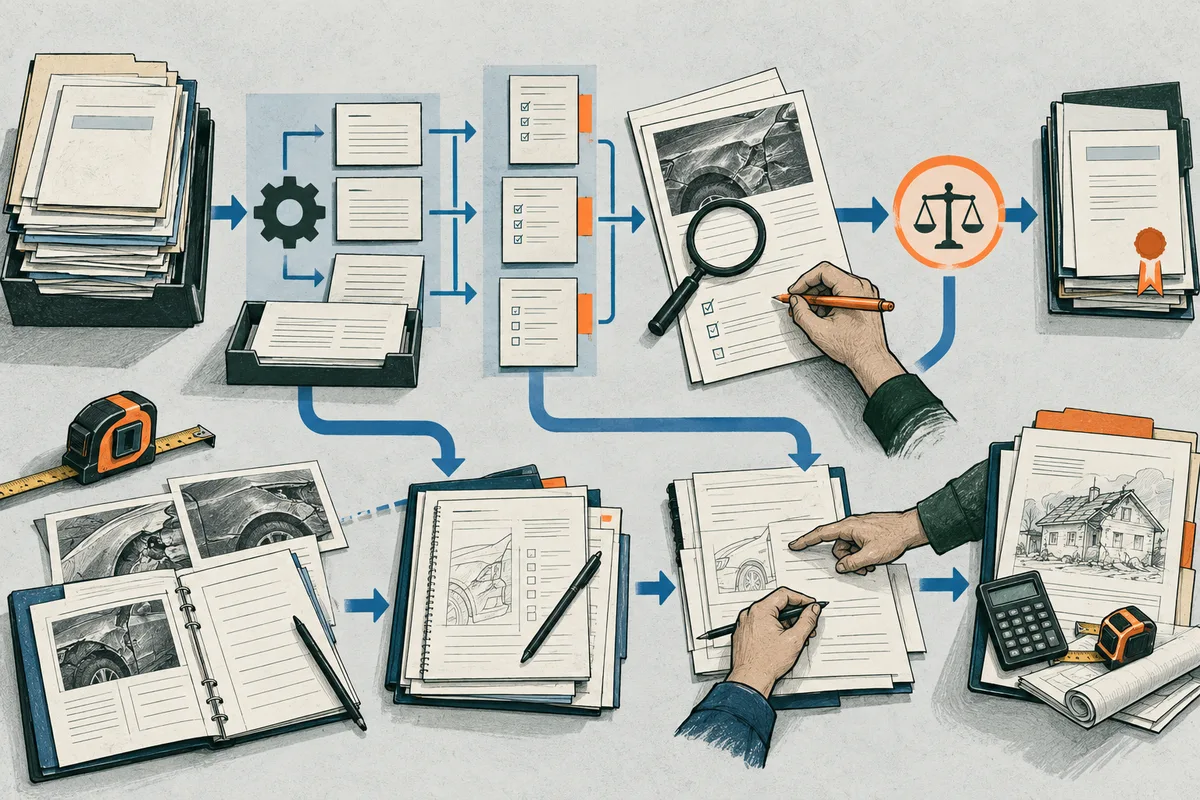
Can AI support learning while it automates the practice?
AI can support learning when the workflow makes the trainee's reasoning visible; speed or agreement with a tool does not show that learning occurred. The useful design question is whether the trainee can explain and transfer a decision after assistance. No claims-specific evaluation in the sources reviewed here establishes which training design works best.
McKinsey proposes an answer-key exercise in which a junior worker attempts a task, compares the work with an AI-generated result, and reviews differences with a manager. Its examples are cross-industry, not an insurance experiment, so this is a design idea rather than evidence of a claims-training effect. It suggests one way to make reasoning inspectable, while leaving the result to be tested in the actual workflow.
For a claims exercise, use an authorized or de-identified file. Before seeing an automated summary or estimate, ask the trainee to identify missing evidence, note policy questions, and draft a recommendation. Then compare both analyses with the source documents, discuss material disagreements with a reviewer, and later assign a different file that tests the same reasoning. Judge the exercise by independent explanation on that later file, not by whether the trainee accepts the tool's answer.
This approach need not duplicate every automated keystroke or add a meeting to every claim. When routine repetition adds little and output is easy to verify, a short demonstration plus selected practice on exceptions may use time better. The proposal is an inference about training design, not a validated insurance curriculum; an employer would need to check accuracy, transfer, and reviewer workload before scaling it.
A team evaluating the exercise can record a few observable measures without turning them into a hiring score: whether the trainee identifies material omissions, supports conclusions with source records, recognizes when a case exceeds authority, and corrects an error after feedback. A later unaided file can show whether the reasoning transfers beyond the example. Track reviewer time and error patterns as well, because a lesson that depends on unavailable senior capacity may not scale. These measures are a proposed evaluation plan; they do not have validated thresholds or prove that a worker is ready for independent handling. Any use of claim files must follow the employer's privacy, security, and authorization rules.
The comparison should also fit the task. A clerk learning a stable data field needs a different exercise from an examiner weighing conflicting records or an adjuster estimating damage from photos. In both cases, the test is whether the person can explain the limits of the evidence and choose an appropriate next step. This keeps AI practice tied to claims competence instead of adding a generic tool tutorial.
Which training can replace missing practice, and what can it not replace?
No single course replaces the learning provided by supervised case work. A realistic replacement is a bundle: foundational instruction in insurance and policy concepts, practice on claim files, feedback from experienced reviewers, increasing complexity, and clear authority boundaries. The right mix depends on the learner's goal. Someone trying to enter claims needs a route to supervised work, licensing information where relevant, and enough basic instruction to contribute. An existing claims handler whose role is changing may need targeted learning in verification, documentation, system use, or a new line of business. A worker aiming to build AI products or conduct machine-learning research has a different education problem and may need programming, statistics, or formal study beyond claims training. Do not buy a long technical credential before identifying which outcome you need.
The BLS entry profile is a useful corrective to degree pressure. It says a high school diploma or equivalent is typically required for entry-level adjuster, examiner, or investigator roles, while some positions prefer a bachelor's degree or insurance-related work experience. Auto damage appraisers commonly bring postsecondary training or experience estimating repair costs, including experience in auto repair. State licensing requirements vary. This means a bachelor's degree is not the universal price of admission into claims, though specific jobs may require or prefer one. Check state insurance department requirements and actual employer postings for the line and location you are considering; an occupational profile cannot replace current local licensing advice. [BLS education and training information](https://www.bls.gov/ooh/Business-and-Financial/Claims-adjusters-appraisers-examiners-and-investigators.htm)
A claims-focused professional designation can supply organized subject knowledge. The Institutes describes the Associate in Claims (AIC) program through courses covering claims in an evolving world, claims perspective, and electives on auto, liability, property, or workers' compensation claims, alongside ethics options. The provider page establishes what courses are offered and how the credential is structured; it does not establish that completing the designation causes hiring, readiness, or a salary increase. Before paying, compare the material with target job postings, ask employers whether they value it, check current fees and time demands directly, and see whether an employer reimburses the cost. A credential may be a useful scaffold when it fills a clear knowledge gap. It is not a substitute for supervised files. [The Institutes AIC program](https://web.theinstitutes.org/designations/associate-claims)
A short course can be the smallest sensible next step when the gap is narrow. It might introduce policy structure, claim documentation, auto damage basics, customer communication, fraud indicators, or responsible system use. A course is easier to fit around work and family than a degree, but its value depends on depth, instructor feedback, practice material, and relevance to a target role. A certificate may make study legible to an employer, but the label alone does not prove that the learner can handle a live file. Ask whether assignments require applying concepts, whether a qualified person evaluates the work, and whether the syllabus matches your intended line of claims. If the course only demonstrates software buttons, its durable value may be limited when the interface changes.
A degree is a larger investment and makes sense when it serves a broader goal than simply proving interest in claims. A program in business, finance, law, construction, engineering, health administration, or data may support certain specialties or future moves, depending on employer requirements. BLS notes some claims positions prefer a bachelor's degree and that technical backgrounds can matter for specific work. But tuition, time away from earnings, geography, caregiving, and debt are real constraints. A degree should be compared with a paid trainee role, employer-supported coursework, a relevant internship, or a targeted certificate against the actual job requirements. There is no basis to tell every early-career applicant to enroll in university just because AI is changing office work.
Self-study is suitable for orientation and low-cost exploration. Public occupational profiles, state regulator materials, introductory insurance texts, and free sample lessons can help a person understand the work before committing money. Self-study offers flexibility but usually provides less feedback, weaker proof of completion, and no access to live cases. A learner can compensate partly by writing explanations, working through instructor-reviewed exercises, or asking a claims professional to critique a nonconfidential practice file. They should not solicit private claimant records or treat online advice as authoritative on state law. The purpose is to become better prepared for supervised entry, not to certify oneself for independent decisions.
The United Kingdom's National Careers Service illustrates a different training structure. Its insurance loss-adjuster profile describes Level 3, Level 4, and Level 6 apprenticeship routes lasting one to three years and combining workplace training with study; it also describes moving into loss adjusting after work as a claims handler or assistant. This is an official example of paid work-study being built into a pathway. It is not a U.S. qualification map and does not transfer directly to state licensing, salary, or employer requirements here. It supports a general comparison: when someone needs practical experience as well as theory, a paid apprenticeship or trainee role can align learning and income better than a standalone course, if available and compatible with their location and circumstances. [UK National Careers Service profile](https://nationalcareers.service.gov.uk/job-profiles/insurance-loss-adjuster)
Sources: Claims Adjusters, Appraisers, Examiners, and Investigators: Occupational Outlook Handbook; Associate in Claims (AIC); Insurance loss adjuster: National Careers Service
What should a junior claims worker ask before choosing a path?
A candidate should get concrete answers about the role's first months: what work is independent, which decisions require approval, who reviews recommendations, and how responsibility grows. Ask which tasks are automated, whether the tool is in production, and what the trainee remains accountable for. A general promise to invest in people is less useful than observable duties and progression criteria.
Check the practical employment terms as carefully as the learning offer. Is training paid? What are the hours, schedule, travel, and location requirements? Which state licenses apply, who pays preparation costs, and what happens if an exam is delayed? Is the role seasonal, catastrophe-based, temporary, or permanent? For a worker with a salary floor or family commitments, these conditions can determine whether a theoretically useful path is workable.
Compare actual options on the same dimensions: present pay and benefits, schedule, training cost and time, licensing, case variety, feedback, portability, and reversibility. A paid trainee job with frequent review, an intake position paired with a self-funded designation, and an internal move from customer service into claims support solve different problems. The best fit depends on the reader's goal and constraints, not on which option has the most technology or schooling.
A manager conversation can stay small: ask to compare one automated chronology or estimate with its source record and clarify what assignment would let you apply the lesson. If coaching is unavailable, ask about a rotation, quality-review session, approved training resource, or mentor. The response is useful information about the opportunity, not a guarantee about a whole career.
Before leaving an established role or paying for a large program, consider a reversible test such as a short internal rotation, one low-cost course, an approved case review, or an application to a paid trainee role while employed. A small test can clarify fit; it cannot predict the whole career. If time or money is limited, that constraint should shape the learning plan rather than be treated as a personal failure.
Sources: Claims Adjusters, Appraisers, Examiners, and Investigators: Occupational Outlook Handbook; O*NET OnLine: Claims Adjusters, Examiners, and Investigators; Insurance loss adjuster: National Careers Service
What is the most realistic next move?
The most realistic next move is to assess the learning function before making a career change. BLS describes supervised progression from small to more complex claims and projects an aggregate decline for the occupational group; that forecast is not AI-specific. NAIC sources report selected insurer activity, especially within health insurance, but do not measure entry-level displacement. The national evidence sets context; it cannot tell a worker how a specific team's workflow or training will change.
Start with one week of actual tasks, or a representative job posting if you are not yet in claims. Mark which activities are assisted or automated, which require your judgment, and where exceptions go. Then identify one concrete gap—such as policy terminology, documenting evidence, or interpreting an estimate—and choose the smallest affordable step that addresses it. For an employed worker, that might be an employer-supported module or a reviewed file exercise; for an applicant, it may be comparing paid trainee roles before buying a credential.
If you already work in claims, ask for one approved comparison of a system output with its source file and a follow-up assignment where you can use what you learned. If that route is unavailable, compare internal quality, complex-claims, training, or adjacent roles with current local vacancies. Students and career changers can compare paid entry routes with course costs and verify any degree or licensing requirement against current employers and the state regulator.
The AI Proof Work task checker can organize task-level change-pressure signals and initial actions; it is not a validated probability that a person will lose a job. The personalized roadmap can compare staying, adjacent moves, and a larger-change scenario against experience, salary floor, location, time, and constraints. Neither guarantees employment or income. [Check task exposure](/ai-job-risk-checker) or [compare career paths](/career-roadmap).
The conclusion would change with credible claims-specific evidence showing how trainee pathways change as automation spreads, or with a local employer's documented progression model. Until then, judge an opportunity by the work and support it can show, and avoid paying for training without a connection to a target role.
Sources: Claims Adjusters, Appraisers, Examiners, and Investigators: Occupational Outlook Handbook; Health Insurance Artificial Intelligence/Machine Learning Survey Results; 2025 Health Artificial Intelligence (AI)/Machine Learning (ML) Survey Analysis; Insurance loss adjuster: National Careers Service
Questions readers ask
Will AI eliminate entry-level insurance claims jobs?
The available evidence does not establish that. BLS projects a 6 percent decline from 2025 to 2035 for a broad group of claims occupations, but it does not attribute that forecast to AI or isolate entry-level roles. NAIC materials report AI activity in selected insurer functions, not a count of jobs removed. Check the hiring and training design of a specific employer.
What training can replace routine claims tasks?
A deliberate mix works better than a credential alone: foundational insurance instruction, supervised practice on varied or carefully simulated files, an independent first attempt, comparison with source evidence and tool output, reviewer feedback, and gradual authority. Courses and designations can teach concepts, but do not provide live case volume or mentoring by themselves.
Do I need a college degree to become a claims adjuster?
BLS says a high school diploma or equivalent is typically required for entry-level adjuster, examiner, or investigator roles, although some positions prefer a bachelor's degree or insurance experience. Requirements and licenses vary by role and state. Compare current local postings and state regulator guidance before enrolling.
How can I tell whether an AI-enabled claims job will still teach me?
Ask what tasks a trainee performs, what they must verify, who reviews their reasoning, how case complexity increases, how they see the outcome after escalation, and what evidence supports more authority. Look for paid practice, source-file access, feedback, and progression criteria rather than relying on a general claim that the employer uses advanced tools.
Sources and notes
- Claims Adjusters, Appraisers, Examiners, and Investigators: Occupational Outlook Handbook
BLS describes entry-level workers handling small claims under experienced-worker supervision before taking on larger, more complex claims; lists varied duties and a 2025–2035 occupational projection. The projection covers the occupation and is not an AI-specific estimate.
- O*NET OnLine: Claims Adjusters, Examiners, and Investigators
O*NET lists occupation-level work activities and work-context ratings for Claims Adjusters, Examiners, and Investigators. These are broad occupational descriptions, not measures of an individual worker’s day or AI exposure; the update record dates Work Context to 2022 and identifies it as incumbent-sourced.
- Artificial Intelligence: Insurance Topics
NAIC outlines selected insurance AI uses, regulatory principles, insurer accountability, and oversight. This page does not quantify overall adoption or employment effects.
- Health Insurance Artificial Intelligence/Machine Learning Survey Results
The survey reports insurer-reported AI/ML activity and deployment stages in health insurance. Its scope does not represent every claims line and does not measure job displacement.
- 2025 Health Artificial Intelligence (AI)/Machine Learning (ML) Survey Analysis
The analysis summarizes health-insurer survey findings across operational areas, including claims adjudication. It does not provide a claims-only adoption rate or workforce replacement rate.
- Task Expansion with Generative AI: The Case of Apprenticeships
The project page describes an RCT design with final-year German IT apprentices and research questions about task range and comprehension; it reports no findings. It supports only that this question is being studied, not an empirical conclusion or insurance-specific claim.
- Rethinking talent development in the age of AI
The article discusses AI-enabled knowledge management, expert validation, feedback loops, and entry-level role design using cross-industry examples. It is a proposal, not an insurance-specific evaluation.
- Associate in Claims (AIC)
The provider page describes current AIC course structure and subject options; it does not establish employment, readiness, or salary outcomes.
- Insurance loss adjuster: National Careers Service
The UK government profile describes loss-adjuster apprenticeships combining workplace training and study, plus a claims-handler route. It is a UK example and does not establish U.S. licensing or employer requirements.
- O*NET Occupation Data Updates: Claims Adjusters, Examiners, and Investigators
For occupation 13-1031.00, O*NET lists Work Context data as last updated in 2022 and sourced from incumbents. This page does not give an occupation-specific respondent count.
Apply this to your own work
See the whole job market at once.
Explore which occupations AI may reshape, then turn the signal into a practical response.
Explore the job map