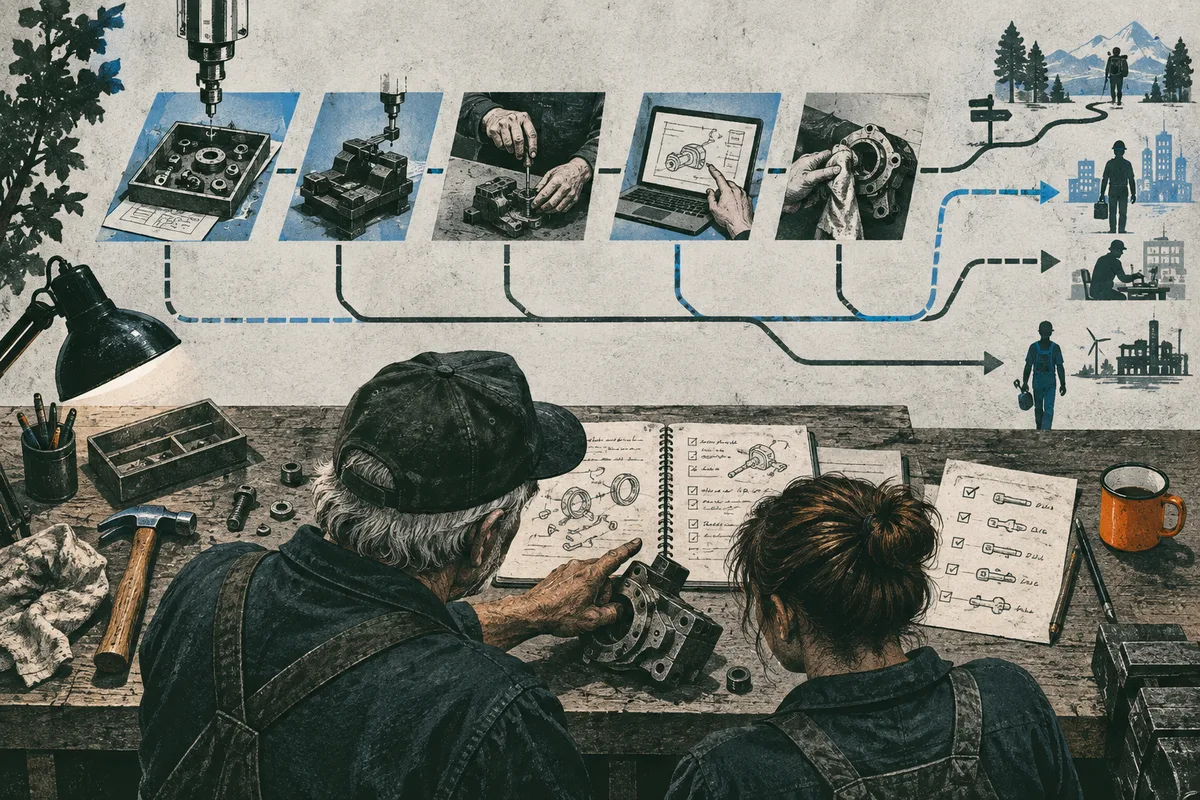
AI changes knowledge transfer in two directions. When a system draws on relevant examples and gives timely suggestions, junior workers can handle some tasks sooner and may pick up patterns embedded in experienced workers’ past work. But receiving a strong answer is not the same as learning to diagnose a new case, verify an output, or explain why it is right. A field study of customer-support agents found meaningful gains for newer workers using AI suggestions; a randomized study of developers learning an unfamiliar programming library found weaker immediate mastery when they used AI, especially when they delegated the work. These findings are compatible because they measure different tasks and outcomes. Use AI as a scaffold for examples and feedback, while keeping the learner responsible for an attempt, a check, and an explanation. If routine starter work is disappearing, ask for another supervised task that builds the same judgment before deciding that a full career change is necessary.
When can AI carry experience from senior workers to junior ones?
The claim that AI can transfer know-how sounds plausible because a system can put useful examples beside the work at the moment a novice needs them. That is different from simply giving everyone a fast text generator. The strongest workplace evidence here comes from a particular customer-support operation where agents received suggested replies and links to internal documentation while handling customer chats.
In a staggered deployment involving 5,172 agents, Brynjolfsson, Li, and Raymond found that access to the suggestions raised issues resolved per hour by 15% on average. The gains were larger for less experienced and lower-skilled agents: the study reports a 30% increase in issues resolved per hour for that group, and agents with two months’ tenure performed about as well as untreated agents with more than six months’ tenure. The authors also found changes in communication patterns and evidence consistent with learning. This is evidence that a tool can make accumulated examples and response patterns available during live work. It is not a direct test that every worker acquired broad, independent expertise.
The conditions matter. The tool operated in a bounded workflow with a relatively stable product and recurring support questions. Its suggestions came from prior conversations and documentation. Agents could decide whether to use them. In that setting, a novice could see a possible response, adapt it to the customer’s facts, and observe whether the issue was resolved. A system that merely produces a polished answer without showing relevant context or leaving room for judgment offers a weaker learning opportunity.
This also explains why AI guidance and human mentoring can complement each other. A senior colleague can explain why one detail changes the diagnosis, which exception matters, or when a familiar pattern no longer applies. The field study shows that AI-supported performance can move toward experienced workers’ patterns in one adopted system; it does not establish that AI broadly replaces those conversations. Separate research in a sales firm found that structured coworker advice improved sales and that gains lasted after the intervention, illustrating the value of human knowledge flows. For a junior worker, the useful question is therefore not whether AI or a mentor is better in the abstract. It is whether the workflow combines relevant examples with a chance to ask why they fit this case.
What is lost when AI does the practice for you?
A worker can complete today’s task successfully and still fail to learn what tomorrow’s unfamiliar task requires. That gap is easiest to miss when teams measure throughput alone. If a junior analyst accepts an AI-written variance explanation without tracing it to the underlying figures, the report may be delivered on time while the analyst gets little practice distinguishing a real business change from a data error. The example is illustrative, but the learning distinction is measurable: output on the assisted task and mastery on a later independent task are not the same outcome.
A 2026 randomized study by Shen and Tamkin examined 52 regular Python users who were unfamiliar with the Trio library. The participants were balanced by prior coding experience; only four were in the 1–3-year experience group, so the paper does not establish that the sample was mostly junior. Participants who had AI assistance scored 50% on an immediate quiz about concepts used in the task, compared with 67% for participants who coded by hand. The AI group finished about two minutes faster, but the time difference was not statistically significant. The largest quiz gap concerned debugging. The study is a preprint and tests a narrow, short-term programming exercise, not all workplace training. It cannot establish that AI harms learning in every job. It does show why an assisted deliverable should not be treated as proof of independent competence.
The details of use mattered. The researchers observed several interaction patterns associated with different results. Participants who delegated code generation or debugging tended to score poorly; those who asked conceptual questions, sought explanations, or used generated code while checking their understanding scored better. The authors caution that these patterns are qualitative and do not establish a causal ranking among ways of prompting. Still, the practical distinction is clear enough to test: substitution removes the learner’s attempt, while scaffolding makes the attempt more informed and keeps the learner engaged in reasoning.
There is a second, organizational question: are entry routes changing? A German Institute for Employment Research project reports that apprenticeship vacancies in more AI-exposed occupations averaged 3.5% lower after November 2022 relative to less-exposed occupations, while full-time employment in those occupations remained stable and workforce composition shifted. The underlying vacancy data cover Germany from 2019 to 2024. This is a project summary, not a direct measure of mentoring or proof that AI caused an individual’s job loss; its project period continues through 2030. It raises a pipeline concern rather than settling it. If fewer junior positions include routine supervised work, organizations may need to create other practice opportunities. Vacancy patterns, AI adoption, skill development, and displacement remain separate signals.
Sources: How AI Impacts Skill Formation; Technological Change and Apprenticeships
What realistic next move preserves both speed and learning?
Do not make a career pivot from exposure alone. First check which part of the work is changing: the speed of producing a draft, the amount of independent judgment you exercise, or your access to starter assignments and feedback. These can move in different directions. A tool may automate a first draft while leaving verification and exception handling with the worker; another workflow may remove a junior task without providing a replacement way to practice. Neither outcome, by itself, gives a probability of job loss.
For one recurring task, try a short practice loop. Before asking for an answer, write down your initial diagnosis, outline, or expected result. Then use AI for a bounded purpose such as generating a counterexample, surfacing a relevant procedure, or critiquing your draft. Check its suggestions against the primary record: source data, policy, documentation, test result, or client facts. Finally, explain what you accepted, rejected, and why. If you cannot reproduce the reasoning on a comparable case without the system, treat that as a learning gap to work on, not a verdict on your career.
The next step depends on what that check reveals. If the tool accelerates familiar work and you can still explain the decisions, keep it in the workflow and ask an experienced colleague about one edge case each week. If you are learning an unfamiliar task, ask for a version where you attempt it first and receive review afterward. If an entry-level task has vanished, ask your manager for a supervised substitute assignment that develops the same underlying skill, with time to review mistakes. That request is concrete: name the task, the decision it used to teach, and the feedback you need. If the current role no longer offers relevant practice, compare adjacent work against your existing experience, salary floor, location, available study time, health, and family commitments before considering a longer course or larger move.
The evidence supports a narrower verdict than either ‘AI transfers expertise’ or ‘AI stops juniors learning.’ AI can distribute documented patterns and timely feedback, and in one customer-support deployment it helped newer workers perform more like experienced peers. It can also let learners bypass the effort that builds independent understanding, as the programming experiment cautions. The most realistic response is to preserve the cycle of attempt, explanation, verification, and feedback around tasks where judgment matters. Start by checking one task bundle rather than assigning yourself a job-risk score. The free task checker can help inventory change pressure across your work; it is not a validated probability of redundancy. A personalized roadmap is relevant only if you need to compare stay-and-redesign, adjacent, and larger-change paths against your actual constraints.
Sources: Generative AI at Work; How AI Impacts Skill Formation; Technological Change and Apprenticeships; Workplace Knowledge Flows
Questions readers ask
Does AI replace mentoring for junior workers?
Current evidence does not show that it does. AI suggestions can make examples and feedback easier to access, but mentoring can explain why a pattern fits, where it fails, and how to handle exceptions. Use AI for bounded guidance and retain opportunities for supervised practice and questions to experienced colleagues.
Sources and notes
- Generative AI at Work
Reports a staggered deployment in one support firm, including larger performance gains for less experienced agents and limits on generalizing beyond the setting.
- How AI Impacts Skill Formation
Reports randomized experiments on developers learning an unfamiliar programming library and distinguishes assisted task completion from immediate mastery.
- Technological Change and Apprenticeships
Summarizes German apprenticeship vacancy patterns by occupational AI exposure and reports stable full-time employment alongside changing workforce composition.
- Workplace Knowledge Flows
A field experiment in a sales firm reports lasting productivity gains when coworkers were encouraged to seek advice through structured meetings.
Apply this to your own work
See the whole job market at once.
Explore which occupations AI may reshape, then turn the signal into a practical response.
Explore the job map