Anthropic's June 26, 2026 Economic Index update shows a meaningful change in the shape of AI use inside the Claude ecosystem: more activity is organized around longer, delegated workflows and concrete artifacts. That is evidence about which digital tasks users are attempting to hand off, not a personal displacement forecast. For an early- or mid-career knowledge worker, the proportionate response is to audit one recurring task, run a bounded experiment with human verification, and then compare an upgrade, adjacent move or larger change against demand, credentials, income, location, health, family and learning constraints.
What changed in the June Economic Index, and why does the measurement matter?
The useful question raised by Anthropic's June 26, 2026 Economic Index update is not whether AI is now replacing a particular occupation. It is whether the shape of use is changing from short assistance toward longer, artifact-producing and sometimes more delegated work. Anthropic's report, titled Cadences, offers evidence about that question inside Claude's own usage ecosystem. It does not provide a census of workplaces or a personal risk score. Read it as a sharper signal about tasks that users are attempting to hand off, then test whether the same tasks matter in your own work.
The measurement changed in several ways. Earlier Economic Index reports used seven-day samples of Claude conversations. In the June update, Anthropic says its privacy-preserving pipeline samples a slice of conversations every day, which allows the researchers to examine use by hour as well as by day. That change matters because daily sampling can show rhythms that a single weekly slice may miss: when work-related use rises, when personal use becomes more common, and whether different kinds of activity cluster around particular parts of the week. The result is not simply a newer total. It is a view with a different temporal resolution.
Anthropic Economic Index: Cadences also adds a classifier for the concrete output associated with a conversation. A transcript-only measure tells you that a person and a model exchanged messages. An artifact classifier asks what the interaction was oriented toward producing: an explanation, document or report, piece of guidance, analysis, code or another recognizable result. That distinction is important for a worker because the economic question usually concerns a deliverable or decision, not the existence of a chat window. A conversation that explains a concept and a conversation that produces a usable draft may contain similar prose but represent different stages of a workflow.
Product-surface separation supplies another necessary boundary. The update distinguishes Claude conversations, including chat and Cowork, from first-party application programming interface traffic, and discusses Claude Code separately when comparing autonomy. A person using an interactive assistant, a team embedding a model in an internal application and a developer asking a coding agent to inspect a repository are not observing the same workflow. They may use related models, but they expose different inputs, controls, interfaces and review points. Combining them into one undifferentiated usage number would hide the very differences the update is trying to make visible.
The difference between a transcript and a delegated workflow becomes clearer with a simple contrast. A request to explain a paragraph may finish after a few turns. A request to inspect a repository, change several files, run checks, summarize the result and return a working artifact contains a sequence of subtasks. The user has delegated more of the transformation, but has not necessarily delegated acceptance. Someone still has to specify the objective, supply permissions, notice when the agent followed the wrong path, review the result and decide whether it can be used. Anthropic's measurement can register the longer interaction and its output; it cannot establish that the artifact was correct or accepted in production.
The report's work rhythms make the date meaningful without making it universal. Anthropic reports that work-related use declines on weekends, though the decline is less pronounced in higher-paid occupations, while personal conversations rise. Different requests also peak at different times. These are observations about how Claude users engage with one set of products in June 2026. They suggest that AI use remains tied to calendars, deadlines, working hours and personal routines. They do not show that every workplace has adopted the same cadence, or that the observed users represent workers who do not use Claude, use another system or cannot use AI because of policy or confidentiality.
There is a measurement caveat before any trend claim. A method change can make use look newly different because the instrument is now better at seeing longer sessions, outputs and hourly patterns. If an earlier sample was less likely to capture a delegated sequence or classify its result, some apparent change may reflect improved visibility rather than a sudden change in behavior. Longer sessions may also be concentrated among heavy users, people with difficult prompts, users exploring a product's new features or occupations with unusually high access. The update can reveal a changing shape of use in the observed sample while leaving the size and direction of change across the whole economy unresolved.
That caveat does not make the update useless. It changes what it can legitimately do. Anthropic's evidence supports a bounded reading: Claude use includes more than isolated question answering, and some users are engaging in workflows that produce concrete artifacts and involve greater delegation. It does not support the stronger claims that employers broadly accept those artifacts, that autonomous performance is reliable, that the cost of work has fallen in a measured occupation or that jobs are being displaced. The International Labour Organization's Workers' exposure to AI: What indicators tell us—and what they don't makes the parallel distinction for exposure measures: technical susceptibility is not an observed labor-market outcome.
A practical reading rule follows. Use the June update to ask which recurring outputs are becoming easier to specify, generate or hand off, and which parts of the workflow remain outside the measurement. Then ask four separate questions: What output is being produced? How much judgment is the system exercising rather than supporting? How much autonomy is the user actually delegating? Who verifies the result and accepts the consequence? Anthropic's telemetry can inform the first three only within its sampled ecosystem. Your employer, customer, regulator or professional responsibility supplies the answer to the fourth.
This is why a longer or more artifact-oriented session should trigger inspection rather than panic. If the evidence were a personal displacement forecast, retreat would seem rational. If it is evidence that certain digital tasks are becoming easier to structure and delegate, the proportionate response is to identify the task, document the human work that remains and check whether the organization is changing its process. A worker who defines the problem, chooses evidence, handles exceptions and carries accountability may see preparation automated while retaining responsibility for interpretation and approval. That is a task change, not proof that the whole role is interchangeable.
The update should therefore be treated as time-bounded evidence. Product surfaces, classifiers, user populations and model behavior can change after June 2026. Anthropic itself notes the need for broader employment and productivity evidence alongside usage logs. Preserve the modest finding that is useful now: longer delegated workflows and concrete artifacts deserve closer task-level analysis. Do not turn that finding into a number about how many jobs will disappear. The report does not observe employer decisions, local demand, wages, headcount or the reliability of the final work, so it cannot supply that conversion.
The measurement question also changes how a worker should read the word delegation. Delegation can mean that a user asks a system to complete more intermediate steps, not that responsibility has moved to the system. A longer session may include repeated correction, source insertion and inspection because the task is difficult. It may therefore indicate greater ambition, greater friction or both. The useful observation is that the workflow is being attempted at a larger unit than a single answer. The career question remains whether that larger unit can be made reliable, authorized and valuable in a particular setting.
For a worker, the report is most useful as a boundary-setting document. It tells you to stop treating AI use as one undifferentiated activity and to ask which surface, output and degree of delegation you are discussing. That precision prevents two opposite mistakes. A short chat interaction should not be inflated into autonomous work, while a multi-step artifact workflow should not be dismissed as ordinary question answering. Both errors make the next career decision worse because they erase the actual handoff that needs to be inspected.
Sources: Anthropic Economic Index report: Cadences; Workers' exposure to AI: What indicators tell us – and what they don't
Which parts of a knowledge-work task bundle are becoming more exposed?
The clearest exposure signal is not a job title. It is a recurring output whose inputs can be described digitally, whose transformation follows a recognizable pattern and whose result can be checked at a tolerable cost. This is an editorial task-level rule, informed by Anthropic Economic Index: Cadences rather than measured as a causal threshold. Delegation pressure is stronger when a system can receive the relevant material, produce a useful version and leave a reviewer with a cheaper checking job than a from-scratch production job. Exposure of that task still says nothing by itself about the exposure of the whole role.
Anthropic's output analysis gives this rule a concrete vocabulary. The June report classifies most Claude conversations as producing an artifact and identifies recurring categories such as explanations, documents or reports, guidance and analyses. It also compares product surfaces and reports higher autonomy for Claude Code across almost all displayed output types than for chat or Cowork. Those findings show where users are directing model activity. They do not show that the artifact has business value, that its claims are correct, that a customer will accept it or that an employer has authorized an unsupervised workflow. An output category is a description of what was produced, not a reliability certificate.
Start with input clarity. A task is more exposed when the relevant facts, files, definitions and constraints can be supplied to the system without hidden context. Spreadsheet cleanup is a clear illustration: if columns, transformations and validation rules are known, much of the mechanical work may be delegable. But a spreadsheet that appears tidy can still contain an incorrect definition, a missing data source or an assumption known only to the team. The question is not whether the model can manipulate cells. It is whether the worker can identify what the cells are supposed to mean and verify the result against the source of truth.
Next examine the transformation and output. Document drafting, policy search, translation, coding, reporting and the creation of variants often have a recognizable input-to-output path. A policy search assistant may locate relevant passages and produce a draft answer. A reporting workflow may join data, calculate a standard measure and prepare a first narrative. A coding agent may modify a narrow, well-documented function and propose tests. These are exposed portions when the objective is clear and the output format is stable. The exposure is conditional because the hard part may be choosing the right question, identifying an exception or proving that the apparently plausible result is safe to use.
Verification cost is the dividing line that a polished artifact can obscure. If a competent reviewer can compare a draft with authoritative inputs, run a meaningful test or check a bounded transformation quickly, delegation becomes easier to contemplate. If verification requires reconstructing the entire reasoning process, consulting several sources, reproducing a hidden calculation or waiting for a real-world consequence, the apparent efficiency may be illusory. A fluent memo can conceal a wrong premise. A working-looking code change can pass a narrow test while breaking an undocumented dependency. More output lowers production effort only if review remains proportionate and effective.
Consider reporting as an illustration, not a claim about every reporting job. The extraction of figures, cleanup of a stable template and first pass at a standard narrative may be exposed when the data are clean and the definitions are settled. The choice of metric, explanation of an unexpected movement, response to an executive's question and decision about whether the data are fit for use carry more contextual judgment. If preparation is automated while the analyst retains interpretation and accountability, the role is redesigned. If access to the decision is removed and the artifact is treated as interchangeable text, the economic pressure is different. The report's artifact signal cannot decide between those organizational outcomes.
Policy search shows the same boundary. Retrieving a clause, comparing versions and drafting a response are legible digital transformations. Deciding which policy governs an unusual case may require knowing the organization's practice, the affected person's circumstances and the consequences of an incorrect answer. A worker may also be accountable for escalating uncertainty rather than producing a confident sentence. Search and drafting can therefore be exposed while exception handling and responsibility remain central. The presence of a generated answer does not mean the underlying decision has been automated.
Coding supplies a further warning against equating production with autonomy. Claude Economic Index findings about product-surface autonomy can indicate that some users are asking a coding surface to take more steps. They cannot establish reliable autonomous engineering in a production environment. Software work includes selecting the change, understanding dependencies, protecting secrets and data, reviewing the diff, judging whether tests are adequate and responding when users encounter a failure. The more consequential the system, the more the verification and accountability burden matters. A coding agent that writes more lines may increase a practitioner's scope, compress routine implementation or create more review work; the output alone cannot tell us which.
Separate five human dependencies when mapping a task: goal-setting, exception handling, physical or operational action, relationship trust and accountability. Goal-setting asks what should be achieved and why. Exception handling asks what to do when the case does not match the template. Physical or operational action includes work in environments the model cannot directly control. Trust includes negotiation, care, persuasion and the continuing relationship around the result. Accountability identifies who has authority to sign off and who bears the consequence of error. These dependencies can coexist with highly exposed preparation. Their presence makes delegation conditional, not impossible, and their absence does not guarantee that an employer will adopt automation.
The distinction between capability, applicability and observed use is essential. A model may be technically capable of producing a draft. The task may be applicable to that capability in principle. Users may already be observed doing it in Anthropic's data. An employer may nevertheless prohibit the workflow because of privacy, procurement, integration, copyright, security or quality requirements. Even after adoption, the organization may require a human to review every result, which changes the task without eliminating the role. The June report primarily informs capability-in-use and observed usage patterns. It does not measure dependable performance in the reader's workplace.
Artifact production can also expand a worker's scope. When routine preparation becomes cheaper, an organization may ask the same worker to cover more accounts, investigate more exceptions, improve the evidence trail or make decisions that were previously unaffordable. That is not a guaranteed productivity or employment outcome; it is one plausible redesign that must be checked against actual management choices. The opposite is also possible: an employer may use the same capability to narrow a role, reduce junior practice opportunities or treat review as an unpaid residual. A task map should record both the new leverage and the risk that responsibility remains while production time is removed.
The practical map is therefore a ledger, not a label. For each recurring activity, record the input, intended output, transformation, current time, possible AI role, human judgment, verification time, common error, stakeholder affected and accountable decision-maker. Mark whether a tool is in use, merely available, under review or prohibited. Then ask whether the task's value lies mainly in producing the artifact or in defining the problem, interpreting evidence, handling exceptions and standing behind the result. The ledger can show a highly exposed activity inside a role whose center of value remains contextual and accountable. It can also show that the preparation path is disappearing even while the higher-level role survives, which matters for training and career progression.
A task ledger should also record what happens before and after the visible artifact. Before production there may be scoping, permission checks, source selection and the decision to use a tool at all. After production there may be reconciliation with a system of record, explanation to a stakeholder, correction of an affected case and maintenance when the underlying policy or data changes. These stages can be more consequential than the draft itself. A workflow that looks highly exposed in the middle may still depend on a worker who frames the request correctly and remains available when the real world refuses the template.
This is especially important when routine preparation is part of how a worker learns. If a junior analyst no longer performs every cleanup or first-pass comparison, the organization may gain speed but lose a place where definitions and exceptions were learned. That is not proof that automation destroys development, but it is a design problem that someone must solve. A worker can respond by seeking explicit review, keeping annotated examples and asking to own a bounded decision rather than only the generated output. An employer can respond by making the learning and verification path visible. The June usage data cannot decide which response will occur.
Does higher exposure mean a worker is likely to lose the job?
No. An exposure label says that some described tasks appear technically susceptible to generative AI under specified assumptions; it does not say that an employer will deploy a system, redesign the workflow, reduce the role, or dismiss the person doing it. The ILO brief Workers' exposure to AI: What indicators tell us—and what they don't defines exposure as technological susceptibility. That is a deliberately narrower claim than automation, adoption or displacement. It can help identify where to inspect a task, but it cannot supply a personal job-loss probability. The missing steps are not minor details: they are the economic and institutional decisions that determine whether a capability becomes a changed job.
The distinction matters because a task can be technically feasible and still be a poor candidate for delegation. An employer has to weigh the cost of the system, integration, data preparation, supervision, security and error correction against the value of the output. The ILO brief treats these questions as separate from exposure, including economic feasibility, institutional barriers, workflow change and labor-market outcomes. A generated report may be easy to produce but expensive to check. A draft may be acceptable for an internal brainstorm but unacceptable when it informs a regulated decision, a customer commitment or a safety-sensitive action. In those cases, human input is not an ornamental final review; it is part of the production process and its cost must be counted.
The corrected ILO Working Paper 140 shows why an occupational exposure index should be read as a gradient of possible transformation rather than a forecast of replacement. Its refined method combines task-level descriptions with worker input, expert input and AI-model predictions. It reports heterogeneous exposure across occupations and concludes that transformation is the more likely broad effect because most occupations retain tasks requiring human input. The paper's modeled global shares—including one-quarter of employment with some exposure and a much smaller highest-exposure category—describe the classification under its data and assumptions. They are not observed job losses, and they do not identify what will happen to one worker in one firm or locality.
Human input can remain necessary for several different reasons. Someone may need to define the problem, supply context the system cannot access, choose among competing objectives, verify evidence, handle exceptions, explain a decision to another person or accept accountability when the output is wrong. Those requirements can change the composition of a job even when first-pass production becomes faster. A worker may spend less time drafting and more time checking, coordinating or deciding; that can be an upgrade where the organization recognizes and resources the responsibility, or a source of pressure where it expects the same accountability without time or authority. Exposure research cannot distinguish those outcomes by itself.
There is a serious counterpoint. Where work is standardized, demand is fixed, errors are cheap to detect and management can change staffing quickly, technical susceptibility can become real job pressure faster. A worker should not use the ILO boundary as reassurance that nothing will happen. It is a reason to ask what additional evidence exists: Is there a live deployment, a changed process, a staffing instruction or a reduction in the volume of the task? Has review responsibility moved, and is the organization preserving the work that develops into more advanced judgment? Those facts can establish urgency, but they still do not turn an exposure category into a reliable probability or timing estimate for the individual.
The practical conclusion is therefore conditional. Exposure research can tell you where a task-change investigation is warranted and which parts of the work may be technically reachable. It cannot tell you whether your employer adopts the capability, whether demand expands or contracts, whether the remaining human work is valued, or whether your particular job ends. Treating the label as a verdict skips the mechanism. The defensible next question is not, 'What is my percentage chance of losing this job?' It is, 'Which task is changing, who could adopt the change, what must still be verified or decided by a person, and what evidence would show that the change is affecting my actual role?'
The same boundary applies to the word risk. A task can have high technical exposure and low near-term employment pressure if demand for the service is growing, if adoption is slow or if the exposed activity releases time for more valuable work. It can have modest measured exposure and still feel precarious if a manager is already consolidating the task, reducing review time or changing the staffing model. The worker needs evidence about both the capability and the institution. Neither a product report nor an exposure index observes that complete chain.
This does not mean that exposure evidence should be ignored until a dismissal occurs. Waiting for an outcome removes bargaining power and learning time. It means acting on exposure with a reversible step: map the task, test the workflow safely, ask what standard applies and record whether the organization is actually changing the process. That sequence preserves the signal's urgency while refusing to claim more certainty than the evidence contains.
Sources: AI and skills; Artificial intelligence, information technology, and employment, 2024–34
What does the June update leave out about adoption, demand and displacement?
The June update leaves out the evidence that connects a capability signal to a career decision. Read the chain in three layers: capability and observed use, organizational adoption and workflow redesign, then labor demand and personal constraints. Anthropic can show what users do with Claude in its observed ecosystem. Exposure research can estimate which task descriptions appear susceptible. Neither establishes that a particular manager has authorized a deployment, that the process works at the required quality, or that the resulting change reduces headcount. Urgency rises only when evidence from the layers converges.
The first layer asks what the system can produce and what users are actually delegating. The second asks whether a real organization can incorporate that output. Useful adoption signals are concrete: a documented pilot with a named workflow; a manager's instruction to use a tool; a changed job description or process map; a new review, privacy or provenance policy; a budget or integration decision; or a shift in what counts as a completed deliverable. A public demonstration, a vendor claim or a headline about rapidly improving models is not equivalent. Adoption also includes the work created around the tool—data preparation, exception handling, evaluation, security and accountability. If those requirements absorb the expected saving, the job may be redesigned rather than simply reduced.
The third layer is demand. Even a successful workflow does not determine whether the organization produces more output, serves more customers, lowers prices, reallocates staff or cuts work. Productivity can expand demand, while a fixed budget can turn efficiency into fewer hours or fewer roles. The reverse can also occur: an employer may reduce a task before a broad occupational trend appears, or retain headcount while changing the standard of performance. These are reasons to inspect the reader's employer, customers and local market rather than infer a result from a global index.
The U.S. Bureau of Labor Statistics' July 2026 2024–34 projections provide a useful directional comparison, not a causal explanation or a local forecast. BLS projects strong growth in occupations such as data science, information security analysis, operations research and software development while projecting declines in several administrative, customer-service and clerical categories. The coexistence of growth and decline demonstrates why exposure and occupational demand must be read separately. The figures do not show that AI caused each movement, guarantee openings or wages, or tell a worker elsewhere whether the relevant employers are hiring. They are a reminder to examine the demand side instead of treating exposure as its proxy.
A disciplined check combines the layers without pretending that they form a validated score. For one recurring task, record the capability tested, the output produced, the verification burden and the error types. Then look for an actual adoption decision and ask who owns the result when it fails. Finally inspect repeated demand evidence: internal openings, changes in workload, customer requirements, recent vacancies in the relevant geography, or a documented reduction in the task. One posting or one manager conversation is weak evidence; a pattern over a defined period is more informative. Add constraints that change the decision, such as income floor, location, health, caregiving, credentials and available learning time.
The strongest counterpoint cuts both ways. Demand may grow after productivity gains, so a tool that reduces time per unit does not automatically eliminate work. Conversely, an employer may cut a team before an occupational projection records a decline, so national growth is not protection for a particular role. The correct response to both possibilities is investigation. If task evidence, a real adoption signal and relevant demand evidence all point toward shrinking work, transition planning deserves speed. If only exposure is high while adoption and demand remain unclear, the evidence supports a bounded task experiment and local fact-finding, not a resignation or a claim of safety.
This three-layer test changes what the June update can responsibly do for a worker. It can raise the priority of examining a recurring task and clarify what to measure. It cannot settle displacement until an organization, a workflow and a market provide additional evidence. The worker's decision should therefore be proportional to the evidence: preserve optionality when the signal is technical or observational, prepare an upgrade when adoption is real and useful judgment can transfer, and compare adjacent or larger changes only when task loss, weak redesign leverage, demand and personal constraints align. That is a stronger basis for action than either catastrophe or reassurance.
Demand evidence also needs a denominator. A statement that one occupation is projected to grow or decline in the United States does not tell a worker whether a specific employer is hiring, whether the relevant work is available in their location or whether the worker can meet the entry requirements. The BLS comparison is useful because it shows that exposure and occupational outlook can move in different directions, not because it identifies a destination. Before investing in a larger transition, inspect current postings or internal openings for the target work, the recurring requirements, the location pattern and the evidence expected from an applicant. Treat those observations as local checks, not as a guarantee that the market will remain unchanged.
Adoption can create a second-order problem: the first task to disappear may be the task through which a worker built evidence for a more advanced responsibility. A role can retain its title while its apprenticeship changes. That possibility strengthens the case for documenting how a worker interprets, verifies and improves AI-assisted output while the work is still available. It also argues against measuring adaptation only by tool use. A worker who can show the source trail, error taxonomy, review rule and decision boundary may be developing a more portable capability than one who can merely produce a fluent artifact quickly.
Sources: AI and skills; Artificial intelligence, information technology, and employment, 2024–34

How should experience, career stage and context change the reading?
Career stage changes the leverage and constraints available to a worker; it does not remove the underlying task risk. Anthropic's linked survey should be read as evidence about a selected group of Claude users, not as a population baseline. The report describes approximately 9,700 respondents who met the usage and survey-linkage conditions, and warns that computer and mathematical occupations and management are over-represented. That composition matters: a respondent who already has access to an advanced tool, discretion over digital work and a reason to answer a usage survey is not interchangeable with every knowledge worker. The survey can show how this group perceives exposure and expects change. It cannot establish how a local employer, sector or occupation will respond.
The survey's exposure perceptions are still relevant because expectations can shape behavior. A worker who believes more of the task can be delegated may experiment more, ask for training or volunteer for a redesigned workflow. But the reported perception is not an observed reduction in work, and the association between more automated use and more favorable expectations is not a causal result. It may reflect tool access, occupation, income, employer support, confidence or the fact that a useful workflow makes delegation feel less threatening. Treat the finding as a reason to inspect your own task bundle and institution, not as proof that your career stage is protected or doomed.
Anthropic's linked survey reports greater concern among earlier-career respondents, a finding that fits the structure of the work many junior employees are asked to perform but does not prove a career-stage effect. Information gathering, file cleanup, routine summaries, formatting, first-pass analysis and procedural drafting can be legible to a system because their inputs and outputs are comparatively clear. If those tasks become easier to delegate, the immediate risk is not only fewer minutes of preparation. It may also be fewer opportunities to see exceptions, receive correction and build the context needed for reliable judgment. The appropriate response is deliberate evidence-building: keep a record of source checks, explain why an output is acceptable, seek review from someone who owns the decision, and turn tool use into a traceable work sample rather than an invisible shortcut.
That does not make junior workers uniquely replaceable. New tools can give a less experienced worker leverage: a faster first pass can create room to ask better questions, explore a broader set of evidence or contribute to work that previously required more time. The condition is feedback. Without review, a polished answer can conceal a gap in domain knowledge; without access to the reasoning behind a decision, faster output can leave the worker unable to handle the next exception. Early-career advantage comes from pairing tool fluency with explicit learning, verification and responsibility—not from assuming that speed alone will be recognized.
Mid-career workers may bring a different asset: context that is not fully present in the artifact. They may know which customer promise is unrealistic, which metric changed definition, which exception matters to an auditor or which recommendation will fail operationally. Anthropic's report discusses judgment, contextual awareness, situational reasoning and relationships as limits respondents associate with current AI use. That supports a qualified inference, not a protection claim. Experience is economically useful when it is made visible as decision criteria, quality controls, exception handling and accountable outcomes. It is vulnerable when it remains private knowledge while the organization measures only the volume of generated output.
The mid-career question is therefore whether AI removes preparation while increasing responsibility. That can be an upgrade if the worker receives authority, review time and recognition for evaluating the result. It becomes a squeeze if the organization expects the same accountability with less access to source material, less time to check errors and no right to challenge an automated recommendation. Document the before-and-after task, ask who signs off, and clarify what decision rights accompany the new workflow. Context is not valuable merely because a worker has held a role for years; it becomes leverage when the institution depends on that context and rewards its use.
Constraints also change the meaning of an apparently attractive response. A junior worker may have more mobility or time to study but less savings and less bargaining power. A mid-career worker may have transferable domain judgment but face a higher income floor, health limits, caregiving responsibilities, location constraints or the cost of abandoning accumulated credentials. Anthropic's selected survey cannot resolve those trade-offs. The usable rule is to preserve and make visible context and accountability while checking whether the employer and local market recognize them. Do not turn tenure into immunity, youth into replaceability or a survey average into a career prescription.
Context includes the sector's tolerance for error and the worker's position in the chain of responsibility. An internal brainstorming draft, a customer-facing explanation and a decision that affects access to money or services may use similar language but require different controls. The more costly the error, the less informative a simple artifact count becomes. A worker who is considering a move should therefore ask not only whether a target role uses AI, but what it is accountable for, how its work is reviewed and whether the organization funds the time required to make that review real.
Career stage also affects the acceptable speed of the experiment. Someone with little financial slack may need an upgrade that can be tested inside current work before considering a course or move. Someone with transferable experience may be able to compare an adjacent role, but still need to protect income and caregiving capacity. These are not demographic predictions; they are decision constraints. The same task signal can rationally produce different next steps because the cost of being wrong is not the same for every reader.
What realistic move should I make after reading the signal?
The realistic next move is the smallest one that can produce evidence about your work. Start with one recurring, meaningful task and a bounded experiment that does not expose a customer, patient, client or colleague to avoidable harm. Record the current process, permitted data, proposed AI role, review standard, verification time, errors, exceptions and who accepts the result. The purpose is not to prove that a tool is impressive. It is to learn whether a named workflow improves useful work, what human contribution remains and whether the organization has any interest in adopting it.
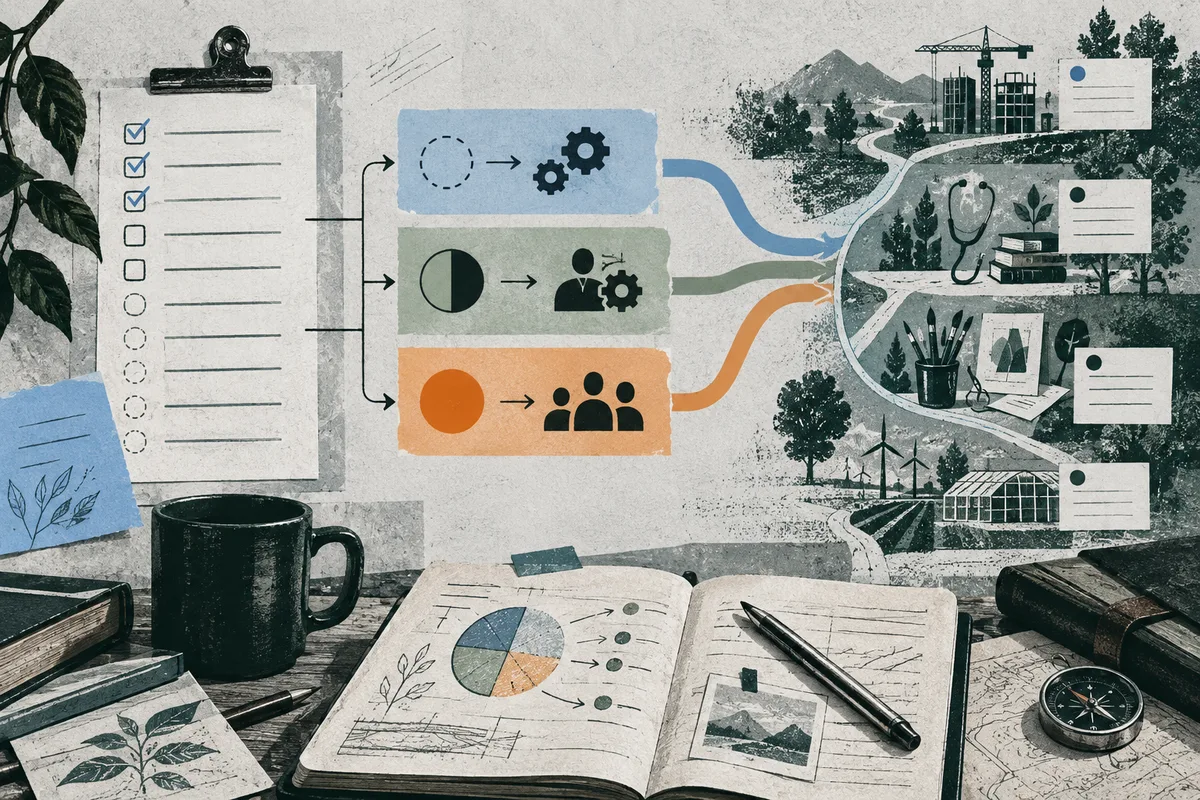
Use three paths as a comparison, not a ranking of personalities. An upgrade keeps the domain and changes the workflow. An adjacent move changes the task bundle while carrying forward some context, relationships or verification knowledge. A larger change leaves more of the current bundle behind and requires a stronger case for demand, prerequisites and household feasibility. The signal from Anthropic can motivate the comparison, but it cannot select the path. That choice requires evidence about the task, the institution, the target market and the worker's constraints.
Choose the upgrade path when the domain remains valuable, the exposed task is only one part of the role and you can pair AI assistance with framing, evaluation and accountable delivery. An upgrade might involve redesigning a reporting process, establishing a review checklist, learning enough data handling to test outputs or taking responsibility for a decision the system cannot make. This does not require becoming a machine-learning engineer. The durable foundations are problem definition, data literacy, verification, domain knowledge and basic automation applied to a named workflow. They are more portable than mastery of one changing interface.
Learning must match the intended outcome. Using AI in an existing role calls for task decomposition, data handling, privacy, evaluation and a work-based project. Building AI-enabled products adds software foundations, system design, deployment and evaluation under real conditions. Becoming a software practitioner requires enough programming and testing depth to review generated code rather than merely request it. ML engineering or research is a different commitment, often involving substantial mathematics, statistics, computing and formal or equivalent depth. OECD's AI-and-skills evidence supports this differentiated response: complementary digital, data, domain and human capabilities matter, but it does not establish that one course or credential creates readiness for all four goals.
Compare the learning vehicle with the gap it is meant to close. Self-study can be efficient for a narrow workflow when the learner can define the problem and obtain feedback. A course can supply sequence, examples and deadlines, but its value depends on depth and feedback. A certificate may satisfy a known screening or continuing-education requirement, but completion is not workplace capability. A project can produce evidence when it uses realistic inputs, documents decisions and evaluates errors. An apprenticeship or supervised assignment adds context and correction. A degree offers broader foundations and credential value when the target role requires that depth or gate. Cost, time, prerequisites and signaling are part of the decision, not afterthoughts.
An adjacent move becomes reasonable when a central task is shrinking but the worker's context transfers. A reporting worker might compare data quality, operational decision support and stakeholder interpretation; a content worker might compare research standards, product education and regulated communications; a developer might compare system ownership, reliability, security and domain-specific product work. These are comparison examples, not guaranteed destinations. Check what carries over, what must be demonstrated anew, what feedback is available within a month, whether the target exists where the worker can live and how income changes during the transition. The target task may be exposed too, so adjacency is a hypothesis to test rather than a safe label.
A larger change deserves a higher evidentiary threshold because it spends more time, money and household capacity. Escalate only when repeated task loss or weak redesign authority is visible, the local or target market provides corroborating demand evidence, adjacent paths fail the worker's constraints or preserve too little value, and the target's prerequisites and training route are verified. Include income floor, geography, health, family responsibilities, learning hours and the cost of a period without the expected outcome. Neither an exposure signal nor a provider's promise can substitute for those checks, and no plan should depend on guaranteed employment or salary.
The strongest case against upgrade-first is institutional, not technological. A manager may impose a tool without changing targets, review time, staffing or decision rights. The task may be removed before the worker is allowed to redesign it, or the organization may value cheaper volume rather than accountable judgment. In that case, document the changed process and errors, ask how responsibility is allocated, and build portable evidence of domain ownership and verification. If repeated task loss, weak authority and corroborated local demand decline occur together, transition planning should accelerate. That exception still does not reveal a precise replacement probability or justify inventing a safe destination.
Use the experiment to decide what to buy or study next. If the workflow is useful and repeatable and the gap is tool fluency, a bounded course or second project may be proportionate. If the gap is data interpretation, domain knowledge or evaluation, study that foundation instead of chasing another interface. If the workflow fails because data, process or demand is weak, training may be solving the wrong problem. A work sample with documented review can answer a task-change question better than a generic credential, while a formal credential remains necessary where the target has a real gate. OECD's distinction between exposure and automation risk supports this discipline, but the project-versus-certificate preference is an editorial decision rule, not a universal outcome claim.
The decision rule is therefore conditional: upgrade when judgment and accountability can be paired with a named workflow and recognized by the institution; test an adjacent path when exposed work shrinks but domain context transfers; investigate a larger change when task loss, redesign limits, target demand, prerequisites and personal constraints align. Preserve the experience that still carries economic value, make it legible through verified work, and learn only what the next decision requires. The point of acting now is not to start over on the strength of a usage signal. It is to create better evidence before making an expensive move.
A useful comparison sheet has one row for each path and one column for each constraint. For the upgrade, record the workflow to improve, the permission needed and the evidence a manager could recognize. For the adjacent path, record the transferable context, the missing proof and the shortest credible test. For the larger change, record prerequisites, training duration, financing, location and the point at which the plan would be abandoned if evidence does not improve. This keeps the decision from becoming a contest between optimistic narratives. It also exposes when a path is attractive only because its costs have not yet been named.
The experiment should leave an artifact of learning even when the tool result is disappointing. Save a redacted before-and-after process, a sample evaluation rubric, a list of recurring failure modes or a note explaining why the workflow was not safe to adopt. Such evidence can support a conversation about redesign, reveal a foundation to study or test an adjacent responsibility. It is not a hiring guarantee and should not be presented as one. Its value is that it converts a vague reaction to AI into a more legible account of what the worker can judge and improve.
Sources: AI and skills; Skills in the AI age: Executive summary
What should the reader conclude, and when is a checker or roadmap useful?
The June update warrants inspection, not panic. Anthropic's June 2026 Economic Index report, Cadences, is meaningful evidence that AI use in the Claude ecosystem is taking more often the form of longer, delegated, artifact-producing work. That finding justifies examining recurring tasks whose inputs and outputs are easy to describe. It does not justify treating a product-usage signal as a personal displacement probability. The decision should turn on a narrower question: does the capability become an adopted, verifiable workflow in your organization or target market, and what valuable human responsibility remains around it?
For the next two weeks, choose one recurring task that matters to your work but can be tested without exposing another person to avoidable harm. Define the task before opening a tool: what starts it, what information it requires, what output is expected, how the work is done today and who accepts the result. Pick a task with a clear boundary, such as preparing a first-pass internal summary, cleaning a permitted dataset, drafting a routine explanation or generating a testable set of alternatives. Do not choose a regulated, safety-critical or confidential workflow merely because it appears highly exposed. The purpose is to make one uncertainty more specific, not to stage a demonstration of autonomy.
Create an audit record that another competent person could inspect. Record the task, inputs, expected output, current time, proposed AI role, human judgment required, verification time, error types, exceptions and stakeholder response. Add whether the tool was actually permitted, whether the output relied on source material that could be checked and whether a manager, client or colleague showed an adoption signal. Note any new work the tool created: fact-checking, prompt repair, data preparation, review, escalation or explanation. The final fields are the learning gap and a decision date. This procedure is a transparent editorial synthesis motivated by Anthropic's artifact and autonomy findings; it is not a validated assessment or a study of your employer.
Judge the result on more than speed. Ask whether the output was accurate enough for its intended use, whether verification remained cheaper than producing the work from scratch, whether the error types were visible, and whether a stakeholder valued the result. A faster draft that demands a second full investigation may not be an improvement. A modest time saving that lets you handle a meaningful exception, explain a decision or serve more users may be valuable even if the tool did not complete the task. Record what you personally did that the system could not do reliably: set the goal, select evidence, interpret local context, negotiate a trade-off, protect sensitive information or accept accountability.
Route the evidence into three possible decisions. Choose an upgrade when the domain remains valuable, the task is changing but demand persists, and you can pair the tool with framing, evaluation and accountable delivery. The next step might be a review protocol, a small workflow improvement, better data handling or a work sample that shows how you use and check AI. Choose an adjacent comparison when the exposed task is shrinking but your context, relationships or verification skill transfers to another role. Compare the target's prerequisites, feedback route, location, income floor and demand rather than assuming that the adjacent label is safer. Investigate a larger change only when documented task loss, weak authority to redesign, corroborated demand pressure and a feasible target path align with your health, family and financial constraints.
Let the learning gap choose the learning purchase. If the experiment shows a narrow tool or workflow gap, self-study or a focused course may be enough. If the gap is data interpretation, evaluation, domain knowledge or software fundamentals, study that foundation rather than chasing a new interface. A project can provide evidence when it uses realistic inputs, documents decisions and includes review. A certificate can provide structure or satisfy a known screening requirement, but completion does not prove workplace capability. A degree, apprenticeship or supervised assignment may be appropriate when the target requires formal depth, a credential gate or sustained feedback. None of these choices follows from an exposure label alone.
The experiment needs a stop condition. Obtain authorization before using work data, remove or protect sensitive information, keep a human reviewer responsible for the result and do not treat a plausible artifact as evidence that a regulated or safety-critical workflow is ready for delegation. If the work cannot be tested safely, use a sanitized or synthetic example only to learn about the mechanics, then seek separate evidence about adoption and accountability. A two-week observation can miss seasonal demand, a later management decision or a longer implementation cycle. It can therefore inform the next question, but it cannot forecast the labor market or prove that a workflow will remain valuable.
The free AI Proof Work checker is useful after the task has been described, or when the task bundle is still too vague to compare. It can structure task-level change-pressure signals and suggest first actions, giving you a place to separate inputs, outputs, judgment, verification and adoption evidence. Treat its result as a prompt for inspection, not as a validated probability that you will lose a job. It should not be used alone to resign, borrow money, choose a degree or accept an employer's prediction. The article's evidence and basic answer remain available without requiring a frightening score or a paid interpretation.
The paid career roadmap belongs later in the decision, when there is a real task bundle and more than one plausible route to compare. It can organize a stay-and-redesign option, an adjacent move and a larger-change scenario against constraints such as experience, income needs, geography, learning time, health and family responsibilities, then turn the chosen direction into a 30/60/90-day plan. Its role is structured scenario comparison. It is not validated professional counseling, a personal displacement forecast or a guarantee of employment, salary or income. Personalization cannot repair an undefined task, and a plan cannot manufacture demand where the target market does not support it.
The conclusion is therefore deliberately conditional. Start with the safest meaningful task inspection, make the human contribution visible and compare the result with an actual adoption signal. Deepen the upgrade if the workflow is useful, repeatable, valued and still requires accountable judgment. Compare adjacent paths if exposed work is shrinking while domain context transfers. Move faster toward a larger-change analysis only when task evidence, institutional evidence, relevant demand and household constraints point in the same direction. Anthropic's June update supplies a reason to look closely at work now; the audit supplies the evidence for deciding what to do next.
A decision date prevents the audit from becoming another indefinite research project. At that date, classify the evidence as useful and repeatable, useful but too costly to verify, technically promising but unauthorized, or not useful for the named task. Each category points to a different next step. Repeatability supports a deeper upgrade; costly verification calls for process redesign or a different task; lack of authorization calls for an institutional conversation rather than more prompting; a failed test calls for revising the question before buying training. This classification is a practical synthesis, not a validated score.
The central safeguard is proportionality. A usage study can justify attention, a task experiment can justify a workflow decision, and corroborated organizational and market evidence can justify a larger career comparison. Each step should earn the next expenditure of time, money and household capacity. If the evidence does not earn it, staying with a bounded upgrade is not complacency; it is a reasoned decision under uncertainty. If the evidence does earn it, moving toward an adjacent or larger path is not panic; it is an escalation supported by a clearer case.
Questions readers ask
What is the main finding of Anthropic's June 2026 Economic Index update?
It shows Claude use becoming more frequent, longer-running and more oriented toward concrete artifacts and delegated workflows. It describes one product ecosystem, not all AI use or the whole labor market.
Does the report predict which jobs AI will replace?
No. It reports usage patterns and survey expectations among selected Claude users. It does not estimate an individual's displacement probability or establish employer adoption, wages, openings or job losses.
Which work is most exposed to the changing pattern?
Recurring digital tasks with clear inputs, repeatable outputs and relatively cheap verification are more exposed. Context, accountability, relationship trust, physical action and costly verification make delegation more conditional.
Should I learn advanced machine learning because my task is exposed?
Not automatically. If your goal is using AI in an existing role, start with task design, data handling, evaluation, privacy and a small work project. Advanced machine-learning study fits a different goal with different prerequisites.
What should I do after reading the update?
Run a bounded two-week audit of one recurring task. Record the AI role, human judgment, verification burden, errors, stakeholder response and adoption signal before deciding on an upgrade, adjacent move or larger change.
When should I use the AI Proof Work checker or roadmap?
Use the free checker to make a vague task bundle explicit. Consider the paid roadmap when you need to compare realistic career scenarios against income, location, training time, health and family constraints. Neither gives validated displacement odds or guarantees employment.
Sources and notes
- Anthropic Economic Index report: Cadences
The June 26, 2026 update changes the Economic Index method, reports work rhythms and artifact categories, compares autonomy across Claude surfaces, and describes a linked survey of Claude users' expectations and experiences.
- Workers' exposure to AI: What indicators tell us – and what they don't
ILO exposure indicators estimate technological susceptibility in tasks, but do not predict adoption, productivity, wages, demand, employment outcomes or displacement.
- Generative AI and Jobs: A Refined Global Index of Occupational Exposure
ILO Working Paper 140 refines occupational exposure by combining task-level data, worker input, expert input and AI model predictions; it finds heterogeneous exposure and frames transformation as the likely broad impact because most occupations retain human-input tasks.
- AI and skills
OECD evidence helps distinguish technical exposure from adoption and implementation conditions, including complementary digital, data, domain and human skills and the need for targeted learning rather than generic AI branding.
- Artificial intelligence, information technology, and employment, 2024–34
U.S. BLS projections show growth in some AI- and IT-related occupations alongside declines in selected routine or administrative occupations, demonstrating that exposure and occupational demand must be read separately.
- Skills in the AI age: Executive summary
OECD distinguishes AI exposure from automation risk and supports a learning response that combines foundational, ICT and complementary human capabilities rather than assuming a single short course creates job readiness.
Apply this to your own work
See the whole job market at once.
Explore which occupations AI may reshape, then turn the signal into a practical response.
Explore the job map