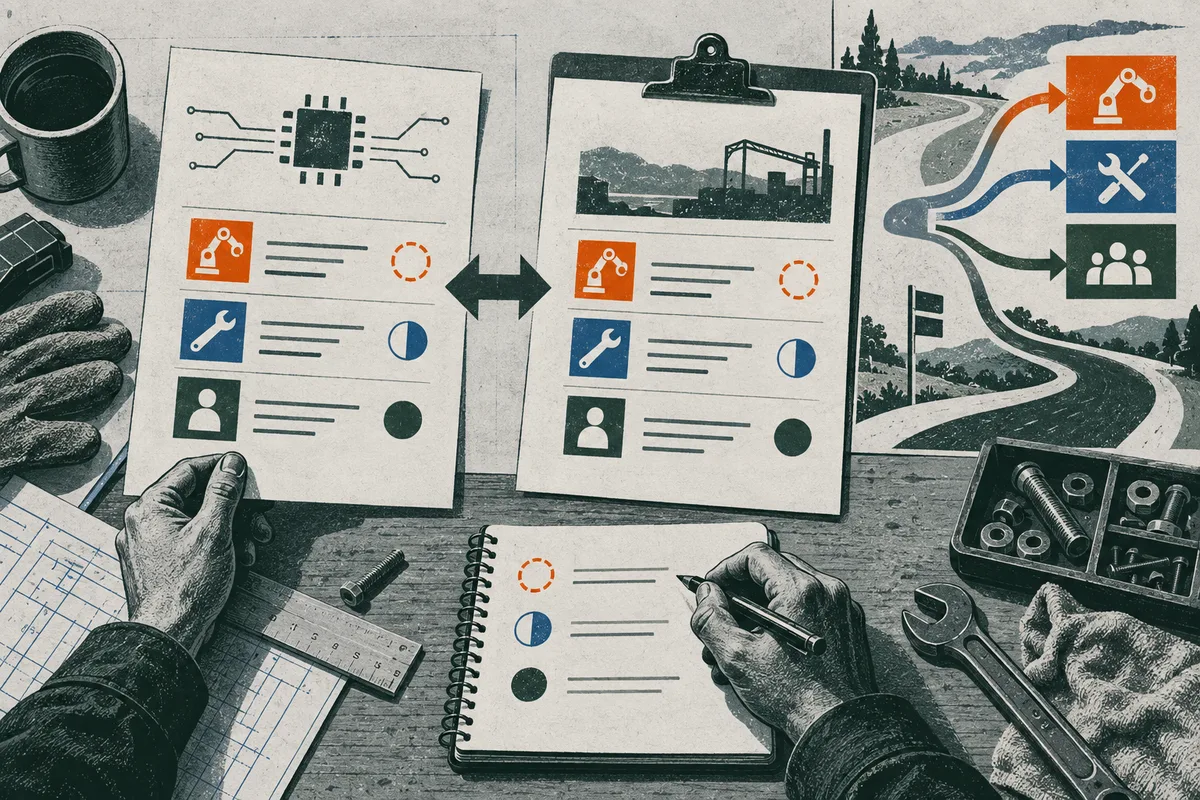
No. An AI agent benchmark measures performance on defined tasks under stated conditions; it does not show that employers have adopted the system or that jobs have been displaced. Compare the benchmark task with your actual duties, then look for workplace use, workflow changes, and relevant labor outcomes. A score can guide what to inspect, but cannot predict your individual job outcome.
The claim under review: does a rising agent score imply fewer jobs?
No. A rising agent score shows stronger performance on tasks included in a particular evaluation, under its stated conditions. It can make changes to some work more plausible, but it does not show that an employer has adopted the system, redesigned a role, or reduced employment. For a worker deciding whether to act, the score is a reason to inspect a relevant task, not a forecast about their own job. The inference can sound straightforward: if an agent completes useful work, a business might need fewer human hours for the same output. But several links remain: does the task recur in the worker’s duties? Can the system perform reliably with the context and quality standards the job requires? Is it used at work, and does its use change who does what? Does that redesign alter hiring, hours, separations, or employment? A benchmark answers only part of this chain. Treating its score as a job-loss signal skips the steps where evidence about work and labor outcomes must appear. METR’s “Task-Completion Time Horizons of Frontier AI Models” defines its time horizon as a predicted success threshold for tasks measured by human expert completion time, not the duration an agent can operate unattended. Its suite is primarily software engineering, machine-learning, and cybersecurity tasks, designed to be self-contained and well-specified. METR notes these conditions differ from much day-to-day professional work. Employment evidence belongs later in the chain. Stanford Digital Economy Lab’s “Canaries in the Coal Mine? Six Facts about the Recent Employment Effects of Artificial Intelligence,” revised in August 2026, analyzes ADP payroll data covering millions of U.S. workers through June 2026. It reports no widespread economy-wide displacement, alongside a relative employment gap for workers aged 22–25 in AI-exposed occupations, primarily through reduced hiring. The authors call these findings early and descriptive, not causal. This signal merits attention, but it does not connect a particular benchmark score to those patterns or predict an individual outcome. Ask what evidence links measured capability to a worker’s task, workplace changes, and relevant employment outcomes.
Sources: Task-Completion Time Horizons of Frontier AI Models; Canaries in the Coal Mine? Six Facts about the Recent Employment Effects of Artificial Intelligence
What does an agent benchmark measure—and what does it leave out?
An agent benchmark is a controlled answer to a narrow question: how well did a specified model or agent setup perform on a defined set of tasks under stated instructions, tools, success rules, and grading? Its result can show that a capability has improved, and can point workers toward tasks worth examining. It does not tell us what share of a particular job can be removed, whether employers have adopted the system, or whether employment has changed. Those conclusions require evidence beyond the benchmark. METR’s “Task-Completion Time Horizons of Frontier AI Models” reports a time horizon: the duration a human expert takes to complete a task at which an agent is predicted to succeed at a selected reliability level. METR estimates human task times, fits a logistic curve to task duration and agent success, and reports where it reaches the 50% or 80% threshold. It is not the number of hours an agent can operate unattended or a claim about half of all work of that duration. The page, last updated May 8, 2026, says its current suite contains over one hundred software tasks, primarily in software engineering, machine learning, and cybersecurity. Tasks are self-contained, well-specified, and have clear success criteria; METR cautions that day-to-day professionals have more prior context. It also marks measurements above 16 hours unreliable with the current suite. “Measuring the performance of our models on real-world tasks,” OpenAI’s GDPval description, measures something different: comparative quality of work products. Its first version covers 44 selected U.S. occupations across nine industries, with tasks built around deliverables such as documents, spreadsheets, and diagrams. Professionals from the represented occupations blindly compare model-produced deliverables with human-produced ones and rank them. The first version is one-shot: it does not test building context through ongoing interaction or improving work over multiple drafts. OpenAI reports model inference speed and API cost comparisons that exclude human oversight, iteration, and integration. They describe benchmark performance, not net workplace savings or staffing effects. The scores should not be ranked against each other as if they shared a unit. METR’s thresholds concern task duration and estimated success reliability on its suite; GDPval’s reported comparisons concern deliverable quality, speed, and inference cost on its selected tasks. Ask what was tested, what counted as success, what context and tools were available, and which review costs were omitted. A close match between a benchmark task and a recurring duty is a reason to inspect that duty, perhaps through a permitted, reviewed trial. It is not a measure of job coverage. Capability evidence earns attention precisely because it helps identify a testable task class; its limits show why the next question must be about actual work use and redesign, not a job-loss conclusion.
Sources: Task-Completion Time Horizons of Frontier AI Models; Measuring the performance of our models on real-world tasks
Why a strong task result may not transfer to a whole role
A benchmark matters when its task resembles work the role contains. A system may complete one step without the context, exceptions, coordination, and responsibility needed for the whole outcome. Ask which recurring task it can do, under what conditions, and what else completes the work, rather than whether an agent can do something that sounds like your job.
METR’s Task-Completion Time Horizons of Frontier AI Models estimates the human-expert duration of tasks at which an agent is predicted to succeed at a selected reliability level. Its current suite consists primarily of self-contained software engineering, machine-learning, and cybersecurity tasks with clear success criteria. METR notes that professionals bring day-to-day context that test tasks lack. A longer estimated duration describes performance on that suite, not the share of a software team’s responsibilities an agent can take over. It identifies a capability worth examining, while role coverage remains unanswered.
Consider an example: a maintenance request arrives for a mature software product. An agent may produce a patch for a clearly described defect. That does not establish that it understood why the issue matters, followed repository conventions, checked security, passed tests, responded to review, coordinated release, or can own a rollback. This illustration does not mean every patch needs each step or agents cannot assist. It separates a scored deliverable from the conditions that make work acceptable in a team.
GDPval’s Measuring the performance of our models on real-world tasks evaluates selected work products from 44 U.S. occupations. Its first version uses one-shot comparisons; speed and cost estimates exclude oversight, iteration, and integration. Results inform us about tested outputs, but not how a deliverable travels through a workplace. A strong patch may need review, revisions, permissions, or a handoff. These steps affect whether a tool changes a task, redistributes work, or alters staffing; the benchmark does not determine the outcome.
The New York Fed’s Do Job Postings Show Early Labor-Market Effects of AI? notes that one task may limit how far an occupation can be automated, even when many tasks are exposed. This is a possible mechanism, not proof of a permanent human bottleneck in every role. A limiting step might be an exception, judgment call, approval, physical action, or accountability requirement; redesign may move or reduce it. Work is delivered through linked steps, not independent benchmark items.
To compare with your work, map one deliverable from request to completion. Mark the step resembling the benchmark, then note assumed context, errors, who checks the result, and remaining handoffs or decisions. Match by task and quality standard, not title. The gaps do not prove safety from change; they show what the benchmark has yet to establish and where verification, domain judgment, or coordination may matter .
Sources: Task-Completion Time Horizons of Frontier AI Models; Measuring the performance of our models on real-world tasks; Do Job Postings Show Early Labor-Market Effects of AI?
What sits between capability and employment change?
Between capability and displacement sit questions: can a system perform a task, does it apply to an occupation, is AI used for it, does an employer change the workflow, and do labor outcomes move? Exposure studies and business surveys locate possible relevance or use. Neither establishes agent adoption in your role or job loss caused by it. Capability is demonstrated performance under test conditions. Exposure is the fit between AI capabilities and occupational tasks. Observed use records interaction with a tool; employer adoption means putting it into a work process. Redesign changes who performs tasks, checks outputs, handles exceptions, or carries accountability. Labor demand and displacement concern outcomes such as hiring, hours, earnings, separations, unemployment, or employment. These measures sit at different points in a chain. A capability result prompts investigation, but cannot stand in for later links. The International Labour Organization’s “Generative AI and Jobs: A Refined Global Index of Occupational Exposure” estimates exposure using task-level input, expert discussion, and model predictions. Its method combined worker surveys about tasks in Poland’s occupational classification with expert input and model predictions. The resulting global index places one in four workers in occupations with some exposure and says transformation is the likeliest impact because occupations generally contain tasks requiring human input. This is modeled exposure, not implemented systems or displaced workers; global classifications cannot show local adoption. The U.S. Bureau of Labor Statistics’ 2025–35 AI exposure categories combine five external measures: three theoretical measures and two mapping observed AI interactions to occupational tasks or activities. They compare occupations’ relative exposure; they do not directly observe whether workers in a particular occupation used AI on the job. BLS says exposure is not a forecast of employment growth or decline, adoption probability, wage effects, productivity, or worker replacement. Inputs differ in coverage and date, and categories do not distinguish automation from augmentation. The ILO’s global share and BLS’s relative U.S. categories answer different questions; neither confirms an agent benchmark score. For a time-stamped view of business use, the U.S. Census Bureau’s Business Trends and Outlook Survey reported overall U.S. business AI use between 17% and 20% from December 2025 through May 3, 2026. It asks whether a business used AI in the prior two weeks, with wording broadened to “in any business function,” including simple tasks. This is context about reported use, not agent adoption. It does not identify occupational use, workflow changes, or staffing effects. Keep the signals in separate columns: benchmark capability; occupational task exposure; observed tool use; employer implementation and workflow redesign; and labor outcomes matched to the concern. Do not combine them into one risk score. Look for repeated use on recurring tasks, changed review or responsibilities, and outcomes such as hiring or hours over time. Until those links are visible, the honest entry is “unknown,” not a job-loss prediction.
Sources: Generative AI and Jobs: A Refined Global Index of Occupational Exposure; Artificial Intelligence (AI) exposure categories; AI use by businesses is holding steady
What do current employment studies say—and why do they differ?
Current evidence does not establish widespread AI-driven job displacement, but signals merit monitoring. Stanford’s payroll analysis finds a relative employment shortfall for workers aged 22–25 in exposed occupations, mainly through reduced hiring. A New York Fed analysis of job postings finds no distinct post-ChatGPT decline after accounting for earlier trends. These studies examine different outcomes; neither connects a particular agent benchmark to a worker’s job. Their disagreement is a reason to inspect what each measure shows, not to choose the more alarming or reassuring headline.
The revised August 2026 study, “Canaries in the Coal Mine? Six Facts about the Recent Employment Effects of Artificial Intelligence,” analyzes ADP payroll records covering millions of U.S. workers through June 2026. It reports that employment among 22–25-year-olds in AI-exposed occupations stands 19% below the level implied had it kept pace with less-exposed peers. The researchers attribute this pattern mainly to reduced hiring, not increased separations, and report no comparable gap for experienced workers or evidence of economy-wide displacement. The 19% is a relative gap against a counterfactual pace, not a finding that one in five young workers lost jobs because of AI. The authors call the results early and descriptive, not causal; the pattern attenuates with education controls, some divergence predates generative AI, and it is more pronounced in ADP than national survey benchmarks. It is a signal about a subgroup and hiring channel, not a forecast for every exposed occupation.
“Do Job Postings Show Early Labor-Market Effects of AI?” uses U.S. Lightcast listings in an event study comparing postings in more- and less-exposed occupations around ChatGPT’s late-2022 release. The New York Fed authors find postings had already diverged before the release, with no clear additional break afterward; they also find no clear divergence between junior and senior postings within highly exposed occupations. They conclude postings offer little evidence of a distinct AI-driven decline in labor demand in this period. This is counterevidence to a simple displacement story, but postings are vacancies, not hires, layoffs, hours, or employment totals. Pre-existing trends also complicate attribution.
A third comparison shows why outcome choice matters. “Labor market impacts of AI: A new measure” combines O*NET task descriptions, Anthropic’s own work-related usage data, and theoretical exposure estimates, then compares exposure with U.S. Current Population Survey outcomes. Its analysis finds the post-ChatGPT change in unemployment for the most exposed workers is small and statistically indistinguishable from zero. For workers aged 22–25, however, it reports a tentative 14% decline in job-finding into the most exposed occupations relative to 2022, barely statistically significant. Possible alternatives include staying in current jobs, taking different jobs, returning to school, or survey misclassification. Usage reflects Anthropic’s platform, not the whole market. Unemployment, job finding, payroll employment, and vacancies capture distinct stages, so findings need not match.
A stronger test would connect actual tool deployment to the tasks it handles, document changes in responsibilities or staffing, and follow a relevant labor outcome over time against a credible comparison group. This helps separate AI from hiring cycles and older trends. Treat Stanford’s young-worker hiring signal as a reason to watch entry routes in affected fields, and the New York Fed’s posting analysis and the Anthropic study’s overall unemployment result as limits on broader claims. None identifies an agent benchmark as the cause. Use these studies for population monitoring; your decision depends on task fit and workplace changes.
Sources: Canaries in the Coal Mine? Six Facts about the Recent Employment Effects of Artificial Intelligence; Do Job Postings Show Early Labor-Market Effects of AI?; Labor market impacts of AI: A new measure
What is the fair comparison—and what evidence should change your response?
Compare at the same level: a benchmark task with a task you perform, observed use with your workflow, and a labor outcome with the decision you need to make. Record geography, population, period, measure, and comparison group. If details differ, mark the mismatch; do not combine unlike numbers into one score. Evidence grows more decision-relevant as it links similar capability to repeated workplace use, changed responsibilities, and sustained labor outcomes in a relevant market. Even then, it describes a pattern to investigate, not your personal probability of replacement.
A practical audit has four stages. First, capability: what task did the agent attempt, with which tools, threshold, and grading method? METR’s “Task-Completion Time Horizons of Frontier AI Models” defines its horizon by the human expert time for tasks at which an agent is predicted to meet a stated success rate. That is a task-difficulty estimate from its suite, not unattended operating time or a share of anyone’s job. “Measuring the performance of our models on real-world tasks” describes GDPval as one-shot comparisons of deliverables in selected occupations; its reported speed and cost comparisons exclude human oversight, iteration, and integration. They answer different questions; their headline values do not share a scale. Second, fit: identify how often the closest task occurs in your role, what makes it complete, the cost of mistakes, and the context, permissions, review, and handoffs it requires. Resemblance warrants inspection, not an assumption that the workflow transfers. Third, use and redesign: distinguish a published capability from approved and repeated use in your workplace. Note what is directly observed: who uses the tool, for which task, how often, who checks its work, and whether assignments, review, output volume, or training have changed. Keep your interpretation separate. The U.S. Bureau of Labor Statistics’ “Artificial Intelligence (AI) exposure categories” explicitly says exposure categories do not measure job loss, adoption probability, wage effects, or worker replacement. They can help compare occupations within their method; they cannot fill in what is happening at your employer.
Fourth, outcomes: choose the measure that matches the concern. Hiring, hours, earnings, separations, unemployment, and employment are related but distinct. Specify whose outcomes, in what occupation and geography, and over what period. Ask what would likely have happened without the change: compare similar roles or periods, and check for broader hiring cycles and trends that began earlier. A before-and-after movement alone does not establish that AI caused it. In “Labor market impacts of AI: A new measure,” Anthropic reports no increase in unemployment for its most exposed U.S. occupations, alongside tentative evidence of slower job finding among workers aged 22–25; the authors note that the result is barely statistically significant and has alternative interpretations. The New York Fed’s “Do Job Postings Show Early Labor-Market Effects of AI?” examines postings, which are not completed hires or separations. These studies do not measure the same outcome or test a benchmark’s effect. Write a short evidence note with separate entries for capability, task fit, workplace use, workflow redesign, and labor signal. Date each entry and state its confidence boundary. Missing links belong under “unknown.” Repeated evidence can strengthen a case for preparing for change, but does not remove confounding or account for local practice and personal constraints. No single score can do that comparison for you.
Sources: Task-Completion Time Horizons of Frontier AI Models; Measuring the performance of our models on real-world tasks; Artificial Intelligence (AI) exposure categories; Labor market impacts of AI: A new measure; Do Job Postings Show Early Labor-Market Effects of AI?
How should a worker turn the comparison into a proportionate move?
If a benchmark resembles one recurring duty in your role, use it as a reason to inspect that duty, not to conclude that your job is going away. Start with an approved tool, a low-stakes sample, and human review. If use becomes routine and responsibilities, review practices, or hiring begin to change, prepare for possible redesign: strengthen judgment and verification around the task, and compare internal and external options against income needs, location, learning time and family responsibilities. A benchmark alone does not justify a career change.
Imagine an analyst who cleans spreadsheets before interpreting results for colleagues. An agent benchmark that appears to cover spreadsheet transformation could justify checking accuracy on a permitted sample and measuring correction required. The analyst may still need to assess which fields are trustworthy, protect sensitive data, explain results , and take responsibility for decisions. A test of one bounded operation cannot establish that these duties have disappeared or that the full workflow can run without review.
The METR time-horizon documentation and GDPval’s first-version evaluation describe different capability evidence, and neither supplies a staffing forecast. METR estimates task-duration thresholds at specified success levels on a limited, self-contained suite; GDPval compares selected work products in a one-shot setting. Their results can help identify a task worth examining, but neither tells an analyst how often it occurs locally, what errors cost, or what happens to saved time. BLS AI exposure categories also do not measure adoption probability or worker replacement. These sources cannot establish a personal employment outcome.
Where policy permits, record current task time, what a correct result contains, consequential errors, and time spent checking and correcting output. Note task frequency and where saved time or responsibility goes. This informs one workflow; it does not predict staffing. If the tool is not approved or data cannot be shared safely, treat that constraint as part of the assessment.
The response can stay proportional. An upgrade may mean learning to evaluate outputs or automate a permitted step in the role you know. An adjacent move may use the same domain knowledge in work focused more on interpretation, handoffs, or quality checks. A larger change may deserve comparison if evidence accumulates across the role or local market, but its costs in time, training, income, and family disruption cannot be weighed by a benchmark. The sensible choice depends on task mix, financial floor, location, health, and time available for learning.
Repeated workplace use can reveal whether a capability is entering the process. Observe who performs the task, who reviews it, whether output expectations rise, and whether hiring or responsibilities shift. The Stanford Digital Economy Lab’s payroll analysis reports a relative employment gap among younger workers in exposed occupations, mainly through reduced hiring, while describing the result as early and noncausal. This supports watching relevant hiring evidence; it does not show that a benchmark caused an outcome in your occupation or predict your employer’s choices.
A useful action threshold concerns the next decision, not a numerical risk score. One capability match warrants inspection. Repeated, permitted use that changes task allocation warrants preparation for redesign. Sustained labor evidence relevant to your occupation and location may warrant comparing broader paths, while checking other explanations for hiring changes. Record what you observed and what remains uncertain. If evidence is only a benchmark result, preserve options with a small, reversible learning step rather than an expensive credential or abrupt exit.
Sources: Task-Completion Time Horizons of Frontier AI Models; Measuring the performance of our models on real-world tasks; Artificial Intelligence (AI) exposure categories; Canaries in the Coal Mine? Six Facts about the Recent Employment Effects of Artificial Intelligence
One next step: inspect the task, then check the work around it
Write down one recurring deliverable and the conditions that make it complete: required inputs, acceptable errors, review, handoffs, and who is accountable for the result. Then identify the benchmark claim that most closely matches one part of that work. Check whether an approved tool is actually used in your workflow, whether responsibility or review has changed, and whether hiring or other labor outcomes relevant to your role have moved over time. Keep those observations separate. The Bureau of Labor Statistics’ AI exposure categories explicitly do not forecast adoption, employment change, or worker replacement. They can help locate tasks for inspection, not settle what your employer will do. The verdict is proportional: a benchmark score is early evidence about capability; displacement needs evidence farther down the chain. Repeated deployment across a meaningful bundle of duties, paired with sustained labor effects and a credible comparison, would strengthen the case for broader preparation. It still would not predict your individual outcome. For a first pass, the free AI Proof Work task checker offers transparent change-pressure signals and first actions; it does not calculate a validated probability of displacement or choose a career. Use it to organize the task review, then decide what deserves attention in your actual work and circumstances.
Sources: Artificial Intelligence (AI) exposure categories; Canaries in the Coal Mine? Six Facts about the Recent Employment Effects of Artificial Intelligence; Do Job Postings Show Early Labor-Market Effects of AI?
Questions readers ask
Does a high AI agent benchmark score mean my job will be replaced?
No. It shows performance on the benchmark’s defined tasks and conditions. It does not establish workplace adoption, workflow redesign, or a change in employment.
How can I tell whether a benchmark is relevant to my work?
Compare its task, success criteria, tools, and context with one recurring duty in your role. Then consider error costs, review, permissions, handoffs, and accountability.
What should I do after seeing a benchmark result?
Treat a close match as a reason to inspect the task. Look for permitted, repeated workplace use and changes to responsibilities or relevant labor outcomes before considering broader career moves.
Sources and notes
- Task-Completion Time Horizons of Frontier AI Models
Defines METR time horizons and describes the task suite, success thresholds, scope, and measurement limitations.
- Measuring the performance of our models on real-world tasks
Describes GDPval’s selected U.S. occupations, deliverable comparisons, one-shot design, and exclusions from speed and cost estimates.
- Do Job Postings Show Early Labor-Market Effects of AI?
Reports the New York Fed’s posting analysis and discusses task complementarity as a limit on whole-job automation.
- Generative AI and Jobs: A Refined Global Index of Occupational Exposure
Presents the ILO’s global task-based occupational exposure index and explains that exposure is not observed displacement.
- Artificial Intelligence (AI) exposure categories
Explains BLS exposure categories and explicitly distinguishes them from employment impacts, adoption probabilities, and worker replacement.
- AI use by businesses is holding steady
Reports broad U.S. business AI-use survey results and the survey’s limits for identifying agent use, workflow change, or staffing effects.
- Labor market impacts of AI: A new measure
Reports U.S. exposure and labor-outcome analyses, including their outcome measures, tentative findings, and limitations.
- Canaries in the Coal Mine? Six Facts about the Recent Employment Effects of Artificial Intelligence
Reports the revised ADP payroll analysis of employment patterns among younger workers in AI-exposed occupations and its noncausal caveats.
Apply this to your own work
See the whole job market at once.
Explore which occupations AI may reshape, then turn the signal into a practical response.
Explore the job map