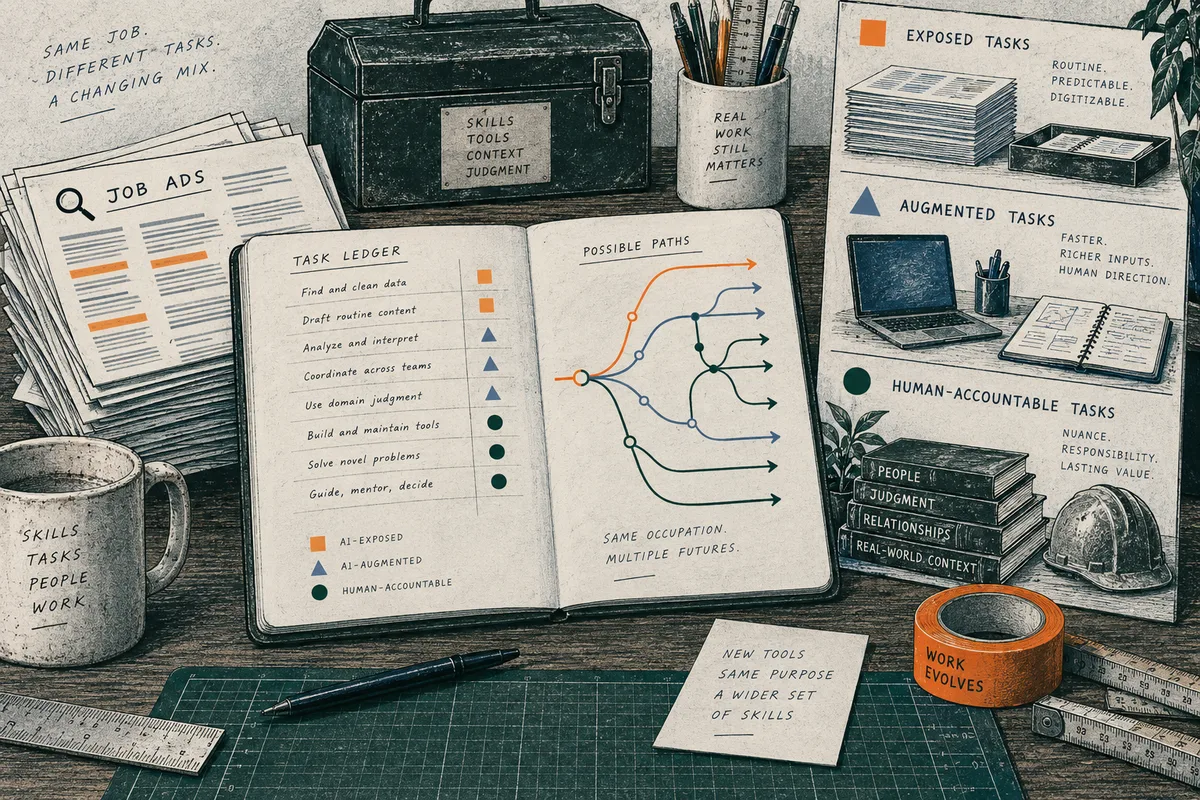
Online job ads can show AI-linked changes in stated skill demand, but rising digital-skill mentions alone cannot distinguish AI from broader digitization. OECD findings can coexist because they compare different units and baselines. Employer comparisons offer a more focused association, while still relying on exposure as a proxy. Ads do not establish adoption, incumbent task changes, or an individual's job-loss risk.
Do job ads show AI changing skill demand, or just digitization?
Online job ads can show AI-linked changes in stated skill demand, but rising digital-skill mentions alone cannot distinguish AI from broader digitization. The comparison matters: a raw trend tracks change over time; an exposed-versus-less-exposed occupation comparison asks whether groups moved differently; and a comparison among similar employers with different baseline exposure estimates relative change. None directly observes whether a firm adopted AI. Exposure describes how much work could be affected by AI capabilities; adoption means an employer puts systems into use. In "Artificial intelligence and the changing demand for skills in the labour market," the OECD reports rising mentions of skill groups across highly exposed occupations alongside modest relative declines in selected skills at more-exposed establishments. These findings can coexist because they use different units and comparison groups. The New York Fed's "Do Job Postings Show Early Labor-Market Effects of AI?" finds that relative vacancy declines in more-exposed U.S. occupations began before ChatGPT's late-2022 release, with no clear added break afterward. This cautions against attributing every skill shift to AI. Ads describe stated requirements; they do not show incumbent task changes or predict an individual's job loss.
Sources: Artificial intelligence and the changing demand for skills in the labour market | OECD; Do Job Postings Show Early Labor-Market Effects of AI?
What does the broad occupation trend actually show?
The broad occupation-level result is straightforward: in the OECD report Artificial intelligence and the changing demand for skills in the labour market, online vacancies for occupations classified as highly exposed to AI increasingly listed several kinds of skills over the periods studied. Across ten OECD countries, the share of vacancies in those occupations asking for at least one cognitive, emotional, or digital skill rose by an average of eight percentage points. Shares mentioning social skills rose by more than six points, while business-process and management skills each rose by more than five points. These are proportions of ads mentioning skills, not changes in workers' abilities or hours spent on tasks. The underlying unit matters. The report uses Lightcast online vacancy data described as a quasi-universe of postings, paired with occupation-level AI exposure rankings. An occupation is classed as highly exposed when its exposure measure is at least one standard deviation above the mean. Those occupations represented about one-third of vacancies in the sample. In 2021–2022, ads in this group commonly requested management and business-process skills: across the ten countries, 72% mentioned at least one management skill and 67% at least one business-process skill. More than half mentioned at least one social, emotional, or digital skill. These broad categories cover items such as project management, finance, administration, clerical work, and customer support; they combine quite different activities into one measure within the report's occupation groupings. The time comparison reaches back roughly a decade, though country coverage and observation periods vary by analysis; it is historical evidence, not a snapshot of today's vacancies. It shows that these broad skill mentions became more common in vacancies attached to high-exposure occupations. This descriptive trend is not a matched comparison with less-exposed occupations, and the dataset does not record employer AI deployment. Exposure indicates potential applicability, not adoption. Consequently, the eight-point rise is evidence that advertised skill bundles changed in this group; the number alone cannot identify AI as the cause. Several processes could move the share. Employers may revise descriptions as work changes, add language about coordination or digital tools, or advertise different roles within an occupation. The mix of employers and vacancies captured online can also shift over time. Meanwhile, common digitization, new software, business practices, and labor-market conditions may affect exposed occupations alongside AI. A rising share may reflect more mentions, fewer omissions, or a changed mix of posted jobs. It does not show which mechanism dominated or whether a hire uses the skill routinely. For a worker, this is a useful signal at the level it supports: skill bundles advertised in occupations with high measured AI exposure have broadened or become more explicit across the studied period. Ask whether it appears in comparable roles and employers, then check whether recurring tasks are changing in your workplace. It does not warrant assuming that AI created every increase, that a particular employer has adopted AI, or that an exposed role is disappearing. The next step is to compare more-exposed employers with similar ones.
Sources: Artificial intelligence and the changing demand for skills in the labour market
How strong is digitization as the alternative explanation?
Broader digitization is a credible explanation for rising digital-skill language in job ads because employers were adapting work to digital systems before generative AI became widely available. The question is whether a later change differs from that earlier movement and is concentrated where AI exposure or use would matter. A historical trend supplies a useful baseline, not a complete causal account. The European Commission Joint Research Centre’s “Digital skills for all? From computer literacy to AI skills in online job advertisements” examines more than 60 million UK online advertisements from 2012 through 2020. This long window shows that ads registered changes in digital work several years before ChatGPT’s public release. It is therefore unsafe to read every later rise in a broad “digital” category as a new AI effect. The study also explains why counts of words such as “computer” or “software” can mislead. Ads tended to understate basic digital competence, including computer literacy and office software, compared with representative surveys. Employers may assume those abilities and omit them. Yet ads were more precise at tracking skills tied to emerging digital technologies. That distinction helps separate general digitization from a possible AI-linked shift. More mentions of spreadsheets, office platforms, data handling, or general software could reflect work becoming digitally organized without showing that AI caused it. A sustained rise in a specific AI tool or AI-related task could be more diagnostic, especially among comparable employers after a defined period. Even then, an ad shows what an employer states, not what a hire uses regularly, whether the organization deployed the tool, or whether another task disappeared. The JRC study identifies an AI and Big Data skill cluster and reports an association between those skills and higher offered wages in its UK ads. Its contribution is narrower: emerging technologies can leave traces in ad text, while basic competence may remain implicit. The OECD’s “Skills for the Digital Transition” offers broader context: digital transformation spans occupations and changes task and skill mixes across the economy. A useful comparison needs a pre-period and reference roles with similar earlier trends. If general digital language rises across both more- and less-exposed roles, that shared movement should not be credited to AI. For workers, separate a broad digital baseline from a new task signal. Compare repeated ads for similar roles over time; distinguish routine platform fluency and data work from named AI capabilities; then look for corroboration in the work itself. A digital-skills trend shows that a job’s toolkit is evolving. By itself, it cannot identify the cause or tell you whether your position is at risk.
Sources: Digital skills for all? From computer literacy to AI skills in online job advertisements; Skills for the Digital Transition
What changes when the unit is the employer?
The employer-level comparison asks a narrower question than whether skill mentions rose across exposed occupations: among establishments in the same broad market, did those with a more exposure-heavy starting workforce change the skills they advertised differently? In Artificial Intelligence and the Changing Demand for Skills in the Labour Market, the OECD builds an establishment panel from Lightcast online vacancies in ten countries. For each establishment, it calculates baseline AI exposure as the average occupational exposure of the jobs it advertised, weighted by each occupation’s share of its baseline vacancies. It then measures how the share of that establishment’s ads mentioning a skill group changed between a base period and 2021–2022. This compares advertised requirements, not workers’ time or tasks. The design tries to make the comparison fairer by accounting for establishments’ region, industry, and baseline vacancy-size category, and by comparing employers whose initial occupational mix gives them different exposure levels. The report says this allows comparisons among similar establishments in the same industry and local labor market. Base periods vary: Canada, the United Kingdom, and the United States use 2012–2013, while Austria, Belgium, Czechia, France, Germany, the Netherlands, and Sweden use 2018–2019. A one-standard-deviation increase in establishment exposure is the comparison unit, roughly a shift from a moderately to a highly exposed establishment; it is not an estimate of what happens when a firm installs an AI system. In this specification, higher baseline exposure is associated with lower shares of vacancies requesting several skill groups. The cross-country average decline exceeds three percentage points for business-process, digital, cognitive, and management skills per standard-deviation increase in exposure. More specifically, the estimated business-process share falls by 3.5 percentage points, while management skills fall by just under four points. Business-process skills include clerical and administrative work as well as sales and customer service; management includes resource management such as financial management. These are changes in the share of an employer’s vacancies mentioning at least one skill in a category, not reductions in headcount or work performed. The digital result counters a simple story that more AI exposure must mean more demand for every digital skill. The OECD estimates a decline of more than three percentage points in the share of ads mentioning digital skills, on average, for the same exposure difference. Digital skills include programming, collaboration software and office tools, and ICT network management. Programming mentions decline by just under one percentage point. Meanwhile, the report identifies increases in demand for production and technology skills, as well as physical skills, at establishments with higher exposure. The advertised mix shifts in different directions, and overall changes are small against broader growth in demand for many skills. This is a more focused signal than a raw occupation-wide trend, but its interpretation has boundaries. Baseline exposure is constructed from the occupations an establishment advertised; it is a proxy for potential exposure, not a record of AI adoption. The authors note that actual AI use is unavailable in Lightcast. The analysis does not observe whether a listed skill is used after hiring, whether an employee’s tasks have changed, or whether a missing mention means a task has disappeared. Estimates also depend on the assumption that, after included controls, exposure differences are not standing in for other unobserved shocks that independently changed skill demand. The report addresses some observable differences, but controls cannot guarantee every concurrent technology or business change is separated. The employer comparison makes an AI-linked interpretation more plausible: it compares establishments within shared labor-market settings and finds relative declines in selected mentions alongside increases in some production-related skills. It does not establish which firms deployed AI, what caused each change, or whether an incumbent worker’s duties were automated. Read it as evidence about relative vacancy wording under a stated design. For a worker, it is a reason to inspect which recurring tasks and requirements are changing in their own role, not a forecast that the role or job is going away.
Sources: Artificial intelligence and the changing demand for skills in the labour market
Why can both findings be true at once?
At first glance, the findings in Artificial intelligence and the changing demand for skills in the labour market seem to conflict. Across highly AI-exposed occupations, the share of vacancies mentioning several broad skill groups rose over time. Yet a separate analysis found modest relative declines in some mentions at establishments with greater baseline AI exposure. The tension dissolves once we ask what each comparison counts: one tracks occupations over time; the other compares changes between more- and less-exposed employers.
The occupation-level result asks: how often does an ad in a high-exposure occupation ask for at least one skill in this group, compared with earlier? The unit is the vacancy, classified by occupation; the outcome is whether a grouped skill appears in its text. In the OECD report’s 10-country Lightcast sample, the share of high-exposure occupation vacancies mentioning at least one cognitive, emotional, or digital skill rose by eight percentage points on average. This is a descriptive trend, not proof that AI caused the increase. Other forces could also move the measure.
The establishment analysis asks a narrower relative question: did skill mentions change differently at more-exposed employers than at the comparison establishments? The report uses a panel and baseline occupational exposure. It finds small relative declines in selected digital, cognitive, business-process, and management skills, against a broader context of rising skill demand. The study does not observe whether employers adopted AI; exposure is a proxy. Its estimate is not a count of tasks removed or jobs lost.
Both results can coexist if a shared trend raises mentions while more-exposed establishments rise less, or fall relative to the comparison group. Imagine, purely as an illustration, that a digital workflow leads employers across an occupation to add a general data skill to ads. If less-exposed firms add it more often, the occupation-wide share could increase while the relative estimate for highly exposed establishments is negative. This is not a reported result. It shows why an overall increase and a negative relative coefficient can coexist: they use different baselines.
The word “demand” can obscure this distinction. Both analyses infer demand from vacancy text and skill groupings. An ad can mention at least one item in a category; that thresholded signal does not measure how many workers use the skill, their time spent on it. A change in mentions also cannot show whether an employer removed a task, bundled it with other work, changed its wording, or hired a different mix of roles. The estimates concern advertised skill composition, not a complete map of workplace activity.
These are not competing answers to the same question. The broad trend says advertised skill bundles in high-exposure occupations changed over time. The establishment comparison says some mentions shifted differently with baseline exposure, conditional on the study’s design. Neither alone proves AI adoption caused a task to disappear. The employer-level design offers a more focused association, but proxy limits and simultaneous changes remain. When a headline cites rising or falling demand, ask whether it reports an overall trend or a relative employer comparison. That question can resolve the apparent contradiction and keep the conclusion within what ads show.
Sources: Artificial intelligence and the changing demand for skills in the labour market
Does the post-ChatGPT timing test settle attribution?
No. The New York Fed’s “Do Job Postings Show Early Labor-Market Effects of AI?” finds that vacancies in more-exposed U.S. occupations were already falling relative to less-exposed occupations before ChatGPT’s public release in late 2022. The series shows no clear additional break afterward. This weakens the claim that ChatGPT caused the aggregate decline, but cannot rule out gradual change, employer-specific effects, or task shifts. The study tests for a broad hiring gap around a dated event, not every way AI could alter work.
The event study compares occupations with relatively high AI exposure against lower-exposure occupations, tracking posting differences across quarters around the release. High exposure means an occupational score of at least 0.2; results are similar under other cutoffs. The score draws on task descriptions and observed AI use, but measures potential applicability, not employer deployment. Postings come from Lightcast, which aggregates company career pages, job boards, and listing services.
For a timing test to be persuasive, the groups should move similarly before the event; otherwise, a later gap may extend an existing trend. A new, sustained divergence afterward would be consistent with an added effect, though timing alone would not prove its cause. The New York Fed accounts for persistent occupational differences and economy-wide hiring changes. It finds the relative decline began before the release, with no clear new break afterward; the gap stabilizes after 2023. The authors say this makes the decline difficult to interpret as a direct consequence of AI adoption. That limits attribution; it does not show that no AI-related change occurred.
The analysis also compares junior and senior postings within high-exposure occupations. It finds no clear relative divergence after the release. This checks the narrower claim that entry-level postings fell distinctly more than senior postings in exposed occupations. It is not a count of young workers employed or a layoff measure.
This timing comparison differs from the OECD establishment-level skill analysis. The New York Fed asks whether aggregate posting trajectories for more- and less-exposed occupations changed around ChatGPT’s public release. The OECD asks whether establishments with greater baseline exposure changed requested skill mixes relative to other establishments. A release-date test can detect a sudden aggregate break but miss gradual shifts; employer comparisons can find relative wording changes without showing when a system was adopted. Neither design observes task redesign directly.
Late 2022 marks a public release, not the start of AI capability or all employer experimentation. A missing break then cannot settle whether earlier tools or slower deployments affected particular work. But possible local changes do not support a broad causal claim that aggregate evidence fails to show. The proportionate conclusion is narrower: the measured relative vacancy decline predates ChatGPT, and this study finds no clear additional decline tied to its release. A missing break should temper confident attribution while leaving room for evidence at a specific employer or task level.
Sources: Do Job Postings Show Early Labor-Market Effects of AI?
What does employer-level evidence add, and where does it stop?
Earlier establishment-level vacancy research shows how AI exposure can accompany a reshaping of advertised skill bundles: some requirements disappear from new postings while others, including AI-related requirements, appear. But the same study found no discernible aggregate employment or wage effect at the occupation or industry level. Those findings concern different outcomes. A change in the wording or mix of vacancies is not, by itself, evidence that workers have lost jobs. The MIT Blueprint Labs summary, “AI and Jobs: Evidence from Online Vacancies,” describes U.S. establishment-level vacancy data covering 2010 onward, with results on AI-related vacancies and skill requirements over 2010–2018. The researchers classify establishments as AI-exposed when workers perform tasks compatible with then-current AI capabilities. In that period, AI-related postings grew more at exposed establishments, and those establishments differentially removed postings listing some previously requested skills while also listing requirements that had not appeared before. The summary also reports reduced hiring in non-AI positions alongside expanded AI hiring at exposed establishments. This is evidence of changing vacancy composition, not a record of each employer’s deployed systems or each incumbent’s daily work. These are clues about hiring priorities, not task-level observations. The study follows establishments classified as exposed or less exposed. Yet exposure is based on task compatibility, not verified adoption. A posting that drops a skill does not prove software now performs that task; an added AI requirement does not show how widely the tool is used or how much oversight remains. The data observe what employers advertise, not the full workflow behind the advertisement. The reported absence of a discernible aggregate employment or wage effect is an important counterweight to any reading of skill changes as displacement. It does not establish that no particular workplace or worker was affected: aggregate occupation- and industry-level measures can conceal smaller or concentrated changes. The observation window largely predates generative AI’s broad public release, so this historical evidence cannot describe current adoption or settle what changed after late 2022. For a worker reading today’s ads, the contribution is narrower and still useful: requirements can be recomposed without a detectable aggregate employment shift in the same study. That possibility warrants attention to recurring tasks and employer-specific workflow changes, while resisting a leap from an exposure label or changed posting language to an individual job-loss forecast. The study supports a reason to investigate task changes; it does not establish their present scale or predict what will happen next.
Sources: AI and Jobs: Evidence from Online Vacancies; AI and Jobs: Evidence from Online Vacancies
What can an ad measure, and what does it leave unseen?
An online job ad records what an employer or intermediary chose to state about one vacancy,. It is evidence of advertised requirements, not a transcript of work performed. In “Six Questions About the Demand for Artificial Intelligence Skills in Labour Markets,” the OECD describes Lightcast data with a unique job identifier that deduplicates postings across portals. This reduces repeated counts; it does not make the records a census of vacancies, hires, or work. Coverage and wording shape the signal before analysis. The OECD cautions that online postings may not represent the whole labor market and can be skewed toward higher-skilled occupations. Roles filled through internal promotion or channels absent from the source may be less visible, so the data speak most directly about jobs advertised online. Listings can bundle required, preferred, and incidental skills in employer-specific language. A keyword count can separate similar work described differently or group unlike requirements under broad labels. Deduplication addresses repeated records; classification rules address how text becomes a skill category. Neither reveals exactly what an employer meant in practice. Classification is also a measurement choice. The OECD study uses natural-language processing and machine-learning methods to represent skill keywords and identify terms appearing in occupations where AI is relevant. It notes that expert-made keyword lists can be subjective and need updating. It still infers relatedness from patterns in ad text. An AI-associated skill label is evidence of co-occurrence in postings, not proof that the skill is used with an AI system at work. Comparisons over time are clearest when definitions stay consistent. The New York Fed’s “Do Job Postings Show Early Labor-Market Effects of AI?” illustrates another boundary. Its U.S. Lightcast analysis combines vacancy records with an occupation-level exposure measure, then compares postings in more- and less-exposed occupations around ChatGPT’s late-2022 release. The authors report that the relative decline began earlier, with no clear additional break afterward. This tests advertised vacancy trajectories; it does not count deployed systems, changed incumbent duties, review time, or completed hires. Fewer ads could also reflect slower turnover, changed recruiting channels, or revised descriptions. The study addresses its stated vacancy comparison, not all these outcomes. For a worker weighing a change, repeated ads naming a specific AI workflow can prompt a useful question: how is that task changing, and what do local employers actually use? Ads cannot show that every incumbent performs it, that the tool runs without checking, or that headcount will fall. Pair vacancy evidence with recurring tasks: what enters the workflow, what a tool drafts or classifies, who verifies it, and where errors or exceptions go. Market signals prioritize attention; workflow evidence clarifies applicability. Neither yields a personal job-loss probability. Treat an ad as one observable layer, and keep the inference within its unit: stated requirements for an online vacancy in a classified dataset. Actual task allocation remains unseen.
Sources: Six Questions About the Demand for Artificial Intelligence Skills in Labour Markets; Do Job Postings Show Early Labor-Market Effects of AI?
What evidence would change the conclusion?
Confidence in an AI-specific shift in advertised skills should rise when change follows relevant exposure or adoption, comparable employers do not show it, the shift concerns plausibly affected tasks, and evidence beyond vacancy wording agrees. This is stronger than a raw rise in digital-skill mentions, which could reflect digitization. The OECD’s *Artificial intelligence and the changing demand for skills in the labour market* shows why the comparison matters. Its 10-country analysis finds growing skill mentions in highly exposed occupations over time, while establishment estimates find modest relative declines at exposed firms. The establishment analysis uses baseline occupational exposure as a proxy, not observed adoption. Stronger evidence would follow employers over time, measure adoption, and compare their vacancies with similar firms that had not adopted. Similar prior trends and controls for industry, location, size, and digitization improve comparison but cannot prove causation. Timing is another test. The New York Fed’s *Do Job Postings Show Early Labor-Market Effects of AI?* compares higher- and lower-exposure U.S. occupation vacancy trajectories around ChatGPT’s late-2022 release, accounting for occupational differences and economy-wide hiring. It reports that the relative decline in higher-exposure postings began earlier, with no clear added break after release. That weakens the claim that this release explains the aggregate decline. It cannot rule out earlier gradual adoption or task shifts too small to alter occupation-wide counts. The date is a check, not AI’s universal start. The mechanism must fit the task. A new requirement to review machine-generated drafts would be more suggestive if an employer also documented a workflow in which a system produces drafts for staff to verify. Generic office-software mentions without corroboration fit digitization at least as well. This is an evidence test, not a claim about an employer. The MIT Blueprint Labs summary, *AI and Jobs: Evidence from Online Vacancies*, describes U.S. establishment-level vacancy changes from 2010 to 2018, including dropped and newly listed skills at exposed firms, but no discernible occupation- or industry-level employment or wage effect. It shows that wording and employment outcomes are distinct; its pre-generative-AI period cannot establish today’s mechanism. Counterevidence matters: similar shifts among less-exposed employers, trends predating adoption, or no corresponding observed task change would reduce confidence in an AI-specific explanation. Repeated adoption-linked employer records, task-level workflow measures, and worker evidence pointing the same way would strengthen it. This editorial decision rule is not a validated score. Conclusions should move with evidence of timing, comparison, and corroboration; exposure labels alone cannot settle it.
Sources: Artificial intelligence and the changing demand for skills in the labour market; Do Job Postings Show Early Labor-Market Effects of AI?; AI and Jobs: Evidence from Online Vacancies
What should a worker do with the signal next?
Use a vacancy pattern to choose one recurring task to inspect, not to decide that your job is disappearing. Compare ads for similar roles by seniority, location, employer type, and period. Note whether they request AI tools or broader digital skills; those are different signals. Artificial intelligence and the changing demand for skills in the labour market, an OECD report analyzing online vacancies, can frame a question about stated demand. It cannot show whether a particular employer adopted a system or changed your duties. Keep a short record over a few weeks: what information comes in, which steps you perform, where review is needed, what errors occur, and how much rework follows. Look for repeated workflow changes. This evidence is more relevant than a broad exposure label, though it cannot predict headcount decisions. Compare options against your constraints. An upgrade may require less retraining than an adjacent move; a larger change may demand time, money, credentials, or relocation that does not fit your salary floor, health, or family needs. The free task checker organizes change-pressure signals, not a validated probability of displacement. The paid career roadmap can help compare paths, but guarantees neither employment nor income. Investigate first; choose a move only when task evidence and your circumstances support it.
Sources: Artificial intelligence and the changing demand for skills in the labour market | OECD
Questions readers ask
Can job ads show whether AI is replacing workers?
No. Ads show stated requirements for advertised vacancies. They do not establish employer adoption, incumbent task changes, employment effects, or an individual's likelihood of losing a job.
Sources and notes
- Artificial intelligence and the changing demand for skills in the labour market
Supports the occupation-level skill trends and establishment-level comparisons, including their different units and exposure-proxy limits.
- Do Job Postings Show Early Labor-Market Effects of AI?
Supports the U.S. vacancy timing comparison around ChatGPT's release and its finding of no clear additional break.
- Digital skills for all? From computer literacy to AI skills in online job advertisements
Supports the UK historical digital-skills baseline in online ads from 2012 to 2020 and its measurement caveats.
- Skills for the Digital Transition
Provides broader context for digital transformation changing tasks and skill mixes across occupations.
- AI and Jobs: Evidence from Online Vacancies
Supports historical U.S. establishment-level vacancy findings on changing skill composition and the absence of discernible aggregate employment or wage effects.
- AI and Jobs: Evidence from Online Vacancies
Provides the underlying working paper for historical establishment-level vacancy evidence described in the research plan.
- Six Questions About the Demand for Artificial Intelligence Skills in Labour Markets
Supports the documented strengths and limitations of online vacancy data and skill classification.
- Artificial intelligence and the changing demand for skills in the labour market | OECD
Supports the article's source-level framing of the OECD vacancy study and its reported comparison findings.
Apply this to your own work
See the whole job market at once.
Explore which occupations AI may reshape, then turn the signal into a practical response.
Explore the job map