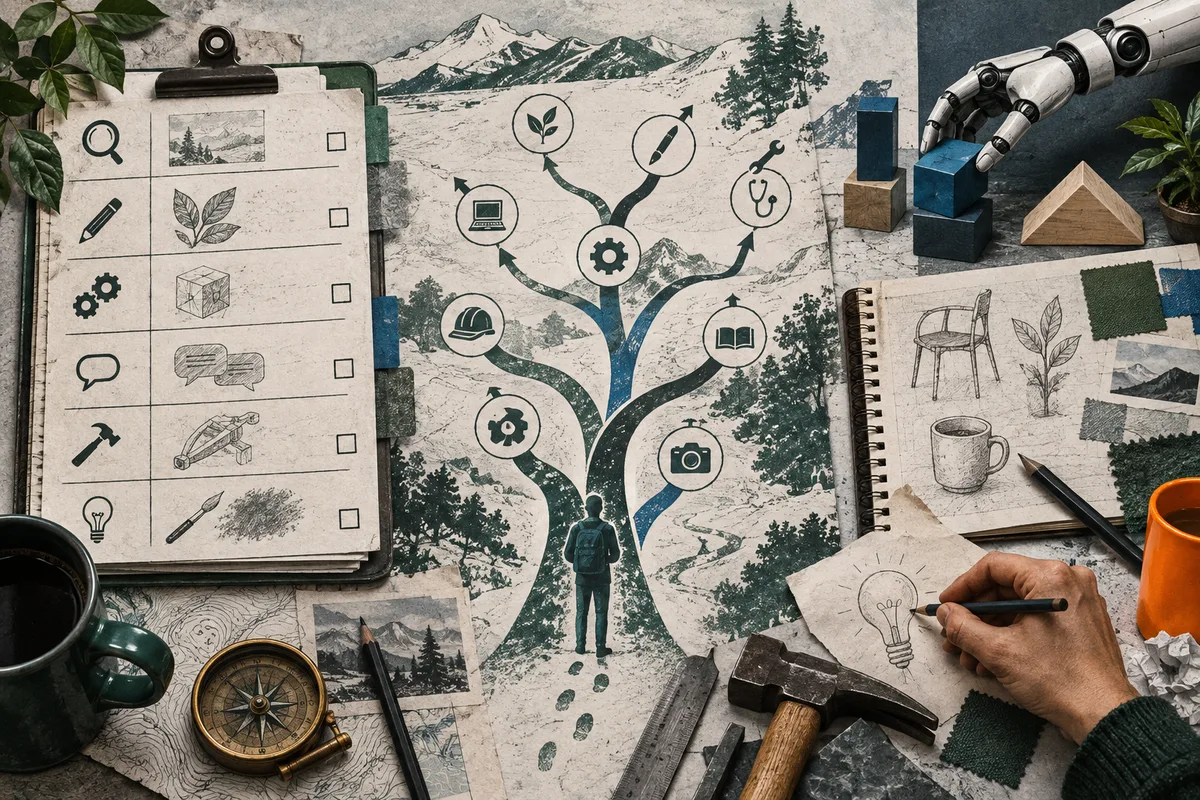
No. Rising demand for AI skills does not make creativity more valuable in every occupation, and it does not turn creativity into protection from job change. The stronger conclusion is narrower: as AI takes on more repeatable information work, creative thinking can become more useful in tasks that require framing an unclear problem, generating and testing options, adapting an answer to a real context, or persuading people to act. In other tasks, the scarce value may sit elsewhere: physical execution, safety, reliability, domain judgment, relationship trust, compliance, or accountability. The practical move is to inspect your task bundle rather than label your whole occupation. Mark which tasks AI can draft or accelerate, which require verification, and which still depend on your access, judgment, relationships, or responsibility. Then build a small AI-enabled workflow around one exposed task while strengthening the adjacent human work that the workflow leaves behind. Creativity is one possible complement to AI. It is not a universal substitute for experience, technical literacy, or dependable execution.
The decision is not whether you are creative
A worker asking whether creativity is becoming more valuable is usually trying to make a more concrete decision: should I develop an AI tool skill, become better at open-ended problem solving, protect my current role, or prepare for a different one? A personality label cannot answer that. Your recurring tasks can.
Start with the work product. Is it a standard report, a recommendation under uncertainty, a repaired machine, a negotiated agreement, a lesson adapted to a particular class, a customer relationship, or a decision that someone must defend later? AI capability, observed use, employer adoption, labor demand, and displacement are separate signals. A system may be able to produce a draft without an employer using it, and an employer may introduce it without removing the worker who verifies, coordinates, or owns the result.
Creativity matters most when it changes the quality of a decision or creates a useful option under constraints. That definition is broader than artistic originality. It includes noticing that a customer has a different problem from the one in the script, redesigning a process around a recurring exception, or translating a technical finding into a decision a non-specialist can use. It also includes knowing when not to generate another option because the requirement is accuracy, safety, or consistency.
So the answer is conditional. If your exposed tasks are mostly drafting, searching, summarising, or formatting, creative framing and verification may help you move toward higher-value work. If your task bundle depends mainly on physical presence, regulated judgment, hand skills, or trust built over time, creativity may be useful but not the first capability to protect. The next step is a task ledger, not a creativity test.
Model one: AI and creativity can be complements
The complement model says AI lowers the cost of some information-processing steps and increases the return on the human work around them. A communications specialist may spend less time producing first drafts and more time choosing the audience, defining the claim, testing whether it is credible, and adjusting it to a sensitive context. An analyst may automate a first pass through data and spend more time deciding which question is worth asking and what action the evidence supports.
The OECD Employment Outlook 2023 makes this case without saying that everyone needs to become an AI engineer. Its review reports that job postings requiring specialised AI skills also call for creative problem solving, communication, collaboration, negotiation, presentation, and management skills. A later OECD skills synthesis says fewer than 1% of workers need advanced AI-specific skills such as model development, while digital skills, data interpretation, problem solving, creativity, and innovation remain relevant for the wider workforce. These are complements in a work system, not a promise that each skill will receive a separate premium.
A field study of 5,179 customer-support agents illustrates why the effect can be uneven. Access to an AI conversational assistant raised issues resolved per hour by 14% on average, with a 34% improvement for novice and lower-skilled workers and minimal impact for experienced and highly skilled workers. The study measures productivity in one organisation and one workflow. It does not show that creativity caused the gain, that every support job will change in the same way, or that productivity becomes better pay. It does show why a worker should ask which part of the task the tool changes and who benefits from the saved time.
Under this model, creativity is practical when it helps you set better goals for the tool, produce alternatives that fit the situation, and evaluate trade-offs. It is not simply writing more imaginative prompts. The complement may instead be domain knowledge, a sharper question, better experiment design, or the confidence to challenge a plausible but unsuitable output in context.
Model two: AI can compress routine creative output
The substitution or standardisation model starts from a different observation. Some work described as creative consists of repeatable combinations: product descriptions in a house style, routine translations, thumbnail concepts, first-pass legal or policy summaries, standard presentations, or variations on a known campaign. AI may produce acceptable versions quickly. In that setting, the number of people needed for the initial output can change even if the organisation still needs humans for approval, client contact, quality control, and accountability.
That is why “creative work” is too broad a category for a career decision. The valuable part may be the brief, the taste, the relationship, the rights clearance, the factual check, the final call, or the ability to explain why an option fits the audience. In another workplace, those parts may not be funded or may be consolidated into a smaller team. Creativity can be present in the occupation while the most repeatable creative tasks face pressure.
The OECD’s 2025 review of generative AI and innovation reaches a similarly bounded conclusion: results depend on the user’s experience and the task, and human-AI collaboration is important. Its skills outlook also describes mixed evidence, including substitution of tasks such as writing and translation, complementarity for less experienced workers, and organisational choices that influence whether adoption augments or displaces work. The evidence does not support a single rule that creative workers win or lose.
This model is also a warning against treating creativity as an invisible safety net. If your creative contribution is hard for a client or manager to see, easy to compare with a generated alternative, and disconnected from a measurable decision, it may not protect the role. Make the contribution legible: show how you define the problem, reduce risk, improve a conversion or service outcome, protect a standard, or resolve an exception.
What the labor evidence can and cannot say
The World Economic Forum’s Future of Jobs 2025 report is useful for one part of this question: it records employer expectations across more than 1,000 employers, 22 industry clusters, and 55 economies. In that survey, AI and big data rank among the fastest-growing skills, while creative thinking, resilience, flexibility, agility, curiosity, and lifelong learning are also expected to rise. This is a signal about reported expectations through 2030, not a count of realised vacancies or a forecast for your local occupation.
The same report argues against the word every. It shows industry-specific differences: insurance and pensions management forecasts particularly fast growth in creative-thinking importance, while other sectors highlight different combinations. It also identifies skills such as manual dexterity, endurance, and precision as having a net decline in anticipated importance overall, with variation by industry. That does not mean a physical skill is unimportant in a particular workplace. It means the direction of employer expectations is not uniform.
The ILO and NASK 2025 global index adds another necessary boundary. It estimates potential exposure by examining nearly 30,000 occupational tasks and reports that clerical work has the highest exposure, while some highly digitised cognitive occupations are also exposed. The ILO explicitly says the figures represent potential exposure, not actual job losses, and that transformation is more likely than full replacement because many tasks still require human involvement. Exposure is therefore a reason to inspect the work, not a personal redundancy probability.
Taken together, the evidence supports a layered interpretation. Technical AI demand is rising in many industries. Creative thinking is often listed as a complementary human skill. The relationship varies by task, sector, experience, adoption design, and the organisation’s willingness to use saved capacity for better work. None of those sources establishes that creativity is more valuable in every occupation, and none can decide what your employer will do next.
A task-bundle comparison: where creativity earns its keep
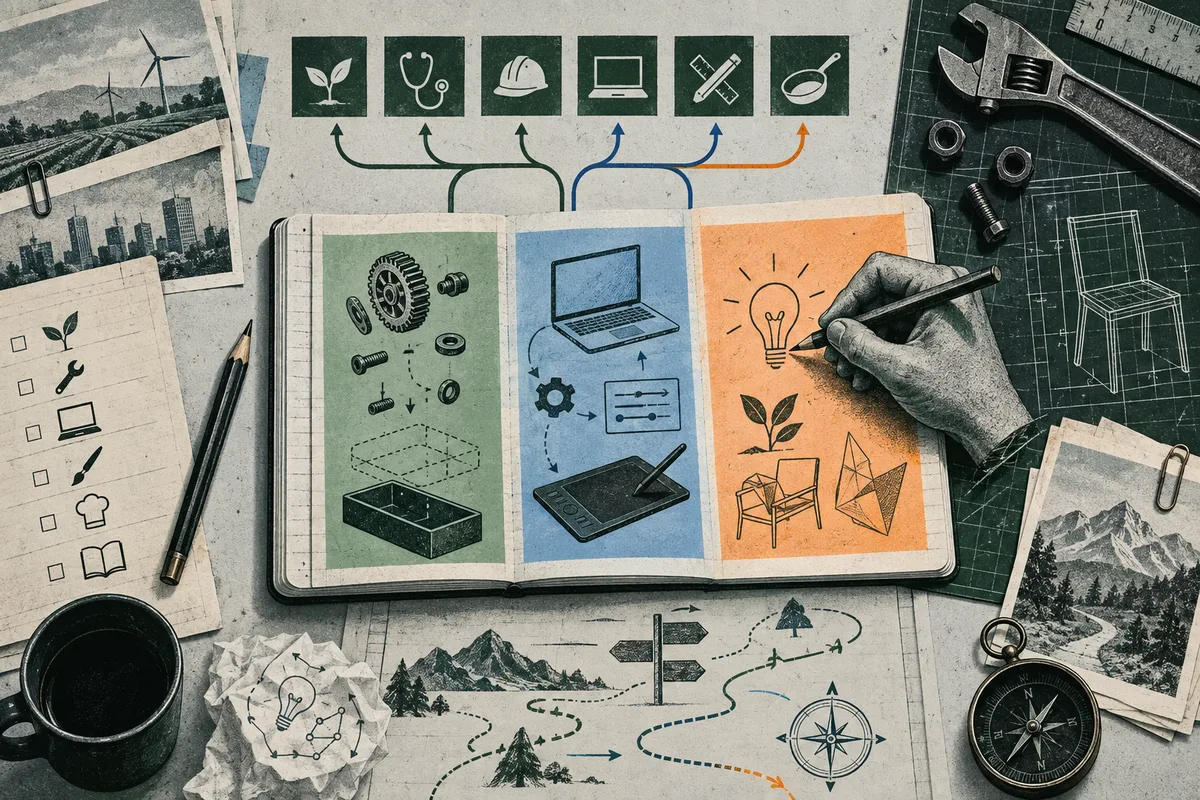
Imagine a marketing coordinator whose week contains research summaries, campaign variants, stakeholder interviews, approval routing, performance checks, and a final recommendation. AI may accelerate summaries and variants. Creative thinking becomes useful when the coordinator identifies a sharper audience problem, rejects a generic message, tests a meaningful alternative, and explains the trade-off to the team. The durable contribution is not producing the largest pile of copy. It is connecting evidence, context, and a decision.
Consider an accounts-payable worker whose core tasks are matching invoices, applying policy, resolving exceptions, and keeping an audit trail. There may be creative process improvement in redesigning the exception queue, but creative ideation is not the main protection. Accuracy, controls, data literacy, escalation judgment, and accountability are closer to the work’s scarce requirements. If software handles the matching, the worker can build value by governing exceptions and improving the control system, not by forcing an artistic identity onto the role.
Imagine a field technician whose work includes diagnosing equipment, handling tools in an awkward environment, communicating with a site contact, and documenting the repair. An AI system may help search manuals or draft notes. Physical access, safety judgment, diagnosis under imperfect conditions, and responsibility for the repair remain central. Creativity can help with an unusual fault, but reliability and hands-on capability may be more consequential than idea generation.
Consider customer support. A tool may suggest a response, surface internal knowledge, and help a newer worker handle a familiar issue. The human work may then shift toward clarifying ambiguous needs, recognising risk, calming a difficult interaction, deciding when a policy exception is warranted, and feeding recurring problems back into product or operations. Here creativity is one part of a bundle that also includes communication, judgment, and ownership. The task comparison matters more than whether the job title sounds creative.
Turn creativity into an observable work capability
If creativity is the capability you want to strengthen, make it concrete enough to practise and verify. The first layer is problem framing: state the user, constraint, decision, and failure cost before asking for an output. The second is option design: generate a small set of materially different approaches rather than many cosmetic variations. The third is evaluation: define what would make an option useful, safe, lawful, accurate, or persuasive, and test it against evidence.
The fourth layer is domain adaptation. A general answer may be fluent and still fail because it ignores a process, regulation, customer expectation, physical limitation, or organisational history. Your experience becomes valuable when it lets you spot that mismatch. The fifth is implementation: persuade the people who must use the change, document the decision, and monitor whether the new process works. That is why creativity often travels with communication, data interpretation, verification, and relationship skills.
Do not assume a course called creative AI will build this capability. A durable learning sequence is usually smaller and more work-specific: learn the relevant tool or workflow, apply it to a real low-risk task, compare its output with a known standard, record errors and rework, and show the before-and-after process to someone who understands the work. A project can demonstrate more than a certificate, while a course may be useful when you need structured feedback or a foundation you cannot safely build alone.
The right level depends on your goal. Someone improving an existing role may need practical AI literacy, evaluation, and basic automation. Someone building AI-enabled products may need deeper software and product skills. Someone pursuing ML engineering or research needs substantially more mathematics, statistics, programming, and supervised practice. Rising demand for AI skills does not erase these differences, and it does not require every worker to make the largest educational leap.

Choose the next move from your constraints
For most early- or mid-career workers, there are three realistic directions. An upgrade keeps the occupation but changes the task mix. Choose it when you have domain access, can test a workflow, and can move from production toward framing, verification, coordination, or accountable decisions. A small project, documented process change, or agreed review metric is a sensible first proof.
An adjacent move keeps valuable experience but changes the setting or emphasis. A writer may move toward content operations, research, editorial quality, or customer insight. An analyst may move toward data governance, implementation, or decision support. A support specialist may move toward knowledge management, service design, or quality assurance. These are examples of reasoning about task adjacency, not promises of openings, pay, or employment outcomes. Check geography, salary floor, credentials, schedule, health, and family responsibilities before treating an adjacent title as realistic.
A larger change may be appropriate when the current task bundle is shrinking, the work no longer fits your constraints, or you want a different technical depth. Compare a course, certificate, degree, apprenticeship, self-study plan, and portfolio project by prerequisites, feedback, time, cost, signal, and the actual role you want. Do not buy a credential to answer an undefined fear. Define the target work first, then identify the smallest credible bridge to it.
A useful 30-day action is to keep a task ledger for five recurring tasks. For each, record the output, inputs, repeatability, error cost, human access, judgment, relationship load, and who is accountable. Test one low-risk AI assist, measure time saved and rework introduced, and ask what higher-value work the change makes possible. If the answer is only ‘more volume’, the experiment has not yet created a career advantage. If it reveals a better decision, safer process, or stronger service, you have evidence for an upgrade or adjacent conversation.
Do not treat the ledger as a private productivity contest. Ask who controls the workflow, who receives the benefit, and whether your employer rewards quality, volume, speed, or cost reduction. A tool that saves twenty minutes may simply create a new quota unless the team agrees how the capacity will be used. Record errors, escalations, customer feedback, review time, and any work that becomes harder to see. This makes the conversation about job design rather than a claim that one tool will save or end a career.
Your constraints belong in the same record. A salaried worker with limited study time may benefit from a small workflow experiment and internal transfer before considering a degree. A parent, caregiver, or worker managing health limits may need asynchronous study, predictable hours, or a path that does not require relocation. Someone with a high salary floor may need to preserve seniority while building a new task mix. These are not excuses to ignore change. They are decision variables that determine whether an otherwise attractive move is usable. A sound plan leaves room to revise the experiment when the evidence, workplace, or family situation changes over time.
Questions readers ask
Does AI make creativity more valuable in every job?
No. Creative thinking can complement AI in tasks involving ambiguous problems, alternatives, adaptation, and persuasion. Other jobs may depend more on physical execution, reliability, safety, compliance, domain judgment, trust, or accountability. Inspect the task bundle rather than applying a universal skill rule.
What does rising demand for AI skills actually show?
It shows stronger demand for some technical, digital, and data-related capabilities, plus related problem-solving and human skills in many settings. It does not prove that every employer has adopted AI, that every worker needs advanced model-building skills, or that demand guarantees a particular career outcome.
Is creativity the same as artistic talent?
No. In career decisions, useful creativity often means framing a problem, generating distinct options, adapting a solution to constraints, and evaluating trade-offs. Artistic production can involve those capabilities, but so can operations, service, engineering, teaching, analysis, and technical work.
Can AI replace creative tasks?
It can automate or accelerate some repeatable creative outputs, such as routine drafts, variations, summaries, and translations. That does not settle what happens to the whole occupation. Briefing, context, quality control, client trust, rights, implementation, and accountability may remain, change, or be reorganised.
Should I learn AI or creativity first?
Start with the task that matters to your goal. If you need to improve an existing role, learn enough of one relevant tool to test a workflow, then practise framing, verification, and implementation around it. If you want ML engineering or research, follow a deeper technical path with the required mathematics, programming, and supervised practice.
Does AI exposure mean my job will disappear?
No. Exposure describes the possibility that some tasks could be assisted or performed by AI. It is not a validated probability of displacement. Adoption, workflow design, regulation, infrastructure, worker skills, and employer decisions shape what happens to the occupation and to individual roles.
What is the best first career action?
List five recurring tasks and note which are repeatable, digital, judgment-heavy, relationship-based, physical, or accountable. Test one low-risk AI assist, record time saved and rework, and identify the human or domain work that becomes more important. Use that evidence to choose an upgrade, adjacent move, or larger learning path.
Is a creativity certificate enough to stay employable?
No certificate can guarantee employability. A credential may provide structure, feedback, or a signal, but workplace capability is better tested through relevant projects, documented results, domain knowledge, and the ability to verify and implement work. Choose education only after defining the target task mix and your constraints.
Sources and notes
- The Future of Jobs Report 2025, Skills Outlook
Supports employer-reported expectations that AI and big data and creative thinking are rising skills, while showing sector variation and limits of current generative AI substitution.
- AI and skills
Supports the distinction between advanced AI skills and wider digital, data, problem-solving, creativity, innovation, and training needs.
- Generative AI and Jobs: A Refined Global Index of Occupational Exposure
Supports task-level exposure, the high exposure of clerical work, and the ILO boundary that exposure is not actual job loss and transformation is more likely than full replacement.
- Generative AI at Work
Supports the single-workplace field evidence of uneven productivity effects among 5,179 customer-support agents using an AI conversational assistant.
- The effects of generative AI on productivity, innovation and entrepreneurship
Supports the conclusion that generative AI effects depend on user experience and task, and that human-AI collaboration and human expertise remain important.
- Skill needs and policies in the age of artificial intelligence: OECD Employment Outlook 2023
Supports the job-posting evidence linking specialised AI skills with creative problem solving and transversal communication, collaboration, negotiation, presentation, and management skills.
Apply this to your own work
See the whole job market at once.
Explore which occupations AI may reshape, then turn the signal into a practical response.
Explore the job map