
Yes, if you use the U.S. Department of Labor AI Literacy Framework as a checklist for a small, real task in your current work. It asks you to understand basic AI principles, explore relevant uses, direct a system, evaluate its output, and use it responsibly. Its delivery principles then point toward hands-on practice, context, human skills, prerequisites, continued learning, support from managers or mentors, and agility. That makes it a sensible guide for a nontechnical worker’s first learning project. It does not tell you which tool to buy, certify your ability, predict whether your job will disappear, or make you ready for machine-learning engineering. The strongest first project is a bounded workflow where you already know what good work looks like, sensitive information can be protected, and a human remains accountable for the result. Use the framework to document what the tool did, what it missed, how you checked it, and whether the workflow actually improved. Then decide whether you need a short course, a certificate, a larger project, or a broader career move based on your target role and constraints.
The decision behind the framework
A nontechnical worker usually does not need a grand answer to begin. The immediate decision is narrower: can I learn enough to use an AI system sensibly on one part of my existing work, while protecting quality, privacy, and my own judgment? The DOL framework is useful because it starts at that level. The Department describes AI literacy as foundational competence to use and evaluate AI responsibly, with emphasis on generative AI. It also says the depth required must vary by role and context. That is a better starting point than treating every worker as a future engineer.
The word framework matters. DOL issued guidance for workers, employers, educators, workforce agencies, and training providers. It provides common content areas and delivery principles, not a personal syllabus with a final exam. The framework is also explicitly a starting point that can evolve with technology, labor-market changes, and implementation feedback. You can therefore borrow its structure without pretending that completing a worksheet produces a recognized qualification.
There are two plausible ways to read it. Model one treats AI literacy as tool operation: learn prompts, try a few features, and become faster. Model two treats it as work judgment: understand what a system can do, choose a suitable task, test the output, manage risk, and keep responsibility with a person. The first model is easier to sell and easier to demonstrate in a short class. The second is more demanding, but it matches what the framework actually says about evaluation, responsibility, context, and complementary human skills.
For a first project, choose model two and use model one only as a component. The goal is not to prove that AI is powerful. The goal is to learn where it helps in your task bundle and where your experience is still doing the essential work. That distinction matters because exposure describes technical applicability to tasks. It does not establish observed use by your employer, adoption across your occupation, labor demand, or a probability that you will lose your job.
What DOL actually asks a learner to know
The framework’s five foundational content areas form a practical learning loop. First, understand AI principles. For a nontechnical worker, that means a working vocabulary and mental model, not mathematical mastery. You should know that outputs are generated from patterns, can vary, and can be confidently wrong. You should understand the difference between a model being trained and a tool producing an output in use. You should also see that people set the data, goals, and boundaries around a system.
Second, explore AI uses. DOL names productivity work, information support, creative assistance, task-specific applications, and decision support. These categories are deliberately broad. A payroll coordinator might explore classifying incoming questions; a procurement worker might organize a draft comparison table; a communications worker might produce variants of a plain-language explanation. The framework does not say that any one of those uses is appropriate in every workplace.
Third, direct AI effectively. Give the system the task, context, audience, constraints, and desired format. Iterate when the first response is weak. This is not a magic prompt formula. It is task framing made visible. The worker still has to know what information is relevant and what a usable result looks like.
Fourth, evaluate outputs. Check facts against trusted material, look for missing steps and faulty assumptions, and ask whether the output serves the actual purpose. Fifth, use AI responsibly. Protect confidential information, follow workplace rules, consider context-specific risks, report misuse, and maintain accountability. The final two areas stop the learning project from becoming a speed experiment with no control around it.
Model one: a prompt practice project
The simplest interpretation is to build a prompt practice project. Pick a low-stakes task you perform repeatedly, such as turning a public meeting agenda into a draft list of follow-up questions. Describe the audience, the format, the source material, and what must not be inferred. Ask for a first draft, inspect it, then revise the instructions after noticing a gap. Keep your original human version beside the assisted version.
This project teaches several DOL areas quickly. You learn how context changes an output, how iteration changes the result, and how a tool can help with a first pass. You also learn what cannot be delegated. If the agenda is ambiguous, the system may fill the gap with a plausible sentence. If the follow-up list misses a dependency, your familiarity with the meeting is what catches it. The useful artifact is not the prompt alone. It is the before-and-after work, the corrections, and the review rule.
A good record has five fields: task, input, output, correction, and decision. Under task, name the narrow activity rather than your whole occupation. Under input, record the kind of material used and remove private or restricted information. Under output, save the draft. Under correction, identify factual, logical, tone, or completeness problems. Under decision, state whether the result was accepted, edited, or discarded and why.
The limitation is important. Prompt practice can show that you can direct a system. It does not show that you can redesign a process, validate a high-stakes decision, manage access controls, or build an AI product. It also produces weak evidence if the task is so trivial that nobody can tell whether the workflow improved. Treat it as a first experiment and a diagnostic, not as a credential.
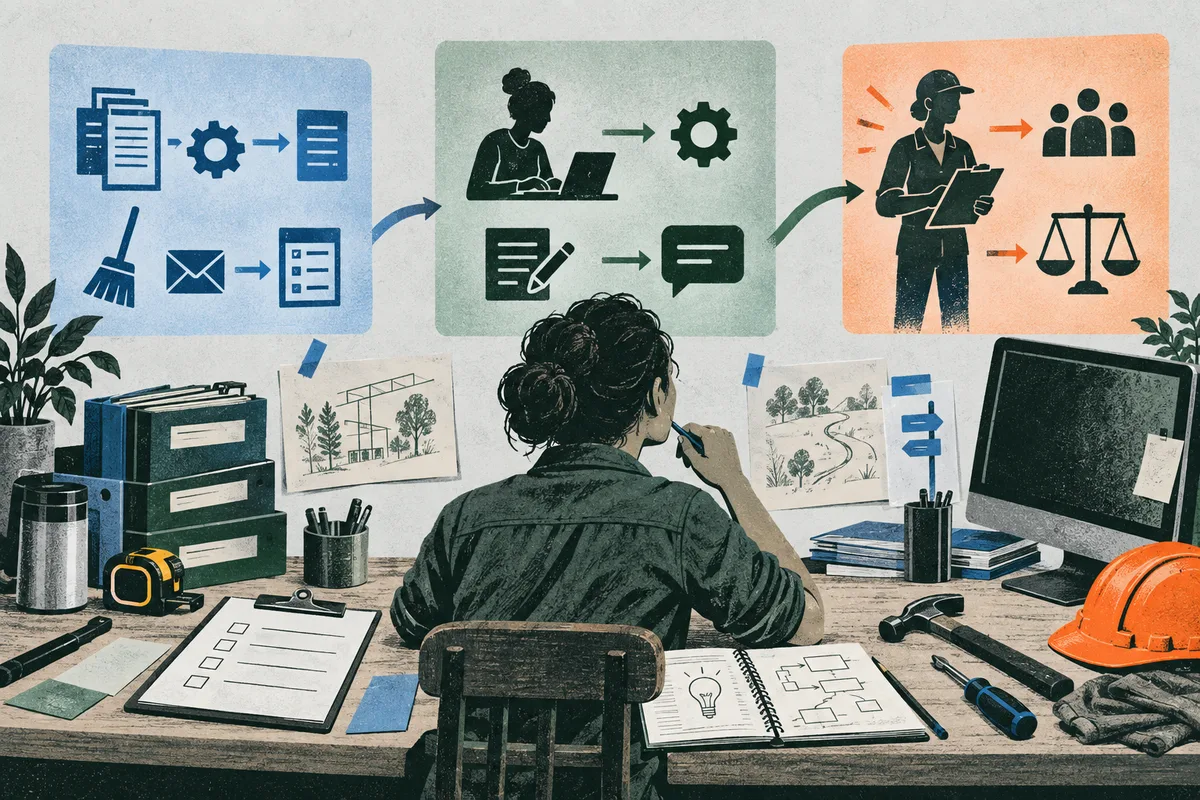
Model two: a work-based evaluation project
A stronger interpretation turns the same task into a small evaluation project. Instead of asking only whether the output looks impressive, define a quality test before using the tool. For a draft internal summary, the test might ask whether every important decision is present, whether open questions are labeled, whether names and dates match the source, and whether the tone fits the audience. For a data-organizing task, the test might ask whether categories are consistent, ambiguous rows are flagged, and no unsupported values are added.
Now run a small sample through the workflow. The sample can be historical, public, or safely redacted. Compare the assisted output with your normal method. Record time saved only if you can measure both methods in the same way, and record review time separately. A faster first draft may create more checking work. A shorter document may omit context. A polished answer may still be unusable because it assigns certainty where the source is uncertain.
This is where DOL’s delivery principles become more than a list. Experiential learning supplies the task. Context keeps it connected to your role. Complementary human skills make your subject knowledge part of the test. Prerequisites force you to notice access, digital confidence, and data handling. Continued learning gives the project a next step. A manager, peer, or mentor can help define the quality bar. Agility means you revisit the workflow when the tool or policy changes.
The project’s conclusion should be modest and specific: use the tool for this first-pass step under these conditions, require this review, and keep these decisions with a person. If the result is unreliable, that is still a successful learning outcome. You have learned where capability meets verification cost. That knowledge is more portable than a list of interface features.
A worked example for a nontechnical worker
Imagine a customer-support specialist who spends part of each week turning resolved cases into internal help-center drafts. The task is exposed to text generation because the source material is digital and repetitive. That does not mean the whole job is exposed in the same way, and it says nothing by itself about displacement. The specialist still knows which customer confusion matters, which policy language is current, and which exceptions deserve escalation.
The first project could use three fully redacted, already resolved cases and a public policy document. The worker asks for a draft article with a title, steps, common misunderstanding, and an escalation note. The instruction says to quote only the supplied policy, mark any missing information as a question, and avoid inventing a promise to the customer. The worker then checks each step against the source and compares the result with a manually written draft.
The DOL content areas appear in sequence. Understanding principles explains why fluent wording is not proof of accuracy. Exploring uses identifies drafting as assistance rather than autonomous policy interpretation. Directing the system means specifying the source, audience, boundaries, and structure. Evaluating means checking every claim, omission, and escalation condition. Responsible use means using approved data and following the employer’s rules. Complementary human skills include product knowledge, communication, and judgment about customer harm.
The final artifact can be a one-page workflow note: inputs allowed, prompt or instruction pattern, review checklist, examples of failure, and an owner for updates. That is a credible learning project because it demonstrates a work capability. It does not prove a hiring outcome or justify a claim that the specialist is now an AI professional. If the worker wants to move toward operations, knowledge management, or AI implementation, this artifact can become a conversation starter and a basis for targeted next learning.
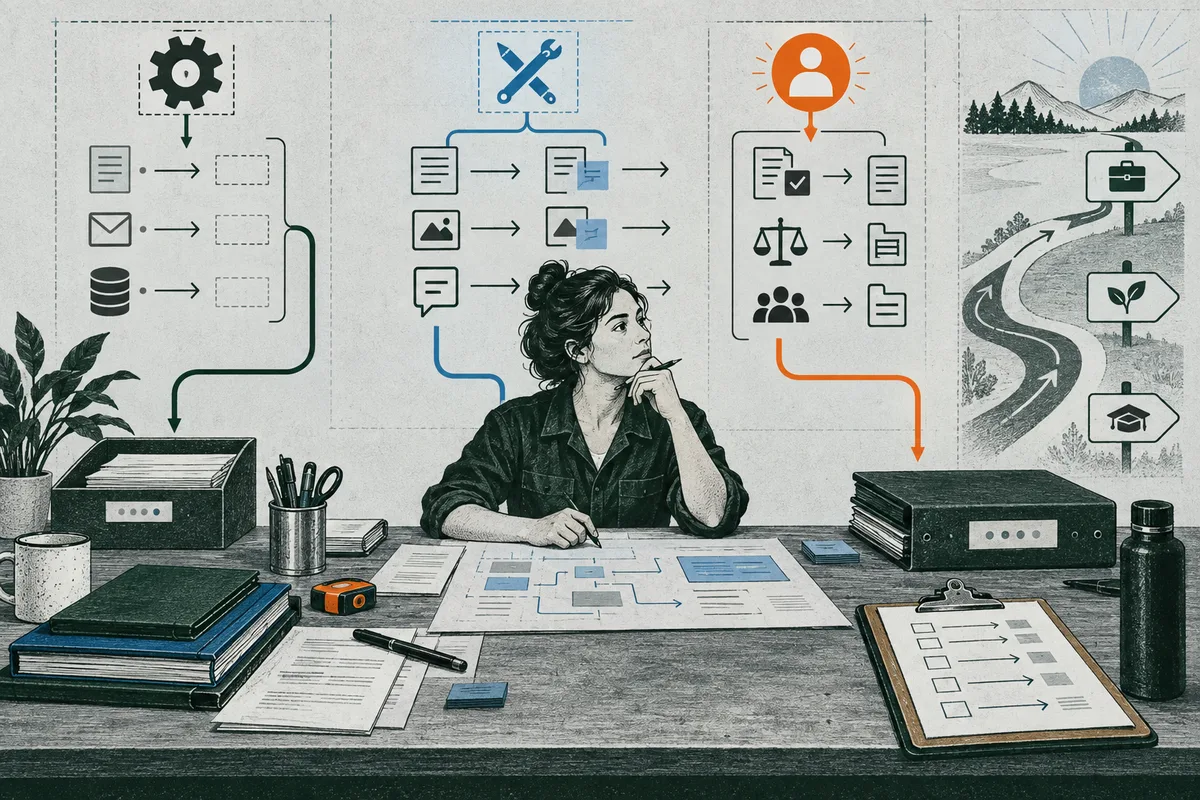
What the framework cannot decide for you
The DOL framework can help answer, “What should I practice and observe?” It cannot answer, “Should I leave my field?” That decision depends on your task mix, employer adoption, local demand, credentials, salary floor, location, schedule, health, caregiving, and appetite for risk. A framework designed for broad workforce use cannot supply those personal constraints.
The ILO’s 2025 global index illustrates why caution is needed. Its researchers combined task-level information, expert input, and model predictions across an occupational classification, and reported that one in four workers globally are in occupations with some degree of generative AI exposure. The study says transformation is the likelier effect because most occupations contain tasks requiring human input. Those are useful directional findings about exposure and possible change. They are not a personal redundancy estimate, a local forecast, or evidence that an employer has adopted a system.
The framework also cannot turn literacy into readiness for every AI-related role. DOL distinguishes baseline engagement from advanced capabilities such as managing or building systems. A short project may be enough for a worker who wants to improve an existing workflow. Someone targeting software practice needs programming, version control, testing, and deployment. Someone targeting machine-learning engineering needs deeper mathematics, data work, systems knowledge, and substantial practice. Someone pursuing research needs yet another level of theory and evidence. The intended outcome should set the learning path.
Nor should you buy a course simply because it repeats the framework’s vocabulary. The OECD’s 2025 policy brief separates demand for specialized AI professionals from demand for general understanding and argues that training supply may not yet meet the need for broad literacy. That supports learning access, not a promise that any provider or certificate creates workplace capability. Inspect prerequisites, feedback, assessment, project work, update practices, total cost, and recognition before paying.
Choosing the next learning path
Use a first project to choose among learning paths, rather than choosing a path from fear. If your goal is to use AI in your current field, start with the work-based evaluation project and add a short course only where it fills a clear gap, such as data handling, verification, or workplace policy. If your goal is to build AI-enabled products, add basic coding, data structures, interfaces, testing, and deployment after you can define a real user problem. If you want to become a software practitioner, seek sustained practice and feedback, not prompt fluency alone. If you want ML research or engineering, expect a deeper technical route and check prerequisites before committing.
A university degree offers depth, structured feedback, peer networks, and a signal that may matter for some roles. It also costs more time and money and may be a poor fit when the immediate goal is a small upgrade in an existing job. A focused course can supply structure quickly, but its value depends on exercises, feedback, and how closely the work resembles your target workflow. A certificate may document completion, yet it is not the same as demonstrated capability or a hiring guarantee. A project gives you evidence of doing, but you must design its quality bar and explain the limits. Apprenticeship or employer learning can provide context and feedback, but access depends on the opportunity. Self-study is flexible and cheap in money, but it requires discipline and an external way to test your work.
Compare each path on six questions: What job or task outcome do I want? What prerequisites do I already have? Who will give feedback? What artifact will I produce? How much time and money can I protect? What would make me stop or change direction? These questions respect real life. A parent with limited evening time, a worker who cannot upload company data, and a career changer without a technical foundation need different sequences even if they read the same framework.
The bounded next step is to spend one work session defining a task, a safe sample, a quality checklist, and a review record. After that session, you will know whether the next gap is tool use, domain process design, technical foundations, or career information. That is enough information to avoid both passivity and an expensive leap.

A 30-day project plan with a stop rule
Days 1 through 3 are for task selection and boundaries. List recurring activities in your work and mark each as drafting, organizing, searching, deciding, communicating, coordinating, or physical execution. Choose one low-stakes, reversible task with a clear reviewer. Check your workplace policy, remove confidential information, and decide what the system must not do. If you cannot obtain a safe sample or a reviewer, stop and redesign the project.
During week one, write down your current method and quality standard before testing a tool. This protects you from judging the new workflow only by novelty. Define what counts as correct, complete, clear, and appropriate. Separate the time spent producing a draft from the time spent checking it. Your baseline need not be scientifically perfect. It only needs to be explicit enough for a fair comparison.
During week two, run a small set of examples. Use clear instructions, relevant context, and an output format. Try one deliberately incomplete or ambiguous input so you can see how the system behaves when the task is underspecified. Compare the output with your own work. Record errors, omissions, invented details, privacy concerns, and cases where the tool made the work harder.
During week three, improve the workflow and ask a trusted colleague or manager to inspect the checklist if that is safe. Do not present a polished demo without showing failure cases. During week four, write the decision: adopt for a defined step, keep experimenting, or discontinue. The stop rule is part of literacy. If verification costs exceed the benefit, if policy forbids the use, or if the task is too high-stakes for the available controls, the responsible decision is not to automate it.
The useful interpretation is that the framework puts practice, context, evaluation, responsibility, human skills, access, and continued learning in one structure. Its weakness is not that it is too basic. Its weakness is that a broad framework cannot choose the task, quality bar, tool, credential, or career path for a particular worker. You supply those through knowledge of your work and honest attention to constraints.
Read the result as a map of changed work, not a verdict on your job. You may find that drafting is easier but checking remains demanding. You may find that the tool handles a repeatable step while your value shifts toward exceptions, explanation, coordination, or accountability. You may find no useful application because the data, policy, or verification burden is wrong. Each finding separates technical capability from actual use and use from employer adoption.
Start with the smallest project that can teach you something real. Keep the source material safe, compare against your normal method, record what failed, and make a human owner visible. Then use the evidence to choose your next learning investment. The framework answers the opening question with a qualified yes: it can guide the first step, provided the first step is a work experiment with a quality test rather than a vague tour of AI tools.
Questions readers ask
Is the DOL AI Literacy Framework a certification?
No. It is guidance for designing and delivering AI literacy across workforce and education settings. A course or certificate may use it, but the framework itself does not certify your skill or guarantee hiring value.
Do I need to learn coding for a first AI literacy project?
Not necessarily. A first project using a familiar work task can teach principles, direction, evaluation, and responsible use without coding. Coding becomes relevant when your intended outcome is building or integrating systems, not merely using AI in an existing workflow.
What is the safest first task to test?
Choose a low-stakes, reversible task with a clear quality standard and no confidential input, such as organizing public information or drafting a nonfinal outline. Keep a human review step and follow your workplace policy.
Does AI literacy protect my job from displacement?
No framework can provide that protection or predict an individual job outcome. Literacy may help you understand changing tasks and participate responsibly in redesign, but employer adoption, demand, role structure, and other conditions remain uncertain.
Should I buy a certificate before doing a project?
Usually, test the learning need with a small project first unless a target role explicitly requires a credential. Compare the certificate’s prerequisites, feedback, assessment, project work, update policy, cost, and recognition. Completion is not the same as workplace readiness.
How is AI literacy different from machine-learning engineering?
AI literacy is a baseline for understanding, directing, evaluating, and using AI responsibly. Machine-learning engineering involves deeper technical work such as data pipelines, model development, software systems, testing, and deployment. They are related but different learning goals.
What should I do after the first project?
Write a short decision record, identify the next gap, and choose one bounded follow-up. That might be a role-specific tool lesson, a data or verification course, a larger work project, or research into an adjacent role. Base the choice on your task evidence and constraints.
Sources and notes
- The U.S. Department of Labor’s Artificial Intelligence Literacy Framework
Supports the framework definition, five foundational content areas, seven delivery principles, worker guidance, and limits of baseline literacy.
- Training and Employment Notice 07-25: The U.S. Department of Labor’s Artificial Intelligence Literacy Framework
Supports the official issuance, intended workforce and education audiences, and framework status as program-design guidance.
- Generative AI and Jobs: A Refined Global Index of Occupational Exposure
Supports the distinction between task-level exposure and displacement and describes the ILO’s global exposure methodology and limits.
- Bridging the AI Skills Gap: Is Training Keeping Up?
Supports the comparison between general AI literacy and specialized AI expertise and the caution about training supply and access.
Apply this to your own work
See the whole job market at once.
Explore which occupations AI may reshape, then turn the signal into a practical response.
Explore the job map