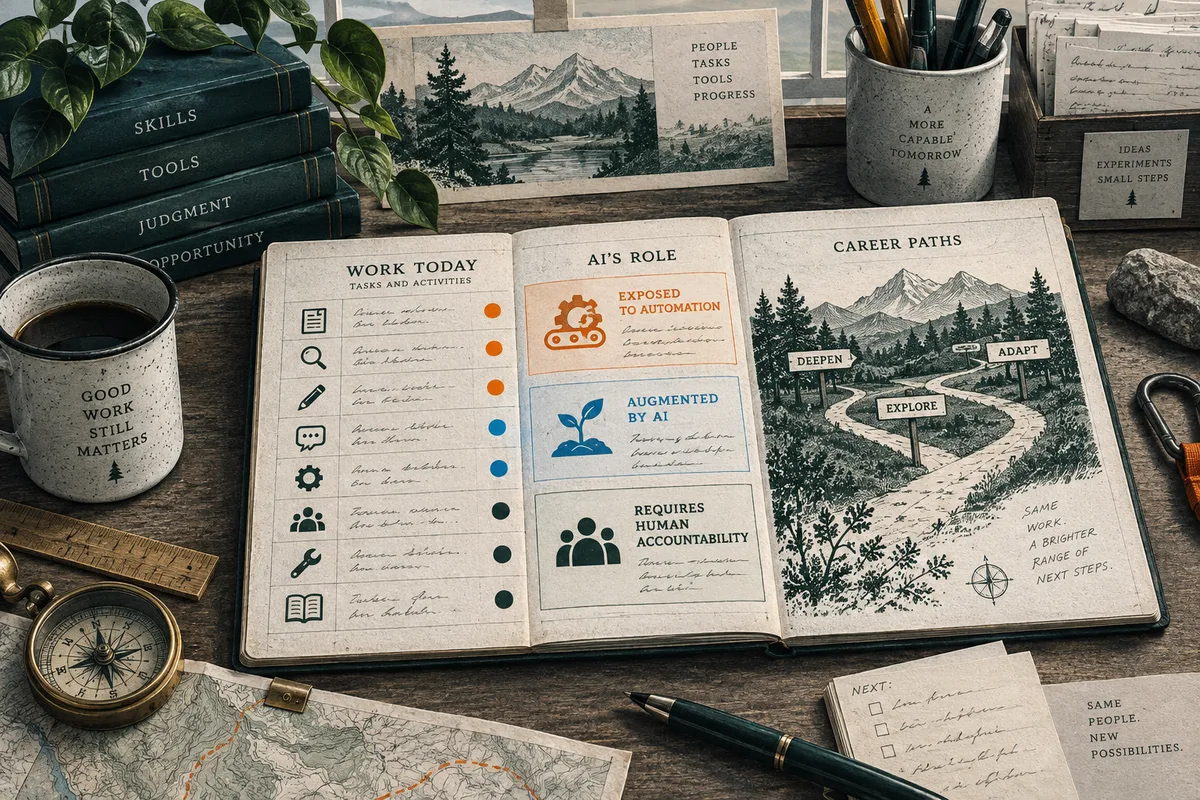
Evidence shows AI can change task mix without a corresponding measured reduction in headcount, but it does not establish a universal sequence in which tasks always change first and jobs are cut later. Employer surveys report task automation alongside task creation; a U.S. Census study finds worker-task use alone is not significantly associated with firm headcount decreases after broader deployment is considered; and a randomized workplace experiment found time savings without significant changes in several measured work patterns. These are different observations, not stages in one proven timeline. For your own decision, record specific task changes and track hiring, hours, and staffing separately.
What counts as evidence that work changed before headcount did?
The strongest evidence for task change is a measured or reported change in what workers do: a task is automated, a new task appears, time spent on an activity shifts, or responsibility moves between people and software. Headcount is a separate outcome. To show that one came before the other, researchers need observations over time that establish when each change happened. A survey asking employers whether tasks changed and whether employment rose or fell can show the two were reported together; it cannot, by itself, tell us which came first.
An OECD survey of AI-using employers in finance and manufacturing asked whether AI had automated tasks workers used to do and whether it had created new tasks. Employers reported both kinds of change. The report cautions that knowing a task was automated or created does not reveal its relative time or importance: a short routine step may disappear while monitoring, maintenance, or problem-solving takes its place. This is direct evidence of task reorganization in those adopting firms, not evidence that every worker’s total workload fell or that layoffs followed it.
A 2026 U.S. Census Bureau working paper gives a more granular snapshot from its Business Trends and Outlook Survey supplement, fielded from November 2025 to January 2026. It separates AI use in firms, business functions, and worker tasks. Writing, document analysis, and information search were common reported task uses, while many firms used AI in only a few tasks. The authors report that worker-task use alone had no significant link to headcount reduction once functional integration and operational investment were taken into account. That is an association in firm-level survey data, not proof that task use prevents cuts or that a sequence has been observed over time.
So “task mix changed before headcount” is most defensible as an operational pattern to watch, rather than a law of labor markets. At work, observable markers might include fewer manual first drafts, more exception handling, new output checks, or a person taking responsibility for decisions that a tool helps prepare. These are useful items to log; the cited studies do not claim each is present in every workplace. Exposure describes what technology might affect, and capability describes what it can do under particular conditions. Neither establishes employer adoption, changed demand, or displacement.
Sources: The impact of AI on the workplace: Main findings from the OECD AI surveys of employers and workers; The Microstructure of AI Diffusion: Evidence from Firms, Business Functions, and Worker Tasks; Shifting Work Patterns with Generative AI
Does task change reliably mean fewer jobs?
No. The evidence points to mixed outcomes, and each study measures a different part of the process. In the OECD employer survey, firms reporting task automation were more likely to report that employment had decreased, but also more likely to report that it had increased. The results show that automation and employment changes can coexist in either direction. They do not reveal a common timing sequence or a causal effect: the answers were employer reports, collected in specific sectors and countries, from firms already using AI.
The Census paper also complicates a simple story. It finds an association between broader AI deployment across business functions and operational investment, on one hand, and firm employment decreases, on the other. Worker-task integration alone did not have a significant relationship with headcount reduction after those factors were considered. This suggests that how far a firm reorganizes its operations may carry different information from whether workers use AI on a task. Because it is observational firm-level evidence, it cannot establish that broad deployment caused a reduction, identify affected individuals, or predict what will happen in a particular company.
A randomized field experiment across 66 firms and 7,137 knowledge workers offers a different comparison. Workers were randomly selected for access to a generative AI tool integrated into familiar email, meeting, and writing applications. In the second half of the six-month experiment, the subset who used the tool spent about two fewer hours on email each week and less time working outside regular hours. The authors found effects mainly on behaviors workers could change independently; activity requiring coordination changed less. This is evidence that access can alter time use. It is not an organization-wide redesign study, a headcount study, or proof of a later staffing effect.
That experiment is a useful counterweight to claims that new tools automatically reshape every worker’s mix of duties. Time saved on one activity might be used for other work, left as reduced hours, absorbed by demand, or not translate into more output. Those are possible routes, not outcomes established by this experiment. Conversely, no detected change in a measured activity is not proof that work will never change. The studies differ in setting, AI system, period, adoption level, and outcome, so they should not be read as contradictory estimates of a single effect.
The practical distinction is between a task signal and a workforce signal. Repeated changes to the work may be an early reason to ask what the organization intends to do with the capacity created. Evidence of lower hiring, fewer scheduled hours, an ended role, or a changed staffing plan is a separate signal. It deserves attention, but even then the explanation may involve demand, budgets, restructuring, or other changes alongside AI. A task checker can map possible pressure across duties; it cannot substitute for information about local decisions.
Sources: The impact of AI on the workplace: Main findings from the OECD AI surveys of employers and workers; The Microstructure of AI Diffusion: Evidence from Firms, Business Functions, and Worker Tasks; Shifting Work Patterns with Generative AI; Generative AI at Work
What should you observe in your own work?
Start with a short task record rather than a verdict about your job title. List recurring outputs, such as a weekly report, customer reply, contract review, or project update. For each, note which steps are drafted, searched, summarized, classified, checked, or decided by a person. Track time and quality before and after a tool-assisted workflow, including corrections and handoffs. This is not a prediction model; it helps distinguish a task that became faster from a role whose responsibilities or demand have actually changed.
A customer-support study illustrates why job titles hide variation. Researchers examined a phased introduction of an AI conversational assistant among 5,172 support agents. They reported an average 15% increase in issues resolved per hour, with substantial differences: less experienced and lower-skilled workers improved in speed and quality, while the most experienced and highest-skilled workers saw small speed gains and small quality declines. The study supports looking inside an occupation at experience, task difficulty, and how the tool is used. It does not show that the productivity change reduced headcount or will repeat in another firm.
A bounded test can answer a more useful immediate question: what changed in one recurring task, and where did the saved time go? Pick one workflow you can test safely for two weeks. Note a baseline, use an approved tool on a suitable step, and compare turnaround time, error correction, and the work still requiring your judgment or accountability. Then ask how any capacity released is allocated. If the experiment involves sensitive information or consequential decisions, follow workplace rules and keep a human review step appropriate to the stakes.
Keep a separate record of workforce evidence over the same period: whether vacancies are filled, hours change, responsibilities move, output targets rise, or managers describe a staffing plan. One unanswered question from the research is how often these signals follow task changes within the same organization; the cited survey snapshots and limited-duration studies do not settle it. If both the workflow and staffing indicators change persistently, consider options in order: improve your current workflow skills, explore an adjacent role that uses your experience, then assess a larger pivot only against your pay needs, location, training time, health, and family constraints. The evidence does not call for everyone to abandon their field or retrain as an engineer.
The verdict is narrow but useful: task-mix changes are measurable and can occur without an observed headcount decrease, yet they are not a reliable predictor of one and have not been shown to precede it everywhere. Treat the change as a prompt to gather better local evidence, not as either reassurance or a layoff forecast. If you want to map which parts of your own work may face change pressure, the free task checker can organize that inventory; its result is a task-level signal, not a probability of losing your job.
Sources: The Microstructure of AI Diffusion: Evidence from Firms, Business Functions, and Worker Tasks; Shifting Work Patterns with Generative AI; Generative AI at Work
Questions readers ask
Does AI usually change tasks before it reduces headcount?
Current evidence supports that task changes can be observed without a matching headcount reduction, but it does not prove a universal task-first timeline. Most available studies measure different outcomes or provide snapshots rather than tracking task mix and staffing changes together over time.
What should I track if AI changes part of my job?
Track the task steps that changed, time and quality before and after, correction work, and where released time goes. Separately watch hiring, hours, responsibilities, and explicit staffing decisions. Those records answer different questions.
Sources and notes
- The impact of AI on the workplace: Main findings from the OECD AI surveys of employers and workers
Supports employer-reported automation and task creation, and the finding that automation was associated with both increased and decreased employment in surveyed sectors.
- The Microstructure of AI Diffusion: Evidence from Firms, Business Functions, and Worker Tasks
Supports the distinction among firm, function, and worker-task adoption and the reported association between deployment breadth and firm employment decreases.
- Shifting Work Patterns with Generative AI
Supports the randomized six-month field experiment's measured effects on email time and other work patterns among knowledge workers given tool access.
- Generative AI at Work
Supports the customer-support field study's productivity result and substantial differences by worker experience and skill.
Apply this to your own work
See the whole job market at once.
Explore which occupations AI may reshape, then turn the signal into a practical response.
Explore the job map