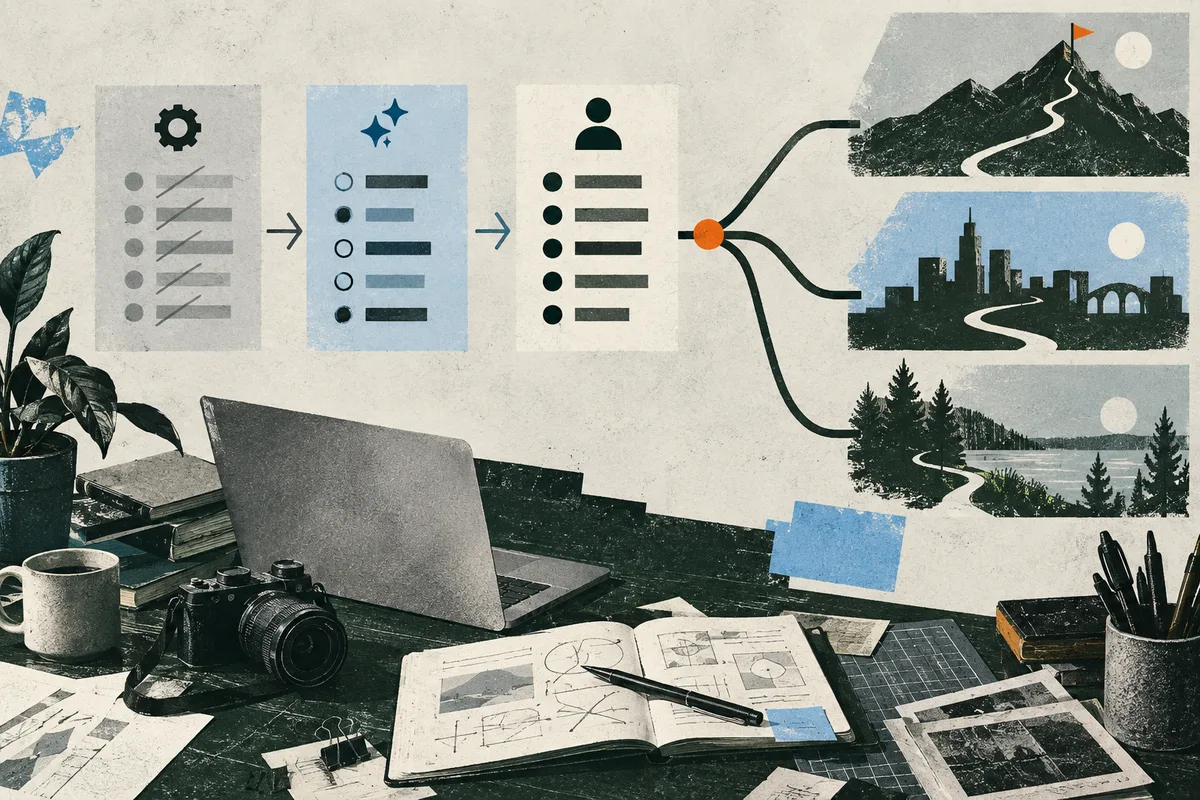
AI changes freelance work unevenly. It puts pressure on digital, repeatable outputs that are easy to specify and check, while helping with research, production, and analysis. That is task exposure, not a personal job-loss forecast. Audit recent projects, make verification and accountability visible, test one low-risk workflow, then compare upgrade, adjacent, and larger-change options against your constraints.
The claim under review: AI will replace freelance work
The claim sounds plausible because freelancing often begins with a clearly named output: 1,000 words, ten social captions, a logo concept, a spreadsheet cleanup, a landing page, or a small automation. Clear digital outputs are easier to describe to a software system than a messy internal decision. A buyer can also compare them quickly, which creates pressure on price when a tool makes a first version fast.
But replaceable output is not the same as replaceable work. A freelance assignment includes finding out what the client actually needs, deciding what good looks like, choosing what to leave out, managing revisions, protecting confidential information, testing the result, and accepting responsibility when the result reaches a customer. Some of those steps may be assisted by software. Some may be compressed. They do not all disappear simply because a plausible draft can be generated.
The ILO's May 2025 global index is helpful here because it measures potential exposure through tasks across occupations. It reports that one in four workers are in an occupation with some generative AI exposure, while 3.3% of global employment falls into its highest exposure category. Those are exposure measures, not forecasts that the exposed workers will be dismissed. The ILO's own explanation says the evidence is currently clearer for likely transformation than for an employment apocalypse.
Freelancers should be especially careful with marketplace evidence. Upwork is a large and useful window into online independent work, but its platform data are not a complete census of all freelancers, countries, clients, or offline referrals. Its 2025 analysis of millions of jobs and freelancer earnings across more than 130 categories found both augmentation and substitution. That combination is more useful than a single replacement headline: it shows why the same occupation can contain tasks moving in opposite directions.
An independent referral practice may feel these changes differently from a platform-based practice. A repeat client can already know your judgment and give you richer context, while a marketplace buyer may compare a short brief, a price, and a visible sample. The same skill therefore has different commercial exposure depending on how work is found, specified, reviewed, and renewed. Include that route to market in your audit.
Why it sounds plausible: freelance offers expose the task mix
A freelancer's vulnerability is often hidden inside the wording of the offer. Compare two versions of a content service. The first promises blog drafts from a supplied brief. The second promises a researched point of view, interviews with subject-matter experts, a fact-checked article, and a revision process that fits the client's legal and brand requirements. Both may involve writing. The first is easier to substitute because the buyer can judge it mainly as text. The second includes research design, source judgment, interpretation, and accountability.
The same difference appears in design. Producing several visual variations from a prompt can be exposed, especially when the client has no strong preference beyond speed. Translating an established brand into a usable system, checking accessibility, preparing production files, and resolving disagreement among stakeholders creates more friction. In software, boilerplate code and simple scripts may be accelerated, while requirements discovery, integration with an existing system, testing, security review, and maintenance remain difficult to hand over safely.
Make your own ledger with five columns: task, current tool capability, cost of an error, client context, and evidence of value. Put research, drafting, formatting, outreach, analysis, meetings, quality control, and delivery into separate rows. Do not use one label for an entire project. A task can be highly exposed but low consequence, such as turning approved notes into a first draft. Another can be less exposed but high consequence, such as deciding which claim can be published or which customer segment should receive a limited budget.
Then ask whether a client can verify the result without you. If the answer is yes and the result is easy to compare, expect pressure on price, turnaround, or volume. If the answer is no, the client may still need an accountable specialist even when tools improve the underlying production. That is not immunity. It is a reason to make the hard-to-delegate part visible in the offer.

The best supporting evidence shows a split, not a verdict
Upwork's June 2025 platform analysis reports that clients expressed more than twice as much trust in human and AI work as in AI-only outputs. It also says 66% of clients in its internal research reported high trust in work from freelancers using AI tools, compared with 26% for work delivered by AI alone. These figures support a commercial observation: for some buyers, the freelancer's direction and review are part of the product. They do not prove that every buyer values human involvement equally, or that every freelancer using a tool earns more.
The same analysis reported 25% year-over-year growth in gross services volume for AI-related work on Upwork in the first quarter of 2025, and 52% growth in its prompt engineering subcategory. This is evidence of observed demand on one platform during a defined period. It is not a general employment projection, and it says little about whether a freelancer in a particular country can access that work or meet its technical requirements.
A separate Upwork study used the public release of ChatGPT in November 2022 as a natural experiment and examined job posts, contracts, and earnings on its marketplace. It found a 2.4% increase in total job posts and a 1.3% increase in earnings per contract at the platform level, while results varied by category. Writing and translation showed reduced earnings in the study, especially in lower-value work, but higher-value work in those categories showed different results. The authors describe a dynamic between replacement and reinstatement effects, not a settled outcome.
There is contradictory evidence inside the same picture. Faster production can increase competition because more people can offer a basic deliverable. A client may keep the freelancer but ask for more output in the same time. A tool can create demand for fact-checking, editing, integration, or prompt design while reducing the number of simple assignments. Upwork's August 2025 hiring report listed fact-checking, video editing, data annotation, graphic design, and English among its ten most-hired AI-related skills. That list suggests quality control and hybrid work are market signals on that platform, not a guarantee of demand everywhere.
A narrower conclusion: redesign the offer before abandoning the field
For most freelancers, the first realistic response is not to become a machine-learning engineer. It is to choose one workflow where a tool can remove low-value friction, then use the saved capacity to improve the part clients find difficult to buy or verify. A copywriter might use a tool to produce headline options, then spend the recovered time on customer interviews, source checks, positioning, and a clearer test plan. A bookkeeper might automate document sorting, then focus the service on exception review, explanations for the owner, and a clean monthly decision packet. A web developer might use code assistance for scaffolding, while making testing, accessibility, data handling, and handover explicit.
This upgrade works only if you can demonstrate it. Keep a before-and-after record of the workflow, but do not market speed alone. Show the brief, the assumptions you clarified, the checks you ran, the errors you caught, and the decision the client could make afterward. The durable skill is not a particular interface. It is problem framing, data literacy, evaluation, domain knowledge, verification, and basic automation applied to a named workflow.
An adjacent move is stronger when it preserves a valuable part of your experience while changing the task bundle. A general writer could move toward editorial operations, content systems, research, or subject-matter communications. A designer could move toward brand systems, user research, production management, or accessibility. A developer could move toward implementation consulting, testing, integration, or technical operations. These are directions to investigate, not universally safe-job lists. Each requires checking local demand, prerequisites, income floor, portfolio expectations, and the time available for learning.
A larger change deserves a higher bar. Consider it when most of your current contracts are low-context outputs, clients are already compressing scope and price, your pipeline is narrowing, and a nearby upgrade cannot restore a workable margin. Before paying for a degree or certificate, compare the path with a focused project, a course with feedback, an apprenticeship, or self-study. A credential can provide depth, structure, and signaling, but completion alone does not create workplace capability. Choose the path that matches the target outcome: using AI in your field, building AI-enabled products, becoming a software practitioner, or pursuing ML engineering or research are different goals.
The comparison should be concrete. A short course may be enough to learn a tool for an existing workflow, especially when you already understand the domain and can get feedback on real work. A project is stronger when you need portfolio evidence, such as an evaluated content pipeline, a tested data-cleaning process, or an accessible website integrated with a real constraint. A certificate may help organize learning or signal a defined curriculum, but check who recognizes it and what practical assessment it includes. A degree makes more sense when the target role requires deeper mathematics, computer science, research methods, or a credential that local employers actually screen for. The point is not to collect education. It is to close the specific capability gap that your task ledger reveals.
Also separate learning from repositioning. You may understand a new tool after two weeks but still lack a reason for a client to choose your service. Pair each learning path with a market test: a revised offer, a small paid pilot, a documented case without confidential details, or conversations about a recurring client problem. If no one values the proposed service, more coursework may only postpone the harder positioning decision.

Your practical decision guide for the next 30 days
Start by reviewing the last three paid projects, not your ideal positioning. For each project, record where the brief came from, how much time went into production, how much went into client communication and checking, what caused revisions, and what the client was really buying. Mark each task exposed, augmented, or human-accountable. Add a fourth label, unknown, when you do not have enough evidence about reliability or client adoption.
Next, choose one exposed task that is safe to test. Safe means a wrong draft can be caught before it reaches a customer, a confidential input can be handled appropriately, and you can compare the output with your normal method. Define a quality checklist first. Test the workflow on a real but low-risk piece of work, measure the review time, and inspect errors rather than assuming the faster first pass is a better service.
Use the result to change one sentence in your offer. Replace a production-only promise with a decision or outcome you can responsibly support. For example, move from a promise to create a newsletter to a promise to turn approved research into a publishable newsletter with source checks, audience fit, and two structured revision rounds. The wording should reflect work you can show, not a claim that a tool makes you uniquely efficient.
Finally, check the market without treating a platform search as destiny. Read recent briefs in your niche, speak with two past or potential clients about what they now struggle to verify, and look at the requirements for adjacent work. Ask whether your current experience transfers, what evidence is missing, and whether a short project can answer that question before a costly course. If your health, caring responsibilities, geography, or income floor limits the plan, put those constraints into the decision rather than treating them as an afterthought.
Put the three paths on the same page before choosing. For an upgrade, record the workflow change, review burden, client benefit, and evidence you can produce within a month. For an adjacent move, record the transferable task, the new task you must learn, the portfolio proof required, and whether the work is available where you live or remotely. For a larger change, add prerequisites, total learning time, direct costs, lost billable capacity, and a fallback if the target market does not respond. This comparison prevents a tool purchase from masquerading as a career plan. It also prevents a frightening headline from making a degree or career change seem inevitable. A path is plausible when it improves your position under your actual constraints, not merely when it sounds future-facing. If you cannot estimate a cost or requirement, mark it unknown and investigate it before committing money or leaving current work. Revisit the comparison after the workflow test, because measured review time and client response are stronger inputs than enthusiasm alone.
Write down the stop conditions before you begin. For example, you might continue the upgrade if the test reduces routine effort without increasing review time, and pause it if errors remain hard to detect or clients reject the revised scope. You might explore an adjacent path if three conversations reveal the same unmet need and your existing evidence transfers, but not if the path requires a credential, schedule, or location you cannot presently support. Clear conditions keep a stressful technology question from becoming an expensive reaction.

What to say when a client asks what AI means for your service
Do not promise that your work is untouched, and do not volunteer a dramatic prediction about your own replacement. Explain the task boundary. You can say: Some production steps are faster now, so I use them for drafts and variations where the risk is controlled. I still own the brief, source checks, decisions, revisions, and final delivery. Here is what I will check, what information I need from you, and what remains your approval.
That answer makes the division of labor observable. It also gives the client a way to compare your service with a raw tool output. If the client only wants the cheapest possible draft, you may lose that assignment. That loss is useful evidence about the old offer, though it may still create real short-term financial pressure. If the client needs judgment, coordination, or a result that can survive scrutiny, your revised offer gives them a reason to keep buying expertise.
The research supports a cautious conclusion. AI is creating pressure on some freelance tasks and new demand around other tasks. Exposure is uneven within occupations. Adoption varies by client and workflow. Demand signals from a marketplace are not the whole labor market. Your response should therefore be proportionate: test one workflow, make checking and accountability visible, speak to clients about the decision they need help with, and investigate an adjacent move if the evidence keeps worsening.
End with one conversation this week: ask a past client which part of your last project they would now trust a tool to draft, which part they would still want a person to own, and what they would pay to have checked before publication or launch. Their answer will not predict your career. It will give you better evidence for the next version of your work.
Questions readers ask
Does AI make freelance writing obsolete?
It can put pressure on low-context drafting, rewriting, and translation work, especially where clients judge only the finished text. It does not remove the need for every writing service. Research, interviews, source checking, subject-matter judgment, audience strategy, and accountable editorial decisions are different tasks and should be evaluated separately.
Which freelance tasks are most exposed to AI?
Tasks are more exposed when they are digital, repeatable, easy to specify, and easy for a client to check. Examples can include first drafts, formatting, transcription, simple summaries, basic code scaffolding, and image variations. Exposure rises or falls with context, error cost, confidential data, and the quality of the review process.
Should freelancers learn prompt engineering?
Learn the workflow before the label. If structured instructions help you research, draft, classify, test, or automate a recurring task, practice that workflow and measure its errors. Prompting by itself is not a reliable career plan. Build durable skills in problem framing, evaluation, domain knowledge, verification, and basic automation.
Should I use AI in client work?
Decide task by task. Use it first where mistakes are visible, confidential information is protected, and you can check the result against a defined standard. Clarify client expectations and your responsibility for the final work. Do not treat a faster draft as proof that the workflow is safe or that the client wants more volume.
Is freelancing more exposed than a regular job?
There is no single answer. Freelancers may feel price and pipeline changes quickly because each contract is visible, but they can also change their offer faster and work across clients. Exposure depends on the actual tasks, client adoption, demand, and the freelancer's ability to move toward work requiring judgment, trust, or integration.
When should I change careers because of AI?
Do not decide from an occupation label or a general exposure headline. Review your contracts and pipeline. A larger change becomes more reasonable when low-context work dominates, demand and margins are weakening, and a realistic upgrade or adjacent move cannot fit your constraints. Compare prerequisites, time, cost, location, income floor, and evidence of demand before committing.
Can the AI Proof Work checker tell me whether I will lose freelance work?
No. The checker provides transparent task-level change-pressure signals and first actions. It is not a validated probability of displacement and cannot predict a specific client's decision. Use it to organize your task mix, then test a workflow and discuss the result with clients or colleagues.
Sources and notes
- Generative AI and Jobs: A Refined Global Index of Occupational Exposure
Supports the task-based distinction between occupational exposure and displacement, including the 2025 global exposure framework and its limitations.
- Generative AI at work: What it means for jobs in Europe and beyond
Supports the interpretation that current evidence points toward job transformation and that practical automation can be harder than theoretical exposure suggests.
- AI Trends on Upwork: How AI Is Reshaping the Way Humans Work
Supports current marketplace observations about human review, client trust, AI-related work growth, and substitution of lower-complexity tasks.
- How Generative AI Adds Value to the Future of Work
Supports the platform study of job posts, earnings, category differences, task complexity, and the limits of Upwork as a broader labor-market proxy.
- Upwork Monthly Hiring Report: AI Amplifies Demand for Human Skills
Supports the August 2025 platform snapshot of high-value work and hiring signals including fact-checking, video editing, and AI-related skills.
Apply this to your own work
See the whole job market at once.
Explore which occupations AI may reshape, then turn the signal into a practical response.
Explore the job map