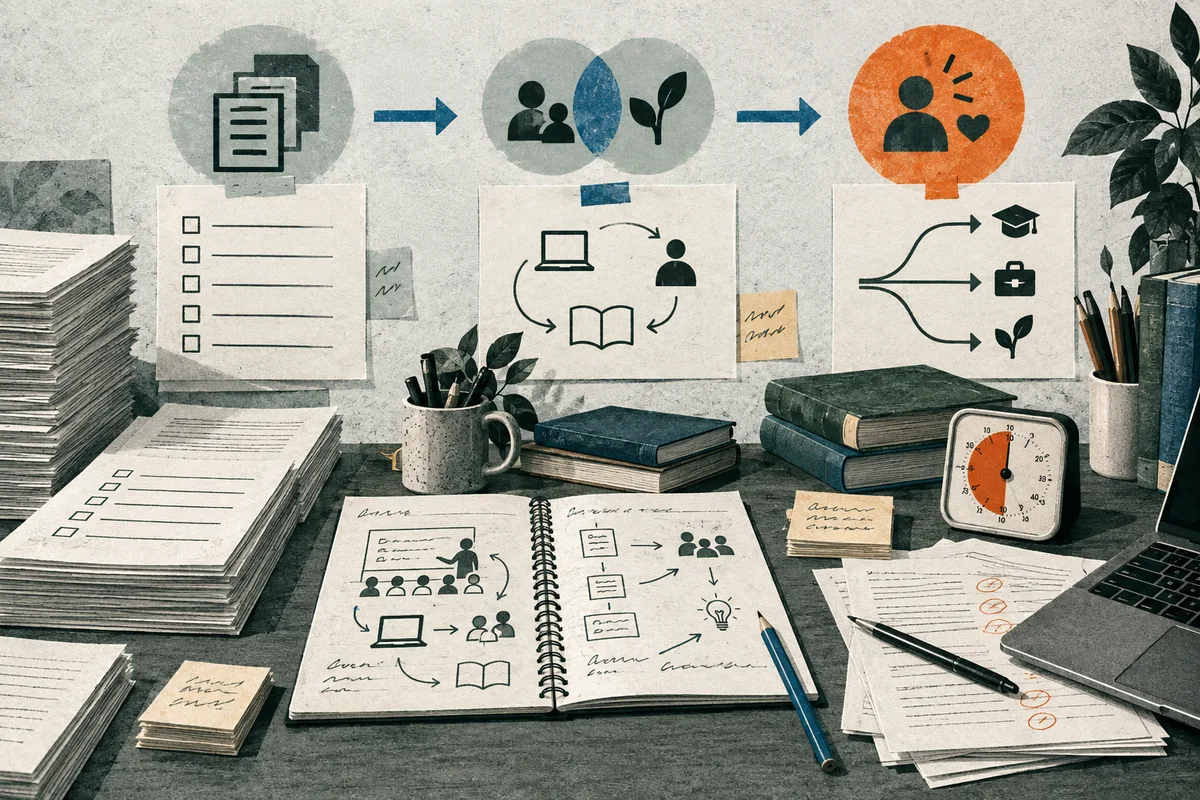
AI is most likely to change first at digital, repeatable education tasks such as drafting materials, creating question variations, summarising notes and preparing routine messages. Teaching also depends on adaptation, trust, privacy judgment and accountable decisions. Map your tasks, test one low-stakes workflow, and compare realistic paths against your constraints. Exposure signals task change, not job loss.
Start with the work, not the job title
When a school, college or training provider says it is adopting AI, the statement is too broad to guide your career. Education work is a bundle of activities with different failure costs. A language teacher may plan a sequence, explain a concept, listen to a learner read, mark an essay, call a parent, record an accommodation and manage a room. A corporate trainer may research a topic, adapt slides, facilitate a difficult discussion, answer questions and judge whether someone can perform a task safely. These are not one kind of work, so they should not receive one risk label.
The first useful split is between production and responsibility. Production includes making a first draft, turning a rubric into question variants, formatting a handout or summarising a long policy. Responsibility includes choosing the learning goal, deciding whether the material is suitable, interpreting a learner's response, changing the sequence and explaining a decision to a student, parent, colleague or regulator. A capable text system may help with the first group. It does not automatically assume the second group.
That distinction is consistent with the occupational description of teaching. The U.S. Bureau of Labor Statistics lists lesson planning, assessment, adaptation, grading, communication with parents, individual support and classroom rules among high-school-teacher duties. O*NET's elementary-teacher profile also includes guiding students with academic or adjustment problems, adapting methods to varying needs, observing performance and conferring with families and other professionals. Those tasks contain digital fragments, but the job is not reducible to the fragments.
Consider an example: you spend an hour producing three versions of a reading exercise and ten minutes deciding that one child needs a simpler text, a spoken explanation and a private check-in. The first task may be highly exposed to drafting automation. The second may be more valuable precisely because it depends on context that is not fully written down. Your practical question is not, ‘Can AI do teaching?’ It is, ‘Which part of my task bundle can change, and where will better judgment matter more when it does?’
The same method works beyond schools. In higher education, separate research assistance, seminar design, marking, supervision and pastoral support. In workplace learning, separate slide production, scheduling, skills diagnosis, facilitation and sign-off on competence. In tutoring, separate exercise generation from the live explanation and confidence-building that follows a wrong answer. The labels may change with the setting, but the decision rule stays stable: inspect the task's inputs, outputs, checks and human consequences.
What AI can change in teaching work
The most immediate pressure sits around work that begins with a clear prompt and ends with a draft or classification. A teacher might ask for examples at several reading levels, a first-pass lesson outline, alternative explanations of a formula, a short parent-message draft or a set of retrieval questions. An instructional designer might turn a policy into a module outline. An administrator might summarise meeting notes or route routine requests. These uses can reduce blank-page time, but they move checking into the centre of the workflow.
Assessment is a particularly important boundary. A tool can suggest questions, group common wording patterns in responses or help a teacher organise a rubric. It can also produce confident errors, flatten cultural context and reward an answer that sounds polished rather than one that shows understanding. If a learner's grade affects progression, support or access, the teacher needs a defensible method and an opportunity to review the evidence. A fast first pass is not the same as a valid decision.
The OECD's Digital Education Outlook describes possible uses such as adaptive systems that track progress, classroom analytics, simulations and tools that may free teachers' time. It also says teachers and learners need the right conditions, and that systems need guardrails for bias, privacy and equitable access. UNESCO's guidance takes a human-centred view and calls for ethical validation, data protection and age-appropriate use. These are not implementation details added after the lesson. They define whether a use is educationally acceptable.
Observed use is also not the same as market-wide adoption. In a 2025 RAND survey report, 53 percent of surveyed U.S. English language arts, mathematics and science teachers said they used AI for school during the 2024–2025 school year. That is evidence of reported use in a defined population and period. It does not show that every subject, country, employer or classroom uses the same tools, or that use has reduced headcount. Treat it as a reason to inspect your workflow, not as a forecast about your employment.
Capability has another boundary: a tool may generate a useful draft in a quiet test while failing in a real classroom. It may misunderstand a local curriculum, invent a source, mishandle a learner's language or create a task that is impossible with the available materials. Reliability is therefore a property of the whole workflow, including the source set, review time, permissions and escalation route. This is why a small, reversible trial teaches more than a general claim that a tool is impressive.
What remains human because the cost of error is high
Trust in education is practical, not decorative. A learner must be able to ask for help, admit confusion and receive feedback without feeling that a hidden system has already decided who they are. A family needs to know who is responsible for a communication about progress. A colleague needs to challenge a placement or accommodation decision. A teacher needs enough knowledge of the learner and the subject to recognise when a plausible answer is wrong.
In-person teaching adds information that a generated response cannot reliably obtain from a prompt. You see which student stops attempting a problem, which group has misunderstood an instruction, or which example creates an unexpected barrier. You can ask a follow-up question, slow down, change the representation and check again. The work is partly verbal and partly relational. It also involves safeguarding, professional boundaries and local rules that may not appear in a neat data record.
This does not make human work automatically safe. Schools can use technology to intensify monitoring, push more pupils through standardised content or shift verification work onto already busy teachers. A human being may remain nominally responsible while having less time and authority to exercise judgment. That is why ‘a human in the loop’ is not enough as a slogan. The human needs access to relevant evidence, time to review it, a route to override the system and a clear line of accountability.
The ILO's 2025 refined global index is useful here because it measures potential exposure at the task level and says transformation is more likely than full replacement for most occupations. Its global figures are not a teacher-specific redundancy forecast. They support a narrower interpretation: digitised tasks can be exposed while occupations retain substantial human input. For education workers, the likely pressure point is how much preparation, documentation and routine assessment can be produced per person, and what employers choose to do with the time released.
Trust also has an institutional side. If a school tells staff to use a system but gives no clear rule for student data, no approved use cases and no way to report an error, the risk is not solved by an individual teacher becoming more enthusiastic. The work may become faster for some users and more stressful for others. A responsible response includes asking for a policy, a training path and a process for contesting a decision. Those requests are part of professional competence, not resistance to change.

A worked task ledger for your next week
You can make the question concrete with a one-week ledger. Write down recurring tasks, not just broad responsibilities. For each task, record the input, the output, who checks it, what happens if it is wrong and whether the learner or family needs a human conversation. This makes exposure observable. It also prevents the common mistake of treating a whole profession as either exposed or protected.
A low-friction example is a first draft of five versions of a practice exercise. The input is a learning objective and a known level. The output is a draft. You can check factual accuracy, reading level and alignment with the objective before use. Change pressure is relatively high because the task is digital and repeatable. A sensible action is to test one approved workflow, retain the source material and record the checks you perform.
A mixed task is reviewing a set of written responses against a rubric. Software may help sort, label or flag patterns. The input is messy learner work, and the output affects feedback. Change pressure is real, but verification cost is also real. Keep the rubric visible, sample the tool's suggestions against your own judgments, look for uneven treatment of language or disability, and do not let a suggested label become the final decision by default.
A low-substitutability task is a meeting with a family about a learner who is falling behind. A system may help prepare a factual summary, but it cannot own the relationship or decide what should be said without context. The output is shared understanding and an agreed next step. The human dependency is high. Your upgrade may be better listening notes, clearer evidence and a repeatable follow-up process, not another content-generation course.
Use four labels in the ledger: exposed, augmented, accountable and context-dependent. They are descriptions of the work, not scores. Review them with a colleague if possible. The point is to find one task where careful use can create capacity and one task where your professional judgment should be made more visible. That pair gives you a clearer development conversation than a general claim that education is ‘at risk.’
Add a fifth question: who benefits from the saved time? If the answer is ‘more worksheets,’ the change may have limited value. If it gives you time for feedback, a small-group explanation, family contact or better preparation for a practical activity, the augmentation case is clearer. If it simply raises the expected volume while preserving the same review burden, you have evidence about job quality and workload. Record that result too.
Choose an upgrade, an adjacent move or a larger change
For many education workers, the first option to test is an upgrade in the current role. Learn enough about data handling, prompt design, evaluation and privacy to improve one named workflow. Build a small before-and-after record: the original task, the tool's draft, your checks, the changes you made and the learner or team outcome you were trying to protect. The durable skill is not memorising an interface. It is designing a useful process and knowing when not to trust the output.
An adjacent move keeps more of your existing experience. A classroom teacher might explore instructional design, assessment operations, learning support coordination, teacher development, curriculum review or education implementation work. A trainer might move toward enablement, learning analytics interpretation or quality assurance. These are not guaranteed safe destinations. They still contain exposed digital tasks. Their attraction is that subject knowledge, facilitation, standards and stakeholder trust may transfer while you add a targeted capability.
A larger change can be rational when your current setting is already shrinking, the work conflicts with your health or schedule, or you want to build a different technical base. Match the route to the goal. Using AI in education usually calls for a project and supervised practice. Building AI-enabled products may call for software foundations and user research. Becoming a machine-learning practitioner requires deeper mathematics, programming, data work and evidence of building systems. A short certificate cannot substitute for prerequisites or a portfolio that demonstrates the target work.
Your constraints should rank the options. Check required credentials, local licensing, salary floor, commute or remote feasibility, study hours, caring responsibilities and the cost of losing paid work. Start with the smallest reversible test that can produce evidence. If an employer wants a new system, ask what problem it solves, what data it uses, how decisions are reviewed, what training is provided and who can override it. RAND found that training and policy have not kept pace evenly across districts, so support should be verified rather than assumed.
The U.S. labor outlook illustrates why exposure and demand must stay separate. BLS projects little or no change in high-school-teacher employment from 2025 to 2035 while projecting about 63,500 openings per year on average, mainly from replacement needs. That is a U.S. occupation-level projection, not an AI effect and not a local promise. It shows why your decision needs both task evidence and the conditions of the market you actually enter.
The learning choice should follow the change you are trying to make. A short course may be enough to learn a specific classroom workflow if it includes practice and feedback. A project is stronger when you need evidence that you can design, test and document a process. A certificate may help structure learning or meet a stated requirement, but its signaling value varies. A degree makes more sense when the target role requires deeper foundations, a regulated credential or a substantial change in discipline. Self-study can be inexpensive and flexible, but you must create your own feedback and proof.
Your next move is a bounded conversation
Do not wait for a perfect policy or a perfect tool. Pick one task that consumes time and has a visible quality check. Ask whether the data can be used lawfully and appropriately. Define the human review before you try the tool. Run the smallest test that fits your setting, then compare the result with the original process. If it saves time but creates extra checking, say so. If it changes the kind of contact you have with learners, measure that as part of the decision.
The professional advantage is not being the person who produces the most machine-written material. It is being able to connect a tool to a learning purpose, test its limits, explain the decision and protect the learner when the output is wrong. That combination can make your contribution more legible as routines change. It also gives you evidence for a promotion, a redesigned role or an adjacent application, without pretending that any path is immune.
If your task mix is unclear, the free task-level change-pressure checker can help you organise the first pass at `/ai-job-risk-checker`. Use its result as a decision signal, not a validated probability of displacement. If the decision involves a move, the paid roadmap at `/career-roadmap` is designed to compare a stay-and-redesign path, adjacent pivots and a larger-change scenario against your experience, salary floor, geography, learning time and constraints. The useful output is a set of trade-offs and a 30/60/90-day sequence, not a guaranteed answer.
End this week by initiating one conversation: ‘Which part of our teaching or learning workflow should we test, what must remain a human decision, and what evidence would make us stop or continue?’ Bring your task ledger. Ask for a named owner, a review point and time to learn. That conversation turns a vague threat into a shared work-design question, while keeping trust and accountability where they belong.
Set a short review window rather than treating the first result as a verdict. Check whether the task took less total time after verification, whether the output met the learning goal, whether any learners were disadvantaged and whether staff understood the process. If the test fails, delete it. If it works, document the conditions that made it work and decide whether the gain belongs in learner support, planning capacity or a reduced administrative burden. That is a work-design decision your team can revisit as the tools change.
Questions readers ask
Will AI replace teachers?
That cannot be concluded from current exposure or use data. AI can produce or organise parts of planning, communication and assessment, while teaching still includes explanation, adaptation, relationships, safeguarding and accountable decisions. The practical question is how employers redesign the task bundle and whether they preserve time for human support.
Which teaching tasks are most exposed to AI?
Digital, repeatable tasks with a clear output are usually more exposed. Examples include drafting lesson materials, generating question variations, summarising notes and preparing routine messages. Exposure rises or falls with the quality of the source data, the cost of checking errors and the consequences of using the output.
Can AI grade student work reliably?
It may assist with sorting, pattern finding or a first pass, but reliability depends on the task, rubric, data and review process. A teacher should check samples, look for uneven treatment and keep final responsibility for consequential judgments. A fluent explanation is not proof that a grade is valid.
What should teachers learn first?
Start with a named workflow, then learn data privacy, clear task instructions, output evaluation and basic automation around that workflow. Practice on a low-stakes task and document your checks. You do not need to become a machine-learning engineer to use AI responsibly in an existing education role.
Is a certificate enough to move into AI in education?
A certificate can provide structure or a signal, but it does not by itself demonstrate workplace capability. Compare it with a supervised project, course, apprenticeship, degree or self-study route by prerequisites, feedback, depth, cost and the job you actually want. Show what you built, evaluated and improved.
What does human trust mean in an AI-supported classroom?
It means learners and families can understand who is making a decision, challenge an error and reach a responsible human. Trust also requires privacy protection, appropriate use, clear communication and enough teacher time to notice context that a system misses. Human presence without authority or review is not sufficient.
How can I decide whether to stay in education or change careers?
Map your tasks first, then compare a current-role upgrade, an adjacent education move and a larger change. Rank them against credentials, location, income needs, study time, health and family constraints. Test the smallest reversible option that can produce evidence before paying for extensive training or leaving paid work.
Sources and notes
- Generative AI and jobs: A 2025 update
Supports the task-level exposure method, global scope and conclusion that transformation is more likely than redundancy.
- Guidance for generative AI in education and research
Supports human-centred, age-appropriate, privacy-conscious and ethically validated use of generative AI in education.
- OECD Digital Education Outlook 2023: Towards an Effective Digital Education Ecosystem
Supports possible AI-enabled education uses, teacher agency, system guardrails, training needs and the separation of digital tools from human educational work.
- AI Use in Schools Is Quickly Increasing but Guidance Lags Behind
Supports the reported 2025 U.S. K–12 teacher and student use findings and the evidence that policies and professional development lag.
- More Districts Are Training Teachers on Artificial Intelligence
Supports the 2024 district-training survey, its poverty-status differences, and the limits of interpreting district plans as completed support.
- High School Teachers: Occupational Outlook Handbook
Supports the listed teaching duties, U.S. education requirements and the 2025–2035 projection and replacement-opening context.
- 25-2021.00 Elementary School Teachers, Except Special Education
Supports the detailed task bundle involving instruction, adaptation, behavior, family communication, assessment, records and interpersonal work.
Apply this to your own work
See the whole job market at once.
Explore which occupations AI may reshape, then turn the signal into a practical response.
Explore the job map