
AI is changing healthcare by rearranging tasks before it changes occupations. Record retrieval, coding, scheduling, and documentation drafts are more exposed to assistance. Consent, physical care, ambiguity, escalation, and accountability remain harder to hand over. Map your task bundle, test one bounded improvement, then compare an upgrade, adjacent move, or larger change. Exposure is not a job-loss probability.
The practical result: your work will be split before it is replaced
If you work in healthcare, the useful question is not whether AI will replace nurses, coders, physicians, technicians, or administrators. Those labels hide very different bundles of work. Ask which parts of your week involve clean digital inputs, repeatable rules, and an output that another qualified person can inspect. Those parts are candidates for assistance or automation. Ask which parts involve incomplete information, a distressed person, physical presence, competing obligations, consent, or a decision that must be explained and owned. Those parts have more friction.
The International Labour Organization's 2025 refined exposure index is helpful because it evaluates tasks rather than treating an occupation as a single unit. It combines task-level information, worker input, expert judgment, and model predictions. The study reports that clerical work remains the most exposed broad category, while some highly digitized professional and technical tasks have also become more exposed as tools improve. That supports a measured conclusion: healthcare roles with substantial records, forms, coding, and text handling may change quickly, but an exposure finding does not establish employer adoption, reduced staffing, or displacement.
Healthcare also has a demand signal that should not be confused with an AI signal. The current U.S. Bureau of Labor Statistics healthcare outlook, last modified August 27, 2026, says overall employment in healthcare occupations is projected to grow much faster than average from 2025 to 2035, with about 1.9 million openings per year on average because of employment growth and replacement needs. That is a directional U.S. outlook, not a promise for your country, employer, specialty, or salary. It does show why a worker can face meaningful task change inside an expanding field. A growing occupation can still redesign particular tasks, raise verification expectations, or reduce demand for a narrow administrative slice.
The immediate career implication is simple: protect the parts of your role that connect information to safe action, and become useful at supervising the parts that software can accelerate. You do not need to predict the final shape of healthcare. You need a clear account of what is changing in the next workflow you touch.
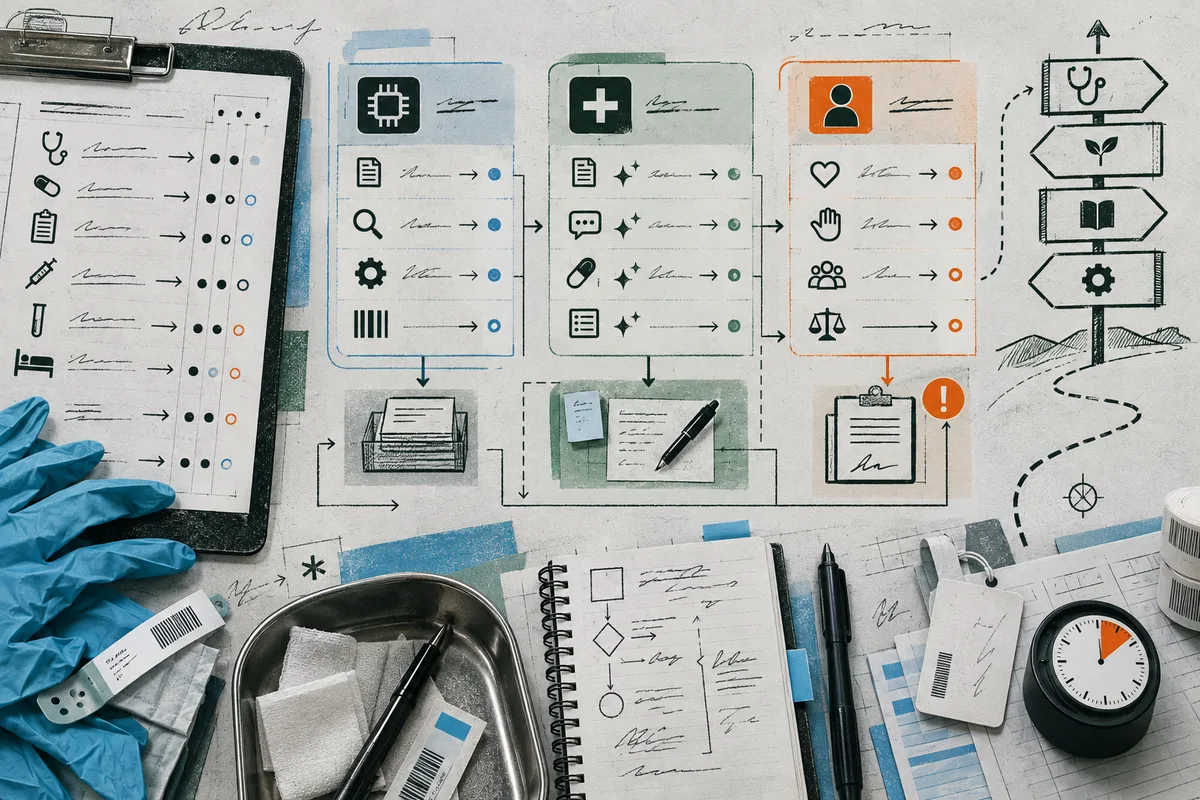
A worked task map for a healthcare workflow
Consider an example in an outpatient clinic. A medical records specialist may receive a referral, retrieve a patient's record, check whether documentation is complete, classify diagnoses and procedures, resolve a conflicting code, release information under the applicable rules, and prepare a record for a clinician or insurer. O*NET's current profile describes this kind of work as combining record maintenance and classification with medical, administrative, ethical, legal, and regulatory requirements. It also lists review for completeness and accuracy, confidentiality protection, and clarification of unclear diagnoses among the work activities.
Now divide that bundle by the kind of change pressure each task carries. Scanning, extracting fields from a document, finding a likely code, drafting a routine request for missing information, or routing a record are relatively structured. A system may assist with them, provided the inputs are available and the output can be checked. That is capability and applicability, not proof that a clinic has deployed the tool or that the specialist's job disappears.
A second group is review work. The specialist still has to compare the proposed code with the source note, notice that a diagnosis is ambiguous, check whether a release is authorized, and send the question to the right clinician. Software can shorten the first pass while increasing the value of exception detection. If a draft looks polished, the review burden does not become zero. It may become more concentrated in unusual cases and more consequential when a mistake slips through.
A third group carries trust and accountability. Explaining why information cannot be released, protecting confidentiality, resolving a dispute, documenting the basis for a correction, and escalating a safety or compliance concern require authority and judgment within a real organization. A tool can surface a rule or draft language. It cannot be treated as the accountable party. The person and institution still need a traceable process for what was accepted, changed, escalated, and communicated.
The same map works for clinical documentation. Speech recognition may capture an encounter and a system may propose a note. A clinician still decides whether the note reflects what was said, whether an omitted detail changes the meaning, whether an assessment is clinically supported, and whether the final record is fit for care. In diagnostic support, a model may flag an image or risk pattern. The professional must understand the intended use, inspect the underlying evidence, consider alternatives, and act within the normal standard of care. The task shifts from producing every first draft to reviewing, correcting, and taking responsibility for the final result.
What current evidence says about documentation and adoption
Documentation is a useful test case because it has a visible output and a real burden. A 2024 study in a children's hospital evaluated an ambient documentation tool in simulated consultations with clinicians and actors. The researchers reported higher documentation scores and shorter consultations on average, while patient interaction time was not reduced. The setting and design matter: simulated consultations with a small clinician sample can show potential and workflow effects, but they cannot establish the result in every specialty, health system, or patient population.
A later quality-improvement evaluation at a large nonprofit healthcare organization examined clinicians before and after access to an ambient platform. It associated use with less time in notes per appointment and improved reported work experience and cognitive load. Because the study was conducted in one organization with a before-and-after design, it is evidence of an observed association in that implementation, not a universal productivity guarantee. Implementation quality, training, editing habits, patient consent, data handling, and local workflow all matter.
The adoption picture is also more mixed than a headline about rapid uptake suggests. The AMA's 2024 physician survey, reported in February 2025, found that 66% of surveyed physicians said they currently used AI in practice, compared with 38% in 2023. The survey also found that administrative burden was the leading opportunity named by respondents. At the same time, physicians reported concerns about privacy, poor electronic-record integration, incorrect recommendations, and liability. The survey measures what respondents report and how they feel. It does not measure reliable performance across all tools or prove that use is equally deep in every workplace.
For a worker, this distinction changes what to learn. Do not simply announce that you use a popular tool. Learn the workflow around it: how input is captured, what the system is meant to do, what it does not do, how errors are found, how a correction is recorded, and when a human must escalate. In healthcare, implementation literacy can be more valuable than surface familiarity with a particular interface because products, vendors, and local policies can change.
Trust is a work task, not a feeling about the tool
Trust in a healthcare system has at least two layers. A patient needs to know how their information is used and who is listening or deciding. A worker needs enough information to judge whether a tool is appropriate for this case, in this setting, for this purpose. Confidence alone is not evidence. Nor is suspicion a complete safety method. The practical question is whether the workflow makes checking possible.
AHRQ's current diagnostic-safety guidance describes several failure modes that can appear when clinicians interact with automated outputs. Automation bias can lead people to over-rely on a recommendation, particularly under time pressure. Confirmation bias can make a matching recommendation receive less scrutiny. Vigilance can decline when a system is usually correct, and prolonged dependence may contribute to deskilling. A human reviewer is therefore not a magic safety switch. The reviewer needs time, relevant source information, a clear intended use, and permission to disagree.
Imagine a tool drafts a patient message from a chart. The safe review is not a quick scan for spelling. The reviewer checks the patient's identity and context, confirms that the draft is supported by the record, removes information the patient should not receive in that channel, tests whether the language could be misunderstood, and routes clinical questions to the appropriate professional. If the workflow makes that review impossible because volume targets assume every draft is accepted, the nominal human decision is weak accountability.
The World Health Organization's health-AI guidance places autonomy, safety, transparency, responsibility, inclusiveness, and sustainability among its core principles. These are not abstract values to leave with a compliance team. They translate into work questions: can the patient understand the role of the system, can the worker see enough to challenge it, are affected groups represented in evaluation, and is there a named route for incident reporting and correction? Workers who can turn those principles into ordinary operating steps are likely to become more useful as systems spread.
Accountability must be designed into the workflow
“A human remains in the loop” is too vague to protect a patient or a worker. Accountability needs an owner at each handoff. Someone should know which version of a system was used, what its intended use was, what evidence it received, who reviewed the output, what was changed, and how a concern is escalated. The exact record will depend on the system and the governing rules, but the principle is stable: responsibility cannot disappear between a vendor, an employer, a clinician, and a patient.
The Office of the National Coordinator's HTI-1 final rule offers a concrete example of this direction in certified health IT. It establishes transparency requirements for AI and other predictive algorithms so clinical users can access baseline information and assess issues such as fairness, appropriateness, validity, effectiveness, and safety. It also introduces reporting metrics about how certified health IT is used. The rule does not make every model safe, and it applies within its regulatory scope. It does show why the ability to ask for model information, document use, and evaluate fit is becoming part of healthcare work.
The FDA's AI-enabled medical device list is another boundary worth understanding. The agency says listed devices have met applicable premarket requirements for their intended use, while also warning that the list is not comprehensive and that public summaries are not all the information submitted. Authorization is therefore evidence about a device's regulatory pathway and intended use. It is not a blanket statement that the device is accurate for every patient, setting, operator, or decision.
A practical worker's checklist follows from these sources. Before relying on a tool, identify its intended task and prohibited uses. Confirm what data it receives and whether the output is a draft, alert, classification, or recommendation. Ask how performance is monitored after deployment and how users report errors. Define the independent check that must happen before action. Record exceptions rather than hiding them. If no one can answer these questions, the problem is not your lack of enthusiasm or technical skill. The workflow is not ready for dependable use.
Three realistic career moves, ranked by disruption
The best response depends on your credentials, local labor market, salary floor, schedule, health, family responsibilities, and appetite for study. No article can choose among those constraints for you. It can make the options clearer. Start with the least disruptive move that addresses a real change in your task mix, then escalate only when the evidence and your goals justify it.
First, upgrade the current role. This fits when your domain knowledge is still valuable and the changing tasks are a contained part of the job. A coder might learn to audit machine-suggested classifications, track error patterns, and improve the source documentation that makes coding reliable. A nurse or physician might participate in a documentation pilot, define review rules, and report unsafe failure modes. An administrator might map referral or authorization work, remove unnecessary handoffs, and test a narrow automation with a measurable quality check. The next learning step is usually a short, bounded project plus basic data, privacy, evaluation, and workflow knowledge. A certificate is useful only if it supplies feedback or a recognized requirement for the role you want.
Second, make an adjacent move. This fits when you want less direct care or when your strongest value is moving between clinical work, records, operations, and technology. Plausible directions include health information management, clinical informatics support, quality improvement, implementation coordination, privacy and compliance operations, or workflow analysis. These paths are not interchangeable. Some require a credential, a clinical background, coding knowledge, or experience with a particular health-record environment. Before paying for training, read current job descriptions in your target geography and list the repeated requirements. Then complete a small portfolio artifact, such as a documented workflow map, evaluation plan, error taxonomy, or de-identified mock implementation brief.
Third, pursue a larger change. This fits when your desired work, constraints, and local opportunities point beyond your current field. Moving into software development, data analysis, or machine-learning engineering generally requires deeper foundations in programming, statistics, systems, and deployment than a short course can provide. A degree may be appropriate when you need structured depth, access to labs, formal prerequisites, or a credential that employers in the target occupation expect. A course, certificate, apprenticeship, project, or self-study plan may be more proportionate when you are testing fit or adding a skill to an existing role. The choice should follow the outcome, not the prestige of the format.
Ranked this way, the paths are not a promise that staying is safer than leaving. They are a way to control downside. Test whether your existing experience creates leverage before discarding it. If the test fails, use the result to specify the larger move instead of buying a vague education product.
A 30-day experiment for exposed healthcare tasks
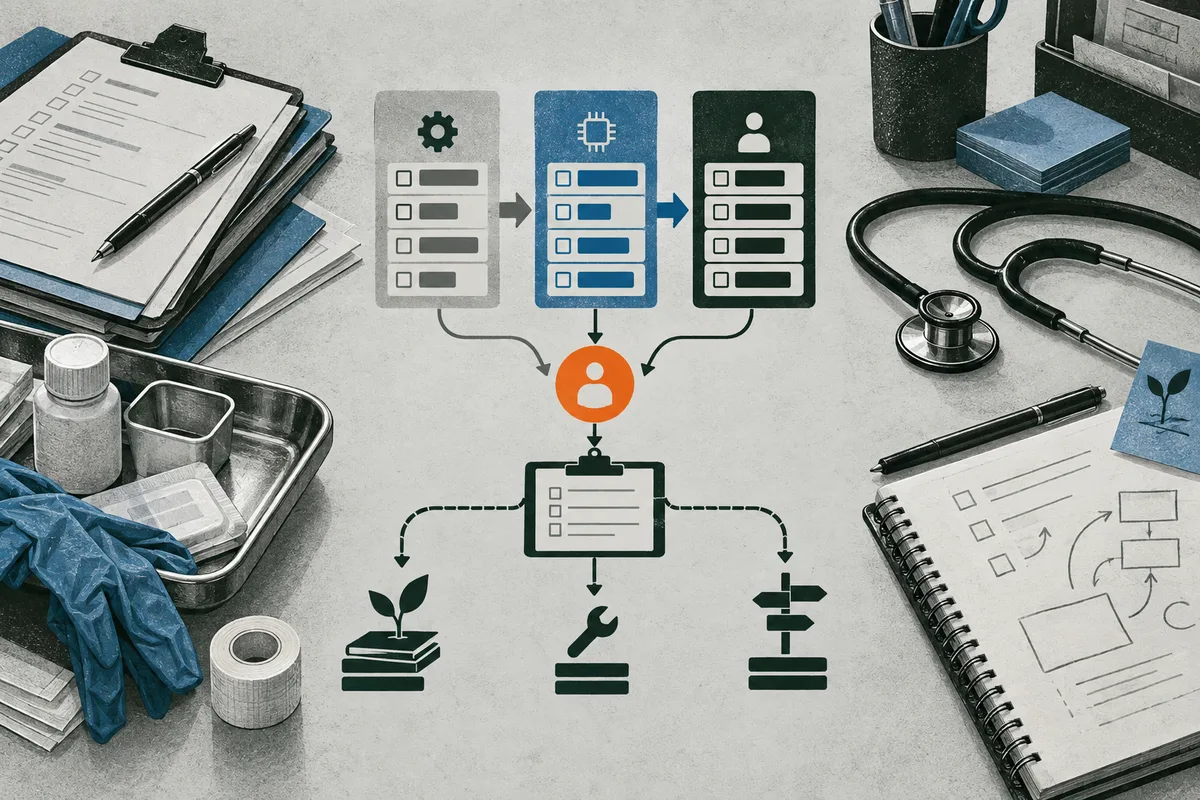
Choose one recurring task that is important enough to matter and narrow enough to observe. Examples include preparing a routine summary for review, routing incomplete referrals, checking a set of proposed codes against source notes, or measuring where documentation is delayed. Do not begin with an open-ended instruction to automate healthcare. Define the boundary, the authorized data, the reviewer, and the failure that would stop the test.
In week one, write the current process in plain language. Count the handoffs, decisions, rework, and places where missing context causes delay. Mark each step as draftable, checkable, accountable, or out of scope. Record the quality requirement in terms someone can inspect, such as completeness, correct routing, timely escalation, or faithful documentation. This gives you a baseline without pretending that one score captures job risk.
In week two, learn only what the task needs. That may mean understanding structured data, prompt boundaries, access controls, evaluation samples, or the local policy for approved tools. It may mean no new software at all. A spreadsheet that reveals the source of rework can be a better first intervention than a new platform. If a tool is approved for the experiment, use synthetic or properly authorized data and keep a human review step.
In week three, compare outputs with the original process. Look for omissions, plausible errors, uneven performance across case types, privacy problems, and new work created by checking. Ask whether the tool saves time without reducing attention or merely moves effort downstream. Have the person who understands the clinical or regulatory consequence review the exceptions. A polished average is not enough if rare failures are serious.
In week four, decide among three outcomes: adopt the narrow assist with a documented control, redesign the task without that tool, or stop and investigate the failure. Save the artifact and the decision. It becomes evidence of a capability you can discuss: not that you know a fashionable product, but that you can frame a workflow, evaluate an intervention, and protect accountability.
Return to the opening question: what should you do next?
Which parts of your work are exposed? Start with the digital, repeatable, information-heavy steps that produce drafts, classifications, retrievals, or routing decisions. Which parts remain harder to hand over? Look for physical presence, consent, ambiguity, exception handling, relationship, cross-team coordination, and responsibility for consequences. Which parts may become more important? Often it is the checking, escalation, explanation, governance, and improvement around the automated step, although the local workflow decides the balance.
Do not turn that map into a personal redundancy forecast. The evidence can tell you that a task is technically applicable, that a profession reports current use, that a study observed a workflow effect, or that regulators expect more transparency. It cannot tell you what your employer will adopt, how your manager will redesign work, or what will happen to your income. Those are separate questions requiring local information and a realistic account of your constraints.
Your proportionate action is to choose one exposed task, make its quality and accountability requirements visible, and run the smallest responsible improvement you can review. If the result strengthens your current role, build from there. If it reveals a mismatch, compare an adjacent path and a larger change against prerequisites, time, cost, location, salary needs, and family reality. Your experience is not a reason to ignore change. It is information about where you may have leverage.
When the uncertainty is still broad, use the free task-level checker to organize the task bundle and identify a first action. It reports transparent change-pressure signals, not a validated probability of displacement. If you need to compare stay-and-redesign, adjacent, and larger-change scenarios against your own constraints, the career roadmap can structure that decision and a 30/60/90-day plan. Neither path can guarantee employment or income. The useful result is a clearer next experiment, grounded in the work you actually do.
Questions readers ask
Will AI replace healthcare workers?
That cannot be answered responsibly as a single occupation-wide forecast. AI can assist or automate some digital and repeatable tasks, while care, context, physical work, exception handling, and accountability remain part of the wider workflow. Employer adoption, regulation, demand, and staffing decisions determine what changes locally. Map your tasks rather than treating exposure as a job-loss probability.
Which healthcare tasks are most exposed to AI?
Tasks with structured digital inputs and inspectable outputs are generally more applicable to software assistance. Examples include record retrieval, field extraction, routine documentation drafts, coding suggestions, scheduling, routing, and some image or signal triage. Applicability does not prove reliable performance or workplace adoption, and high-consequence outputs still require appropriate review.
Does a human reviewer make healthcare AI safe?
No. A reviewer needs time, relevant source information, a clear intended use, training, and permission to challenge the output. AHRQ describes automation bias, confirmation bias, reduced vigilance, and possible deskilling as risks in human-AI interaction. Safety requires a designed workflow with named responsibility, monitoring, escalation, and correction, not just a person nominally placed in the loop.
Should I learn AI tools or pursue a new healthcare qualification?
Begin with the outcome you want. If you want to improve your current healthcare role, learn the data, evaluation, privacy, and workflow concepts needed for one real task. If you want health information, implementation, informatics, or compliance work, inspect current local job requirements and build a relevant project. A larger move into software or machine learning usually needs deeper study. Choose a degree, course, certificate, apprenticeship, project, or self-study path based on prerequisites, feedback, signaling, cost, and time.
Are healthcare jobs safer because demand is growing?
Growth and AI exposure are separate signals. U.S. Bureau of Labor Statistics projections show strong expected growth across healthcare occupations, but those projections are not local guarantees and do not prevent particular tasks from being redesigned or reduced. Use demand data to understand the field, then examine your occupation, specialty, geography, and task mix.
What should I do this month if my healthcare tasks are changing?
Select one recurring task, document the current process, mark draftable and accountable steps, define a quality check, and run a small authorized experiment. Compare time saved with omissions, errors, privacy concerns, rework, and escalation quality. Keep, redesign, or stop the intervention based on what you observe. That artifact can guide an upgrade, an adjacent move, or a more deliberate larger change.
Sources and notes
- Generative AI and Jobs: A Refined Global Index of Occupational Exposure
Supports the task-level method for discussing occupational exposure and explains why exposure should not be treated as a displacement measure.
- Healthcare Occupations: Occupational Outlook Handbook (2025–2035 projections)
Supports the BLS healthcare outlook last modified August 27, 2026: 2025–2035 employment projections and about 1.9 million average annual openings; it does not predict AI displacement or local outcomes.
- 29-2072.00 Medical Records Specialists
Supports the concrete medical-records task bundle, including classification, review, confidentiality, clarification, and regulatory record handling in real healthcare workflows and compliance decisions.
- Use of an ambient artificial intelligence tool to improve quality of clinical documentation
Supports the reported documentation and consultation findings from a simulated clinical study, including the limitations of its setting and design.
- Human-AI Interaction
Supports the review risks of automation bias, confirmation bias, vigilance decline, and possible deskilling in human-AI clinical work under workload pressure.
- Limitations of AI and the Resulting Risk
Supports concerns about hallucinations, bias, opaque outputs, and why effective human oversight requires more than a nominal reviewer in clinical settings.
- Evaluation of an Ambient Artificial Intelligence Documentation Platform for Clinicians
Supports the qualified observation that one healthcare organization associated ambient documentation use with reduced note time and improved reported experience.
- AMA: Physician enthusiasm grows for health care AI
Supports reported physician use, perceived administrative opportunity, and continuing concerns about privacy, integration, errors, liability, and regulatory oversight in practice.
- HTI-1 Final Rule
Supports the U.S. certified-health-IT algorithm transparency and usage-reporting requirements described in the accountability section of this article and their practical relevance.
- Ethics and governance of artificial intelligence for health
Supports the health-AI governance principles concerning autonomy, safety, transparency, responsibility, inclusion, and sustainability in responsible deployment across health systems and affected communities.
- Artificial Intelligence-Enabled Medical Devices
Supports the distinction between FDA authorization for an intended device use and any claim of universal safety or comprehensive coverage.
- Healthcare, science, and engineering careers that don’t require a 4-year degree
Supports comparing healthcare transition paths by typical education and training requirements rather than prescribing one credential for every reader or occupation.
Apply this to your own work
See the whole job market at once.
Explore which occupations AI may reshape, then turn the signal into a practical response.
Explore the job map