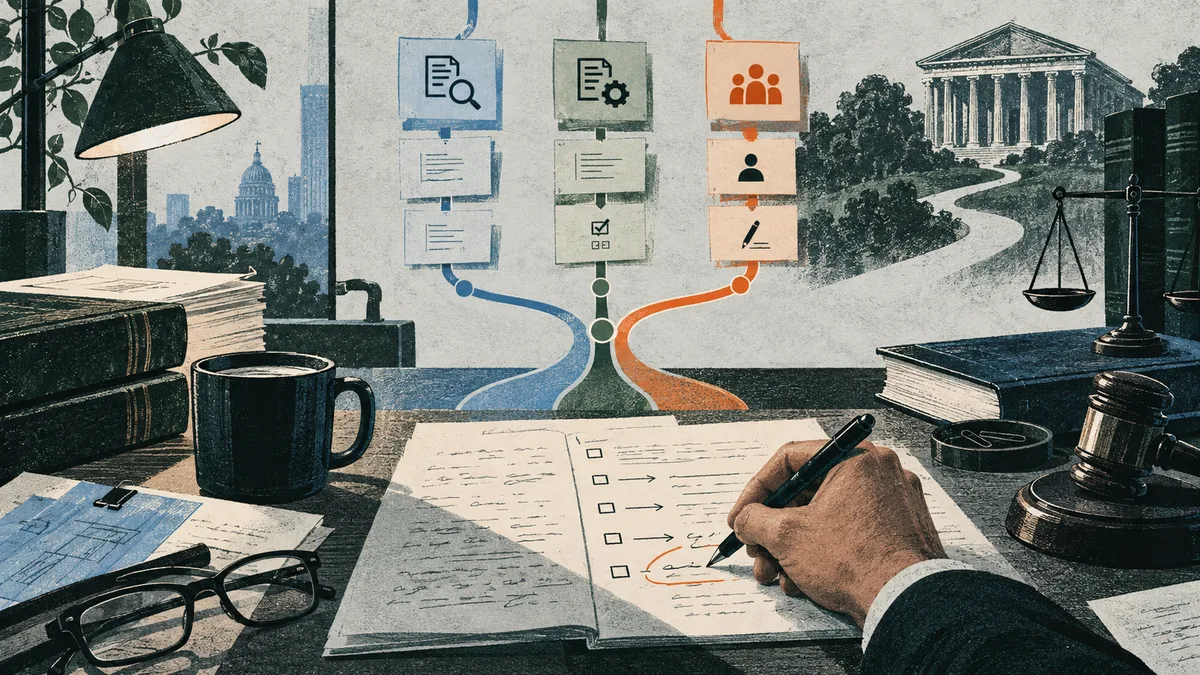
AI is changing legal work unevenly. Research, comparison, summarization, and first-pass drafting are more exposed, while client advice, confidentiality, negotiation, judgment, and accountability remain harder to delegate. Treat exposure as a task signal, not a job-loss probability. Map one workflow, test controls, and choose a realistic next move.
Start with the legal task, not the job title
Suppose you are asked to prepare a first-pass memo before a client call. Your immediate question may be, “Will AI make this role smaller?” That question is too broad to guide a decision. A better question is: which parts of this assignment can a tool perform or accelerate, which parts require a licensed professional, and which parts become more important when the first draft is cheap?
The Bureau of Labor Statistics describes lawyers as people who advise and represent clients, conduct research and analysis, interpret law for particular circumstances, present findings, and prepare legal documents. O*NET breaks that bundle into tasks including interpreting laws, analyzing likely case outcomes, gathering evidence through interviews, advising clients, drafting documents, negotiating settlements, and supervising legal personnel. These tasks do not have the same exposure to software. A document comparison is not the same work as deciding what a client should do after the comparison reveals a risk.
Use five questions for any recurring task: Is the input digital? Is the output bounded? Can a qualified person verify it against an authoritative source? Does the task require facts that are missing from the record? Who bears the consequence if the answer is wrong? The first three questions often indicate useful augmentation. The last two identify where review, judgment, trust, and accountability remain central. This is a more useful map than labeling the entire legal occupation exposed or safe.
That distinction also explains why labor evidence should be read carefully. The OECD notes that exposure measures compare occupational tasks with AI capabilities, while actual effects depend on adoption, regulation, organizational change, and social choices. An exposed task may be automated, assisted, redistributed to a junior worker, or left unchanged because the organization cannot accept the verification cost. Exposure describes technical fit. It does not describe a person's redundancy.
Model one: AI as a research and drafting accelerator
The most practical interpretation is that AI becomes a fast first-pass layer around work that already exists. A lawyer may use a search system to identify potentially relevant authorities, ask a document tool to group provisions by topic, compare two versions of a contract, extract dates from a supplied record, or turn notes into a rough outline. The American Bar Association's Formal Opinion 512 lists legal research, contract review, due diligence, document review, regulatory compliance, and drafting among possible uses.
This model changes the shape of junior work. Time previously spent locating a clause, building a chronology, or producing a rough summary may shrink. Time spent defining the question, selecting the source set, checking omissions, testing the output, and explaining the result may grow. That can be a good redesign if the worker is allowed to learn the higher-value parts. It can be a poor redesign if the organization treats the first draft as finished and removes the supervision that made the work reliable.
Consider an example. A commercial lawyer receives a 180-page agreement and a request to identify termination rights, notice periods, and change-of-control language. A tool can help locate candidate provisions and create a comparison table. The lawyer still has to check defined terms, schedules, amendments, governing law, and the factual trigger in the client's situation. A missed exception can matter more than a polished summary. The valuable skill is not merely knowing where to click. It is designing a review that makes omissions visible.
The same pattern applies to legal research. A system can suggest an issue tree or surface authorities. It may miss a jurisdictional split, rely on an outdated rule, accept a false premise, or state a holding too broadly. The output is a research lead, not authority. If you can turn a broad question into verifiable subquestions and show why each source supports the conclusion, your value may increase even as raw drafting time falls.
Model two: AI as a judgment and responsibility problem
The second model starts from the professional boundary. AI may produce an answer, but it does not become the lawyer who owes duties to a client or a court. Formal Opinion 512 connects AI use with competence, confidentiality, communication, supervision, candor toward a tribunal, meritorious claims, and reasonable fees. The point is not that every AI-assisted sentence is dangerous. The point is that using a tool changes the lawyer's control and review obligations.
A court's guidance makes the boundary concrete. The Northern District of California says a person remains responsible for everything filed, regardless of whether an AI tool was used. It warns that tools may produce nonexistent citations, misstate the law, misread facts, and expose confidential information. It tells filers to confirm that a cited case exists, read the case, verify current rules and quotations, and review original sources rather than rely on generated summaries.
This is why a plausible answer is not the same as dependable legal work. The work product must fit the actual record, the correct jurisdiction, the relevant date, the client's objective, and the procedural setting. A lawyer must also decide when not to use a tool, what information may be entered, how much review is proportionate, and how to communicate material limitations. Those are professional decisions. They are not solved by asking for a more confident paragraph.
The strongest counterpoint is that advanced systems may improve rapidly and outperform people on some legal reasoning tasks. That is worth tracking. It still does not erase the institutional problem: a benchmark answer is not a client relationship, a complete factual record, a filed representation, or an allocation of responsibility. Better capability can increase the value of careful oversight because more work can be attempted at lower cost. It does not remove the need for a person who can validate and own the result.
Research changes when verification becomes part of the work
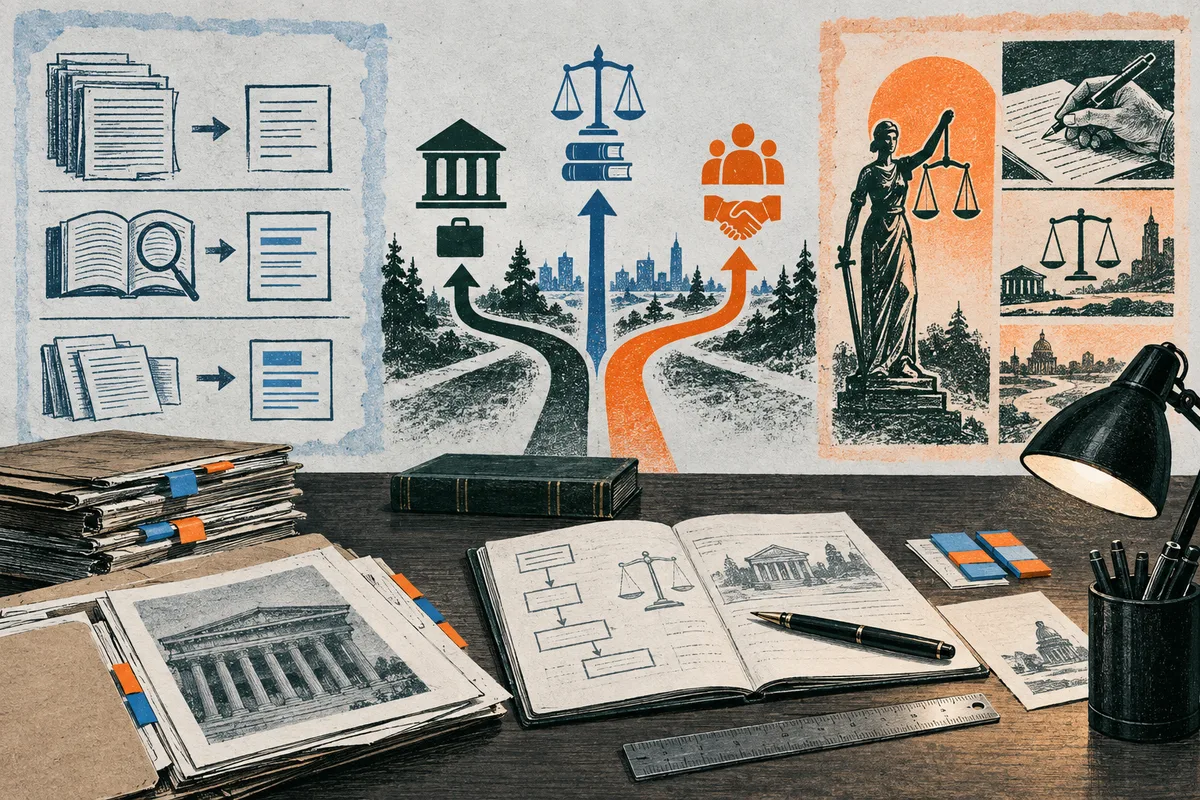
Legal research is exposed because much of it involves language, retrieval, classification, and synthesis. But the exposed portion is not the whole research function. A useful research process still begins by clarifying the issue, identifying the jurisdiction and time period, collecting primary authorities, and separating facts from assumptions. AI can assist with some of the middle steps. It cannot be treated as the source of law.
A Stanford RegLab and Stanford HAI study tested leading legal research tools on a preregistered set of more than 200 open-ended questions. The study reported that the tools made fewer errors than general-purpose systems, but it also found incorrect information in the tested answers. The published results were not a population-wide error rate for every legal query. They were a warning against treating specialized branding or retrieval features as proof that verification is unnecessary.
For a research memo, make the verification trail visible. Record the question asked, the authorities returned, the authorities you independently opened, the proposition each authority supports, and the unresolved issue. Check negative conclusions especially carefully. “No case says X” is harder to establish than “this case says Y.” If a tool proposes a case, statute, quotation, or procedural rule, verify it in the primary source before it enters the memo or filing.
This workflow turns an apparent productivity loss into a professional asset. You are not competing with a machine on who can generate the most text. You are making the result auditable. A partner, client, judge, or colleague can see what was checked and where uncertainty remains. That skill transfers across research platforms because it rests on source discipline, issue framing, and legal reasoning rather than on one interface.
Drafting changes, but responsibility stays with the filer
Drafting is another high-exposure area. A tool can produce a client-email outline, a clause comparison, a chronology, or a first draft in a requested structure. It may also make the text sound finished before the legal work is finished. The risk is not limited to invented citations. A draft can omit an exception, soften a qualification, mix facts from two matters, use the wrong defined term, or create a confident statement that the record does not support.
The safe division of labor is simple to state. Use software for bounded transformation of material you understand and are permitted to process. Keep issue selection, factual validation, legal interpretation, strategic advice, and final approval with the qualified human responsible for the matter. For a court document, inspect every authority and quotation. For a client communication, check that the advice answers the client's actual question and states consequences in plain language. For a contract, compare the draft against the business deal, not only against a template.
Confidentiality is part of task design. The court guidance notes that information entered into third-party tools may be stored or processed outside the user's control, may not be confidential or privileged, and may be discoverable. Your workplace may have approved tools, restricted data classes, logging rules, or client-consent requirements. A generic public interface is not automatically an acceptable place for client facts. The practical skill is learning the firm's data boundary and designing prompts and review steps around it.
Billing and disclosure can change too. Formal Opinion 512 discusses communication with clients and reasonable fees when a lawyer uses generative tools. The exact rule depends on the jurisdiction, engagement, tool, and billing arrangement. Do not promise a universal answer. Instead, learn the policy that governs your work and make your time, tool use, and review defensible.
What this means for legal roles and early careers
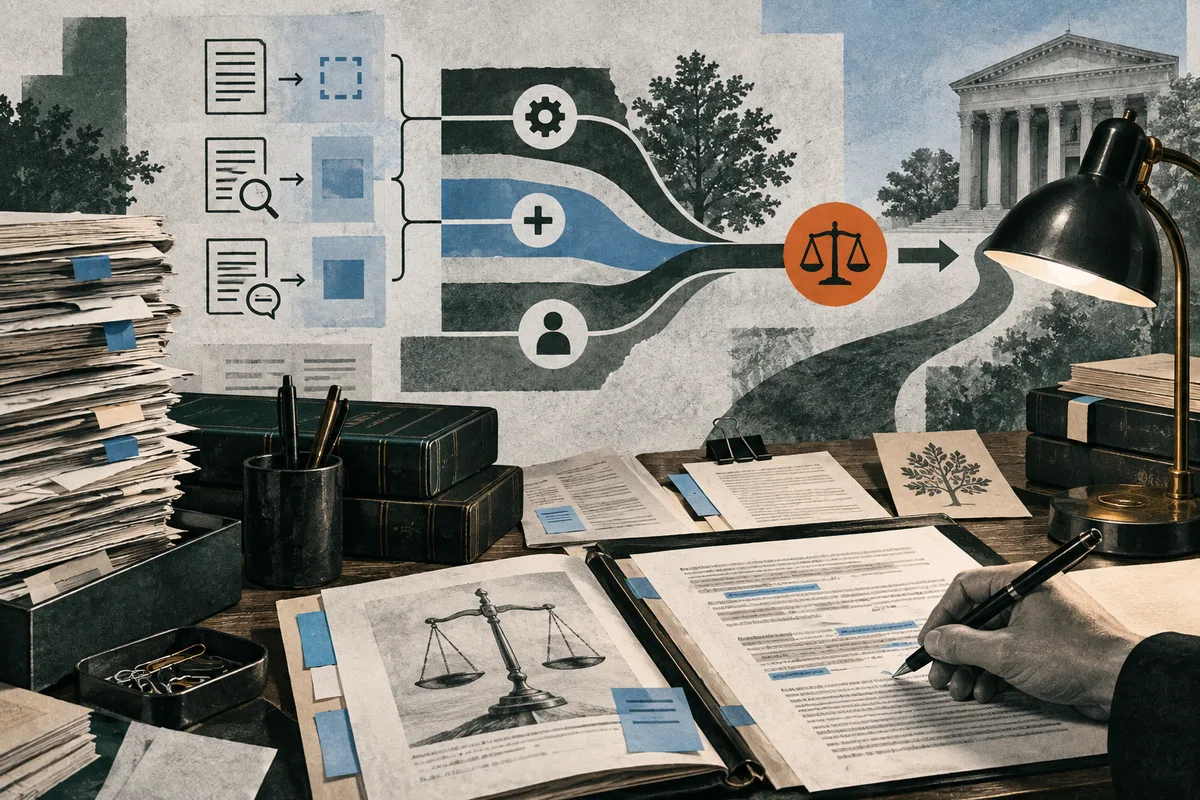
For lawyers and legal professionals, the likely pressure is uneven. Repetitive text handling, basic retrieval, routine summaries, and standard document assembly are easier to accelerate than client counseling, negotiation, advocacy, fact development, and accountability. The balance will differ by practice area, organization, jurisdiction, data access, and risk tolerance. A legal assistant, paralegal, junior associate, in-house counsel, and litigator may use similar tools for different tasks and face different review duties.
Do not read the current outlook as proof that AI has no effect. The U.S. Bureau of Labor Statistics projects lawyer employment to grow 5 percent from 2025 to 2035, with openings also arising from replacement needs. That is a U.S. occupational projection, not a forecast for your city, practice area, employer, or individual career. It also measures employment, not the distribution of tasks, training opportunities, billing models, or entry-level work inside the occupation.
For someone early in a legal career, the risk is not simply that fewer documents will be drafted. It may be that some low-risk tasks used to learn doctrine, procedure, and professional judgment are compressed. Seek assignments where you can see the full chain: facts, issue, authority, recommendation, client communication, and review. Keep a small portfolio of de-identified work processes, such as a source-checking checklist, a contract review protocol, or an issue tree with verification notes. The artifact demonstrates how you work, not just that you can produce polished prose.
For a mid-career worker, start with the recurring work that consumes time and creates rework. Measure where a bounded tool could help, then identify the quality control that must be added. You may become the person who designs the review process, trains colleagues, handles exceptions, or translates tool output into advice. That is an upgrade only if the organization recognizes and rewards the responsibility. If it does not, an adjacent move into legal operations, knowledge management, compliance, contract management, or legal technology implementation may use your domain experience without requiring you to abandon it.
Choose a move that fits your constraints
There are three sensible responses, and none is automatically best. First, upgrade the current role. Choose this when you have useful domain experience, access to supervised work, and a task where better research, review, or workflow design can show value. Learn the approved tools, basic data handling, evaluation, source verification, and process documentation. A bounded pilot on a low-risk internal workflow is more informative than collecting certificates without a workplace use case.
Second, make an adjacent move. This can fit someone whose legal knowledge is strong but whose current work is becoming repetitive or whose organization offers little room to redesign it. Possible directions include legal operations, contract lifecycle work, compliance process design, knowledge management, litigation support, or implementation roles. These are not guaranteed “safe” jobs. They still involve digital tasks and changing demand. The case for them is fit: they may combine legal context with process ownership, stakeholder communication, and quality controls that your experience already supports.
Third, consider a larger change only when the destination is clear enough to test. If you want to build AI-enabled products, you may need more software, data, and product practice. If you want ML engineering or research, the prerequisites and depth are substantially greater than a short prompt course. If you want to use AI in an existing legal field, you may need no new degree at all. You may need a supervised project, an internal workflow, and evidence that you can evaluate outputs responsibly.
Set the decision against your actual constraints: salary floor, location, licensing, time available after work, caregiving, health, debt, and appetite for uncertainty. A seven-year path to legal qualification is not interchangeable with a short course, and a certificate is not the same as workplace capability. The next step should reduce uncertainty. Interview the person who owns a relevant workflow, inspect current job descriptions in your target geography, or complete one de-identified project with a review checklist before paying for a large program.

A practical next step for the next two weeks
Return to the memo or document that made you ask this question. List the tasks in order, not the job title: intake, fact gathering, search, document review, analysis, drafting, client discussion, negotiation, filing, and follow-up. Mark each task as exposed, augmented, or human-accountable. Use “exposed” for work that a capable tool can plausibly speed up; “augmented” for work where the tool can assist but review shapes the outcome; and “human-accountable” for decisions that require professional judgment, trust, authority, or responsibility. The categories are working labels, not a validated score.
Then choose one low-risk task and write a control plan before using a tool. Define the permitted data, the source set, the expected output, the checks, and the person who approves it. Run the task, record what the tool missed or made harder, and compare the time saved with the time required for verification. If the result is useful, you have a grounded case for an upgrade. If it is not, you have learned something more valuable than a vague fear that the entire occupation is changing.
The conclusion is measured. Legal research, review, and drafting are exposed to AI because they contain digital, repeatable, language-heavy work. Legal judgment is not a magic shield, and responsibility is not a decorative human touch. They are the controls that make legal work reliable. Your next move is to strengthen the part of the workflow where you can frame the issue, verify the source, explain the trade-off, and own the decision.
Questions readers ask
Will AI replace lawyers?
Current evidence does not support a precise personal replacement forecast. AI can automate or accelerate some legal tasks, especially digital retrieval, comparison, summarization, and first-pass drafting. Lawyers still handle facts, strategy, client advice, negotiation, professional duties, and responsibility for filings. The effect will depend on adoption, supervision, regulation, workflow design, and demand.
Which legal tasks are most exposed to AI?
Research leads, document review, clause comparison, due diligence, chronology building, routine summaries, and standard drafting are relatively exposed because they use digital text and bounded outputs. Exposure means technical applicability. It does not mean the whole job disappears or that a person has a known probability of losing employment.
Can AI do legal research reliably?
It can help generate search ideas and identify possible authorities, but reliability is query-dependent. A Stanford study found fewer errors in tested legal research tools than in general-purpose systems while still finding incorrect information. Verify every authority, holding, quotation, jurisdiction, and date in the original source before relying on it.
Who is responsible for an AI-assisted court filing?
The responsible filer and supervising legal team remain accountable. Northern District of California guidance says AI use does not change the obligation to support claims, facts, and legal arguments, and warns that inaccurate filings can lead to sanctions or harm credibility. Check local rules, standing orders, disclosure requirements, and professional obligations.
Should law students learn AI tools or traditional legal skills first?
Learn the durable foundation first: issue framing, legal research, source evaluation, writing, procedure, factual interviewing, and professional judgment. Then apply an approved tool to a named workflow and test the output. A changing interface is less valuable than knowing what must be checked and why.
Do I need a computer science degree to work with AI in law?
Not if your goal is to use AI responsibly in an existing legal workflow. You may need tool literacy, data handling, evaluation, process design, and legal domain knowledge. Building AI products or pursuing ML engineering is a different goal with deeper technical prerequisites. Choose education by destination, not by the presence of the word AI.
What should a mid-career legal worker do first?
Map one recurring workflow into tasks, identify where review and rework occur, and test one approved tool on low-risk material with explicit controls. Compare the result with your salary, location, time, and family constraints. If redesign is blocked, investigate an adjacent path that combines your legal experience with operations, compliance, knowledge, or implementation work.
Is legal judgment safe from AI?
No occupation or skill should be described as immune. Judgment can also be supported, challenged, or partly automated. Its current value comes from applying law to incomplete facts, explaining consequences, choosing among trade-offs, communicating with people, and accepting professional responsibility. Those demands may change, so keep testing which part of your judgment creates value in the workflow.
Sources and notes
- ABA Formal Opinion 512: Generative Artificial Intelligence Tools
Supports the legal duties of competence, confidentiality, communication, supervision, candor, and reasonable fees that lawyers must consider when using generative AI in client matters.
- U.S. Bureau of Labor Statistics: Lawyers Occupational Outlook Handbook
Supports the description of lawyer duties, education and licensing requirements, and the clearly bounded U.S. employment projection cited in the article, without establishing local or individual outcomes.
- O*NET OnLine: Lawyers, 23-1011.00
Supports the task-level breakdown of legal work, including interpretation, evidence gathering, drafting, negotiation, advising, and supervision across the occupation broadly.
- OECD: Artificial intelligence and the changing demand for skills in the labour market
Supports the distinction between occupational exposure and changing skill demand, and the warning that exposure does not determine actual adoption, job redesign, or employment effects.
- Stanford HAI: AI on Trial, Legal Models Hallucinate in 1 out of 6 or More Benchmarking Queries
Supports the evidence that tested legal research tools can improve on general systems while still returning incorrect information on challenging legal queries, requiring independent verification.
- U.S. District Court, Northern District of California: Using AI Tools in Your Case
Supports the practical filing, verification, confidentiality, disclosure, and accountability guidance for people using AI in court-related work, including checking authorities and facts.
- International Labour Organization: Generative AI and Jobs, A Refined Global Index of Occupational Exposure
Supports the task-level approach to exposure measurement and the distinction between possible task transformation and observed job displacement, which the index does not directly measure.
Apply this to your own work
See the whole job market at once.
Explore which occupations AI may reshape, then turn the signal into a practical response.
Explore the job map