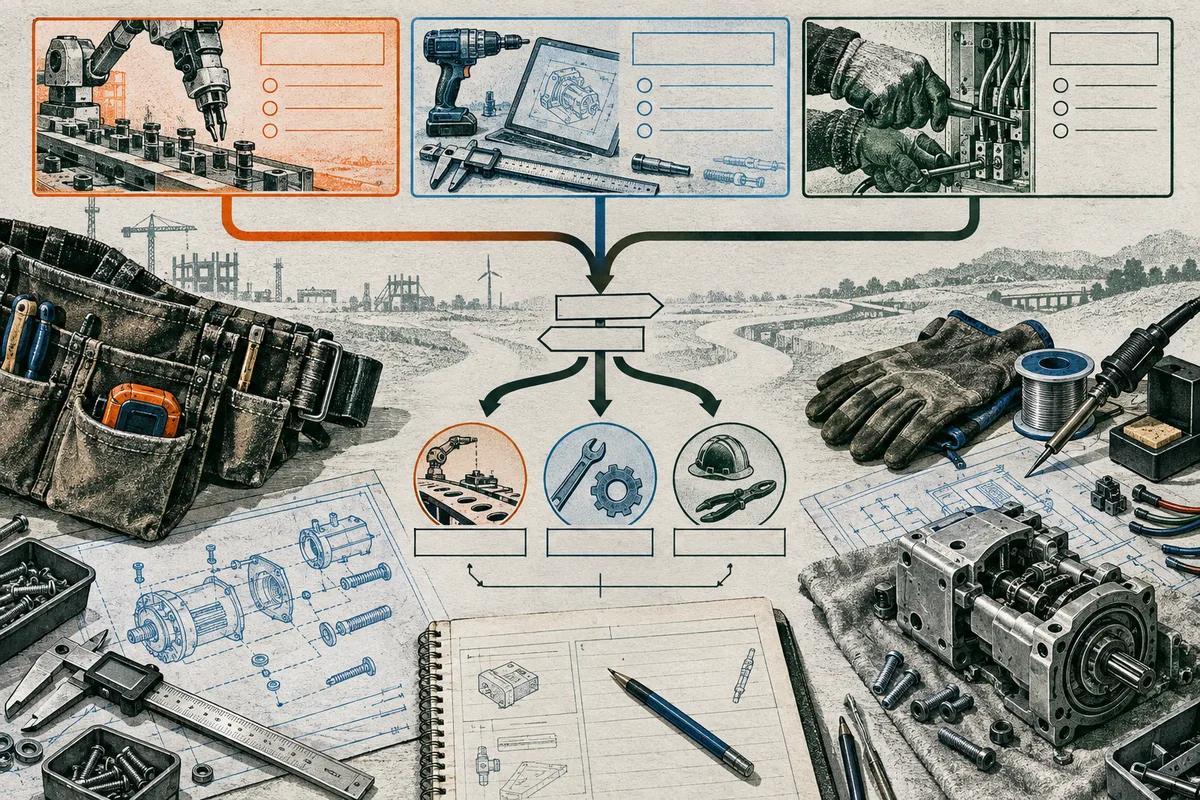
AI is changing skilled trades unevenly. Generative AI can assist with manuals, records, and fault information; robotics can automate repeatable physical operations. The practical question is which tasks your employer redesigns, not whether a trade disappears. Map your work, then test one supervised improvement in diagnostics, setup, quality, safety, or automated-equipment support.
Start with the task bundle, not the job title
A job title hides the part of the work that technology can reach. Skilled trades are especially mixed. A single shift can include reading a drawing, moving into a confined or awkward space, listening to a machine, using a diagnostic screen, making a repair, explaining a fault to a customer, completing records, and deciding whether equipment is safe to return to service. Those tasks do not have the same exposure to AI or robotics.
The first useful distinction is capability versus adoption. A system may be able to summarize a manual or detect an unusual vibration in a controlled test. That does not mean your employer has the sensors, clean data, software, integration budget, training, or approval process to use it. The second distinction is exposure versus displacement. Exposure describes where a tool could alter a task. It does not establish that an occupation will shrink, that a worker will be dismissed, or that a new role will pay enough to replace the old one.
Use a simple four-column inventory. In the first column, list digital and repeatable information work: finding procedures, entering measurements, writing inspection notes, scheduling routine maintenance, or checking a parts list. In the second, list repeatable physical work: loading a machine, moving materials, applying a standard weld path, or inspecting a consistent surface. In the third, list diagnosis, setup, exception handling, and verification. In the fourth, list safety, customer trust, and accountability. The first two columns are the most obvious places to test automation. The last two often determine whether an automated design works outside a demonstration.
This inventory also prevents a common career mistake. If one task is automated, you do not have to throw away every skill connected to the occupation. You can ask which adjacent task uses the same equipment knowledge at a higher level of responsibility. A person who knows how a machine fails may be well placed to learn its sensors, controls, maintenance data, or safe operating procedures. That is an upgrade hypothesis to test, not a guaranteed career ladder.
Two models explain the change better than one headline
There are two overlapping models of change. The first is the information model. Generative AI works on language, images, audio, code, and structured records. In a trade setting it may help retrieve a procedure, turn a technician's notes into a draft report, compare symptoms with documented fault codes, or create a first-pass checklist. Its value depends on the quality of the source material and on a worker checking the result against the actual machine, site, and safety rules.
The second is the physical automation model. A robot, CNC system, machine vision camera, programmable controller, or automated material-handling system performs a defined operation in a physical environment. The system requires a fixture, work envelope, sensor arrangement, program, maintenance plan, and safe method for dealing with jams and unusual conditions. AI may improve perception or adaptation, but the complete work system still has to move, grip, cut, weld, measure, or transport something reliably.
These models are often confused. A chatbot does not install a pump. A vision system does not automatically make a repair decision. A robotic welder may repeat a qualified path, but someone still has to decide whether the part is positioned correctly, whether the joint meets the specification, and what to do when the material, fixture, or environment is different. The strongest practical question is therefore not, ‘Can AI do my trade?’ It is, ‘Which part of my current workflow can be made more repeatable, and who will own the exceptions?’
The ILO's 2025 update is useful here because it measures potential exposure at the task level and says that continued human input matters. Its global occupational index is not a local forecast for a particular trade or employer. The OECD's AI exposure measure, published in May 2026, maps capabilities across cognitive, social, and physical domains to occupational requirements. OECD presents it as a forward-looking, transparent, updateable way to study how AI may affect work, skills, and education over the next five to ten years. The paper also says that actual effects will depend on adoption, regulation, organizational change, and social choice. That is a measure of potential exposure, not a forecast of what your employer will implement.
What changes first in maintenance, repair, and field service
Maintenance work is a good test because it combines records, diagnosis, physical access, and consequence. Software can make the information side faster. A technician may search a service manual with a specific symptom, retrieve a prior repair record, compare a sensor trend, or draft a handoff note. A condition-monitoring system may flag temperature, vibration, pressure, or current that deserves inspection. These uses can reduce time spent hunting for context, but they do not remove the need to check the equipment and validate the diagnosis.
O*NET's description of industrial machinery mechanics shows why the task bundle matters. The occupation includes repairing and replacing components, disassembling equipment, adjusting machinery, monitoring processes, analyzing performance data, testing equipment, and maintaining records. Its work activities include solving problems, identifying changes, monitoring surroundings, and repairing mechanical equipment. Those activities sit at different points on the automation spectrum. Record entry may be easy to assist. A fault in a damaged machine in an unfamiliar environment is harder to standardize.
Heavy-equipment service work adds location and physical access. The Bureau of Labor Statistics describes technicians consulting manuals and drawings, using computerized diagnostic tools, repairing engines and hydraulic systems, traveling to worksites, and disassembling and reassembling components. The work is increasingly computerized, but the repair still takes place in a real machine with worn parts, contamination, weather, access constraints, and a customer who needs a safe result. That is an example of augmentation: software can change the diagnostic sequence without eliminating the hands-on repair and accountability.
A realistic upgrade sequence is narrow. First, learn the diagnostic and record systems used around the equipment you already service. Next, choose one recurring fault or inspection routine and document the inputs, the decision points, and the verification step. Then test whether a digital aid reduces search or documentation time without weakening safety. Do not begin by buying a generic AI course. Begin with the machine, workflow, and decision that your employer actually values.
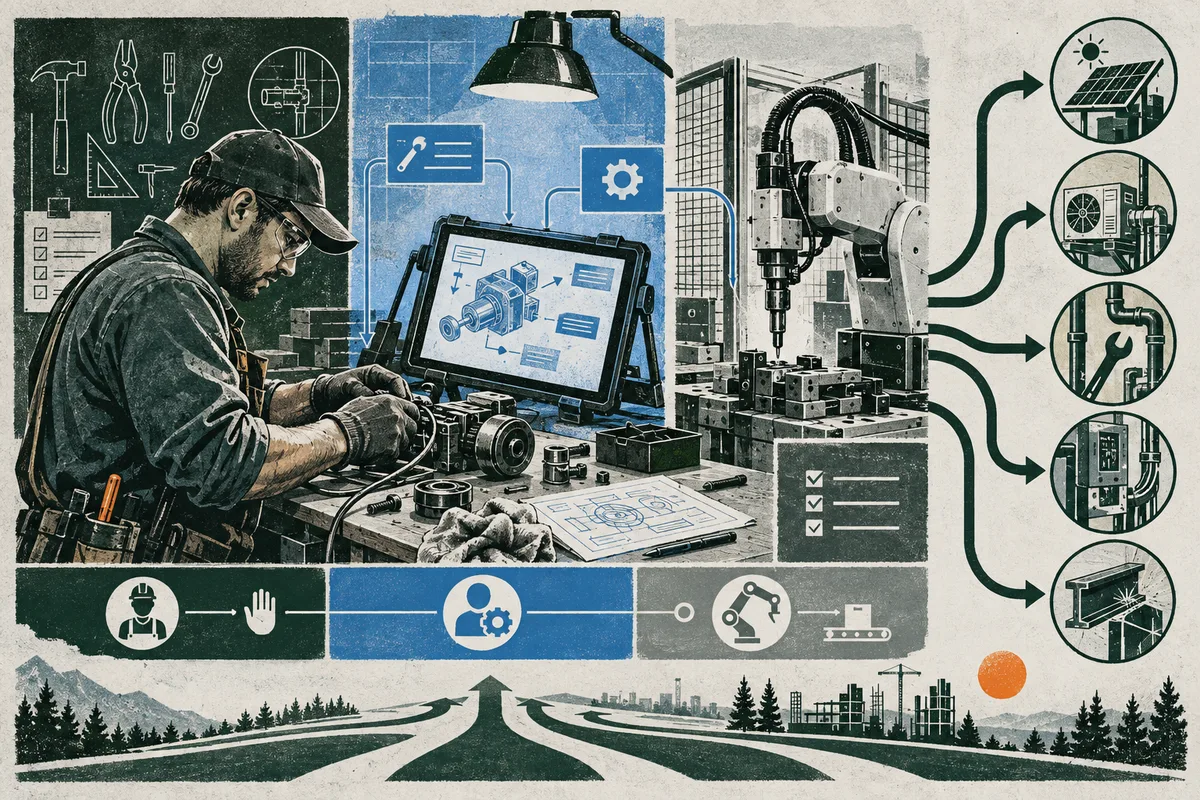
What changes first in welding, machining, and production
Production work has a different exposure pattern. A repeatable part, stable material, consistent fixture, and high enough volume can make robotic welding, CNC operation, automated inspection, or machine tending attractive. In those settings, the trade worker may spend less time repeating the same motion and more time setting up the process, checking the result, correcting defects, maintaining tooling, and handling changeovers.
The BLS description of welders includes interpreting blueprints and specifications, measuring parts, inspecting materials, monitoring the weld, adjusting heat, and maintaining equipment. Automation may reach a repeatable weld path, but the surrounding work still includes fit-up, material variation, inspection, rework, and process control. BLS also notes that automation may limit overall demand for welders even while replacement openings continue. That combination is more useful than either ‘welding is safe’ or ‘robots will replace welders.’ Demand can remain while the mix of tasks changes.
O*NET's current profile for CNC tool operators makes the same point from another angle. Core tasks include listening to machines for vibration or dull tools, changing machine programs, calculating speeds and feeds, transferring commands, maintaining machines, modifying programs after problems, and resolving production errors with supervisors or programmers. A worker who only loads parts may face more pressure from automation than a worker who can set up, measure, adjust, troubleshoot, and document the process. The difference is not a promise of protection. It is a reason to examine where your contribution sits in the workflow.
If you work in production, compare two interpretations. Model one says the main opportunity is operating a machine more efficiently. Model two says the stronger opportunity is becoming the person who can connect the machine, process, quality check, and exception response. Model one may fit a stable line with a clear operator pathway. Model two may fit a worker who wants broader responsibility, can tolerate more technical learning, and has access to controls, quality, or maintenance work. Your next step should be the smallest project that tests which model your workplace rewards.
Robotics creates work around the machine, not just inside it
A robot changes the boundary of the job. It may perform a hazardous, repetitive, or precise motion, but the system around it needs people who can define the operation, install and adjust the equipment, check output, respond to faults, and maintain safe access. The International Federation of Robotics reported 542,000 industrial robot installations worldwide in 2024 and said annual installations were above 500,000 for a fourth consecutive year. The number describes deployment, not the number of jobs removed. It does show why learning to work with automated systems is a reasonable option to investigate in manufacturing regions where those systems are being installed.
OSHA's robotics guidance makes the boundary more concrete. It identifies programming, maintenance, testing, setup, and adjustment as non-routine conditions in which workers may enter a robot's working envelope. Its technical manual recommends task-based risk assessment that considers programming, start-up, environmental conditions, worker errors, maintenance, malfunction, and every worker function. This is not a reason to treat every worker as a robotics engineer. It is a reason to treat safety and exception handling as part of the technical work.
The new tasks can include teaching a robot a path, checking a fixture, interpreting a fault message, restoring a controlled process after a stop, inspecting an end effector, verifying a measurement system, and escalating a change that requires engineering approval. Some workers will learn these through an employer's equipment training. Others may use a community-college controls course, an apprenticeship, or a small supervised project. The correct route depends on your starting point and on whether you need an immediate workflow improvement or a credential for a different role.
The exception is important. A robot cell can also narrow work into monitoring, loading, or repetitive correction, especially when the system is tightly controlled and the employer separates operators from setup and maintenance. More automation does not automatically mean better work. Ask who owns faults, whether workers can learn the controls, how quality decisions are made, and whether safety training accompanies the new system. Those questions reveal the actual job redesign better than the presence of a robot on the floor.
The durable skill is the bridge between signal and action
Tools change quickly, so a durable learning plan should not begin with a brand name. Start with the ability to frame a problem, collect usable data, judge whether a result is plausible, and take a safe action. For a mechanic, that could mean understanding what a sensor measures and what it cannot establish. For a welder, it could mean linking a process parameter to a specification and inspection method. For a CNC operator, it could mean understanding how a program change affects dimensions, tooling, and quality checks.
NIST published its Analysis of the Manufacturing USA Occupation and Competency Framework on June 2, 2026. The analysis uses data collected in 2025 and identifies 132 occupations and 235 knowledge, skills, and abilities connected to advanced manufacturing technologies, then organizes those KSAs into competencies and sub-competencies. Its purpose is to give industry, training providers, and workers a common language. It does not prove that a particular certificate causes hiring or wage gains. It does support a practical learning principle: advanced manufacturing work is a portfolio of technical, digital, process, and safety capabilities rather than one magic AI skill.
Use a ladder with four rungs. On the first rung, learn the vocabulary and workflow around your current equipment. On the second, complete a bounded task such as interpreting a diagnostic trend, editing a basic CNC parameter under supervision, or following the inspection path for a robotic cell. On the third, produce evidence: a cleaned maintenance log, a measured reduction in search time, a documented fault analysis, or a supervised quality improvement. On the fourth, decide whether deeper education is justified because the target role requires controls, programming, engineering mathematics, or a recognized credential.
A degree can be sensible for a larger change into engineering, automation design, or research, but it is not the default response to task change. A course may be enough to use a tool in an existing role. A certificate may help signal structured training, while an employer project or apprenticeship may provide stronger feedback about the work itself. Self-study is useful for foundations, but it needs real equipment, evaluation, and a visible artifact if the goal is workplace credibility. Match the learning format to the decision, not to the fear created by a headline.
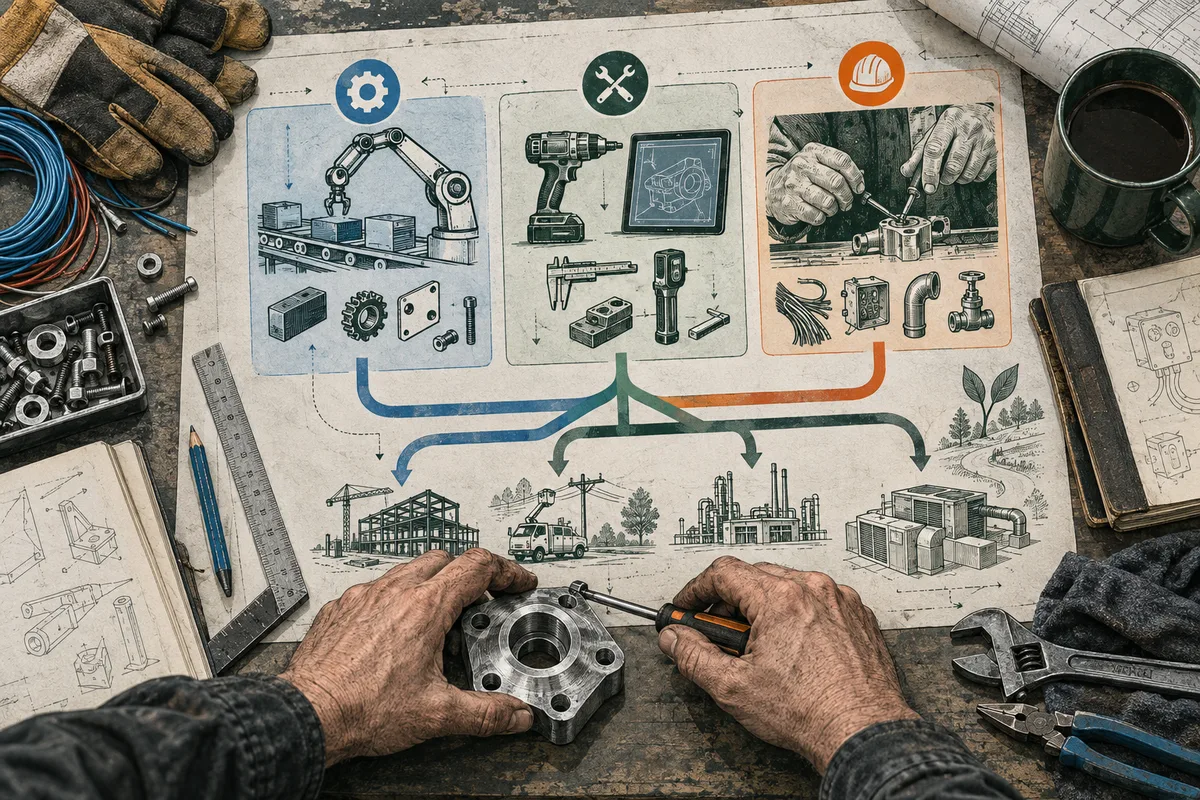
Choose among three moves with your constraints visible
There are three defensible responses to change pressure. The first is stay and redesign. Keep the occupation, then move toward diagnosis, setup, quality, safety, customer explanation, or automated equipment support. This is usually the lowest-disruption option when your experience is valuable, your pay floor matters, and your employer is adding technology. The risk is that the employer may keep the new technical work concentrated in another team, so test access before committing to a long course.
The second is an adjacent pivot. Move to a nearby role that uses your domain knowledge with a different task mix. Examples include a production operator moving toward CNC setup or quality inspection, a mechanic moving toward computerized diagnostics or fleet maintenance data, or a welder moving toward robotic-cell operation and process verification. These are examples of directions, not job guarantees. Compare the actual prerequisites, shift pattern, travel, physical demands, local openings, and pay range before treating an adjacent title as progress.
The third is a larger change. A degree, longer technical program, apprenticeship, or move into engineering, controls, or software may make sense when your target requires deeper mathematics, programming, design responsibility, or a formal credential. It also has the highest cost in time, money, geography, and family disruption. A larger change should start with evidence: read current job postings, speak with someone who does the work, inspect admission requirements, and complete a small relevant project if possible.
Rank the options by fit, not by how impressive they sound. First ask which move improves your current task bundle within your constraints. Second ask which move creates credible evidence within a bounded learning period. Third ask whether the move preserves enough income, location stability, health, and family capacity to be sustainable. If you cannot answer those questions, you do not yet need a more dramatic career decision. You need better information about the work.
A practical 30-day test for your next move
In the first week, write down ten recurring tasks from a normal month. Mark each as information, repeatable physical execution, diagnosis or exception handling, setup or coordination, or safety and accountability. Note frequency, time, error cost, physical strain, and who currently approves the result. This gives you a work map rather than a vague sense that AI is everywhere.
In the second week, choose one task with a clear input and output. Ask a supervisor, trainer, or experienced colleague where technology is already used and where it is not trusted. If the task involves a robot, CNC machine, electrical system, hydraulic system, or other hazard, use the required safety and lockout procedures. Do not test an unapproved tool on live equipment or sensitive work records.
In the third week, learn one bounded concept tied to the task. That might be how a condition-monitoring signal is interpreted, how a control system organizes faults, how a quality measurement is taken, or how a service report is structured. Prefer a source that gives practice and feedback. If you are comparing a course, certificate, apprenticeship, degree, or self-study route, check prerequisites, equipment access, assessment, completion time, total cost, and whether the target role actually asks for it.
In the fourth week, create a small evidence record. State the original problem, the steps you tested, what changed, what remained uncertain, and how the result was verified. Bring it to a real conversation about a shift, project, training opportunity, or role requirement. The goal is not to claim that you are AI-proof. It is to replace an abstract threat with a specific decision about a task you understand.
If your work is changing faster than you can map it, the free task-level change-pressure checker can help you separate exposed, augmented, and human-accountable parts of your work. Its result is a decision aid, not a validated probability of displacement. If you need to compare a stay-and-redesign path with adjacent and larger-change options while accounting for salary, geography, learning time, and family constraints, the personalized career roadmap is the more suitable next step.
Questions readers ask
Will AI replace skilled trades workers?
There is no general answer that applies to every trade, employer, or task bundle. Generative AI can assist information work, while robotics can automate repeatable physical operations. Diagnosis, setup, exception handling, safety, customer communication, and accountability may remain important or grow in value, but adoption can also narrow some roles. Map the tasks in your own work instead of treating occupational exposure as a job-loss probability.
Are skilled trades safer from AI than office jobs?
Some trade tasks are harder to automate because they involve variable environments, physical access, dexterity, safety risk, and changing conditions. That does not make a trade immune. Industrial robotics, computer-controlled equipment, machine vision, and diagnostic software can change production and maintenance work. The useful comparison is task by task, including how much of the work is digital, repeatable, physical, judgment-heavy, or accountable.
What should a mechanic learn about AI first?
Start with the diagnostic and record workflow around the equipment you already service. Learn what the sensors, fault codes, computerized tools, and maintenance records actually measure. Then practice verifying a result against the machine, manual, and safety procedure. A broad AI course is less useful than a bounded project that improves one real inspection, diagnosis, or service handoff.
Will welding robots eliminate welding jobs?
Robotic welding can reduce repetitive work when parts, fixtures, materials, and volumes are consistent. Human work can shift toward fit-up, cell setup, process checks, inspection, maintenance, rework, and exception response. BLS projects slower-than-average employment growth for welders and notes that manufacturing automation may limit demand, while also projecting many annual openings mainly from replacement needs. That is a changing task mix, not a precise forecast for an individual worker.
Do I need a degree to move into robotics or automation?
Not always. The right route depends on the target task. An equipment course or employer training may support an operator or maintenance upgrade. A certificate may organize learning and signal completion. An apprenticeship or supervised project can provide practical feedback. A degree is more relevant when the target role requires deeper engineering, controls design, mathematics, or a formal credential. Check actual job requirements before choosing a long program.
How can I decide whether to upgrade my current trade or change careers?
Compare three paths: stay and redesign the current role, make an adjacent move using your equipment knowledge, or make a larger change that requires substantial retraining. Score each against your salary floor, location, training time, cost, health, family responsibilities, prerequisites, and evidence of local demand. Start with a small task project or conversation that tests the leading option before making an irreversible commitment.
Sources and notes
- Generative AI and jobs: A 2025 update
Supports the distinction between task-level GenAI exposure, automation potential, and likely job transformation rather than a direct displacement forecast.
- Industrial Machinery Mechanics, O*NET OnLine
Supports the concrete task bundle of industrial maintenance, including repair, monitoring, problem solving, testing, and records.
- Computer Numerically Controlled Tool Operators, O*NET OnLine
Supports examples of CNC setup, program changes, machine listening, maintenance, measurement, and production-error resolution.
- World Robotics 2025, International Federation of Robotics
Supports the current global industrial-robot deployment context and the limitation that deployment data do not equal jobs removed.
- Heavy Vehicle and Mobile Equipment Service Technicians, U.S. Bureau of Labor Statistics
Supports the combination of computerized diagnosis, physical repair, worksite travel, component testing, and service records.
- Welders, Cutters, Solderers, and Brazers, U.S. Bureau of Labor Statistics
Supports welding duties, training routes, projected outlook, replacement openings, and the effect automation may have on demand.
- OSHA Technical Manual: Robotics
Supports the safety and task-boundary discussion around programming, maintenance, testing, setup, adjustment, and robot work envelopes.
- Analysis of the Manufacturing USA Occupation and Competency Framework, NIST
Supports the learning argument that advanced manufacturing requires a connected set of competencies, knowledge, skills, and abilities.
- The OECD AI exposure measure: Mapping the OECD AI Capability Indicators to occupations
Supports the 2026 forward-looking, updateable exposure measure and its stated limits around adoption, regulation, organizational change, and social choice.
Apply this to your own work
See the whole job market at once.
Explore which occupations AI may reshape, then turn the signal into a practical response.
Explore the job map