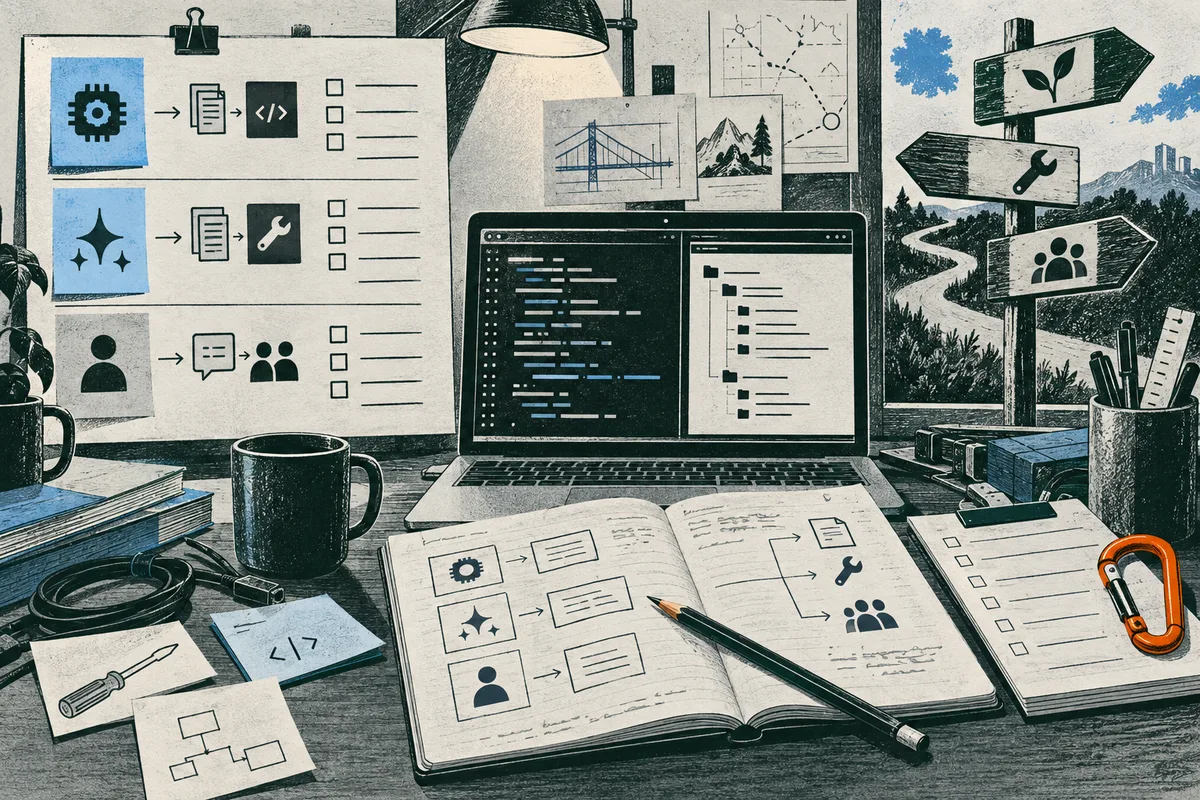
AI can assist with parts of coding, documentation, and other digital tasks, but software work also includes requirements, design, testing, maintenance, coordination, and accountability. Map your full task bundle. Test assistance on one workflow, count review and rework, then choose role redesign, an adjacent move, or retraining based on your skills and constraints.
What does software work include beyond coding?
Start with the whole delivery lifecycle. The U.S. Bureau of Labor Statistics describes software developers as analyzing user needs, designing and developing software, upgrading and maintaining it, testing, documenting, and collaborating with programmers and stakeholders. Coding is one part of that chain, not a synonym for the job.
O*NET likewise lists requirements analysis, testing and validation, modification of existing software, performance standards, project documentation, consultation, and advice to others. These tasks may produce little code, but they shape whether a change solves the right problem and works in its setting.
Your task bundle may differ from another developer's. You may spend more time understanding an old system, clarifying a requirement, reviewing a release, or explaining a trade-off than writing new code. Record those activities before judging how AI could change your role. Include the decisions, checks, and responsibility attached to each task.
A permissions change shows why the bundle matters. The visible work may be a form, an endpoint, and a few tests. The less visible work includes deciding which roles exist, confirming how old accounts are represented, checking denied actions, and agreeing on audit behavior. A first draft can accelerate implementation. It cannot settle the policy or prove that the policy is consistent across the interface, API, background jobs, and logs.
Incident response has the same shape. A tool may summarize logs or suggest causes, while the engineer must decide which evidence is trustworthy, assess blast radius, choose a reversible mitigation, and explain uncertainty. The cost of a wrong answer is not a bad draft alone. It may be a longer outage or a misleading customer update. Assistance can help, but ownership and escalation remain part of the work.
Include frequency and consequence in the map, but do not confuse either with value. A frequent task may be easy to assist and still provide important system context. An infrequent task may be difficult to assist but central to trust, such as approving a migration or reviewing a security finding. Note which later tasks depend on an earlier decision. A change at the start of the chain can move work into review, support, or maintenance.
One week can contain very different exposure levels. You might spend two hours on scaffolding, six on repository investigation, three clarifying requirements, four testing, and several supporting a release. The routine portion may be the easiest pilot, but the rest of the bundle may determine your value and learning needs. Use your calendar, tickets, and pull requests to reconstruct this mix instead of guessing from a job title.
A task map also exposes the difference between an artifact and an outcome. Code is an artifact. A reliable feature is an outcome. A test file is an artifact. Confidence that an important behavior works is an outcome. A summary is an artifact. A shared understanding of the incident is an outcome. AI can help produce artifacts while the worker remains responsible for connecting them to outcomes.
This is why a tool-first response can miss the bottleneck. If drafting is not slowing you down, faster drafting will not solve the problem. If the difficulty is weak test coverage, learn evaluation. If it is unclear ownership, have the role conversation. If it is a shrinking product line, inspect demand and adjacent options. The task bundle tells you what kind of intervention could help.
Before buying a tool or course, save a short record of five meaningful changes. Note the request, the decisions, the checks, the handoffs, and what happened after release. This record is not a performance score. It is a baseline for seeing where assistance could remove friction and where your judgment is already doing the work that makes software useful.
The practical conclusion is narrow but important. Software work is not protected merely because it is called design, analysis, or review, and it is not fully exposed merely because it includes code. The relevant unit is the connected task bundle, including context, checks, consequences, and responsibility. That is the unit you should map before choosing a career response.
When you write the map, describe actions rather than labels. “Architecture” may include comparing two interfaces, explaining a trade-off, documenting a decision, and handling a later migration. “Review” may include style comments, correctness checks, security analysis, and approval. “Support” may include reproducing a defect, calming a user, and deciding whether the issue reveals a product gap. Action-level descriptions make it possible to test assistance and identify transferable evidence.
Also distinguish work you perform from work you are accountable for. A junior developer may implement a change while a senior engineer approves the design. A contractor may supply code while an internal team owns the service. A manager may own staffing and risk decisions without writing code. AI can affect each person’s tasks differently because responsibility and access differ even when the artifact is shared.
The result should be a working document, not a permanent classification. Revisit it after a release, incident, tool pilot, or team reorganization. New automation may change one step and create another. A task that was once too expensive to check may become easier to evaluate. A task that looks routine may become more consequential as the system grows. Career planning improves when the map is updated from evidence rather than treated as a fixed identity.
Sources: Software Developers, Quality Assurance Analysts, and Testers: Occupational Outlook Handbook; O*NET OnLine: 15-1252.00 Software Developers
Exposure tells you where to inspect work
Treat exposure as a task-level inspection signal. The International Labour Organization defines its exposure index as the potential for tasks to be performed using generative AI. It does not mean that an entire occupation will be automated immediately.
Exposure does not tell you whether your employer has adopted a tool, whether the tool can work safely in your codebase, or whether your team has permission, secure access, training, and a review process. Technical suitability and workplace use are separate questions.
Observed use is separate again. Anthropic mapped Claude conversations to tasks in the O*NET framework. That evidence shows how people used one platform in the studied dataset. It does not represent every software worker, measure employer-wide adoption, or show that an output was accepted and used without checking.
Neither exposure nor observed use measures your probability of displacement. To assess your position, record which tasks could be assisted, which decisions and checks remain, what your team permits, and how demand is changing around your role.
The word exposure can hide a difference between applicability and substitution. A tool may apply to a task without reducing the people needed for the surrounding work. Faster drafting can create room for more features, stronger testing, or shorter response times. An employer may use the capacity to grow output, hold staffing steady, reduce contractors, or change the mix of roles. The technology signal does not determine that choice.
Adoption has several steps. A company may approve a tool, distribute licenses, and report usage. That tells you about access and behavior, not whether workers use it for trivial drafts or consequential changes, whether suggestions are accepted, or whether managers change targets. Ask what work is actually changed and what evidence the organization uses to judge the result.
Exposure can lead or lag the workplace. A system may be capable of a task before a team has data controls, review practice, or permission to use it. A team may already automate work with ordinary software even when a generative-AI index gives it attention. Use a measure to scan the landscape, then inspect the tools, rules, processes, and demand in your own setting.
When reading a study, keep four notes: what was observed, who or what was studied, what the measure means, and what it cannot establish. For platform data, record the platform and sampling frame. For a labor index, record the task model and occupational aggregation. For a survey, record whether results are self-reported. This prevents one source from carrying a claim its method cannot support.
The employer’s workflow determines whether technical capability becomes work change. Security review may restrict what enters a tool. Procurement may limit the products available. A team may lack time to evaluate suggestions. A regulated system may require records of human approval. These constraints are not evidence that the capability is irrelevant. They are part of the mechanism between capability and adoption.
The labor-market question has another layer. If a task becomes cheaper, demand for the resulting product may rise, stay flat, or fall. Workers may be moved to different tasks, teams may be reorganized, or an employer may keep output constant with fewer hours. A task-exposure source cannot identify which path will occur without evidence about demand and organizational decisions.
For a personal review, label each task with four separate judgments: technically assistable, allowed in your workplace, independently reviewable, and consequentially owned. Do not collapse these labels into one score. A task can be technically assistable but not allowed, allowed but difficult to verify, or easy to verify but too minor to affect your role. The separate labels point to different actions.
Use exposure as a prompt for a bounded experiment, not as a verdict. If data can be handled safely, the team permits the workflow, and the check is affordable, test it. If one condition fails, the next action may be security review, process design, training, or a role conversation. The useful result is a decision about what to inspect next.
A cautious interpretation does not mean ignoring a high-change signal. If much of your week consists of routine, well-specified digital work and your employer is actively standardizing it, that is a reason to act earlier. The action may be strengthening evaluation, learning adjacent system responsibilities, documenting your contribution, or investigating a different market. The signal raises the priority of inspection; it does not select the answer for you.
Likewise, a low-change signal should not become complacency. Demand can weaken for reasons unrelated to technical exposure. A team can be reorganized even when its tasks are difficult to automate. A new manager can change expectations. A worker can face a health, location, or family constraint that makes the current role less sustainable. Task exposure is one input to a career decision, not a complete account of career risk.
The honest language is conditional: if the task is technically assistable, allowed, reviewable, and connected to meaningful demand, it deserves a pilot. If not, investigate the missing condition. That sentence is less dramatic than a replacement forecast, but it tells a worker what to do and keeps the evidence attached to the claim it can support.
Sources: Generative AI and Jobs: A Refined Global Index of Occupational Exposure; The Anthropic Economic Index; Which Economic Tasks are Performed with AI? Evidence from Millions of Claude Conversations
Coding is already a major point of contact
Coding is a clear point of contact between software work and current AI tools. Anthropic analyzed 500,000 coding-related interactions from April 6–13, 2025. In its Claude Code sample, 79% of conversations were classified as automation and 21% as augmentation. The comparable Claude.ai coding sample was 49% automation.
Those categories describe interaction patterns on one platform. They do not show how much of a developer's job is automated, whether code is production-ready, or whether a team has changed its staffing. The study's language breakdown is similarly narrow: JavaScript and TypeScript together represented 31% of queries, HTML and CSS together 28%, and Python 14%. Those are query shares, not shares of developer work or labor demand.
Use this evidence to inspect your coding tasks, not to label your occupation. Ask who defines the change, supplies the context, checks behavior, resolves conflicting requirements, and accepts responsibility when the software reaches users. The coding interaction data cannot answer those questions for your team.
The reported categories also need careful interpretation. Automation in a conversation can mean that the user asked the system to complete a large part of a coding task. It does not prove that the user accepted the answer, that the task reached production, or that the user stopped doing other work. Augmentation can mean iterative assistance, but it does not tell you whether the interaction reduced total effort after checking and repair.
Language shares have a similar boundary. If a language appears often in queries, that is evidence about the studied interaction set. It is not a measure of the number of developers using that language, the number of hours spent on it, or the strength of its labor demand. A worker should not choose a learning path from query share alone.
Coding is nevertheless a sensible place to inspect because it has visible artifacts and existing checks. Start by separating routine transformations from open-ended implementation. A small conversion with a clear test oracle is different from changing a concurrency path in a service with undocumented behavior. Both are code. Their review burdens are not comparable.
Also record where code comes from. A suggestion based on a short prompt may omit repository conventions, dependency versions, licensing concerns, or security assumptions. Supplying more context can improve usefulness, but it can also raise privacy and information-governance questions. The ability to provide context safely is part of the workflow, not a minor setup detail.
The most exposed coding tasks may therefore be the ones with a narrow problem statement and a cheap independent check. That is a practical inference from task conditions, not a measured ranking of all software work. The least convenient tasks for delegation may be those with hidden constraints, high consequence, unfamiliar context, and weak or expensive verification. They can still receive assistance, but the human review is heavier.
A developer can use this distinction in planning. Put low-risk drafting into a pilot queue. Put high-context changes into a review-first queue. For the second group, use tools for search, explanation, or alternative suggestions only when the engineer can reconstruct the reasoning. This preserves learning and makes it clearer which capability the team is actually buying.
The platform evidence is valuable because it shows real interaction patterns, not because it settles the future. Read it as a map of contact points. Then compare the map with your tickets, pull requests, incident work, and support responsibilities. The gap between the platform pattern and your own week is often where the useful career decision begins.
That comparison can produce three different findings. You may discover that the published pattern closely matches your routine implementation work. You may discover that your work is mostly integration, maintenance, and support, with coding embedded in a harder context. Or you may discover that your title covers several occupations and needs to be split into separate task bundles. Each finding leads to a different pilot and a different learning question.
Do not use the publication’s examples as a substitute for your own evidence. A tool may perform well on a repository or language that resembles yours while failing on your framework, data model, deployment process, or business rules. Search and explanation can still be useful, but the burden of proving fit remains local. The further your environment is from the study condition, the more modest your conclusion should be.
The career advantage comes from being able to explain the boundary. A manager can act on “this helps draft isolated transformations, but review of authorization and migration behavior remains the bottleneck.” A manager cannot act well on “software is highly exposed.” Clear boundaries support better training requests, better workflow design, and better conversations about responsibility.
Sources: Anthropic Economic Index: AI's impact on software development
Speed depends on the task and the review burden
A bounded experiment found a large speed difference. In a GitHub experiment, 95 professional developers wrote the same JavaScript HTTP server with or without Copilot. The Copilot group completed the task 55% faster on average, with a reported 95% confidence interval of 21% to 89% for the speed gain. This applies to one timed task with one product. It does not establish a general productivity or employment effect.
A real-repository trial found the opposite direction for its sample. METR randomized 246 issues among 16 experienced open-source developers working in repositories they had contributed to for years. With early-2025 AI tools allowed, measured completion time was 19% longer. The participants and repositories were specialized, so the result does not show that AI makes developers slower in general.
The studies tested different conditions. A specified implementation task is easier to compare than an issue requiring repository context, integration, testing, and judgment. That is an interpretation of the designs, not a measured explanation of the difference. Neither study tells you how newer tools, other repositories, or your own review process would change the result.
Measure your own workflow after including checking and rework. Separate a small coding task from ambiguous work in an unfamiliar system. If assistance reduces drafting time but adds validation or coordination, record both effects. That task-level record is more useful for a career decision than copying one speed estimate.
A specified benchmark has a useful property: the target is known before the work begins. That makes it possible to compare completion times. Real software work often begins with an incomplete request. The worker must discover the problem, negotiate scope, and choose what not to build. If assistance makes implementation faster but leaves discovery unchanged, the percentage gain in one stage may have a small effect on total delivery time.
Repository context changes the calculation. A familiar contributor may know the conventions, tests, and historical reasons for a pattern, while an unfamiliar change requires searching and cautious reading. A tool can help with search or explanation, but it can also suggest a change that looks locally sensible and violates an older contract. The cost is not only correcting syntax. It is noticing the mismatch before release.
Quality measures matter as much as speed measures. A team can compare test failures, review comments, rollback frequency, defect reports, or maintenance questions, but each measure captures only part of quality. A lower review-comment count could mean cleaner code or a rushed review. A faster issue close could mean a smaller fix or a weaker investigation. Interpret the measure alongside the process that produced it.
The DORA findings are useful as a warning about system effects. A tool may make an individual feel faster while a team accumulates more changes, more review load, or more instability. That is why local measurement should include downstream work. Ask who handles the extra questions, how incidents are detected, and whether the team can understand a change six weeks later.
A fair comparison also accounts for tool familiarity. A worker may initially lose time learning an interface, then gain time later. Another worker may be productive without the tool because the task is already well understood. Short trials can therefore understate or overstate a stable effect. Keep the observation period long enough to include the ordinary review and support cycle, but do not pretend a small pilot is a universal study.
Use a decision rule that is deliberately modest. Repeat a workflow when total effort falls, important checks remain effective, and the worker can explain the result. Redesign the workflow when drafting improves but review or verification becomes the bottleneck. Stop when the output cannot be checked, sensitive information cannot be handled safely, or repair consistently costs more than the assistance saves.
The research does not tell you which result your team will see. That uncertainty is not a reason to wait for a perfect forecast. It is a reason to run a safe local test and keep the conclusion proportional to the evidence. A small record of total effort and defects can improve a career decision more than a dramatic average borrowed from a different task.
Productivity should also be connected to demand. If a team completes work faster, what will it do with the capacity? More features, better reliability, fewer contractors, shorter response times, or no change are all possible. An individual cannot settle that question from a coding benchmark. Ask the manager what outcome the team is targeting and what responsibilities will move as a result.
A study can support a narrow conclusion without supporting a career conclusion. The GitHub experiment supports a reported result on a specified task. METR supports a different result in a real-repository setting. DORA supports a description of perceptions and associations among surveyed technology professionals. None tells you whether your employer will change headcount. Keeping those levels separate is not pedantry. It prevents a worker from making a costly decision from evidence that answers a smaller question.
When you compare studies, note who supplied the task, who chose the tool, how completion was defined, and whether quality was measured independently. A task designed for a benchmark may reward rapid production. A repository issue may reward caution and context. A survey may reflect confidence, expectations, or reporting behavior. The methods do not need to agree because they are not observing the same thing.
Your local test should therefore be interpreted as a workflow observation. It can show that total effort fell or rose for a defined class of work under a defined review process. It cannot prove what will happen after a reorganization, with a different tool, or in a different labor market. State that boundary when you report the result. Precision about limits makes the evidence more credible, not less useful.
Sources: Research: quantifying GitHub Copilot's impact on developer productivity and happiness; Measuring the Impact of Early-2025 AI on Experienced Open-Source Developer Productivity
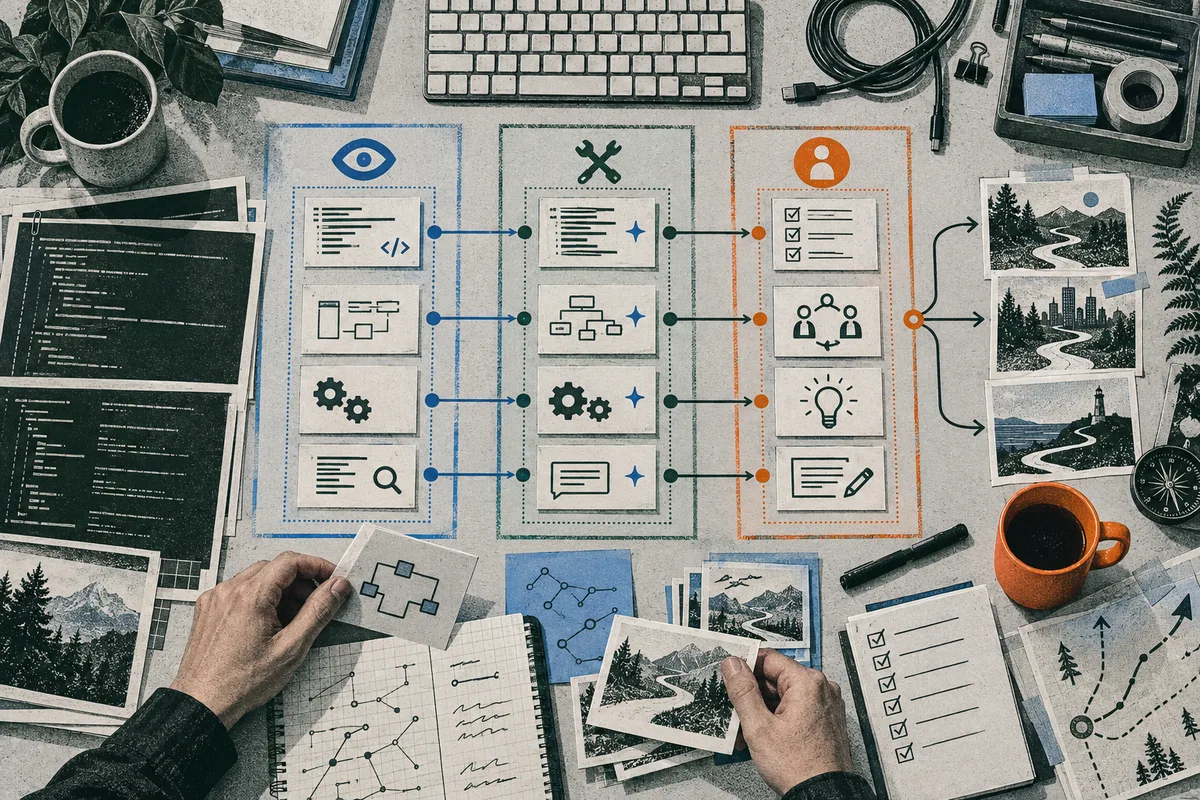
Quality, stability, and trust remain part of the job
Generated code does not remove testing or validation. O*NET includes testing, performance standards, modification of existing software, and advice to others among software-developer tasks. A tool may supply a first draft, but someone still has to check its fit with the requirement, the existing system, and the people who rely on it.
The 2025 DORA report illustrates the tension between assistance and confidence. Its survey of nearly 5,000 technology professionals found that 90% reported using AI at work, more than 80% believed it increased productivity, and 30% reported little or no trust in generated code. These are self-reported measures. They do not verify productivity or code quality in your team.
DORA also reported a positive relationship between AI adoption and delivery throughput and product performance, alongside a negative relationship with delivery stability. This is an association, not proof that AI caused either result. The practical question is whether your workflow can still detect defects, understand changes, recover from failures, and show who approved the result.
Treat verification as part of the skill you are building. Keep evidence of the checks that catch wrong assumptions, broken integrations, other defects, or regressions in your context. That capability is more durable than familiarity with one coding interface.
Verification begins with a specification, even when the specification is informal. Write down what the change should do, what it must not do, and what evidence would change your mind. Without that step, review becomes a reaction to whether the code looks plausible. A tool can produce a polished implementation that satisfies an unstated or mistaken objective.
Testing should cover boundaries, not only examples. Ask what happens with empty input, duplicate data, missing permission, delayed dependency, partial failure, large volume, and a user who follows an unexpected path. The exact list depends on the system. The durable skill is learning to derive checks from the consequence of failure rather than from the happy path shown in a prompt.
Security review is part of this burden. Generated code can include broad permissions, weak validation, unsafe logging, or an assumption that an internal service is trustworthy. A developer does not need to memorize every vulnerability class to act responsibly, but must recognize when a change touches identity, secrets, user data, external input, or trust boundaries and request the appropriate review.
Stability also has a time dimension. A change can pass today’s tests and still create a maintenance problem when a dependency changes, traffic grows, or a new team inherits the code. Documentation of assumptions, observability, rollback steps, and ownership helps a team see that future risk. These are ordinary engineering practices, but assistance can make them more important when implementation becomes faster.
Trust is not the same as confidence in a tool. A developer may trust an output for a low-risk transformation and distrust it for a security-sensitive path. A team may trust a workflow because it has evidence from repeated checks, not because a vendor says the tool is reliable. Record which claims are supported by tests, review, monitoring, or prior experience. Make uncertainty visible rather than converting it into a general feeling.
A useful portfolio artifact is a short before-and-after note. State the original requirement, the assistance used, the checks designed independently, the defects found, and what changed after review. This demonstrates judgment to a manager or future employer more clearly than a list of tool names. It also helps you notice whether your contribution is expanding into evaluation and ownership or shrinking into acceptance of drafts.
There is a danger on both sides. If workers assume generated code is always wrong, they may miss useful assistance and spend time repeating routine work. If they assume plausible code is probably right, they may weaken independent understanding. The proportionate practice is to match verification effort to consequence and uncertainty. That is a professional judgment, not an attitude about technology.
The career implication is specific. Learn the checks that matter in the systems you want to work on. If you want to remain close to delivery, deepen testing, observability, security, and system design. If you want a neighboring role, identify which forms of review, facilitation, or risk ownership that role requires. Durable value comes from connecting technical output to reliable outcomes.
There is no single “human skill” that solves this. Communication without system understanding may produce clear but unsafe decisions. Technical depth without stakeholder context may produce elegant work that solves the wrong problem. Domain knowledge without testing may hide defects. The useful combination is task-specific: know enough about the system, the user, and the consequence to design and judge the work.
Learning should follow the gap you observed. If you cannot define expected behavior, practice requirements and acceptance criteria. If you cannot trace a change, practice architecture and debugging. If you miss failure modes, practice testing and threat modeling. If you can do the work but cannot show it, improve documentation and explanation. A course may help, but a small project with feedback often reveals whether the concept transfers.
Do not treat verification as an invisible burden that only protects the employer. It also protects your career evidence. When you can show how you found a defect, challenged an assumption, or made a change reversible, you demonstrate a capability that remains relevant across tools. The record should describe the judgment and the outcome, not merely the product used to generate a first draft.
Sources: Announcing the 2025 DORA Report: State of AI-Assisted Software Development; O*NET OnLine: 15-1252.00 Software Developers
What should you do with your task bundle?
Role redesign is the proportionate first option when your current work contains substantial requirements, design, testing, maintenance, documentation, and stakeholder responsibility alongside coding. Test one workflow. Use assistance for a draft, then take ownership of the checks, edge cases, explanations, and decisions that make the change acceptable.
An adjacent move may fit when your strongest responsibilities transfer better than your coding tasks do. Quality assurance, release coordination, technical documentation, developer support, architecture discussions, and product requirements can point toward neighboring work or a changed version of your current role. Treat that as a hypothesis. Compare real target tasks, prerequisites, portfolio evidence, and local openings before paying for training.
Consider a larger career change only after checking prerequisites, demand where you can work, learning time, cost, salary floor, health, caregiving, and immigration status. A new title alone does not solve a mismatch between your circumstances and the work.
For U.S. context, BLS projects software-developer employment to grow 10% from 2025 to 2035 and reports about 106,100 average annual openings across software developers, quality-assurance analysts, and testers. These are occupational projections, not AI-specific forecasts, local predictions, or guarantees for your specialty or outcome. Readers elsewhere need evidence from their own labor market.
Write down three scenarios: stay and redesign, move adjacent, or retrain more substantially. For each, compare the tasks you would perform, the evidence you already have, the gaps to close, and the constraints you cannot ignore. The free task checker can organize a task-level change-pressure review. Its result is a transparent signal, not a validated redundancy probability.
Role redesign is strongest when the current role still gives you access to meaningful context and decisions. You can test assistance on drafting while making requirements, evaluation, integration, and support more visible. A useful proposal to a manager names the workflow, the review standard, the expected benefit, and the risk boundary. It does not ask for permission to automate everything or claim that one pilot proves a future role.
An adjacent move needs the same discipline. Quality engineering, release coordination, platform work, technical documentation, implementation support, and product requirements may share some foundations with development, but their daily work differs. Read current job descriptions, inspect the tools and schedules, and identify the evidence employers ask for. Treat the title as a search term, not as proof that your existing experience transfers completely.
A larger change should begin with a target task bundle. “Work in AI” can mean using tools in a current field, building AI-enabled products, developing machine-learning systems, evaluating model behavior, or governing organizational use. These paths have different prerequisites. A short course may be enough for a focused workflow skill and insufficient for engineering work. A degree may supply foundations and a signal while requiring more time and money than your situation allows.
Projects are useful when they answer a question. Can you build and test a small service? Can you evaluate a system against defined cases? Can you explain a data or security trade-off? Can you maintain the project after the first demo? A project without feedback can become a polished artifact with weak learning value. Pair it with code review, user requirements, tests, or an experienced practitioner’s critique where possible.
Certificates have a narrower role than marketing often suggests. They can structure a curriculum, document participation, or signal interest in a topic. They do not by themselves demonstrate that you can perform the target work. Before paying, check what is assessed, whether feedback is included, whether the material is current, and whether employers in your target market recognize the credential. Compare that value with a smaller work-based project.
Constraints are part of the decision, not an afterthought. A path requiring evening study may conflict with care responsibilities or health. A role with on-call work may be unsuitable even if it looks adjacent. A location change may be impossible. A lower initial salary may not be tolerable. A plan that ignores these facts creates a false choice between commitment and failure. Write the constraints before ranking the paths.
Use labor evidence carefully. BLS’s 2025–2035 projections are directional for U.S. occupations, not a forecast for every specialty or country. A local employer may be hiring for a narrow stack while the national category grows. Another region may have different demand. Check local vacancy requirements, public labor data, and conversations with people doing the work before committing to a costly transition.
The decision rule is therefore staged. First clarify the task bundle. Then run the smallest experiment that tests fit. Then compare the path that preserves the most useful experience with the path that addresses the strongest constraint. Escalate to larger retraining when the target is clear and the evidence justifies the cost. This is slower than choosing a fashionable title, but it reduces the risk of solving the wrong problem.
The three paths can also be combined over time. A worker may redesign the current role while building a project for an adjacent option. An adjacent move may preserve income while creating a bridge to deeper retraining. A course may be useful only after a workplace pilot identifies the missing foundation. Treat the paths as scenarios to test, not identities that must be chosen in one dramatic moment.
Protect optionality where possible. Keep evidence of completed work, decisions, tests, and outcomes. Learn concepts that transfer across products. Talk with people who perform the target work. Avoid paying for a path before checking prerequisites and constraints. Optionality is not endless indecision. It is a way to make a larger commitment after small evidence has reduced the most important uncertainty.
The exception remains real: if the organization’s direction is clearly reducing the surrounding work, waiting for perfect proof may be costly. In that case, begin an adjacent or larger-change investigation while continuing the smallest useful redesign. The evidence still does not justify a personal probability, but it can justify earlier planning. Timing is a constraint, not a reason to exaggerate certainty.
Sources: Software Developers, Quality Assurance Analysts, and Testers: Occupational Outlook Handbook; O*NET OnLine: 15-1252.00 Software Developers
How can you make the task map useful in a real conversation?
Choose one recurring workflow, such as turning a requirement into a reviewed change. List its steps in order. Mark each step as assisted, independently checked, or owned by a person. Include requirements, testing, maintenance, documentation, and coordination, not only code. O*NET provides a task checklist, not a forecast of how much of your week AI can change.
Take the map to your manager or a teammate and ask: “Which step can we assist safely, what evidence must a reviewer see, and which responsibility should I own next?” Agree on one review standard. It might specify tests, failure cases, system dependencies, documentation, and the accountable reviewer required before acceptance.
Review the result after several real tasks. If assistance reduces drafting effort but adds review or coordination work, record the trade-off. DORA's findings make downstream effects worth checking, but they do not predict what will happen in your team.
End with one testable action: pilot assistance on one task, define the independent checks, and choose the capability to strengthen next. If the map points beyond your current role, the paid career roadmap can compare a stay-and-redesign path, an adjacent pivot, and a larger-change scenario against your experience and constraints. It does not guarantee employment, income, or a particular decision.
Choose a workflow that is representative enough to teach you something and bounded enough to stop safely. A synthetic example may protect confidential information but miss repository friction. A real task may be more informative but require permission and careful data handling. State which limitation applies. A small test is valuable when you know what it can and cannot tell you.
Write the acceptance conditions before opening the tool. Include behavior, constraints, security assumptions, performance concerns, and the evidence needed for handoff. If you cannot write those conditions, the workflow may be too ambiguous for a first pilot. Spend time clarifying the work before measuring assistance. Otherwise the tool is being asked to compensate for an undefined task.
Separate preparation from generation. Record how long it took to find the relevant files, understand history, and assemble context. Then record the assistance time, review time, testing time, and rework. This shows where the total effort moved. A tool that cuts drafting by ten minutes but adds twenty minutes of review has not saved time for that workflow, though it may still improve learning or quality.
Use independent checks rather than asking the same tool whether its answer is correct. Run tests designed from the requirement. Compare behavior with a known specification. Inspect the data flow. Ask a teammate to review the risk boundary. The more consequential the result, the more independence you need between generation and verification.
Review the failures in categories. A missing requirement points to problem framing. A wrong assumption about a dependency points to system context. A weak test points to evaluation. Unsafe handling points to security or governance. A confusing explanation points to communication. These categories turn a failed pilot into a learning plan instead of a simple verdict about the tool.
Do not hide the human work when reporting the result. A team may see a faster pull request and miss the extra review performed by a senior engineer. It may see fewer lines written and miss more time spent designing tests. Make handoffs, reviewer time, and support questions visible. Otherwise the organization may reward a local speed gain while moving cost elsewhere.
A manager conversation can also surface adoption constraints. Ask what data may enter the workflow, which tools are approved, how output should be logged, who owns a defect, and whether targets will change. These questions connect capability to operating conditions and protect workers from being judged by an unofficial process with no agreed quality standard.
Repeat only when the result is stable enough to matter. One successful task may be luck. Several similar tasks can show a pattern, though still not a universal effect. Keep the claim narrow: this helps with a defined first pass under a defined review process. That is stronger evidence than saying AI makes developers faster.
A bounded test creates career evidence even when the tool is not useful. You learn which skills the workflow requires, what your team values, and where the task burden actually sits. That evidence can support role redesign, a training request, or an adjacent investigation. The point is not to force adoption. It is to make the next decision less abstract.
If the test succeeds, ask what changed for the team rather than claiming that your job is now safer. Did review become more important? Did you take on more system explanation? Did the manager expect more throughput? Did another task become the bottleneck? These questions show whether the experiment changed your responsibility, not only your typing speed.
If the test fails, preserve the reason. “The tool was bad” is less useful than “the repository context took longer to assemble than the draft saved,” or “the output could not be independently checked,” or “policy did not allow the data to be used.” Each reason points to a different response. A failed pilot can still clarify whether the gap is technical, organizational, or career-related.
End by agreeing on one conversation and one review date. Ask a manager or teammate which workflow to examine, what evidence is required, and which responsibility you should own next. Revisit the result after several real tasks. That creates a small feedback loop between evidence, learning, and role design. It is a more reliable response to change than a one-time declaration that coding is either safe or finished.
A good review conversation has a concrete object in front of it. Bring the task list, the acceptance conditions, the time record, and the defects or questions found. Do not bring only a claim that a tool was faster. Ask whether the team wants more output, lower review risk, better documentation, faster incident response, or a different allocation of work. Each goal changes what should be measured and which capability should be strengthened.
If the manager wants a speed target, ask what quality boundary accompanies it. Who checks authorization? Who owns the test plan? How will a later maintainer understand the change? What happens when the tool is wrong? These questions do not oppose efficiency. They define the conditions under which efficiency is real. They also make it harder for an organization to count only visible production while hiding review, support, and failure-recovery work.
If the conversation reveals that the team has no clear answer, that is itself evidence about the work environment. The immediate need may be a lightweight review standard, a training request, a safer pilot, or a decision about which tasks should remain manual. If the organization wants broad adoption without time for evaluation, record that constraint and consider how it affects your role choice. Technical capability cannot substitute for an operating model.
If the map points toward a career change, use the same evidence outside the team. Describe the tasks you performed, the decisions you made, the systems you understood, the checks you designed, and the outcomes you supported. Then compare that evidence with actual target-role requirements. This translation is stronger than saying that you are “AI-ready.” It shows what you can do, what you still need to learn, and why the next step fits your experience.
The final decision can remain provisional. Choose the next action that produces the most useful information at an acceptable cost. A low-stakes pilot may answer whether a task is assistable. A manager conversation may answer whether the organization will redesign the role. A project may answer whether an adjacent task bundle fits. A course may answer whether you can build a foundation, but only practice and feedback can show whether it transfers. Keep the claim matched to the evidence.
One final distinction protects the reader from false reassurance. A person can build stronger, more transferable capability and still face a difficult employer decision. Conversely, a highly exposed task can remain valuable when demand grows or when the surrounding responsibility is hard to delegate. Career resilience is not immunity. It is the combination of useful capability, evidence of contribution, awareness of constraints, and enough time to make a deliberate next move.
That is also why the article does not end with a list of supposedly safe occupations. Every occupation contains tasks that can be changed, tasks that require context, and decisions shaped by demand and institutions. The honest question is how your work is changing, what evidence you have, and which option preserves agency without ignoring risk. A task map gives you a place to begin.
Bring that map to the conversation you can initiate now: which part of this workflow can we assist safely, what must a reviewer verify, what responsibility should I own, and when will we review the result? The answer will not predict the whole labor market. It can make your next learning, work, or career decision more concrete.
If the conversation produces no clear owner, review standard, or time to test the workflow, record that organizational constraint too. It may matter more than the tool’s technical capability. A worker can then decide whether to ask for clearer support, build evidence independently, or investigate another team or path while preserving useful experience.
The aim is disciplined movement: observe the task, test the smallest safe change, learn from review, and choose the next step that fits the work and the life around it. That sequence keeps urgency without turning uncertainty into a forecast. It gives you evidence before commitment and preserves room to adjust.
Sources: O*NET OnLine: 15-1252.00 Software Developers; Announcing the 2025 DORA Report: State of AI-Assisted Software Development; Generative AI and Jobs: A Refined Global Index of Occupational Exposure
Questions readers ask
Will AI replace software developers?
The evidence here cannot answer that as a personal forecast. AI use is concentrated in coding-related interactions, while software work also includes requirements, design, testing, maintenance, collaboration, and accountability. Exposure indicates task potential, not immediate occupation-wide automation or an individual's redundancy probability.
Which parts of software work are most exposed to AI?
Coding and other clearly specified digital tasks are visible points of contact. But the available platform evidence measures observed interactions, not the share of your job or reliable production performance. Map the task, its inputs, review burden, and consequences before calling it exposed.
Why is coding only part of a software developer's job?
Software developers may analyze user needs, design systems, develop and test software, maintain and upgrade it, document work, and collaborate with stakeholders. Requirements and accountability shape whether code is useful, safe, and supportable.
Can AI coding tools make developers slower?
They can in some settings. GitHub reported faster completion on one controlled task, while METR measured longer completion time in a small trial with experienced open-source developers and real repository issues. The results are not general forecasts; measure drafting, review, testing, and rework in your workflow.
Does observed AI use show that employers will automate software work?
No. Observed use shows how people interacted with a platform in a studied dataset. It does not establish employer adoption, permission to use tools, reliable autonomous performance, staffing changes, or displacement.
What should software developers learn as AI changes coding tasks?
Strengthen problem framing, system context, data and security literacy, evaluation, testing, communication, and ownership of outcomes. Learn a tool only in a named workflow, and keep evidence of the checks that make assisted output dependable in your environment.
How should I assess AI change in my own software role?
List recurring tasks, decisions, inputs, checks, and consequences. Pilot assistance on one workflow and record drafting time, review time, rework, and failures. Then compare redesign, adjacent, and larger-change options against prerequisites, location, time, cost, and family or health constraints.
Sources and notes
- Software Developers, Quality Assurance Analysts, and Testers: Occupational Outlook Handbook
Describes software-developer duties and provides the 2025–2035 U.S. employment projection and annual openings for the occupation group.
- O*NET OnLine: 15-1252.00 Software Developers
Lists software-developer tasks including requirements analysis, testing, maintenance, documentation, consultation, and advising; its task data are not AI-exposure scores.
- Which Economic Tasks are Performed with AI? Evidence from Millions of Claude Conversations
Analyzes more than four million anonymized Claude conversations and maps observed platform use to O*NET tasks; it does not measure employer adoption or displacement.
- The Anthropic Economic Index
Reports observed Claude use mapped to associated O*NET tasks; the platform sample is not an occupational exposure estimate or displacement probability.
- Anthropic Economic Index: AI's impact on software development
Reports the April 6–13, 2025 analysis of 500,000 coding-related interactions, including automation/augmentation classifications and query shares by language.
- Measuring the Impact of Early-2025 AI on Experienced Open-Source Developer Productivity
Reports a randomized study of 246 issues among 16 experienced open-source developers and its 19% longer measured completion time with early-2025 AI tools; the sample is small and specialized.
- Research: quantifying GitHub Copilot's impact on developer productivity and happiness
Reports a controlled task experiment with 95 professional developers, including the average speed difference and confidence interval; it does not establish general productivity or employment effects.
- Announcing the 2025 DORA Report: State of AI-Assisted Software Development
Reports survey measures on AI use, perceived productivity, and trust, plus relationships between AI adoption, delivery outcomes, and stability; these are not causal or independently verified effects.
- Generative AI and Jobs: A Refined Global Index of Occupational Exposure
Defines exposure as the potential for tasks to be performed using generative AI and states that it does not imply immediate automation of an entire occupation.
Apply this to your own work
See the whole job market at once.
Explore which occupations AI may reshape, then turn the signal into a practical response.
Explore the job map