AI is most likely to assist urban planners with digital evidence preparation, document search, comment synthesis, translation, and early scenario generation. These uses can change parts of a workflow without proving broad adoption or job displacement. Site interpretation, public representation, and approval advice still require careful local verification and accountable judgment. A planner’s proportionate next step is to map recurring tasks, check employer policy, and test one low-stakes workflow against the current method before choosing training or a career change.
A planner’s job is a chain of decisions, not one task
AI can assist with parts of evidence preparation, spatial analysis, communication, and scenario generation. That is different from saying that an urban planner’s job has disappeared. A task may become faster while the role still requires someone to decide what question matters, what evidence is missing, who is affected, and what recommendation can be defended.
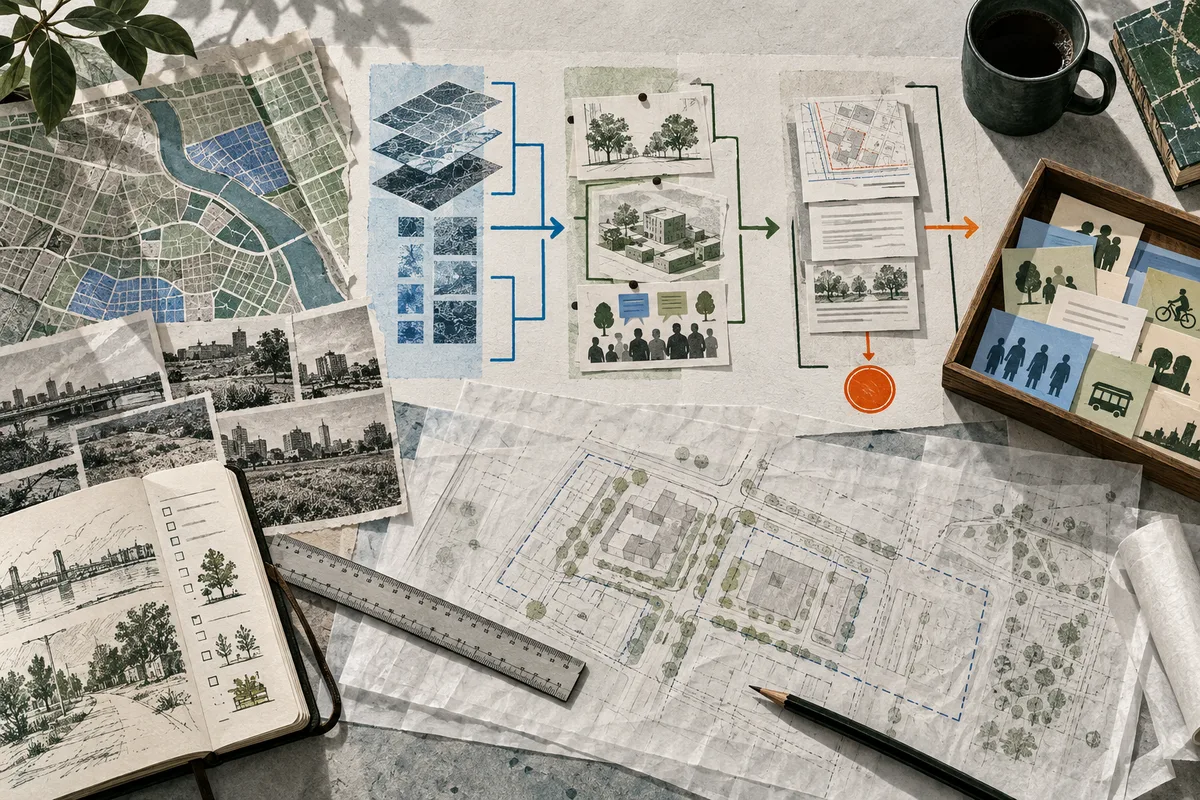
The U.S. Bureau of Labor Statistics describes urban and regional planners as people who meet with officials, developers, and the public; gather and analyze data; assess proposals; and consider options when recommending whether site plans should be approved or denied. It also notes that planners may inspect proposed sites and use GIS to connect population and other information with maps. These duties give us a useful sequence: understand a place, gather evidence, hear people, interpret rules and trade-offs, then advise a decision-maker. The sequence is a practical frame, not a claim that every planner performs the same tasks in the same proportions. [BLS](https://www.bls.gov/ooh/life-physical-and-social-science/urban-and-regional-planners.htm)
The change is uneven along that chain. A digital table of zoning references or a first-pass summary is easier to hand to a tool than an unresolved dispute about who bears the cost of a land-use decision. Image recognition may help flag a feature, but it does not establish that a feature is current, legally relevant, or important to a neighborhood. A generated visualization may help people discuss an option, but it cannot tell a planner whether the people in the room represent those who will live with the outcome.
So the practical question is not whether an occupation is ‘exposed.’ Ask which recurring outputs in your own week are digital and checkable, which require synthesis followed by careful review, and which depend on a planner’s authority, local understanding, or relationship with the public. Those differences point to where assistance may fit and what should remain under direct human responsibility.
The available evidence supports a change in work preparation and synthesis, not a personal job-loss forecast. A useful first response is to map your own workflow before deciding whether you need a tool, a short course, a broader skill upgrade, or a career move. The article follows that workflow from site evidence to consultation to approval advice, then gives a small test that can fit around a real job and its constraints.
Sources: Urban and Regional Planners, Occupational Outlook Handbook
Which parts of an urban planner’s work are most exposed?
Work is more exposed to AI assistance when inputs are already digital, the task recurs, and a reviewer can compare the output with known records. Exposure is more conditional when outputs depend on place, contested goals, incomplete information, or accountable judgment. This is a task-level distinction, not a ranking of people or a measure of who will be laid off.
It helps to keep six signals separate. Capability asks whether a system can produce a kind of output under some conditions. Exposure asks whether that capability applies to a task in a real occupation. Observed use records whether people actually use it. Adoption asks whether an organization has approved, integrated, and resourced the use. Demand concerns the number and type of jobs employers need. Displacement would mean work or employment was removed as a result. Evidence for one signal does not prove the next. A tool demonstration does not establish municipal adoption, and a planner’s use of a drafting aid does not establish that a position was eliminated.
A simple three-band lens helps. First are repeatable digital-production tasks: sorting documents, searching a known code corpus, formatting a table, preparing a meeting agenda, or classifying mapped features. Second are synthesis tasks where an output can save a first pass but needs checking: summarizing comments, comparing policy options, drafting an environmental narrative, translating outreach, or generating a scenario image. Third are tasks where public legitimacy and consequence dominate: setting the question, judging whether evidence applies locally, resolving competing needs, explaining uncertainty, and making or owning a recommendation.
Imagine a site-review packet that contains a parcel map, traffic counts, environmental layers, a development proposal, and several public submissions. Software might organize documents and draft a comparison table. A planner still needs to confirm that each map layer uses the right date and boundary, that the traffic measure answers the question, and that a letter raising a safety concern is not lost because it uses different words from other submissions. This is an illustration of task structure, not a report of a specific project or measured result.
The American Planning Association’s 2023 practice report maps methods such as computer vision, machine learning, and natural-language processing to planning activities, while warning that data quality, transparency, fairness, privacy, and accountability affect whether an application fits. It is a task map and professional resource, not a current adoption survey or a guarantee of performance. [APA, *Planning With Artificial Intelligence*](https://planning-org-uploaded-media.s3.amazonaws.com/publication/download_pdf/PAS-Report-604.pdf)
For your own work, list five to ten recurring tasks and their deliverables. Mark whether the inputs are digital, whether the output is easy to verify, how costly an error would be, whether sensitive information is involved, and who must explain the result. That list is more useful than treating a single occupation-level exposure category as a personal employment outlook.
Sources: Urban and Regional Planners, Occupational Outlook Handbook; Planning With Artificial Intelligence, APA Planning Advisory Service Report 604
Site analysis: the digital evidence is the first pressure point
The first pressure point is often the preparation of digital evidence: finding relevant records, joining datasets, locating features in imagery, and presenting a first-pass pattern. These are plausible applications because they turn structured or visual inputs into a checkable map, classification, or summary. The important qualification is that a pattern is not yet a planning conclusion.
The APA’s 2023 *Planning With Artificial Intelligence* report describes planning uses of machine learning and computer vision, including analyzing imagery and geographic patterns, and explains that AI methods can support mapping, classification, predictive modeling, and clustering. The report’s examples show where methods may fit; they do not tell us how often local planning departments use them today or how reliably they perform on a particular parcel. The report itself stresses clarifying the method and examining performance, fairness, accountability, privacy, and security. [APA report](https://planning-org-uploaded-media.s3.amazonaws.com/publication/download_pdf/PAS-Report-604.pdf)
A 2025 study of participatory urban planning offers more direct evidence of planners’ reported experience. Its three-phase Delphi research invited teams in 53 Finnish municipalities and associated planning organizations with more than 20,000 residents; researchers received 34 survey responses from 16 municipalities. Participants reported uses or potential uses that included analysis of environmental and traffic data, as well as analysis of participatory material. In the study, 97 percent agreed that AI could help planners analyze participatory data. That is a perception measure among a small, selected group, not a measured accuracy result or a national adoption rate. [Raymond et al., 2025](https://link.springer.com/article/10.1007/s44327-025-00137-4)
For an actual site, a digital result depends on mundane questions. Is the parcel boundary current? Are demographic figures measured at a scale that hides variation inside the site? Does the environmental layer cover the relevant season? Were traffic counts taken before or after a nearby road change? Does the model recognize a feature that is visually present but not recorded in the source data? Each mismatch can make a polished summary misleading without the system having ‘failed’ in an obvious way.
A planner can separate assistance from interpretation by keeping the source and transformation visible. Preserve the original layers, note dates and definitions, label derived outputs, and ask what evidence would contradict the apparent pattern. If an automated process marks possible sidewalk gaps, for example, a site visit or a trusted current inventory may be needed to confirm access conditions. That follow-up is not a ceremonial human check; it is the work that turns a possible signal into useful local evidence.
The practical opportunity is to reduce the time spent assembling and presenting evidence while spending more attention on data fitness and the question being answered. But the time saved is not established merely because a tool produces a map quickly. A fair test compares completeness, factual errors, corrections, and review time with the existing method. If verification absorbs the gain, the workflow may not be worth changing.
Sources: Planning With Artificial Intelligence, APA Planning Advisory Service Report 604; Uses, opportunities and risks of artificial intelligence in participatory urban planning
What changes when a planner visits the site?
A visit to a proposed site remains a distinct source of information because it places the planner in the actual physical setting. Digital analysis can help decide what to look for and what to compare; it cannot make a remote layer equivalent to observing the site, nearby connections, or conditions that were not captured in the available data.
BLS notes that planners may travel to inspect potential sites and proposed changes, and may need to consider multiple options when assessing whether site plans should be approved or denied. That is a description of U.S. occupational duties, not evidence that every planner has the same field responsibilities. It does show why a map or generated image is only one input in a planning task that can include observation and communication. [BLS](https://www.bls.gov/ooh/life-physical-and-social-science/urban-and-regional-planners.htm)
AI may help prepare a field checklist from a proposal, compare site photographs with a list of stated concerns, or organize observations after a visit. Those tasks are useful candidates only if the records are current, the tool is approved, and the reviewer can trace each claim to its source. A checklist can remind a planner to examine a pedestrian route; it cannot confirm that the route is safe at the time people use it. A photo classifier might flag tree cover; it cannot by itself establish which trees are protected or what a local policy requires.
The distinction between urban design research and planning work also matters. A 2026 study available through UCL’s repository reports interviews with UK urban-design practitioners. Its abstract says respondents described considerable experimentation with AI but limited influence on actual design, while judgment, contextual understanding, and personal engagement remained important. Urban design overlaps with planning, but it is not the same occupation, and the accessible abstract does not state the interview count or sampling details. It is counterevidence to the claim that experimentation automatically means redesigned professional work; it is not a representative estimate for municipal planners. [UCL Discovery record](https://discovery.ucl.ac.uk/id/eprint/10223367/)
An urban planner reviewing a site should therefore treat a tool’s output as a prompt for attention, not a substitute for the visit or for a reliable local record. This is especially relevant where the concern involves access, noise, safety, seasonal conditions, or how a proposal meets the surrounding street. Some of those issues may be documented digitally, but a document’s availability does not establish that it is complete or current.
For a worker deciding what to learn, this points toward strengthening the ability to interpret spatial information and explain its limits, rather than simply collecting another visualization credential. If your role is mostly desk-based, field evidence may come from colleagues or community records, so the useful skill can be knowing when to request it, how to compare it with mapped information, and how to explain disagreement between sources. A short GIS or data-literacy course may help with a specific gap; a new degree is a larger choice that should be tied to an actual role requirement, time, cost, and salary constraints.
Sources: Urban and Regional Planners, Occupational Outlook Handbook; The impact of AI on urban design practice: exploring practitioners’ perspectives
What changes when planners invite the public into the process?
AI can make parts of public participation easier to prepare and discuss: it can help summarize a large set of written submissions, translate or simplify drafts, or produce a visual prompt that lets participants react to a possible change. Those outputs can widen the ways people express an idea, but they do not determine whose views have been heard or whether the resulting summary is fair.
In the Finnish Delphi study, 34 planners from 16 municipalities responded across three phases, and 13 joined a follow-up focus group. Participants were asked about possible uses of analytical, generative, and humanized AI in participatory planning. They reported examples involving summaries of plan feedback, images, text, translation, proofreading, and scenarios. This is valuable evidence about planners’ reported uses and judgments, but the study used snowball sampling, covered municipalities above 20,000 residents, and had limited representation from smaller places. It does not estimate use across all Finnish planners, let alone globally. [Raymond et al.](https://link.springer.com/article/10.1007/s44327-025-00137-4)
A separate Montreal prototype study examined WeDesign, a custom consultation platform using text-to-image methods. A half-day workshop involved five focus groups containing residents and professionals, and the researchers also interviewed six planning professionals. Participants said rapid images could support creativity and dialogue. They also identified difficulty representing mobility needs, local architectural details, and bilingual prompts accurately. This small workshop and interview study illustrates both a possible use and concrete limits; it does not show a lasting improvement in participation, plan quality, or municipal adoption. The paper was posted as a preprint on arXiv in August 2025. [Mushkani, Berard, and Koseki](https://arxiv.org/abs/2508.19256)
A visual prompt changes the conversation by making a possibility tangible. That can help a resident point to a missing ramp, a street tree, or an uncomfortable building edge. It can also import assumptions that were never discussed: the model may add people, greenery, lighting, or architectural styles that make a proposal seem more attractive or complete than the underlying plan. An image is therefore a discussion aid whose omissions and invented details should be visible, not a prediction of the future or a survey of community preference.
The same is true of text summarization. A system can group repeated words or draft a short account of submissions, but a cluster is not a vote and a frequency count is not a measure of importance. One detailed letter about a barrier may carry a distinct planning issue even if hundreds of other comments use different language. A summary should preserve the source material and give staff a route back to individual comments, especially where the public record or response obligations require it.
A proportionate role for AI in consultation is to make material easier to examine and discuss while preserving pathways for people to correct a summary, contribute in accessible formats, and see how input was used. Whether that is feasible depends on local policy, language access, accessibility, records rules, and facilitation capacity. The evidence supports investigating these uses, not assuming that a tool alone makes a process more inclusive.
Sources: Uses, opportunities and risks of artificial intelligence in participatory urban planning; WeDesign: Generative AI-Facilitated Community Consultations for Urban Public Space Design
Consultation is not a counting problem
Consultation work is not complete when comments have been counted or grouped. The planner must interpret what people mean, note who may be missing from the record, distinguish preferences from legal or technical constraints, and explain what changed in response. AI may help with the first organization pass, but the public legitimacy of the process depends on how that pass is checked and used.
The Finnish study found strong agreement among its respondents that AI could help planners analyze participatory data, while opinions were more divided about whether AI could help local decision-makers make informed land-use decisions: 51.5 percent agreed, 33.3 percent were neutral, and 15.2 percent disagreed. On whether AI could help planners give feedback to residents, 67.6 percent agreed, 14.7 percent were neutral, and 17.6 percent disagreed. These figures describe the responses in this particular survey, not the Finnish public’s views or an observed effect on planning decisions. The sample’s selection and small size sharply limit generalization. [Study results](https://link.springer.com/article/10.1007/s44327-025-00137-4)
The study’s discussion identifies risks that matter to a planner: privacy, bias, explainability, legitimacy, misinformation, and data that do not represent all affected groups. Those concerns affect not only whether an output is correct but whether it deserves a place in a public process. A summary that omits a minority concern can be grammatically clear and still be procedurally harmful. A translation that loses a condition or tone can change what staff think a participant asked for.
The WeDesign workshop offers a concrete example of this tension. Participants found immediate image generation useful for creative discussion, yet they raised problems around visualizing reduced mobility and local architecture and handling bilingual prompts. The study’s scale means we should not claim that these problems occur in every tool or that the proposed platform solved them. It does show why the ability to generate an attractive picture is not the same as accurately expressing what participants intended. [WeDesign preprint](https://arxiv.org/abs/2508.19256)
An accountable consultation workflow can use software to surface themes while keeping the original submissions available for human review. A planner can check whether themes are grounded in actual comments, inspect outliers, test whether alternate wording would be grouped differently, and report the limits of the synthesis. Where a public summary will influence a recommendation, retain a clear route from the summary back to the comments that support it. This is a governance choice, not a guarantee that every participant will agree with the result.
The decision rule is straightforward: use automation to reduce clerical friction only when it preserves the evidence needed to understand dissent and correct errors. If your role involves consultation, a useful capability is not just prompt writing. It is accessible facilitation, careful synthesis, records handling, and the ability to explain how a comment became an issue in the staff analysis. Those skills remain valuable whether a particular organization adopts a tool or not.
Sources: Uses, opportunities and risks of artificial intelligence in participatory urban planning; WeDesign: Generative AI-Facilitated Community Consultations for Urban Public Space Design
Can AI recommend whether a site plan should be approved?
AI can help assemble a draft analysis or compare a proposal with stated criteria, but the evidence here does not justify handing it the approval recommendation. A decision-support output can be one input to a planner’s work; it does not assume the planner’s statutory role, explain disputed facts, or own the consequences of a recommendation.
BLS describes planners as weighing multiple options when deciding whether a site plan should be approved or denied. In the United States, the authority to make a final land-use decision may sit with a public body or official, while planners prepare analysis or advice. The precise division varies by jurisdiction and procedure. An automated document therefore may affect staff preparation without becoming the legal decision-maker. [BLS](https://www.bls.gov/ooh/life-physical-and-social-science/urban-and-regional-planners.htm)
The American Planning Association’s 2024 ethics guidance relates generative AI use to the AICP Code of Ethics. It advises planners to review outputs, check organizational disclosure requirements, attribute sources, and be proactive about learning. Its illustrative local-government scenario describes draft hearing reports containing incorrect code citations, misinterpreted requirements, or omissions. This is professional guidance and an example, not a controlled measurement of error rates in planning reports and not a statute that applies everywhere. The authors explicitly note that general model accuracy measures do not establish performance on detailed planning tasks. [APA ethics guidance](https://www.planning.org/blog/9295637/planning-ethics-and-generative-ai/)
An approval recommendation combines different kinds of reasoning. A tool may extract conditions from a code or organize a proposal’s claims. The planner still must confirm that the cited rule is in force, that the right version applies, and that the analysis addresses the actual application. If the proposal raises a conflict among housing, environmental protection, access, and neighborhood impacts, that conflict cannot be settled by presenting a fluent summary as if it were a neutral answer. The relevant policy may leave judgment to an accountable person or body.
A cautious workflow keeps the distinction visible: use assistance to locate or organize evidence; have a qualified reviewer verify every material citation and factual proposition; document uncertainty and disagreement; route judgment and advice through the required process. An output that cannot be traced back to authoritative records should not quietly become a premise in the recommendation. If review finds a material omission or a misread condition, the correction should be recorded rather than treated as an editing detail.
This boundary does not mean a tool has no place in recommendation work. A planner might ask it to compare a draft report against a checklist, generate a list of questions for follow-up, or identify inconsistent dates across documents, subject to employer policy and verification. The planner’s value shifts toward defining the criteria, checking the evidence, explaining the trade-offs, and ensuring the recommendation is attributable to the people responsible for it. The source evidence supports that prudent division; it does not prove that every employer will preserve the same staffing model.
Sources: Urban and Regional Planners, Occupational Outlook Handbook; Planning Ethics and Generative AI; Planning With Artificial Intelligence, APA Planning Advisory Service Report 604
Where does the workflow change, and where does it stop?
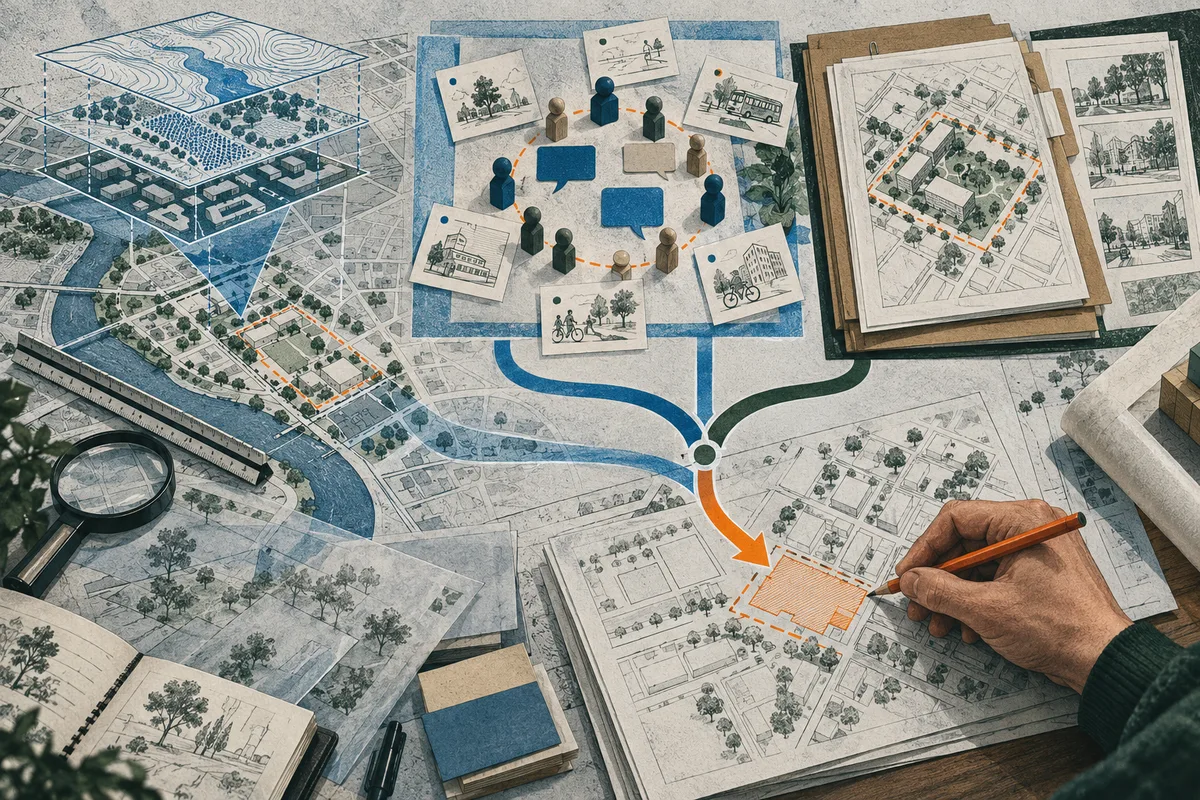
A likely point of change is the handoff between preparation and interpretation. Tools may compress document search, classification, first drafts, translation, and scenario generation. The planner’s work then includes setting up the task, testing whether the output is fit for local use, correcting it, and explaining how it informed a recommendation. Whether this actually saves time depends on the quality of the data, the review burden, and organizational rules.
The APA practice report is useful because it frames AI as a family of methods applied to specific tasks rather than one general capability. Its planning examples include analysis of geographic information and the use of computer vision or natural-language methods. It also warns that claims around AI are often exaggerated and that planners should clarify what a system does, how performance is assessed, and how fairness, accountability, privacy, and security are handled. Since the report dates to 2023, it is a foundation for task fit and governance, not a guide to the current performance of every product. [APA report](https://planning-org-uploaded-media.s3.amazonaws.com/publication/download_pdf/PAS-Report-604.pdf)
The Finnish study helps distinguish perceived capability from actual practice. Although respondents saw promise in using AI to analyze participatory data, most reported no experience applying AI in participatory urban planning: 78 percent said they had zero years of such application experience, while 22 percent reported one to three years. This coexistence of high perceived potential and limited reported experience is important. It suggests interest and uneven experimentation, not broad institutional adoption. These self-reports came from a small snowball sample and cannot stand in for all municipalities. [Raymond et al.](https://link.springer.com/article/10.1007/s44327-025-00137-4)
The practical boundary is not a fixed list of tasks that machines can or cannot do. It depends on consequence and verification. A draft meeting note may be easy to compare with a recording, if recording is lawful and permitted. A draft statement about a code requirement has higher stakes and needs authoritative checking. A generated visualization used in a brainstorming meeting has a different role from one shown to residents as a likely outcome. The same technology can be low risk in an internal, reversible exercise and unsuitable for an official record.
This suggests a useful comparison across five dimensions: time to first output; coverage of relevant material; factual accuracy and omissions; privacy and explainability; and the time required for correction. This rubric is an editorial decision aid synthesized from APA’s concerns, not a validated assessment scale. A tool that creates a draft in seconds but adds substantial checking time may not improve the workflow. A slower process that is traceable, accessible, and trusted may remain the better choice for a consequential decision.
The work that is most likely to change is not necessarily the work that disappears. A department could reassign time toward more cases, more public engagement, or deeper review; it could also change staffing or procurement choices. No source in this evidence packet measures which outcome is occurring across planning departments. A planner should therefore document local changes rather than infer them from a capability claim or exposure score.
Sources: Planning With Artificial Intelligence, APA Planning Advisory Service Report 604; Uses, opportunities and risks of artificial intelligence in participatory urban planning; Planning Ethics and Generative AI
What does labor evidence say—and what can it not tell a planner?
Current labor evidence offers context about the occupation, but it does not estimate AI-caused job loss for planners. The U.S. Bureau of Labor Statistics projects urban and regional planner employment to grow 4 percent from 2025 to 2035, about as fast as average, with roughly 3,200 openings per year. The profile says many openings are expected to replace workers who transfer or leave the labor force. It does not attribute this outlook to AI, model the effect of AI on staffing, or predict a particular planner’s job security. [BLS outlook](https://www.bls.gov/ooh/life-physical-and-social-science/urban-and-regional-planners.htm)
There is also an internal inconsistency on the BLS page: the quick-facts panel lists 1,800 openings, while the detailed outlook section states about 3,200 annual openings. This article uses the detailed outlook figure with that caveat; a reader comparing numbers should consult the page directly and note the version date. Either number is a national projection, not a local hiring promise. The profile was revised August 27, 2026, and its employment projection runs over a decade.
The scope is limited in another way. BLS describes the occupation and its work; it does not say what share of a planner’s time is spent on each task, which tools an employer has approved, or whether a planner’s job is redesigned. The U.S. market also cannot stand in for readers working elsewhere. Public-sector budgets, legal authority, credential norms, local housing or infrastructure needs, and procurement decisions vary by place.
The other empirical sources answer narrower questions. The Finnish Delphi study reports planners’ views and self-reported experience in a selected set of municipalities. The Montreal preprint reports what participants in a single half-day prototype workshop and six professional interviews found useful or difficult. The UCL study reports UK urban-design practitioners’ interviews and says experimentation had limited influence on actual design at the time studied. Each can illuminate mechanisms or perceptions. None estimates an occupation-wide displacement rate, future vacancy counts, or employer adoption across a country.
A reader may encounter numerical exposure scores on commercial or advocacy websites. Such a score can be a task classification or an analyst’s estimate, depending on its method. Unless it is based on representative employer data and a clear causal design, it does not tell you the chance that your position will be eliminated. Even high task applicability could lead to augmentation, changed quality expectations, higher output, fewer hires, or little organizational change. The direction depends on management, budget, law, demand, and how costly error is.
The conclusion is modest but useful: there is no evidence here for panic or complacency. Employment projections provide general context; task research points to areas worth monitoring; local policy and work records determine what can actually be tried. If you need a decision about your own work, use evidence from your task mix and employer rather than trying to convert occupational exposure into a personal probability.
Sources: Urban and Regional Planners, Occupational Outlook Handbook; Uses, opportunities and risks of artificial intelligence in participatory urban planning; The impact of AI on urban design practice: exploring practitioners’ perspectives
Should you upgrade in planning, move adjacent, or make a larger change?
For most early- or mid-career planners, the first option to examine is an upgrade within planning, because it tests whether your existing experience can be extended before you incur the cost of starting over. That is a recommendation about decision order, not a claim that staying is always best or that planning employment is protected. An adjacent move or a larger change may fit better when local opportunities, compensation, health, family needs, or the nature of the work make the current path unsuitable.
An in-role upgrade might pair planning judgment with stronger GIS, data interpretation, accessible facilitation, records handling, or evaluation of automated outputs. This path is most reasonable if your employer permits the tools or if the skill has value without a particular vendor product. A short course or guided project can help close a specific gap; a portfolio artifact could show a reproducible map review, carefully sourced policy comparison, or documented consultation synthesis. A course certificate alone does not establish workplace competence or guarantee a hiring advantage.
An adjacent move could build on planning experience in transportation, housing, climate adaptation, civic technology, environmental review, or public-sector data work. These are possibilities to investigate, not a list of safe jobs. Compare actual postings and conversations with practitioners in your region. Ask what credentials are required, whether your current experience counts, what salary range is available, how much travel or public meeting work is involved, and whether additional training can fit your schedule. Do not assume that an adjacent title has higher pay or lower AI exposure.
A larger career change might make sense if your preferred work has shifted, local planning employment is weak, or your constraints make the current role impractical. It carries transition costs: lost seniority, training time, uncertain income, and potentially a credential requirement. BLS says U.S. urban and regional planners typically need a bachelor’s or master’s degree from an accredited planning program, and employers may prefer or require certification. Those requirements are relevant for entering the occupation, not proof that an existing planner needs another degree to adapt. [BLS education profile](https://www.bls.gov/ooh/life-physical-and-social-science/urban-and-regional-planners.htm)
A useful comparison asks: What work would I do weekly? Which experience transfers? What evidence do local employers request? How long and costly is the training? Would the salary meet my floor during and after transition? Can I accommodate the schedule, commute, field work, or evening meetings? The BLS profile notes that planners may attend meetings in evenings or weekends, so family and health constraints belong in this comparison rather than being treated as afterthoughts.
Before paying for a credential, look at several current postings for the target role, speak with a local professional if possible, and identify a small work sample that tests the skill. Choose the degree route when the target requires its depth or credential; a course when you need structured instruction in a bounded skill; a certificate when employers recognize that specific signal; a project when you need applied evidence; and self-study when feedback and accountability are available elsewhere. No path should be chosen just because a tool is currently prominent.
This comparison should include the opportunity cost of leaving a familiar field. Planning experience may carry knowledge of land-use processes, stakeholder communication, regulatory research, project coordination, and the local institutions that shape decisions. Those capabilities can transfer, but a hiring manager may still require a credential, technical portfolio, or experience with a specific jurisdiction. Treat transferability as a hypothesis to test against postings and conversations, not as a promise that years in planning will convert automatically into a new title. If retraining would reduce income temporarily, include that transition period in the budget. If evening meetings or site visits conflict with care responsibilities or health needs, compare the actual schedule of the destination role before enrolling in training. A sensible path is one that fits both the work you want to do and the constraints you have to live with.
Sources: Urban and Regional Planners, Occupational Outlook Handbook; Planning Ethics and Generative AI
Run one low-stakes workflow test before choosing a larger move
A small, approved test can replace speculation with evidence about your actual work. Choose a recurring task with a clear source record and a reversible output, such as organizing public-domain policy documents or producing a draft checklist from a non-sensitive template. Avoid live applicant data, personal information, confidential comments, or a consequential recommendation unless your employer has explicitly approved the system and handling method.
Before beginning, check local policy, procurement rules, records retention, disclosure requirements, and any collective agreement or professional obligations. The APA’s ethics guidance specifically recommends consulting organizational requirements, checking outputs, and attributing source material. It also discusses privacy and security concerns. The guidance applies its ethical analysis to the U.S. AICP context; it does not replace local law or your organization’s policy. [APA ethics guidance](https://www.planning.org/blog/9295637/planning-ethics-and-generative-ai/)
Write down the baseline first: how long the task currently takes, what a complete result must contain, and which mistakes would matter. Then test one permitted workflow on material you can safely use. Keep a copy of the inputs, the output, and your corrections. Check every factual statement against an authoritative source, look for omitted items, and record how long verification takes. If the output is a summary, spot-check the source items it claims to represent. If it is a map or image, record the layer dates and assumptions that affect interpretation.
This produces a practical comparison, not a scientific trial. A single planner’s test cannot establish broad performance or predict department-wide savings. It can answer a bounded work question: Did the tool help with this task under these conditions, and what review remained necessary? If it fails, note whether the cause was poor inputs, a bad fit, policy restrictions, or a correction burden larger than the time saved. A failed low-stakes test is useful information if it prevents an unsafe or expensive rollout.
The APA’s 2023 report urges planners to identify the problem and clarify how a proposed system would perform, including fairness, accountability, privacy, and security. Turning those concerns into a small comparison is our practical synthesis, not a validated rubric from the report. Record at least five observations: time to first usable draft, omissions, factual errors, edits or corrections, and any privacy or explanation issue. Add a sixth if relevant: whether a colleague or public user could understand how the result was produced.
Do not measure only speed. A faster first draft can transfer work into verification or create new documentation needs. Nor should the test treat a plausible answer as a correct one. For a code search, check the operative rule and its date. For a comment summary, check whether distinct concerns disappeared. For a translation, have a competent speaker review consequential wording. The test should end with a plain note on what the tool did, where it failed, what human review cost, and whether the result belongs in this workflow at all.
If policy prohibits the tool or the data is too sensitive, the next step may be to map the task and ask the responsible manager what approved options exist. That is still progress. A worker does not need to use a consumer tool or expose work materials to demonstrate AI literacy. Understanding why a workflow is unsuitable, what controls it would require, and which skills remain useful is part of practical competence.
Sources: Planning With Artificial Intelligence, APA Planning Advisory Service Report 604; Planning Ethics and Generative AI
Make the next move from evidence about your own work
The evidence points to a specific conclusion: AI is changing the preparation and synthesis around urban planning more clearly than it has been shown to change planners’ accountability for site interpretation, public representation, and approval advice. The biggest near-term question for an individual planner is therefore which tasks in their own role are permitted, repeatable, and cheap to verify. A broader career move should follow that examination, not precede it by default.
There are important exceptions. If your employer is already restructuring a team, reducing entry-level document work, or requiring new systems, a personal pilot may not capture the main risk. If local demand is weak or the salary cannot meet your needs, a different path may be sensible even without AI pressure. If a workflow handles sensitive information or affects a statutory decision, policy and law may rule out experimentation. A job can change through budgets, procurement, political priorities, or workload, even when the technology itself is not the cause.
For a planner in a supportive organization, begin with a one-week task log: list repeated outputs, time spent, source type, review burden, and consequences of error. Choose one low-stakes workflow and check policy. Test it against the current method using non-sensitive material, and record time, omissions, corrections, and human review. Then discuss the result with a manager or colleague responsible for the process. That sequence turns an abstract concern into a specific conversation about work design.
If the test identifies a useful skill gap, choose the smallest learning route that closes it. A GIS refresher, introductory data course, public-engagement practice, or structured project may be enough for a bounded need. A degree makes sense when the target role requires it or you want the deeper foundation and can afford the time and cost. A certificate makes sense when local employers recognize it. A project makes sense when applied proof is missing. Self-study can work when you have reliable feedback and a way to judge your output. None guarantees a job or protects income.
The labor evidence should keep expectations grounded. BLS projects modest U.S. occupational growth over 2025–35, while the direct AI planning studies are small and measure reported views or prototype experiences. The UK urban-design interviews provide counterevidence to claims that experimentation already dominates actual design, but they are adjacent evidence. Taken together, these sources support attention and measured preparation, not an estimate of displacement. A reader outside the U.S. should seek their own local vacancy, credential, and pay evidence before making a costly decision.
The free AI Proof Work task checker can help you describe task-level change pressure and possible first actions; it does not calculate a validated probability of displacement. Use it as a prompt for the task audit, not as a verdict. If you need to compare a stay-and-redesign path with adjacent or larger changes against your salary floor, location, training time, and family constraints, the paid career roadmap is a separate option. It provides scenarios and a 30/60/90-day plan, not employment or income guarantees.
The next steps are observable: list the tasks, check the rules, test one safe workflow, record what changed, and identify the missing skill or local evidence. Then decide whether an in-role upgrade still fits your goals and constraints. If the evidence says it does, build from the experience you already have. If it does not, compare a specific adjacent or larger move with real postings, costs, and time before committing.
Sources: Urban and Regional Planners, Occupational Outlook Handbook; Uses, opportunities and risks of artificial intelligence in participatory urban planning; Planning Ethics and Generative AI; The impact of AI on urban design practice: exploring practitioners’ perspectives
Questions readers ask
Does AI exposure mean urban planners are likely to lose their jobs?
No. Exposure describes whether a capability may apply to tasks; it is not a probability of job loss. The available planning studies examine reported uses, perceptions, or small prototypes, while BLS employment projections do not isolate AI’s effects. Use your own task mix, employer policy, local demand, and workload changes to guide a decision.
Sources and notes
- Urban and Regional Planners, Occupational Outlook Handbook
Supports the U.S. occupation’s stated duties, site visits, GIS use, education context, and 2025–35 employment projection; it is not an AI impact estimate.
- Planning With Artificial Intelligence, APA Planning Advisory Service Report 604
Maps AI methods to planning tasks and discusses data, performance, fairness, accountability, privacy, and security constraints; published in 2023, not a current adoption survey.
- Uses, opportunities and risks of artificial intelligence in participatory urban planning
Reports a three-phase Delphi study with 34 planners from 16 Finnish municipalities plus follow-up participants, measuring reported experience and perceptions rather than adoption rates or employment effects.
- WeDesign: Generative AI-Facilitated Community Consultations for Urban Public Space Design
Describes a Montreal half-day workshop with five focus groups and interviews with six planning professionals; supports prototype opportunities and limits, not scaled outcomes.
- Planning Ethics and Generative AI
APA Technology Division and Ethics Committee guidance discusses output verification, disclosure, attribution, privacy, and organizational policy in the U.S. AICP context.
- The impact of AI on urban design practice: exploring practitioners’ perspectives
UCL repository abstract reports UK urban-design practitioner interviews finding considerable AI experimentation but limited influence on actual design; adjacent qualitative evidence, not a planner labor estimate.
Apply this to your own work
See the whole job market at once.
Explore which occupations AI may reshape, then turn the signal into a practical response.
Explore the job map