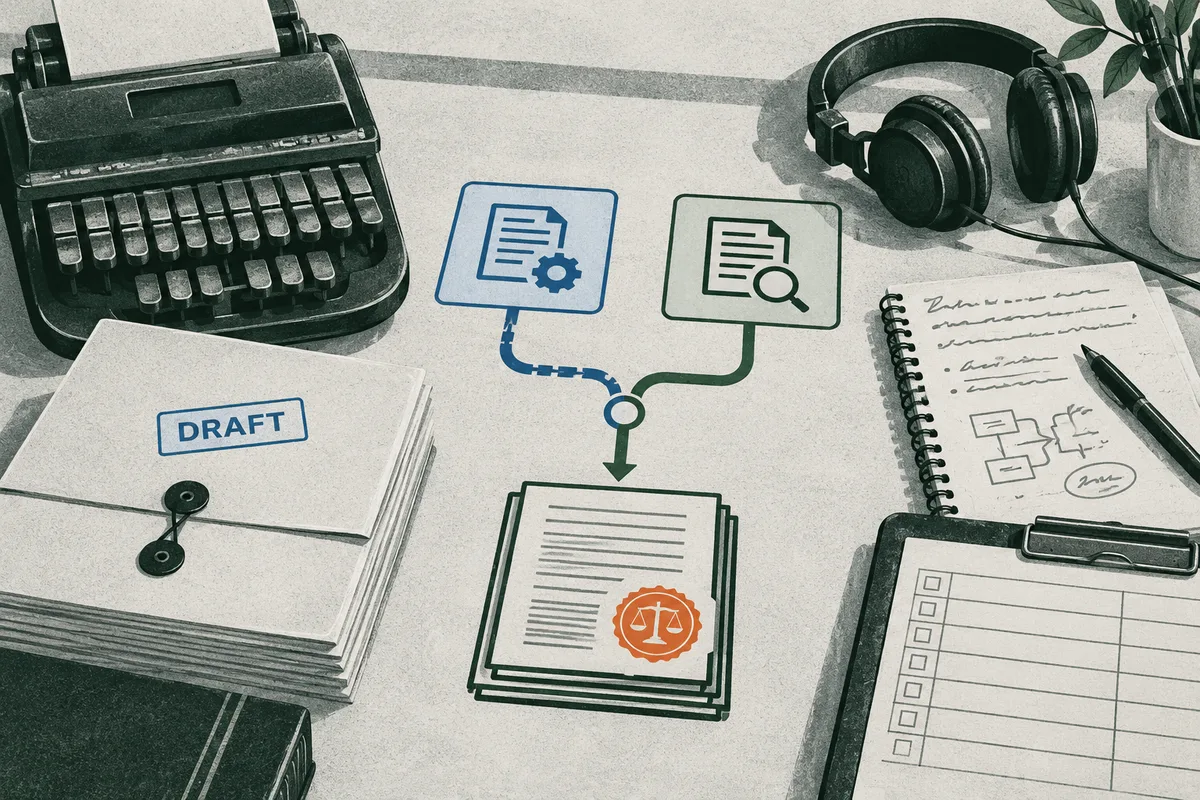
Before testing AI transcription, confirm that your assignment’s rules and your professional obligations permit it. NCRA’s July 2026 guidance for stenographic reporters allows some assistive uses but says AI may not create transcripts or captions in place of stenographic capture. If transcript generation is expressly permitted for a non-record test, use approved non-case audio and the named tool. If authority is unclear, do not process proceeding audio; request a written decision or ask about a permitted non-transcription task.
The short answer: test permission before transcription
Before testing transcription, establish that your role and the rules governing the assignment permit the test. For stenographic reporters, NCRA’s July 17, 2026 COPE AI Guidance says AI may support work such as technical research or spelling and vocabulary clarification, but may not create transcripts or captions in place of stenographic capture. It also requires compliance with applicable court rules and statutes. Calling it “draft only” does not answer whether generating it is permitted; a test may be restricted before certification becomes relevant. If the relevant authority expressly permits a non-record evaluation, use only approved, non-case audio and the named tool in the approved environment; label and keep its output outside the official workflow. The Federal Court Reporting Program describes federal recording and transcript responsibilities, including filing a certified electronic copy when an original transcript is delivered. This federal guidance does not settle permission in every jurisdiction or role. If your authority is unclear, do not upload or process proceeding audio. Ask the responsible authority for a written decision on the specific test, or evaluate an expressly permitted assistive task that does not generate a transcript.
Sources: NCRA COPE AI Guidance — July 17, 2026; Federal Court Reporting Program
Which authority controls before any audio is processed?
There is no single nationwide permission rule for every court reporter and proceeding. Before processing audio, identify the rules for this assignment and your role. Start with statutes and court rules, then read any judge’s order, protective order, and court instructions. Add client or employer policy, the proposed service’s terms, and professional obligations tied to your certification or membership. These sources do different jobs and do not carry equal authority. Vendor permission cannot override a court order or workplace restriction; supervisor approval may not settle a separate professional obligation. For federal work, the Federal Court Reporting Program explains that proceedings designated by statute, rule, or order must be recorded through specified methods, and that the district judge may elect the method. It also describes transcript and certified-copy duties. This provides context for federal assignments, but does not establish permission to send audio to an AI service. Court Reporting Guidance says federal courts administer reporting services locally while meeting statutory and Judicial Conference requirements. Federal materials should prompt a check of applicable court instructions, not serve as a nationwide answer for state, tribal, municipal, freelance, captioning, or deposition work. The 2025 Southern District of California order illustrates why details matter. The court denied a request for a legal videographer to act as deposition officer and transcriber using Zoom AI. It discussed the person’s qualifications and duties, including clarification and speaker management, along with confidentiality concerns under that case’s protective order and uncertainty about platform data handling. The order left room for a different person or case to present a different situation. It is not a general ruling that every AI tool or evaluation is prohibited. Its narrower lesson is that permission, role, record duties, and specific data restrictions can all affect a decision. Professional guidance is another layer. NCRA Official Statements lists its July 17, 2026 COPE AI guidance as addressing AI in the role of stenographic reporter. The guidance is not a statute for every reporter, but members should read it alongside relevant ethics obligations. A court or manager saying “the tool is approved” does not by itself answer whether a proposed use fits those obligations. Conversely, professional guidance is not binding law on every digital reporter or jurisdiction. If sources conflict, are silent, or do not clearly cover a test that generates transcript text, pause before processing proceeding audio. Ask the responsible authority to resolve that exact use in writing. Name the court and jurisdiction, proceeding type, your role and credential, whether audio is live, recorded, or synthetic, the AI function, tool and data path, who can access the material, and whether output is for evaluation only or could be read back, delivered, filed, or certified. Include relevant client, employer, vendor, and professional requirements so the answer addresses the actual arrangement. That distinction matters when a tool creates a parallel text record, even if no one plans to certify it. Keep approval with the test plan and follow its limits. If it covers only synthetic audio or a controlled environment, do not extend it to a client recording or personal account. If no responsible authority will clarify the boundary, do not proceed with transcript-generation testing. The question is not only whether the system can produce words, but whether this reporter, on this assignment, may run this defined process.
Sources: Federal Court Reporting Program; Court Reporting Guidance; NCRA Official Statements; NCRA COPE AI Guidance — July 17, 2026; Southern District of California Order, Case 3:21-cv-01990
What does current professional guidance allow a reporter to test?
The key question is not only whether an AI transcript will be filed or certified. For a stenographic reporter, it is also whether producing that transcript as a test fits the professional boundary that applies before any output becomes an official record. NCRA’s July 17, 2026 COPE guidance says AI may support the stenographic reporter’s work but may not generate the record. It gives technical research and spelling or vocabulary clarification as possible uses, but says AI may not create transcripts or captions in place of stenographic capture. Written for stenographic reporters and captioners, it is professional guidance aligned with NCRA’s ethics code, not a statute for every reporting role or jurisdiction. That distinction changes the proposed experiment. A transcript labeled “draft,” “shadow,” or “not for filing” remains a transcript that the tool has generated. Keeping such an output outside the official record does not establish that generating it is permissible. The guidance does not expressly resolve a hypothetical evaluation using purpose-made, non-case audio; silence is not approval. A non-record label or supervisor’s informal okay does not answer that professional question. Applicable statutes, court rules, orders, workplace instructions, and professional obligations may each matter; the specific scope must be clarified before processing audio. NCRA’s broader Artificial Intelligence Position Statement, in its Policies and Procedures Manual, recognizes AI as a supplemental tool while maintaining that AI or automatic speech recognition cannot replace a trained, certified, impartial human reporter in creating, preserving, and certifying the official record. The detailed July COPE document adds the more operational boundary: limited assistance, sole human responsibility for the record, and no AI-generated transcript or caption in place of stenographic capture. Together, they distinguish discrete assistance from creating a parallel account. They do not grant blanket permission: the COPE guidance says AI use must comply with rules and requirements applicable to the reporter. For a first evaluation, that may mean shifting the question from “How accurate is an AI transcript?” to “Can an expressly permitted support task help without generating one?” A reporter could ask whether a controlled tool may research a technical term or clarify spelling or vocabulary using approved material. These examples are not blanket approval for any tool or workflow. The reporter still needs to respect confidentiality and avoid unauthorized uploading, sharing, storage, or reuse of proceeding content. If the proposed evaluation specifically requires transcript generation, the next step is not to run a small live-case test and label the result provisional. Ask the relevant professional and workplace authorities to interpret the current rules for the precise role, task, audio source, and tool, and obtain a clear scope decision before handling audio. Where the reporter is an NCRA member, the July guidance deserves particular attention as current ethics guidance; where the reporter has another role or is outside NCRA, it should not be misrepresented as universally binding law. Until the applicable boundary is clear, the safer pilot is a permitted non-transcription task—or no audio processing.
Sources: NCRA COPE AI Guidance — July 17, 2026; NCRA Policies and Procedures Manual, Section 11: Position Statements; NCRA Official Statements
What is the actual task being tested?
A useful test begins with a sentence narrow enough that another person could tell whether it succeeded: “Can this approved tool suggest spellings for a supplied list of technical terms?” is a different question from “Can it transcribe a proceeding?” The first names a support function; the second asks a system to produce transcript text. For stenographic reporters, that distinction matters under the July 17, 2026 NCRA COPE AI Guidance: it says AI may support the reporter’s work, gives technical research and spelling or vocabulary clarification as possible uses, and says AI may not generate transcripts or captions in place of stenographic capture. The guidance does not settle every test scenario, so a reporter should confirm the proposed function is within applicable rules and professional obligations before proceeding. The task boundary also keeps a technology claim from turning into an occupation claim. Speech recognition can convert sound into candidate words. That capability alone does not show that a particular workplace has adopted it, that a court permits it, or that it can take responsibility for a certified record. Nor does the fact that one task is technically exposed establish that a reporter will be displaced. Those are separate questions: what a tool can produce, which slice of work it could affect, whether an institution actually uses it, and what happens to work and staffing. A small evaluation can answer only its stated question under its stated conditions. The Bureau of Labor Statistics’ “Court Reporters and Simultaneous Captioners” profile makes clear why “transcribe the hearing” is too broad a test label. Its typical duties include capturing dialogue, identifying speakers’ gestures and actions, playing back portions on request, asking for clarification when testimony is inaudible, checking names and technical terminology, and producing complete, accurate, secure transcripts. It also notes that reporters using digital recording may take notes to identify speakers and add context; in some cases they use the recording to create a written transcript. These tasks connect words to people, events, procedure, and the record’s handling. A word string produced from audio does not, by itself, demonstrate those surrounding functions. Before seeking approval, write down the one function under consideration and what counts as its output. Is the proposed use a terminology lookup, a spelling suggestion, a transcript draft, speaker labeling, or indexing? Which part of the reporter’s existing workflow would it touch, and which responsibilities remain with the reporter? This is a scope description, not permission. A permitted vocabulary aid cannot be quietly expanded into transcript creation; success on an isolated transcription task cannot establish that the whole role has been automated. Naming the task precisely gives the approving authority something concrete to assess and gives the later comparison a defined target.
Sources: Court Reporters and Simultaneous Captioners; NCRA COPE AI Guidance — July 17, 2026
How can a permitted test avoid a misleading sample?
A useful evaluation set is deliberately ordinary and varied. If authorities have allowed transcript generation for this specific evaluation, start with purpose-made audio or material expressly cleared for the exact recording, service, and use. “Non-case” does not itself establish permission to upload. Record who cleared the audio, which tool and configuration may process it, who may access results, and when files must be deleted. If permission is missing, leave that sample out. Removing names from a real proceeding does not necessarily anonymize it: a voice, unusual event, location, or surrounding details can still identify people or reveal confidential context. Build the reference before requesting a transcript. A qualified human should check the recording, mark genuine uncertainty, and note speaker changes. Keep the reference separate from the system output so a reviewer does not adopt a plausible but incorrect phrase. Document language, recording conditions, speakers, and exclusions. The goal is not to recreate every courtroom; it is to know what this sample represents and leaves out. Vary features that can change meaning or challenge recognition: speaker turns, quiet or noisy recording, overlapping voices, numbers, names, unfamiliar technical terms, negation, and speech patterns represented in approved material. Include a feature only when the audio can be lawfully used and the test has a reason to examine it. Clear, rehearsed sentences can make a demonstration look stronger than the work it is meant to inform. A handful of difficult clips cannot establish failure across a profession. Describe the sample; do not turn it into a universal verdict. The accessible abstract for “Testifying While Black: An Experimental Study of Court Reporter Accuracy in Transcription of African American English” offers a reason to check meaning as well as word matching. In a Philadelphia experiment involving human court reporters and ordinary African American English examples, the abstract reports that reporters did not meet stated certification-level accuracy and errors could alter who did what under which circumstances. This concerns those participants and examples, not AI or a present-day error rate; the accessible abstract does not verify exact sample counts. Its practical lesson is narrower: check whether a transcript preserves agency and circumstances rather than assuming familiar-sounding language is faithful. A 2024 preprint, “Automatic Speech Recognition for Legal Proceedings: A Benchmark on French Canadian Courtroom Speech,” describes testing three commercial and open-source systems on curated French legal speech. Its abstract reports word error rate and a phonetic measure, and says the systems showed promise but needed refinement for legal needs. That result belongs to its language, dataset, systems, and study period. It cannot predict how a current tool handles another court’s audio, vocabulary, speakers, or recording setup. These sources support disciplined sampling, not a local performance prediction. Before interpreting results, write a sample note: source and clearance, languages and conditions included, reference-check method, features present, and known gaps. A small, varied set can reveal questions for review and guide a narrower next test. It cannot validate every speaker, proceeding, jurisdiction, or later software version, nor authorize processing that governing rules have not allowed. If a clip exposes consequential ambiguity, preserve it as unresolved rather than smoothing it into a score. The useful outcome is a clear account of where this limited evaluation did and did not provide evidence. Treat any resulting conclusion as specific to this approved sample and documented setup, and revisit it if either changes.
Sources: Testifying While Black: An Experimental Study of Court Reporter Accuracy in Transcription of African American English; Automatic Speech Recognition for Legal Proceedings: A Benchmark on French Canadian Courtroom Speech; NCRA COPE AI Guidance — July 17, 2026
What should a permitted comparison measure?
A permitted comparison should answer two separate questions: what did the system get wrong, and what work remained for a reporter to make the result dependable? Use the same expressly approved audio and defined task for the AI output and the reporter’s ordinary authorized workflow. Compare both with a human-verified reference made from that audio. Record the tool and version, settings, date, audio conditions, and reviewer. Do not let a single aggregate score stand in for the errors that matter. A word-error rate (WER) can summarize substitutions, omissions, and insertions against a reference, but identical totals can conceal very different consequences. A wrong article or punctuation choice may be easy to correct; a dropped “not,” changed number, mistaken speaker, or altered legal term can reverse meaning or attribute an action to the wrong person. Mark each error by type and severity, and note whether correction required replay or contextual judgment. Keep uncertain cases unresolved until a qualified reviewer adjudicates them; do not count a guess as a correct match. The benchmark record for “The State of Commercial Automatic French Legal Speech Recognition Systems and their Impact on Court Reporters” describes three commercial and open-source systems tested on a curated dataset of French legal speech. The researchers used WER and introduced a phonetic measure, Sonnex Distance; their abstract says the systems showed promise but needed further refinement for legal-domain needs. This supports recording the dataset and language alongside multiple measures. It supplies no safe threshold for another tool, current English proceedings, or certification. A different language or dataset cannot establish performance on the reporter’s approved task. Review should also attend to speaker attribution, overlap, names, dates, numbers, negation, and whether the transcript preserves who did what under which circumstances. “Testifying While Black: An Experimental Study of Court Reporter Accuracy in Transcription of African American English” reports an experiment involving Philadelphia court reporters and mundane examples of African American English. Its publisher abstract says reporters failed to meet stated certification accuracy in those examples and that errors could change represented actions and circumstances. This is evidence that meaning and speech variation deserve scrutiny; it is not an AI evaluation and does not predict a particular model’s performance. The available abstract does not give the study’s sample size or detailed rates, so those figures should not be inferred. Finally, measure time across the full review, not just generation: listening, checking names and technical terms, correcting text, resolving speaker labels, and documenting unresolved passages. The Bureau of Labor Statistics lists speaker and action identification, playback, clarification, and checking names and technical terminology among reporters’ duties. Thus, a transcription score cannot represent the whole workflow. Separate generation time, correction time, consequential errors, and ambiguity. Use the same reviewer instructions and timing method for both workflows so the comparison remains interpretable. A fast output with costly or uncertain review may not help; a narrow terminology aid may prove useful without substituting for transcript creation. Results apply only to the approved audio, tool version, and task; they establish neither broader permission nor certification.
Sources: Automatic Speech Recognition for Legal Proceedings: A Benchmark on French Canadian Courtroom Speech; Court Reporters and Simultaneous Captioners; Testifying While Black: An Experimental Study of Court Reporter Accuracy in Transcription of African American English
Why are permission, confidentiality, and certification separate gates?
Permission, confidentiality, and certification answer different questions. Permission asks whether this reporter may use this tool for this assignment. Confidentiality asks whether the recording and any output may be disclosed to, processed by, stored with, or retained by the service. Certification asks who is authorized and accountable for the transcript that becomes the official record. A yes at one gate does not answer the others: approval to evaluate a tool is not permission to upload protected material, and a service’s security controls do not make a generated transcript permissible or certifiable. The distinction matters before a transcript is delivered. Proceeding audio can include confidential evidence or details that identify a matter even if obvious labels are removed. Sending audio to a cloud service may involve processing or retention beyond the reporter’s local device. A no-training term does not establish who can access files, how long they remain, whether subcontractors process them, or whether disclosure is allowed. Do not assume any vendor’s configuration or terms. Confirm the actual account, service, settings, and data path that the proposed test would use. NCRA’s “Ensuring the Confidentiality and Security of Outsourced Transcription” position statement describes accuracy, impartiality, security, and confidentiality as central professional concerns when legal records leave a reporter’s control. Its AI position statement recognizes supplemental uses but keeps creation, preservation, and certification of the official record with trained human reporters. The more specific July 2026 NCRA COPE AI guidance also addresses unauthorized uploading, sharing, storage, and reuse, alongside compliance with applicable rules. These are professional guidance, not universal law, and do not replace duties governing a particular matter. A 2025 Southern District of California order illustrates why the gates can converge without creating a general rule. In denying a request for an unqualified videographer to serve as deposition officer and transcriber using Zoom AI, the court discussed that person’s qualifications and duties as well as concerns about providing designated confidential material to a third-party platform. This case-specific order does not establish a general ban or permission; it shows that role, information, platform, and protective terms can all matter. Before any approved test, obtain answers tied to the exact workflow: what audio may be used and who authorized it; whether disclosure to the service and any subprocessors is allowed; where files and outputs are processed; who can access them; retention and deletion periods; whether content may be reused; and what account controls apply. Name who reviews errors and stops the test, and keep labeled output out of readback, delivery, filing, or certification unless expressly authorized. A generic AI policy or reassuring product description cannot establish assignment-specific permission or data handling. If any answer is missing, pause before processing audio and ask the responsible authority to resolve that point in writing.
Sources: NCRA COPE AI Guidance — July 17, 2026; NCRA Policies and Procedures Manual, Section 11: Position Statements; Southern District of California Order, Case 3:21-cv-01990
What if the institution has an approved AI workflow?
An institution’s written approval can create a route to evaluate AI, but only within the workflow that issued it. A court’s decision does not automatically extend to every reporter, freelance assignment, jurisdiction, or separate experiment. Check whether your role, assignment, audio, tool, and intended output are covered by authorization that fits your professional obligations. The Louisiana Judicial Council’s March 2026 Report of the Judicial Council is a counterexample to the claim that courts uniformly reject AI assistance. In response to a legislative request, it surveyed 81 judges and 372 reporters about digital platforms and computer-assisted transcription. The report records that some respondents were open to AI-assisted rough drafts if a certified reporter edits and manages the final transcript. These are stakeholder views and policy discussion, not evidence that a system was deployed or shown to improve accuracy or efficiency. The report also complicates a story of consensus. In ranking proposed responses to staffing concerns, a gradual move to digital platforms with an in-house reporter ranked ahead of cloud recording with off-site transcription; the latter ranked least practical. The report says webinar participants later showed more interest in digital platforms than survey responses suggested. That shift does not establish adoption or outcomes. Institutions may consider reporter-supervised assistance while views about its form and control remain mixed. A documented workflow may provide safeguards an individual experiment lacks: approved accounts, restricted access, a defined reviewer, fallback procedures, and an owner for errors. Verify these in the protocol instead of assuming they follow from “approved.” Ask whether authorization covers your role and transcript generation, or only another function such as terminology support. Confirm permitted recordings, tool and version, access, retention, disclosure, reviewer, escalation route, and whether the output is a working aid or part of the official record. Identify who may finalize or certify that record. Compare the protocol with rules and professional guidance applicable to your work. Federal judiciary Court Reporting Guidance concerns federal operations; it cannot settle a state or freelance assignment. A Louisiana report cannot authorize a test elsewhere. NCRA’s July 2026 COPE guidance is specific professional guidance for stenographic reporters and may constrain use even where an employer approved a system. If the workflow appears inconsistent with an applicable rule or obligation, do not assume approval resolves the conflict. Ask the responsible authority to clarify before processing audio. Make the request specific: “Does this approval cover my role and assignment, and may I process expressly cleared audio with this named tool to create a non-record test draft?” Ask for permitted scope, reviewer, and stop procedure in writing. Another court’s proposal shows supervised assistance is being considered; it does not grant your permission.
Sources: Louisiana Judicial Council Report of the Judicial Council; NCRA COPE AI Guidance — July 17, 2026; Court Reporting Guidance
When should the reporter stop, narrow, or continue?
Use three gates to decide whether a permitted evaluation should stop, narrow, or continue: authority, control of the data and record, and demonstrated value after human review. A favorable result clears none of the gates for a different use. Stop before audio is processed if you cannot establish who authorized this test, whether the audio may be sent to the named service, who can access or retain it, or whether the output could be mistaken for an official transcript. Ask the responsible authority to resolve the proposed use; general encouragement is not a ruling on a specific obligation. The NCRA COPE AI Guidance for stenographic reporters makes the first gate especially important: it describes limited assistive uses but says AI may not create transcripts or captions in place of stenographic capture. If it applies to your role, an internal “rough” label does not make transcript generation permissible. Ask whether the exact evaluation is allowed. If the answer is no, or remains unresolved, narrow the project to a permitted task such as terminology research or spelling clarification, if the applicable authority allows it. Another organization’s workflow does not decide yours. If authority and data handling are clear, the third gate is whether the defined task remains useful after a qualified person checks the result. Stop or narrow the test if reviewers cannot consistently find errors that change speaker attribution, negation, names, numbers, or other consequential meaning. Stop if ambiguity remains or review takes longer than the authorized baseline. A fast first output has little value if checking erases the time saved or leaves unmanaged risk. The 2024 legal-speech benchmark, the 2024 French legal-speech preprint, evaluates particular systems on curated French data; it cannot set a safe threshold for another language, tool, or workplace. Keep a compact record for the approved scope: audio type and clearance, tool and version, settings, reviewer, error classes, generation time, correction time, unresolved items, and reason for any stop. Preserve enough detail to reproduce the comparison, but do not retain audio or outputs beyond the approved retention period. Separate accuracy from efficiency, and record whether a narrower task could address a failure. Continue only inside the written approval, with a named person responsible for verification and a manual fallback. The Louisiana Judicial Council’s 2026 court reporter research recommendations record stakeholder interest in AI-assisted rough drafts edited and managed by certified reporters. That is evidence of a policy discussion, not measured savings, an operating pilot, or permission for an individual assignment. A favorable local result supports a request for the next bounded step. Obtain approval before expanding to new audio, users, tools, or duties. Neither a benchmark nor a pilot establishes certification, wider adoption, job security, or displacement.
Sources: NCRA COPE AI Guidance — July 17, 2026; Automatic Speech Recognition for Legal Proceedings: A Benchmark on French Canadian Courtroom Speech; Louisiana Judicial Council Report of the Judicial Council
The next move: request a bounded ruling, not a live-case demo
Before proposing a pilot, put the decision in writing. Name your role, task, whether the system would generate words from audio, the audio source, the tool and data path, who may access or retain material, and what the output may be used for. State that it will not enter readback, delivery, filing, or certification; identify the human reviewer, comparison method, and stop conditions. Ask the responsible authority: may this role generate a transcript from cleared, non-case audio for this evaluation under the rules and professional obligations that apply? NCRA’s July 2026 COPE guidance says AI may assist stenographic reporters but may not create transcripts or captions in place of stenographic capture. Workplace approval alone does not settle a professional restriction. The Federal Court Reporting Program describes transcript and certification responsibilities, but does not grant general permission to process audio with AI. Until the scope is clear, do not process proceeding audio. If transcript generation is not permitted, ask whether a narrower task, such as terminology research, is allowed. The free task checker can help map which parts of your work involve transcription, clarification, custody, or certification; it does not determine legal permission.
Sources: NCRA COPE AI Guidance — July 17, 2026; Federal Court Reporting Program
Questions readers ask
Does labeling an AI transcript “draft only” make it permissible?
No. The label does not establish whether generating the transcript is allowed. For stenographic reporters, NCRA’s July 2026 guidance says AI may not create transcripts or captions in place of stenographic capture. Confirm the exact proposed use with the authorities and professional obligations that apply to your role.
Can I use anonymized proceeding audio for a test?
Do not assume removing names makes proceeding audio safe to process. Voice, context, and case details may still identify people or reveal confidential information. Use only audio expressly cleared for the exact test, tool, and service.
Is a court’s approved AI workflow permission for every reporter?
No. Check whether the written approval covers your role, assignment, audio, tool, and intended output, and whether it fits the rules and professional obligations that apply to you.
What should a permitted test measure?
Compare the approved audio and defined task with a human-verified reference. Record meaning-sensitive errors, speaker attribution, unresolved ambiguity, and the time needed to generate and review the output. A word-error rate alone cannot establish that legally important meaning is intact.
Sources and notes
- NCRA COPE AI Guidance — July 17, 2026
Supports the stated professional boundary for stenographic reporters, examples of assistive uses, and confidentiality requirements.
- Federal Court Reporting Program
Supports the description of federal recording methods, transcript duties, and certified-copy filing responsibilities.
- Court Reporting Guidance
Supports the point that federal courts administer reporting services locally under applicable federal requirements.
- NCRA Official Statements
Supports that NCRA lists its July 2026 COPE guidance as addressing AI in stenographic reporting.
- Southern District of California Order, Case 3:21-cv-01990
Supports a case-specific example involving deposition duties, qualifications, and confidentiality concerns about a third-party platform.
- Court Reporters and Simultaneous Captioners
Supports the description of reporting duties beyond converting speech to text, including speaker identification, playback, and clarification.
- NCRA Policies and Procedures Manual, Section 11: Position Statements
Supports NCRA’s position on supplemental AI uses and professional concerns about confidentiality and security.
- Testifying While Black: An Experimental Study of Court Reporter Accuracy in Transcription of African American English
The accessible publisher abstract supports checking whether transcripts preserve agency and circumstances in the reported Philadelphia experiment.
- Automatic Speech Recognition for Legal Proceedings: A Benchmark on French Canadian Courtroom Speech
The abstract supports that a bounded French legal-speech benchmark evaluated three systems with word-error and phonetic measures.
- Louisiana Judicial Council Report of the Judicial Council
Supports reporting stakeholder interest in reporter-managed AI rough drafts as policy discussion, not proof of deployment or outcomes.
Apply this to your own work
See the whole job market at once.
Explore which occupations AI may reshape, then turn the signal into a practical response.
Explore the job map