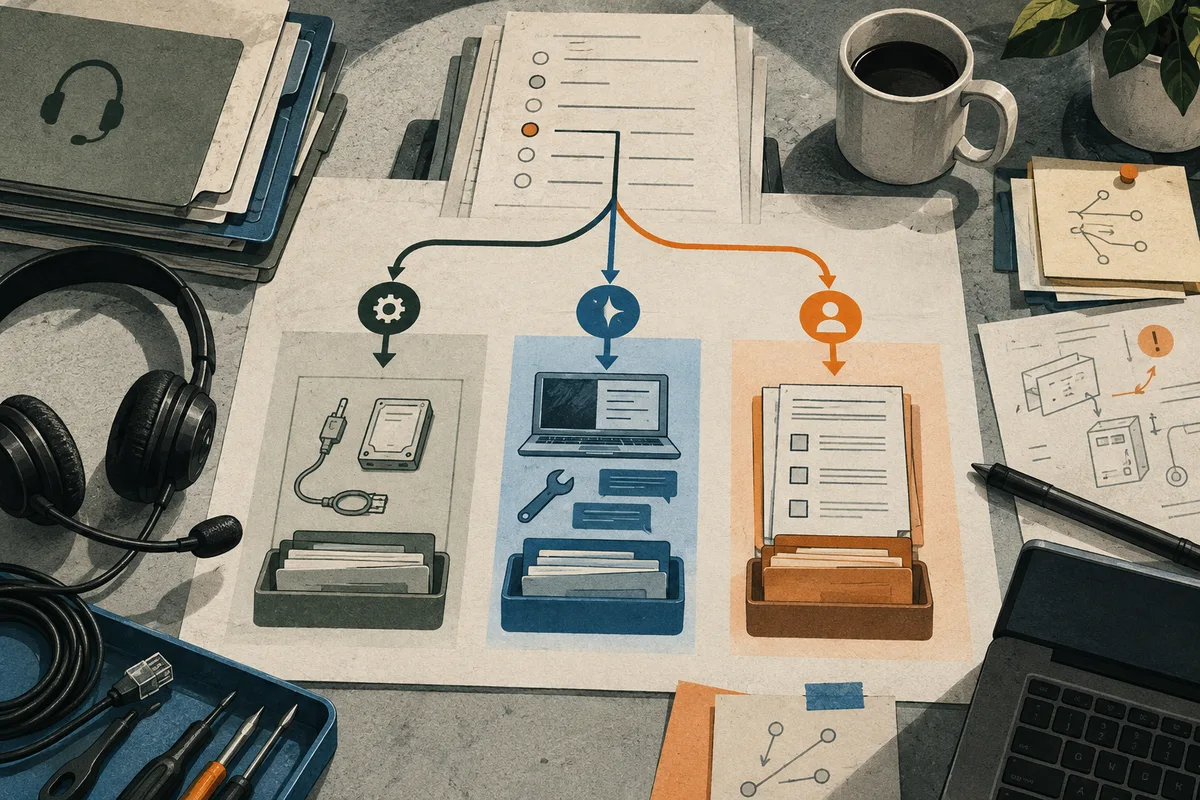
Generative AI is most useful around a technical support escalation: collecting ticket details, finding documentation, suggesting routine checks, and drafting a handoff. A small study of REDCap support tickets found promising classification and response drafting for lower-complexity cases, but did not establish reliable autonomous handling of difficult incidents. For a support worker, the practical move is to test one approved, repeatable preparation task and verify every claim against the ticket and system evidence. Escalation still depends on diagnosis, uncertainty, impact, and accountable decisions. These findings describe capability in particular settings; they do not show universal employer adoption or an individual's likelihood of job loss.
What changes when a ticket moves toward escalation?
When a ticket is about to move from first-line support to a specialist, generative AI can reduce the clerical work of making the case legible. It may turn a long exchange into a summary, retrieve relevant documentation, suggest checks, or draft a note for the next queue. That can shorten the path to useful evidence. It does not establish that the incident is understood, that a suggested fix is safe, or that a specialist can act without asking for missing context.
The U.S. Bureau of Labor Statistics describes user-support work as diagnosing problems, documenting customers’ accounts, guiding troubleshooting, repairing equipment, and reporting recurring issues. Network-support work includes testing and troubleshooting networks. Those duties show why an escalation is more than a transfer between inboxes: it carries observations and decisions from one part of diagnosis to another. BLS also says automation such as chatbots may free some user-support specialists for more complex cases, while projecting fewer workers overall. This is an occupation-level U.S. outlook, not a forecast about generative AI or any one support team.
Consider an example: several users report that a VPN stopped working after a software update. A drafting tool might pull together timestamps, devices, error messages, and checks already attempted. The technician still needs to verify whether the update preceded the failures, whether affected devices share a configuration, and whether the proposed workaround could disrupt access. If that evidence is absent, a fluent handoff can hide the gap instead of closing it.
A field experiment in Alibaba Taobao customer service offers a useful but indirect comparison. It studied AI-led resolution of eligible consumer chats, not technical-support desks. The authors report that human intervention could preserve service quality in technical escalations beyond the system’s capability, with outcomes depending on the failure and timing of intervention. That supports attention to how and when a human receives a case; it does not estimate technical-support job effects.
Sources: Computer Support Specialists: Occupational Outlook Handbook; Agentic AI and Human-in-the-Loop Interventions: Field Experimental Evidence from Alibaba's Customer Service Operations
Which escalation tasks can AI assist with today?
The clearest direct evidence supports bounded information tasks: ticket categorization and response drafting for routine, documented issues. In a 2026 JAMIA Open evaluation, researchers selected 90 REDCap support tickets from 6,316 received by one academic medical center in 2023. They compared four language-model configurations, with and without local and product documentation, against expert judgments on complexity, category, and drafted email replies.
All configurations categorized 81% to 89% of tickets correctly, with high agreement against human judgments. For low- and moderate-complexity tickets, about two-thirds of replies in the best-performing documentation-supported configuration were rated substantially or fully correct. That is meaningful evidence for assistance, but it also means a substantial share did not meet that standard. The study’s four high-complexity tickets are too few to support a stable conclusion about difficult cases. The authors call for human oversight and expanded local documentation; the evaluation did not test a deployed system autonomously closing incidents or measure labor-market effects.
The comparison with older escalation-prediction research helps clarify what ‘AI support’ can mean. A field study at IBM used historical ticket data to predict which support tickets might escalate. Its model was trained on more than 2.5 million tickets and 10,000 escalations. That work concerns prioritization from past records, not generative diagnosis or resolution. Prediction may help a team decide where to look; it does not itself explain a novel failure or prove that the predicted escalation should be avoided.
For a worker, the practical test is a narrow workflow with a visible check. On cases where policy allows, compare a generated summary with the original ticket: are the affected users, system version, timing, error text, attempted steps, and outcomes all accurate? Check whether cited documentation is current and actually applies. Track corrections and rework, not just drafting time. Do not paste confidential data into an unapproved service. These checks reveal whether a tool helps your team’s local process; they cannot establish adoption elsewhere.
Sources: Evaluating large language models for automated REDCap support ticket triage and response; What do Support Analysts Know about Their Customers? On the Study and Prediction of Support Ticket Escalations in Large Software Organizations
What makes a human handoff valuable after the first pass?
A useful escalation preserves diagnostic continuity. It distinguishes observed facts from hypotheses, states which checks were run and what happened, describes customer or service impact, and explains what remains unresolved. The next team should be able to continue investigation without repeating basic discovery or mistaking a plausible explanation for a verified cause.
That standard follows from the work itself. BLS duties include problem diagnosis and documentation, while the IBM study describes analyst knowledge of customers and ticket history as relevant to escalation management. In the VPN example, ‘VPN issue after update’ is a label. A more actionable note would record the update time, affected device and network, exact error, whether the issue reproduces, tests already attempted, and which detail is still unknown. This is an editorial illustration, not a reported case.
The Alibaba experiment adds a workflow warning: in its consumer-service setting, intervention timing and effort mattered, and technical failures differed from emotional failures. The setting is not directly transferable, but it makes a sensible design question visible: does a human receive enough context and authority to help while the case is still recoverable, or only after the customer has repeated the story and confidence has fallen? An escalation process that summons a person late can create more work even when the initial automated answer was fast.
Support workers can make this contribution visible through a before-and-after handoff artifact using approved, non-confidential material. Show how you separated facts from guesses, found the relevant knowledge source, flagged a risky or unsupported recommendation, and gave the receiving team a clear next question. Durable value here comes from domain knowledge, diagnostic reasoning, verification, and communication. A vendor certificate may help when an actual target role asks for it, but these studies do not show that a certificate alone produces readiness or hiring value.
Sources: Computer Support Specialists: Occupational Outlook Handbook; Agentic AI and Human-in-the-Loop Interventions: Field Experimental Evidence from Alibaba's Customer Service Operations; What do Support Analysts Know about Their Customers? On the Study and Prediction of Support Ticket Escalations in Large Software Organizations
What is a realistic next move for a support worker?
Start with the task mix in your own queue rather than making a career decision from a broad exposure label. If repetitive work is gathering known facts, searching approved documentation, or restating a case, try improving that workflow and measure whether errors and rework stay acceptable. If cases turn on inconsistent system behavior, security, unclear impact, or risky workarounds, build evidence of your diagnostic and handoff skill. A larger career move should wait until you have checked real openings, pay requirements, location, training time, and household constraints.
The BLS provides a sober U.S. demand signal: it projects computer user-support employment to decline 3% between 2025 and 2035, while computer network-support employment is projected to rise 1%. BLS attributes the user-support outlook partly to automated troubleshooting and says some workers may handle more complex cases. These projections cover the occupation, not generative AI alone; they do not say that an individual support worker will be displaced or that a network role is a guaranteed safe move. Local demand and entry requirements need separate checking.
A proportionate sequence is: keep a one-week log of work by task; choose one repetitive escalation-preparation step; ask which approved tools and data rules apply; compare assisted output with the source record; then note time saved, corrections, and service consequences. If the experiment improves the handoff, share the evidence and ask whether the workflow can be formalized. If it does not, retain the diagnosis and learn why. Consider an adjacent move only when its actual duties and prerequisites fit your experience and constraints.
Verdict: generative AI can change the preparation around technical escalations sooner than it can take responsibility for resolving ambiguous incidents. The best-supported near-term response is verified assistance on routine, information-heavy steps plus stronger evidence of diagnostic continuity. That conclusion could change as tools, integration, and employer workflows change; current studies do not tell us how widely this will happen or what it will mean for staffing at a particular employer. The free task checker can help organize your task inventory and surface change-pressure signals, but those signals are not a probability of redundancy.
Sources: Computer Support Specialists: Occupational Outlook Handbook; Evaluating large language models for automated REDCap support ticket triage and response
Questions readers ask
Can generative AI resolve technical support escalations without a technician?
The available direct evidence does not establish reliable autonomous resolution of complex technical escalations. A study of 90 REDCap tickets found useful categorization and some correct low- and moderate-complexity drafts, but only four high-complexity tickets were included. Treat the evidence as support for bounded assistance with human verification.
Which support escalation tasks are most suitable for AI assistance?
Tasks with structured information and checkable outputs are reasonable candidates to test: summarizing a ticket, suggesting a category, locating relevant documentation, and drafting a handoff. The worker should verify those outputs against the original record and local procedures.
Does AI exposure in support mean support jobs will disappear?
No. Exposure, tool capability, employer adoption, labor demand, and displacement are different signals. U.S. BLS projections indicate declining user-support employment and modest growth in network support for 2025–35, but they are not generative-AI-specific and cannot predict an individual outcome.
What should a support worker learn next?
Begin with a task audit and one approved, low-risk workflow experiment. Practice checking generated summaries, retrieving current documentation, separating observations from hypotheses, and handing off unresolved evidence clearly. Pursue a course or credential only when it addresses a demonstrated gap or appears in requirements for a real target role.
Sources and notes
- Computer Support Specialists: Occupational Outlook Handbook
Supports the occupation duties and U.S. 2025–35 projections for user and network support, including BLS's automation explanation.
- Evaluating large language models for automated REDCap support ticket triage and response
Supports the bounded evaluation findings for categorization and reply drafting on 90 tickets at one academic medical center.
- Agentic AI and Human-in-the-Loop Interventions: Field Experimental Evidence from Alibaba's Customer Service Operations
Supports an indirect comparison of human intervention timing and effort in technical versus emotional consumer-service escalations.
- What do Support Analysts Know about Their Customers? On the Study and Prediction of Support Ticket Escalations in Large Software Organizations
Supports the historical distinction between predicting escalation risk from tickets and generative diagnosis or resolution.
Apply this to your own work
See the whole job market at once.
Explore which occupations AI may reshape, then turn the signal into a practical response.
Explore the job map