
Public evidence shows German employers are formalizing generative-AI use, but it does not measure how consistently rules reach workers or whether workers understand them. Check the current instruction against one real task: the tool and account, the information involved, required review, responsibility for the result, and where to take exceptions. German and EU information or consultation duties apply in defined circumstances; they do not establish one universal AI-policy format. If a material point is unclear, ask the appropriate policy owner or workplace representative, and pause sensitive or consequential use until you have an approved route.
How do German employers communicate AI workplace rules to workers?
For a knowledge worker in Germany whose employer has adopted generative AI, public evidence does not show a national standard for how workplace rules are communicated to employees. Employer surveys can show whether establishments report using AI or putting rules and training in place; they do not establish whether a particular worker received the message, understood it, or can apply it to a specific task. The best-supported answer is therefore that formalization is visible, while the quality and reach of worker-facing communication remain unmeasured in the strongest public evidence reviewed here.
Those are distinct stages. Adoption means an employer reports AI use. A policy’s existence means guidance has been written or a rule introduced. Delivery is whether it reaches the relevant worker; understanding is whether its meaning is clear; application is whether it resolves what to do with a particular tool, input, output, and responsibility. Evidence for one stage cannot stand in for the next. A rule can exist without being easy to find, and a message can be received without answering whether a recurring task is covered.
This article examines workplace communication after AI adoption: what employer and employee surveys establish, how access categories complicate an adopted/not-adopted label, which legal and workplace channels matter, and how to judge whether an instruction covers a task. It does not forecast job loss, measure replacement, or give individualized legal advice.
For an immediate decision, treat an announcement that the employer is using AI as evidence of adoption, not as blanket permission to use any tool for any work. Before entering information or relying on an output, find the current instruction that covers the tool and task, or ask the appropriate owner about the unresolved boundary. A worker may already have detailed local guidance and training; national evidence cannot rule that out. The point is to verify what applies in that workplace rather than infer it from the announcement alone.
What do German employers actually report?
The main employer-side trend comes from the IAB report “Artificial Intelligence in German establishments: One in four has adopted generative AI.” It uses the IAB Establishment Panel, an annual longitudinal survey of German establishments with at least one socially insured employee. The IAB’s methodology page describes a stratified representative sample of roughly 15,000 establishments each year, with interviews conducted face to face, online, or by telephone. The unit being asked about is the establishment, not an individual employee’s experience of a policy or training session.
The IAB report says the share of establishments using generative AI rose from 5% in 2023 to 24% in 2025. Among establishments reporting use, about half said they had introduced or planned to introduce workplace rules, and a similar share said they had offered or planned to offer employee training. Read together, these findings show that employer-reported governance and preparation accompany adoption for some establishments, while they are not reported as completed across all adopters.
The denominator changes between those statements. The adoption figures refer to establishments overall; the rules and training figures refer only to the subset reporting generative-AI use. The latter should not be read as a share of all German establishments, still less as a share of employees. Nor can the difference between the two adoption years be used to infer that rules or training rose at the same rate: the report does not provide a worker-level before-and-after measure of communication. This distinction keeps an employer-side indicator from becoming a claim about individual reach.
The key qualification is in the survey wording: “introduced or plan to introduce” combines an action already taken with an intention for the future. It therefore does not mean that half had a finished policy in force at the time of reporting. The parallel training category has the same completed-or-planned problem. These combined categories indicate that rules and training are on the agenda for many AI-using establishments, but they cannot tell us how many had completed either step, how detailed the measures were, or whether they were available to staff.
The panel’s scale and representative design make its trend meaningful evidence about German establishments, not a census of workers. Establishments differ greatly in workforce size: an establishment share is not the share of employees working under a given rule. The finding cannot be converted into a percentage of German workers who have received guidance, and the reported categories do not indicate whether every department, role, or task was covered. Nor do they tell us how rules varied by tool, data sensitivity, or level of risk.
The panel’s longitudinal design shows how establishment-reported use changed across survey years, rather than offering only a snapshot. It does not follow the same employees or show how rules operated or messages reached teams. Interview modes describe data collection, not communication effectiveness.
The combined categories also limit comparisons between governance and preparation. Similar shares reporting rules and training do not show that the same establishments did both, that training explained the rules, or that a rule was reinforced in training. Without a cross-tabulation or employee responses, those relationships remain unknown. A workplace could report one measure without the other, and the published summary does not let a reader estimate how common each combination was. The finding is consequently about separate reported actions or plans, not a complete implementation package.
The distinction matters when a worker tries to move from a headline to a decision. A reported workplace rule could refer to a general statement, a detailed policy, or an instruction still being developed; the published survey category does not resolve which. Likewise, planned training is not evidence that a worker has attended it, or that it explains what to do in a concrete workflow. These are possible interpretations left open by the measure, not descriptions of what any particular employer did.
The IAB evidence thus establishes a real employer-side pattern: generative-AI use increased, and rules and training were reported as introduced or planned by around half of the establishments using it. It does not measure the next links needed to answer the worker-facing question: whether guidance was delivered to affected employees, whether employees understood it, whether they knew where to find the current version, or whether they could apply it to their own task. Those gaps are why establishment-level formalization cannot by itself establish communication quality.
Sources: Artificial Intelligence in German establishments: One in four has adopted generative AI; The IAB Establishment Panel
What does employee use add to employer reports?
Employee-initiated use and employer-led formal use are two routes by which AI can enter work. In the first, an employee tries a tool or applies it to a task without that practice necessarily being part of an organization-wide process. In the second, use is formally integrated: the organization supports or structures it, for example through training or supervision. The distinction helps explain why workers may already be using AI even while an employer is still deciding how to govern it. It describes routes of diffusion, not a judgment about whether an individual has permission.
The ZEW discussion paper “Low Barriers, High Stakes: Formal and Informal Diffusion of AI in the Workplace” draws on a representative survey of nearly 10,000 employees in Germany. It reports that 64% used AI tools and 20% used them frequently. These are employee-level reports, so their denominator is people surveyed rather than establishments reporting a policy or adoption decision. The paper’s measure covers AI broadly; it does not isolate generative AI. Its results therefore inform the spread of AI use at work, but should not be recast as a generative-chatbot adoption rate.
The two reported shares also describe different levels of engagement. The overall-use figure indicates whether respondents reported using AI tools, while the frequent-use figure captures a more regular pattern. Neither number by itself says which tasks respondents performed with AI, whether the tool was employer-provided, or whether use was approved. Nor does frequent use necessarily mean that a worker has integrated AI into a high-stakes workflow. Frequency is a description of reported practice, not a measure of task risk, quality, or organizational authorization.
ZEW reports that formal use is associated with more frequent use, training, AI supervision, and higher perceived productivity gains. The pattern is consistent with an organization and its workers reinforcing one another: structured use may accompany more repeated practice, while repeated practice may be one feature of settings where use has been formalized. The survey association cannot establish which direction, if either, causes the other. It also does not show that training was effective, that every frequent user received it, or that a supervisor checked each output.
The perceived-productivity result needs the same care. It concerns workers’ perceptions, not an independent measurement of output or a demonstrated improvement in job security. Someone who uses AI formally may also have a role, manager, task mix, or work environment that shapes how productive the tool feels. The reported association cannot isolate those explanations. It supports a narrower reading: formal AI use and perceived gains occur together in the survey, which is relevant to how work is changing, but it does not prove that formalization produced the gains or that the gains will persist.
The employee findings complement establishment reporting because the surveys observe different actors: establishments report organizational measures, while employees report personal use. They do not match the same employer and worker, so the results cannot be combined into one trend or used to calculate how many workers are covered by a rule. Employee reports show individual-level use, but do not fill the gap about whether instructions reached staff or were understood.
That distinction matters in a workplace where practice can move faster than formal integration. An employee might test AI for a low-stakes task while an employer is still selecting an approved service, preparing training, or clarifying supervision. Conversely, an organization may formally support a tool while some workers do not use it. These are plausible arrangements, not cases identified by the ZEW survey. Its broad use measures do not reveal an individual respondent’s employer, conduct, or policy environment, so the paper cannot tell a reader what a particular colleague was permitted to do.
Formal use associated with training or supervision does not establish that rules were clearly communicated or effective. Communication research would need to track who received which instruction, when and through what channel, and whether it addressed actual tasks; effectiveness also needs a defined outcome. “Low Barriers, High Stakes” measures neither. Treat coworkers’ visible use as evidence of practice, not as a proxy for the rule governing your task.
Sources: Low Barriers, High Stakes: Formal and Informal Diffusion of AI in the Workplace
When does access amount to a usable rule?
Access is not a single yes-or-no condition. In “Hardly Any Companies Forbid the Use of AI,” ZEW reports a March–April 2026 survey of roughly 1,500 companies in Germany’s information economy and manufacturing. The release distinguishes whether a company provides generative-AI tools, allows employees to use them, tolerates use without clear guidelines, or prohibits use. These categories describe different relationships between employer and tool access; collapsing them into “adopted” or “not adopted” hides distinctions that matter when an employee has to decide what is allowed for a task.
Provision is the clearest signal that an employer has made a tool available through its own arrangements. Availability still does not answer every use question: an account may be intended for defined work, require safeguards, or be limited to selected teams. The company-level category does not specify account terms or tasks covered. Seeing a tool in a catalogue tells an employee where access may come from, but not whether a particular input or workflow is within scope.
A company may allow generative-AI use without supplying a tool, leaving open which service is acceptable, whether a personal account is permitted, and what information may be entered. Allowance separates authorization from procurement but does not define boundaries for every team or task; details may sit elsewhere or remain unspecified. The category cannot show whether employees have another instruction to consult.
Tolerance without clear guidelines describes use that a company does not stop, despite the absence of clear guidance. Tolerated practice is not equivalent to a communicated rule. Seeing routine use cannot establish whether management reviewed the tool, set data conditions, or decided how outputs should be checked. Silence also does not identify who is responsible if the task produces an error. This distinction matters because tolerated behavior may be visible to coworkers yet remain institutionally ambiguous: observation communicates that something happens, not the conditions under which it should happen again.
Prohibition signals that a company reports disallowing generative-AI use, but does not explain how the ban is communicated, which services or tasks it covers, or whether exceptions exist. A ban on an external tool would not necessarily explain how to handle an approved internal system unless the instruction clarifies the relationship. ZEW classifies company responses; it does not test worker comprehension or show how a particular employee encountered the rule.
The categories complicate a simple adoption label: a company may allow access without supplying a tool, and employees may use tools where use is merely tolerated. Provision can coexist with task limits; prohibition may leave scope or exceptions unclear. The taxonomy does not show which arrangement produces clearer communication or whether employees interpret it as intended. It is not a governance ladder: the labels reveal neither underlying processes nor whether provision means stronger governance than allowance.
For a task-level decision, do not infer permission from a tool’s presence or a colleague’s use. As a practical interpretive rule—not a survey finding—identify the exact tool and account, the information involved, and the task. Then check the current instruction for that combination. A company might allow public information but restrict confidential material, or permit drafting while requiring human review; the survey category confirms neither example. Verify the rule against actual employer guidance.
ZEW’s survey covers information-economy and manufacturing firms, not every German employer. Its categories simplify arrangements that may differ by team, tool, or task, and cannot capture changes after the March–April 2026 field period. A company-level answer is context, not a substitute for local guidance. If category and task instructions conflict, ask the relevant policy owner which rule applies.
What does German workplace law require people to be told?
German workplace law provides several distinct routes for information, consultation, and participation when workplace processes change. It does not, on the evidence mapped here, require every employer adopting a generative-AI chatbot to issue one standardized AI policy to every worker. The relevant question is what the system does, how it changes work, whether a works council exists, and which statutory trigger applies. The Works Constitution Act (Betriebsverfassungsgesetz, or BetrVG) sets different duties for a works council, employer, and affected employee; Article 26(7) of the EU AI Act adds an advance-notice requirement for a narrower category: high-risk AI systems deployed in the workplace. These are communication channels with conditions, not a general inference that any AI announcement satisfies all legal duties.
Under BetrVG Section 90, an employer must inform the works council in good time about planned construction, alteration, or technical facilities, work procedures and workflows, and workplaces. The section expressly includes the planning of work procedures and workflows involving artificial intelligence. The timing matters: the provision concerns plans early enough for discussion, rather than only an explanation after a system is already embedded in a process. The council is to be consulted on the intended measures and their effects on employees. This gives a clear statutory route for discussion of a planned AI-related work procedure where the conditions in the section are met. It does not mean that every ordinary use of a general chatbot necessarily constitutes a qualifying planned change; the actual procedure, establishment, and facts determine whether the duty applies.
Section 80 supplies a related but different channel. It describes the works council’s general responsibility to monitor compliance with laws and agreements benefiting employees and its role in promoting workplace matters. To perform its statutory duties, the council has information rights against the employer, and the section addresses access to experts under specified conditions. This can matter when the council needs information to assess an AI-related proposal or its effects. The section is not a freestanding requirement that management distribute a detailed technical dossier to every employee whenever a tool becomes available. Its purpose and recipient are different: information to the representative body so that it can carry out its legally assigned work.
A further participation route may arise under BetrVG Section 87(1), item 6, concerning the introduction and use of technical devices designed to monitor employees’ behavior or performance. If a workplace AI system falls within that subject matter, the provision can require works-council co-determination on the introduction and use of the device. The statutory trigger is the monitoring function described in the provision, not simply the fact that software uses AI or that an employer can see aggregate workflow data. Whether a particular system is designed for such monitoring is a fact-sensitive legal question. This participation right is therefore relevant to some deployments, but it should not be generalized into a claim that every generative-AI writing or research assistant automatically requires the same process.
Section 81 addresses information to the employee when changes are made to the employee’s work area or activity. In the circumstances it specifies, an employee is to be informed before a change in the work area or activity, and the provision also covers discussion of the effects of a change in the work process. This is an individual-facing route, unlike the employer’s information to a works council under Section 90. It may be relevant where AI changes an employee’s tasks or how those tasks are carried out. The scope depends on whether the described change and statutory conditions are present; the section does not itself prescribe an all-purpose chatbot notice, nor establish that a general tool launch changes every employee’s work in the same way.
The EU AI Act creates another specific route. Article 26(7), in the operative text reproduced by the European Commission’s AI Act Service Desk, says that before putting a high-risk AI system into service or use at the workplace, the employer must inform workers’ representatives and affected workers that they will be subject to its use. The recipient includes affected workers directly as well as their representatives, and the timing is before workplace use. Its defining limit is equally important: the provision concerns deployment of high-risk AI systems. It is not a blanket advance-notice rule for every generative-AI tool, general-purpose chatbot, or experiment. Nor should the article’s rule be expanded into broader transparency duties that are not in this paragraph’s text. Other applicable national duties can coexist with it, but each has its own basis and trigger.
Taken together, these laws distinguish advance consultation on a qualifying planned work procedure, representative access and participation on specified matters, information to an employee about a relevant change to their work, and advance notice for affected workers in a high-risk AI deployment. They establish that a workplace can have concrete communication obligations even though surveys do not measure what employees actually receive. At the same time, statutory duties depend on matters such as the nature of the system, the work change, the presence and role of representation, and the procedural facts. A reader should not treat this overview as a legal determination about their employer’s deployment or as individualized legal advice.
For a worker trying to understand a particular system, the useful next question is therefore not simply, “Is AI allowed here?” Ask what process governs this system and change: is the employer planning an AI-based workflow that should be discussed with the works council; does the system perform employee monitoring that may engage participation rights; has the worker’s activity or process changed in a way that calls for individual information; or is the system classified and deployed as high-risk AI, engaging Article 26(7)? If a works council or employee representative is present, it may be an appropriate channel for asking which process was followed. The answer will identify the relevant route without assuming one universal policy template or one trigger for all AI use.
Sources: Works Constitution Act (Betriebsverfassungsgesetz), Sections 80, 87, 90 and 81; Artificial Intelligence Act, Article 26: Obligations of deployers of high-risk AI systems
Why must data instructions be separate from tool permission?
Permission to use an AI service answers only one part of a workplace question: whether the account, system, or tool may be used. It does not automatically answer whether a particular kind of information may be entered, whether the output is reliable enough for the task, or who remains responsible for acting on it. These are separate decision points even if an employer places them together in one policy or workflow. The distinction is a practical diagnostic aid, not a claim that the law requires separate documents or that every work task contains personal data.
The Federal Data Protection Act (Bundesdatenschutzgesetz, or BDSG) Section 26 sets conditions for processing employees’ personal data for employment-related purposes. Its role here is narrow: when a workplace AI task involves personal data about an employee, the fact that an application is accessible or approved does not by itself establish that the relevant processing meets the applicable conditions. Section 26 alone does not determine every question under German or EU data-protection law, decide whether a specific system or input is lawful, or dictate the wording and delivery channel of an employer’s AI instructions. The individual facts and applicable rules matter, so a worker with a concrete data-protection concern should use an appropriate competent workplace channel rather than infer a legal answer from a tool list.
A useful way to reason through a task is to keep four questions visible: Is this tool or account approved for the work? Is this information permitted for this tool and purpose? What checking is needed before relying on the generated output? Who takes responsibility for the final communication or decision? A “yes” to the first question cannot substitute for answers to the other three. This separation also helps pinpoint what an instruction leaves unstated: a policy might name a platform but say nothing about personal information, or prohibit certain inputs while leaving the review standard unclear.
For example, imagine—purely as a generic illustration, not a reported case—that an employee wants an AI service to draft a reply to a customer using internal notes. Approval to access the service would establish only the tool boundary. The employee would still need an instruction about whether those notes may be entered, especially if they contain identifiable customer or employee information, and whether an approved environment or a reduced, non-identifying version is required. The draft then needs checking against the underlying record and the organization’s commitments before it is sent. The employee or other designated person remains accountable for the final act according to the workplace process; the generated text does not make the decision on the organization’s behalf. These are operational questions, not conclusions that this hypothetical input is permitted or forbidden under Section 26.
The practical implication is to ask for the missing boundary at the level of the information and purpose, not to rely on a broad statement that “AI is approved.” If the task includes employee personal data, Section 26 makes clear that employment-related processing has its own legal conditions alongside tool governance. If it does not, other confidentiality, customer-data, security, or quality requirements may still matter, but they should not be misattributed to Section 26. A workplace may combine several controls in one clear instruction; what matters for the worker’s decision is that tool permission, permitted inputs, output review, and responsibility can each be understood for the task at hand.
This distinction also makes a request for clarification more precise. Instead of asking only whether a tool is “safe,” an employee can describe the proposed purpose and type of material, then ask which categories may be used in that environment, what transformation or removal of identifiers is expected if any, and who can confirm an exception. The employer’s answer can then be checked against the actual task before information is submitted. This is a way to locate the decision-maker and the unresolved control; it does not itself authorize processing or replace the organization’s data-protection assessment.
Sources: Federal Data Protection Act, Section 26
What makes a rule operational rather than symbolic?
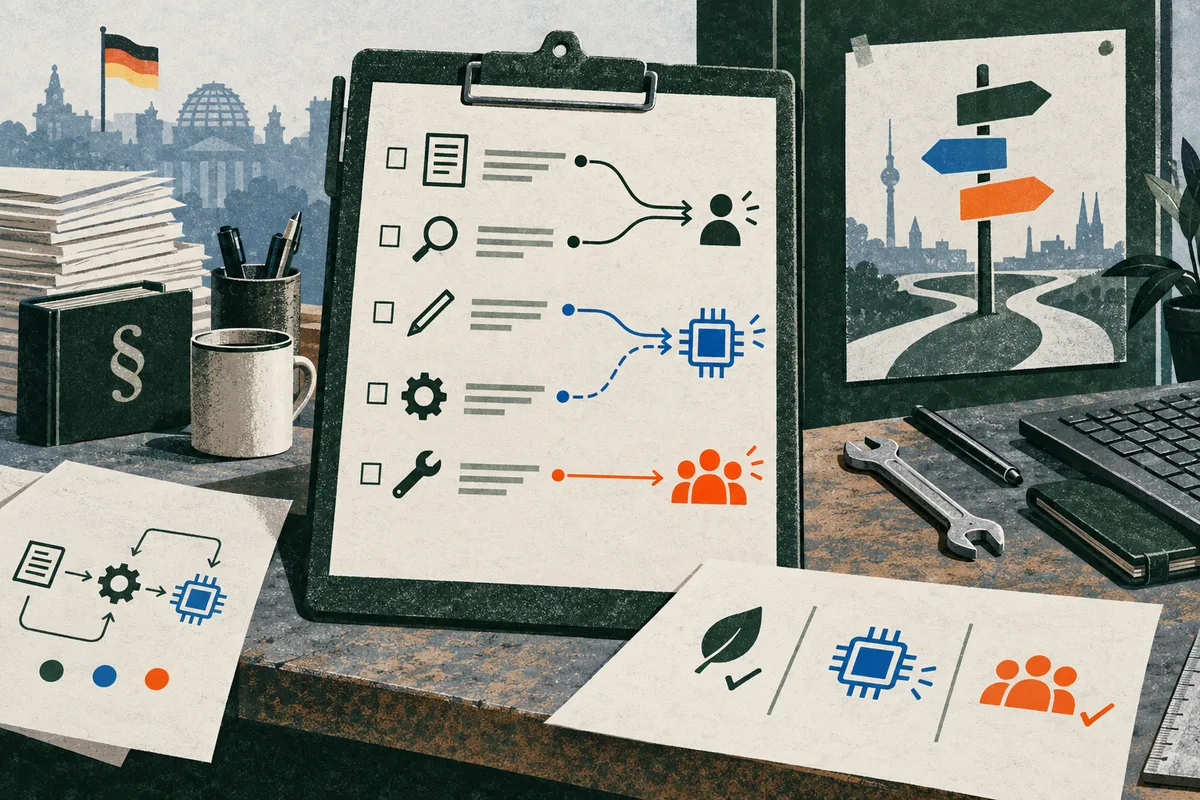
A workplace rule becomes operational when an employee can use it to decide what to do with a particular assignment, not merely repeat the organization’s preferred attitude toward AI. “Use AI responsibly” expresses a value, but leaves the worker to infer which service is covered, what information may be entered, what work may be delegated, how an output must be checked, and who owns the final result. A practical test is whether a person can locate the current instruction, match it to the tool and task, act within its boundaries, and find a named route for uncertainty or exceptions. This is an editorial implementation test derived from the problem of applying a rule; it is not a validated score or a standard measured by the studies discussed here.
The first quality is findability. Guidance that exists only in an old launch email, a manager’s memory, or a document with no clear owner may be difficult to apply at the moment of work. The employee should be able to identify the current version and the scope it covers: a named service or approved environment, the relevant team or work context, and an effective date or update marker where versions can change. This does not require a long handbook. A short instruction linked from the tool itself or a maintained workplace hub could be easier to retrieve than a detailed policy buried in a general document library. Findability is about access at the decision point, not document length.
Specificity then connects the general permission to a work activity. A usable instruction distinguishes, for example, drafting from sending, summarizing from deciding, or using public material from submitting restricted information. It names the data boundary in terms the employee can recognize and states whether the task is permitted, limited, or prohibited in that environment. Where permitted, it describes the expected verification: check generated facts against an authoritative record, inspect calculations before reuse, or obtain review before an external commitment. These examples illustrate the kind of concrete distinction that can make guidance actionable; they are not claims about what German employers commonly require. The point is to make the boundary answerable for the employee’s actual work rather than leave every application to personal guesswork.
A complete instruction also makes accountability visible. It identifies who checks the result, who approves consequential use, and who remains responsible for the final communication or decision. Naming a human reviewer is useful only if the review has a purpose: what must be checked, against which source or standard, and at what point in the workflow? Otherwise, “human in the loop” can become a label without a dependable control. The rule should also give a route for cases it does not cover: a policy owner, team lead, data-protection contact, or another designated function able to answer and record the interpretation. A clear exception path matters because a blanket instruction may not anticipate every tool, input, or changing assignment.
Training and guidance need to agree. If a policy permits a bounded use but training says to avoid it, or demonstrates a tool without explaining data limits and checks, workers receive competing signals. Examples, access, review expectations, and escalation routes should match the maintained rule, so workers see the same limits and responsibilities in the demonstrated workflow.
The Federal Ministry of Labour and Social Affairs’ INQA resource “KI-Einsatz im Betrieb” establishes that practical workplace-AI guidance is available as an implementation resource. It is not a survey of employer policies, a measurement of whether staff received them, or an evaluation showing which format improves understanding. “Machine Learning Applications in Practice,” the Hans-Böckler Foundation I.M.U. analysis of 29 completed works and service agreements, offers a different kind of context: agreements can provide examples of negotiated governance arrangements. Its machine-learning corpus is not evidence of how prevalent or effective current generative-AI rules are. These sources make it reasonable to look for concrete implementation detail, but do not establish that any particular checklist is already standard practice.
A concise rule can still work if the relevant detail is available through linked task guidance, aligned training, and a responsive owner. Formal documentation alone does not show that workers can find or use it; neither does brevity show that it is vague. The useful judgment is functional: can the employee identify the tool and permitted task, recognize the information boundary, perform the required check, understand who is accountable, and reach someone when the situation falls outside the rule? If those elements are distributed across materials, the links between them need to be clear. That is a reasoned usability test for workplace communication, not a claim of measured compliance or an empirically validated rating.
Sources: KI-Einsatz im Betrieb; Machine Learning Applications in Practice
What can workplace cases show about worker voice?
Works councils can provide one route for collective questions and input about AI, but their presence is not universal and does not prove that every employee received clear task instructions. The IAB Research Data Centre summary “Mitbestimmung: Zusammenarbeit mit dem Betriebsrat aus Sicht von Betrieben und Beschäftigten” draws on establishment evidence from 2023 and employee evidence from 2024. It describes gaps in works-council coverage as well as alternative forms of communication. That context matters because workers cannot assume a council is available in every workplace, or that it is the sole channel through which a manager, trainer, or employer explains a new system. The summary supports this qualitative context; without checking the underlying report tables, it should not be used here to state a precise coverage percentage.
Representation and communication are related but distinct. A council’s institutional access can create a place to raise questions or convey collective concerns, while direct manager briefings, training, written guidance, or other workplace channels may also reach employees. Conversely, the existence of a representative body tells us neither which information it received nor what was then explained to particular workers. The IAB summary is about representation and cooperation in establishments and among employees, not a measure of AI-specific communication, policy quality, or comprehension. It therefore helps explain why routes differ across workplaces, but cannot establish whether a worker understands the rule for a task.
“Building Worker Voice and Power in AI Decisions: Three Cases in the German ICT Industry” examines a different question through comparative cases from 2020–2024. The study distinguishes management-automating applications, such as monitoring and workforce analytics, from work-automating applications that change or automate employees’ work. Its abstract reports an asymmetric pattern: works councils strengthened worker voice around management-automating AI, while they faced greater challenges concerning skill development and employment restructuring associated with work-automating AI. The distinction matters because the opportunity to influence how management uses AI is not identical to the capacity to shape how automation changes jobs and skills. Treating these applications as one undifferentiated category would conceal the different reported difficulties.
The study’s value is comparative and explanatory, not representative. The publisher’s full text was not accessible for this review; the account here is limited to the publisher landing page and abstract-level description, with the IAB bibliographic record as a cross-reference. The available record identifies three German ICT-company cases over the stated 2020–2024 period, but it does not support a national estimate of how often councils influence AI decisions, nor a claim that a particular communication practice caused a better outcome. The reported contrast indicates that institutional voice may have more traction in some kinds of AI decision than others; it does not tell us how many workplaces share those conditions or how each case’s employees were informed day to day.
For a worker, the limited implication is practical: where a works council is present, it may be a useful channel for asking what collective discussion occurred, what concerns were raised, or where a task-level rule can be clarified. The three cases suggest that voice and influence can vary with the kind of AI decision under discussion, especially between management-automating and work-automating uses. They do not show that council involvement guarantees a usable instruction for an individual assignment. A representative process and a worker-facing explanation answer different needs: one can address shared effects, while the other must tell a person what they may do, with which information, under what review conditions. The existence of the first is not evidence that the second reached every employee.
There is also a counterexample to treating representation as the decisive communication route: an employee might receive precise, timely guidance directly from a manager or through practical training in a workplace without a works council, or where another channel is more immediate. The IAB context explicitly leaves room for alternative forms of communication, and the three-case study does not compare all such channels or measure which reaches workers most effectively. It would therefore be unwarranted to rank direct communication and representative input from these sources. The relevant question is whether the channel available in a given workplace produces an answer that workers can apply, not whether one institutional form is present in the abstract.
The IAB summary and three-case study show why worker voice should not be collapsed into policy prevalence. Coverage varies, and in the studied ICT cases council influence differed by application, with limits around skills and restructuring. Neither source estimates how commonly employers communicate AI rules, whether workers received a notice, or whether instructions were specific. A representative channel can surface shared questions, while workers still need task-level guidance. The quality and reach of individual communication remain open empirical questions.
Sources: Building Worker Voice and Power in AI Decisions: Three Cases in the German ICT Industry; Mitbestimmung: Zusammenarbeit mit dem Betriebsrat aus Sicht von Betrieben und Beschäftigten
How can I tell whether the message covers my actual task?
Test the instruction against one real piece of work from start to finish. Imagine, purely as a hypothetical illustration, that you need to prepare a customer response from internal notes and are considering an AI draft. The question is not simply whether your employer has announced an AI policy or whether a colleague uses a chatbot. Put the actual task beside the current guidance and trace what would happen before, during, and after prompting: which service and account, which notes, what review, whose approval, and what to do if the case falls outside the stated example. This is a practical reasoning method, not evidence from a study or a legal test.
First, identify the precise tool boundary. Does the message name the service or approved work account you would use, and does it distinguish that environment from a personal account or another product with a similar name? A general announcement that the company is “using AI” or has “approved AI” does not necessarily resolve which interface, account, or feature is covered. For the imagined reply, write down the service you intend to open and compare it with the named instruction. If the message only says that a team has access, the authorization for your particular account and workflow may remain unclear; ask the policy owner or manager to point you to the current applicable instruction.
Next, classify the material in the notes before copying anything. The instruction should let you tell whether the relevant categories are allowed for this tool and purpose, restricted, or excluded. A note may combine ordinary product details with a customer name, contact information, account history, internal pricing, or a promise made by the organization. Do not infer permission for the whole note from permission to use the tool. Nor should you assume that removing a name automatically makes every remaining detail safe to submit. If the guidance does not explain the boundary for the material you actually have, leave it out while asking what approved alternative applies; do not experiment with sensitive inputs to discover the rule.
Then ask what a satisfactory check means for this particular output. A customer response may contain dates, product terms, a refund statement, or commitments that must match the record and the organization’s current rules. An instruction to “review AI output” is hard to apply unless it indicates what needs checking, against what source, and before which step. In the hypothetical task, compare each factual claim and proposed commitment with the authoritative customer record and the applicable service guidance. If the response could create a consequential commitment and the required check or approval is unspecified, hold that draft from being sent until an authorized person clarifies the process. The generated wording itself is not confirmation that its claims are correct.
Make responsibility equally concrete. Who is expected to inspect the draft, and who sends or approves the final reply? The person entering a prompt, the person checking a draft, and the person authorized to make a customer commitment might be different roles. A message that says a human remains “in the loop” may not tell you which person owns the last decision. For this example, look for a clear handoff: whether you may prepare text only, whether a named role must approve it, and who is answerable for sending it. Do not assume that the tool, a manager’s general endorsement, or an informal team habit transfers or removes your workplace responsibilities.
Finally, locate the exception route and a way to identify the instruction you relied on. If the notes contain an unusual complaint, a disputed fact, or information the examples do not cover, the message should direct you to someone able to resolve that case—such as the named policy owner, team lead, or relevant internal contact. Ask where to raise the question and whether the answer should be recorded for future use. Keep a copy of the clarification, or note the policy title and version or date, so you can distinguish the answer you received from a later revision. This creates a usable record of the guidance; it does not establish that the employer’s legal obligations have been met.
A coworker’s routine may show how work is done, but not whether your task is covered: the colleague may use another account, different material or review route, or an older informal practice. An announcement can likewise signal an AI initiative without defining a permitted workflow. Compare your task with maintained guidance and ask about any gap that changes what you would do.
A neutral clarification can be brief and factual: “I’m preparing a reply from these types of internal notes. Which approved account should I use, may this information be entered for drafting, what must I verify before sending, who approves the final response, and where should I take an exception?” You can add the policy version or link you checked and ask whether it covers this case. If the answer resolves the tool, data, checking, ownership, and exception questions, follow that workflow. If it does not, pause the sensitive input or consequential action and use the designated channel for an answer. That pause is a prudent response to unresolved scope, not a legal determination that the use is prohibited.
Does clearer communication protect a worker's job?
No reviewed evidence isolates the causal effect of workplace AI communication quality on displacement, job retention, or income. Clearer rules may help a worker understand a permitted task, raise a concern, or see where a decision is made; that immediate clarity does not establish what happens to the role over time. The evidence in this article therefore cannot support a claim that an employer with a clearer policy is more likely to retain a worker, or that a worker who receives a notice is protected from restructuring. Communication is relevant to navigating a change, but the employment outcome remains a separate question.
The distinction matters when reading “Low Barriers, High Stakes: Formal and Informal Diffusion of AI in the Workplace.” That ZEW employee survey reports associations between formal AI use and factors such as training, supervision, and perceived productivity, but its measured relationships do not isolate the clarity or receipt of workplace rules as a cause of continued employment. Its AI-use measure is broader than generative AI, and perceived productivity is not a measure of job retention or income. Even where a formal-use environment and training appear together, the survey does not tell us whether a particular worker was told what to do for a task, whether that guidance changed the work, or whether any employment effect followed.
The three-case study “Building Worker Voice and Power in AI Decisions: Three Cases in the German ICT Industry” offers a different kind of evidence. Its abstract-level account distinguishes management-automating applications from work-automating ones and reports that works councils strengthened voice around the former while facing greater challenges around skills and restructuring with the latter. That comparison can help explain why worker influence may depend on what a system is being used to change. But three ICT cases do not estimate the effect of clearer communication on job retention across German workplaces. A channel that makes a concern hearable may change the process of discussion without determining management’s eventual staffing or task decisions.
The strongest case for expecting some employment benefit is still plausible: timely information and meaningful participation could help workers identify risks earlier, shape implementation, and connect training or redeployment to the actual workflow. Better understanding may also let an employee distinguish a tool that assists a task from a system that changes who performs it. These are credible mechanisms by which communication and voice might support safer integration or greater agency. The available ZEW associations and German ICT cases, however, do not test this chain from communication through implementation to employment outcomes. A plausible route to benefit is not evidence that the route reliably prevents displacement or protects income.
So treat a clear instruction as useful information for deciding how to perform or question a task, not as a promise about the future of the position. For the near term, resolve the practical permission and responsibility questions before using a system. For the longer term, watch for observable changes in the work itself: which tasks are removed, combined, checked, or newly assigned; which skills the revised workflow requires; and whether responsibility or workload has shifted. These signals address role change directly. They should not be inferred from the quality of an announcement alone, whether it is detailed or vague.
A career judgment also needs evidence beyond internal communication. Compare the changed task bundle with requirements in relevant vacancies or adjacent roles, and consider whether an upgrade within the current role or a move to related work is realistic given your location, credentials, training time, income needs, health, and family constraints. This is not a claim that any one transition will be available; it is a way to keep employer messaging separate from labor demand and personal feasibility. If the work is changing, record concrete examples and identify which experience transfers before deciding that a broad retraining or immediate exit is necessary.
A stronger estimate would require research tracking communication received, subsequent task and role changes, and employment and income outcomes over time while accounting for workplace differences. The reviewed evidence does not provide it. Better communication may help workers understand and participate in change, but does not prove job protection. Assess immediate-use rules and role trajectory on their own evidence.
Sources: Low Barriers, High Stakes: Formal and Informal Diffusion of AI in the Workplace; Building Worker Voice and Power in AI Decisions: Three Cases in the German ICT Industry
What should I do next?
Choose one task you expect to do soon, and write down the current rule you believe applies, including its title or version and who owns it. Ask that owner one focused question about the material gap: for example, whether this tool and account may handle this information for this purpose, or what review is required before the result is used. If sensitive information or a consequential action is involved and the approved route is still unclear, pause that use or action until you have an answer. Where relevant, a works council can help raise a shared workplace question; a data-protection contact may clarify the organization’s handling route. If existing task-specific guidance already answers the question, apply it and record the version instead of opening a broader review. If you have several task questions to organize, the free task-level checker can help surface change-pressure signals and first actions; it does not calculate a validated probability of displacement. If you need to compare career scenarios against your own constraints, the paid roadmap can help structure that comparison, but it does not guarantee employment or income. Check my task exposure.
Questions readers ask
Do German employers have to give every worker a generative-AI policy?
The sources reviewed do not establish a universal requirement for one policy format or the same announcement for every deployment. German works-council and employee information provisions apply in defined circumstances, and the EU AI Act requires advance information for affected workers and their representatives when an employer deploys high-risk AI at work. Whether a duty applies depends on the system and workplace. Ask which current instruction governs your task and tool.
Does a company AI announcement mean I can use a public chatbot for work?
No. An adoption announcement does not by itself establish that a public tool or account is approved, that your information may be entered, or that the task is permitted. Check the applicable instruction for the tool, information, review, responsibility, and exception route. Ask for an approved alternative if a material point is unclear.
Do AI workplace rules protect my job?
The evidence reviewed does not show that clear rules prevent displacement or guarantee job security. Rules may clarify how to perform or question a task, but assess changes to your role and relevant labor demand on their own evidence.
Sources and notes
- Artificial Intelligence in German establishments: One in four has adopted generative AI
A nationally representative establishment panel reports generative-AI use rising from 5% in 2023 to 24% in 2025; among users, about half offered or planned employee training and a similar share introduced or planned workplace rules. This is employer-reported formalization, not evidence of employee receipt or comprehension.
- The IAB Establishment Panel
The panel is an annual longitudinal, stratified representative survey of German establishments with at least one socially insured employee, roughly 15,000 establishments yearly, collected by face-to-face, online, or telephone interviews.
- Low Barriers, High Stakes: Formal and Informal Diffusion of AI in the Workplace
A representative survey of nearly 10,000 German employees reports 64% use AI tools and 20% use them frequently. Formal use is associated with frequent use, training, AI supervision, and higher perceived productivity gains, but does not broaden access; the measure concerns AI broadly, not generative AI alone.
- Hardly Any Companies Forbid the Use of AI
ZEW's March–April 2026 survey of roughly 1,500 German information-economy and manufacturing companies distinguishes employer provision, allowance, tolerance without clear guidelines, and prohibition of generative AI; these categories show why adoption alone is not equivalent to a worker-facing rule.
- Works Constitution Act (Betriebsverfassungsgesetz), Sections 80, 87, 90 and 81
The official statute provides conditional works-council duties and rights, including access to information and experts for AI-related duties under Section 80, participation in specified social matters under Section 87, timely information and consultation on planned work procedures including AI under Section 90, and employee information about changes to their work under Section 81. Applicability depends on statutory conditions; these provisions do not prescribe one universal generative-AI announcement.
- Artificial Intelligence Act, Article 26: Obligations of deployers of high-risk AI systems
Article 26(7) requires employers deploying high-risk AI at work to inform worker representatives and affected workers before putting it into service or use; the duty is limited to high-risk AI deployments and coexists with applicable national worker-information rules.
- Federal Data Protection Act, Section 26
Section 26 sets conditions for processing employee personal data for employment-related purposes, showing that workplace AI instructions involving worker data operate alongside data-protection requirements rather than replacing them.
- Building Worker Voice and Power in AI Decisions: Three Cases in the German ICT Industry
A comparative study of three German ICT-company cases covering 2020–2024 reports works councils strengthened worker voice around management-automating AI, including monitoring and workforce analytics, while facing greater challenges around skill development and employment restructuring associated with work-automating AI.
- Mitbestimmung: Zusammenarbeit mit dem Betriebsrat aus Sicht von Betrieben und Beschäftigten
The IAB data summary draws on establishment survey evidence from 2023 and employee evidence from 2024 and reports works-council coverage gaps alongside alternative communication forms; it contextualizes why a worker cannot assume that a works council is present or is the only communication channel.
- KI-Einsatz im Betrieb
The Federal Ministry of Labour and Social Affairs/INQA publication is a government practice resource about introducing AI at work and can inform a distinction between practical implementation guidance and empirical evidence of how commonly employers communicate rules.
- Machine Learning Applications in Practice
The Hans-Böckler Foundation I.M.U. practice analysis describes 29 completed works and service agreements concerning machine-learning applications. It can illustrate agreement-based governance precedents but does not estimate current generative-AI communication prevalence or worker comprehension.
Apply this to your own work
See the whole job market at once.
Explore which occupations AI may reshape, then turn the signal into a practical response.
Explore the job map