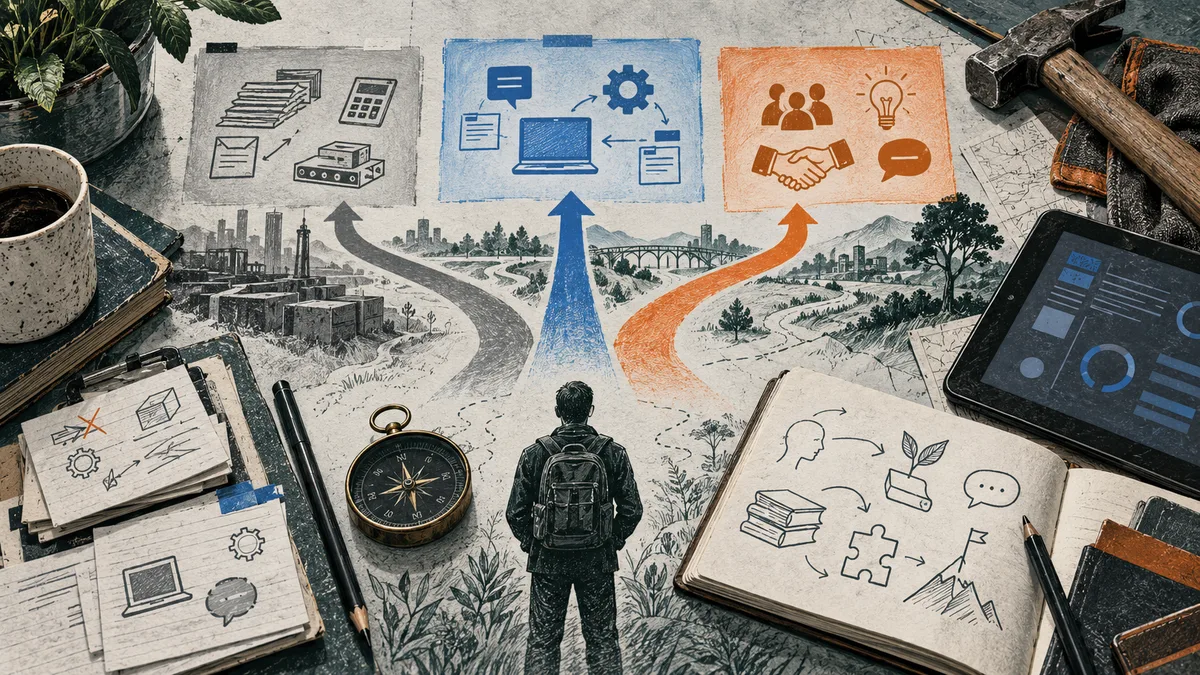
The ILO identifies connected capabilities: safe and ethical AI literacy; analysis, critical thinking, problem-solving, contextual judgment and oversight; digital and data skills; socio-emotional abilities; and adaptability, resilience, learning-to-learn and human agency. The report does not call these skills durable or show they protect a job. Here, durable means capabilities that may transfer as tools and tasks change.
What does the ILO identify as durable skills?
The ILO’s Changing Landscape of Skills in the Age of AI identifies a connected set of capabilities: safe and ethical AI literacy; higher-order analysis, critical thinking, problem-solving, contextual judgment and oversight; digital and data skills; socio-emotional abilities; and adaptability, resilience, learning-to-learn and human agency. The report does not call these skills “durable,” define a permanent list, or show that holding them protects a particular job. Here, durable is an interpretation: capabilities that may transfer as tools and work tasks change. For a worker choosing what to learn next, the first distinction is whether the goal is to use AI in an existing field or to develop and maintain AI systems.
Published in August 2026, the report is a joint review and synthesis prepared through the Inter-Agency TVET Working Group, drawing on existing research and examples. Its overview says AI adoption can change how workers use cognitive, socio-emotional and physical abilities, often increasing the variety and depth of skills required. It also treats broad AI literacy as foundational while discussing technical AI work as a separate, more specialized pathway. These capabilities work together: domain knowledge helps frame and judge work; digital and data capabilities support interaction with systems; and social and adaptive capabilities matter as tasks and responsibilities shift. The ILO publication record and the full report support this summary, but neither supplies a job-security score. Choose a capability tied to a recurring task or technical goal, within available time and training access.
Sources: Changing landscape of skills in the age of AI | International Labour Organization; Changing Landscape of Skills in the Age of AI
Why is AI literacy broader than tool use?
For the ILO’s Changing Landscape of Skills in the Age of AI, literacy means being able to understand, use, monitor, and critically reflect on AI systems. It has three connected parts: basic technical understanding of how AI works; analytical and data literacy for interpreting its outputs in real situations; and ethical and societal awareness of issues such as privacy, bias, transparency, accountability, fairness, and sustainability. That definition is broader than knowing which buttons to press or how to phrase a prompt. The three parts are useful because each addresses a different point of failure. Basic technical literacy helps a user understand that an AI system produces outputs from data and can have limits; it does not require every user to build a model or learn advanced mathematics. Analytical and data literacy asks what an output actually supports: what information it drew on, what may be missing, and whether its apparent conclusion makes sense in the real context. Ethical and societal literacy widens the check to who could be affected and what obligations apply. If a draft contains personal information, for example, the relevant question may be whether the worker is permitted to enter that information into the service at all. If an output informs a decision about people, bias, transparency, and accountability are part of the task, not optional polish. Depending on the rules and stakes, the right response may be to use another process or ask an authorized person to review it. The report’s three-part framing makes clear why “I can get an answer” is too narrow a test of literacy: capability to operate a tool does not establish sound interpretation or responsible use. Consider a worker using an approved system to prepare a summary from work records. Knowing the system’s basic limits can guide how much to rely on a first draft. Checking the draft against the records and the decision it is meant to support draws on analytical literacy and domain knowledge. Confirming that the records may be used in that way, and that a responsible person can explain or review the result, draws on ethical and societal literacy. Some learning is likely to travel better across tools than a particular menu or command. Evaluating outputs, handling data responsibly, reflecting on limitations, and applying knowledge of a field remain useful when interfaces change,. This is an interpretation of transferability, not a claim that any skill is permanent or protects a position. A practical learning gap can therefore be specific: perhaps the worker needs to understand what evidence can verify a recurring output, or which privacy rules apply to a task. Studying that gap may call for a short, focused learning activity and feedback, not automatically an advanced technical course. Individual care also has limits. A worker cannot personally create employer safeguards, authorized access, adequate review, or paid time to learn. The report places literacy within education, training, workplace practice, and broader institutional support. So use the definition to identify what you need to understand for one real task, then check what guidance and review your organization provides.
Which cognitive and data skills matter after AI generates an answer?
The ILO’s *Changing Landscape of Skills in the Age of AI* points to a shift in cognitive work: when a system can produce a draft, summary, or pattern, workers still need to frame the task, bring subject knowledge, interpret data, test claims, notice exceptions, and decide what the result can support. It identifies higher-order analysis, critical thinking, problem-solving, oversight, and judgment, with digital and data literacy as foundations rather than substitutes for subject knowledge. The transferable skill is deciding whether an output is fit for this purpose and what evidence could change that judgment. Plausible language is not verified information. A generated answer does not establish where a number came from, whether records are complete, or whether an exception changes the conclusion. The ILO describes critical thinking as shifting from gathering information toward verifying it. Workers need domain knowledge to frame a question, data literacy to inspect evidence, and judgment to explain limits. Consider an illustrative case: a knowledge worker prepares a weekly operational summary from records they are authorized to use. They first define the decision: prioritize a backlog, investigate a service step, or escalate a change? A summary built for one purpose may omit what another requires. Framing sets relevance; it is not merely writing a longer prompt and assuming the tool will infer context. Next, the worker checks the source material. Which dates and records are included? Are entries missing or grouped under changed categories? A tool limited to an approved export cannot account for data outside it. Data literacy means understanding provenance, coverage, definitions, and missingness well enough to judge what analysis can show; it need not make every worker a data scientist. Suppose the summary says one category of requests has increased. They check the claim against records and definitions, then test it against a domain exception, such as a process change that altered logging. This is illustrative, not an ILO finding. Consider an alternative explanation before presenting a pattern as meaningful, and keep claims connected to sources. Review should follow the cost and detectability of error. A formatting mistake may be cheap to correct; a conclusion affecting customers or scarce staff time may need stronger checks, another reviewer, or sign-off. This is an inference from the ILO’s emphasis on oversight, not a tested workflow. Review depends on task, evidence, policy, and authority. A checklist cannot justify using a tool without approved data access. The OECD’s *AI and Skills: What We Know So Far* offers a separate comparison of broad and specialist needs. It says workers need digital and data skills, alongside problem-solving, creativity, and innovation. It cites a 2023 study for the estimate that fewer than 1% of workers need advanced AI-specific skills such as programming or model development. This is not a current census or local forecast; it distinguishes using AI from developing it. A bounded next step is practising evidence checks around a recurring task unless a target technical role requires deeper preparation. A useful practice goal is a traceable work sample made under approved data rules. State the question, records, claim check, uncertainty, and decision owner. If workplace data is unavailable, practise with permitted public or synthetic material. Identify a specific gap and choose a lesson or project that addresses it; prompts or generic badges alone do not show contextual judgment.
Sources: Changing Landscape of Skills in the Age of AI; AI and skills: What we know so far | OECD
What changes when AI is embedded in task bundles?
AI can automate one part of a task, assist another, or change the order and responsibility of work around it. The ILO’s *Changing Landscape of Skills in the Age of AI* says resulting skill demand depends on how workplaces introduce and use AI, organize jobs and tasks, and provide education and training. A system’s ability to perform a task therefore cannot tell a worker, by itself, whether their role will be redesigned, whether an employer will adopt it, or whether jobs will be added or removed. Consider an illustrative operational summary prepared from records the worker is authorized to use. A tool might help format the summary or produce a first draft of recurring points. That does not settle whether a figure is current, whether a missing record changes the interpretation, or whether an unusual case needs attention. Someone still has to know what decision the summary supports, check claims against the appropriate sources, identify exceptions, and determine who may review and sign off. This illustration shows how one job can contain tasks with different requirements. The ILO report describes AI as capable of automating, augmenting, and redefining tasks. The distinctions matter. Automation means a system performs some work previously done by a person; augmentation means it assists a person; redefinition means the task or its place in the job changes. They can coexist within one role. For the summary, drafting may be assisted while verification and escalation remain with a worker, or an organization may redesign the whole process. If a tool takes on more drafting, the remaining work may put greater weight on context, exception handling, review, and communicating consequences. That is a plausible implication of a shifted task mix, not a guarantee that every employer will create those responsibilities or retain the same staffing. The ILO says management, work organization, training systems, and policy choices help shape skill demand. Keep the signals separate when considering a personal next step. Technical capability asks what a system can do under specified conditions. Observed use asks whether workers or organizations are using it in practice; use by some workers does not establish adoption across an occupation. Adoption describes an employer’s implementation, while job redesign concerns changes to tasks, workflow, authority, or staffing. Labor demand concerns the number and kind of workers sought. Displacement concerns workers losing work or employment. Neither a capability demonstration nor a skill list proves that displacement has occurred or predicts its likelihood for a particular person. A task map is evidence about work, not a forecast about employment. The OECD’s *Skills in the AI Age* likewise treats AI’s employment effects as varying across sectors, regions, cities, and skill levels, and warns that transitions can pose displacement challenges if poorly managed. It does not provide a personal risk estimate or local forecast. The practical starting point is a map of repeated tasks: what records or people each involves, what errors would cost, who has review authority, and which employer rules govern AI use. That map can reveal whether the next learning need is data checking, domain judgment, or understanding a workflow. It can guide learning; it cannot tell you your job-loss probability.
Sources: Changing Landscape of Skills in the Age of AI; Skills in the AI Age | OECD
Why do socio-emotional and physical capabilities still matter?
The ILO’s Changing Landscape of Skills in the Age of AI includes socio-emotional capabilities because work involves coordination, communication, and complex interaction around decisions. It also discusses physical and manual skills because automation changes how those abilities are used unevenly: routine actions in controlled settings may be more affected than non-routine work in changing environments. These capabilities can complement digital and cognitive skills, but none makes a role immune to redesign. The question is where people must coordinate, interpret context, act physically, or remain accountable. The handoff around an AI output is one place these capabilities matter. A worker may need to agree what a system may handle, explain a result’s limits, arrange who checks exceptions, and decide when not to act on an output. Communication makes assumptions, uncertainty, and responsibility visible. The ILO report links human-AI collaboration to context, oversight, and area-specific expertise. This does not establish that every system needs the same human review. Assigning a task to a tool still leaves questions about difficult handoffs and responsibility. Physical capability calls for the same task-level view. The report’s discussion of manual skills distinguishes routine activity in controlled settings from less predictable work. A robot moving uniform packages along a predefined route illustrates the first kind; resolving an unexpected problem in a real, unstructured environment illustrates why physical adaptation may still be required. This is an illustration in the report, not an occupation forecast. It gives no basis for describing all manual work as protected: equipment, setting, task mix, and the way work is organized affect what changes. Nor should “human-facing” be treated as a synonym for safe. Ask what the work requires and who handles exceptions. There is a separate reason not to treat a capability list as a personal promise: workers may not get the opportunity to use what they know. How Workers Use, or Don’t Use, their Skills in the Workplace, an OECD report drawing on the 2023 Survey of Adult Skills (PIAAC), finds that proficiency and workplace use do not reliably move together. In some participating countries, including Singapore and Croatia, one in three highly skilled workers reported using those skills only rarely. Self-organization, task discretion, and cooperative skills are widely used in surveyed countries. These cross-country adult-skills patterns are not an AI-specific test, and reported associations do not show that socio-emotional ability causes a wage, productivity, or job result. For a worker deciding what to develop, map the actual task before choosing a course or career label. Where does coordination happen? Which physical conditions or exceptions require adaptation? Who explains a result, checks it, and has authority to pause or escalate? Ask whether the job gives you a chance to practise them. A next step may be improving a handoff, communicating uncertainty, or clarifying review responsibility; elsewhere, physical context may matter more. Build the complementary capability that fits the work and its constraints. This supports attention to relevant skills and workplace opportunity, not a generic “human skills” promise of security.
Sources: Changing Landscape of Skills in the Age of AI; How Workers Use, or Don’t Use, their Skills in the Workplace | OECD
How should readers interpret evidence about durable skills?
Treat the International Labour Organization’s skill list as a policy-oriented synthesis of capabilities that may matter as AI changes tasks, not as a ranking, a controlled test of skill returns, or a guarantee of job security. “Durable” is a useful question to ask of a skill: can it transfer as tools and work processes change? It is not a measured promise in the report. The ILO’s Changing Landscape of Skills in the Age of AI describes a review of existing knowledge and examples, brought together by an inter-agency group. Neither should be recast as a new experiment that compared workers with different skill sets or measured who kept a job. It does not show that acquiring one item on the list prevents displacement. Other evidence answers different questions. AI and Skills, the OECD’s 2026 synthesis, draws together prior research and employer evidence. It reports that fewer than one percent of workers need advanced AI-specific skills such as programming or model development, attributing that estimate to a 2023 study. That figure is a broad estimate whose meaning depends on the underlying study’s definitions and population; it is not a current census of every workforce, a local forecast, or a reason to skip technical study when a target role requires it. Neither directly inventories every worker’s daily tasks or proves that a listed skill causes a hiring outcome. The OECD report How Workers Use or Don’t Use Their Skills in the Workplace uses the 2023 Survey of Adult Skills, or PIAAC, to examine proficiency and reported skill use. It finds that skill proficiency and actual workplace use can diverge, and reports associations between more frequent skill use and outcomes such as productivity, wages, satisfaction, and autonomy. These are cross-country associations, not an AI-specific causal test and not an individual wage prediction. They underline a practical limit: possessing a capability does not ensure that a job gives someone discretion or an opportunity to use it. The ILO’s Lifelong Learning and Skills for the Future informs access and pathways, but does not show that a specific certificate improves employment outcomes. Skills in the AI Age, an OECD policy paper, notes that effects vary across sectors, regions, cities, and skill levels. That variability is a reason to check local requirements and the actual task bundle, not to turn a global skill list or statistic into personal odds. The strongest counterpoint is that transferable skills can lose practical value when work is reorganized, staffing changes, training time is unavailable, or a role offers little discretion. That possibility does not invalidate the ILO synthesis; it shows why responsibility is shared with employers and institutions. A proportionate response is to practise useful foundations on a real, permitted task and check requirements for any target role. Do not infer security from a skill label, a certificate, or a global statistic.
Sources: Changing Landscape of Skills in the Age of AI; AI and skills: What we know so far | OECD; Skills in the AI Age | OECD; How Workers Use, or Don’t Use, their Skills in the Workplace | OECD; Lifelong learning and skills for the future | International Labour Organization
How do learning paths compare for using versus building AI?
If your goal is to use AI in your current field, start with safe, task-specific literacy, data interpretation, verification, and judgment grounded in your subject knowledge. Advanced machine-learning study is not the default. If you want to build or maintain AI systems, deeper technical learning may fit, but the target role’s actual prerequisites should set its depth. Choose the format that supplies your next needed capability within your constraints. The ILO’s Changing landscape of skills in the age of AI describes a spectrum from basic familiarity with AI tools, through intermediate abilities to use or implement them, to advanced competencies for development and engineering. The spectrum separates two goals. Users need enough technical understanding to interpret outputs and recognize limits. System designers and maintainers may need relevant programming, mathematics, data, and systems knowledge. The OECD’s AI and skills synthesis similarly distinguishes broad digital and data abilities from specialist AI skills. It reports that fewer than 1% of workers need advanced skills such as programming or model development, attributing that estimate to a 2023 study. Treat this as a broad estimate tied to that study’s definitions and population, not a current census or local forecast. It does not call for universal specialist training. Learning formats solve different problems. Self-study can cover a defined concept at low direct cost, but may offer little feedback or recognized evidence. A course can structure foundations and practice. A certificate records completion; its value for a particular role depends on curriculum, assessment, and recognition, and does not itself establish readiness. A permitted project can demonstrate application and invite review. A degree can provide sustained theory and required qualifications, with greater time and cost commitments. No format guarantees hiring, a salary increase, or job security. The ILO’s Lifelong learning and skills for the future adds a practical condition: learning happens outside classrooms too. Its May 2026 summary says day-to-day work, peer support, and practical experience are widespread, while access to structured training is unequal. It reports 16% of workers received training in the past year, not AI-course completion. The summary also says interventions are more effective when they build rounded skills, combine classroom and work-based experience, and lead to qualifications. These are intervention features, not proof of a specific career outcome. Access matters: employer-funded time, a supportive reviewer, and tuition money cannot be assumed. Choose a learning unit by the gap it closes. If you can practise an approved recurring task, pair a short lesson with a reviewed example: check an output, explain its supporting evidence, and identify where human judgment is needed. If workplace material or review is unavailable, use public or synthetic examples and seek feedback before treating the work as evidence of competence. For a certificate, check syllabus, assessment, cost, schedule, and recognition for the role you want. For an AI development position, inspect current local role requirements, then compare self-study, a course, a project, or a degree against the technical depth and feedback needed. A degree may fit when it supplies required foundations or a qualification other routes cannot; a smaller step may be enough to test interest or close a discrete gap. Include your salary floor, caregiving, health, location, and available study time in the decision. A long program may not fit an income or time constraint; a free course may lack needed practice. Ask a manager or colleague which approved task, review, and skills could support a small exercise. Then choose one bounded next step tied to that task or a verified target-role prerequisite. Learning can expand options, but neither a skill label nor a credential predicts whether a particular job will remain unchanged.
Sources: Changing Landscape of Skills in the Age of AI; AI and skills: What we know so far | OECD; Lifelong learning and skills for the future | International Labour Organization
What is the smallest useful next step?
Choose one recurring, low-risk task your workplace permits you to practise with AI. Note the decision the output supports, which source material can verify it, applicable data rules, where human judgment or sign-off belongs, and who can review it. The ILO’s Changing Landscape of Skills in the Age of AI connects human-AI work to framing, context, oversight, and area-specific expertise; it does not present this checklist as a tested job-protection method.
Practise once, then compare the output with approved sources. Record one gap: perhaps you could not interpret a data field, spot a system limitation, or explain uncertainty. Choose the least costly learning route that addresses it and gives feedback: a guided lesson, knowledgeable reviewer, or supervised project. If workplace practice is unavailable, use public or synthetic material; do not put confidential information into an unapproved service.
Transferable skills are useful when the task offers a chance to apply them and the work provides support and review. The free task checker organizes task-level change-pressure signals; these are not a validated probability of displacement. If you need to compare a role upgrade with adjacent paths under salary, location, time, health, or family constraints, the career roadmap is another option. Ask your manager which task is approved for a small trial and what evidence would count as a good result.
Sources: Changing Landscape of Skills in the Age of AI; Lifelong learning and skills for the future | International Labour Organization
Questions readers ask
Does the ILO say these skills make a worker’s job safe from AI?
No. The report synthesizes research and policy examples; it does not rank skills by job protection or estimate an individual’s displacement risk. Workplace adoption, task design, training access and labor-market conditions also shape what changes.
Do workers need advanced machine-learning training to use AI at work?
Not by default. The report distinguishes foundational AI literacy for people using AI from advanced technical capabilities for developing or engineering systems. Start with the requirements of your task or target role.
Sources and notes
- Changing landscape of skills in the age of AI | International Labour Organization
The official publication record identifies the ILO report and its broad themes of changing skill demand in the age of AI.
- Changing Landscape of Skills in the Age of AI
The full report supports the article’s account of AI literacy, cognitive, data, socio-emotional and adaptive capabilities, and conditional task change.
- AI and skills: What we know so far | OECD
The OECD synthesis distinguishes broad workplace skills from advanced AI skills and attributes its under-1% estimate to an earlier study.
- How Workers Use, or Don’t Use, their Skills in the Workplace | OECD
This OECD report uses 2023 Survey of Adult Skills evidence to describe workplace skill use and related associations, not AI-specific causal effects.
- Lifelong learning and skills for the future | International Labour Organization
The ILO summary supports claims about unequal training access, informal learning and features of effective learning interventions.
- Skills in the AI Age | OECD
The OECD publication abstract supports the caveat that AI employment effects vary by sector, region, city and skill level.
Apply this to your own work
See the whole job market at once.
Explore which occupations AI may reshape, then turn the signal into a practical response.
Explore the job map