In a two-week AI trial, track total human minutes for one defined claims task from intake to an agreed completion point, across the adjuster and every reviewer or downstream role. Log preparation, prompting, output checking, correction, approval, handoffs, and later rework; measure elapsed cycle time separately. Compare similar AI-assisted and usual-work cases, and pair time with task-specific quality checks. A faster draft counts as time saved only when total labor falls without unacceptable quality loss or hidden review transfer. Treat a small or mismatched sample as a local signal, not proof of long-term productivity or job displacement.
The claim that a faster AI draft means time saved
A two-week trial should answer a narrow question: did one defined claims task require less total human work from intake to an agreed completion point, while meeting the same quality and control requirements? A screen that produces a summary in seconds can still leave an adjuster reading the whole file, checking each factual statement, correcting omissions, documenting approval, and answering a follow-up question from an examiner. The output step got shorter; whether the work did is an empirical question.
Keep two numbers separate. Gross step time is the time apparently removed from the particular activity the tool targets, such as drafting a routine status summary. Net human time is the labor spent by every person who touched the task under the AI condition, including preparation, prompting, interpretation, verification, correction, escalation, and later rework. Only the second answers whether labor was saved. If the AI draft takes two minutes but introduces a ten-minute verification task, the draft is faster and the workflow may be slower.
The appropriate unit is a comparable task or claim-work unit, not a vague label such as ‘claims productivity.’ A property-damage estimate, a coverage letter, a medical-record chronology, and a claimant call have different inputs and consequences. BLS describes adjusters gathering photographs and statements, reporting to examiners, negotiating, and settling; O*NET adds form review, verification, interviews, documentation, and complex-claim resolution. Those descriptions show why a short text-generation step cannot stand in for the whole job. They do not report how long your own team spends on any task.
This article proposes a local workflow ledger and decision rule. It is an editorial synthesis of occupational descriptions and evaluation guidance, not a validated claims-industry instrument or evidence that an unnamed tool saves time. A two-week window is useful for finding friction, missed work, and a plausible task-level signal. It is not enough by itself to establish rare-error safety, durable productivity, staffing effects, or employment outcomes.
The decision is limited to this task and setup. Continue only when comparable cases show lower total human minutes, agreed quality controls remain acceptable, and review has not moved to another person or later stage. Otherwise, narrow the test, stop, or collect evidence that can resolve what remains uncertain.
Be precise about the claim you will later make. ‘The drafting step took less time in this sample’ is a narrower statement than ‘the team became more productive.’ The latter can imply a broader output rate, and it needs an output denominator, comparable work, and a quality account. Keep the label close to the metric so that a dashboard or meeting note does not accidentally widen the conclusion.
Sources: Claims Adjusters, Appraisers, Examiners, and Investigators; Claims Adjusters, Examiners, and Investigators (O*NET 13-1031.00)
What counts as the whole task in an adjuster’s workflow?
Define the task boundary before anyone tries the tool. Write down the trigger that starts the work, the deliverable, the person who accepts it, and the event that means it is complete. For example, a team might test preparing a first-pass chronology from an approved set of claim documents, beginning when the documents are ready and ending when an examiner accepts the chronology or returns it for correction. That boundary includes more than the model’s generation time and less than the entire life of the claim.
The boundary should follow how work actually moves. If one adjuster gathers records, another checks the summary, and a supervisor approves a consequential communication, those roles belong in the workflow map even if only one person uses the tool. Include handoffs and waiting states, while distinguishing active labor from elapsed queue time. A task that takes five minutes of active work but waits two days for an approval has five labor minutes and two days of cycle time; these are different outcomes and should not be blended.
O*NET’s current occupation record lists reviewing forms to determine coverage, analyzing investigation information, verifying data, assessing damage, interviewing or corresponding with parties, entering payments and reserves, maintaining files, and resolving complex claims. BLS likewise describes evidence gathering, reporting, negotiation, and settlement. These are occupational descriptions, not a universal sequence. Auto physical damage, property catastrophe, liability, workers’ compensation, and desk claims can differ, and company roles divide the steps differently.
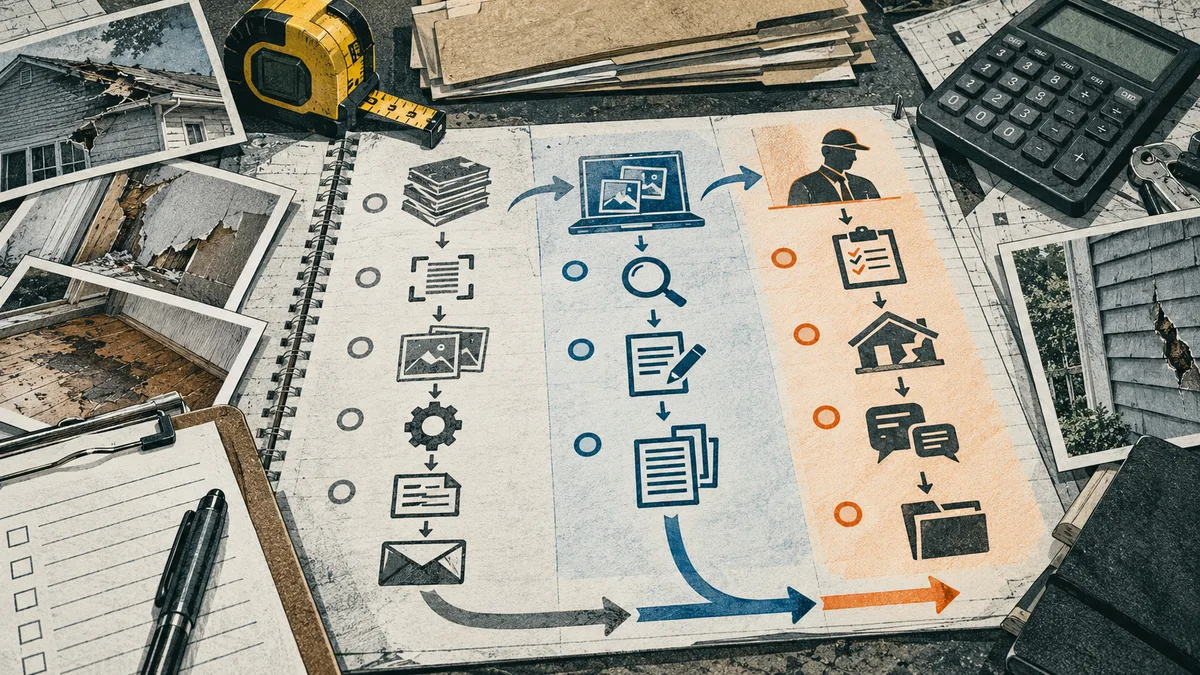
Use a simple workflow map with three columns: before the tool, AI-assisted, and after the immediate output. In the first, list intake, file gathering, and eligibility checks. In the middle, list what the tool performs and what the adjuster must provide. In the final column, list review, corrections, recording, approval, claimant contact, downstream review, and any reopened work. Mark who performs each step and what evidence shows it happened. This prevents an automation boundary from being mistaken for a labor boundary.
State what is excluded. If the pilot tests only summarization, do not quietly include settlement negotiation or field inspection in the outcome. But do include a later correction that exists because the summary omitted a document. If a separate legal or compliance review would occur regardless of the tool, record it consistently in both conditions rather than charging it only to AI. If the tool changes the sequence or creates a new approval, that is part of the assisted workflow, not an incidental nuisance.
For field adjusters, the finish event may depend on information outside the office, such as an inspection or estimate from a repair professional. If that activity is outside the pilot task, state the boundary. If the AI output changes the need for a second visit or follow-up photograph, it is relevant downstream work. The decision is not to time every aspect of claim handling, but to avoid pretending that a task ends before its consequences are known.
Sources: Claims Adjusters, Appraisers, Examiners, and Investigators; Claims Adjusters, Examiners, and Investigators (O*NET 13-1031.00)
Which claim task should enter the trial first?
Choose one recurring, bounded task with a visible completion event and reviewable output. A reasonable first candidate could be organizing a known set of documents into a chronology or extracting specified fields from an approved document bundle, if company policy permits the tool and a qualified person can check the result. Avoid beginning with a task whose success depends on a final coverage, liability, reserve, or settlement judgment unless the pilot has appropriate authority, safeguards, and review design.
A task is a stronger pilot candidate when the inputs are reasonably consistent, the expected output can be checked against source material, the frequency is sufficient to observe several cases, and errors can be caught before they affect a customer or payment. It is a weaker candidate when the cases are rare, highly varied, missing critical records, or governed by special rules that a short trial cannot reliably sample. The aim is not to pick a task because it looks easiest to automate; it is to pick a task where an honest comparison is possible and the downside is bounded.
The NAIC’s insurance AI overview reports survey responses and describes use cases including accident-image analysis, estimating ultimate settlement values, and fraud detection. Those examples demonstrate that AI-related activity in insurance spans different functions; they do not prove how common a specific deployment is across all firms, whether an adjuster’s local tool is accurate, or whether the tool reduced labor. NAIC also notes that models may automate, augment, or support human decisions depending on use. In a trial, name which of those roles the tool is actually playing.
Separate candidate tasks by mechanism. Extraction and summarization turn existing records into a structured representation. Image analysis classifies or estimates from visual evidence. Drafting creates language that may need factual, policy, and tone review. Triage ranks or routes work. Prediction estimates a future or latent outcome. Each calls for different measures: extraction can be checked against fields in source records; drafting can be assessed for unsupported statements and omissions; triage needs routing and missed-escalation checks; an estimate needs comparison to an approved reference process and a clear account of who remains accountable.
Select a task with enough ordinary cases, not merely the most convenient showcase case. If the team sees a handful of matching claims in two weeks, the trial may still reveal usability friction, but it cannot support a stable estimate of average minutes. A narrow task can also be too narrow if the AI creates work elsewhere. For example, a document summary may save the preparer time but require examiners to reopen source records because citations are absent. The unit must therefore include those downstream minutes.
Before the first case, write down the eligible case definition and exclusions: line of business, document types, complexity markers already used by the organization, tool version, and conditions that require escalation. Do not feed claim or customer information into an unapproved service. Confirm privacy, security, retention, and access rules with the organization. If approvals or safe data handling are not in place, the right first action is to resolve them, not to improvise a trial. A bounded task is a measurement choice and a control choice at once.
A task may be repetitive yet still carry meaningful judgment because exceptions are consequential. Conversely, a task can be cognitively demanding but easy to evaluate if a source of truth is available. Choose the initial pilot by observability and safe review, not by an assumption that routine means trivial or that judgment means no assistance is possible. This keeps the test focused on what can actually be measured.
Sources: Claims Adjusters, Examiners, and Investigators (O*NET 13-1031.00); NAIC Members Approve Model Bulletin on Use of AI by Insurers; Insurance Topics: Artificial Intelligence
Which comparison makes the two weeks interpretable?
Compare AI-assisted cases with the usual workflow for the same task and broadly similar case complexity. If operationally approved, random assignment among eligible cases is the clearest way to reduce selection effects. A concurrent comparison group can also help account for workload changes. Where neither is practical, use a recent baseline and label the result as a local before-and-after signal, not a causal estimate. Do not compare simple AI cases with unusually complex historical cases and call the difference a tool effect.
Record factors that can change the result: task category, complexity indicators already available in the workflow, worker familiarity, prior tool experience, volume and season, interruptions, system outages, waiting time, and changed instructions. Keep the same acceptance criteria in both conditions. If AI cases receive an extra review step by design, count it. If ordinary cases receive supervisor review too, count that as well. If an unexpected policy or process change occurs, record when it happened rather than smoothing it away.
NIST’s AI Risk Management Framework says measurement can use quantitative, qualitative, or mixed methods; it calls for performance assessment with uncertainty, comparison to benchmarks, formal reporting, and attention to human-AI configurations. It is voluntary cross-sector guidance, not a prescribed insurance pilot. Applied here, it supports defining a baseline, documenting the configuration of people and tool, and showing how uncertain a small sample remains rather than presenting a single percentage as self-explanatory.
A field study offers a useful measurement analogy but not a claims forecast. Brynjolfsson, Li, and Raymond studied a staggered introduction of a conversational assistant among 5,172 customer-support agents. The accessible abstract reports increased issues resolved per hour on average, with substantial heterogeneity across workers. This was one employer, a customer-support setting, and a different system. It shows why averages and worker mix matter, not what an insurance trial should expect.
For each condition, report the number of eligible and completed cases and how many were excluded, abandoned, or missing time records. Show the distribution, not only the average. A few complex files can pull the mean upward; a median helps describe a typical observed case but does not show the total labor consumed. A useful compact report gives both total human minutes and per-case median, range or quartiles, and a short explanation of case mix. With very small numbers, avoid pretending that a neat decimal is precision.
Before calculating a per-case result, show how many assigned units reached the agreed finish event in each condition. A low completion rate can hide unfinished correction work, while excluding abandoned cases can make the remaining cases look easier than the original workload. Report assigned and completed counts side by side, give reasons for exclusions, and keep the original condition assignment visible when a case crosses over. Treat a difference in completion as an outcome to investigate, not as a reason to silently change the denominator.
If randomization is not feasible, say why. A before-and-after comparison may reflect learning, seasonal volume, staff composition, catastrophe events, or changed documentation standards. A worker who selects only easy cases for AI can create a misleading apparent gain. When groups differ or records are incomplete, label the finding tentative and state what better comparison would be needed.
A concurrent control is not automatically fair if workers have different experience or if one team carries a catastrophe surge. Randomization also may be inappropriate for some cases or impermissible under local rules. The comparison design should be approved by operational owners and consistent with customer obligations. When a rigorous design cannot be used, transparent limits are preferable to pretending the comparison is experimental.
Define the comparison unit before assigning cases. If one unit is a document chronology, do not pair it with a full claim review simply because both belong to the same file. Specify which case attributes make units comparable using fields already collected in ordinary work, and keep the rule stable during the trial. If a category has no reasonable counterpart in the other condition, report it separately as descriptive experience rather than combining it into the main comparison. This protects the conclusion from a denominator that changes after results are visible.
If staff rotate between conditions, record that pattern and consider whether familiarity carries over: someone who has learned a shortcut in the assisted workflow may complete later usual-work cases differently. Likewise, a case may move between conditions when an exception appears. Keep its original assignment and record the crossover and reason, then report results by the planned assignment with the deviation visible. This avoids silently reclassifying difficult cases after their outcomes are known.
Sources: Artificial Intelligence Risk Management Framework 1.0; Generative AI at Work
What minutes belong in the ledger?
Use one row per eligible task case and log human labor by phase. A practical set of event codes is: prepare inputs; prompt or configure; inspect output; verify against source; correct or regenerate; document and obtain approval; communicate or hand off; resolve failure; and rework after apparent completion. Add role or reviewer, condition, start and stop time, completion state, and a case-complexity category already permitted by company practice. Keep the set short enough that people can use it during normal work.
Measure active labor and elapsed time separately. Active labor includes the adjuster’s or reviewer’s attention. Tool waiting is elapsed time; count it as labor only if the person is unable to do other work and is required to remain engaged. If a background process runs while the adjuster handles another task, its clock time is not saved labor. Conversely, if the tool blocks progress and forces the adjuster to wait, record the delay as a cycle-time consequence even if no active minutes accrue. A ledger that combines these concepts can make a slow workflow look efficient or an efficient one look slow.
Include all workers who touch the defined unit, not just the person who operates the tool. If a reviewer checks a generated summary, record review time. If a supervisor clarifies an omission, record that time. If a claimant must be contacted again because the first communication contained an error, include the extra handling when it is attributable to the task and observable within the agreed follow-up window. Where attribution is uncertain, mark it uncertain instead of assigning blame or creating false precision.
For example, suppose six comparable usual-work chronologies take 42, 48, 51, 55, 63, and 81 adjuster minutes through acceptance. Six AI-assisted chronologies take 27, 34, 39, 43, 58, and 96 adjuster minutes, while examiners spend 4, 5, 6, 7, 8, and 19 minutes checking them. The assisted totals are 31, 39, 45, 50, 66, and 115 minutes. The median falls from 53 to 47.5 minutes, but the assisted total is 346 versus 340 usual-work minutes: this tiny illustrative set does not show aggregate labor saved, and one long correction changes the story. Because the cases are merely assumed comparable, the arithmetic demonstrates reporting, not a causal estimate. The team should show each unit or a distribution and investigate the 96-minute outlier rather than deleting it.
NIST calls for documenting human-AI configurations and formalizing measurement and reporting. O*NET’s adjuster record makes the practical reason clear: work can include verification, interviews, file documentation, payment entries, and referral of questionable claims. Those occupational details do not say that every case includes every activity, but they warn against ending the ledger at text generation. Your event codes should reflect the actual workflow selected, not copy a generic list mechanically.
Make the log lightweight. A timestamp at each phase can be burdensome and can itself alter work. If existing workflow systems hold reliable timestamps, use them where appropriate, then ask workers to record only active review, correction, and interruption time that the systems do not capture. A brief daily reconciliation can catch forgotten follow-up or double-counted handoffs. Let participants correct entries without turning ordinary uncertainty into a performance issue. The goal is to observe process, not rank individuals.
Agree on attribution rules before the trial. Count time caused by an AI error when it generates correction or rework; count normal review present in both workflows in both. If an examiner reopens a source file because the AI summary lacks traceable references, that review is part of the assisted workflow. If a routine audit would inspect the file anyway, keep it in both conditions. This consistent rule matters more than elaborate precision. A complete, modest ledger is more informative than a detailed time sheet that misses the work moved across roles.
A second person can record a handoff rather than forcing the primary adjuster to switch constantly between claim work and a timer. If measurement changes the task or slows completion, note that burden too. Do not use the pilot ledger as a covert individual ranking tool; participants need to know its purpose, access, and retention. Good measurement depends on workers being able to report friction honestly.
Set a simple event rule for interruptions and waiting. Count active work when a person reads, prompts, checks, corrects, records, or contacts someone about the unit. If a worker switches to another claim while a tool or reviewer is waiting, record the wait as elapsed time, not as continuous labor on the first claim; record any later return as active minutes. For work done in parallel, count each person’s labor separately in the team total, while avoiding double-counting one person’s overlapping clock time. If the work log cannot separate an interruption from the claim task, flag that interval as uncertain and apply the same rule in both conditions. These conventions matter because AI may change queueing and task switching even when direct handling time looks similar. A compact event code such as prepare, generate, verify, correct, handoff, or follow-up can make later reconciliation easier, provided workers use the codes consistently and can still describe an unanticipated task. Do not force ambiguous activity into the nearest convenient category; preserve a note and resolve the classification before calculating the comparison. This is a proposed accounting convention for the local trial, not a published industry standard.
Sources: Claims Adjusters, Examiners, and Investigators (O*NET 13-1031.00); Artificial Intelligence Risk Management Framework 1.0
How do you distinguish time saved from review shifted?
For each completed task unit, add human minutes across roles and phases, then compare with usual work using the same unit, completion boundary, and attribution rule. Keep phase breakdowns beside totals so review burden cannot disappear inside an average, and report per-case distributions. The arithmetic is simple; comparability is the hard part.
A useful calculation has two lines. Gross step minutes changed equals the usual-work minutes for the targeted step minus the AI-condition minutes for that same step. Net human minutes saved equals total human minutes for usual-work cases minus total human minutes for AI-assisted cases, through completion. Positive net means fewer observed labor minutes under the assisted condition; zero means no observed difference; negative means more. If one group has more complex files, this subtraction is not a clean tool effect, so show the mismatch and qualify or withhold the comparison.
Read the two lines together. If the targeted step falls but total human minutes do not, the task has become faster to generate without saving labor across the workflow. If total minutes fall, report where the reduction occurred and whether any quality or service measure changed; do not infer that the same result will hold outside the observed cases.
Also keep elapsed cycle time as its own measure. Perhaps an AI draft is ready sooner but queues for a reviewer; perhaps it saves active effort yet moves the completion date because of integration delays. Report intake-to-completion elapsed time separately from labor minutes. If cases that require follow-up remain open at the end of the trial, state how you handle them and establish a follow-up window. Do not count unfinished AI tasks as fast completions simply because their correction has not happened yet.
For summaries, medians can describe the typical case, while totals show aggregate workload. If 20 assisted cases save one minute each but one case requires an hour of correction, the median can look favorable while total labor is worse. If a few severe claims dominate total time, the mean can obscure routine-case performance. Present an overall view and, only where there are enough cases, separate pre-defined complexity groups. Avoid slicing a tiny sample into many categories until a favorable subset appears.
A decrease in adjuster time paired with an increase in examiner or supervisor time is not a team labor saving, though it may be an intentional role change. If review time rises while errors fall or service improves, report that as a separate tradeoff. Judge it against the goal agreed before seeing the data.
Do not multiply the observed minute difference by a full year or entire workforce unless volume, eligibility, reliability, and workflow stability support that calculation. Extrapolation adds assumptions about future case mix, adoption, outages, training, and downstream use. For a two-week decision, the observed number and an explicit next sample are usually more defensible than a headline annual-hours figure.
Sources: Artificial Intelligence Risk Management Framework 1.0
What quality checks keep a faster draft from becoming slower claim work?
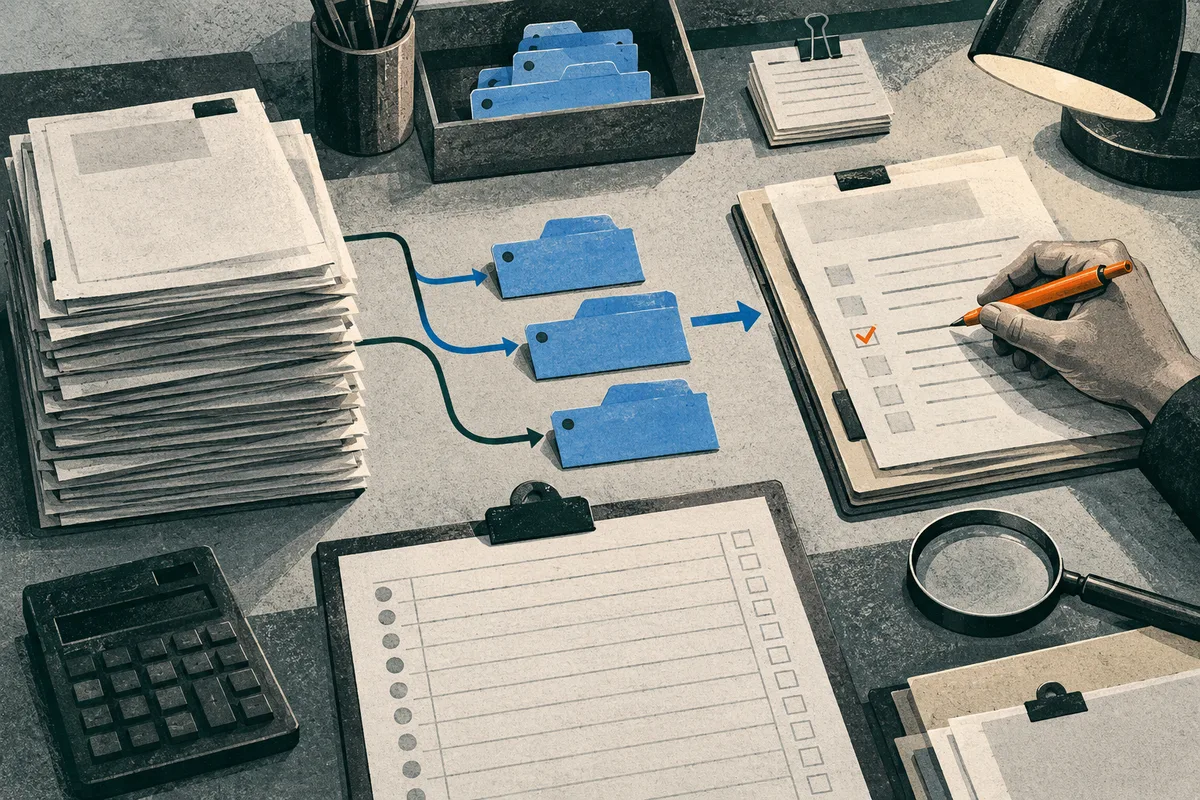
Pair time with a small, task-specific quality rubric approved by the claims, compliance, and operational owners. For a chronology, check whether required events are present, dates and parties are accurate, source references are traceable, and uncertain facts remain marked as uncertain. For a draft communication, check factual accuracy, policy references, required disclosures, clarity, and whether the language makes a determination the assigned worker is not authorized to make. These are examples to tailor, not a universal legal checklist.
Record errors by stage and severity. An issue caught by the adjuster before release differs from a customer-facing error, but both reveal something about the workflow. Note omissions, unsupported assertions, misread documents, incorrect dates or amounts, inappropriate confidence, missing escalation, and revisions. Track who caught the issue and the time spent fixing it. If a correction is discovered after the initial completion point, attach it to the original task where possible so that rework is not separated from the output that caused it.
Define the quality review method before cases begin. Review all outputs if the volume is small and the consequence warrants it, or use a documented sampling approach set by the responsible team. Do not quietly inspect only the easiest outputs. Reviewers should know the standard and have access to the underlying record needed to evaluate the result. If reviewers know which condition produced an output, that may affect judgments; blinding may not be practical, but record the limitation and use objective checks where available.
The NAIC model bulletin describes expectations for insurer governance and accurate consumer-impacting decisions supported by AI, with documentation regulators may request. It is a model bulletin rather than a uniform law in every jurisdiction, and the article does not turn it into a specific adjuster checklist. Its relevance is narrower: a speed measure cannot stand alone where decisions or communications affect consumers, and teams should follow applicable law, company controls, and authorized review procedures. NIST likewise calls for measuring uncertainty and documenting tradeoffs rather than hiding them in a single performance figure.
Do not claim that a two-week sample proves rare-error safety. If no serious error appears in 20 cases, that is evidence only that none was observed in those 20 reviewed cases under those conditions. Rare events require much larger samples and ongoing monitoring. Likewise, repeat contact, reopened files, complaints, or corrections may be useful signals, but their interpretation depends on consistent recording and time windows. A small trial can surface failure modes to investigate; it cannot certify a system.
Quality can also improve while minutes rise. If a tool helps include records that would otherwise be missed, or makes an explanation clearer, a team may rationally accept extra review time for a defined reason. But do not relabel that as time saved. State the measured trade: for example, more verification labor and fewer observed omissions, with the sample and limits shown. Whether that is worthwhile depends on consumer impact, severity, applicable standards, staff capacity, and who bears the extra work. A balanced pilot gives decision-makers enough information to discuss those tradeoffs explicitly.
Review the rubric with the people who know the file and the people accountable for the consumer outcome. A checklist should distinguish a harmless formatting issue from a missing fact that changes the next step. It should also record near misses, not just released errors, because a skilled reviewer may prevent harm while spending substantial time. That prevention labor belongs in the ledger.
Link quality findings to the same approved task identifier as the time ledger. Record whether each reviewed output met the standard, where an issue was found, and whether correction preceded completion. If detailed review uses a sample, record the selection rule and counts by condition; mark other outputs unreviewed rather than implying they had no issues.
Sources: Artificial Intelligence Risk Management Framework 1.0; NAIC Members Approve Model Bulletin on Use of AI by Insurers
How should the two weeks be organized?
Treat the schedule as a proposed local protocol, not a formal standard. Before the clock starts, get authorization for the tool and data handling, select one task, set the start and finish boundary, agree on eligible cases, and decide what quality means. Name the person responsible for the ledger and the person who will inspect quality. If these elements cannot be set before the trial, use the time to establish them rather than collecting numbers that cannot be interpreted.
In the first portion, observe or reconstruct the usual workflow using recent eligible cases or a brief baseline period. Confirm where timestamps exist, what work is commonly forgotten, and whether the acceptance criterion is applied consistently. A baseline made from memory is weaker than a contemporaneous log. If the two-week calendar does not allow enough baseline cases and AI cases, record that constraint early and plan an extension or narrower task instead of forcing symmetry through assumptions.
During the assisted period, keep the task and tool configuration stable where possible. Record the product or system version, enabled features, instructions, and any material changes. A changing model or prompt is a changed intervention: mark the date and compare periods cautiously. Log exceptions daily, including failures, cases taken out of the trial, extra review, and missing records. A short daily check can reveal that one role is not recording time or that workers interpret ‘complete’ differently, while there is still time to correct the process.
At the end, check whether open or reopened units remain and whether any follow-up is needed to capture delayed corrections. Summarize the sample, missing records, configuration changes, labor by role and phase, elapsed time, and quality findings. State any limitation that could change the comparison, such as a surge, outage, or unequal case mix.
The NIST framework supports ongoing testing, measurement, uncertainty, benchmark comparison, and documentation. NAIC’s insurance AI page describes current regulatory work and insurer use cases, but neither source publishes this two-week schedule. The sequence here translates general measurement principles into a practical suggestion: define, baseline, observe, reconcile, decide. It should be adapted to the organization’s claim process, jurisdiction, privacy rules, and review requirements.
A short written protocol can fit on one page: task boundary, eligibility rule, condition assignment, event codes, quality checks, missing-data treatment, and decision owner. Ask one person outside the daily workflow to check that both conditions use those definitions. This is a consistency check, not an independent audit; its purpose is to catch a drifting clock, a newly introduced review step, or a changed meaning of “complete” while the observations are still recoverable.
The trial schedule should not create pressure to use the tool on an ineligible claim just to increase the sample. Maintain the normal escalation route and let workers opt out where policy requires or permits it. Record exclusions without penalizing the person who identified a risk. A safe pilot respects operating limits even when that makes the evidence smaller.
Sources: Artificial Intelligence Risk Management Framework 1.0; Insurance Topics: Artificial Intelligence
What can a two-week result say about your work—and what can’t it say?
A carefully bounded trial can say that, in the observed cases and setup, a defined task appeared to use more or fewer human minutes, with particular review, correction, and quality patterns. It can show which step changed and which role absorbed work. It can reveal that workers need better source links, that a task definition is too broad, or that an apparent shortcut creates a new follow-up. These are useful findings about a local workflow, not a forecast about a person’s job.
Keep six ideas distinct. Technical capability concerns what a system can do under some conditions. Use means someone actually tried it. Adoption concerns an organization putting it into routine work. Exposure describes overlap between tasks and capabilities. Demand concerns how much work or labor employers need. Displacement concerns workers or jobs being reduced or removed. A two-week time log mainly informs observed use and workflow effects in one setting; it does not by itself establish broad adoption, labor demand, or displacement.
The ILO’s 2025 update refines a global occupational exposure assessment using task-level information, expert input, and AI predictions across nearly 30,000 tasks. The brief says one in four workers globally are in occupations with some degree of exposure and that most exposed jobs are more likely to be transformed than made redundant because human input remains necessary. That is an occupation-level global estimate, not a U.S. insurance-adjuster estimate, a company adoption measure, or a prediction for an individual. Exposure helps identify where to ask questions; it does not answer what happened in this trial.
The BLS Occupational Outlook Handbook offers a separate U.S. employment projection for the broad combined group of claims adjusters, appraisers, examiners, and investigators. It projects a 6 percent net employment decline from 2025 to 2035, or about 21,800 fewer jobs, while still projecting about 21,600 openings per year on average, largely to replace people who leave or transfer. These are occupation-wide projections shaped by multiple forces, not an AI-caused decline; they cannot show whether a particular adjuster’s position will be cut or preserved and are not a local forecast for readers outside the United States.
A saved minute can be used in several ways: reduce overtime, handle more claims, increase contact time, improve documentation, or reduce staffing. Which outcome follows depends on demand, policy, budgets, worker voice, and management choices. The trial cannot tell you which future path the employer will choose unless the organization states a plan, and this article will not invent one. Nor does a good result make a career ‘AI-proof.’ It identifies one task where a particular workflow may be useful under observed conditions.
Sources: Claims Adjusters, Appraisers, Examiners, and Investigators; Generative AI and Jobs: A 2025 Update
Which result supports stopping, narrowing, or continuing?
Agree on decision conditions before reviewing the numbers. There is no universal percentage of saved time that makes a claims tool worthwhile. The threshold depends on the task, quality requirements, cost of mistakes, review capacity, claimant impact, and operational goals. A team might require a minimum net labor reduction, no unacceptable quality failures, and no unapproved handoff before continuing. Another task might justify extra minutes if a clearly specified quality outcome improves. Write down the chosen rule first to reduce the temptation to move the goalposts after results appear.
Continue the exact task when comparable cases show lower total human minutes through completion, quality meets the established standard, and the review burden is counted across all roles. Continue means gather more evidence or use the workflow within authorized boundaries; it does not mean expand to unrelated claim decisions or infer an employment result. If the sample is small but promising, label the signal preliminary and define what further monitoring is needed.
Narrow the use when results vary by case type or a failure pattern has a clear boundary. For instance, a team might test only a document set that contains required source references, excluding cases with missing records until those are handled. That is appropriate only if the eligibility rule is operationally meaningful and applied consistently. Do not retrospectively filter cases to preserve a favorable average. A narrowed test should declare its inclusion criteria before new observations begin.
Stop or redesign when added review and correction erase the apparent gain, errors create unacceptable risk, the tool fails to meet policy requirements, or data handling is not approved. ‘Stop’ can mean stopping this tool for this task under this configuration; it is not proof that all AI use is ineffective. If the principal problem is training, source integration, or unclear ownership, a redesigned workflow may merit a new bounded trial after the underlying issue is addressed. Do not keep a workflow in use merely because time has already been spent piloting it.
There are mixed outcomes. Suppose minutes rise while quality improves, or adjuster time falls while examiner time rises. Report both outcomes rather than collapsing them into ‘productive.’ Ask whether the quality change is valuable, whether the receiving role has capacity, and whether the added work is sustainable. If faster service is the aim, measure completion time and customer-facing service separately from labor. If extra capacity is the aim, agree how it will be used. The organization’s goal should be explicit rather than inferred from a convenient metric.
NIST frames measurement as support for decisions and tradeoffs, with uncertainty and benchmarks documented. The NAIC model bulletin emphasizes governance and accurate consumer-impacting decisions; it does not provide a numerical pass threshold for this trial. Together they support a conditional verdict: continue only when a task-level benefit is visible, quality and controls are acceptable, and responsibility remains clear. Otherwise narrow, redesign, or stop. If the evidence is inconclusive, preserve that answer and collect a better sample rather than converting uncertainty into approval.
A result can be statistically uncertain and still operationally useful if it reveals a repeatable failure that requires a control. Equally, a favorable average is not enough to override a severe observed issue. The decision rule should consider severity as well as frequency, and the responsible risk owner should determine whether an issue is acceptable. This is why time and quality need parallel reporting.
Sources: Artificial Intelligence Risk Management Framework 1.0; NAIC Members Approve Model Bulletin on Use of AI by Insurers
What should you ask your manager before the trial closes?
Use the closing meeting to resolve one issue that the ledger cannot settle by itself: what decision will the organization make from this local result, and who is accountable for interpreting it? Bring a privacy-safe summary of the task boundary, eligible and missing cases, configuration, total labor by role and phase, elapsed time, quality findings, and the largest uncertainty. Ask the manager to confirm that the result applies only to the defined workflow and observed conditions, and whether any proposed workload change requires a separate review. Do not circulate claim details unless policy authorizes it.
End with an owner and date for the next action: keep this exact use within current controls, narrow eligibility, stop or redesign it, or extend measurement because the sample cannot answer the question. If reviewer time, follow-up work, or comparable usual-work cases were not captured, name that gap and avoid a productivity conclusion until it is addressed. This meeting should apply the pre-agreed rule from the prior section; it should not reopen the threshold after seeing a favorable or unfavorable average.
Use one reporting row per condition with case count, total human minutes, median and range per unit, reopened units, and quality results; keep phase subtotals visible. Mark unreliable time as missing and report counts by condition. If missingness differs, calculate a sensitivity range only when logged workflow supports defensible bounds; otherwise state that a reliable net comparison is unavailable.
Sources: Artificial Intelligence Risk Management Framework 1.0; NAIC Members Approve Model Bulletin on Use of AI by Insurers
Sources and notes
- Claims Adjusters, Appraisers, Examiners, and Investigators
BLS describes claim evaluation, investigation, evidence gathering, reporting, negotiation, and settlement; this broad U.S. occupational profile does not give task time shares or measure AI effects.
- Claims Adjusters, Examiners, and Investigators (O*NET 13-1031.00)
O*NET lists examining forms, analyzing evidence, verifying data, assessing damage, contacting parties, documenting files, and resolving complex claims; task listings are not time shares for an individual role.
- Artificial Intelligence Risk Management Framework 1.0
NIST calls for fit-for-purpose measurement, benchmarks, uncertainty, documentation, monitoring, and attention to human-AI configurations; it does not prescribe this claims pilot.
- NAIC Members Approve Model Bulletin on Use of AI by Insurers
The NAIC describes governance expectations and accurate consumer-impacting decisions; the model bulletin is guidance whose legal effect varies with state action and applicable law.
- Insurance Topics: Artificial Intelligence
NAIC reports survey responses and examples of insurer AI use, including accident-image analysis, settlement-value estimation, and fraud detection; this does not show that a particular adjuster tool is adopted or effective.
- Generative AI and Jobs: A 2025 Update
ILO summarizes task-based global exposure estimates covering nearly 30,000 tasks and says most exposed jobs are more likely to be transformed than made redundant; it is not an individual or insurance-trial forecast.
- The Impact of AI on the Workplace: Evidence from OECD Case Studies of AI Implementation
OECD case studies conducted in 2021–2022 include an auto-claims image tool that suggested repair estimates for adjuster review; cases illustrate task redesign, not a measured effect transferable to every insurer.
- Generative AI at Work
The accessible research abstract reports a staggered introduction involving 5,172 customer-support agents and average issues-resolved-per-hour gains with substantial worker heterogeneity; another occupation and system cannot establish expected claims results.
Apply this to your own work
See the whole job market at once.
Explore which occupations AI may reshape, then turn the signal into a practical response.
Explore the job map