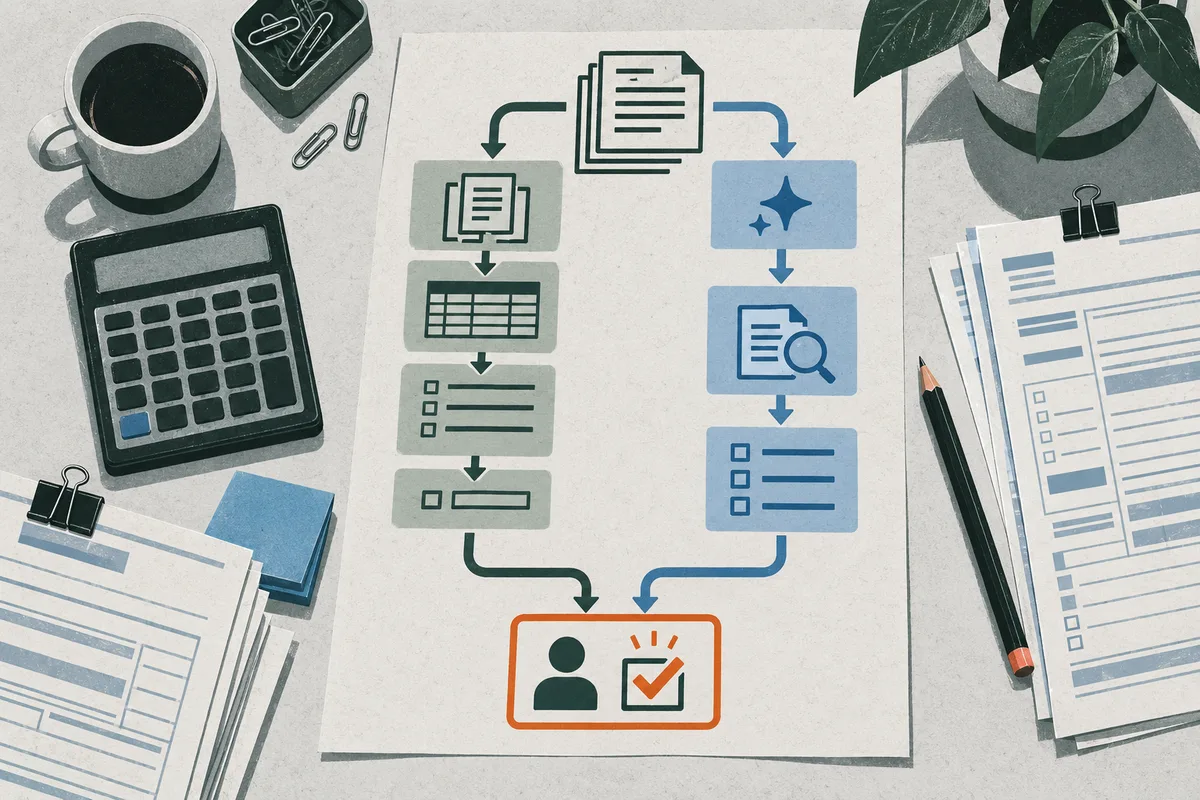
A tax-focused AI certificate can be worth it if it fills a specific gap in your current review work, fits your tax jurisdiction, and gives you a method you can practice. It is a weaker purchase when the main value is the word “certificate”: completion alone does not show that you can trace a tax claim to current authority, reconcile figures, spot missing facts, protect client information, or decide when to escalate. Before enrolling, name one recurring output you review, inspect the syllabus and assessment for that task, and compare the fee and study time with supervised practice using permitted material. If the course offers useful foundations but no realistic review assessment, take it only if the structure itself is worth the cost, then build the evidence of skill through an approved work sample.
Is a tax-focused AI certificate worth it for output review?
A certificate can be worth considering when it closes a specific gap in the tax-AI work you already do and gives you a method you can apply. It is not a substitute for tax knowledge, permission to use a particular system, or evidence by itself that you can review a client-facing answer. That distinction matters because a polished certificate can feel like a portable career signal, while the actual job may require a less visible skill: knowing what to verify, what the output leaves out and when the decision must go to someone else.
The decision in this article is about an early- or mid-career tax worker who wants to review AI-assisted material in a current role, not someone seeking to become a machine-learning engineer or launch a tax technology business. The country, seniority, employer and precise output are unspecified, so U.S. government sources below are explicitly U.S. examples. Course terms also change; provider descriptions establish what is advertised, not how well learners perform afterward.
Use two tests. Learning fit asks whether the syllabus teaches tax-relevant AI risks and a repeatable review method that matches your task. Proof fit asks whether the course makes you demonstrate the method on realistic work and gives feedback. A course may pass the first test and fail the second. It can still be useful for structured orientation, but completion should then be described honestly as learning completed, not competence proven.
This framing leads to a practical provisional answer: first name one recurring output you review and the decision attached to it. Then inspect a course’s jurisdiction, examples, assessment, recognition, cost and time against that task. If the fit is strong and affordable even without a promotion, enrollment may be sensible. If the course promises only broad AI awareness, consider whether a supervised practice exercise or targeted self-study would address the gap faster. A credential cannot establish that your employer has adopted AI, that your role is secure, or that demand for your work will rise.
The likely search path is an editorial hypothesis, not measured search behavior: someone seeing generated research, drafts or extracted data at work may look for a certificate because it appears to resolve two uncertainties at once, what to learn and whether the learning will count. The evidence supports separating those questions. Course pages can show format and stated outcomes; occupational sources can describe a task bundle; professional guidance can show review responsibilities. None of those alone measures a certificate’s return for an individual worker.
Sources: Introductory Guidelines for Responsible AI Use in Federal Tax Practice; Tax Preparers: O*NET OnLine; Professional Certificate in AI for Tax Accountants course listing, The Tax Faculty
What kind of review work are you trying to strengthen?
“Review AI output” can describe several different jobs. You might check a summary of tax research, compare extracted figures against source documents, review a draft client email, or test whether a proposed treatment is supported by current law and the client’s facts. These require different knowledge. A certificate can only be judged against a defined task; its tax label is not enough.
For a U.S. example, O*NET’s Tax Preparers profile includes checking data or totals on forms prepared by others, consulting tax law materials on atypical returns, explaining federal and state rules, and answering tax-planning questions. These are occupational task descriptions, not a survey of how much time any one worker spends on them, and they do not say which tasks are currently performed with AI. They do show why “tax work” is not one skill. Arithmetic checking, legal research, client fact gathering and advice have different failure modes.
Consider an illustrative task: a preparer receives a generated draft explaining whether a client may claim a deduction. A sound review would establish the relevant taxpayer facts, tax year and jurisdiction; find the underlying authority rather than trust a citation; check that the explanation addresses exceptions and limitations; reconcile any figures to the source records; and decide whether the draft is suitable for the client or needs escalation. If the person’s actual responsibility is only to reconcile figures, a course dominated by broad AI strategy may be poorly matched. If they are asked to advise on edge cases, a narrow tool tutorial may be inadequate because the harder gap is tax judgment.
Separate five questions while you assess the task. Can a tool produce this kind of output? That is a capability question. Has the tool been used successfully under controlled conditions? That is a performance question. Has your firm approved and integrated it? That is adoption. Does the occupation contain tasks to which the capability may apply? That is exposure. Have roles, staffing or demand changed as a result? That is a labor-market question. None of the first four, by itself, gives an individual probability of losing a job. A certificate addresses learning; it does not establish employer adoption or a labor-market outcome.
The first useful step is therefore a short task description: “I review [output] for [decision] under [jurisdiction and year], using [approved sources and tools], and I am responsible for [approval, correction or escalation].” If you cannot fill those blanks, ask your manager or professional lead what review responsibility is actually expected before buying. If you work outside the United States, replace the U.S. examples in this article with your own tax authority, professional rules, approved systems and local course recognition.
A course can still help when the task is not yet assigned to you. It may supply vocabulary for discussing risks, procurement or workflow design. But that is a different goal from proving that you can review an output in your present role. Keep those goals distinct when reading marketing language.
Sources: Tax Preparers: O*NET OnLine; Accountants and Auditors, Occupational Outlook Handbook, U.S. Bureau of Labor Statistics
What does sound tax AI review involve?
The core ability is accountable verification: determine whether an output is supportable for the known facts, period and jurisdiction; correct or reject unsupported material; protect information; and document or escalate uncertainty under the rules of your role. This is more than prompting for citations. A citation can be fabricated, irrelevant, outdated or accurately quoted but misapplied to the case.
The IRS Office of Professional Responsibility’s June 24, 2026 introductory guidance for U.S. federal tax practice describes fabricated output, bias, lack of transparency, and privacy and confidentiality concerns. It connects review to existing professional duties: the guidance says practitioners should verify facts, citations and calculations in AI-created material before delivery or filing, and understand the technology’s limitations. It also discusses secure data handling, staff training, third-party vetting and documented firm procedures. This is guidance for federal tax practice, not a global rulebook, a measure of how often errors occur, or proof that a particular course teaches those practices.
The Taxpayer Advocate Service’s page on AI-generated tax advice, first published June 11, 2024 and updated January 7, 2026, adds a narrower illustration. It says taxpayer-facing assistants may struggle with complex tax law and unique circumstances. It cites an informal Washington Post review in which two tax-preparation companies’ chatbots gave inaccurate or irrelevant responses up to 50 percent of the time when initially asked 16 complex questions. The sample is small, informal, limited to two companies and 16 selected complex questions, and not a controlled estimate for professional systems or all tax questions. Treat it as a warning about the boundary conditions of a specific test, not as a general failure rate.
NIST’s voluntary Generative AI Profile gives a broader risk-management frame. It defines confabulation as fluent, confident false or erroneous content, and recommends evaluating capability with empirically grounded methods, documenting limits of generalization, and checking sources and citations. The profile is cross-sector guidance. It does not prescribe a tax-review credential or certify that a checklist is sufficient. Its practical contribution is to make evaluation and ongoing monitoring explicit rather than treating a single successful demonstration as proof of reliability.
For an individual reviewer, these sources translate into a modest set of observable habits. Can you identify which factual assumptions are missing? Can you trace a legal claim to an authoritative source and confirm that the source applies to the relevant year and jurisdiction? Can you independently reconcile a number or calculation? Can you notice when the draft omits an exception or turns uncertain facts into certainty? Can you tell whether the tool and data handling are permitted? Can you record your changes and get a second view when the issue exceeds your authority? A certificate is relevant if it teaches and assesses some of these habits in the context of your work.
There is also a limit to review skill itself: a human cannot verify an answer they do not understand. A short course cannot replace tax expertise needed to decide whether a fact is material or authority applies. Conversely, tax expertise does not automatically teach safe system use, data governance or evaluation design. The useful learning target is the overlap between your tax domain knowledge and the parts of the workflow you actually own. A reviewer who only learns prompt formulas but cannot make that judgment has not closed the central gap.
Sources: Introductory Guidelines for Responsible AI Use in Federal Tax Practice; Is AI Generated Tax Advice Making the Grade? Taxpayer Advocate Service; Artificial Intelligence Risk Management Framework: Generative AI Profile
What does a tax-focused AI certificate actually certify?
Read the exact credential wording, learning outcomes, assessment and recognition terms. A certificate of completion usually documents that a learner completed a provider’s activities. A pass/fail test may show performance on its questions. A graded case or supervised work sample can show more direct application. None of those forms, alone, proves consistently competent review on the job; the evidence becomes more relevant as the assessment resembles the task and the standard is transparent.
When provider terms are unavailable for direct verification, do not use search excerpts to support claims about course length, modules, quizzes, assessment or credential terms. Ask the provider for its current syllabus and assessment details before paying. The recommendation here does not depend on any particular CIOT course: compare whichever course you are considering against your review task, and treat unverified details as open questions rather than evidence.
A directly opened South African Tax Faculty catalog lists a Professional Certificate in AI for Tax Accountants beginning November 6, 2026, lasting four months and costing R7,950. The provider describes the offering as a professional certificate. Those are catalog facts, not independent evidence of educational quality, accreditation, whether the assignments test your particular review task, or a salary or hiring return. The country and tax context matter: a South African course may be suitable for a South African tax professional, while a U.S. preparer or UK adviser must check legal and syllabus fit rather than infer transferability from the title.
This is why “certificate” is an incomplete signal. Ask: Is there an exam, and does passing require demonstrated understanding? Are quizzes formative or decisive? Does the learner work through a realistic tax case? Is feedback provided by a qualified reviewer? Does the assessment test verification and correction, or only recall of definitions? Can you show an employer or supervisor what you did without exposing client information? The strongest relevant proof is not necessarily the most advanced-sounding title; it is evidence that matches the actual responsibility.
Recognition is a separate question from learning. The IRS Continuing Education FAQ, updated in parts as recently as September 1, 2026, explains that IRS-approved CE providers must meet specified provider categories and obtain a continuing-education provider number to offer approved credit. It gives examples of state licensing bodies and qualifying organizations. That U.S. system does not determine recognition elsewhere, and a certificate’s completion document should not be mistaken for CE credit unless the provider and program status are confirmed for the relevant body and reporting period.
Ask the provider or your professional body directly whether the course qualifies for the credit you need, how many hours count, and whether the credit is recognized for your specific credential. If your goal is simply to improve a workflow, formal CE recognition may be less valuable than applicable material and feedback. If you need documented CPD for renewal, recognition could be a necessary condition even when the course’s practical assessment is modest. These are different purchase cases.
Sources: Professional Certificate in AI for Tax Accountants course listing, The Tax Faculty; CE FAQs: Continuing education providers, Internal Revenue Service
How should you compare a course with practice and broader study?
For a current-role reviewer, compare options against the skill gap rather than ranking education formats in the abstract. A short certificate may be efficient for shared vocabulary and a structured introduction. Targeted self-study can be cheaper and faster for one narrow concept, such as learning how to verify an authority citation or use an approved system’s audit trail. A supervised work sample can test whether you can apply existing tax expertise to the review task. A broader tax-technology qualification makes more sense when you want to participate in workflow redesign, data or systems projects, not merely review one output type.
The Tax Faculty listing gives one current example of the spread in format: its AI for Tax Accountants professional certificate is catalogued as four months at R7,950. This is a meaningful commitment for someone with limited evening study time or a tight budget. Before treating it as a comparison benchmark, inspect the actual prospectus and confirm payment terms, assessment, jurisdiction, support, dates and current price. The public listing alone does not disclose enough to decide whether the course is a fit for a specific reviewer.
Use a four-part fit test. Learning fit: does the syllabus cover the failure modes you need to recognize, including factual grounding, citations, calculations, missing context, privacy and escalation? Task fit: does it use examples from the tax type, jurisdiction, software and year relevant to you? Proof fit: must you demonstrate a review, explain corrections and receive useful feedback? Constraint fit: can you complete it without displacing essential work, care, health or rest, and is the cost acceptable if no promotion follows? A good result on one dimension does not cancel a failure on another.
Then compare the practical alternatives. A permitted work sample has high task relevance and can show a supervisor your reasoning, but it may not provide external recognition or a complete conceptual foundation. Self-study can target gaps cheaply, but without feedback it may leave errors uncorrected. A certificate supplies structure and a portable record of completion, but the record may be a weak signal if assessment is light. A diploma or degree can offer greater breadth and depth, with correspondingly higher time and cost, but is disproportionate if the only need is to review a bounded workflow. An apprenticeship or supervised rotation can offer feedback and context but depends on access at work.
For example, if you already have sound tax knowledge and need to review an AI-generated research memo, you might first ask whether your employer has an approved system and an existing quality-control process. Then build a small exercise from a public ruling or a synthetic case: record the question, the source material, what the system returned, which claims you verified, any missing facts, the corrected explanation and the point you escalated. Do not upload live client records to an unapproved tool. A supervisor’s feedback on this exercise could reveal a more specific learning need than a generic introductory course can.
If your goal changes from reviewing outputs to building or governing tax workflows, broaden the comparison. A tax-technology qualification may teach project vocabulary, process mapping or implementation context that a short AI course does not. Ask providers to show the current syllabus and compare it with the responsibilities you seek. A larger credential is justified by the larger goal, not by a vague fear of falling behind.
Sources: Introductory Guidelines for Responsible AI Use in Federal Tax Practice; Artificial Intelligence Risk Management Framework: Generative AI Profile; Professional Certificate in AI for Tax Accountants course listing, The Tax Faculty; CE FAQs: Continuing education providers, Internal Revenue Service

Does task change make the certificate a career hedge?
A certificate may help you learn or communicate a relevant skill; it is not a hedge against redundancy in the actuarial sense, and there is no evidence here that completing a tax-AI course protects a role. Exposure describes which tasks a technology might affect. Adoption describes whether an employer uses it in a particular workflow. Demand and employment projections describe a labor market over time. Displacement asks whether work or jobs are reduced or reorganized. Those signals operate at different levels and should not be collapsed into one forecast about you.
The current U.S. Bureau of Labor Statistics pages show why even adjacent occupational categories should not be blended. The Occupational Outlook Handbook projects employment of accountants and auditors to grow 5 percent from 2025 to 2035, with about 115,300 openings per year on average; it notes some openings are replacement needs and describes routine-task automation alongside analytical and advisory work. For tax examiners and collectors, and revenue agents, BLS projects a 1 percent decline over the same period and about 4,400 openings each year, all expected to arise from replacement needs. These are U.S. national occupational projections, not AI-caused effects; they cover different jobs and do not measure private tax-preparer work or certificate holders.
The projections complicate both easy stories. A positive outlook for accountants does not mean every task or worker is insulated. A modest decline in a government tax occupation does not show that AI caused it, or that private preparers face the same conditions. The figures cannot tell a reader whether their firm will adopt a tool, whether headcount will change, or whether a particular certificate improves mobility. BLS itself projects occupations, not personal career outcomes. Use these data only as context, never as a personal job-loss probability.
The IRS’s 2026 federal tax-practice guidance says AI tools can assist with routine tasks and research while maintaining that competence, diligence and confidentiality responsibilities remain. The same guidance says firms should use policies for training, secure handling, accuracy monitoring, vetting third parties and documenting procedures. This makes an applied reviewer skill plausible as part of professional practice in that U.S. context. It does not demonstrate that all firms have adopted generative systems, that employers prefer certificate holders, or that review work will expand enough to offset any task reductions.
A better career question is: what work do you already understand that becomes more valuable when outputs are easier to produce but still need context, verification or accountable communication? Depending on your role, this could mean becoming the person who can reconcile extracted data to source documents, explain why a proposed treatment does not fit a case, or coordinate a safe review procedure. That is a hypothesis to test against actual assignments, manager feedback and local demand, not a guarantee. It could support an upgrade in your current role, an adjacent move into tax operations or systems, or no immediate change if the workflow is not present.
The certificate itself may be a weak labor-market signal unless employers recognize it and it documents a meaningful assessment. No source opened for this assignment measures hiring outcomes or wages for graduates of the named programs. So do not buy on a promise of career protection or salary growth. If the learning is useful even without a promotion, and the cost fits, it may still be worthwhile. If the purchase only makes sense under an unverified hiring premium, pause and seek employer or professional-body confirmation first.
Sources: Introductory Guidelines for Responsible AI Use in Federal Tax Practice; Accountants and Auditors, Occupational Outlook Handbook, U.S. Bureau of Labor Statistics; Tax Examiners and Collectors, and Revenue Agents, Occupational Outlook Handbook, U.S. Bureau of Labor Statistics
When is the course worth your time and money?
Enroll when the course passes the task, learning, proof and constraint tests, and when its benefits are useful even if your job title and salary do not change. Decline or delay when the syllabus is generic, its tax jurisdiction does not match yours, you cannot verify its current terms, or the fee would require an employment payoff that no evidence supports. A course does not need to be an exam to have value, but the lighter its assessment, the less it can support a claim about demonstrated skill.
For a U.S. enrolled agent or other worker who needs continuing education, check recognition independently. The IRS CE FAQ distinguishes provider eligibility, provider numbers and course approval. Confirm the exact program in the relevant current listing, and check whether the credit fits your credential’s subject rules and renewal period. For a CPA, state preparer or non-U.S. professional, check with the governing body rather than assuming IRS status is relevant. “Certificate,” “professional certificate,” “CPD” and “accredited” are not interchangeable labels; ask what precisely is awarded and by whom.
Price and duration should be judged against your real calendar and financial floor. The South African Tax Faculty’s public listing at the time accessed gives a four-month duration and R7,950 price for its AI for Tax Accountants certificate. That is a concrete advertised commitment, not a recommendation or value score. A four-month course may be reasonable if you have study capacity, relevant cases, useful feedback and a local reason to pursue it. It may be a poor fit if you are covering peak-season work, caring responsibilities, health constraints or a salary floor that makes the fee difficult to absorb. Do not treat willingness to invest as proof of seriousness.
Before paying, send the provider a short set of questions: Which jurisdictions and taxes are covered? Which tools or workflow assumptions does the course use? What does a learner submit? Is there a scored assessment or only completion activity? Who reviews the work, and is feedback included? What credential is issued, and is any CPD or CPE credit recognized by the body I need? What are the current dates, total cost, cancellation terms and eligibility requirements? Can I inspect a sample lesson or assessment? A clear answer helps distinguish a course designed for applied learning from one that primarily offers orientation.
Then ask your workplace what is allowed. The IRS internal AI governance manual, which governs IRS personnel rather than private tax practices, requires approved systems and human review for government work and forbids sharing outputs without checking accuracy and appropriateness. Private employers may have different controls, but the general practical lesson is to check the policy that applies to your own environment. A course cannot authorize use of a system or client data. Do not experiment on actual taxpayer information unless your employer has explicitly approved the tool and process.
If your constraints are tight, you can still take a bounded step without purchasing anything. Pick one task you already review, identify the applicable tax-year authority and data rules, and ask a supervisor to clarify what decisions you own. Use a public or properly permitted training example to practice source checking and reconciliation. Track what took time and where you needed help. That small diagnostic can tell you whether you need tax-law refresh, AI literacy, system-specific training, assessment practice or simply a clearer review procedure.
Sources: Introductory Guidelines for Responsible AI Use in Federal Tax Practice; Professional Certificate in AI for Tax Accountants course listing, The Tax Faculty; CE FAQs: Continuing education providers, Internal Revenue Service; 10.24.1 IRS Policy for Artificial Intelligence (AI) Governance
What is the next bounded step?
The useful next step is not “become an AI expert.” It is to answer one work question: which output do I review, what could go wrong in it, and what evidence would show that I can catch the problem? Take these steps in order: write down one recurring output and decision; check the approved system and data rules; inspect the course syllabus and assessment against that task; compare price, time and recognition with your constraints; then choose a course, supervised practice or targeted self-study.
If a certificate teaches the relevant risk concepts but offers no applied assessment, consider it foundational learning, not proof of competence. Pair it with a bounded practice case and feedback. If it has a realistic assessment aligned to your jurisdiction and task, and its cost is acceptable without an assumed raise, enrollment may be reasonable. If neither fit nor recognition is clear, wait for answers rather than paying to resolve uncertainty with a badge.
The AI Proof Work task checker can help map which parts of a role are more exposed to task change and suggest initial actions. Its signal describes task-level change pressure, not a validated probability of displacement. Use it to make a task inventory more concrete, then apply your employer’s policies and local tax rules. If you need to compare staying and redesigning your role with adjacent paths or a larger change under constraints such as salary floor, location and available learning time, the career roadmap is a separate option. Neither tool replaces professional tax guidance or guarantees employment or income.
Decide after you have the task, policy and course facts in hand. If they line up, enroll with one applied objective. If they do not, practice the specific review step you can safely test and revisit the course decision when your role or requirements change.
Sources: Introductory Guidelines for Responsible AI Use in Federal Tax Practice; Artificial Intelligence Risk Management Framework: Generative AI Profile; 10.24.1 IRS Policy for Artificial Intelligence (AI) Governance
Questions readers ask
Does a tax AI certificate prove I can review AI-generated tax advice?
Not by itself. Completion records participation or course requirements; the strength of the evidence depends on whether you pass a relevant assessment, work through realistic tax cases, explain your verification and corrections, and receive feedback. Your professional responsibilities and employer’s review rules still apply.
Should I take a tax AI course before using AI in my tax job?
First check your employer’s approved tools, data rules and review process. A course cannot authorize a tool or use of client information. Training can help if it addresses a specific knowledge gap, but you can begin by mapping one task and asking a supervisor what review standard applies.
Is a tax-focused AI certificate better than a general AI certificate?
It may be more relevant when it covers your tax jurisdiction, tax year, workflow and review duties. A general course may be sufficient for broad AI literacy or system concepts. Compare actual syllabus, assessment, feedback, recognition, cost and time rather than relying on the title.
Sources and notes
- Introductory Guidelines for Responsible AI Use in Federal Tax Practice
IRS Office of Professional Responsibility guidance for U.S. federal tax practitioners describes AI risks and says practitioners should verify facts, citations, and calculations; it discusses competence, confidentiality, training, and firm procedures. It is guidance, not evidence of course effectiveness or industry adoption rates.
- Tax Preparers: O*NET OnLine
O*NET's U.S. Tax Preparers profile lists tasks such as checking totals prepared by others, explaining tax law, client planning, and consulting references on atypical returns. It describes an occupation and does not establish any individual's task mix.
- Is AI Generated Tax Advice Making the Grade? Taxpayer Advocate Service
Taxpayer Advocate Service recounts an informal Washington Post review where two tax-preparation chatbots gave inaccurate or irrelevant responses up to 50% of the time on an initial set of 16 complex tax questions. This is a narrow reported test, not a general error rate or professional-system benchmark.
- Artificial Intelligence Risk Management Framework: Generative AI Profile
NIST's voluntary, cross-sector Generative AI Profile discusses confabulation and recommends empirical evaluation, documenting limits on generalization, and checking sources and citations. It does not validate a tax credential or a particular review checklist.
- Professional Certificate in AI for Tax Accountants course listing, The Tax Faculty
The provider's accessible course listing currently advertises the Professional Certificate in AI for Tax Accountants for 6 November 2026, with a four-month duration and R7,950 cost. This verifies the listing only, not course effectiveness, accreditation, or employment outcomes.
- CE FAQs: Continuing education providers, Internal Revenue Service
IRS FAQ describes requirements for IRS-approved continuing-education providers and programs. It supports checking current provider/program recognition for relevant U.S. IRS CE; it does not establish recognition by other jurisdictions or bodies.
- Accountants and Auditors, Occupational Outlook Handbook, U.S. Bureau of Labor Statistics
BLS Occupational Outlook Handbook reports U.S. national 2025–2035 projections and discusses automation for accountants and auditors. These are occupational projections, not estimates of AI-caused displacement or forecasts for other countries.
- Tax Examiners and Collectors, and Revenue Agents, Occupational Outlook Handbook, U.S. Bureau of Labor Statistics
BLS Occupational Outlook Handbook reports U.S. national 2025–2035 projections for tax examiners and collectors, and revenue agents, a distinct government occupational group. These projections do not predict an individual preparer's prospects or certificate returns.
- 10.24.1 IRS Policy for Artificial Intelligence (AI) Governance
IRS Internal Revenue Manual sets AI governance rules for IRS personnel, including human review of AI outputs used in government business. These internal rules should not be generalized as requirements for private firms.
Apply this to your own work
See the whole job market at once.
Explore which occupations AI may reshape, then turn the signal into a practical response.
Explore the job map