
Google AI Essentials is worth considering when you are new to generative AI, have one recurring task your employer or client permits you to examine, and will turn the lessons into a documented, verified work experiment. Its value is structured orientation—basic concepts, prompting, responsible-use questions, and practice—not a forecast of displacement, a guaranteed hiring signal, or preparation for technical AI work. If you already know the basics, lack approved access or review, or need a career pivot, an approved project, employer-supported learning, or a deeper target-specific path may produce stronger evidence. Decide whether the course is the shortest credible route to a permitted experiment whose quality, rework, limits, and next learning need you can record.
Is Google AI Essentials worth it for your actual workplace goal?
Yes—conditionally. Google AI Essentials is a reasonable purchase for a beginner who wants to use generative AI for one recurring, permitted task in an existing job and will document what happened when that task is tested. It is not job insurance, a displacement forecast, or standalone proof of AI capability. Grow with Google describes it as foundational, practical AI and prompting education for workplace use; that description does not establish that an employer will adopt a tool, redesign a role, or preserve demand for the work (Grow with Google, “Learn the Fundamentals of AI & Basics of Prompting”).
The decision is therefore not simply whether the course is useful. It is which uncertainty you are paying to reduce. A beginner may be paying for orientation: a sequence of explanations and exercises that makes it easier to identify a plausible use, write a clearer instruction, notice limitations, and begin a controlled test. A worker who expects the course, its brand, or its certificate to protect income is paying for a different thing—career security—that the course is not designed to provide. The OECD’s “AI and skills: What we know so far” separates exposure, adoption, skill needs, training, and employment effects; evidence that learning is relevant to changing work is not evidence that this particular course produces a personal employment outcome (OECD, “AI and skills: What we know so far”).
Use a four-part rule before buying: goal, permission, task, and evidence. The goal should be practical use in your current field—for example, improving a defined preparation, drafting, research, or summarisation step—not an unstated plan to become a software practitioner or machine-learning engineer. Permission covers the account, tool, data, and output under your employer’s policy or client commitments. The task should recur often enough to practise, have visible inputs and an expected output, and retain a human review point. Evidence means deciding in advance what improvement would count, such as fewer avoidable omissions, less rework, or a more repeatable preparation process. This is an editorial decision rule built from the programs’ stated scope and the OECD’s warning against treating broad skills evidence as an individual forecast; it is not a validated score.
The goal test matters because “learn AI” can hide four different purchases. If you want to use an assistant for a bounded part of your current work, a beginner workplace-literacy course may be a sensible on-ramp. If you want to make your occupation safe, the question is misframed: no introductory course can forecast employer adoption or displacement. If you want an AI-enabled product, software practice, or machine-learning engineering or research, you need target-specific foundations, practice, feedback, and work evidence. Google’s own workplace framing supports the first interpretation, not the claim that AI Essentials prepares a learner for technical AI work (Grow with Google, “Learn the Fundamentals of AI & Basics of Prompting”).
Permission should come before prompting. Can you use an approved system? May the relevant material be entered, or must you use public, synthetic, or redacted examples? Who checks the output, and who remains accountable if it is wrong? If those answers are unclear, the immediate bottleneck is access, governance, or ownership rather than a missing lesson. The course may still help you prepare questions or practise safely, but it cannot authorise a workflow, override confidentiality, or convert a generated answer into an accepted work product. That boundary is especially important because the OECD evidence covers varied employers and settings rather than your policy, manager, client, or geography (OECD, “AI and skills: What we know so far”).
A short course should not be dismissed merely because it is short. For a genuine beginner, structure may be the fastest way to move from vague interest to a safe first experiment. The value is in reducing search and sequencing costs: instead of assembling disconnected tips, the learner gets a starting vocabulary and a path through basic use. But structure is not the finished capability. A completed lesson can show participation; it cannot by itself show that you selected a suitable task, protected restricted information, checked the output, or improved the complete path to usable work. The course earns its keep when it leads to that next piece of evidence.
So the defensible verdict is narrow: buy Google AI Essentials when you are a beginner, your intended workplace use is specific and permitted, and the course is the shortest credible route to a documented test. Do not buy it as a hedge against displacement, a substitute for a work sample, or a technical-career credential. If you already know the basics, cannot obtain permission or review, or need proof for a larger career move, the same money and time may be better spent on an approved work project, employer-supported learning, or a deeper path matched to the target. The course is worth it when it helps answer one task question; it is not worth asking it to answer whether your job is safe.
Sources: Google AI Essentials Specialization, Coursera; Google AI Essentials, Grow with Google; AI and Skills: What We Know So Far, OECD
What does Google AI Essentials actually give a beginner?
The offer buys a structured starting point, not a finished workplace capability. Coursera’s current Google AI Essentials Specialization page describes a five-course, self-paced sequence for learners without technical experience. Its published scope includes an introduction to generative AI, workplace productivity uses, prompting, responsible use, practical activities, and continued learning, alongside a shareable Google certificate (Coursera, “Google AI Essentials Specialization”). Those details explain the course’s likely value to someone at the beginning: it puts basic questions in an order. They do not establish that the learner can transfer the lessons reliably to a particular job.
The first thing a beginner gains is orientation. The lessons can introduce the distinction between a generated response and a verified answer, show where an assistant might help, and make limitations less abstract. That can prevent a common early mistake: treating fluent output as evidence that the work is complete. The course cannot decide which internal source is authoritative, which documents may be entered, how much checking a task requires, or who is allowed to accept the result. Those decisions belong to the learner’s domain and workplace, so the instructional sequence lowers the cost of starting without removing responsibility.
The second gain is guided practice with prompting and ordinary workplace uses. Coursera lists activities involving ideas, drafting, planning, research, email, evaluation, and tool selection (Coursera, “Google AI Essentials Specialization”). For a novice, exercises can make it easier to supply context, specify an output format, and ask for a response that is easier to inspect. That is useful rehearsal. It is not proof that the same instruction is suitable for confidential, regulated, customer-facing, financial, legal, or technically consequential work. A better prompt remains only one component of a process that must include appropriate data, review, and ownership.
The responsible-use material is similarly valuable but bounded. The published course scope includes privacy, security, bias, and harm, giving a beginner a vocabulary for asking what should not be entered and what must be checked (Coursera, “Google AI Essentials Specialization”). Awareness is not operational control. In live work, the learner still has to identify the applicable policy, use an approved environment, protect restricted information, preserve traceability where needed, and escalate an uncertain result to someone with authority. The course can prompt those questions; it cannot answer them for every organization.
The program also offers a way to think about tools and continued learning. A beginner may start asking whether a workflow needs drafting, search, summarisation, classification, or another capability, rather than assuming that one assistant fits every task. That is a more durable result than memorising a favourite prompt. Interfaces, model behaviour, access rules, and product availability can change, however, so the course’s practical examples should be treated as demonstrations of a method rather than a permanent tool prescription. The lasting capability is comparing a tool with the task and checking what it returns.
The certificate has a narrower but legitimate role. Coursera describes a shareable Google certificate attached to completion of the sequence (Coursera, “Google AI Essentials Specialization”). For a learner who needs a low-friction start, it can record that the person invested time in introductory study and may make that learning easier to communicate. It does not independently record the quality of the learner’s work, the difficulty of a real task, the amount of human correction, employer permission, or the consequences of an error. It is evidence of completing a provider-defined sequence, not evidence that an employer should grant access or treat the holder as technically qualified.
The same distinction applies to the course’s practical and time claims. Coursera presents a short, self-paced learning experience, but the instructional estimate is not a universal time-to-competence promise (Coursera, “Google AI Essentials Specialization”). A worker must add time for selecting a task, checking permission, preparing safe material, practising, obtaining feedback, comparing assisted and unassisted work, and recording failures. Current price, trial, currency, tax, and cancellation terms should also be checked at the relevant checkout rather than assumed from a general program description (Grow with Google, “Learn the Fundamentals of AI & Basics of Prompting”).
In plain language, Google AI Essentials gives a beginner sequence, explanations, exercises, responsible-use orientation, and a completion record. It does not give permission to use a tool, domain judgment, production reliability, a role-specific portfolio, or preparation for building and operating AI systems. That is not a defect when the purchase is meant to close an orientation gap. It becomes a mismatch when “hands-on” is read as workplace validation or when the certificate is asked to carry the weight of a career pivot. Judge the offer by whether its published scope closes your beginner gap and leads to a permitted, checkable next step—not by whether the certificate sounds like proof of more than it records.
Sources: Google AI Essentials Specialization, Coursera; Google AI Essentials, Grow with Google
Why do permission, access, and employer context change the value?
The same course can have different practical value because workplace use depends on conditions outside the lesson: an approved tool, an allowed input, time to practise, a review process, and a person who remains accountable for the result. The OECD's *AI and Skills: What We Know So Far* places training and skills alongside adoption conditions rather than treating learning as an isolated outcome. A learner may understand prompting and responsible-use principles yet still be unable to apply them to the work that pays them. In that case, the course may improve orientation without producing immediate workplace impact. The controlling question is not simply whether the method is useful in theory. It is whether the surrounding organization permits, supports, and can inspect the proposed use.
The OECD synthesis *AI and Skills: What We Know So Far* is useful here because it treats skills, training, adoption, and work outcomes as related but distinct parts of the evidence. It draws together studies across countries, sectors, employers, and workers; it is not a randomized evaluation of Google AI Essentials. Its findings can support the modest inference that skills and training may help create conditions for useful adoption. They cannot show that this course caused better performance, that every trained worker can use AI effectively, or that training protects an individual job (OECD, *AI and Skills: What We Know So Far*). The course decision therefore has to be tested against the local workflow rather than borrowed from broad labour-market evidence.
The OECD's *Generative AI and the SME Workforce* makes the organizational boundary more visible. Its survey evidence from SMEs in seven countries reports differences in generative-AI use, access to training, perceived skill changes, and practical resource constraints. The study is cross-sectional and largely based on employer reports, so it cannot establish that a particular course caused adoption or productivity. It also should not be treated as a forecast for every large employer or every knowledge worker. It does show why private learning and workplace application are separate resources: a worker may have the motivation to learn while lacking paid time, an approved environment, budget, managerial support, or a process ready for experimentation (OECD, *Generative AI and the SME Workforce*).
Start with the tool boundary. A public chatbot, an employer-managed assistant, and an approved application connected to internal systems may have different access, retention, audit, and support arrangements. A course can teach a learner to formulate an instruction; it cannot grant an account, change a procurement decision, or establish that a specific system is acceptable. If the tool is not approved, the learner should not treat personal initiative as authorization. The right next question is who owns approval and what evidence that person needs before a narrow test can begin.
Then define the data boundary before choosing an exercise. Public material, synthetic examples, and redacted documents may be suitable practice inputs where live confidential material is not. Customer records, source code, health information, financial material, private correspondence, and strategic documents may carry different obligations, even when the task appears routine. The course can introduce privacy and responsible-use concepts, but it cannot decide which information may enter a particular system under a particular contract or policy. Confidentiality and accountability remain properties of the work context, not skills that disappear after a lesson.
Time and review ownership are equally important. An organization that tells a worker to use AI but provides no time to compare outputs, no reviewer with relevant context, and no agreed quality standard has created a request without a complete learning environment. A faster first draft may increase total work if someone must check every claim, restore omitted details, or repair an inappropriate tone. Before buying, identify who can judge the result, what must be checked, and whether the experiment can fit inside normal responsibilities. The course may supply structure, but it cannot create capacity that the employer has not made available.
Employer size changes the route to an approved experiment without changing the decision rule. A small firm may permit a narrow test quickly because a founder or process owner can decide, while having fewer resources for security review or formal training. A larger employer may provide managed tools, learning budgets, and governance, while requiring more approvals before access is granted. The SME evidence does not predict what any one employer will do; it is a reason to inspect the local conditions rather than assume that a privately purchased certificate will overcome them. Worker initiative can identify a low-risk task and prepare a precise request. It cannot silently change a controlled process.
This does not mean a lack of immediate production access makes learning pointless. A learner can practise with public, synthetic, or redacted material and use that work to clarify what approval would be needed later. The claim must then be stated accurately: the exercise demonstrates preparation for a possible workflow, not impact in the employer's live process. That distinction is important because simulated practice can reveal whether the learner understands the method, while only an authorized task can reveal the local review burden, data constraints, exception rate, and ownership requirements. When access is pending, the course's value is preparatory and conditional.
The practical rule is therefore simple: buy the course for an orientation bottleneck only when there is a credible path from learning to an authorized, reviewable test. If approval, data handling, review, or time is the real bottleneck, address that condition first or choose employer-supported learning and a supervised project. If the tool is approved and the task is narrow, the course may be a proportionate way to prepare a beginner. If the worker already knows the basics, another introductory sequence is less valuable than resolving access and accountability. These are conditions for judging the purchase, not evidence of a guaranteed return from it.
Sources: AI and Skills: What We Know So Far, OECD; Generative AI and the SME Workforce: New Survey Evidence, OECD
What can one task experiment tell you about your work?
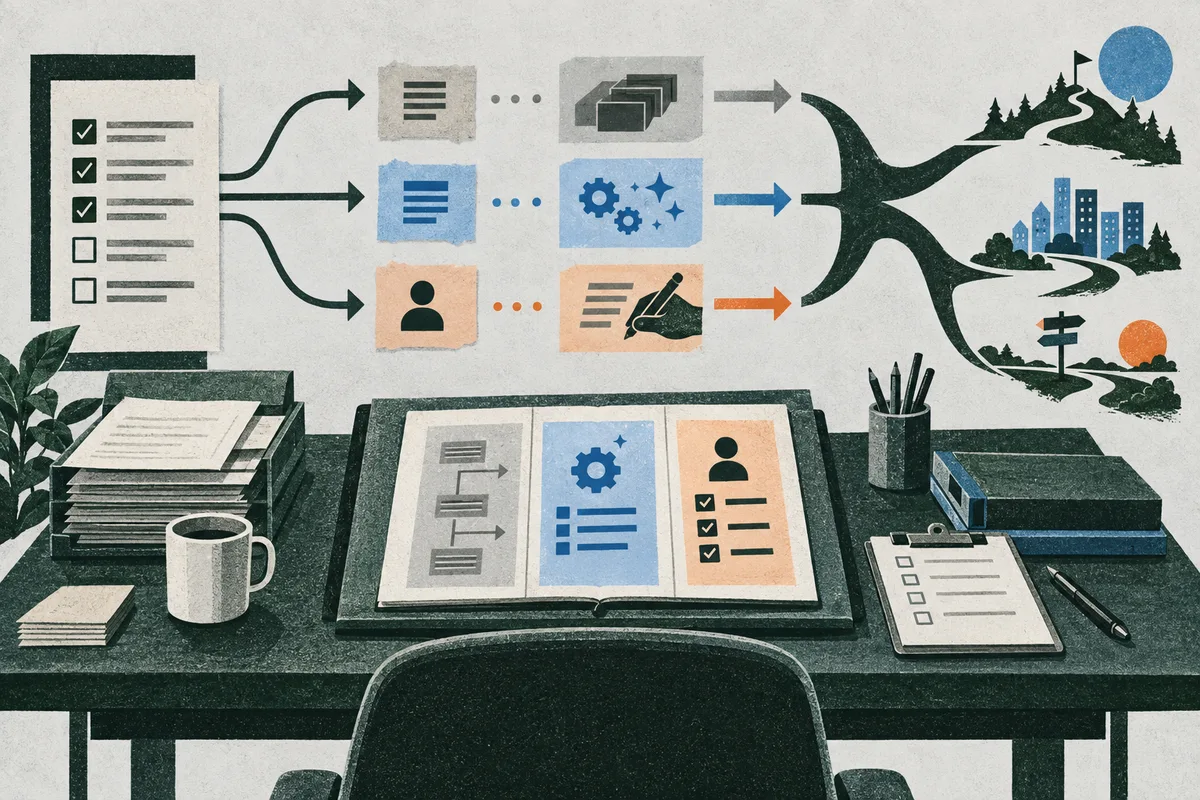
One task experiment can tell you whether a specific, authorized part of your work can be assisted under stated controls. It cannot tell you that your occupation is safe, doomed, or generally automated. The OECD's *AI and Skills: What We Know So Far* distinguishes exposure and adoption questions from employment effects; applying that boundary to a task is the useful starting point. Drafting, summarizing, research organization, classification, and first-pass planning may be exposed to assistance when their inputs and outputs are relatively legible. Judgment about what matters, tacit knowledge, negotiation, exception handling, accountability, and verification may remain central even when a tool helps earlier in the sequence. Exposure describes possible change pressure or applicability; it is not a personal displacement probability.
Define the experiment around the actual output, not the job title. Ask what inputs are needed and which may enter the system; whether the output is a draft, comparison, recommendation, decision, or record; what an omission or plausible error would cost; who can review it; and what context the system will not see. Record the current baseline in terms of preparation time, revision, coverage, escalation, or another task-relevant measure. Finally, specify which step may be assisted while the human owner, decision, and accountability remain unchanged. These questions distinguish a useful draft aid from an unsafe autonomous handoff.
The field evidence in *Generative AI at Work* shows why a local result can be meaningful without being universal. In a staggered workplace introduction involving 5,179 customer-support agents, the NBER working paper reported a 14% average increase in issues resolved per hour, with larger measured gains for novice and lower-skilled agents and minimal impact for experienced and highly skilled agents (NBER, *Generative AI at Work*, Working Paper 31161). That is evidence of an observed change in a defined task and deployment. It is not an evaluation of Google AI Essentials, a general knowledge-work sample, or displacement.
The result is useful counterevidence to two opposite shortcuts. It shows that deployed assistance can produce real gains for some workers, including beginners, so a learner should not dismiss local testing as pointless. It also shows heterogeneous effects: the measured outcome was not uniform across experience levels, and the study examined one employer, one customer-support operation, one assistant, and one throughput measure. A worker in another occupation may care more about source traceability, accuracy, review time, coverage, or time released for judgment than about issues resolved per hour. Transfer is possible, but it must be tested rather than assumed (NBER, *Generative AI at Work*).
Keep four concepts separate when interpreting the result. Assistance means a tool helps with a bounded subtask while a worker supplies context and checks the output. Redesign means the sequence, reviewer, or division of work changes because the tool is now part of the process. Exposure means some activity is susceptible to change; it says nothing by itself about demand for the occupation. Displacement would require evidence about work volume, staffing, demand, accountability, and organizational decisions in the relevant setting. Moving from an exposed draft task directly to a job-loss forecast skips the evidence needed between those steps.
A defensible experiment records the whole path to usable work. Compare an unassisted baseline with an assisted version on a bounded set of cases. Note time to a usable result, review time, substantive edits, omissions, source traceability, exceptions, and any privacy or policy issue. A faster first draft may disappear when verification is counted; a slower process may still be worthwhile if it improves coverage or releases attention for a higher-value step. Do not count raw output volume or prompt count as the answer. Use the task's real quality standard and preserve human review where the consequences require it.
If the tool is not approved, use public, synthetic, or redacted material and record the access barrier instead of making unauthorized use look like evidence. The result can show that you are prepared to test a method, but it cannot establish production impact. If no reviewer is available, use a stable checklist and mark uncertainty: check required fields, source support, calculations, omissions, sensitive content, and escalation cases where relevant. Self-review is weaker than independent review, but it is more informative than a polished output judged only by appearance.
Interpret the outcome as a next-step signal. If one permitted task improves usable work without unacceptable review burden, continue learning around that workflow and document what remains human-owned. If the limiting factor is approval, quality ownership, or accountability, have the process-owner conversation before buying more introductory content. If the experiment reveals a need to build capability for a different role, choose a work sample or deeper target-specific study. The NBER finding justifies testing because real assistance can help unevenly; its narrow setting also explains why one local result cannot become a course return, occupation-wide forecast, or personal job-loss probability.
Sources: AI and Skills: What We Know So Far, OECD; Generative AI at Work, NBER Working Paper 31161
Which durable foundations should remain after tools change?
Learn the capabilities that let you frame, inspect, and own work before memorizing one assistant's interface. The durable sequence is task framing, data and source literacy, evaluation, verification, risk awareness, domain judgment, basic automation, and accountable communication. Google AI Essentials can introduce these ideas through beginner exercises, but a lesson or prompt pattern is only a starting point. The test is whether you can carry the capability into a different approved tool or unfamiliar task without surrendering responsibility. The U.S. Department of Labor's Artificial Intelligence Literacy Framework groups useful literacy around understanding AI, applying it to work, evaluating outputs, and responsible use; that is stronger than counting prompts (The Department of Labor's Artificial Intelligence Literacy Framework).
Start with task framing because an assistant cannot decide what the work is for. State the user's or organization's objective, the inputs available, the output required, the quality threshold, the deadline, and the point at which a person must decide. A worker who can frame a task can reject an attractive but irrelevant use, divide a broad assignment into inspectable stages, and explain what assistance is actually being requested. Interface-specific prompting may help express that request, but it is downstream of the question. If the task is poorly defined, a polished response can make the ambiguity harder to notice rather than solve it. Task framing also gives you a portable record when a model, vendor, or workplace tool changes.
Next, build data and source literacy. Know what information the task depends on, which material is authoritative, what may be entered into the approved system, and what must remain private, redacted, or outside the workflow. Then distinguish a generated statement from evidence that supports it. This is not an abstract warning about hallucinations; it is a working habit of preserving the source, checking its date and scope, and marking what the system did not establish. The OECD's *AI and Skills: What We Know So Far* places digital, data, and complementary human skills alongside AI adoption rather than treating a single tool skill as the whole requirement. Inference from that synthesis is modest: source discipline is likely to travel better than familiarity with one product's controls, although the report does not measure this course's individual effect (AI and Skills: What We Know So Far, OECD).
Evaluation is the next foundation. Before asking whether an output is good, define good for the task: complete coverage, correct calculations, faithful summary, appropriate tone, traceable sources, safe handling of information, or compliance with a local requirement. Use examples of acceptable and unacceptable work where possible. A learner who can name the criteria can compare assisted and unassisted work without treating fluency as accuracy. The Department of Labor framework's emphasis on applying AI and evaluating outputs supports this distinction, but the framework is guidance, not a validated test or hiring standard. Passing a quiz about evaluation is therefore weaker evidence than demonstrating that the criteria were applied to a real or clearly labeled practice case (The Department of Labor's Artificial Intelligence Literacy Framework).
Verification turns evaluation into an accountable action. Check important claims against the relevant source, recalculate consequential numbers independently, inspect omissions, and look for cases in which the system's confidence exceeds the available evidence. Decide in advance which errors require correction, escalation, or stopping the workflow. This is where domain judgment matters: the person who understands the customer, regulation, process, or technical context can notice a plausible answer that violates the actual conditions of the work. A beginner course can make verification visible and give it a name; it cannot supply all the domain knowledge or authority needed to perform it. The transferable skill is not skepticism for its own sake, but a repeatable reason for accepting, changing, or rejecting an output.
Risk awareness should be concrete rather than ceremonial. Map the consequences of a wrong answer, the people affected, the sensitive inputs involved, the possibility of bias or exclusion, and the point where a human must intervene. Then communicate those boundaries clearly to colleagues, clients, or managers. Accountable communication means saying what the system contributed, what you checked, what remains uncertain, and who owns the decision. It also means not presenting a generated draft as independent research or implying that a certificate transfers responsibility to the course provider. These habits matter even when the task is low stakes, because they make it easier to recognize when a seemingly convenient use has crossed into a context requiring specialist review.
Basic automation belongs after those foundations. A worker does not need to become a software engineer to make a repeatable process more reliable, but should understand the inputs, transformations, outputs, failure conditions, and handoffs in any small automation they introduce. Start with a simple sequence: collect approved material, apply a defined operation, preserve the source or record, run checks, and route exceptions to a person. If you cannot explain where an error could enter or how to stop the process, another tool may increase opacity rather than capability. The OECD's synthesis treats AI-related work as dependent on broader digital, data, managerial, and human skills, not only model development or interface use (AI and Skills: What We Know So Far, OECD).
Rank these foundations by task consequence and your current gap. For low-risk drafting, begin with framing, source boundaries, and a review checklist. For research or analysis, put source literacy, evaluation, and verification first. For customer, regulated, or consequential work, add ownership, escalation, and documentation before experimenting. A beginner course can provide a coherent first pass and reduce the friction of starting. It cannot demonstrate depth, transfer, production ownership, or exception handling merely because the learner finished. Those require practice, feedback, and evidence from work or a carefully designed project.
Tool fluency is not irrelevant. An interface can reduce friction and reveal possible workflows. The boundary is durability: a button, model name, prompt convention, or vendor rule may change faster than the need to define the task, protect data, test output, and explain the decision. Treat interface familiarity as a layer over the foundations. If the course leaves you with a method for choosing a task, checking a result, documenting limits, and communicating ownership, it has started useful learning. Remembered prompts alone produce familiarity without much transfer evidence.
Sources: AI and Skills: What We Know So Far, OECD; The Department of Labor’s Artificial Intelligence Literacy Framework
Which alternative is better when AI Essentials is not enough?
Choose the learning route by the capability you need to demonstrate, not by the broadness of the word AI. There are at least four different goals here: use AI in an existing field, build an AI-enabled product, become a software practitioner, or pursue machine-learning engineering or research. Google AI Essentials is best matched to the first goal when the learner is a beginner seeking structured workplace orientation. Google frames it as foundational, practical AI learning rather than technical preparation (Google AI Essentials, Grow with Google). That makes it a reasonable starting purchase for a defined workplace experiment, but a weak substitute for the prerequisites, feedback, and proof demanded by the other three goals.
If your goal is to use AI in an existing role, compare four routes: AI Essentials, free or library-based learning, employer-supported training, and a small documented work project. The course earns its place when sequence is your main bottleneck and its exercises help you reach a permitted task faster. Free learning may be enough when you can choose and evaluate material independently. Employer support may be better when access, policy, data handling, or review is the real constraint. A project is better when you already understand the basics and need evidence that you can improve a real workflow. The OECD's *AI and Skills: What We Know So Far* supports treating training as part of a wider adoption setting, not as an isolated guarantee of an individual outcome (AI and Skills: What We Know So Far, OECD).
For an experienced user, buy less introductory material before asking what proof is missing. Document one workflow from input to usable output, preserve the checks and exceptions, and obtain feedback from someone who knows the standard. That project can reveal whether your gap is task design, source handling, evaluation, automation, communication, or employer permission. A short course may still fill a specific gap, but the project should control the purchase rather than become an afterthought. A certificate records learning activity; a work sample can show judgment in context. Neither, by itself, guarantees hiring, promotion, salary, or immunity from task change.
If your goal is to build an AI-enabled product, move beyond workplace prompting toward product and implementation foundations. You need to define a user problem, inspect and structure data, choose an appropriate system or service, evaluate behavior against requirements, handle failures, and communicate tradeoffs. A broader applied AI certificate may offer a more coherent sequence than disconnected tutorials. Coursera's Google AI Professional Certificate page describes a separate, broader Google-branded applied AI option; that establishes scope and intended progression, not job readiness or income effects (Google AI Professional Certificate, Coursera). The deciding evidence should be a target-relevant project that someone can inspect, including what the product does not do reliably.
If you want to become a software practitioner, the center of gravity shifts again. Learn programming fundamentals, version control, testing, debugging, data handling, and the ability to read and modify existing systems. Add AI tools as accelerators inside that practice, not as replacements for understanding the code or verifying its behavior. Google frames AI Essentials as foundational workplace AI learning, not a software-development curriculum (Google AI Essentials, Grow with Google). A broader certificate is worth considering only if its published work, prerequisites, feedback model, and assessment fit the target role; otherwise a sequence of smaller projects with code review may create stronger evidence for less cost or less time, depending on your starting point and support.
If your target is machine-learning engineering or research, do not let a beginner workplace certificate stand in for mathematics, statistics, programming, data structures, model evaluation, experimentation, and the relevant technical literature. The right path may involve university study, a rigorous technical program, supervised research, or a sequence of increasingly difficult projects. The choice depends on prerequisites, available time, finances, location, and the actual requirements of the role or program. A general certificate can be a bridge into vocabulary or motivation, but it cannot be called preparation for engineering or research merely because it includes the word AI. Check the target's stated prerequisites and expected work samples before paying.
Compare the alternatives on five dimensions. First, prerequisites: what can you already do, and what must be learned first? Second, feedback: who will inspect your work and correct your misunderstandings? Third, proof: will you finish with a documented workflow, a functioning product, reviewed code, or a research artifact? Fourth, time and cost: can you complete the route alongside work, health, caregiving, and financial obligations? Fifth, signaling: will the credential be legible for the specific role, or is demonstrated capability more important? A coherent program may reduce search costs, while self-directed learning may be cheaper and more adaptable. Neither advantage removes the need for credible evidence.
Employer support deserves its own comparison because it can outperform a private purchase even when the lessons are less polished. An employer may provide an approved tool, real feedback, protected practice time, internal examples, and a process owner who can decide whether a change is acceptable. That combination addresses the transfer problem directly. It can also expose constraints that a public course cannot know: data retention, procurement, disclosure, security, or responsibility for errors. If employer support is unavailable, a public or synthetic project can still build preparation and a work sample, but label it honestly as practice rather than evidence of permission or production performance.
A broader certificate is not automatically the answer when AI Essentials feels too small. Coherence can be valuable: a planned sequence may prevent a learner from collecting disconnected tutorials. But coherence is not the same as depth, transfer, or job readiness. The Google AI Professional Certificate is a relevant comparison when the goal has moved toward broader applied AI capability, while the target role's requirements should determine whether it is actually appropriate. Use provider pages to establish what a program contains; use your own inspected work, independent feedback, and target-role evidence to judge what you can do afterward. Do not turn provider positioning into a claim about employment outcomes.
The recommendation is therefore conditional and ranked. Choose AI Essentials when you are a beginner whose immediate goal is practical use in an existing field, and when structured orientation is the shortest credible route to an approved experiment. Choose free or employer-supported learning when money, access, policy, or feedback is the bottleneck. Choose a documented project when you already know the basics and need transfer evidence. Choose a broader applied, software, or technical path when the target demands product building, programming, engineering, or research foundations. In every case, keep the target role, prerequisites, review, proof, time, cost, and personal constraints visible; a learning label cannot make those requirements disappear.
Sources: Google AI Essentials, Grow with Google; AI and Skills: What We Know So Far, OECD; Google AI Professional Certificate, Coursera

How should you test the purchase without mistaking speed for value?
Treat the next 30 days as a bounded decision experiment, not as a race to finish lessons. The question is whether the course helps you perform one permitted task more usefully under the controls that apply to your work. Before you start, write down the task, the intended outcome, the approved tool or practice environment, the information you may use, and the person who remains accountable for the result. NIST’s AI Risk Management Framework Playbook organizes this kind of work through Govern, Map, Measure, and Manage functions; the 30-day procedure here is an editorial application of that risk-oriented structure, not a validated personal productivity test (NIST, “AI Risk Management Framework Playbook”).
Begin with permission, because a result obtained through an unauthorised workflow is not a workplace gain. Check whether your employer, client, or professional obligations allow the tool, account, input material, output handling, and proposed task. If live data are not approved, use public, synthetic, or redacted material and label the result as preparation rather than production evidence. Name the human owner who can accept, reject, or escalate the work. If no one can answer those questions, record governance as the current constraint; do not solve an access problem by putting restricted information into an assistant.
Then establish a baseline before asking the system to help. Use a small set of comparable instances from the same recurring task, or create a representative test set if real work cannot be used. Record end-to-end time, not only the minutes spent generating a first draft: include preparation, prompting, source checking, editing, approvals, and handoff. Also record the requirements that matter for acceptance, such as factual coverage, required fields, calculations, citations, tone, formatting, privacy, and escalation. The baseline can be qualitative when the task is irregular, but it must still identify what a reviewer normally checks and where failures tend to appear.
Choose a task with a visible beginning and end. “Use AI in reporting” is too broad; “prepare the first draft of a recurring internal summary from approved source notes, then verify every claim against those notes” is testable. Keep the first trial narrow enough that a human can inspect the inputs and output. Do not let the experiment silently expand into customer decisions, legal conclusions, financial commitments, medical judgments, or other work whose risk requires a different approval path. A bounded task lets you learn about assistance without pretending that one successful subtask represents an entire occupation.
Run an assisted and an unassisted comparison using the same acceptance standard. The unassisted version is not a ritual rejection of tools; it is the reference needed to see what changed. Where practical, compare several instances rather than one unusually easy example. For each version, preserve the source material, the instructions or method, the output, the human edits, and the final accepted form. The Department of Labor’s Artificial Intelligence Literacy Framework places understanding, application, output evaluation, and responsible use together; a comparison that records only elapsed minutes omits most of the capability the learner is supposed to develop (U.S. Department of Labor, “Artificial Intelligence Literacy Framework”).
Measure usable work, not impressive intermediate output. Track total time to an acceptable result, avoidable rework, omissions, unsupported claims, traceability to source material, privacy handling, review burden, and the number and seriousness of exceptions. An assistant can shorten drafting while increasing checking, reconciliation, or correction. The NBER field study *Generative AI at Work* found a 14% average increase in issues resolved per hour after a conversational assistant was introduced to 5,179 customer-support agents, with heterogeneous effects across workers; that result shows why a deployed tool can help a bounded workflow, but it does not establish that this course or this method improves every knowledge task (Brynjolfsson, Li, and Raymond, “Generative AI at Work”).
Keep an exception log beside the measurements. For each failure, note what went wrong, whether the problem was visible before use, how it was detected, what correction was required, and whether the task should have been escalated or refused. Include cases where the output was fluent but incomplete, where the source could not be traced, where the tool exposed an information risk, or where a reviewer had to rebuild the work. This log may be more informative than a neat productivity ratio. It shows the conditions under which assistance is useful and the boundary beyond which the course has not supplied enough judgment or control.
At day 30, apply an explicit rule. Keep the course and workflow when the task is permitted, the output meets the required standard, verification is feasible, review burden is acceptable, and the evidence is repeatable enough to justify another controlled use. Change the method when the task is promising but prompts, source preparation, tool choice, or review steps are inefficient. Stop when privacy, accuracy, accountability, or exception risk cannot be controlled, or when the course is answering a different goal from the one you actually have. Escalate when the result depends on a policy decision, specialist review, broader access, or a redesigned process that you cannot authorise yourself.
Do not force a numeric verdict when the sample is small or the task has no stable count of outputs. Report what was observed, what remains uncertain, and which failure would change the decision. “The method saved drafting time but added a full source audit” is a usable finding. “The tool felt faster” is not enough. The experiment earns its keep when it produces a redacted work sample, a task map, a verification checklist, and a clear next question—whether the next investment should be more practice, employer support, a different course, or no further purchase.
Sources: The Department of Labor’s Artificial Intelligence Literacy Framework; AI Risk Management Framework Playbook, NIST; Generative AI at Work, NBER Working Paper 31161
What is the earned verdict for your next learning move?
The earned verdict is conditional: buy or keep Google AI Essentials when you are a beginner whose immediate goal is practical use in an existing field, you have a permitted recurring task, and the 30-day experiment can turn the lessons into inspectable evidence. The course is a structured on-ramp, not a displacement forecast, a job guarantee, or proof that you can perform technical AI work. Coursera’s published course scope and Google’s foundational framing support the first description; they do not establish hiring, salary, or individual productivity outcomes (Coursera, “Google AI Essentials Specialization”; Grow with Google, “Google AI Essentials”).
Choose another path when the experiment identifies a different bottleneck. If you understand the basics but cannot show reliable work, spend the next effort on a documented project, feedback from a qualified reviewer, or employer-supported practice. If the task is blocked by policy, data access, or accountability, seek a governance decision before buying more prompting instruction. If your goal is to build an AI-enabled product, become a software practitioner, or pursue machine-learning engineering or research, compare the target role’s prerequisites, technical depth, feedback, and work-sample expectations rather than treating a beginner workplace course as a shortcut. The OECD’s synthesis warns that training and complementary skills sit within uneven adoption conditions; learning alone does not determine an individual employment result (OECD, “AI and Skills: What We Know So Far”).
The strongest exception is a course that proves useful without being sufficient. A beginner may finish with a better task map, safer questions, and a repeatable first workflow, yet still need deeper domain knowledge, automation practice, data literacy, or a stronger review process. That is a successful learning result if it changes the next decision. Conversely, a completed certificate with no authorised task, no reviewer, and no retained work evidence is a completion result, not evidence that the purchase improved the reader’s work. Both outcomes should remain visible in the record.
Rank the next move by the evidence you now have. First, keep and apply the course if one permitted task improved on the full path to usable work and its risks remain controlled. Second, change the learning route if the task is viable but the course stopped before the capability you need. Third, stop purchasing and resolve governance or access if those conditions are the binding constraint. Fourth, widen the question if your task map shows several exposed or changing activities and the decision is no longer “which beginner course?” but “should I upgrade this role, move adjacent, or pursue a larger change?”
Take the smallest action that can reduce the remaining uncertainty: ask for permission on one named workflow, run the baseline, preserve a redacted comparison, or write down the prerequisite missing from the current path. The free checker at `/ai-job-risk-checker` can organize task-level change-pressure signals and first actions; it reports transparent signals, not a validated probability that you will lose your job. If the unresolved decision involves an internal upgrade, an adjacent move, or a larger change under salary, location, time, health, or family constraints, the paid roadmap at `/career-roadmap` can compare those scenarios and build a 30/60/90-day plan. It does not guarantee employment or income.
Do not let the verdict outrun the evidence. A short experiment can support a decision about one authorised workflow and the next learning investment. It cannot certify that an occupation is safe, predict employer adoption, or convert exposure into a personal replacement probability. The practical conclusion is narrower and more useful: keep the course when it is the shortest credible route to a verified task experiment; choose another route when the required capability or proof lies beyond its scope; and widen into a constrained career decision when one task no longer represents the change you need to manage.
Sources: Google AI Essentials Specialization, Coursera; AI and Skills: What We Know So Far, OECD; Generative AI at Work, NBER Working Paper 31161; AI Risk Management Framework Playbook, NIST
Questions readers ask
Is Google AI Essentials enough to get an AI job?
No. It is a beginner workplace-use program, not complete preparation for AI engineering, software development, data work, or research. Pair it with a relevant project and the foundations required by the target role.
Does Google AI Essentials give a recognized certificate?
The provider pages say completion produces a shareable Google certificate. Treat it as a record of completing the program, not independent proof of reliable workplace capability or a guaranteed hiring advantage.
How much does Google AI Essentials cost?
Price, currency, taxes, trial, and cancellation terms can vary by location and account. Check the current provider checkout rather than relying on a historic or region-specific figure.
Can I use Google AI Essentials without becoming a programmer?
Yes. Its published scope is foundational generative-AI use for workplace tasks and does not require prior technical experience. That does not make it preparation for technical AI development.
Should I take the course if I already use ChatGPT or Gemini?
Only if you have a specific gap the structure will solve, such as task selection, responsible use, verification, or a repeatable workflow. If those basics are familiar, a documented work project may create more useful evidence.
Can a short AI course protect my job from automation?
No course can guarantee that. Exposure, tool use, employer adoption, job redesign, labor demand, and displacement are separate questions. A course may help you test a task, but it cannot forecast your employment outcome.
What should I do after finishing Google AI Essentials?
Apply one relevant lesson to an authorized recurring task, record a baseline, verify the assisted output, document rework and constraints, and decide whether to keep, change, stop, or escalate the workflow.
Sources and notes
- Google AI Essentials Specialization, Coursera
Supports the five-course beginner scope, self-paced format, workplace activities, listed topics, tools, time estimate, and shareable certificate.
- Google AI Essentials, Grow with Google
Supports Google’s description of the program and its foundational workplace-use framing; current checkout terms should be verified before enrollment.
- AI and Skills: What We Know So Far, OECD
Supports the distinction between AI exposure, adoption, complementary skills, training, and uncertain individual outcomes; the synthesis spans heterogeneous studies and does not establish course-specific causation.
- Generative AI and the SME Workforce: New Survey Evidence, OECD
Supports the 2024 cross-sectional survey evidence on training access and reported resource constraints among SMEs in seven countries; it does not estimate individual course returns or prove causation.
- Generative AI at Work, NBER Working Paper 31161
Supports the bounded customer-support field evidence that deployed AI assistance affected productivity heterogeneously across workers; the single-employer setting limits transfer to other tasks and courses.
- The Department of Labor’s Artificial Intelligence Literacy Framework
Supports a practical AI-literacy framing around understanding systems, applying them to work, evaluating outputs, and addressing responsible-use concerns; it is a framework, not evidence of employment outcomes.
- AI Risk Management Framework Playbook, NIST
Supports the Govern, Map, Measure, and Manage framing used to structure a bounded workplace experiment; it does not validate a personal productivity or displacement score.
- Google AI Professional Certificate, Coursera
Supports comparison with a materially broader Google-branded learning option for readers seeking applied capability; the provider page does not establish hiring or salary effects.
Apply this to your own work
See the whole job market at once.
Explore which occupations AI may reshape, then turn the signal into a practical response.
Explore the job map