
ISO/IEC 42001 work primarily requires management-system and governance skills: defining scope, assigning accountability, mapping AI use, assessing risks and impacts, documenting decisions, checking controls, communicating with affected parties, and improving the system over time. It also requires enough technical AI literacy to ask good questions about data, models, performance, limitations, security, and monitoring. That is different from machine-learning engineering. You may need ML depth when your role develops models, validates model behavior, designs evaluation methods, or makes technical decisions about deployment. You do not need to become an ML engineer simply because you coordinate an AI management system, maintain an AI inventory, prepare audit evidence, run an impact assessment, or translate policy into operating practice. The realistic next move is to match your learning to the task bundle and the role you want: governance practitioners should build a small, evidence-based AIMS work sample; technical practitioners should add model and evaluation depth; existing compliance, security, privacy, quality, procurement, product, or operations professionals can often extend their domain experience into AI governance. ISO itself describes 42001 as a management-system standard for organizations that develop, provide, or use AI, and its current implementation-guidance work item is still under development. Treat a course or certificate as structured learning, not proof of workplace readiness. Start by inventorying one real AI use case, naming its owner and affected parties, and recording what evidence would let a reviewer understand its intended use, risks, controls, monitoring, and open questions.
Start with the work, not the label
A job title such as AI governance lead, ISO 42001 consultant, responsible AI manager, internal auditor, or AIMS coordinator can hide very different work. Before choosing a course, write down the decisions the role must make and the evidence it must produce. Are you setting the scope of an AI management system? Building an inventory of systems and suppliers? Interviewing process owners? Reviewing an impact assessment? Testing whether monitoring actually happens? Preparing management review material? Explaining a control to product or engineering teams? These are not interchangeable tasks, and they do not carry the same technical depth.
ISO/IEC 42001:2023 specifies requirements for establishing, implementing, maintaining, and continually improving an artificial-intelligence management system. ISO describes that system as interrelated organizational elements that establish policies and objectives and the processes used to achieve them. That framing matters for career decisions. The object of the work is not one model in isolation. It is the way an organization governs the responsible development, provision, or use of AI across a defined context. [The ISO page](https://www.iso.org/standard/42001) supports this definition and scope, but it does not promise a particular job title, hiring route, or universal skills checklist.
Consider an example that begins with Imagine: a company uses a text-generation service to draft customer replies, a forecasting model to plan stock, and a vendor's screening tool in recruitment. The governance work might include recording intended purposes, deciding which uses fall inside scope, identifying owners, checking contracts and data practices, setting review and escalation paths, and retaining evidence of decisions. Someone still needs to understand enough about each system to challenge vague descriptions. But the core activity is organizing accountability and controls around actual use, not recreating the model architecture.
A useful first distinction is between capability and responsibility. A model may be capable of producing a draft or ranking candidates. A worker may be responsible for deciding whether that output can be used, under what conditions, with what review, and how a person can raise a concern. Keep four signals separate: observed use means a worker or team is already using a tool; employer adoption means an organization has chosen to deploy it in a workflow; labor demand means vacancies or employment data show what employers are seeking; displacement means roles or employment actually shrink. One signal cannot stand in for the others. Exposure to AI in a governance worker's document and analysis tasks may indicate assistance or redesign, but it is not a redundancy forecast. Judgment about scope, materiality, exceptions, and accountability remains a separate question.
The governance skill set ISO 42001 work actually uses
The most transferable foundation is management-system thinking. You need to turn a broad intent such as responsible AI into a repeatable cycle: understand organizational context, define objectives, assign roles, identify risks and opportunities, implement controls, evaluate performance, correct failures, and improve. This resembles familiar work in quality, information security, privacy, safety, risk, and compliance. AI adds new questions and evidence requirements, but it does not erase the value of knowing how a controlled process works.
A second foundation is evidence discipline. A governance practitioner should be able to trace a claim to an owner, record, decision, test, or observation. For a deployment, that could mean linking the stated purpose to system requirements, data provenance, validation results, user information, incident records, monitoring results, and approval decisions. Good writing helps because policies and audit reports must be precise about what is required, what was observed, what is missing, and what remains an accepted risk. Spreadsheet fluency, version control for documents, interview technique, sampling, and clear issue writing are practical skills, not decorative extras.
A third is risk and impact reasoning. You need to identify who may be affected, what could go wrong, how serious the effect might be, what uncertainty remains, and which control or decision follows. This is not the same as assigning a dramatic risk score to every system. It is often a structured conversation about context, intended and actual use, human oversight, data, security, fairness, privacy, transparency, and routes for correction or appeal. NIST's AI Risk Management Framework is a useful companion lens because it organizes activities into Govern, Map, Measure, and Manage, with governance treated as cross-cutting rather than a one-time gate. [NIST's AI RMF Core](https://airc.nist.gov/airmf-resources/airmf/5-sec-core/) supports that comparison; NIST says the framework is voluntary and not a one-size-fits-all checklist.
Finally, the work is social. You may need to interview engineers without pretending to be one, ask legal or privacy specialists focused questions, explain a finding to executives, train users, and create a channel for concerns. Independence and tact matter in audits. So do the ability to say 'we do not yet have evidence' and the patience to follow a corrective action to closure. These skills are governance skills because they make decisions visible, reviewable, and owned.

What technical AI literacy means in practice
Governance is not a license to stay technically vague. You need working literacy: the ability to describe what a system takes in, what it produces, where a model or rules engine sits in the workflow, what data was used or accessed, what the output means, how performance is tested, and what happens when the system is uncertain or wrong. For a generative system, that may include retrieval, prompts, context limits, data leakage, output evaluation, access controls, and human review. For a predictive system, it may include labels, thresholds, drift, false positives and false negatives, calibration, validation data, and operating conditions.
The important verb is interrogate, not implement. You should be able to ask an engineer or vendor: What is the intended use? What uses are out of scope? Which population or setting was represented in evaluation? What metric was selected and why? How does performance change across relevant conditions? What logs are kept? Who can override or stop the system? How are incidents reported? What changed since the last review? You do not need to derive gradient descent to recognize that a metric may not match the business or human impact, or that a benchmark result may not establish reliable performance in a new setting.
The European Union's AI Act offers a helpful adjacent definition of AI literacy. Article 4 describes skills, knowledge, and understanding that support informed deployment while taking account of rights, obligations, opportunities, risks, possible harm, technical knowledge, experience, education, training, and context. The provision also says providers and deployers must take measures to support staff and others operating or using systems on their behalf, and it does not require a specific level for every individual. [EUR-Lex's current text](https://eur-lex.europa.eu/eli/reg/2024/1689/2026-07-27/eng) supports this context-sensitive distinction. It is not an ISO 42001 job description, but it helps explain why literacy should be matched to duties.
Separate four technical levels. At level one, a user understands safe and appropriate use. At level two, a governance practitioner can map a system, question evidence, document risk, and monitor controls. At level three, an assurance or evaluation specialist designs tests, analyzes results, and interprets uncertainty. At level four, an ML practitioner develops, tunes, deploys, or researches models. ISO 42001 roles can draw from all four levels, but a single person rarely needs all four. The right level follows the system, authority, and decisions assigned to the role.
Where machine-learning skills become necessary
Deeper ML knowledge becomes necessary when you own technical performance rather than merely reviewing whether the organization has a process. Examples include choosing a model architecture, preparing training data, tuning a model, building a retrieval or ranking system, designing a test set, setting thresholds, diagnosing drift, implementing monitoring, or deciding whether a technical mitigation changes behavior enough to reduce risk. If the job description says you will build evaluation pipelines, run experiments, inspect model failure modes, or ship production inference, treat those as engineering responsibilities and plan accordingly.
The boundary is not perfectly clean. An impact assessor may need to understand how a model's output enters a consequential decision. An auditor may sample logs and inspect validation evidence. A product manager may define acceptance criteria with engineers. A privacy professional may need to understand data flows. In these cases, technical literacy and domain judgment meet. The governance worker should be able to detect a weak explanation, ask for the right evidence, and escalate a technical question. They do not automatically need to produce the code or independently certify the model.
NIST's crosswalk between its AI RMF and ISO/IEC 42001 makes this layered relationship visible. It maps governance outcomes to roles, communication, training, leadership, competence, and management-system clauses, while also mapping measurement outcomes to validation, monitoring, documentation, data quality, and model explanation. [The crosswalk](https://airc.nist.gov/docs/NIST_AI_RMF_to_ISO_IEC_42001_Crosswalk.pdf) supports the interpretation that a 42001 program touches technical evidence without making every governance role a model builder. It is a mapping aid, not proof that the two frameworks are identical.
A practical test is to ask what you must be able to do without another specialist. If you must explain why a metric is appropriate, reproduce a test, or change the system, technical depth is central. If you must decide which evidence is needed, challenge an unsupported assertion, assign an owner, communicate a finding, or track corrective action, governance depth is central. If both appear, build a deliberate bridge rather than taking a generic machine-learning course and hoping it covers the job.

Three realistic learning routes
For an existing compliance, audit, privacy, security, quality, procurement, or operations professional, the strongest first route is usually an upgrade. Keep the domain you understand, learn ISO management-system structure and AI-specific vocabulary, and produce a work sample such as an AI inventory, scoped AIMS map, risk-and-impact register, control-to-evidence matrix, supplier question set, or internal-audit plan. Add enough technical practice to read a system card, data-flow diagram, evaluation summary, and monitoring record. This route is often more credible than starting over because it connects new AI duties to an existing way of working. It still requires checking the actual role, geography, credential expectations, and access to real evidence.
An adjacent route fits someone moving from software delivery, data analysis, product operations, model risk, cybersecurity, or legal and regulatory work. Choose the missing side of the bridge. A data professional may need audit independence, policy, and stakeholder practice. An auditor may need hands-on evaluation and data literacy. A lawyer may need operational understanding of AI lifecycle and evidence. A product professional may need impact assessment and accountability design. The output should be a bounded project with feedback, not a stack of disconnected badges.
A larger change is appropriate when the desired work is genuinely technical. A course or certificate can provide vocabulary, sequence, and instructor feedback. A project can demonstrate applied ability. Self-study can reduce cost and test interest. An apprenticeship or supervised work assignment can provide context and review. A university degree offers broader theory, structured assessment, and a signal that may matter for some technical roles, but it costs more time and is not a universal requirement for governance work. For ML engineering or research, prerequisites in programming, mathematics, statistics, systems, and software practice may be substantial. Do not infer readiness from completing a short ISO or AI course.
PECB's current Lead Implementer candidate handbook is useful as a description of one certification syllabus, not as an independent labor-market guarantee. It lists competencies such as planning an AIMS, analyzing context, managing risks, defining roles, implementing controls, creating training and awareness, monitoring effectiveness, running an internal-audit program, handling nonconformities, and preparing for certification audit. [The handbook](https://pecb.com/pdf/candidate-handbooks/pecb-candidate-handbook-iso-iec-42001-lead-implementer.pdf) supports what that exam is designed to cover. It does not establish that the certificate alone creates job readiness, salary gains, or a particular career outcome.
Turn the distinction into a next move
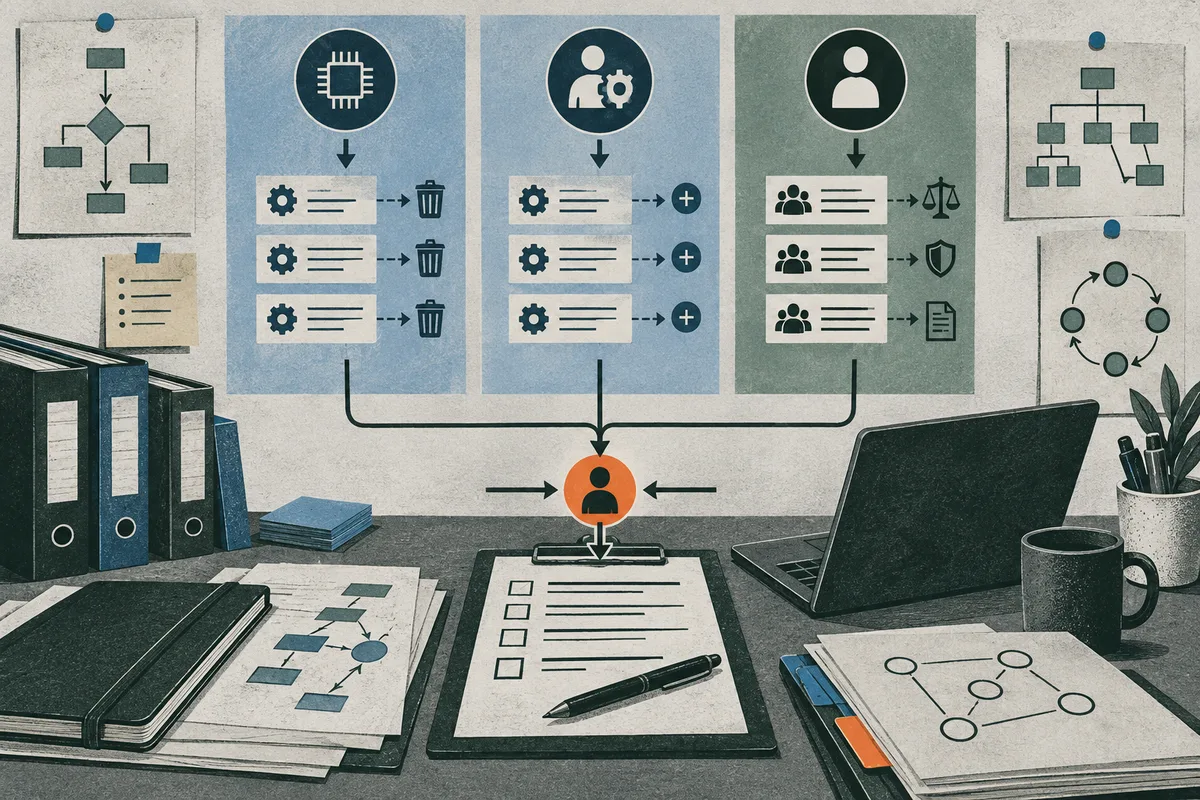
Use a one-page task map before spending money. Create columns for task, AI exposure, consequence of error, human authority, evidence required, and capability gap. Put ordinary work in the rows: collect system information, interview a vendor, draft policy language, review a data-flow description, test a control, summarize an incident, brief leadership, or maintain a register. Mark whether AI could assist the task, whether a person must verify it, and whether the work involves a decision that needs accountable ownership. This is more useful than asking whether 'AI governance' is safe or future-proof as a whole.
Then choose one of three experiments. In an upgrade experiment, take an existing workflow and produce an AI-specific control or evidence artifact. In an adjacent experiment, shadow a technical or assurance colleague and translate one system's lifecycle into a risk and monitoring view. In a technical experiment, build a small evaluation notebook or monitoring prototype with documented assumptions and failure cases. Keep the scope small enough to receive review within a few weeks, and record what you could not verify. A public portfolio can show structure and reasoning without exposing confidential data or copying proprietary assessment material.
If you are considering a course, compare it on prerequisites, depth, instructor feedback, assessment, current standard version, practical exercises, credential status, total cost, and what artifact you will leave with. Ask whether it teaches the purchased standard's text or only a marketing summary. ISO/IEC AWI 42003, which ISO lists as an approved work item under development, is specifically intended to provide implementation guidance including competencies for AIMS professionals. [ISO's project page](https://www.iso.org/standard/91021.html) supports its status. That status is a reason to check update dates and avoid treating future guidance as published requirements.
For U.S. readers testing an adjacent compliance path, BLS describes compliance officers' recurring work as interpreting rules, developing policies, assessing risk, conducting audits, training staff, investigating possible violations, documenting findings, and measuring program effectiveness. It projects 4% growth for compliance officers from 2025 to 2035, with about 32,700 openings a year, while noting that many openings reflect replacement needs. That is a directional demand signal for a broad occupation, not evidence of ISO 42001-specific hiring demand. O*NET's 2025 compliance-manager profile adds risk strategy, technical-professional advice, audits, and testing procedures. Use these sources to compare a target role with an existing occupational base, then check your country, sector, salary floor, and actual vacancies.
The wider evidence also argues against a simple 'learn machine learning or be left behind' conclusion. An OECD analysis of online vacancies in ten countries found that high-AI-exposure occupations commonly requested management, business-process, social, emotional, and digital skills, while people who actively develop and maintain models remained a small share of employment. This is evidence about changing skill demand in a defined vacancy sample, not proof that every employer values governance skills equally or that a certificate will create demand. [The OECD report](https://www.oecd.org/content/dam/oecd/en/publications/reports/2024/04/artificial-intelligence-and-the-changing-demand-for-skills-in-the-labour-market_861a23ea/88684e36-en.pdf) is useful for that distinction.
Finally, ILO research makes the evidence boundary explicit: its exposure measure scores potential task automation, while actual employment effects depend on adoption decisions, work organization, worker adaptation, and other institutions. A 2026 review of empirical evidence reports uneven productivity effects and limited large-scale displacement so far, but it does not turn that finding into a promise about any person's job. Read exposure as an early warning about tasks, observed use as a workflow fact, demand as a labor-market signal, and displacement as an outcome that must be measured separately. [The ILO 2025 update](https://www.ilo.org/publications/generative-ai-and-jobs-2025-update) and [2026 evidence review](https://www.ilo.org/publications/impact-genai-jobs-productivity-and-work-organization-review-empirical) support those limits.
The decision is simple but not easy: preserve the work you already understand where it creates leverage, add the smallest missing capability that changes your options, and test that capability against evidence from a real workflow. If the task map shows mostly policy, risk, evidence, communication, and audit work, do not let the word AI push you into an unnecessary ML reset. If it shows model development or evaluation ownership, plan deeper technical study. Neither route is immune to change. Both can become more valuable when they make AI decisions clearer, testable, and accountable.
Questions readers ask
Do I need to know Python to work with ISO/IEC 42001?
Not for every role. You need enough technical literacy to understand system boundaries, data, outputs, evaluation, monitoring, limitations, and evidence. Python becomes more important when you personally build tests, monitoring, data pipelines, or models. Read the task requirements before choosing programming study.
Is ISO/IEC 42001 mainly a compliance standard?
It is an AI management-system standard. Compliance and audit work can be part of implementing or evaluating it, but the system also covers leadership, planning, support, operation, performance evaluation, and continual improvement. It is broader than checking a list of legal rules.
What is the difference between an ISO 42001 implementer and an auditor?
An implementer helps establish and operate the management system, including processes, controls, records, training, monitoring, and corrective action. An auditor evaluates evidence against defined requirements and reports findings. Independence and the specific certification arrangement matter, so a person who designed a process may not be suitable to audit it independently.
Will an ISO 42001 certificate get me an AI governance job?
A certificate can provide structured learning and signal familiarity with a framework, but it does not establish workplace capability or guarantee hiring. Pair it with relevant domain experience, a reviewed work sample, clear evidence-writing, and technical literacy matched to the role.
What should an ISO 42001 portfolio project include?
Use a fictional or safely anonymized workflow and show scope, roles, intended use, affected parties, risks and impacts, selected controls, evidence owners, monitoring questions, escalation, and one improvement cycle. Explain assumptions and unknowns. Do not publish confidential records or copy proprietary assessment items.
How much machine learning should an AI governance professional learn?
Learn enough to interrogate technical claims and understand how data, models, metrics, thresholds, drift, monitoring, and human oversight affect the workflow. Go deeper into statistics, programming, and ML engineering when you own evaluation, implementation, or model performance decisions.
Is ISO/IEC 42003 already a required skills standard?
No conclusion like that is supported by its current status. ISO lists ISO/IEC AWI 42003 as an approved work item under development, with a draft prepared. Treat it as a developing guidance project and verify its publication status before relying on it as a finalized requirement.
Sources and notes
- ISO/IEC 42001:2023 - AI management systems
Supports the definition, scope, purpose, and management-system character of ISO/IEC 42001.
- NIST AI RMF Core
Supports the Govern, Map, Measure, and Manage comparison and the cross-cutting role of governance.
- ISO responsible AI governance and impact standards package
Supports ISO's description of leadership, planning, support, operation, evaluation, and continual improvement.
- PECB ISO/IEC 42001 Lead Implementer Candidate Handbook
Supports the competencies covered by one current Lead Implementer certification syllabus.
- Regulation (EU) 2024/1689, Article 4, EUR-Lex
Supports the context-sensitive legal definition and duty to support AI literacy.
- NIST AI RMF to ISO/IEC 42001 Crosswalk
Supports the link between governance, competence, training, technical evidence, validation, and monitoring.
- ISO/IEC AWI 42003 implementation guidance project
Supports that ISO/IEC AWI 42003 includes AIMS competencies but remains under development.
- Compliance Officers, U.S. Bureau of Labor Statistics
Supports the U.S. description of compliance tasks, typical education, and broad 2025-35 occupational outlook context.
- Compliance Managers, O*NET OnLine
Supports examples of compliance-manager work involving risk strategies, auditors, and technology oversight.
- Artificial intelligence and the changing demand for skills in the labour market, OECD
Supports the defined vacancy-sample evidence about changing skill demand in AI-exposed occupations and its limits.
- Generative AI and jobs: A 2025 update, ILO
Supports the distinction between task-level exposure, transformation, and actual job-loss outcomes.
- The impact of GenAI on jobs, productivity and work organization, ILO
Supports the current empirical boundary around uneven productivity effects and limited large-scale displacement.
Apply this to your own work
See the whole job market at once.
Explore which occupations AI may reshape, then turn the signal into a practical response.
Explore the job map