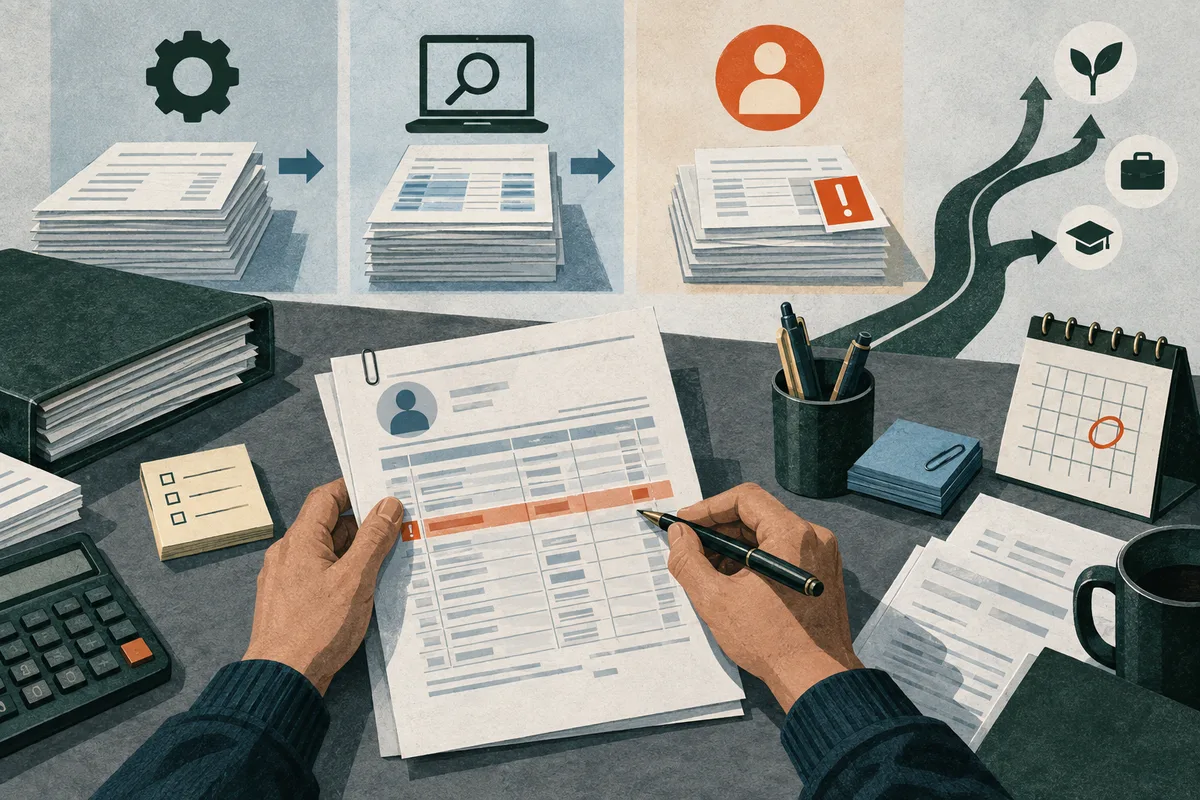
Before payday, a person should resolve a payroll exception when records conflict or are incomplete, approval is unclear, a change could materially affect pay or reporting, or nobody has verified that an approved correction reached the final payroll. Software can match and calculate from dependable inputs and documented rules, but a flag does not establish facts or authorize a change.
What does “AI-affected” mean for the decision at payday?
AI exposure means a task may be technically assisted or automated; it does not show that a payroll employer has adopted a tool, that it performs reliably in production, or that a clerk will lose a job. For a pay exception, ask a narrower question: can the system match and calculate from verified inputs, or must someone establish a disputed fact, obtain an authorized decision, understand the consequence, or confirm the outcome? The International Labour Organization’s *Generative AI and Jobs: A 2025 Update* estimates potential exposure by examining tasks within occupations. Its global method combines task data, expert input, and AI predictions across nearly 30,000 tasks. The brief says one in four workers worldwide are in occupations with some exposure, while most jobs are more likely to be transformed than made redundant. This is not a test of U.S. payroll software, a measure of employer adoption, or a forecast of an individual clerk’s displacement. Keep five signals separate. Capability asks what a tool can do under defined conditions. Exposure asks whether parts of an occupation’s tasks may be applicable to that capability. Use is evidence that someone employs a tool for a task; adoption concerns whether an organization has put it into a workflow. Task redesign describes how duties change when people and systems divide the work. Displacement is a change in jobs or employment, and cannot be inferred from exposure alone. A system that can compare hours or calculate a routine adjustment demonstrates neither organization-wide adoption nor a decision about staffing. Payroll already involves ordinary software and rule-based processing; that is not the same claim as generative AI resolving an ambiguous exception. O*NET’s 2026 profile for Payroll and Timekeeping Clerks describes compiling and recording time and pay data, verifying hours and adjustments, reconciling discrepancies, balancing payroll, and recording retroactive corrections. The profile does not show task shares for an individual clerk or autonomous AI performance. A clean mismatch with complete records and a known rule may suit software-assisted matching and recalculation under workplace controls. Conflicting records, missing facts, or unclear permission require more than a system flag or explanation. The evidence reviewed here does not benchmark current payroll AI tools on ambiguous pre-payday exceptions. The practical decision concerns whether a task has dependable inputs, a known rule, clear authority, and a verifiable result, not whether a clerk is “AI-proof.” Audit one recurring exception: note what software matches or calculates, and where a person supplies evidence or authorizes and confirms the correction. This task-level view is more useful than treating an occupation-level exposure label as a verdict.
Sources: Generative AI and Jobs: A 2025 Update; 43-3051.00 - Payroll and Timekeeping Clerks
What work is inside a payroll exception, beyond finding a mismatch?
A payroll exception is more than a number that fails to match. The U.S. Department of Labor’s O*NET OnLine profile for Payroll and Timekeeping Clerks describes work that begins with compiling time and payroll data, but also includes verifying hours and pay adjustments, detecting and reconciling discrepancies, balancing payroll, recording retroactive pay changes, tracking leave, and answering employee or manager questions. Taken together, these duties trace a workflow: notice a difference, find the information that explains it, record an authorized correction, and check the resulting payroll. The profile describes the occupation broadly; it does not tell us how much time a particular clerk spends on each duty or which tasks a given employer assigns to payroll. That distinction matters when discussing AI. Compiling, entering, calculating, and posting information are identifiable parts of the job. So are reviewing source records, reconciling a variance, updating a prior-period adjustment, and communicating about what a payroll entry means. A tool may assist with comparing values or applying a defined calculation. But locating a mismatch is only the start of some exceptions: payroll may need information from timekeeping, human resources, a manager, or another authorized owner before it can determine what should be recorded. O*NET lists these duties; it does not evaluate AI systems or establish that any particular employer has adopted them. Consider an illustrative workflow in which a time record and a payroll preview differ. The comparison can surface the discrepancy, and a calculation may show the amount associated with either input. Those steps do not, by themselves, establish which record reflects the approved information. A clerk may need to trace the entry to its source, ask the responsible person to clarify or correct it, and then process the change under the organization’s procedure. The example is a way to distinguish tasks, not a reported case or a claim about a specific payroll system. The same distinction applies after a correction is approved. Recording a retroactive adjustment is listed among O*NET’s payroll-clerk tasks, as are balancing period-end reports and reconciling issued payrolls to bank statements. These duties put correction and checking alongside calculation. A changed input needs to be represented in the payroll record, and the resulting figures need to be checked through the relevant process. The profile does not prescribe a particular control sequence, so steps must follow the employer’s documented procedure. This task bundle is neither just repetitive data entry nor proof that every exception requires a person to inspect every transaction. Routine work may follow complete inputs and established rules. Exception work becomes different when information is missing, records disagree, or the correction must be obtained and carried through a workflow. O*NET’s list supports the narrower point that the occupation includes data processing as well as reconciliation, corrections, balancing, and communication. It cannot establish task shares, current AI use, or which duties will remain staffed. The human contribution at issue is therefore specific: responsibility for closing an information gap and checking a payment workflow, where that responsibility is assigned. The next question is where the evidence, authority, or consequence makes that checkpoint necessary.
Which time and attendance discrepancies cannot be settled by comparing two totals?
A comparison can locate a mismatch without explaining it. If the scheduled shift shows eight hours and the timekeeping record shows seven, arithmetic can calculate the difference, but it cannot establish whether the employee left early, missed a clock entry, or worked an hour that was never recorded. Those possibilities lead to different corrections. For employees covered by the cited Fair Labor Standards Act recordkeeping rule, an employer may use a fixed schedule record when the worker indicates that the scheduled hours were actually worked. When more or fewer hours were worked, the record must show the exact hours worked each day and week. That distinction appears in 29 CFR 516.2(c); it is not a universal rule for every worker or payroll arrangement.
Consider an illustrative missing-punch exception. The schedule says the employee worked a normal shift, but the time clock has no departure entry. The schedule describes the expected hours; the time clock records an event, but its blank field does not prove when work stopped. An employee correction may supply a firsthand account, while a supervisor confirmation may be required by the employer’s procedure to authorize an adjustment. A payroll preview shows how the entered correction affects the run, but it does not independently establish that the underlying time is accurate. The point is not that every case requires all four records or that a clerk should decide a disputed account. The responsible person must identify which source can answer the missing question and who has authority to confirm or change it.
This is the difference between anomaly detection and fact resolution. A rule-based system may flag a missing punch, compare a schedule with recorded time, or recalculate pay after an approved value changes. The alert says where a discrepancy exists; it does not show which account is correct. The official O*NET profile for Payroll and Timekeeping Clerks includes verifying attendance, hours worked, and pay adjustments; reviewing time sheets and other information to detect and reconcile discrepancies; and issuing adjustments for previous errors or retroactive increases. It also lists tracking leave. These tasks show why matching totals is only one part of the workflow. If a leave balance conflicts with a time entry, or a retroactive change affects a prior period, someone may need to trace the relevant record and route the correction under workplace rules. O*NET describes occupational tasks, not the authority assigned to every clerk or a tested capability of payroll software.
A useful exception record can note the discrepancy, the source consulted, the person responsible for resolving it, the action taken, and whether the corrected value appears in the payroll preview. Keep records within approved systems and follow employer privacy and retention procedures. This is a practical workflow suggestion, not a legal checklist. For covered fixed-schedule workers, the eCFR rule makes actual hours important when the schedule was not followed; O*NET shows that reconciling payroll discrepancies belongs among the occupation’s listed duties. Together they support a stronger human checkpoint when time evidence is missing or conflicting than when complete, authorized inputs merely need arithmetic recalculation. If evidence remains unresolved, route the question to the appropriate manager or payroll authority before changing pay.
Sources: 29 CFR 516.2 - Records to be kept by employers; 43-3051.00 - Payroll and Timekeeping Clerks
Why do payroll errors persist after systems automate the data flow?
Automation can move and compare payroll data without making the source data true or timely. In the 2025 Getting the World Paid Survey Report, PayrollOrg lists poor-quality data inputs, late or inaccurate time-tracking data, and inputs after payroll cutoff as the three leading reported causes of decreased accuracy. An alert can expose these gaps; it cannot establish which record is correct or obtain missing approval. A change may begin in timekeeping, HR, benefits, or finance, then travel through an interface before payroll uses it. PayrollOrg reports that 86% of respondents used a global HR information system as the employee system of record, while time and attendance arrangements were more varied. That contrast helps explain why connected flows can still carry inconsistent inputs: systems have different owners, update timing, and correction routes. The report says APIs commonly connect end-to-end payroll processes, yet poor source data remained the leading reported accuracy problem. Moving a value reliably is not the same as validating the event it represents. When a discrepancy appears, software may compare records, flag an outlier, or calculate a proposed correction. The unresolved question may sit upstream: Was a time entry incomplete? Did an approved change arrive late? Must the source owner correct the record, or should a manager confirm it first? Those differ from whether a calculation follows its configured rule. After an authorized correction arrives, payroll can recalculate; before release, someone still needs time to check that it reached the relevant payroll result. A late input can leave less time to obtain evidence, route approval, and verify the output. PayrollOrg identifies after-cutoff inputs as an accuracy problem, but does not measure how often a particular employer misses payday or how any tool handles delay. This survey is context, not a representative measure of AI adoption among U.S. payroll clerks. PayrollOrg collected responses from February 3 through April 3, 2025, and reports 585 respondents. Most described their roles as global payroll managers, specialists, or analysts, and most respondents’ organizations were located in the United States. It is not a clerk-only U.S. sample. The report says AI is already used in global payroll processes and that 30% expect to use it more. That is reported future-use intention, not the share of U.S. employers currently deploying AI, evidence that clerks’ exception work has been replaced, or proof that a system safely resolves disputed inputs. For a clerk, a useful capability to build is tracing a variance to its source, asking the responsible owner for a corrected or confirmed record, escalating when authorization is unclear, and checking the result before cutoff. Source validation and integration controls can matter as much as the model or automation layer. Follow approved systems and handling procedures for payroll data; do not copy identifiable employee records into personal files or unapproved tools. A generated explanation may help organize a question, but its confident wording does not prove the source is right. When data is late or unreliable, trace its provenance and escalate promptly.
What changes when a mismatch can alter wages, overtime, or a filing?
When a discrepancy could change pay, overtime, a deduction, a retroactive adjustment, or a tax report, resolving it means more than correcting a cell. Someone must establish which evidence applies, route approval to an authorized owner, and confirm the change appears in payroll output and required reporting. A calculator can apply a rule consistently; it cannot authorize an undocumented decision. The checkpoint should match the consequence: the greater the potential effect, the clearer the evidence, approval trail, and final check should be.
Under 29 CFR 516.2, employers covered by the cited Fair Labor Standards Act recordkeeping provisions must maintain records including hours worked, regular rates when overtime is due, overtime premium, additions or deductions, and wages paid. For fixed-schedule employees, the regulation allows the employer to record normal hours when the worker indicates those hours were actually worked; when more or fewer hours were worked, the record must show exact hours each day and week. This does not cover every worker or assign a particular fact-finding duty to a payroll clerk. It does show why an hours variance that could change overtime cannot be closed by choosing whichever total looks more likely. The workflow needs supported evidence of actual hours and the proper owner to confirm it.
A correction may also have a path beyond the current run. The IRS’s Publication 15 (2026), Employer’s Tax Guide, describes procedures for correcting previously filed employment-tax returns, including forms for the return and period. An after-filing discrepancy may require a formal correction process, not a silent change to current payroll. A clerk can preserve the resolution, follow the organization’s escalation route, and check that the change reaches the assigned records or filing process. The guide describes employer procedures; it does not direct a clerk to decide tax treatment or give individualized tax advice.
Outsourcing does not remove the need to know who is authorized. Publication 15 says a payroll service provider may prepare paychecks, file returns, prepare Forms W-2, and make deposits using the employer’s EIN; in that arrangement, the employer remains responsible for employment-tax obligations. Other arrangements, including an agent authorized under Form 2678, allocate duties and liability differently. The IRS’s Outsourcing Payroll and Third-Party Payers guidance likewise makes the arrangement relevant. A clerk should not infer responsibility from a vendor name or dashboard. Employer authorization and procedure determine who approves a correction and verifies a filing. These are employer-level obligations, not personal liability for the clerk.
Before payday, route an unresolved high-consequence exception under workplace procedure when evidence or authority is missing; a plausible default can turn uncertainty into an incorrect payment or record. Once an authorized decision is documented, software can recalculate and carry the correction through connected systems, while a person checks the relevant preview and reporting handoff. Where controls automate a routine, fully evidenced adjustment, a human need not re-decide every arithmetic step. Keep accountable review at the unresolved dependency: what happened, who can approve the change, and whether the final result propagated. A useful skill is tracing a consequential exception from evidence through authorization to verified completion, within the clerk’s role and employer’s rules.
Sources: 29 CFR 516.2 - Records to be kept by employers; Publication 15 (2026), Employer's Tax Guide; Outsourcing Payroll Duties
Which tasks still need a person to close the exception before payday?
A person should own an exception when records do not settle what happened, approval authority is unclear, a change could materially affect pay or reporting, or nobody has confirmed that an approved correction reached the final payroll. This boundary does not require manual review of every alert. A system can compare fields and recalculate from dependable inputs and documented rules. A warning identifies a question; it does not answer it or authorize a change.
Use four gates. Evidence: which authoritative record resolves the difference? Authority: who may confirm the fact or approve an adjustment? Consequence: could the answer change wages, overtime, a deduction, a prior-period amount, or reporting? Verification: did the approved correction reach the payroll preview and related records? If a gate remains open, route the item to its owner. Record the source, decision, approval, and check. This is editorial synthesis from occupational duties and recordkeeping and tax guidance, not a legal checklist or tested product comparison.
Consider an illustrative missing-punch exception. A system may flag fewer recorded hours than scheduled, but those figures do not establish hours actually worked. For employees within the cited FLSA recordkeeping rule, 29 CFR 516.2 permits a fixed schedule record under specified conditions when the employee indicates the schedule was followed; when actual hours differ, records must show exact hours worked each day and week. The rule does not assign fact-finding to a particular clerk. The clerk can locate a correction or confirmation, route a disputed fact to the decision maker, and check the calculation. Missing or conflicting evidence calls for resolution, not a plausible guess.
A retroactive rate change tests authority and consequence. Software may recalculate once a rate and effective date are entered, but arithmetic cannot establish approval or which hours the change covers. Use the authorized change record, route unclear terms to the responsible owner, and determine whether the correction affects this run, a prior period, or reporting. IRS Publication 15 describes corrections for previously filed employment-tax returns; IRS outsourcing-payroll guidance says employer responsibility varies by third-party arrangement. These sources concern employer obligations, not a clerk's personal legal liability. Processing a number and validating its basis are separate tasks.
A leave-balance conflict or disputed deduction follows the same logic. Payroll can flag different balances and recalculate from supplied inputs, but someone must establish which approved leave record governs and whether paid hours change. A deduction calculation may be simple once its status and authorization are known; an unexplained amount goes to the authorized owner. The consequence gate helps set review depth: pay or reporting changes need a clear decision trail. Employer policy and applicable law determine the route.
By contrast, suppose hours, approved rate, effective date, and deduction instructions match complete records, and a documented rule determines the correction. Software-assisted recalculation can handle that repeatable computation under workplace controls. Comparing the corrected preview with approved inputs checks propagation. The distinction is whether a material dependency remains unresolved. Automation may calculate while a person resolves evidence, authority, or follow-through; a person need not re-key every clean calculation.
O*NET's Payroll and Timekeeping Clerks profile lists discrepancy reconciliation, retroactive adjustments, payroll balancing, and employee or manager questions. This supports treating exception closure as work in the occupation, but does not establish identical authority at every employer or immunity from automation. PayrollOrg's 2025 survey reported poor inputs, late or inaccurate time data, and after-cutoff inputs among leading causes of reduced accuracy. Its 585 respondents were predominantly global payroll professionals, so it is context, not a U.S. clerk adoption rate or proof a tool resolves ambiguity. When source quality, timing, or ownership is unresolved, trace it rather than accept an explanation at face value.
A clerk can learn one exception from trigger through final verification, within workplace authority and data-access rules. Ask which evidence controls, who approves, what downstream values may change, and where completion is checked. Escalate open gates; process clean, authorized cases under documented controls. This is not a promise of job security: the evidence supports a workflow boundary, not a forecast that a particular clerk or task will remain staffed.
Sources: 43-3051.00 - Payroll and Timekeeping Clerks; 29 CFR 516.2 - Records to be kept by employers; Publication 15 (2026), Employer's Tax Guide; 2025 Getting the World Paid Survey Report
What does the national outlook say about valuing exception work?
Exception resolution is real work in payroll and timekeeping, but it is not evidence that a clerk's job is secure. The U.S. Bureau of Labor Statistics projects employment in the occupation to decline from 159,600 in 2025 to 134,300 in 2035, a 15.9% decrease. Its table also reports 11,400 annual average openings during that period. These are national occupational estimates, not a count of AI-related job losses or a prediction for a particular worker. The figures support two conclusions at once: exception work matters to payroll operations, while total employment in the occupation is projected to fall.
Openings do not cancel a projected decline. They can include positions that become available when workers leave, alongside changes in the total number employed. The BLS table reports a 2025 median annual wage of $58,260 and lists a high school diploma or equivalent as typical entry education. A personal decision still depends on nearby opportunities, present income, schedule, and time available to learn.
The BLS's Factors Affecting Occupational Utilization table says payroll and timekeeping clerks' employment share decreases as more payroll and timekeeping work is automated, enabling fewer workers to do more. This is counterevidence to any claim that exception work protects a role. The explanation concerns automation broadly: it does not isolate generative AI, identify systems used by particular employers, or name exceptions that will remain staffed. It cannot predict whether an employer will automate a workflow or what duties a future clerk will hold.
O*NET's Payroll and Timekeeping Clerks profile includes detecting and reconciling discrepancies, recording adjustments for prior errors or retroactive increases, balancing reports, and answering payroll questions. This confirms exception work is part of the occupation's described duties. It does not show how frequently each duty occurs or whether it will remain assigned to that role. A task can involve judgment and still be reduced, centralized, reassigned, or supported by software.
A proportionate response is to build evidence of capability, not treat the capability as insurance. If it fits the role and workplace rules, choose one recurring exception and learn its route from source record through authorized decision, correction, and final verification. Practice documenting what was reconciled, who approved a change, and how the result was checked. This develops concrete experience in reconciliation, recordkeeping, escalation, and verification.
Before investing in a credential, compare nearby payroll, accounting, or operations postings with the work you can demonstrate, and ask whether internal cross-training is available. Check requirements against your experience, salary floor, and time constraints. If postings ask for different qualifications or the cost and schedule do not fit, a bounded learning step may be more practical than a broad career change. National projections do not establish local demand for a specific pivot.
Revisit the choice as your workplace changes. If documented controls and reliable systems handle an exception end to end, the clerk may do less hands-on work there. If someone still needs to reconcile records, route approval, or confirm a correction, knowing that process can help perform the task well. Neither case overturns the national outlook. Treat exception ownership as a bounded skill upgrade, then test its value against local duties, compensation, and constraints. It is not job security, just as the national decline does not predict any one clerk's outcome.
Sources: Occupational projections and worker characteristics; Factors affecting occupational utilization; 43-3051.00 - Payroll and Timekeeping Clerks
What is the next practical step before your next payroll cutoff?
Choose one recurring exception you are authorized to examine and map it from alert to verified result. Using permitted, anonymized details, note the trigger, relevant source records, decision owner, correction path, pay or reporting consequence, and final check. O*NET’s Payroll and Timekeeping Clerks profile includes discrepancy reconciliation, retroactive adjustments, payroll balancing, and employee or manager questions. One workflow is more useful than an abstract AI-capabilities list. Do not copy identifiable payroll information into personal files or unapproved tools. Ask a payroll lead or manager: which step can I learn to own, and what training or approval does that require? Compare the answer with local job postings, your pay floor, time, and constraints before investing in a course or pursuing a larger change. This is a small skill experiment, not a validated hiring signal. BLS’s Occupational Projections and Worker Characteristics table projects declining employment for payroll and timekeeping clerks, so exception experience should not be treated as job protection. The free task checker can organize task-level change-pressure signals; these are not a probability of job loss. Keep the transferable skill, but reassess if employer controls remove unresolved steps or local work does not support building it. The paid roadmap compares paths and constraints; it does not guarantee employment or income.
Sources: 43-3051.00 - Payroll and Timekeeping Clerks; Occupational projections and worker characteristics
Questions readers ask
Does an AI flag show that a payroll exception is resolved?
No. A flag can identify a mismatch, and software may recalculate from supplied values. Someone may still need to establish which record is authoritative, obtain approval, assess the consequence, and verify the correction in the final payroll.
Does resolving payroll exceptions make a clerk's job secure?
No. BLS projects national employment for payroll and timekeeping clerks to decline from 159,600 in 2025 to 134,300 in 2035, and cites increasing automation as a factor. These projections do not isolate AI or predict an individual worker's outcome.
Sources and notes
- Generative AI and Jobs: A 2025 Update
Provides a global, task-based assessment of potential GenAI exposure and distinguishes exposure from job redundancy.
- 43-3051.00 - Payroll and Timekeeping Clerks
Lists payroll clerk duties including discrepancy reconciliation, retroactive adjustments, balancing payroll, and answering questions.
- 29 CFR 516.2 - Records to be kept by employers
Sets recordkeeping requirements for covered employees, including exact hours when actual time differs from a fixed schedule.
- 2025 Getting the World Paid Survey Report
Reports survey respondents' leading causes of reduced payroll accuracy and their stated expectations for future AI use.
- Publication 15 (2026), Employer's Tax Guide
Describes federal employment-tax correction procedures and employer responsibilities across payroll service arrangements.
- Outsourcing Payroll Duties
Explains that federal employment-tax responsibility depends on the type of third-party payroll arrangement.
- Occupational projections and worker characteristics
Provides BLS national 2025–35 payroll and timekeeping clerk employment projections and annual openings.
- Factors affecting occupational utilization
Identifies automation of payroll and timekeeping work as a factor in projected lower occupational utilization.
Apply this to your own work
See the whole job market at once.
Explore which occupations AI may reshape, then turn the signal into a practical response.
Explore the job map