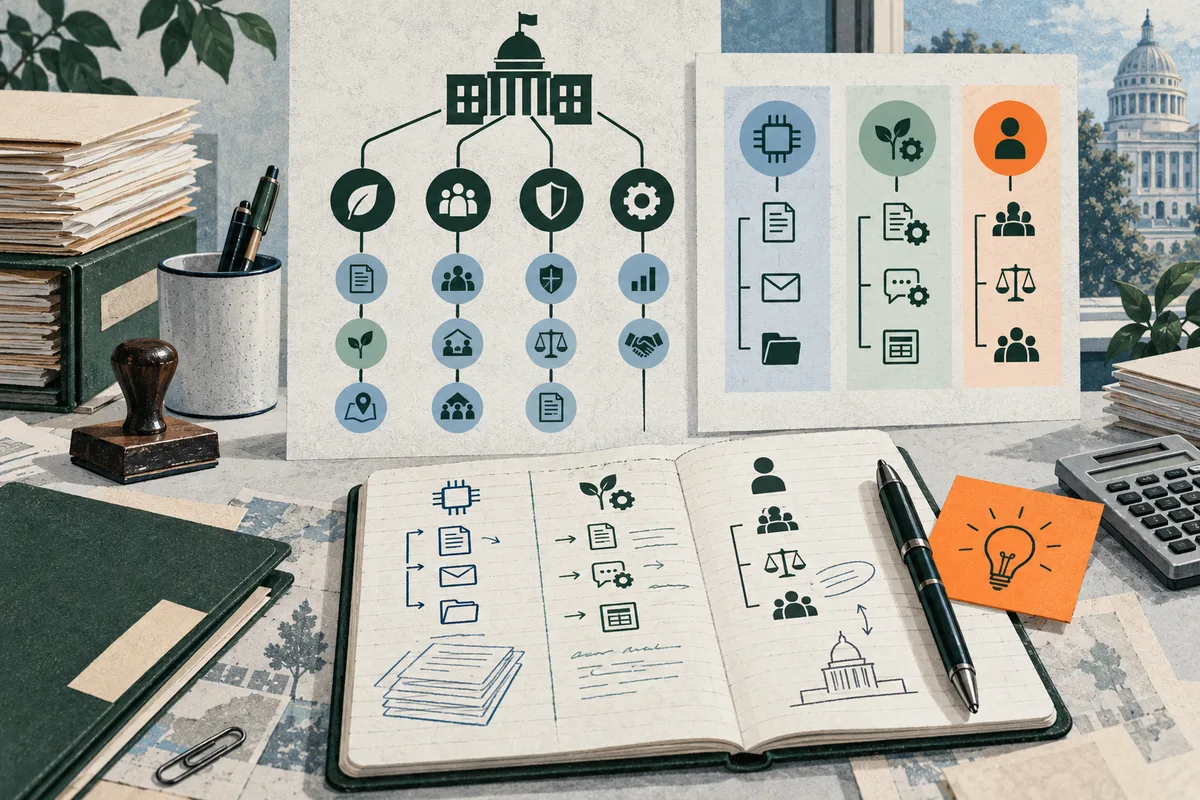
For AI use in an existing administrative role, start with a concise public-service foundation and supervised practice on one permitted, low-stakes task. Choose a certificate or technical degree only when its assessment, depth or credential matches a specific responsibility or target role. Judge learning by accountable work and feedback, not completion alone.
Choose learning by the responsibility you want next
If your aim is to use approved AI in your current public-administration role, begin with a short foundation in AI limits, data handling, verification and public-service accountability, then practise one low-stakes task in an approved environment with feedback. Do not start with a technical degree unless the work you want actually involves building, evaluating, securing or researching AI systems, or a specific target role requires that depth. A course can introduce concepts; a reviewed work sample can show how you apply them; neither on its own guarantees a job outcome.
This advice is a fit judgment, not the result of a trial comparing every learning route. No opened study directly tests degrees against certificates, short courses and work projects for public administrators. The evidence instead gives us several useful pieces: public-service frameworks distinguish the needs of general staff, leaders and technical specialists; governments publish different kinds of courses; risk guidance names the responsibilities around AI; and a review of management training offers cautious clues about useful learning design. Put together, those sources support matching the depth and format of learning to the responsibility being taken on. They do not establish that a particular credential prevents displacement or improves promotion prospects.
A practical decision starts with the work, not the word “AI” in a course title. Are you trying to draft or summarize material faster while retaining responsibility for the final text? Do you need to assess a proposed service or vendor? Are you expected to manage an AI project, build an application, or conduct technical research? These are different learning goals. A public-facing information summary may call for basic understanding and careful checking; deciding whether an automated process should affect a resident’s eligibility calls for a much wider institutional, legal and service-design process. A technical degree is not the universal bridge between those tasks.
The comparison later in this guide uses one test for every option: does it close a gap in the responsibility you want to take on, and can you afford its time, cost and prerequisites? Self-study is flexible and inexpensive but may provide little feedback. A short course can offer a sequence and guided examples. A certificate may structure several units or provide assessed evidence of completion. A work project can reveal practical judgment if it is authorized and reviewed. A degree can provide sustained technical foundations for roles that need them, but consumes more time and money. The useful question is not which format sounds most impressive. It is which is proportionate to your goal and circumstances.
This question also needs a boundary. A task’s exposure to generative AI, an employer’s adoption of a tool, and the likelihood of a person losing a job are not the same measure. Learning can help someone understand task changes and make a considered move, but it cannot turn uncertainty into a personal forecast. The OECD’s 2026 public-workforce report is a policy synthesis of examples and workforce needs, not a controlled assessment of individual employment outcomes. The recommendation here is therefore about choosing a next learning action, not promising security.
Sources: Building an AI-ready public workforce: Implications and strategies; Adopting and governing AI in government: Digital Government Outlook 2026
Which responsibility are you learning to take on?
Choose among four goals before choosing a format. First, you may want to use AI within your existing administrative work: understand what a tool can do, follow the local rules, check its output and keep human accountability clear. Second, you may want to improve a service or process that could make use of AI; that involves service design, user needs, data readiness, procurement, evaluation and governance. Third, you may want to implement or maintain AI systems; that calls for technical preparation in areas such as programming, data, model evaluation, security and integration. Fourth, you may want to do AI research, where advanced mathematical, statistical and computing foundations may be essential. These goals overlap, but they are not interchangeable.
The OECD report “Building an AI-ready public workforce” separates general employees, leaders, and digital or data professionals because their responsibilities differ. For general employees, it discusses responsible tool use, awareness of data protection, critical thinking and independent judgment. Leaders need enough understanding to decide where AI may serve an institutional purpose and what conditions are needed. Technical professionals need deeper capabilities in their specialty and must work across organizational functions. The report synthesizes public-administration initiatives in several countries; it does not randomly assign workers to courses or measure whether one pathway increases their earnings. Its value here is the role distinction, not a claim that a particular course works.
UNESCO’s competency framework for civil servants calls for capacity-building contextualized to national needs and says public services need an enabling environment for digital transformation. The OECD similarly describes skills alongside institutional infrastructure and governance. Read together, these frameworks support a practical boundary: a worker may be willing to learn and still lack approved tools, usable data or time. A personal certificate cannot authorize experimentation or repair missing infrastructure. Ask what support and boundaries exist rather than treating every obstacle as an individual skills deficit.
Try writing a one-sentence target: “I want to use an approved tool to help prepare a first draft of routine public information, while I verify the source and remain responsible for the release.” Or: “I want to assess whether an AI-supported intake process fits a service, including access, error handling and procurement questions.” The first target points toward introductory learning and supervised use. The second points toward service design and governance, perhaps with a cross-functional project. If your target is “I want to implement a retrieval system for agency records,” identify the programming, data engineering, security and evaluation requirements before deciding whether a degree, structured course sequence or supervised technical apprenticeship is appropriate.
Avoid defining your target as “be AI-proof” or “keep up with AI.” Those phrases do not name a responsibility a course can teach or an employer can assess. Instead, identify an observable work output: a summary that cites verified source passages, a documented assessment of a vendor claim, or a technical prototype tested against defined cases. The output makes it possible to ask what you need to learn next. It also protects useful experience: knowledge of administrative process, public needs, records and service context remains part of the task analysis, even when a tool can help with one step.
Sources: Building an AI-ready public workforce: Implications and strategies; Digital Transformation & Artificial Intelligence Competency Framework for Civil Servants
Why does accountable public work change the learning target?
Public administration involves decisions, records and services that affect people. Learning to produce fluent text is only one slice of responsible AI use. A worker also needs to know which purpose is permitted, what information may be used, how the result will be checked, who owns the decision, what should be documented, and when to stop or escalate. The relevant learning is therefore partly technical and partly about procedure, judgment and responsibility.
The NIST AI Risk Management Framework 1.0 groups risk work under Govern, Map, Measure and Manage. NIST describes these as functions for managing risk across a system’s lifecycle, not a mandatory sequence or checklist. Governance runs across the work; context and affected parties need to be understood; risks should be assessed; and responses need management and review. The framework is voluntary guidance, not a statute, a public-administration curriculum or proof that someone completing a course can implement controls. It is useful as a map of questions a course or project should help a learner recognize.
Consider a low-stakes example: an administrator is asked to prepare a plain-language summary of published service guidance. Before using a tool, they need to know whether the organization permits it and which environment is approved. They should use public, authoritative material rather than resident case files or unpublished restricted information. They can compare each claim in a draft against the source, verify dates and eligibility language, check that a qualification has not disappeared in simplification, and review whether the text is accessible. A named person remains responsible for deciding whether the summary is accurate and suitable for release. The point is not that this workflow is automatically safe. It is that learning should teach the checks and local escalation process, not only prompt wording.
Now compare an eligibility or enforcement decision. Errors may affect an individual’s rights or access to a service. A worker should not treat a generic AI course as authority to introduce an automated decision aid. The institution may need legal, privacy, security, procurement, domain and affected-user input, along with evaluation and formal approvals. Training can help an administrator identify questions and contribute to a team; it cannot substitute for those controls. OECD’s Digital Government Outlook 2026 chapter connects workforce skills with data infrastructure, procurement, governance and oversight. It reports a survey of government programmes, not evidence that individual learners can fix institutional weaknesses by taking a course.
This distinction changes what counts as a useful syllabus. Look for instruction on data boundaries, limitations, verification against authoritative sources, error consequences, documentation, human review and escalation. For a role that advises on or oversees a system, add procurement questions, service context, evaluation and governance. For a technical implementer, add the relevant engineering skills and testing. A syllabus focused only on “get better outputs” may be useful for one narrow task, but it is incomplete for accountable public work.
The reader’s goal may also be to decline a particular use. Knowing when not to use a tool can be a successful learning outcome. If the source material is sensitive, no approved environment exists, or the task calls for a judgment the system cannot explain or validate, the appropriate conclusion may be to use ordinary procedures. That does not mean the learner failed to adapt. It means the learning helped identify a boundary. NIST’s framework places responsibility in organizational structures as well as in individual action, so courses should not imply that a careful employee can personally neutralize every system risk.
Sources: AI RMF Core; Adopting and governing AI in government: Digital Government Outlook 2026; Digital Transformation & Artificial Intelligence Competency Framework for Civil Servants
What foundations stay useful when tools change?
Build a compact base that travels across vendors and interfaces. First, frame the task: what is the intended outcome, what material may be used, and what would count as an error? Second, understand basic AI and data concepts well enough to know that fluent output is not the same thing as verified fact. Third, evaluate the result against authoritative records and domain knowledge. Fourth, protect information and respect local rules. Fifth, explain how the work was checked and who is accountable. Sixth, communicate uncertainty and escalate when the system or process does not fit.
The OECD’s general-employee discussion supports learning focused on responsible use, data protection, critical thinking and independent judgment, while NIST’s Govern, Map, Measure and Manage functions help explain why context and oversight matter. These sources do not prescribe one universal curriculum. The competency map above is an editorial synthesis: it combines the user-level needs in the public-workforce report with the responsibilities named in the risk framework. A local employer may add requirements for records retention, accessibility, security or approved tools. The learner should ask what applies before practising with work materials.
A concrete example shows why these foundations outlast a particular interface. A system may help sort incoming correspondence or draft a reply, but the worker still needs to determine what categories mean, what cases do not fit them, how a missed urgent request is detected, and whether the draft cites current policy. If the interface changes its prompt box or menu, those task questions remain. Similarly, a policy comparison might involve extracting differences between two public documents; useful judgment includes checking version dates and whether the system omitted a condition. Basic task framing and source-checking matter more than memorizing a particular sequence of menu clicks.
Tool-specific skills are not worthless. If the employer provides an approved tool for a recurring workflow, learning its available functions can be practical. The limitation is that product interfaces, names and features can change. Learn them as a layer above the durable base: establish which features are supported in the permitted environment, practise the relevant workflow, and keep notes that can be updated. Do not pay for a course simply because it promises mastery of a current interface unless that exact tool is needed and the training remains current.
A useful self-check is to ask whether the course teaches a learner to detect a plausible but wrong output. Can you find a false date, outdated service detail, invented reference or distorted eligibility condition? Can you decide when to ask a subject expert? Can you identify personal information that should not be entered? Can you state who signs off? If the answer is no, a feature tour may leave the most important gap untouched. Conversely, a general literacy course may be enough for an employee who does not need to configure or procure a system.
This base is also portable between fields. A person who knows housing administration, tax operations, planning, public communications or records has domain knowledge that helps define a valid result. Learning AI concepts does not erase that knowledge. In an adjacent role, the combination may be useful: for example, an experienced service administrator who learns process mapping and evaluation can contribute to a redesign discussion without claiming to be a machine-learning engineer. Whether a particular employer values that combination depends on local roles and recruitment criteria, so check real job descriptions instead of assuming a credential will signal it.
Sources: Building an AI-ready public workforce: Implications and strategies; AI RMF Core; Digital Transformation & Artificial Intelligence Competency Framework for Civil Servants
When is a short course the right first investment?
A short course is a reasonable first investment when you need a bounded foundation or a small new capability for your current role, especially if it addresses public service and is followed by practice under your organization’s rules. It is an introduction, not proof of workplace competence. A short course may help you name system limits, understand common risks and learn a structured workflow. It cannot by itself confer authority to handle restricted data or make a high-stakes decision with an AI tool.
The UK Government Skills “Artificial intelligence skills for all” catalog, published 31 March 2026, illustrates a staged structure for UK civil servants: awareness modules, working-level courses on ethics, business value and generative-AI tools, and practitioner courses in areas such as machine learning, natural-language processing and computer vision. That menu is evidence of what the UK catalog lists, not evidence that the courses improve employment outcomes or are available to every public employee outside its intended audience. The distinction is useful: a general administrator can consider an awareness or working-level course without enrolling in a practitioner course designed for a different responsibility.
In the United States, the Office of Personnel Management’s 2026 training page describes foundational materials for federal employees, supplied as downloadable SCORM packages for learning-management systems that support specified SCORM formats. That delivery model may suit an agency able to load training into its own system; it may be less useful for an individual outside that environment or someone seeking instructor feedback. The page establishes a delivery format and stated purpose, not evaluated learning outcomes. A worker should check whether the material is current and accessible in their workplace rather than assuming it is a universal free course.
The OECD’s public-workforce report documents examples across countries and formats, including self-paced introductions, cohort learning, leadership workshops and modular training. It reports, for example, a one-hour module in France and an Austrian certificate based on eight days of AI-, digital- or data-related training over three years. These examples show variety, not a league table. They do not compare costs, course quality or learner outcomes on a common measure. A one-hour module may be a low-friction orientation; a multi-day pathway may suit a broader responsibility; neither is automatically better for every reader.
A 2025 UK rapid evidence review of management training offers one cautious clue about design. Prepared as a snapshot of evidence available in July 2024, it synthesizes prior management-training research and reports that facilitation and adaptation to context have robust support as design features; practice and feedback are often favorable. It also notes limits, including evidence drawn from private-sector settings. This is not a trial of AI courses, nor evidence that one workshop improves public-sector AI performance. It supports a modest question for course selection: will a learner apply ideas to a relevant task, receive feedback and connect the material to their context, or only watch content?
Before enrolling, inspect the syllabus, access conditions, duration, assessment, instructor availability, update date, language and total price. For a tight budget, ask whether your employer or public-service training body already offers foundational material. If you work shifts, have caring responsibilities or cannot travel, asynchronous learning may be the only feasible start; if you need help judging work output, see whether a manager, colleague or tutor can review one practice example. The choice should work in your actual week, not an imagined schedule with unlimited study time.
Use a short course when it has a clear next step. For instance, after a foundation module, you might take a guided session on evaluating generated text and then request a review of a harmless, approved practice task. If no task access exists, use public material in a personal exercise and label it practice, not workplace authorization. If the course offers only generic claims about “AI skills,” ask what you will be able to do afterward and how that will be checked. A short course earns its place by reducing a defined learning gap at manageable cost, not by promising that completion will protect a job.
Sources: Artificial intelligence skills for all; 2026 AI Training; Building an AI-ready public workforce: Implications and strategies; What do we know about the design of effective management training in government? A rapid evidence review
How should you compare courses and certificates?
Treat a certificate as a container for learning and, sometimes, a record of completion. It is not a universal license, proof that you can handle a workplace task, or guarantee that a hiring panel will value it. Before paying, ask what the credential assesses, who issues it, whether assessment is supervised or applied, whether employers in your target setting recognize it, what prerequisites apply, how current the material is, and what the total cost and time commitment include.
Compare a single short course with a certificate by looking at breadth and structure. A course can be enough for one narrow need, such as understanding AI basics or practising a tool workflow. A certificate may sequence several modules and require a project or examination. That extra structure can help someone who wants a planned curriculum or an externally documented completion. But if the credential has no meaningful assessment, no feedback and no relevance to the role, its label may add little. The OECD-reported Austrian example documents a modular certificate based on eight training days over three years; it does not demonstrate that the credential is valued by employers or more effective than a short course.
Provider claims need to be read at the right level. A government course page establishes that an offering is listed and describes its audience or content. A university page can establish its curriculum and admissions requirements. A vendor page can show what the vendor teaches and what badge it awards. None of those pages alone proves that completion causes a pay increase, improves hiring chances or prepares a learner for all public-administration contexts. Seek independent evidence for outcome claims, and do not confuse course marketing with labor-market evidence.
A useful comparison sheet has six columns: target responsibility; topic coverage; assessment and feedback; prerequisites; time and total cost; and evidence you will have at the end. Add a seventh column for workplace compatibility: can you practise with permitted tools and data, or will examples remain disconnected from your duties? The goal is to make trade-offs visible. For example, a lower-cost asynchronous course may fit a caregiver’s schedule but provide limited feedback. An assessed cohort may offer more practice but require fixed attendance. A certificate may be employer-funded but still demand substantial study time. A university unit may provide deeper theory but not the precise operational workflow you need.
Ask a training provider or manager practical questions: Can I see the detailed syllabus? Is there an assessed task? Who gives feedback? Does it cover source checking, privacy, records, accessibility and human responsibility? How often is the content updated? What is included in the quoted price? Does the credential carry credit, and if so, can that credit be used toward another qualification? Are there eligibility rules? Will the organization allow me to use what I learn in an approved environment? Clear answers are more useful than a broad claim that the credential is “industry recognized.”
A certificate is more compelling when a target role explicitly asks for it or when its assessed work demonstrates capabilities that role needs. Even then, check the exact wording of the requirement and speak with a hiring or workforce-development contact if possible. Some roles may require accredited study, professional authorization or technical prerequisites; others may simply value evidence of relevant practice. Do not infer a universal requirement from one job advertisement. Gather several current local postings, note repeated requirements, and distinguish essential criteria from preferred ones before investing.
For an administrator with a specific workflow need, a certificate may be less informative than an approved project reviewed by someone familiar with the process. For a person seeking an adjacent governance or service-design role, a structured certificate may supply breadth and vocabulary while a project demonstrates application. For an aspiring technical practitioner, a technical sequence with rigorous assessment may be more relevant than a broad introductory badge. These options are not rival status levels. Their value depends on the gap between what you can currently do and the responsibilities you are aiming to take on.
Sources: Building an AI-ready public workforce: Implications and strategies; Artificial intelligence skills for all

When is an applied project better than another credential?
A bounded, approved work project can be a strong next learning step when your goal is to improve or oversee a process in your current field. It lets you practise task definition, source selection, verification, documentation and judgment together. A certificate records a learning path; a project artifact can show how you approached a specific task. That artifact is not a validated performance study and should not be presented as proof of productivity gains or system safety. Its value is that it gives you and a reviewer something concrete to discuss.
Imagine an administrator wants to compare a manual draft of a public-information summary with an AI-assisted draft, using only published guidance in an approved environment. Before beginning, they ask whether the use is permitted and what the organization requires. They define the task narrowly: create a first-pass summary, not decide an individual case. They identify authoritative source documents, a reviewer, and a stop condition if the tool introduces a factual error or omits an important qualification. They do not use real resident case files or restricted content in a public tool.
The resulting work sample could contain the task statement, permitted source list, a baseline version prepared through the usual process, the generated draft, a record of verification checks, corrections made, accessibility review and a short note on where the tool did not help. If time or quality observations are collected, describe them honestly as observations from this small exercise. Do not generalize them to other tasks, teams or future conditions. The sample demonstrates disciplined practice, not a causal estimate of productivity or a guarantee that a workflow is appropriate for general use.
A reviewer can ask useful questions that a quiz may not reveal. Did the learner compare claims with the source, or accept fluent prose? Did they notice a date mismatch? Did they preserve an exception that changes the meaning? Did they protect data? Did they make clear what the system contributed and what the administrator checked? Could a person with a disability use the output? Was the final text reviewed by the right human? The point is not to create a burdensome audit for every low-risk exercise. It is to decide in advance what checks suit the task and its consequences.
NIST’s risk framework provides a way to think about context, measurement and management, while OECD’s government chapter emphasizes that individual skill sits alongside institutional systems and governance. A project should therefore include the organization’s policy and support, not ask a learner to bypass it. If no approved environment or reviewer is available, the project can use public documents and simulated examples for learning, clearly separated from real service delivery. If the task would affect eligibility, enforcement, licensing or access to benefits, a personal practice exercise is not permission to trial a tool in production; formal institutional review is needed.
Learning-design evidence supports the project idea only indirectly. The UK review concerns management training and draws on earlier studies, not AI projects. It reports positive evidence for contextualized, facilitated learning and notes that practice and feedback are often associated with stronger outcomes, while also cautioning about evidence transfer. This makes a supervised practice task a reasonable design choice, not a proven intervention for AI competence. Where possible, seek feedback from a subject expert and someone responsible for information governance or digital practice. If that combination is unavailable, write down the limits instead of overstating what the exercise establishes.
A project can also expose the next learning gap. If you understand the process but struggle to define a test set or measure error types, targeted evaluation learning may help. If your difficulty is explaining service impact and user needs, service design may be more relevant. If the challenge is implementing an integration securely, you may need technical study or a specialist colleague. This is the project’s practical advantage: it can inform the next investment. It does not promise that a project itself will be recognized in every recruitment process, so describe the artifact in terms of the actual decisions and skills it demonstrates.
Sources: What do we know about the design of effective management training in government? A rapid evidence review; AI RMF Core; Adopting and governing AI in government: Digital Government Outlook 2026
What can self-study teach, and where does it stop?
Self-study is useful for orientation, vocabulary and durable concepts when money or time is limited and you can maintain a small sequence. Public frameworks, official guidance and introductory material can help you learn what AI systems do, why generated text needs checking, and what questions to ask about data, risk and oversight. You can work through a short reading plan during available time without committing to a degree or paid credential. For learning to count, connect it to a question or task and find a way to check your understanding.
A simple self-study sequence might be: read an official public-sector guide on permitted use; learn basic concepts and limitations; study a framework such as NIST’s AI RMF as a vocabulary for risk questions; then analyse a low-stakes example built from public documents. Write down the purpose, information boundary, likely failure modes, source checks, human owner and stop condition. Ask a knowledgeable colleague to challenge the analysis if one is available. This builds an initial mental model without assuming you can access a work tool or use operational data.
OECD’s report describes scalable online learning alongside more intensive formats for selected groups. That is evidence that public administrations use different delivery modes, not that self-paced learning produces equal outcomes for every learner. A person who is comfortable studying independently may benefit from its flexibility. Another learner may need deadlines, feedback, practice with colleagues or an instructor who can correct misconceptions. The UK rapid review’s evidence on facilitation and context concerns management training, so it cannot resolve this question for AI literacy; it does suggest that course format is worth considering rather than treating content alone as the whole experience.
Self-study stops where permission, local procedures and demonstrated competence begin. It cannot authorize entry of protected information into a tool. It cannot tell you whether your employer has approved a particular application. It cannot substitute for records, privacy, security, accessibility or procurement rules. Reading about model evaluation does not establish that you can run a reliable evaluation. Completing a tutorial does not make you responsible for a system’s institutional impacts. These boundaries are not reasons to dismiss independent learning; they help keep its claims proportionate.
There is also a difference between being able to explain a concept and being able to perform a task under realistic conditions. You may understand that a system can produce incorrect content but still miss a subtle error when reviewing a long draft. You may know that data protection matters but not know which classification applies to a document in your organization. Practice, feedback and access to a safe environment help bridge some of these gaps. If work-based practice is unavailable, use an example based on public information and be explicit that it does not demonstrate authorized workplace readiness.
Avoid endless course collecting. Set a stopping rule: after a defined introductory sequence, produce one small artifact or answer one practical question. If you can explain what the tool can and cannot support, identify what must be checked, and say when to stop, move to a supervised task or targeted follow-up. If not, identify the specific confusion and find a course, colleague or tutor that addresses it. The next unit should respond to a revealed gap, not merely extend a playlist.
For people who need credentials for a promotion or career change, self-study may have lower signaling value than an assessed program in their local market. That is a question about a particular role and employer, not a universal hierarchy. Compare actual requirements, seek employer-funded options, and consider whether prior experience or a project is accepted as evidence. A low-cost first step can be sensible while gathering that information. It need not become the entire learning plan if the target responsibility later proves to require deeper formal preparation.
Sources: Building an AI-ready public workforce: Implications and strategies; What do we know about the design of effective management training in government? A rapid evidence review; AI RMF Core
When does a technical degree make sense?
A technical degree makes sense when the work you intend to do requires sustained foundations in programming, mathematics, statistics, data engineering, model evaluation, cybersecurity or research, and when a specific degree fits the target role’s entry requirements. It can provide a coherent sequence, rigorous assessment, access to instructors and peers, and, in some settings, a recognized qualification. It is a large commitment of time, money and opportunity. Those benefits and costs should be weighed against your location, salary needs, caregiving duties, health, schedule and ability to study.
The distinction is responsibility. An administrator using an approved tool to prepare a draft may need practical literacy and careful review, not to derive optimization algorithms. A service manager assessing an AI-supported process may need data and evaluation literacy, procurement knowledge and governance skills, but not necessarily to train a model. A technical implementer may need to code, integrate systems, assess model behavior, handle data pipelines and manage security. A researcher may need advanced mathematical and methodological study. A degree becomes more plausible as the target moves toward the latter responsibilities, but actual role descriptions and requirements matter more than labels.
The UK government’s learning catalog visibly separates awareness and working-level learning from practitioner courses in machine learning, deep learning, language processing and computer vision. This does not establish that practitioner training requires a degree or that every technical role has the same entry pathway. It does illustrate that learning about AI in public service and learning to develop technical systems are different aims. Before applying to a degree, look at several current local job postings and identify the repeated requirements: programming languages, quantitative foundations, security, domain knowledge, accreditation or experience. Confirm which are essential and which are preferred.
A fair comparison includes alternatives. A focused course can address one technical gap, such as introductory programming or data analysis, but may not provide a full foundation. A certificate can bundle technical topics and assessments, though quality and recognition vary. A supervised project can demonstrate applied work, but it may not replace the prerequisites needed to understand system behavior or be admitted to a particular role. An apprenticeship or employer pathway may combine study with practice, where available. A university degree can offer depth and structure but may be too broad, too long or too costly for a goal that requires only a bounded skill.
If you are considering a larger technical transition, test the plan before committing. Review admission requirements and the syllabus. Check how much mathematics, programming and independent study are assumed. Estimate tuition and fees, commuting or relocation, childcare and lost work hours. Ask whether part-time study is realistic with your health and family needs. Look for a short introductory module or small project that lets you assess interest and prerequisite gaps. This is not a substitute for the degree if the target demands one; it is a lower-risk way to learn whether the path fits before taking on its full cost.
Do not assume a degree is worthwhile just because AI is changing tasks in your current occupation. Exposure describes where capabilities may be relevant to tasks; it does not establish adoption by your employer or a probability of displacement. Nor does a degree guarantee employment or income. The decision should be tied to a chosen role, its actual work and requirements, and your resources. If those factors do not support a degree now, a staged plan can still move you forward: foundations, a supervised project, then reassessment against a real target role.
Sources: Building an AI-ready public workforce: Implications and strategies; Artificial intelligence skills for all
How do you choose around real constraints and uncertainty?
Use a goal-and-constraint filter. Write the responsibility you want, the current skill gap, the acceptable learning time and cost, and the conditions needed to practise. Add salary floor, geography, health, caregiving and schedule. Include employer policy, access to an approved environment, data availability and the presence of a reviewer. Then compare options against the same list. If an option requires resources you do not have, it is not the right immediate step, even if it might be useful in an abstract sense.
For a current-role upgrade, a short public-sector foundation plus a small approved task exercise is often the most proportionate starting combination. It preserves domain experience while building practical judgment. For an adjacent move into service design, procurement, evaluation or AI governance, combine foundational literacy with the specific professional capability you are missing and look for cross-functional practice. For a larger technical change, map prerequisites and target-role requirements first; a degree may be justified if it offers the depth and qualification those roles call for. These are recommendations based on fit, not measured rankings of employment outcomes.
A counterargument deserves attention: broad technical study may preserve options and help an administrator ask better questions of specialists. That can be true, especially for someone who wants a technical career or whose work involves evaluating complex systems. The conclusion is not to avoid technical learning. It is to avoid assuming that maximal study is the only serious response to change. A worker with limited funds can learn enough to identify a technical gap and then pursue targeted study. Someone whose desired role already demands formal depth should plan for that depth rather than stopping at an introductory badge.
The choice should also account for institutional limits. OECD’s 2026 digital-government chapter reports country-level AI skills programmes alongside infrastructure and governance needs. In its 2025 Digital Government Index survey covering activity from January 2023 through December 2024, 32 of 36 OECD countries reported some AI-skills training; 28 reported practical-use training, 22 ethics training, 20 privacy or security training, and 13 training on AI in public services or policy. Germany and the United States were absent from this survey data, according to the report. These counts describe national programme presence, not access for an individual, course quality, completion, skill gains, adoption or job demand. The report says data were unavailable for Germany and the United States; its 2025 Digital Government Index survey covers 1 January 2023 through 31 December 2024. The relative coverage suggests that public-service-specific application may be less consistently represented than practical tool use in the responding country reports, but that is a cautious interpretation, not a claim about every jurisdiction.
This evidence changes the decision in one way: do not blame yourself for a gap that belongs to the organization. If you have no permitted tool or data environment, request a clear policy and safe learning route. If leaders expect you to assess a vendor but offer only basic user training, ask for procurement or evaluation support. If there is no time for study, discuss protected learning hours or a smaller objective. Individual learning is useful, but institutions decide many of the conditions that make it possible to apply.
Revisit the plan when a specific trigger appears: a target job requires an accredited qualification; your manager confirms a technical implementation need; a project reveals a gap in testing or data work; or local policy changes what is allowed. The answer may then move from self-study to a certificate, a technical course, an apprenticeship or a degree. Until then, do not invest based only on a vague fear of being left behind. Choose the smallest learning path that responds to a real task or responsibility and can be completed without putting essential income, health or family obligations at undue risk.
Sources: Building an AI-ready public workforce: Implications and strategies; Adopting and governing AI in government: Digital Government Outlook 2026; What do we know about the design of effective management training in government? A rapid evidence review
What is one proportionate next step?
This week, choose one recurring task you want to handle better and write down its purpose, source material, likely errors and the human decision that must remain yours. Ask your manager or training lead which tools and information are approved for that task, what records or review rules apply, and who could give feedback on a small practice exercise. Choose one short public-service foundation or guided session that fits your available time. Agree on a safe exercise before paying for a larger credential or degree. If you still cannot identify which tasks are changing, the free task-level change-pressure checker can help organize that question; its signals are not job-loss probabilities. If your constraints require comparing a stay-and-redesign path with adjacent or larger changes, the paid career roadmap is an optional next step, not a promise of employment or income.
Sources: Building an AI-ready public workforce: Implications and strategies
Questions readers ask
Does a public administrator need a technical degree to use AI responsibly at work?
Usually not when the goal is to use an approved tool for a bounded task in an existing role. Start with AI limits, data handling, verification and local policy, then practise with feedback. A technical degree is more relevant when the target work requires building, evaluating, securing or researching systems, or a specific role requires formal study.
Sources and notes
- Building an AI-ready public workforce: Implications and strategies
Distinguishes general employees, leaders and technical professionals and documents varied public-sector learning formats; it is a cross-national synthesis, not a controlled course or employment-outcome study.
- Adopting and governing AI in government: Digital Government Outlook 2026
Reports OECD country survey counts for government AI-skills programmes in 2023–24 and connects workforce skills to institutional governance and infrastructure.
- AI RMF Core
Defines Govern, Map, Measure and Manage as voluntary lifecycle risk-management functions and emphasizes organizational roles and accountability.
- Artificial intelligence skills for all
Lists awareness, working-level and practitioner AI courses for UK civil servants, showing differentiated course scope but not learning or employment outcomes.
- 2026 AI Training
Describes foundational federal AI training materials as downloadable SCORM packages; the page does not report learner outcome evaluation.
- Digital Transformation & Artificial Intelligence Competency Framework for Civil Servants
UNESCO proposes a civil-service competency framework and calls for capacity-building contextualized to national needs and an enabling environment; this is framework guidance, not course-outcome evidence.
- What do we know about the design of effective management training in government? A rapid evidence review
Synthesizes management-training evidence available to July 2024 and discusses facilitation, contextual adaptation, practice and feedback; it is not AI-course research.
- Artificial intelligence for the public sector
Describes a 32-hour intermediate course for public officials with groupwork, feedback and assessment, but its listed 2026 Nairobi dates have passed and it is not a general availability claim.
- DAP to Launch National AI Capability-Building Program for the Philippine Public Sector
Reports a Philippine public-sector programme divided into foundational, domain-specific, advanced technical and executive pathways; the announcement does not evaluate outcomes.
Apply this to your own work
See the whole job market at once.
Explore which occupations AI may reshape, then turn the signal into a practical response.
Explore the job map