
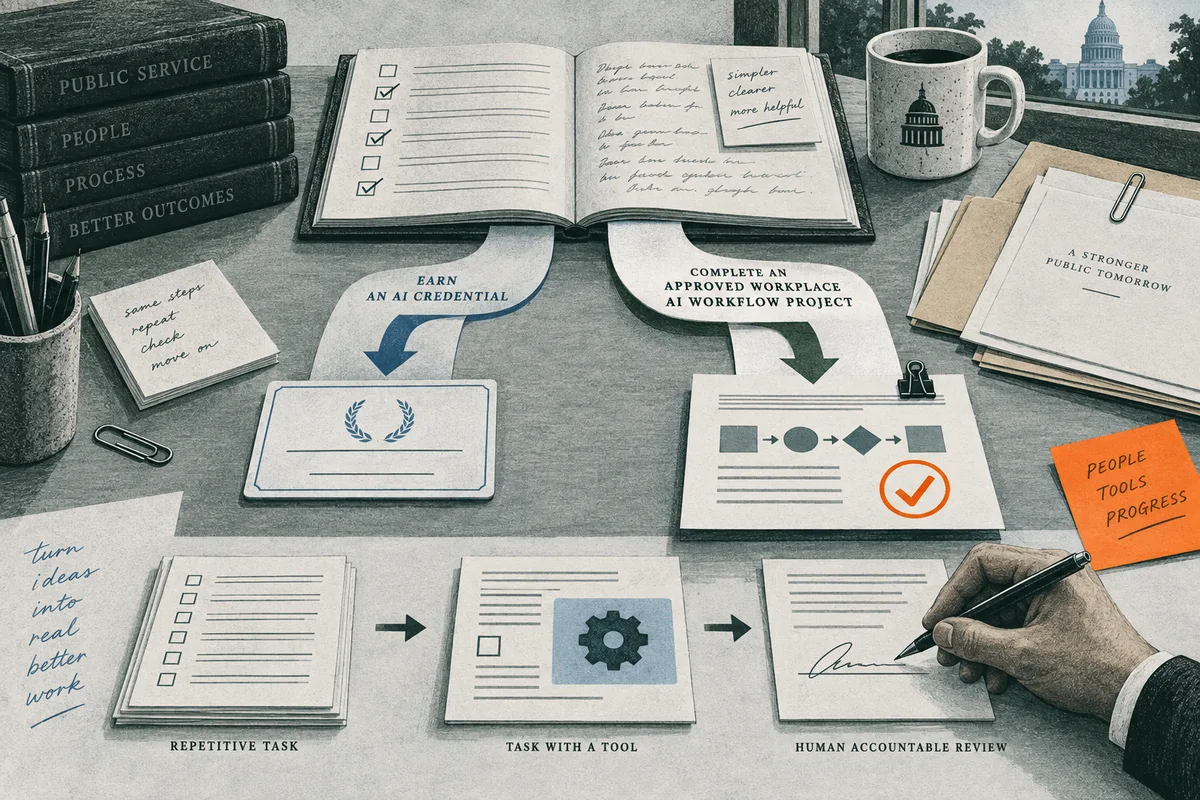
If your goal is to improve your current public-sector work, start with a small, approved workflow project when you already know the task and can judge its output. It tests fit in your actual setting and can show how you handle scope, review and limits. Choose a credential first when a target role or employer requires it, when structured learning is needed to work safely, or when the project depends on knowledge you do not yet have. If the gap is basic, a short foundation course followed by a project is often the proportionate middle path. No reviewed study directly compares these sequences for career outcomes, so treat this as a decision rule, not a guarantee.
Should I study first or test an approved workflow?
The useful choice is rarely “credential or project forever.” It is which one should come next, given what you already know, what your employer permits and what uncertainty you need to reduce. For an employee who wants to improve a recurring task in the current role, an approved, limited project usually comes first if the employee can describe the task and check the output. If the task is unfamiliar, the tool is restricted, or a specific qualification is required, learning or approval comes first. A short foundation course can bridge the two.
A credential and a project answer different questions. A structured course can teach concepts, give feedback and sometimes meet a formal entry requirement. A project can reveal whether a particular workflow benefits in the actual institutional setting, what errors arise and which human checks matter. A badge is evidence of completion or assessment under the provider’s design; it is not, by itself, evidence that a person can safely change a public service process. A project is not automatically proof of skill either. Its value depends on authorization, evaluation quality and the honesty of its record.
This distinction matters because government adoption is an organizational choice. The OECD’s 2026 policy brief draws on examples from several countries and describes workforce training, hiring and continuing learning as parts of building public-sector capability. It identifies distinct needs for general staff, leaders and digital or data specialists. That is evidence against a single course recommendation for every public employee; it does not tell an individual whether their own department has approved a tool or task. The employee must follow local rules and identify their goal before selecting a learning path.
This guide answers a narrow question: for an early- or mid-career public-sector employee considering AI in administrative, analytical, communication or service work, which move should happen first? It does not assess eligibility for a technical job, determine whether an employer plans to reduce staffing, or predict an individual’s job security. The comparison is between a current, relevant credential with meaningful instruction or assessment and an approved, bounded workflow project. Neither label tells you enough until you inspect what is taught or tested.
A practical opening question is: what do I need to know after the next month or quarter? If the answer is “whether AI can help with this repeatable, low-consequence task without weakening quality,” a project can address that uncertainty. If it is “what is allowed here?” ask the relevant manager, data protection, security or AI governance contact; a credential does not grant permission. If it is “I need foundational understanding before I can evaluate outputs,” take a focused course. If it is “this target vacancy requires a named qualification,” verify the requirement and sequence study accordingly.
No reviewed evidence directly assigns public employees to project-first or credential-first and compares later promotion, pay, mobility or job retention. The recommendation below is therefore an inference from task-level exposure research, government implementation evidence, training guidance and credential-demand limits. The decision rule is useful precisely because it makes the missing comparison visible instead of treating a popular badge or a successful demo as career proof.
Sources: Building an AI-ready public workforce: Implications and strategies; Generative AI and jobs: A 2025 update
Begin with the task and goal, not the badge
Before you compare programs, write down the work outcome you want. “Learn AI” is too broad to guide a purchase or a work proposal. More specific goals include reducing time spent formatting a recurring internal summary, checking whether an approved tool can help organize non-sensitive public material, improving your ability to review vendor claims, qualifying for a named digital role, or preparing for technical study. Those goals call for different learning depth and evidence.
Then describe the task rather than relying on a job title. Many public roles mix repeatable document handling with interpretation, communication, exception management and accountable decisions. A caseworker might receive forms, check them for completeness, interpret policy, contact a person about missing evidence and make or support a consequential decision. A communications officer might collect approved facts, draft a notice, confirm accessibility and coordinate sign-off. In either bundle, a tool’s ability to produce text does not establish that it can interpret local rules, know which case is exceptional or take responsibility for a decision.
The International Labour Organization’s 2025 update estimates potential exposure using a refined task-level method covering nearly 30,000 tasks and detailed occupations. It reports that one in four workers globally is in an occupation with some degree of generative AI exposure; its summary says continued human input makes transformation more likely than redundancy for most jobs. This is a global occupational index built from task data, expert input and AI predictions, not a survey of one agency’s adoption or a personal job-loss estimate. It justifies looking inside a task bundle, not buying a credential or leaving a field.
Keep six ideas apart. Capability describes what a system can do under some conditions. Exposure describes whether tasks may be affected. Use means someone has tried a tool. Adoption means an organization has permitted and incorporated it. Redesign means the workflow or division of work changes. Demand and displacement concern jobs and labor markets. Evidence for one does not automatically prove the next. A system may draft a plausible text, while an agency blocks that use; an approved pilot may alter one step without changing staffing; and an exposure estimate says nothing certain about a particular employee’s future.
A task inventory can be short. For a week, note recurring activities, approximate time, information handled, errors or rework, who makes the final decision and what happens when a case is unusual. Identify the part that is predictable enough to test and the part that needs contextual judgment or direct human contact. The aim is not to label every activity automatable. It is to find a question small enough that an approved trial could answer without placing service users or protected information at risk.
Your goal also determines what “useful evidence” means. For improving current work, credible learning may be a before-and-after comparison on a defined task. For internal mobility, a supervisor may value a documented process improvement, governance contribution or role-specific training. For a technical career, a general workplace project is not a substitute for the mathematics, programming, data or systems knowledge required by a particular vacancy. Avoid assuming that all public employees should become machine-learning engineers; most roles need enough literacy to use, question and oversee tools in context.
Sources: Generative AI and jobs: A 2025 update; Building an AI-ready public workforce: Implications and strategies
What counts as a credential, and what does it demonstrate?
“AI credential” covers very different things: a self-paced introduction with a completion record, a course with assessed work, an industry certificate, a professional qualification, a technical program, or a degree. These vary in entry requirements, feedback, depth, price, time, assessment and recognition. A short course can help someone learn concepts and vocabulary. A tested program may show performance on its stated assessment. A degree offers broader, longer study. None should be treated as interchangeable, and none automatically demonstrates competence in a particular public workflow.
The UK government’s public-sector resources illustrate this range. The collection lists free Civil Service e-learning on AI introductions, technologies, business value and ethics, alongside a technical curriculum leading to qualifications. The same collection links a playbook for safe, effective and secure use. This is a description of resources for the UK Civil Service, not proof that all are open to every local-government employee or public servant elsewhere, nor evidence that completing one causes better performance or employment outcomes. It is useful because it shows that the choice need not be between an expensive qualification and no learning.
The right first check is the target, not the provider’s marketing. If a vacancy or promotion framework names a qualification, read the current wording: required, preferred, or one example of equivalent experience are materially different. If an internal approval process requires training before tool access, confirm which course counts. If you want to improve a task, inspect the syllabus for work-relevant material: information handling, limitations, checking outputs, privacy settings, risk, workflow design and practice. Confirm whether assessment involves only attendance, a quiz, an applied exercise or a proctored examination.
A certificate can signal effort and organize learning, but labor-market evidence should be read within its population and period. Georgetown’s Center for Security and Emerging Technology analyzed U.S. job postings in AI occupations from 2010 through 2020. It found that 2.5 percent of more than 56 million postings required an AI or related certification. The report also says its dataset cannot show whether certificates improved hiring when they were not listed as requirements, or whether they supported lateral moves and advancement inside an employer. These postings predate the present generative-AI course market and concern AI occupations, not public servants applying tools in existing jobs. They cannot settle the value of a current credential for this reader.
The study does, however, challenge a broad claim that an AI certificate is routinely a substitute for education or experience. Its measure is explicit posting requirements, not the full hiring decision, and its authors note data limitations in separating certificates, certifications and licenses. For a public employee, the best evidence of relevance is a real requirement in the target role or a well-defined learning objective. General enthusiasm about AI is not enough to justify personal spending, especially when an employer may provide training or protected study time.
Compare the options against your actual goal. A short course gives bounded foundations quickly, often with limited feedback. Self-study can be low-cost and flexible but leaves you responsible for selecting reliable material and checking your understanding. A certificate may add structure or a recognized assessment, though recognition is role-specific. A project creates contextual practice and a work sample, but requires permission, a safe task, review capacity and time. A degree supports sustained technical depth and broader foundations, with greater duration and cost. The right choice is the least demanding path that credibly closes the actual gap, not the most impressive title.
Sources: Artificial intelligence resources for the public sector; U.S. Demand for AI Certifications
What should come before either option?
You do not need advanced machine-learning study to decide whether a simple, approved tool can help with a bounded administrative task. You do need enough understanding to give a clear instruction, recognize that an output can be wrong, protect information and know when a person must decide. If these basics are missing, learning should precede an experiment. If they are present, collecting more introductory badges may add little before a practical test.
Skills England’s 2026 foundation benchmark, which applies to England, groups six skills across technical, non-technical and responsible or ethical domains. It includes writing clear instructions, using AI for routine tasks, adjusting settings, using simple automation, understanding risks and analyzing information by checking outputs and spotting errors. The benchmark is designed to guide training providers and help workers understand basic skills for simple tools. It is not an independent validation that a badge ensures workplace competence, and its geographic remit should not be mistaken for a universal public-sector standard.
A readiness check can be phrased as questions. Can you explain the task and what a good result looks like? Do you know which data may be used with the particular system? Can you compare the output against a reliable source or an existing process? Can you identify a plausible failure and an escalation route? Do you know which decision stays with an accountable employee? If you cannot answer these, choose a short foundation module, ask for approved training, or seek a knowledgeable colleague before proposing a test. If you can, focus the learning on the specific uncertainty that remains.
Durable skills are more valuable than memorizing a changing interface. Problem framing helps identify what should be improved and what should not be automated. Data literacy helps distinguish source information from generated text and notice missing context. Evaluation means checking outputs against a standard rather than trusting fluent wording. Domain knowledge supports the judgment needed to detect a plausible but materially wrong answer. Verification and accountability define who checks, records and owns the outcome. These abilities transfer across tools even as menus, model names and product features change.
The OECD’s 2026 public-workforce brief makes a similar distinction by staff group. It says general employees need basic digital skills, awareness of AI’s potential and risks, data protection awareness, critical thinking and independent judgment. Leaders need strategic and governance skills; digital and data professionals need technical expertise alongside risk and collaboration capabilities. The brief draws on examples and policy synthesis rather than testing one course against another. Its practical implication is that learning depth should track responsibility. A user of an approved writing aid has a different need from the person procuring or building an AI service.
A degree makes sense when the intended destination calls for sustained foundations: for example, a technical role that expects programming, statistics, data systems or research methods. A course or certificate is more proportionate when the goal is a bounded skill or formal gate. A project is useful when the main open question is local application. Self-study may fit someone with a strong base and reliable feedback, but not someone who needs structured support. Accessibility, disability accommodations, language, caring responsibilities, available study hours and cost are not secondary details; they can determine whether a route is feasible.
Public employers may offer learning before employees pay out of pocket. The UK Civil Service guidance describes introductory and practical courses, while the OECD report gives examples of short self-paced courses in Estonia and France and classroom learning in Canada. Those examples establish that public institutions use different formats; they do not establish universal availability or their effect on job outcomes. First ask what is offered locally, whether study time is supported and which option maps to your goal. A one-hour introduction may be enough to scope a low-risk proposal; a technical target role may need a longer, recognized program.
Sources: AI foundation skills for work benchmark; AI Risk Management Framework; Building an AI-ready public workforce: Implications and strategies
Why does approval change what a useful project can prove?
For a public employee, project quality includes whether the work was authorized. A useful project is not simply a prompt that produces a convincing answer. It has a defined purpose, permitted system and data, a responsible sponsor or owner, a clear baseline, review criteria, a human decision-maker and an agreed stopping point. The employee should find the employer’s actual process before testing. Requirements differ by country, government tier, agency, procurement contract, data classification, records rules, privacy law, accessibility duties and workforce agreements.
An illustrative proposal might ask whether an approved internal tool can help draft a routine, non-sensitive public notice from already approved material. The employee would first identify who owns the notice and who approves publication, what source text is authoritative, what the current drafting and checking process looks like, and what quality standard applies. The project would not paste case records, personal data or confidential deliberations into an unapproved service. If no permitted tool or safe data path exists, the correct result is to stop and ask the designated contact, not to run a quiet experiment.
Approval is not paperwork detached from skill. It reveals whether the employee can recognize that a public workflow has obligations beyond speed: accuracy, consistency, access, explainability, records, security and service to people affected by decisions. The OECD brief says human oversight, transparency, accountability and trust remain central in government procedures and services. It also reports that many institutions lack a structured approach to identifying AI skill needs, and that open-access tools can pose data-protection risks when their use conflicts with organizational policy. This is policy synthesis, not a universal local checklist; an individual must follow their institution’s requirements.
A practical proposal can ask for a named sponsor and the smallest available approval route. Describe the task in plain language; state the intended benefit and the people affected; identify data types and the proposed tool; ask who can confirm the tool is approved; agree how outputs will be checked; and define who can stop the trial. Depending on the process, privacy, information security, procurement, legal, accessibility, records management or staff representatives may need to be involved. The employee need not invent a governance framework. Their competence lies partly in knowing when to bring the right people in.
The National Institute of Standards and Technology’s AI Risk Management Framework offers one U.S. example of voluntary guidance for managing trustworthiness through design, development, use and evaluation. NIST says it is intended for voluntary use and notes that version 1.0 is under revision. It can help an organization structure risk questions, but it is not a legal approval, procurement permission or substitute for an agency’s rules. Employees outside the United States should not assume that it sets their obligations. The relevant authority remains their own employer and applicable law.
A credential can teach useful vocabulary about risk, privacy or evaluation; it cannot authorize a system or grant access to data. A project can demonstrate that the worker knows how to seek approval and respect the answer; it cannot establish that a tool is safe for all future uses. This is why the comparison favors a project only after permission is confirmed. When that permission is unavailable, learning can still proceed using public examples or simulated material that the employer allows, but do not represent that exercise as a live workflow deployment.
There is also a public-service reason to keep the scope small: mistakes can affect people who did not choose to participate. A tool that summarizes a public policy document for an employee to review poses different issues from a system that ranks benefit applications or drafts a decision notice from personal case data. Consequence, reversibility, information sensitivity and who bears the cost of error should shape the approval route and review burden. A training certificate will not erase these differences. A careful project makes them explicit before judging whether the tool is useful.
Sources: Building an AI-ready public workforce: Implications and strategies; Artificial intelligence resources for the public sector; Microsoft 365 Copilot Experiment: Cross-Government Findings Report
How can a small project produce stronger evidence than course completion?
A well-designed, approved project can provide evidence of applied judgment that a course completion record alone cannot: the employee can define a task, compare a permitted AI-supported process with the existing one, inspect errors, retain human accountability and explain what the result does not show. This is a claim about the kinds of evidence produced, not a claim that projects cause promotion or are universally valued more highly by employers. The project only earns that value when the work is authorized and the evaluation is credible.
The Government Digital Service ran a three-month Microsoft 365 Copilot experiment from 30 September to 31 December 2024 involving 20,000 employees across 12 UK government organizations. Its report page says it evaluated satisfaction, effort, task quality and time spent on routine activity. These are useful examples of distinct outcome dimensions: speed alone can miss rework or poorer service, while user satisfaction alone does not show that a process is accurate. The deployment was large and tool-specific. It does not compare credential-first with project-first learning, and its reported dimensions do not prove that every employee project should use the same measures.
For a bounded trial, pick one recurring, low-consequence task with an existing human owner. Before using a tool, define a small set of representative cases or materials that are allowed for the test. Record the current process and what counts as acceptable output. If the work is drafting, criteria could include factual fidelity to approved source material, completeness, readability, accessibility and required sign-off. If it is organizing information, criteria might include correct categories, missing items and time required for later checking. Select measures that matter to the task, not a convenient score that makes the tool look good.
Then compare like with like. Have the same approved source material handled through the existing route and the proposed route, where policy permits. Record time spent generating and reviewing, corrections, omissions and failure types. Include edge cases that are common enough to matter, not only the clean examples on which a system may perform well. Note whether the tool output was accepted, edited or discarded. A fast first draft may create extra checking work; conversely, a modest time reduction can be valuable if quality holds and the task is frequent. The result depends on the observed process, not a general benchmark.
Use a clear stop rule. Stop if the tool returns unsupported details, mishandles sensitive inputs, creates inaccessible material, or requires more review than the team can provide. If consequential errors appear, report them rather than averaging them away. If the test is inconclusive, say so. “We tried it on a small, approved set and found that it helped with one part but not another” is a useful finding. “AI makes public services more efficient” is far broader than the trial could establish.
The project record should say what was tested, by whom, under which approvals, with what permitted information, over what period and against which criteria. It should separate observed results from interpretation. If the trial was informal or small, say that the evidence is preliminary. Do not disclose protected material in a portfolio. Ask whether the employer permits a sanitized write-up and describe the method and learning without sharing confidential data or implying that internal approval extends to another organization.
The GDS experiment is useful as an example of evaluating time, effort, quality and satisfaction at scale, but not as a forecast for an individual team. The UK Department for Work and Pensions later conducted its own Copilot trial with 3,549 staff from October 2024 to March 2025, using user and comparison-group surveys plus qualitative interviews. That separate evaluation shows why institutional context and comparison design matter. It involved corporate staff, not frontline operational colleagues, and studied a licensed Microsoft product. Results from such trials cannot be transplanted to a different task, tool, country or employee without qualification.
Sources: An Evaluation of DWP’s Microsoft 365 Copilot Trial
Which evidence would make a project credible beyond one trial?
One successful demonstration is a beginning, not proof of dependable performance at scale. To make a project credible beyond its first trial, document the conditions that another person would need to understand: task boundaries, source material, approved system, evaluation sample, review procedure, errors, time and quality measures, and limits. The record should make it possible to see what the employee did and what remained a human responsibility. It need not be a polished public case study; an internal learning note may be more appropriate.
A sound comparison uses the same task definition and quality standard for the current process and the AI-supported one. Otherwise, the apparent improvement may come from comparing an easy case with a difficult one, or a carefully edited AI result with an unreviewed baseline. Keep time measures inclusive: prompting, reading, verification, corrections, escalation and final approval all count as work. If the tool shortens drafting but adds review time, report both. If it reduces repetitive effort but creates a new accessibility check, record that tradeoff rather than collapsing everything into net minutes.
Quality is often plural. A public notice may need to be accurate, complete, comprehensible, accessible, consistent with policy, and approved by the responsible officer. A categorization aid may need high recall for a critical category even if overall accuracy looks good. A service workflow may need to preserve a route for people whose circumstances do not fit the typical case. Select criteria with the task owner and people who understand the consequences. Where the employee lacks evaluation expertise, ask for it rather than inventing a metric after seeing outputs.
Review failure cases deliberately. Look for invented facts, omitted caveats, stale policy, inconsistent treatment, unsupported conclusions, missing information and cases where the output sounds certain despite ambiguity. Record how often the employee had to intervene and which error types were material. A simple count can be informative if the sample and method are clear; it should not be presented as a universal error rate if the examples are few, selected or unrepresentative. The purpose is operational learning, not false precision.
Adoption is a separate question from capability. A small trial may establish that a tool can assist one task under close review. It does not show that the agency has approved deployment, that staff will use it consistently, that procurement and maintenance are feasible, or that service quality will hold under higher volume. Redesign is different again: the organization may change who performs a step, what information flows and where human review sits. Demand or staffing changes require labor and organizational evidence beyond a task trial.
For a transferable work sample, sanitize the account and ask permission before sharing it. State the constraint that shaped the work, the reasoning behind the test, what was measured and where the result fell short. If the agency cannot permit any external details, you can still document the skills in general language, such as “defined review criteria for an approved internal drafting trial,” without naming the system or exposing records. A credential may provide a portable signal; a well-described project may provide contextual proof. Which matters more depends on the role and the employer’s evaluation process.
NIST’s voluntary framework emphasizes considering trustworthiness across design, development, use and evaluation. That lifecycle framing supports the idea that a trial needs more than a prompt-and-output screenshot. It does not endorse a particular local method or establish that a project portfolio is hiring evidence. A credible project should therefore be modest about transfer: it shows how the employee reasoned in one context, while a new team must still assess its own rules, data, tool and risks.
Sources: An Evaluation of DWP’s Microsoft 365 Copilot Trial; Microsoft 365 Copilot Experiment: Cross-Government Findings Report
When does a credential deserve to come first?
Choose study first when there is a specific reason the project should wait. The strongest reasons are a formal qualification requirement, an internal gate requiring training before access, or a knowledge gap that makes it difficult to define safe inputs and check outputs. A credential may also come first when the goal is deliberate movement into a role whose work requires deeper technical foundations. In each case, identify the requirement or skill, then select the shortest credible learning path that meets it.
Check the target vacancy or career framework directly. Is a credential mandatory, preferred, or simply one route among several? Does it name a specific qualification, or would assessed experience count? What prerequisites are expected? The CSET study of U.S. AI job postings from 2010 to 2020 found AI certifications listed as requirements in 2.5 percent of the AI postings it analyzed, but that is not a useful proxy for current public-sector hiring. It is old, concerns AI occupations, and excludes benefits that do not appear as formal requirements. Use it to reject sweeping claims, not to dismiss a credential that your actual employer requires.
Different goals warrant different depth. A public servant who wants to use an approved assistant for routine writing may need a short course on capabilities, risks and verification. A procurement officer comparing vendor claims may need structured learning in evaluation, privacy, security, accessibility and governance. A digital practitioner implementing a system may need technical training in data, software, testing and applicable regulation. Someone pursuing machine-learning engineering or research may need sustained mathematics, programming and methods study. One introductory certificate should not be sold as preparation for all four.
The Skills England foundation benchmark offers an example of basic outcomes for simple AI tools, including checking outputs and understanding risks. It is an England-specific training benchmark rather than a universal qualification. Its value to a reader is that it helps turn the vague aim “get AI certified” into concrete learning targets. If a course does not teach or assess the skill you need, the badge may be poorly matched even if its title sounds relevant. Review curriculum, assessment, update date, provider, access, price and time commitment before enrolling.
A credential-first route can protect a worker from learning by risky trial and error. The DWP evaluation offers a concrete caution: in its 2024–25 licensed Copilot trial, training materials and sessions were available, yet the report says many participants learned through self-directed exploration and some wanted shorter, more role-specific support. The study used 1,716 user survey responses and 2,535 responses from non-users, plus qualitative research; survey results are self-reported and the trial focused on central-office staff. It does not prove that credentials are better, but it shows that access to a tool does not ensure the right learning support reaches people.
Consider a course when you need feedback, structure or a recognized signal that self-study cannot supply. Consider self-study when material is reliable, the stakes are low and you can check your understanding. Consider a project when the remaining uncertainty is about the actual workflow. Consider a degree when a technical destination genuinely needs longer foundations and you can meet the time, cost and admission demands. Apprenticeships, employer training and modular programs may combine study with supported practice, but availability depends on location and employer. Verify the actual offer instead of assuming a route exists.
The personal constraints matter. If leaving paid work or taking on debt would threaten financial stability, first check employer-funded learning, internal programs, part-time study and whether a shorter course addresses the gate. If health, disability or family care limits uninterrupted study, ask about asynchronous material, accommodations, workload and deadlines. If relocation is impossible, check whether the target qualification is recognized in your jurisdiction and whether the destination role exists locally. A credential’s nominal prestige cannot compensate for a path that is infeasible or unrelated to the work you want.
Sources: Artificial intelligence resources for the public sector; U.S. Demand for AI Certifications; AI foundation skills for work benchmark
What does public-sector implementation add to the comparison?
A public-sector employee’s ability to use a tool is only one piece of implementation. The institution also needs a permitted system, appropriate data, clear purpose, ownership, review, procurement and support. Citizens and service users may be affected by errors even when they never interact with the model. This creates a stronger reason to evaluate public value, fairness, accessibility and accountability alongside convenience. It also means that an employee’s useful contribution may be recognizing that a proposed use is not suitable or that the organization needs a different process first.
The OECD’s 2026 brief describes capability gaps as a barrier to public-sector adoption and distinguishes general staff, leaders and digital or data professionals. It says general employees need responsible-use literacy and independent judgment, while technical staff need deeper expertise to develop, implement and maintain systems. It notes that governments use training, hiring, external partnerships and continuous learning. These are cross-country policy findings and examples, not a forecast for one department. They suggest that a project can expose a team skill or governance gap, but the employee should not claim that a pilot establishes an agency-wide adoption plan.
The UK Department for Work and Pensions trial offers a useful view of institutional context. It involved 3,549 licensed users in central-office roles from October 2024 to March 2025, with the evaluation drawing on two surveys, regression analysis and qualitative interviews. The report states that users had a policy framework and access to training and guidance. It also says frontline operational colleagues such as Jobcentre staff were not included. This illustrates how a trial’s participant group and governance shape what can be inferred. Its findings cannot be generalized to frontline decisions or to every public employer.
The same report notes that 89 percent of user respondents engaged in self-directed exploration, 77 percent used department-provided resources, and 61 percent learned from peers. Those percentages refer to 1,713 survey respondents selecting learning methods, not mutually exclusive groups and not measured mastery. The pattern suggests formal and informal learning often coexist. A credential might provide structured foundations, while peer exchange and a supervised project help translate them to a local workflow. It does not show that one format caused better outputs or that the sequence should be identical in every agency.
The report’s user and comparison surveys included 1,716 responses from licensed users and 2,535 from a stratified sample of non-users; response rates were 48 percent and 27 percent respectively. The authors used regression adjustment and qualitative interviews. This is more informative than a simple testimonial, but survey response and selection limitations remain, and perceived quality or time outcomes are not the same as independently audited service outcomes. Even a comparison-group design does not turn a single department’s licensed-tool evaluation into a universal effect estimate.
Adoption rates and usage counts should not be read as job-demand signals. A person may use a tool daily for summarization without an agency redesigning roles. An agency may approve a limited tool while maintaining staffing and human review. A task can be technically exposed yet remain manual because data, accountability or procurement constraints outweigh potential gains. Conversely, a technology can alter task expectations without immediate headcount change. Keep occupational exposure, observed use, institutional adoption, workflow redesign, labor demand and displacement distinct when making a career choice.
A useful project can therefore find that the proposed tool is not currently viable. Perhaps the agency lacks an approved environment, the data are too sensitive, quality checks cost more than the task, or the process itself should be simplified first. That result is not a failure of learning. It can show judgment about public service and risk. But do not claim a blocked proposal proves that AI cannot assist the task anywhere, or that the employee’s position is safe. It is evidence about a defined situation and time.
Sources: Building an AI-ready public workforce: Implications and strategies; An Evaluation of DWP’s Microsoft 365 Copilot Trial; Generative AI and jobs: A 2025 update
How should I choose if time, money, or permission is tight?
When resources are limited, choose the step that addresses the binding constraint. If permission is missing, seek the approval route and do not test with restricted information. If basic understanding is missing, take a focused course or employer-provided module. If you know the basics but do not know whether a tool fits the real process, propose a small approved project. If a target role has a formal requirement, verify it and plan for that credential. This sequence prevents a broad purchase from standing in for a permission check or a workflow question.
There are three common paths. Project-first suits someone who understands a low-risk task, knows the local rules and can obtain review. The project may itself identify a need for further study. Foundation-then-project suits someone who can describe the task but lacks confidence in AI limits, data handling or evaluation. Credential-first fits a formal gate, manager requirement, substantive knowledge gap or purposeful transition to a technical role. These are not personality types or permanent tracks. A person can move from one to another as the goal changes.
Protect your time by scoping a proposal to one task, one approved environment and a modest evaluation. Ask for work time rather than assuming you can add a project to an already full workload. If the employer does not provide time or a sponsor, recognize that constraint. Do not turn unpaid evenings into an unapproved pilot, especially where service data or institutional accounts are involved. You can still study public material or use synthetic examples if permitted, but label that work as practice rather than an organizational test.
Protect your money by checking internal learning provision before purchasing a course. The UK Civil Service resource page lists free e-learning and a technical curriculum, and the UK benchmark links to badge-eligible training. These are specific UK resources; an employee in another system should search the equivalent civil-service academy, union learning fund, professional development budget, public university or employer program. Confirm whether an option is actually free to you, whether staff time is covered and whether the credential is recognized by the target role. Avoid financing a program on the promise of a salary increase that the provider cannot substantiate.
If accessibility, health or care obligations constrain study, compare the delivery details: live attendance, asynchronous access, deadlines, reading load, assistive technology compatibility, accommodations and assessment format. A compact course may be easier to complete than a long program, but only if its pace and format work for you. If a project requires coordination across multiple offices, a smaller learning objective may be more realistic. The goal is a feasible step with a clear next decision, not an idealized schedule detached from life.
Geography and institutional rules also shape the answer. The UK guidance is helpful as an example, but local law, procurement rules and data classifications differ. A credential recognized by one civil service may not carry the same weight elsewhere. A course teaching a specific vendor interface may age quickly or be unavailable in the approved environment. Prefer durable material in problem framing, data, evaluation and verification, and check the update date for fast-changing tool content. For a local credential requirement, confirm with the employer or official qualification body rather than relying on a general article.
A bounded learning plan might use a few weeks to clarify the task and rules, take a short module only if needed, then ask for approval and review. If approved, run a limited test and write down the method and limits. If no sponsor or safe tool is available, revisit the career goal: perhaps the next step is a conversation about training access, a credential tied to an actual vacancy, or an adjacent role using existing public-service expertise. Do not interpret the lack of project permission as evidence that you must abandon the field.
Sources: AI Risk Management Framework; Building an AI-ready public workforce: Implications and strategies; An Evaluation of DWP’s Microsoft 365 Copilot Trial
Make one bounded move, then decide again
Start by writing one task and one goal. Check the local approval path and the data rules. If you cannot yet judge tool outputs, choose a relevant foundation module. If you can, ask a manager or designated contact to sponsor a small test with a permitted system, representative material, clear review criteria and a stop condition. If a role explicitly requires a credential, verify its name, status and prerequisites before enrolling. After the first milestone, use what you learned to decide whether deeper study or an adjacent move is warranted.
Keep the decision reversible where possible. A short course can clarify whether you want to go deeper. A small project can show whether a task is a sensible use case. A larger credential or degree deserves a stronger rationale because it costs more time, money and energy. That rationale might be a named role requirement, a sustained technical goal or a skill gap that repeatedly blocks work. It should not be vague anxiety about an exposure score or the claim that one badge will future-proof a career.
If the trial works, record exactly what improved, what checking remained and where human responsibility sat. If it does not work, record the reasons and whether a different task or learning need emerged. If local policy blocks the test, seek permitted training or clarification rather than moving sensitive work into a public tool. These are observable decision points that preserve both service obligations and the employee’s agency.
For a task-level starting point, the free AI Proof Work checker can help organize tasks by change-pressure signals and suggest first questions. Its result is not a validated probability of displacement and does not replace local approval. A paid career roadmap is for comparing a stay-and-redesign path, adjacent options and a larger change against constraints such as experience, income floor, geography and learning time; it does not guarantee work or income. Use either only after you have named the decision you need help with.
The verdict is conditional but clear: when your goal is to improve current work and you already have the foundations, pursue an approved workflow project first. Put a credential first when a real requirement or knowledge gap makes that project premature. If time and money are tight, a short foundation course followed by a tightly scoped project is often a sensible middle route. The exception that changes the order is local authority: without permission, there is no approved project to run.
Sources: Artificial intelligence resources for the public sector; Generative AI and jobs: A 2025 update
Questions readers ask
Can a workflow project replace an AI credential?
Only if the target role or employer does not require the credential and the project demonstrates the needed skill. A project can show applied judgment in one approved context; it does not provide a formal qualification where one is required.
Should I get an AI certificate before using an approved work tool?
Follow your employer’s access and training rules. If a course is required, complete it first. Otherwise, basic literacy in safe inputs, limitations and output checking may be enough to begin a tightly bounded, supervised task test.
Does AI exposure mean public-sector jobs are likely to disappear?
No. Exposure estimates potential task applicability. They do not establish local tool adoption, workflow redesign, labor demand or an individual displacement probability.
Do I need a degree to work with AI in government?
Not for every goal. General tool use and workflow evaluation may call for focused learning, while technical development roles can require deeper computing, data or mathematical foundations. Check the actual role requirements.
Sources and notes
- Building an AI-ready public workforce: Implications and strategies
OECD policy synthesis describes distinct AI skills for general employees, leaders and technical staff, and government training approaches.
- Generative AI and jobs: A 2025 update
ILO task-based global exposure index covers nearly 30,000 tasks and distinguishes potential exposure from likely job transformation.
- Artificial intelligence resources for the public sector
UK Civil Service collection shows available foundation, ethics, business-value and technical qualification learning resources.
- U.S. Demand for AI Certifications
Analysis of U.S. AI occupation postings from 2010 to 2020 found 2.5 percent listing certification requirements, with stated limits.
- AI foundation skills for work benchmark
England benchmark defines six foundation outcomes including instruction writing, risk awareness and checking AI outputs.
- AI Risk Management Framework
NIST describes voluntary guidance for trustworthiness across AI design, development, use and evaluation.
- Microsoft 365 Copilot Experiment: Cross-Government Findings Report
GDS report page documents a three-month trial across 20,000 staff and evaluation dimensions of satisfaction, effort, task quality and time.
- An Evaluation of DWP’s Microsoft 365 Copilot Trial
DWP mixed-method evaluation reports trial population, survey design, training and limitations for licensed Copilot use.
Apply this to your own work
See the whole job market at once.
Explore which occupations AI may reshape, then turn the signal into a practical response.
Explore the job map