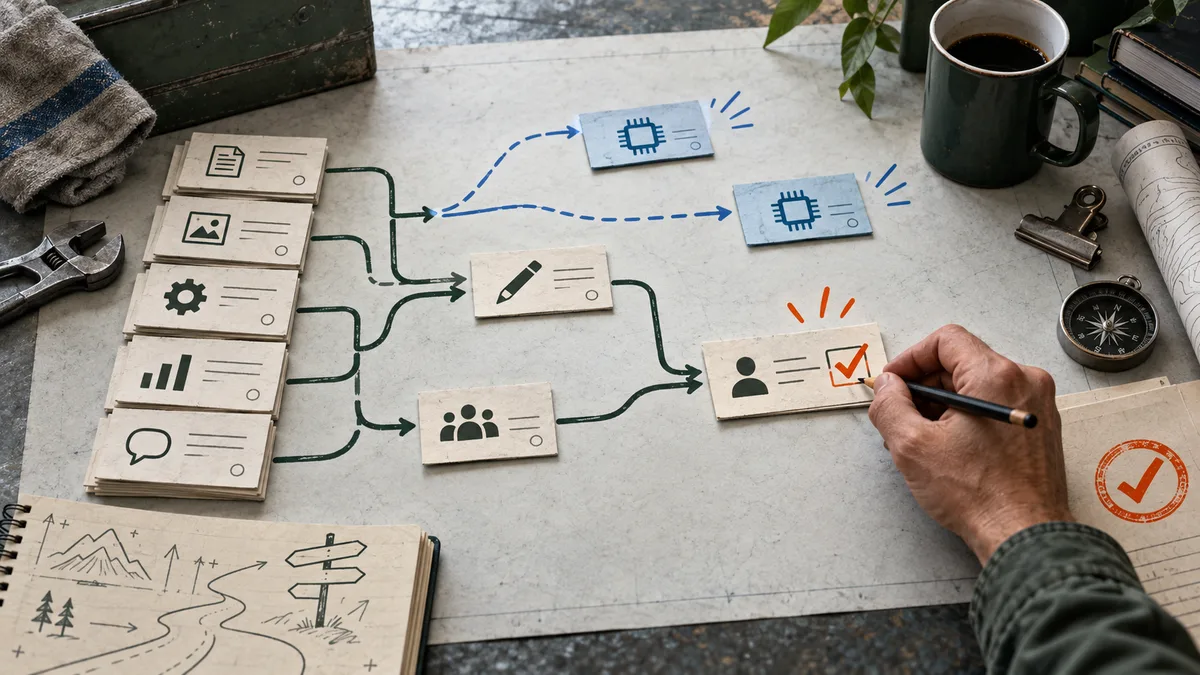
Treat the change as a workflow question before treating it as a career verdict. Identify which task the tool drafts or recommends, test its output against ordinary and exception cases, and keep final approval only when you have the evidence, time, skill, and authority to verify or reject it. If those conditions are missing, ask for clearer decision rights and escalation. A task’s AI exposure is not evidence that your employer has adopted it everywhere or that your job will disappear.
Which part of the work changed, and which decision stayed yours?
The first claim to audit is often an overstatement: “AI can do my job now.” A tool may summarize records, draft a response, sort exceptions, or suggest a next step while leaving the consequential choice and its explanation with a person. The reverse claim, “I still approve it, so my role has not changed,” can be just as misleading. The work may have shifted from producing a first pass to checking an unfamiliar one under a tighter deadline.
Start a task ledger from a normal week. For each recurring task, record what goes in, what the tool produces, what you check, who decides, who can stop or reverse the action, and what happens when the case is unusual. Note how often the task occurs and the cost of a missed error. For example, an analyst might use a generated exception summary to locate mismatches in a report. Sorting and summarizing may be more automatable than deciding whether a mismatch signals a harmless timing difference or needs escalation. That distinction is a description of task boundaries, not a claim about every analyst’s work.
The ILO’s 2025 global index assessed nearly 30,000 tasks across detailed occupations and estimated that one in four workers is in an occupation with some degree of generative AI exposure. The ILO says continued human input makes job transformation more likely than redundancy in most cases. That is an occupational estimate of technical potential; it does not show whether your employer has deployed a tool, how your team uses it, or what will happen to a particular position. Your ledger is more useful for the next conversation because it describes the work actually assigned to you.
What should a fair test compare?
Compare the current process with an AI-assisted process on the same kinds of work, including edge cases. A faster first draft is not a net gain if checking takes as long as writing, errors move downstream, or exceptions become harder to notice. For a bounded trial, agree on a small sample of representative cases and record completion time, corrections, missed issues, escalations, and downstream rework. Keep the task reversible and low consequence while learning. Use approved data and follow workplace rules for the tool.
Research gives reasons to test rather than assume. A 2025 study in the *Quarterly Journal of Economics* followed a staggered introduction of a conversational assistant among 5,172 customer-support agents. It reported an average 15% increase in issues resolved per hour, with uneven results: less experienced workers gained in speed and quality, while the most experienced and skilled saw small speed gains and small quality declines. This is evidence from one company and one support workflow, not a forecast for another occupation or proof that final responsibility was redesigned well.
A separate randomized field experiment across 66 firms and 7,137 knowledge workers found that tool access reduced email time among frequent users, but researchers detected no change in the quantity or composition of tasks from individual access alone. This complicates the attractive story that time saved automatically becomes judgment work, customer care, or learning. Ask who chooses how saved time is used. Compare manual work, AI assistance with real review, and nominal approval where the reviewer lacks time or access. If the last version is what is being proposed, faster throughput alone does not establish a sound process.
Sources: Generative AI at Work; Shifting Work Patterns with Generative AI
When does your sign-off count as control?
A final click is meaningful only if you can examine relevant evidence, understand the decision standard, spot important errors, and reject or escalate the result. The OECD’s workplace analysis warns that human involvement can become rubber-stamping when the person simply approves an AI decision. Its paper is policy analysis, not a legal ruling about your job, but it gives a practical test: is the person reviewing the output able to intervene, and is the responsibility for doing so clear?
Make the conditions observable. Can you see the source records behind a recommendation, not just its summary? Do you know which cases require a second check? Is there enough review time for the volume assigned? Can you change the result or pause it without being penalized for missing a throughput target? Who handles a case outside the system’s scope? These questions matter more as consequences rise. A low-stakes internal draft may need a quick factual check; a decision affecting safety, rights, money, or access calls for a review path proportionate to that impact.
If you are expected to certify outputs you cannot inspect, keep a factual record of the task, missing information, time allowed, and examples of unresolved errors. Then ask your manager or the relevant compliance, safety, or worker-representative channel to clarify the decision owner, review standard, escalation route, and time allocated. Workplace policies and legal duties differ by country and sector, so this is a work-design conversation, not a substitute for jurisdiction-specific advice. The point is to make responsibility match actual control instead of quietly accepting an uncheckable signature duty.
Sources: Using AI in the workplace: Opportunities, risks and policy responses
Which next move fits your work and constraints?
The proportionate first move is usually a bounded learning and workflow experiment when the task is reversible, outputs can be checked, and the revised job still uses your judgment. Learn the tool only as far as the real workflow requires: how to provide permitted inputs, compare output with source evidence, recognize failure cases, and document corrections. A short practice project using non-sensitive material may demonstrate more than a generic credential if your goal is to improve a task in your current field. A course can help when it teaches a missing skill; a degree or longer program makes sense only when the target path actually requires its depth, credential, time, and cost.
Compare three routes against your own salary floor, location, training time and budget, health, family duties, credentials, and existing domain knowledge. First, upgrade the present role by taking responsibility for a tested workflow and making quality checks visible. Second, consider an adjacent role where your subject knowledge transfers but the task mix or decision authority is better. Third, plan a larger transition if the redesigned work remains undesirable, the accountability gap cannot be fixed, or credible local demand and prerequisites support another path. Neither exposure estimates nor one productivity study establishes which option will be available or pay well for you.
The June 2026 ILO review synthesizes experiments, firm data, platform studies, and worker surveys across seven countries. It describes productivity gains as real but uneven and often unverified, and says reported time savings have not yet translated into higher measured output, earnings, or employment. That evidence makes local measurement and a dated decision point more defensible than a rushed resignation or a promise that an upgrade will protect a job. Recheck after a few weeks: did errors and rework stay acceptable, did you have real authority to intervene, and did the work you value remain in the role?
Verdict: map the changed tasks, test the assisted process on routine and exception cases, then keep sign-off only with workable review conditions. If your review changes results, preserve that evidence and discuss how the role should recognize and allocate that judgment. If responsibility still exceeds access, competence, time, or authority, escalate the mismatch and compare adjacent paths before committing to a costly change. The free task checker at /ai-job-risk-checker can organize task-level change-pressure signals; it does not estimate your chance of displacement. If several paths remain plausible, the paid roadmap at /career-roadmap compares a stay-and-redesign route, adjacent moves, and a larger change against your stated constraints, without guaranteeing employment or income.
Sources: Shifting Work Patterns with Generative AI; The impact of GenAI on jobs, productivity and work organization: a review of the empirical evidence
Sources and notes
- Generative AI and jobs: A 2025 update
Supports the distinction between modeled occupational task exposure and likely job transformation, not an individual displacement forecast.
- Generative AI at Work
Reports productivity and quality effects from an AI support assistant across 5,172 agents, with results varying by experience.
- Shifting Work Patterns with Generative AI
Reports a randomized six-month experiment where time savings did not produce detected shifts in task quantity or composition.
- Using AI in the workplace: Opportunities, risks and policy responses
Supports the workplace risks and oversight discussion; accompanying OECD analysis warns human approval can become rubber-stamping.
- The impact of GenAI on jobs, productivity and work organization: a review of the empirical evidence
Summarizes evidence across seven countries and distinguishes reported time savings from measured output, earnings, or employment.
Apply this to your own work
See the whole job market at once.
Explore which occupations AI may reshape, then turn the signal into a practical response.
Explore the job map