
Usually, yes, but only as a short decision step. Use an AI job-risk checker before buying a career course when you know that AI may be changing your work but cannot yet say which recurring task, target outcome, or capability the course should improve. A task-level result can help you separate exposed and repeatable work from work that still depends on context, judgment, trust, accountability, or physical and interpersonal conditions. That makes it easier to reject a generic course, choose a small work-based project, or select a bounded AI-literacy course. It cannot tell you the probability that you will lose your job. If the course is tied to a defined credential, academic requirement, employer prerequisite, or transition with clear entry conditions, check those requirements first and possibly skip the checker. The practical order for an uncertain purchase is: define the work goal, map the real task bundle, use the checker to surface change pressure, verify the signal against your workflow and employer context, then buy only training that produces a relevant capability or work sample.
The short answer: check the task before you buy the course
Imagine opening a course page after a difficult week at work. The headline promises future-ready skills, the lessons mention automation, and the checkout page asks you to commit money and evenings before you have decided what problem you are solving. The pressure is real, but the first question is not whether the course sounds modern. It is whether it addresses a change in your actual work. A task-level checker can help with that question. It is useful when the gap is uncertainty about where AI may alter your day, which parts of your role still depend on judgment, and what learning outcome would be worth paying for. It is much less useful when you already have a defined requirement and are simply deciding whether the course meets it.
A checker and a course are different decision instruments. The checker is an orientation tool. It organizes a task bundle and highlights possible change pressure, likely points of assistance, and questions worth investigating. The course is a learning commitment. It should create knowledge, practice, feedback, a credential, or a work sample that serves a defined goal. One should not be treated as a cheaper version of the other. A result cannot prove that a course is valuable, and a polished course page cannot tell you which part of your work deserves attention first. The useful bridge is the question the checker helps you ask before you buy.
The International Labour Organization's 2025 global index shows why job titles are a poor place to begin. Its method combines task-level information, worker input, expert discussion, and model-assisted scoring. The paper reports that clerical work remains highly exposed and that some strongly digitized professional and technical work has become more exposed as systems handle more specialized tasks. It also says most occupations include tasks that still require human input, so job transformation is the more likely near-term impact. That is evidence about modeled potential across occupations, not a forecast about your manager, your country, your employer, or your employment status.
The ILO's accompanying discussion makes the boundary practical. Exposure is an estimate of the automation potential of tasks. Adoption depends on an organization's decision, data, controls, budget, workflow, and willingness to change. Even after adoption, the work may be redesigned rather than removed. A worker may spend less time preparing a first draft and more time checking evidence, explaining a recommendation, handling exceptions, or taking responsibility for a decision. A course that teaches only a visible interface may miss the new value in those surrounding tasks.
The decision rule is simple: use the checker before the course when the checker can make the purchase question more specific. If the result changes your candidate learning outcome, it has done useful work. If it merely gives you an alarming label while leaving the course, task, and constraint unclear, it has not earned authority over the decision. You should not buy because a score sounds high, and you should not dismiss change because a score sounds low. Treat the signal as an invitation to inspect the workflow.
This matters for early- and mid-career knowledge workers. You may have useful experience, a salary floor, limited evenings, caregiving duties, a health constraint, a visa or credential boundary, or no realistic option to pause paid work. A generic recommendation to start over in a technical field ignores those conditions. The useful question is not, 'What is the safest job?' It is, 'Given the work I already know, which task is changing, which capability would increase my value or options, and what learning path can I sustain?'
There are three legitimate routes. Use the checker first when your work feels exposed but your next learning step is vague. Buy or verify the course first when a credential, employer requirement, or academic route already defines the target. Run a small, permitted work-based test before either purchase when you can safely learn more from the workflow itself. These routes are responses to different uncertainties, not a universal ranking. The right first step addresses the biggest unresolved question at the lowest acceptable cost and risk.
The rest of this article follows that distinction. First, map the work rather than the title. Then interpret exposure without turning it into a loss forecast. Next, audit the course for durable capability, feedback, prerequisites, and proof. After that, compare the cases where the course should come first with the cases where the checker or an experiment is better. The ending turns the result into a bounded next step rather than an open-ended research project.
Sources: Generative AI and Jobs: A Refined Global Index of Occupational Exposure; Generative AI at work: What it means for jobs in Europe and beyond
What should you map before you run the checker?
Start with a task inventory. Write down recurring outputs that occupy a meaningful part of your week, not every action in your calendar. For each one, name the input, the transformation, the output, the person who relies on it, and the cost of an error. This turns 'I work in marketing' into something inspectable: gather campaign data, clean a spreadsheet, draft a performance summary, explain an anomaly to a client, choose a test, obtain approval, and record what happened. The title remains useful for context, but the task bundle is where a learning decision can begin.
A practical inventory asks what you produce repeatedly, how digital the work is, how standardized the inputs and outputs are, where exceptions appear, who verifies the result, what information cannot be shared, and what decision or relationship depends on it. These questions do not assign a risk grade by themselves. They describe the conditions under which assistance, automation, or redesign might be feasible. Frequency matters, but so do consequence, review burden, and the value of the surrounding judgment.
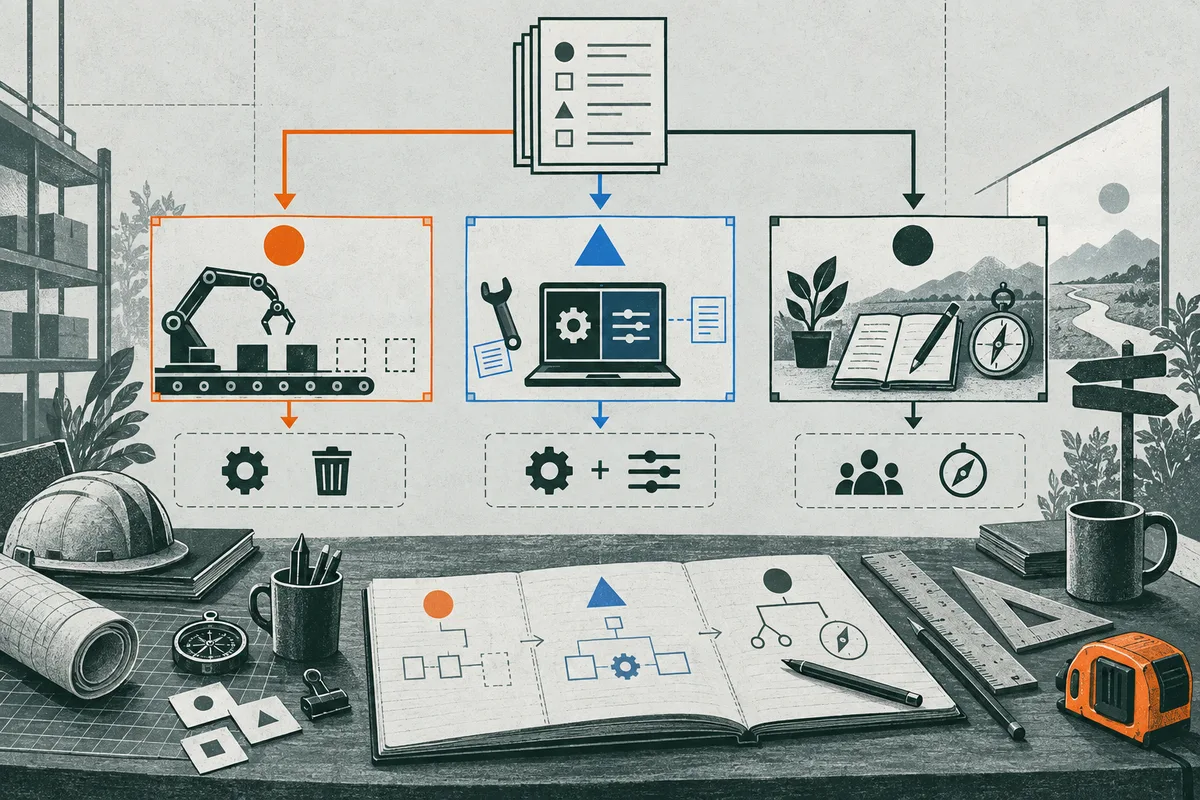
The first category is repeatable transformation: formatting, sorting, summarizing, drafting from supplied material, classifying routine requests, converting information between formats, or producing a first version of a familiar document. These tasks may be technically exposed because a system can generate a plausible output. That does not mean the output is reliable enough to send, that the employer permits the workflow, or that the time saved will reduce headcount. It means the task deserves a closer look at quality, verification, and who owns the final call.
The second category is interpretation. A report may be easy to summarize but harder to interpret when data is incomplete, the baseline is changing, or the decision affects a customer, patient, employee, or supplier. A system may produce a sensible explanation while missing a local fact that changes the recommendation. In that setting, domain knowledge and verification are part of the work product. Learning how to frame the question, inspect the evidence, test an output, and explain uncertainty may be more valuable than learning a particular prompt pattern.
The third category is coordination and accountability. A task can be digital and repeatable yet remain dependent on permission, negotiation, trust, timing, and responsibility. Preparing an agenda is different from getting a group to agree on a difficult decision. Drafting a client response is different from managing a relationship after the response changes expectations. Filling a case note is different from deciding what a case requires. The checker can surface exposure in the visible text or record, but it cannot know the full social and institutional cost of a mistake unless the task description includes it.
The fourth category is physical and situated work. Some knowledge workers move between a screen and a site, laboratory, workshop, classroom, clinic, or customer setting. A digital planning task may be exposed while the physical inspection, adaptation, or relationship remains less directly affected. This does not make the role immune to change. It means the learning decision should follow the actual mix. A course in generic automation may be less useful than a project that improves handoffs, documents exceptions, or helps the worker evaluate a tool in the setting where the work occurs.
Use occupational references as a scaffold, not a substitute for observation. O*NET summary reports include occupation-specific tasks, technology skills, work activities, work context, experience requirements, training and credentials, education, and related occupations. That breadth helps translate a title into candidate tasks and find adjacent roles. It does not describe every employer's workflow, access policy, software stack, or quality standard. A title from a database is a starting hypothesis about your work, not the final description.
The same title can contain different task bundles. Two operations analysts may both report dashboards, but one may maintain a stable internal process while the other investigates unusual cases for a regulated customer. Two content specialists may both draft articles, but one may work from a strict evidence library while the other conducts interviews, manages review, and owns corrections. A title-only checker flattens those differences. A task-level input makes the uncertainty visible.
Now add the constraint map. Record the minimum income you need to protect, hours available for learning, location or remote-work limits, family responsibilities, health and energy limits, language needs, credential rules, and whether you can use work material in a project. These are not obstacles to remove from the analysis. They determine whether an upgrade, adjacent move, or larger transition is realistic. A learning plan that cannot survive the reader's week is not a practical plan, however current its subject matter.
Finally, write the decision you want the checker to improve. It might be, 'Should I learn evaluation and workflow design for my current reporting work?' It might be, 'Does this course address the gap between my operations experience and a target implementation role?' It might be, 'Do I need a formal credential, or can a work sample test the direction first?' If you cannot write a decision sentence, pause before running the checker. The missing step is not more scoring. It is clearer problem framing.
Sources: Generative AI and Jobs: A Refined Global Index of Occupational Exposure; O*NET OnLine Help: Summary Report

Why does exposure change the learning decision without predicting job loss?
Exposure is potential overlap between a capability and a task. It is not the same as a system performing the task well in your environment. It is not the same as your employer deploying a system. It is not the same as management redesigning the workflow, customers accepting the result, a regulator allowing the use, or the organization sharing the benefits. It is also not the same as demand for the occupation rising or falling. These signals can move in different directions, which is why a single job-risk number is a poor basis for a high-cost purchase.
The ILO's 2025 index is useful precisely because it works at the task level and states its limits. It uses a sample of tasks from the Polish occupational classification, a survey of employed people across broad occupational groups, expert input, and model-assisted predictions. The resulting gradients indicate different levels of potential exposure. The paper reports that one in four workers globally are in an occupation with some exposure, but that statement does not say one in four workers will be replaced. It says occupational task bundles contain different degrees of potential interaction with the technology.
The OECD provides a second reason to resist a simple conclusion. Its 2024 analysis combines online vacancy data from ten OECD countries with a relative occupational exposure measure. It focuses on workers who may use AI in their jobs rather than people who build or maintain AI systems. In highly exposed occupations, management and business skills were among the most demanded groupings, alongside digital skills. The study also reports changes in skill demand at more exposed workplaces, with small magnitudes and cross-country variation. This is evidence that work can be rearranged around a capability, not proof that everyone should buy an AI-development course.
The insurance example in the OECD brief shows the mechanism. A tool can identify accounts that deserve attention before an agent performs a check. The agent may spend less time scanning random files and more time communicating with customers. The value of the role moves toward prioritization, explanation, and relationship work. The firm may also create demand for people who handle physical appraisal or other tasks outside the tool's direct reach. This is not a promise that such gains will occur in every workplace. It is a reminder that task changes can redistribute work rather than simply erase it.
Usage evidence adds another layer, but it needs careful handling. The Anthropic Economic Index shows that its dataset is concentrated in particular occupations and tasks, especially computer and mathematical work. In one analysis, only a small share of occupations used the system across most associated tasks, while moderate use was more widespread. The same source reports an augmentation majority in its task classification and explains that augmentation can include iteration, learning, validation, and collaboration. It also warns that the data comes from one product's users, may include non-work activity, and cannot show how outputs were used.
A later update from the same project reports that augmentation led automation in its latest sample, while the balance changed across earlier samples. That movement is informative about one product's user population. It is not a market-wide adoption rate. It cannot tell you whether your employer has approved the tool, whether a colleague is checking the result, or whether the process creates new hidden work. Observed use is evidence about use. It is not evidence of reliable autonomous performance or an individual employment outcome.
NIST helps explain why surrounding work matters. Its Generative AI Profile describes confabulation, including confident but false or internally inconsistent content, and notes that contextual and domain expertise can be important. It recommends attention to testing, evaluation, verification, and validation, along with documentation, feedback, and people who can interpret risk in context. For a worker, a task that looks easy to generate may still require substantial work to validate. For a course, output inspection and responsible use should be part of the curriculum rather than an afterthought.
The strongest counterargument is that uncertainty can become an excuse for delay. Capabilities are changing, employers may adopt before workers feel ready, and a person who waits for perfect evidence may lose time that could have been used to learn. That concern is legitimate. The answer is to act on one consequential task with a bounded experiment or clearly scoped learning objective. You can investigate without predicting your fate. You can build a capability without buying an entirely new identity.
A high signal should produce a question, not a conclusion. Ask which part of the task is technically assistable, what still needs judgment or verification, what policy or privacy rule blocks use, and what adjacent responsibility becomes more important if the task changes. Ask whether the course teaches that responsibility or merely shows a tool. Ask what evidence would make you stop. These questions translate exposure into a learning decision while preserving uncertainty where the evidence cannot resolve it.
A low or uncertain signal also needs care. It may mean the task is less directly exposed, that the input description is vague, that the tool studied does not match the workflow, or that the barriers are social, physical, or organizational. It does not grant permanent safety. If the work depends on a specific credential, customer expectation, or defined employer project, those facts may matter more than a broad exposure result. A checker should sharpen attention, not close it.
The practical interpretation is a three-part note: likely change pressure, evidence I have, and unknowns I must verify. For example: 'Routine first-draft preparation may be assistable; my employer has no approved process; final recommendations require source checks and client context.' That note is more actionable than 'my job is high risk.' It points toward a project, manager conversation, course audit, or different path. It also protects you from treating a modeled or product-specific result as a personal forecast.
Sources: Generative AI and Jobs: A Refined Global Index of Occupational Exposure; Generative AI at work: What it means for jobs in Europe and beyond; How is AI changing the way workers perform their jobs and the skills they require?; Economic Index: New building blocks for AI use; Artificial Intelligence Risk Management Framework: Generative Artificial Intelligence Profile; Introducing the Anthropic Economic Index
What should you verify before paying for the course?
Once the task is clear, audit the course as a purchase. Begin with the intended outcome. There are at least four different goals often mixed together: using AI in an existing field, building an AI-enabled product, becoming a software practitioner, or pursuing machine-learning engineering or research. Each can require different depth in mathematics, programming, data work, evaluation, and formal preparation. A short workplace course may fit the first goal while being inadequate for the fourth. The checker can help identify a direction, but it cannot erase the prerequisites of the target.
For an existing role, look for a named workflow rather than a list of fashionable tools. A useful course might have you define a problem, prepare or inspect data, choose a bounded use, compare an output with a human baseline, record errors, protect confidential information, and decide whether the result is good enough for context. The interface may change. Those habits can transfer. A course whose main outcome is trying several tools may be fine for orientation, but it is weak evidence of workplace capability unless it creates a meaningful artifact and teaches you how to judge it.
The U.S. Department of Labor's 2026 Artificial Intelligence Literacy Framework is useful as a curriculum lens. The federal repository describes it as a common foundation for workers, employers, training providers, teachers, faculty, and workforce systems, with content and delivery principles that can adapt to roles and contexts. Read that as program-design guidance, not a guarantee about any provider. Ask whether the course connects AI principles, practical use, output evaluation, human judgment, and responsible decisions to a real setting. A course can use the right vocabulary and still fail to offer practice or feedback.
Check prerequisites in plain terms. Does the course assume spreadsheet fluency, statistics, programming, domain knowledge, access to a particular software plan, or study at fixed times? Are requirements merely listed, or will they be checked? If the gap is basic data handling, an advanced system-design course may create frustration without solving the immediate problem. If the target is regulated or credentialed, a beginner certificate may not substitute for a degree, license, supervised experience, or examination the route requires.
BLS occupational data makes this boundary visible in the United States. Its 2025 National Employment Matrix lists typical education, related work experience, and on-the-job training by detailed occupation. The table ranges across roles with different entry patterns, from high school education and training to bachelor's or master's degrees and prior related experience. These are occupational norms, not universal laws, local hiring guarantees, or evidence that one course has a particular return. They are a reminder to compare a course with the actual entry conditions of the target role.
Compare formats by what they can realistically provide. A short course can give a bounded introduction and a fast interest test. A certificate can organize study and provide a signal, but its value depends on recognition, assessment, and target market. A project can produce direct evidence of a capability but may lack expert feedback or cover full theory. Self-study can be inexpensive and flexible but makes quality control harder. An apprenticeship or supervised assignment can provide context and feedback but may be difficult to access. A degree can offer depth, network, and formal eligibility while requiring more time, money, and opportunity cost.
No format is automatically superior. The goal sets the comparison. If you need to use a tool in current reporting next month, a small project with feedback may beat a broad degree. If you need eligibility for a formal technical role, a sequence of short courses may not be enough. If you want to build an AI-enabled product, you may need software practice, data handling, evaluation, security, and product discovery rather than an isolated prompt course. If you are exploring machine-learning research, the mathematical and research foundations are a different commitment entirely.
Ask what the course will make you produce. A deliverable could be a documented workflow, tested classification process, evaluation set, data-quality report, decision memo with sources, small application, or portfolio explanation of limits and tradeoffs. The artifact should be relevant to target work and safe to share. A completion badge without a meaningful output can show persistence, but it does not demonstrate transfer by itself. A modest project with clear scope and honest evaluation can reveal more about fit than a large collection of certificates.
Inspect the assessment. Are learners asked to check an output against a source, find a failure, explain a tradeoff, revise a workflow, or defend a decision? Are there examples of feedback from a qualified reviewer? Can the learner ask about their own task? Does the course distinguish a plausible draft from an acceptable work product? These details matter because AI-supported work often shifts effort from first production to selection, verification, exception handling, and accountability. A curriculum that never measures those tasks is likely to overstate what completion means.
Calculate total cost rather than ticket price. Include enrollment, software, equipment, travel, books, exam or renewal fees, unpaid study time, childcare, and the cost of pausing other learning or work. If the course requires a subscription that may change, record that risk. If the promise depends on a cohort, check schedule and attendance rules. If you need an income floor, ask whether the path can be pursued alongside work. Financial pressure can turn respectable content into a bad purchase.
Set a stop rule before paying. Stop if you cannot state the task or transition it addresses, the durable capability it develops, the prerequisites you meet, the work sample or assessment it produces, and the time and cost you can sustain. Stop if the course promises a safe career, salary, guaranteed hiring, or readiness for a role whose prerequisites it does not teach. Stop if every outcome is described as tool familiarity. A stop rule protects a limited budget from a purchase made mainly to quiet fear.
Sources: Artificial Intelligence Literacy Framework; Education and training assignments by detailed occupation; O*NET OnLine Help: Summary Report

When should you buy the course before using a checker?
The checker should not become a gatekeeper. There are situations where the course or formal requirement deserves attention first. If an employer requires a credential for a defined internal project, verify the employer's requirement, provider status, and syllabus. If an academic program has admission prerequisites, use the institution's published requirements and an adviser where appropriate. A general task signal cannot override a concrete rule. In these cases, the checker may help later with planning, but it is not the deciding evidence for eligibility.
A defined technical transition is another case. Suppose the target is an implementation role with known prerequisites in software, data, systems, or a domain. Begin by comparing current skills with entry expectations, course depth, and feedback or portfolio requirements. A job-risk result about your current role may explain why you are interested, but it does not establish that the transition is feasible. Gap analysis and the target's real requirements matter more than the emotional force of an exposure label.
A course-first decision can also be reasonable when the learning path is constrained and proportionate. You may have a specific assignment, a short internal training window, a known budget, and a deliverable reviewed by a manager or client. In that case, the course is not speculative. It is part of a defined experiment. Even then, use the task inventory to check that the curriculum addresses the assignment and that the work can be completed without exposing restricted data or making an unapproved decision.
The checker is stronger when the course is being used as an answer to anxiety. A broad promise to future-proof your career is not a goal. It does not tell you whether you need AI literacy, data analysis, project management, domain specialization, a credential, or a larger change. Paying first can create sunk-cost pressure. After several lessons, you may defend the course because you invested in it, even if the work problem was never clear. A short task inventory and checker result create enough friction to ask what the purchase is meant to change.
A small work-based test may be better than both. If policy, confidentiality, safety, and time permit, choose one recurring task and define a narrow comparison. Record the current process, output standard, common errors, and who reviews the result. Then test one bounded use and inspect the output against the same standard. You are not trying to prove that AI is good or bad. You are learning about usefulness, verification effort, data limits, and whether the task's value shifts toward another capability. If the experiment is not permitted, use approved public, synthetic, or non-sensitive material.
Compare the routes by the uncertainty they reduce. A checker can reduce uncertainty about where to look. A course can reduce uncertainty about knowledge and practice, if it is designed well. An experiment can reduce uncertainty about workflow fit and verification cost. None answers every career question. The best first step addresses the largest unresolved uncertainty at the lowest acceptable cost and risk. This is why a free checker may be sensible before a course for one reader and almost irrelevant for another.
Your career move also matters. An upgrade changes the current role by adding capability, improving a task, or taking on more judgment. An adjacent move uses existing experience in a nearby role with a different task mix. A larger change accepts a longer period of retraining or a new credential. Exposure may create urgency for any of these, but it does not choose among them. Salary continuity, location, family, health, language, visa status, and appetite for uncertainty can outweigh a general technology signal.
For an upgrade, look for a course that improves a consequential workflow and communicates limits. For an adjacent move, look for transferable domain knowledge, target-role prerequisites, and a project that demonstrates the bridge. For a larger change, map the full sequence, including foundational study, formal eligibility, supervised practice, portfolio evidence, and the period before the new path produces income. A checker can be a first map, but it cannot make a larger change low risk by giving it a score.
The OECD evidence is helpful because it shows that skills can change inside exposed occupations and workplaces. Management, business, digital, social, emotional, cognitive, and communication demands do not form a universal recipe, and the reported changes are modest and heterogeneous. Still, the mechanism suggests why an adjacent move may preserve more experience than a total restart. A worker who understands the process, customers, data, or regulations may have a useful base for learning to evaluate and govern a new tool. That is an inference for planning, not a guaranteed labor-market outcome.
Use the course-first route when the target is concrete, prerequisites are known, the curriculum matches the gap, the output will be assessed, and constraints are tolerable. Use the checker-first route when the target is vague, the purchase is fear-led, the title hides task bundles, or you are deciding between upgrade and change. Use the experiment-first route when the question is whether a workflow works and you can test it safely. Buying nothing yet is valid when evidence does not justify the cost.
Sources: Artificial Intelligence Literacy Framework; How is AI changing the way workers perform their jobs and the skills they require?; Education and training assignments by detailed occupation
What should you do after the checker result?
A result is useful only if it changes your next action. Begin by copying the task description and writing down what the checker can and cannot know. It may identify a recurring digital task with potential for assistance or automation. It may suggest that judgment, context, trust, or verification remain central. It cannot see confidential employer plans, local hiring conditions, your manager's priorities, or whether you can afford a course. Treat those missing variables as part of the result, not as footnotes to ignore.
Days one through three are for the work map. Select three to five recurring tasks that matter to your role or transition. Estimate frequency and consequence without pretending the estimates are scientific measurements. Note the information involved, quality standard, reviewer, and whether the task involves a sensitive or regulated decision. Record the constraint that would make learning fail: a fixed shift, limited energy, childcare, cost, travel, a prerequisite, or an employer policy. This gives the checker a real decision to inform.
Days four through seven are for the checker and course audit. Run the task-level assessment, then compare each suggested action with the syllabus. Does the course address the task's hard part or only its visible surface? Does it teach evaluation and responsible use? Does it produce evidence you could explain to a manager, client, or future employer? Does it require more time, money, software, or prior knowledge than you have? If the result and syllabus point in different directions, investigate the disagreement rather than averaging it into a compromise.
Week two is for a permitted test or clearer requirement check. If an experiment is safe, use a small sample and a defined standard. Compare not just speed but error detection, editing, source checking, handoffs, and the consequences of a poor result. A faster first draft can be a bad workflow if review takes longer or if the output creates new liability. NIST's emphasis on testing, evaluation, verification, validation, and feedback is a useful mental model even for a small trial. Know what good looks like before deciding that the tool helped.
If a work test is not possible, inspect the workflow through documents and people you may consult. Review course assignments, sample lessons, assessment method, and update date. Ask a manager or experienced colleague which part of the task is changing and what evidence would make the change valuable. Check target-occupation education and experience expectations in an appropriate national source. The goal is not to collect opinions. It is to find the fact that would alter the purchase: a missing prerequisite, unacceptable use, weak deliverable, or constraint you cannot solve.
Week three is for choosing the smallest credible learning path. It may be a focused course tied to one workflow, a project with a reviewer, a certificate or degree required by the target, or self-study followed by a safe work sample. If the intended outcome is to build systems, increase technical depth. If it is to use AI in current work, prioritize problem framing, data literacy, evaluation, verification, and context before collecting tool badges. If it is research or engineering, respect mathematics and programming foundations rather than pretending a short course closes them.
Week four is for choosing upgrade, adjacent move, larger transition, or no purchase yet. State what you will produce, who will review it, what constraint you are protecting, and what evidence would cause you to stop or change course. Set a review date because adoption, policy, tools, and goals can change. A review date is better than a permanent declaration that a role is safe or unsafe. It keeps the decision connected to observed work rather than a single assessment result.
The free AI Proof Work checker belongs at the beginning when you need a transparent task-level change-pressure signal and a first action. It is not a validated probability of displacement. The result should remain useful without payment. A personalized career roadmap belongs later when you need realistic scenarios compared against experience, salary floor, geography, learning time, health, family, or other constraints. It can organize a 30/60/90-day plan, but it cannot guarantee employment, income, or a particular outcome.
The most important evidence may be negative. A course may fail to transfer to your workflow. A tool may create more review than value. A target role may require a credential you cannot currently pursue. Your employer may prohibit the proposed use. The project may reveal that your interest is in a neighboring responsibility rather than the advertised topic. These findings are not wasted effort. They prevent a larger commitment from being made on a vague premise. A good process makes it safe to stop.
Return to the opening scene: the course page, the difficult week, and the temptation to buy certainty. The changed interpretation is that the right first purchase is often a clearer question. Use the checker if it helps name the task and learning outcome. Buy first if a concrete requirement governs the choice. Test the workflow first if direct evidence is available and safe. Then choose the smallest path that can produce capability you can verify. That is not a promise of an AI-proof career. It is a disciplined way to preserve experience, agency, and options while work changes.
Sources: Generative AI and Jobs: A Refined Global Index of Occupational Exposure; Economic Index: New building blocks for AI use; Artificial Intelligence Risk Management Framework: Generative Artificial Intelligence Profile; Artificial Intelligence Literacy Framework
Questions readers ask
Does an AI job-risk checker predict whether I will lose my job?
No. A responsible checker reports task-level change pressure or exposure signals. It cannot validate a personal probability of job loss because it cannot observe employer adoption, redesign, demand, local conditions, performance, or management decisions. Use the result to decide what task to investigate and what capability to learn, not to forecast redundancy.
Should I use a checker if I already know which course I want?
Use it only if it can test whether the course addresses a real task or transition gap. If the course is required for a defined credential, academic route, employer assignment, or formal prerequisite, verify those requirements first. A checker should not override a concrete eligibility rule.
What should I enter into a task-level checker?
Enter recurring tasks rather than only your job title. Describe what you produce, how digital and repeatable the work is, where judgment or trust enters, who checks the output, what happens if it is wrong, and what constraints limit tool use.
What makes an AI course worth buying?
The course should address a named workflow or target outcome, state prerequisites, provide practice and feedback, teach output evaluation and responsible use, fit your time and cost constraints, and produce a relevant work sample or assessed capability. A current tool name or completion badge is not enough by itself.
Is a short AI-literacy course enough for an AI career change?
Usually not by itself. A short course may suit practical AI use in an existing job or test an interest. A transition into software practice, AI-enabled product development, machine-learning engineering, or research may require deeper programming, data, mathematics, domain, portfolio, credential, or supervised-experience requirements.
Should I run a work experiment before buying a course?
If policy, confidentiality, safety, and time permit, a small experiment can reveal usefulness and verification cost before you pay. Define the output standard first, test one bounded task, inspect errors and review time, and record what changed. If real data is unavailable, use approved public or synthetic material.
What is the difference between an upgrade and an adjacent career move?
An upgrade changes your current role by adding capability or responsibility. An adjacent move uses existing experience in a nearby role with a different task mix. A larger transition accepts more retraining or formal eligibility for a different occupation. Exposure can create urgency, but your salary, location, health, family, credential, and time constraints should help choose among them.
When should I use a personalized career roadmap?
Use one after the basic question is clear and you need realistic scenarios compared against your constraints. The AI Proof Work roadmap can compare staying and redesigning, an adjacent move, and a larger change with a 30/60/90-day plan. It does not guarantee employment, salary, income, or a safe career.
Sources and notes
- Generative AI and Jobs: A Refined Global Index of Occupational Exposure
Supports task-level exposure methods, exposure gradients, occupation differences, and the boundary between modeled exposure and job transformation.
- Generative AI at work: What it means for jobs in Europe and beyond
Supports the distinction between exposure, workplace adoption, organizational redesign, worker consultation, and employment outcomes.
- How is AI changing the way workers perform their jobs and the skills they require?
Supports comparison of exposed occupations, changing skill demand, worker-facing AI use, workplace effects, and study limitations.
- Economic Index: New building blocks for AI use
Supports reported augmentation and automation mix, concentrated use patterns, changing samples, and product-specific data caveats.
- Artificial Intelligence Risk Management Framework: Generative Artificial Intelligence Profile
Supports the need for context, domain expertise, testing, evaluation, verification, validation, feedback, and scrutiny of confabulated outputs.
- Artificial Intelligence Literacy Framework
Supports using a federal AI-literacy framework as a curriculum lens without claiming it validates a provider or employment outcome.
- Education and training assignments by detailed occupation
Supports checking typical education, related experience, and on-the-job training for a target occupation before choosing a course.
- O*NET OnLine Help: Summary Report
Supports using occupation tasks, technology skills, work context, requirements, credentials, education, and related occupations to build a task inventory.
- Introducing the Anthropic Economic Index
Supports distinguishing observed product usage, task depth, augmentation, automation, and selection and classification limits.
Apply this to your own work
See the whole job market at once.
Explore which occupations AI may reshape, then turn the signal into a practical response.
Explore the job map