Stanford’s August 2026 update makes the entry-level hiring question more urgent, but it does not show that AI caused every missing job or predict your personal job prospects. In its ADP payroll sample, employment for U.S. workers aged 22–25 in highly AI-exposed occupations was about 19% below a comparison path based on similarly aged workers in less-exposed occupations by June 2026. The authors say fewer hires, rather than a rise in separations, is the main channel. Treat this as a reason to inspect how your target role teaches and rewards work, then strengthen evidence of judgment and accountable task ownership. Do not take it as a reason to abandon a field or buy a credential before checking actual openings and your constraints.
What did Stanford measure, and what changed in 2026?
Stanford’s revised “Canaries in the Coal Mine” analysis uses high-frequency ADP payroll data covering millions of U.S. workers, comparing employment changes across age groups and occupations with different measured AI exposure and use. Through June 2026, employment among workers aged 22–25 in highly exposed occupations was about 19% below a comparison path based on similarly aged workers in less-exposed occupations. The estimate was 15% at the July 2025 data vintage. The authors identify reduced hiring, rather than increased separations, as the main adjustment channel. This is a relative group employment comparison, not a claim that 19% of junior workers were laid off.
The study is useful because payroll records provide frequent updates on employment, but its sample is firms using ADP and may not represent the broader U.S. economy. The researchers report no comparable gap for experienced workers in exposed occupations. They also distinguish more automation-oriented from more complementary AI use: the weaker early-career pattern is concentrated in the former, while employment is flat or rising in some complementary-use groups. These are patterns in the data, not proof that every employer has adopted AI or that AI caused the changes.
The 2026 update extends the observed pattern and reports checks that weaken several alternative explanations, including excluding technology firms and computer occupations and accounting for remote-work exposure and interest-rate changes. The estimates shrink when education is considered, some differences predate widespread generative AI, and the ADP estimates exceed national survey benchmarks. The authors therefore describe the findings as descriptive, not causal. The result raises the value of examining entry routes; it cannot establish that AI caused the full gap or forecast an individual’s prospects.
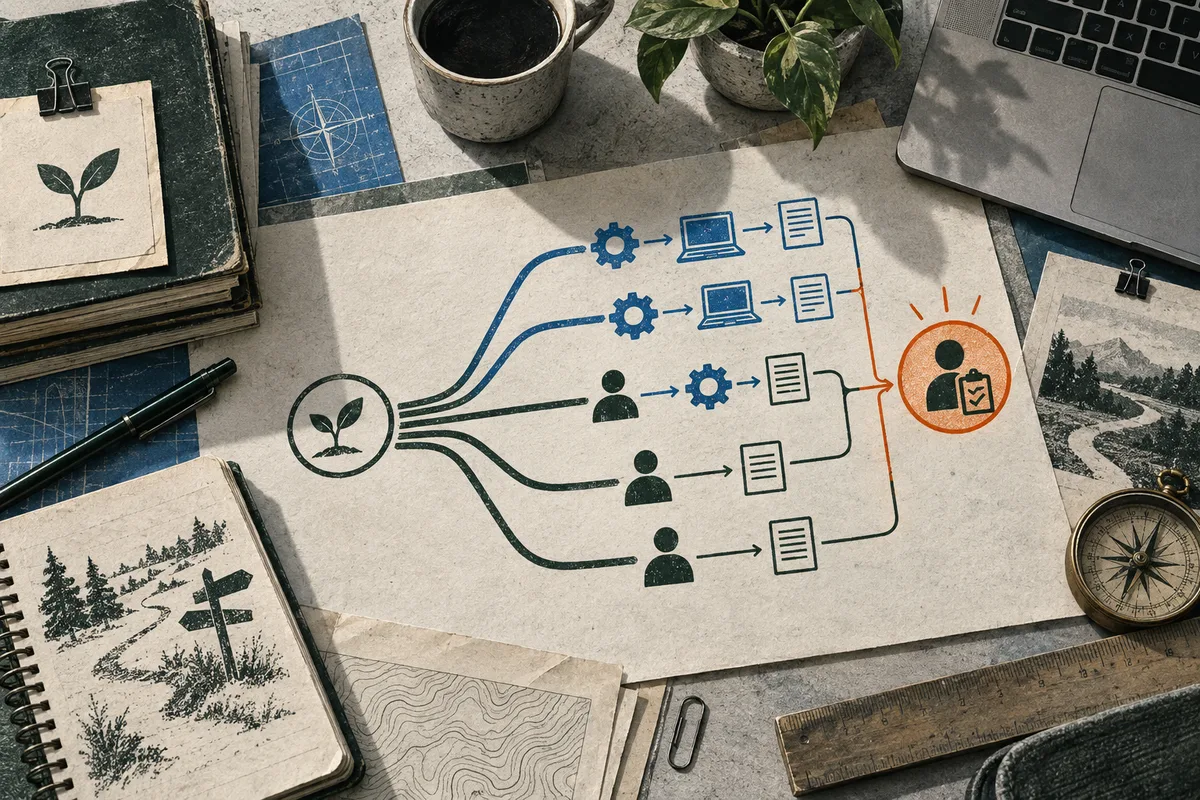
For a junior worker, the practical question is how a role creates its first rung. If beginner assignments mostly produce standardized digital outputs, those tasks may face pressure as tools improve or teams reorganize. Work that also requires checking evidence, resolving exceptions, communicating trade-offs, and learning under review gives a worker more ways to demonstrate contribution. That is a task-level interpretation, not a prediction about any occupation.
Sources: No Widespread Displacement, but the AI Employment Gap for Young Workers Has Widened to 19%; Canaries Dashboard
How much of the hiring signal can we attribute to AI?
Other studies add context without settling the cause. A 2026 U.S. Census Bureau working paper uses matched employer-employee data in the Quarterly Workforce Indicators and defines early-career workers as ages 22–24. It reports an immediate relative decline in hiring after ChatGPT’s release in the most exposed industry-state groups and a regression-adjusted 12% employment decline over ten quarters. The author also finds some relative changes around the pandemic onset and discusses remote work and rising educational attainment as possible explanations. The paper says its views are the author’s, not necessarily the Census Bureau’s. Its industry-level exposure measure does not observe individual task use, and its results do not isolate AI as the cause.
A Warwick working paper offers a competing explanation for the wider decline in early-career hiring shares. It analyzes 243 million hires and 407 million job postings across the United States, United Kingdom, Canada, and Australia from 2017 to 2025 using a difference-in-differences design. The authors report that the AI coefficient attenuates when work-from-home exposure is modeled alongside it. That result makes remote work a relevant competing pathway to examine; it does not prove remote work caused the decline or rule out an AI contribution. The paper studies hiring shares across countries and postings, while Stanford measures a U.S. employment comparison in an ADP payroll sample, so their estimates are not interchangeable.
Together, the evidence supports neither ‘AI is eliminating junior jobs everywhere’ nor ‘AI has nothing to do with the missing first rung.’ Stanford provides timely payroll evidence but uses a sample that may not represent the broader economy. Census adds matched administrative data but groups exposure by industry and state, with competing explanations and a non-Census-endorsed working-paper status. Warwick’s design highlights how work location may overlap with AI exposure. A firmer causal conclusion would require repeated representative data that connect actual adoption and task changes to hiring while tracking local conditions and junior training.
For now, use this as a reason to inspect opportunities rather than to panic-pivot. In your region or feasible remote market, check how many openings are genuinely junior, what experience they demand, what work samples they request, and whether supervision or progression is described. If those signals are weak in your target, investigate adjacent roles and alternative routes into the same field. The national studies cannot tell you whether a particular city, employer, or specialty has the same pattern.
Sources: You’re (not) Hired: Artificial Intelligence and Early Career Hiring in the Quarterly Workforce Indicators; The Broken Ladder: AI, Remote Work, and Early-Career Hiring (working paper); No Widespread Displacement, but the AI Employment Gap for Young Workers Has Widened to 19%
Which parts of junior work should you examine first?
Start with outputs, not job titles. List recurring tasks in a current or target role and ask whether each produces a standardized digital result, whether a tool can make a useful first pass, how costly errors are, and who owns the final decision. A routine research summary may be easier to draft with software than to validate: checking whether a source is current, spotting a missing assumption, and explaining what evidence means for a client can remain consequential work. Spreadsheet cleanup or first-line ticket sorting may also be more repeatable than resolving a case with incomplete information. These examples illustrate a way to audit tasks; they are not measured rankings of occupations.
A useful junior contribution is visible evidence that you can work efficiently and take responsibility for quality. Show how you checked a result, handled an exception, protected confidential information, or explained uncertainty. In an interview or portfolio, describe the task, your method, the verification you performed, and the decision or handoff your work enabled. Avoid claiming that using a tool made you an expert. Employers decide what they need, and the studies do not show which proof will change a particular hiring decision.
Compare three possible moves against the same constraints. First, stay and redesign your path: learn approved tools for one recurring task, document a before-and-after work sample where permitted, and ask who reviews the output. Second, look at an adjacent role that uses your existing domain knowledge but adds context, coordination, customer understanding, or responsibility for exceptions. Check its actual prerequisites rather than assuming it is safer. Third, consider a larger change only if current openings, likely pay, geography, training time and cost, health, and family needs make it feasible. A degree may fit a target requiring depth, a regulated credential, or structured recruiting; a course may fill a specific knowledge gap; a project may demonstrate applied skill. None is automatically the right response to an exposure signal.
Take one bounded step this week: audit five current or target-role tasks. For each, mark what could be assisted, what needs human verification, and what requires accountable judgment or practice with feedback. Compare the list with a handful of current local openings and ask a recruiter, manager, or experienced practitioner how junior staff learn the work. If a repeated skill gap connects to a real target, choose the least costly learning route that provides practice and feedback. If the gap is access to supervised experience, another generic course may not solve it; look for internships, apprenticeships, internal projects, or employers that describe mentorship when those options fit your circumstances.
The 2026 update strengthens the case for taking junior task design and hiring access seriously. It does not establish that your role is doomed or identify a universally safe alternative. Use the evidence to make your next move specific: preserve useful experience, build proof around relevant tasks, and verify demand and training conditions where you can realistically work.
Sources: No Widespread Displacement, but the AI Employment Gap for Young Workers Has Widened to 19%; What is really happening to jobs? Separating AI hype from reality
Questions readers ask
Does Stanford’s 19% figure mean I have a 19% chance of losing my job?
No. It is a relative employment shortfall for a group of workers aged 22–25 in highly exposed occupations versus a comparison path based on peers in less-exposed occupations. It is not an individual probability, a layoff rate, or proof that AI caused the whole difference.
Sources and notes
- No Widespread Displacement, but the AI Employment Gap for Young Workers Has Widened to 19%
Stanford's August 2026 update uses high-frequency ADP payroll data covering millions of U.S. workers and reports a relative employment shortfall of about 19% for workers ages 22–25 in highly AI-exposed occupations through June 2026, compared with similarly aged workers in less-exposed occupations; it was 15% at the July 2025 vintage. Reduced hiring is the primary channel; the authors characterize results as descriptive rather than causal. The dashboard notes that the ADP-firm sample is large but may not represent the broader economy.
- Canaries Dashboard
The Stanford dashboard documents a five-year balanced sample of firms using ADP payroll services, describing it as large but not necessarily representative of the broader economy, and presents exposure and employment patterns as correlations rather than causal estimates.
- You’re (not) Hired: Artificial Intelligence and Early Career Hiring in the Quarterly Workforce Indicators
This Census working paper uses matched employer-employee data in the Quarterly Workforce Indicators and defines early-career workers as ages 22–24. It reports relative hiring and employment declines in the most AI-exposed industry-state groups after ChatGPT's release, while discussing prior trends and competing explanations. The paper explicitly states that its views are the author's and not necessarily those of the Census Bureau.
- The Broken Ladder: AI, Remote Work, and Early-Career Hiring (working paper)
The working-paper record supports the study scope of 243 million hires and 407 million postings across the United States, United Kingdom, Canada, and Australia from 2017–2025, its difference-in-differences design, and the finding that the AI coefficient attenuates when work-from-home exposure is modeled alongside it. These are competing explanatory patterns, not a causal verdict that remote work explains the decline or AI has no effect.
- What is really happening to jobs? Separating AI hype from reality
Stanford SIEPR says junior roles often include routine research, analysis, and writing tasks that AI can now largely perform, while discussing mixed evidence and unresolved causal attribution for recent employment changes.
Apply this to your own work
See the whole job market at once.
Explore which occupations AI may reshape, then turn the signal into a practical response.
Explore the job map