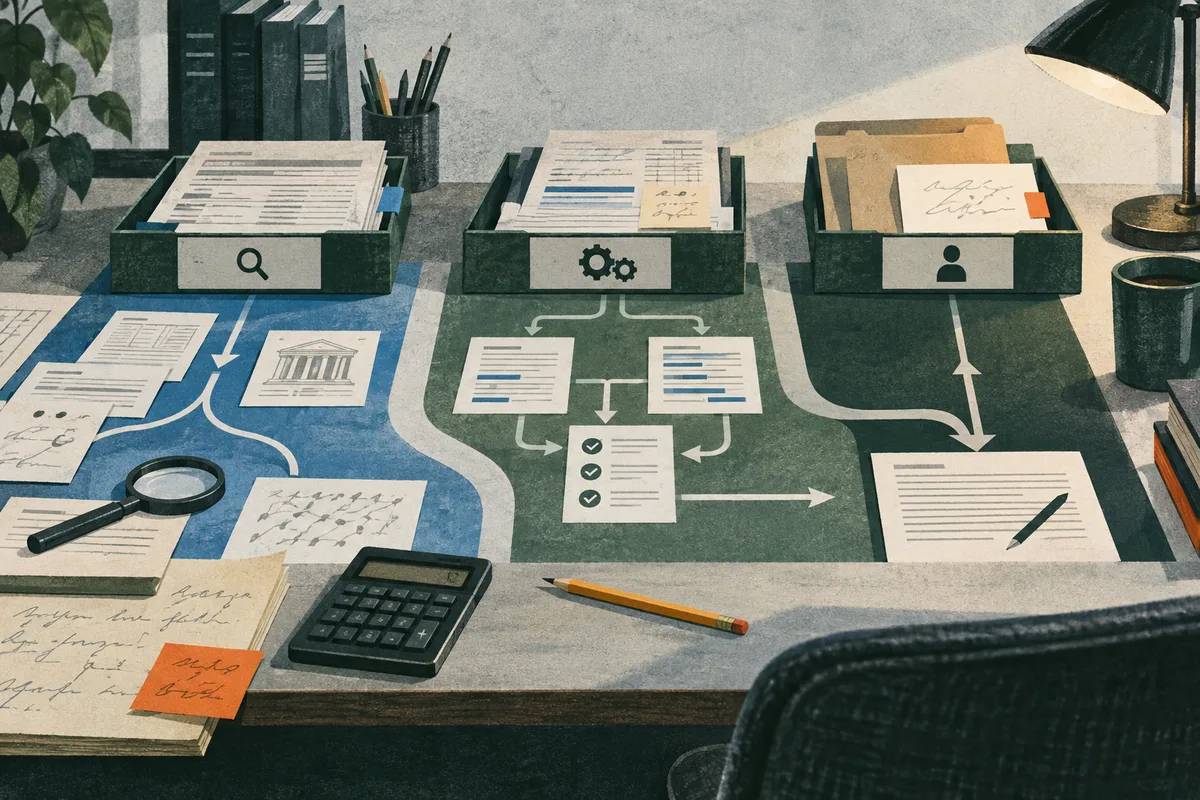
Tax preparers can use AI for bounded research only when the firm approves the tool and data use, sources are traceable and opened, taxpayer facts are established, law and calculations are independently checked, and an authorized reviewer approves the work. Pause if any condition is missing. A research lead becomes accountable advice when someone applies it to a taxpayer’s circumstances, adopts a filing position, or communicates a conclusion. Tool use alone does not show adoption or job displacement.
The short answer: let AI help assemble research, not own the conclusion
A tax preparer should use AI for bounded research only when five conditions are met: the firm approves the tool and data use; sources are traceable and opened; relevant taxpayer facts are established; legal authorities and calculations are independently checked; and a authorized reviewer reviews the work before it becomes advice or a filing position. If a condition is missing, pause or escalate. An internal lead or outline is not automatically advice. The handoff occurs when someone relates authority to a taxpayer’s circumstances, adopts a position, files it, or communicates a conclusion. The IRS Office of Professional Responsibility’s “Introductory Guidelines for Responsible AI Use in Federal Tax Practice” says practitioners must verify AI-produced facts, citations, and calculations, and authenticate information before giving written advice. Generated advice is a starting point for thorough review, not a substitute for it.
That boundary follows responsibility, not fluency. Polished prose does not establish that authority is current, assumptions fit the taxpayer, or arithmetic is sound. The same OPR guidance calls for secure, firm-approved systems and documented procedures, which must come before entering client material. The IRS “Frequently Asked Questions” explains that Circular 230 practice before the IRS includes preparing and filing documents, communicating with the agency, and giving oral or written tax advice. It also identifies who is subject to Circular 230; applicability depends on the practitioner’s role and practice. This is a workflow guide, not a universal legal test for every preparer, service, or jurisdiction. Before trying a task, map tool scope, review evidence, and approval authority. AI use alone does not establish broad employer adoption or imply preparer job displacement.
Sources: Issue Number: 2026-19. Introductory Guidelines for Responsible AI Use in Federal Tax Practice; Frequently Asked Questions
What exactly counts as research, advice, and accountable work?
Research is the work of finding, organizing, and summarizing potentially relevant tax authorities so a preparer can examine them. Those outputs are leads, not established answers. The practical boundary is therefore not whether a person or a tool produced the first words. It is whether someone has verified the material and taken responsibility for applying it. Advice begins when authority is related to a taxpayer’s circumstances and a conclusion is adopted or communicated:. The IRS Office of Professional Responsibility’s “Issue Number: 2026-19. Introductory Guidelines for Responsible AI Use in Federal Tax Practice” summarizes Circular 230 §10.37’s requirements for written federal tax advice. It says practitioners must use reasonable factual and legal assumptions, consider relevant facts and circumstances, make reasonable efforts to identify facts relevant to the matter, relate applicable law and authorities to those facts,. The guidance says AI-generated advice should be treated as a starting point: citations and cases must be checked, and forecasts, inputs, and formulas confirmed before use. Producing text and adopting its conclusion are separate acts: an employee may collect a lead for a reviewer without endorsing it, while copying that lead into a return position gives it practical effect. The preparer should therefore label unverified material, preserve its source trail, and prevent it from being treated as settled until a qualified reviewer resolves the issue. The handoff can happen inside the firm, before a client sees anything. An internal draft that contains taxpayer information still raises data-handling questions,. The OPR guidance calls for secure, enterprise-approved AI,. So “internal” describes the audience; it does not itself establish that a tool or use is permitted, that the answer is reliable, or that no one has adopted its conclusion. Circular 230’s boundary also needs care. The IRS “Frequently Asked Questions” page defines practice before the IRS as matters involving a presentation to the agency about a taxpayer’s rights, privileges, or liabilities. It includes preparing and filing documents, IRS communications, oral or written tax advice, and representation. The FAQ identifies categories of practitioners and says who may practice; it does not mean every person who prepares a return is governed identically for every service. Nor does the federal definition decide what state licensing rules or a particular engagement require. The OPR guidance itself is introductory guidance for federal tax practice, not a complete rulebook for every preparer or jurisdiction. Before using this distinction as a workplace rule, identify your own role, the service and engagement, the relevant jurisdiction, and your firm’s policy. Ask who may approve research tools, who must verify authorities and facts, and who has authority to sign off on a client-facing position or filing. If those answers are unclear, keep the task within approved limits and escalate the question. The useful separation is between assembling information for review and owning its application—not between a machine’s output and a human’s keystrokes.
Sources: Issue Number: 2026-19. Introductory Guidelines for Responsible AI Use in Federal Tax Practice; Frequently Asked Questions; Office of Professional Responsibility and Circular 230
Which parts of the preparer's task bundle can be assisted?
The dividing line is not “computer work” versus “human work.” O*NET’s “Tax Preparers” profile lists these tasks, including consulting tax references for atypical returns. It describes an occupation’s work; its importance ratings do not show how much time each task takes, whether a particular AI system performs it reliably, or whether an employer has adopted that system. Choose a step with bounded inputs and checkable output. Candidate research uses include organizing a defined issue list, suggesting search terms, locating candidate authorities, or structuring an internal memo around rules, facts to verify, and open questions. These steps retrieve and organize leads; they do not establish that an authority is current, controlling, or relevant. Open each source, check jurisdiction and tax year, and look for conditions or contrary authority. The IRS Office of Professional Responsibility’s “Introductory Guidelines for Responsible AI Use in Federal Tax Practice” says practitioners must review AI-created material incorporated into client or IRS documents and verify facts, citations, and calculations. It supports treating an outline as a lead for investigation, not a substitute for one. Calculations and record checks can look suitable for assistance when the task is concrete: reconcile a figure, flag a mismatch, or identify a missing field. But a structured input may still be incomplete, mislabeled, or subject to a special rule. O*NET lists computing tax amounts, reviewing financial records, and checking data or totals as core tasks. Check a suggested calculation’s inputs, method, rules, and result under firm process. The boundary sharpens when facts are unsettled. Asking a client about income or expenses, deciding whether records support an account, noticing contradictions, and identifying which missing detail matters call for inquiry and judgment. A tool might help draft questions for an issue already identified; a summary cannot establish that a client’s answer is true or credible. O*NET also lists interviewing clients, furnishing advice, explaining tax law, answering questions, and planning. These tasks apply information to circumstances; generated responses need review before becoming client answers or filing positions. A practical test is to choose one repeatable research step with clear inputs, expected sources, and stop conditions. For instance, an approved tool could structure an internal memo on a narrow issue; the preparer would retrieve and read each proposed authority, mark unknown facts, and obtain authorized review before the analysis is used. The OPR guidelines say written advice should rest on reasonable factual and legal assumptions, consider relevant facts, and relate law to facts. Record what was organized, verified, remains uncertain, and who approved the conclusion. If the task requires judging taxpayer facts, resolving an unusual issue, choosing a filing position, or explaining a result as advice, it has moved beyond research mechanics. Keep the decision with a competent, authorized reviewer and escalate when facts or expertise are missing. This does not mean every task is equally exposed or assisted work will disappear; capability is not adoption, and assistance does not transfer responsibility. Start with traceable work; stop before a draft becomes the firm’s answer.
Sources: 13-2082.00 - Tax Preparers; Issue Number: 2026-19. Introductory Guidelines for Responsible AI Use in Federal Tax Practice
Why tool and data approval come before the research prompt
Permission belongs before the prompt because the information can leave the preparer’s controlled workflow as soon as it is entered. A taxpayer name, identifying number, income record, dependent detail, or return excerpt may be tax return information. The IRS Office of Professional Responsibility’s “Introductory Guidelines for Responsible AI Use in Federal Tax Practice” notes that the statutory definition is broad and warns of unauthorized use or disclosure when sensitive data is uploaded to unsecured or public systems. The guidance also describes a less obvious confidentiality concern: information supplied for one client or issue could be repurposed or combined in a response involving another client. That is a risk the preparer cannot assess from the prompt box or a polished answer alone.
So the first question is not whether a tool can summarize a tax rule. It is whether the firm has approved that particular system, configuration, data category, and work purpose. OPR recommends secure, enterprise-approved AI, robust confidentiality safeguards, internal protocols for secure data handling, access controls, staff training, and vetting of external providers. It also says firms should document their processes. Those recommendations make approval specific: a firm’s general permission to experiment with AI does not automatically authorize uploading client documents to every service, account, or feature. An enterprise label is not itself evidence about retention, provider access, model use, or the controls enabled in a particular deployment.
This is why removing a name may not settle the question. A combination of amounts, dates, transactions, family details, and unusual circumstances can still describe a real return or reveal information about a client. If policy is unclear, pause that use. Ask the supervisor or compliance lead what systems and data are allowed, or continue with non-sensitive material in an approved workflow while the question is resolved.
The IRS “Frequently Asked Questions” explains that Circular 230 governs practice before the IRS and that duties vary with a practitioner’s role and practice. It also points tax professionals to data-security and privacy planning. The sources do not mean every preparer, service, jurisdiction, or engagement has identical obligations. They do show why the firm should identify the safeguards governing the actual work rather than infer permission from marketing claims.
For a low-risk research task, the permitted input might be a general tax question with no taxpayer details, entered into an approved tool under the firm’s procedures. Even then, approval covers only the allowed use; it does not verify the answer or authorize sending generated text to a client. In practice, record the approved tool and purpose, the data boundary, and who to contact when the task crosses it. The sequence matters: permission first, then research, then source and fact checks, then authorized review. This gate prevents confidentiality from becoming an afterthought once an answer already looks useful.
Sources: Issue Number: 2026-19. Introductory Guidelines for Responsible AI Use in Federal Tax Practice; Frequently Asked Questions
A five-gate test for deciding whether a task stays research
Before an AI-assisted artifact reaches a return, client message, or filing position, ask five questions: Is tool and data use approved? Can sources be traced to the right tax year and jurisdiction? Are client facts sufficient and verified? Has a qualified person checked law, contrary authority, and calculations? Is an authorized person accountable for approval? The gates mark the handoff; it is not an IRS checklist or compliance guarantee.
First, confirm permission for this system and information. A routine prompt may contain tax return information. The IRS Office of Professional Responsibility’s “Introductory Guidelines for Responsible AI Use in Federal Tax Practice” warns of confidentiality risks and calls for secure, enterprise-approved tools. Approval must cover this configuration and data use, not merely . If uncertain, do not enter taxpayer information; seek approval or use authorized non-sensitive material.
Second, verify sources against the underlying authority. A generated citation or summary is only a lead until checked for existence, jurisdiction, and tax year. OPR advises checking citations and reading cases, and cautions that reliance may be unreasonable when system logic is opaque. A source list alone does not establish support. If a citation cannot be verified, pause and research through an approved source or escalate.
Third, determine whether facts are adequate. A rule summary cannot establish that a client meets it. For specified credits and filing-status determinations, IRS due-diligence guidance requires follow-up when information appears incorrect, inconsistent, or incomplete, and evaluation of whether answers make sense. Those duties are specific, but show why AI cannot fill evidentiary gaps. It may organize questions; the preparer must assess answers and records. Mark missing material facts unresolved.
Fourth, verify application as well as retrieval. OPR describes written-advice duties to identify relevant facts and relate authority to them; it also advises confirming forecasts, inputs, and formulas. Check applicable law, contrary facts or authority, and material calculations before deciding whether the conclusion follows for this taxpayer. A correct quotation may fit the wrong facts, and sound research does not ensure correct arithmetic. If the reviewer cannot check these points, escalate to someone competent.
Fifth, name who may approve the result and when. OPR says AI-created material used in client or IRS-facing writing needs thorough review and cannot be the sole basis for the work. “Have a human check it” does not say who verified facts, sources, and calculations or owns the conclusion. The authorized reviewer should trace evidence to advice. Without that reviewer, keep the output as unapproved research.
Each gate blocks a different failure: approved data handling does not validate a citation, and valid authority does not prove facts or application. A failed gate means pause, verify, escalate, or return to manual work. Advance an artifact with evidence that lets the next reviewer repeat the checks; hold advice or a filing position for competent approval. This synthesis of OPR guidance and narrower IRS due-diligence instructions does not replace Circular 230 or firm policy; it makes the handoff and responsibility visible.
Sources: Issue Number: 2026-19. Introductory Guidelines for Responsible AI Use in Federal Tax Practice; Due diligence requirements for tax preparers
Why can a research summary not settle client facts?
A research summary can identify the rule to investigate, but it cannot establish whether the taxpayer’s account supplies the facts needed to use that rule. The difference matters when eligibility depends on details that are missing, inconsistent, or based on someone else’s records. A fluent summary cannot establish that it is complete enough for the task. The IRS’s “Due diligence requirements for tax preparers” gives a specific example in its rules for paid preparers handling covered credits and filing-status determinations. When information appears incorrect, inconsistent, or incomplete, a reasonable and well-informed preparer knowledgeable in the law must make additional inquiries. The IRS also says that tax software cannot replace professional judgment: preparers must ask reasonable questions, evaluate whether answers make sense, and follow up on inconsistencies, omissions, or suspicious information. These duties apply to the specified due-diligence contexts, not identically to every tax question. The examples show why applying a rule is different from retrieving it. To determine earned income for the Earned Income Tax Credit, the preparer may need to ask about the source and amount of income used to support the family and whether all income is reported. To assess whether a child qualifies for a credit, relevant facts may include whether that child is also the qualifying child of another person. For head-of-household status, the IRS points to the total cost of maintaining the home and whether the client paid more than half. A research note can list the questions; it cannot answer them for the client or turn assumptions into evidence. The same IRS guidance says preparers must use professional judgment about the credibility of the client and the answers received. If the answers or the client’s credibility leave the preparer uncomfortable, the page says not to prepare the return until satisfactory information resolves the concern. For the due-diligence matters it covers, the IRS also specifies records to keep, including relevant client documents, worksheets, and notes of additional questions and answers, retained securely. Those record rules apply in the stated contexts. That fact-finding work is part of the occupation’s described task mix. The U.S. Department of Labor’s O*NET “Tax Preparers” profile includes interviewing clients for income and expense information, reviewing financial records, furnishing advice, and checking entries. This occupation-level profile does not measure task time or AI use. This locates the handoff: a tool may organize questions, but the preparer must ask them and resolve gaps. So an AI-assisted summary can help prepare for fact gathering by organizing issues or flagging a missing input. It is a prompt for verification, not a finding. If an answer depends on household support, income sources, or who may claim a child, the preparer must obtain and assess the relevant information. A plausible narrative generated from incomplete inputs is not a substitute for the client’s evidence, a follow-up inquiry, or the judgment required.
Sources: Due diligence requirements for tax preparers; 13-2082.00 - Tax Preparers
What the available performance evidence does—and does not—show
The available chatbot example is a reason to verify complex tax answers, not a score for professional research tools. The Taxpayer Advocate Service's “Is AI Generated Tax Advice Making the Grade?” relays an informal Washington Post review of two consumer tax-preparation companies’ chatbots. Asked 16 complex tax questions, the chatbots gave inaccurate or irrelevant responses up to 50 percent of the time. That is a notable result for those products and questions, but the sample is small and consumer-facing. “Up to 50 percent” is not a measured error rate for all answers, tax questions, tools, or users, and the review does not establish how current professional research systems perform.
The distinction matters because a consumer chatbot answering a taxpayer differs from a preparer using an approved research platform to locate candidate authorities or organize an internal memo. The review reported inaccurate or irrelevant responses, not a controlled comparison of professional systems against a defined standard. It does not establish a general accuracy level, whether preparers could catch each error, or the time needed to verify results. Product type, question selection, date, and outcome definition shape what can be concluded. The TAS page was published in June 2024 and last updated in January 2026; it remains a bounded warning, not a benchmark for every tool now available. A vendor’s claim that its system draws on tax sources does not answer these questions.
The IRS Office of Professional Responsibility’s June 2026 “Introductory Guidelines for Responsible AI Use in Federal Tax Practice” offers process guidance, not a comparative performance study. It says practitioners must review AI-created material incorporated into client writings or IRS submissions, verify facts, citations, and calculations, and independently authenticate factual and legal information. It advises treating generated written advice as a starting point for review; opaque logic or unclear sources can make reliance unreasonable. This does not show every system performs poorly. It explains why system quality alone cannot settle whether an answer fits a client: the preparer still needs relevant facts, current authority, sound application, and responsibility for the conclusion.
For a work decision, judge the workflow rather than borrowing a chatbot score or accepting a vendor description. Can the preparer confirm each authority, check the tax year and jurisdiction, test facts and calculations independently, and account for review time and corrections? If a tool returns a conclusion without a traceable path, the work has not crossed the research-to-advice handoff. A transparent retrieval system may make checking easier, but cannot establish missing client facts or assume professional responsibility. The TAS example supports caution with complex consumer answers; OPR guidance supports review and authentication in federal tax practice. Neither establishes a universal error rate, proves professional tools are interchangeable, or predicts adoption or job displacement. Source-level verification and accountable review are the useful standard for an approved workflow.
Sources: Is AI Generated Tax Advice Making the Grade?; Issue Number: 2026-19. Introductory Guidelines for Responsible AI Use in Federal Tax Practice
How should a preparer document the handoff and reviewer?
For an authorized AI-assisted research task, the handoff should let a reviewer retrace the question, evidence, checks, and approval. Record the issue and tax year, jurisdiction, authorities actually opened, client facts and documents relied on, and assumptions, gaps, or contrary authority. Note what the tool contributed, what the preparer changed or rejected, which calculations were independently checked, and who approved the client-facing advice or filing position. Follow firm rules for retention, access, and security. A citation in a generated transcript does not show anyone verified it. The IRS Office of Professional Responsibility’s “Introductory Guidelines for Responsible AI Use in Federal Tax Practice” says practitioners should document AI use and verification. It describes firm procedures for secure handling, accuracy monitoring, staff training, and vetting third-party tools. For written advice, the guidance calls for independent authentication of factual and legal information: citations should be checked and cases read, while forecasts, inputs, and formulas should be confirmed. A useful record shows those checks, not simply “reviewed.” Identify the authority consulted and the point it supports; for a calculation, record verified inputs and independent recomputation. Documentation makes reasoning inspectable, but does not establish correctness by itself. The IRS’s “Due Diligence Requirements for Tax Preparers” offers a specific example. For covered credits and filing-status determinations described there, paid preparers must retain specified materials for three years, including Form 8867, worksheets, client documents relied upon, notes about how, when, and from whom information was received, and records of additional questions and answers. The page also calls for follow-up when information appears incorrect, inconsistent, or incomplete, and professional judgment about whether answers make sense. These rules concern the listed contexts; they are not a universal template or retention period for every tax matter. Follow the requirements and firm policy that apply to the file. The record should distinguish a tool’s suggestion from the preparer’s finding. If a system proposes a rule, identify the authority consulted, tax year, and how it relates to established facts. If it organizes a calculation, preserve source inputs and the independent check. When facts are missing or inconsistent, record the question, answer, and what follow-up resolved—or did not resolve—the issue. Flag material contrary authority or assumptions for escalation instead of hiding them in a polished summary. Approval must represent substantive judgment by a competent reviewer with authority to approve, not a signature added to satisfy a workflow. The reviewer should reproduce the path from relevant facts through current authority to the conclusion, see what was verified, and decide whether more inquiry is needed. A log cannot supply missing expertise or turn weak facts into adequate evidence. If a material claim cannot be traced or ownership of the conclusion is unclear, the handoff is incomplete: pause client-facing use, resolve the gap under firm procedures, and record the decision.
Sources: Issue Number: 2026-19. Introductory Guidelines for Responsible AI Use in Federal Tax Practice; Due diligence requirements for tax preparers
What capability is worth building inside the current role?
For a preparer who wants to remain in the field, build the skills that let you check a research lead against the right tax year, jurisdiction, records, and client circumstances. Prioritize finding and authenticating authority, asking precise follow-up questions, checking inputs and calculations, explaining why a rule applies, and recognizing when an issue needs escalation. Learn an approved tool only for a defined workflow. The 2026 O*NET Tax Preparers profile includes consulting tax references on atypical returns, reviewing records, interviewing clients, verifying entries, computing taxes, explaining tax law, and answering questions or planning with clients. Its task ratings describe occupational importance, not time spent, AI capability, or employer adoption. Identify the weak link in your own work rather than treating the job title as indivisible. If cases stall because facts are missing, improve targeted questions and escalation. The IRS Office of Professional Responsibility’s “Introductory Guidelines for Responsible AI Use in Federal Tax Practice” says practitioners should independently authenticate factual and legal information, check citations and read cases, confirm forecasts, inputs, and formulas, and thoroughly review generated advice. It means tool users need enough tax and workflow knowledge to spot a stale source, wrong jurisdiction, assumed fact, or answer they cannot check. Knowing when not to use an output is part of competent tool use. Choose learning by the gap and intended outcome. To improve one research step, a short course, supervised practice, or project with approved materials may be more proportionate than a degree. To deepen tax expertise, compare continuing education or credential requirements for your role and jurisdiction. The IRS FAQ describes Circular 230 as governing defined practice before the IRS and specified practitioners, so it is not a universal credential rule for every preparer. A technical degree fits only a broader technical transition if prerequisites, cost, schedule, and current income needs are workable. Choose one recurring task and name its weak link: current authority, fact gathering, figures, or explanation. Ask a supervisor which approved learning resource and review standard fit, then practice on permitted material and get the result checked. Keep practice tied to a real workflow. Weigh time and cost against salary, location, family, health, and available study time. Tax research, evidence checking, and clear explanation can carry across changing tools. This is an adjacent-skill direction, not job-security advice; the right next step depends on the work you want and can do.
Sources: 13-2082.00 - Tax Preparers; Frequently Asked Questions; Issue Number: 2026-19. Introductory Guidelines for Responsible AI Use in Federal Tax Practice
What is a proportionate next move at work?
A proportionate next move is a small, approved workflow test, not a broad decision about whether tax preparation is becoming automated. Map one recurring research task: its inputs, where the answer will go, and which step requires a preparer’s judgment. Ask a supervisor or compliance lead to approve the specific system and data use, identify acceptable authorities and checks, and name the reviewer authorized to approve a client-facing conclusion. If permission is unclear, keep taxpayer information out of the tool. The IRS Office of Professional Responsibility’s “Introductory Guidelines for Responsible AI Use in Federal Tax Practice” recommends firm procedures, secure approved tools, oversight, and documentation, supporting permission and review as part of the test’s design.
Use an authorized example and record sources opened, corrections, review effort, and any facts or assumptions that remain uncertain. Then decide whether to expand, narrow, or stop the task. This local test can show whether one workflow is useful and reviewable; it cannot establish market adoption or predict an individual preparer’s job prospects. If you still need to map your task mix, the free AI job-risk checker offers task-level change-pressure signals, not a validated probability of job loss. Treat it as a starting point for a work discussion, grounded in your actual duties, firm rules, and constraints.
Sources: Issue Number: 2026-19. Introductory Guidelines for Responsible AI Use in Federal Tax Practice
Questions readers ask
Can tax preparers use AI to research tax questions?
Only within the firm’s approved tool and data rules. Treat generated material as a lead: open and verify authorities, check the relevant tax year and jurisdiction, and independently review facts and calculations before use.
Does AI-assisted tax research make the preparer less accountable?
No. When a conclusion is applied to taxpayer facts, adopted as a filing position, or communicated as advice, an authorized competent preparer must own and review it. The rules that apply depend on the practitioner’s role, service, jurisdiction, and firm policy.
Sources and notes
- Issue Number: 2026-19. Introductory Guidelines for Responsible AI Use in Federal Tax Practice
Supports the federal practice guidance on verifying AI-generated facts, citations, calculations, confidentiality, firm procedures, and review before written advice.
- Frequently Asked Questions
Explains the scope of practice before the IRS under Circular 230 and that compliance depends on practitioner role and practice.
- Office of Professional Responsibility and Circular 230
Provides IRS information about the Office of Professional Responsibility and Circular 230 relevant to federal tax-practice boundaries.
- 13-2082.00 - Tax Preparers
Lists tax-preparer tasks including calculations, records review, client interviews, explanations, advice, planning, and tax-reference research; it does not measure AI use or task shares.
- Due diligence requirements for tax preparers
Describes follow-up inquiries, credibility judgment, and recordkeeping for specified paid-preparer due-diligence matters.
- Is AI Generated Tax Advice Making the Grade?
Reports an informal review of two consumer tax-preparation chatbots on 16 complex questions; the bounded result is not a benchmark for professional research systems.
Apply this to your own work
See the whole job market at once.
Explore which occupations AI may reshape, then turn the signal into a practical response.
Explore the job map