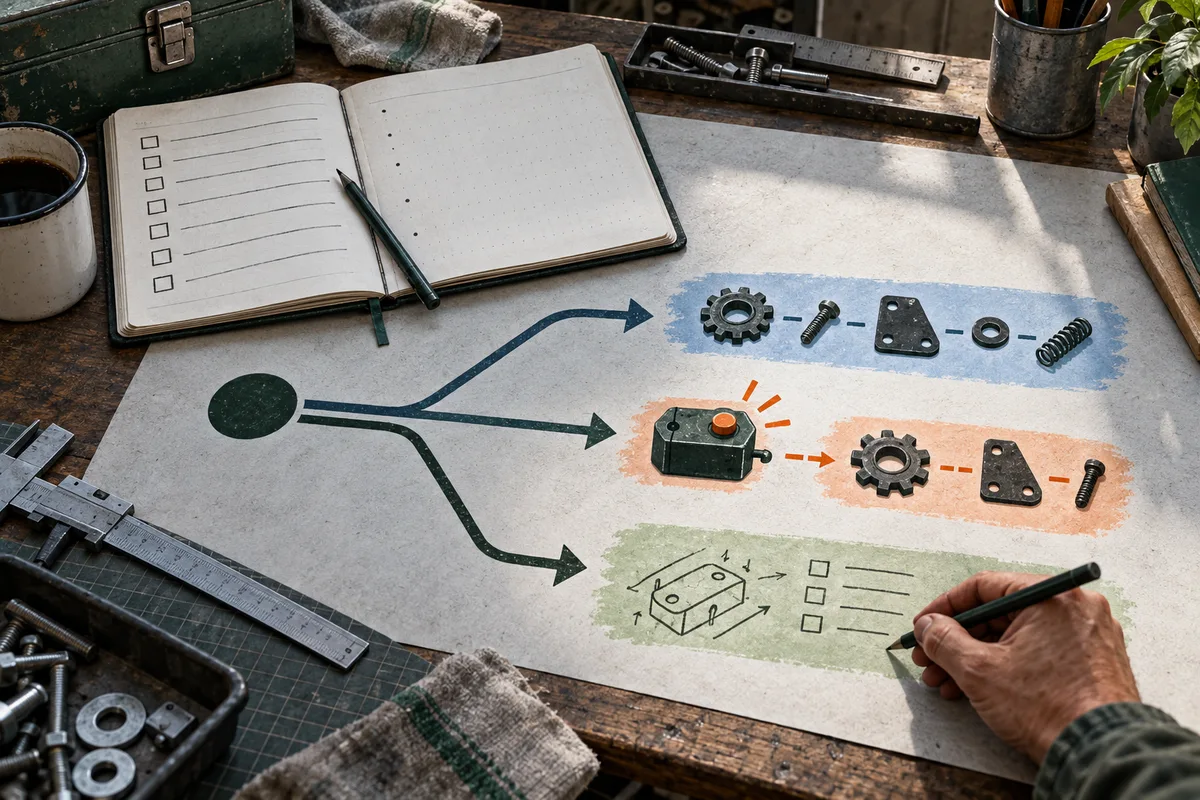
Compare a recorded unaided baseline with a fresh, similar attempt after using AI on a recurring task. Apply the same quality and error criteria, and separately note whether you can explain key choices, catch consequential mistakes, and account for review and correction time. A better assisted result shows workflow help; successful unaided performance is a local sign of transfer, not proof of durable mastery.
A faster AI-assisted result is not proof you learned the task
A faster or more polished AI-assisted result does not by itself show that you learned a recurring work task. The useful question is whether, after a short gap, you can handle a fresh comparable instance without the tool and meet the task’s ordinary quality standard. Compare it with a baseline recorded before using AI, applying the same criteria for acceptable work and consequential errors. Note the assisted result and checking time separately. This practical self-check concerns one worker and one task; it is not a validated assessment or a measure of job-loss risk. An unaided attempt that meets the standard, can be explained at important steps, and catches meaningful errors is a local sign of near transfer, not proof of durable mastery. “How AI Impacts Skill Formation” reports randomized developer experiments: learning an unfamiliar programming library, participants had weaker understanding, code-reading, and debugging outcomes overall, while some cognitively engaged patterns preserved learning. The July 2026 IZA discussion paper reports different results in an undergraduate experiment, including later unaided gains among explanation-oriented users. The unlike studies support testing how you use AI; neither validates this check. Use the evidence to decide whether to change the workflow or pursue training.
Sources: How AI Impacts Skill Formation; Experimental Evidence on the Learning Impact of Generative AI
What does ‘learning the task’ mean in observable work?
“Learning the task” should mean more than producing a good answer while the tool is present. For a recurring work task, look for a fresh attempt without AI that meets the task’s ordinary quality standard, can be explained at its important decision points, and catches consequential errors. Record these as three separate observations: quality describes the result; explanation gives evidence that the worker can account for key choices; error detection shows whether they can inspect and supervise work. Do not average them into a single score. A clean deliverable can hide a weak grasp of why it is correct. The first useful distinction is between assisted performance and transfer. Assisted performance answers, “What can I produce with this tool in the workflow I used?” Transfer asks whether I can use relevant knowledge on a new instance after the tool is removed. A structurally similar instance tests near transfer; changed constraints or context test broader transfer. One short-gap attempt cannot establish durable retention. The test is narrow: it informs a decision about one recurring task and one way of using AI. That distinction matters because a tool can complete visible steps while leaving the worker unable to explain them. In *How AI Impacts Skill Formation*, randomized experiments asked developers to master an unfamiliar asynchronous programming library with and without AI assistance. The abstract reports weaker conceptual understanding, code reading, and debugging with AI, while three of six cognitively engaged interaction patterns preserved learning outcomes. This narrow experiment illustrates why assisted output and independent understanding differ. The evidence also cautions against assuming that AI assistance necessarily blocks learning. *Experimental Evidence on the Learning Impact of Generative AI*, an IZA Discussion Paper, describes a randomized, proctored in-person experiment in which undergraduates learned an unfamiliar topic, wrote an analytical essay, and completed unaided assessments immediately and one week later. The abstract reports higher knowledge-test scores with AI, persisting at one week. Essay quality improved in style and relevance in later unaided work; gains were larger among students asking AI to explain concepts, while automation users’ short-run gains disappeared when AI was removed. This study concerns students learning unfamiliar academic material, not employees learning recurring tasks. Record the assistance mode: explanation and delegated production differ. Consider an illustrative spreadsheet task: reconcile a monthly total and investigate an exception. First, the worker defines the standard from the existing procedure: which records count, what qualifies as a discrepancy, and what evidence resolves it. After AI-assisted practice, a fresh case changes a category label or gives an exception a different cause. A useful check asks whether the worker can reach an acceptable reconciliation, explain why the exception changes the result, and notice a planted or naturally occurring inconsistency. This illustrative case makes no claim about accounting teams’ AI use; it shows how a changed detail tests rule application rather than answer memory. The standard must come from the work itself. Use the organization’s approved procedure, an established quality checklist, or a qualified colleague’s review where available. Do not invent a universal pass mark: acceptable error differs between a low-consequence draft and work that affects customers, payments, compliance, or safety. An explanation need not be polished. Ask whether the worker can identify key decision points, name the information relied on, and say when they would pause or seek review. Fluency, confidence, and a plausible-sounding rationale are not substitutes for checking the result against the real standard. Before seeing the fresh attempt, write down what would count as acceptable quality and which errors would change the decision or require escalation. Judge the three separately. Disagreement points to what to practice or review next. This gives a worker a more useful answer than “AI made me faster” or “I felt like I understood it.” It remains a task-specific signal, not a credential, a durable mastery claim, or a prediction about whether the worker’s job will change.
Sources: How AI Impacts Skill Formation; Experimental Evidence on the Learning Impact of Generative AI
How can you make the comparison fair enough to use?
A fair comparison begins before opening the tool: choose one recurring task with a result you can judge, and write down what acceptable work looks like. Do not invent a universal rubric or score. If quality depends on an accountable reviewer, use the existing standard and ask for qualified review where needed. Record one ordinary attempt without AI as a baseline. Record the case, applicable rules, result, and full task time. The comparison should have the same basic structure and difficulty, but should not be an exact repeat whose answer you remember. An identical case may test answer recall; a substantially harder case may make a sound process look worse. A similar but fresh instance is a practical compromise, not a guarantee that cases are equivalent. Next, use the tool on a few comparable instances and note how you used it. Did you ask for an explanation, request a critique, seek a hint or outline, or ask it to draft or complete the work? “How AI Impacts Skill Formation” reports randomized experiments with developers learning an unfamiliar asynchronous programming library. The researchers found weaker conceptual understanding, code reading, and debugging overall, while three of six interaction patterns involving cognitive engagement preserved learning outcomes. That developer experiment does not show which mode works for every job; it supports recording the interaction instead of treating all AI use as one condition. After a short gap, close the tool and attempt a fresh comparable instance. Compare the result against the same quality and error criteria as the baseline. Can you explain important choices in your own words? Can you notice a consequential mistake before it passes to the next step? Record these separately alongside quality, rather than blending them into a score. Log task context, assistance mode, quality, errors, production and checking minutes, and choices you can explain unaided. Note changes in rules, inputs, feedback, or workload; these can explain a difference as readily as the tool. If you repeat the check, use another comparable case. If results differ, consider fatigue, practice, or case difficulty. One baseline and a few repetitions cannot isolate cause or establish lasting mastery. A randomized online experiment summarized by the Stanford SCALE repository gives a reason to include an unassisted follow-up. It involved 1,174 adults aged 25–45 doing a workplace-style problem-solving task with or without a generative AI assistant, followed by an unassisted module. The repository reports that AI improved assisted performance, participants did not perform worse after AI was removed, and some follow-up improvement appeared when intensive use coincided with sustained effort. This online experiment used a short follow-up module, not repeated training on employees’ jobs. It cannot supply your wait interval or predict your result; it shows why assisted output and later unaided performance should be observed separately. Keep the check within authorized, low-risk boundaries. Do not put confidential customer, employee, financial, health, or company information into an unapproved tool. Use approved practice material, a sandbox, or anonymized examples when permitted. Avoid live tests where errors could affect safety, legal obligations, pay, or a customer. Follow workplace review and disclosure rules, and involve the qualified person responsible for the outcome. At the end, ask: did this use pattern help me meet the task standard unaided on a fresh case, and what did checking add to total effort? If unclear, the test has identified what to observe next. Repeat with a comparable case before making a consequential training or workflow decision.
Sources: How AI Impacts Skill Formation; Does Generative AI Narrow Education-Based Productivity Gaps? Evidence From A Randomized Experiment
Why might the way you use AI change what transfers?
Compare coaching uses—asking for an explanation, hint, critique, or practice question after making your own attempt—with completion uses that hand the tool most of the reasoning or production. Research does not show that one mode always works, but several studies make mode and sustained engagement plausible factors to observe.
In the randomized developer experiments reported in How AI Impacts Skill Formation, participants learned an unfamiliar asynchronous programming library with and without AI. Yet the researchers distinguished six interaction patterns, and three involving cognitive engagement preserved learning outcomes despite AI assistance. This is evidence about a narrow programming task and experimental group, not a rule for every experienced worker or tool. It does suggest that who does the thinking during practice may matter more than the mere presence of assistance.
A different pattern appears in Experimental Evidence on the Learning Impact of Generative AI, an IZA Discussion Paper. In a randomized, proctored study, undergraduates learned an unfamiliar topic, wrote an analytical essay, and completed unaided assessments immediately and one week later. The IZA record reports higher immediate knowledge-test scores with AI, gains that persisted at one week, and later unaided essay improvements in style and relevance. Those delayed gains were larger among augmentation users, who used AI to explain concepts, while automation users' short-run essay-quality gains disappeared once AI was removed. The paper also reports that students shifted time from drafting toward reading and searching.
The Stanford SCALE record for Does Generative AI Narrow Education-Based Productivity Gaps? Evidence From A Randomized Experiment describes 1,174 adults aged 25 to 45 in an online experiment. Participants completed a workplace-style problem-solving task with or without an AI assistant, followed by an unassisted module. AI improved task performance, and the record says participants did not perform worse after removal; some follow-up improvement appeared when intensive use came with sustained effort. A sizable gap in unaided performance re-emerged, however. Read alongside the developer and undergraduate studies, it cautions against both blanket claims: delegated assistance does not always erase later performance, and assisted success does not itself prove independent learning.
The studies differ in population, task, assistance pattern, duration, and measure. Practice, prior knowledge, task design, or differences in how participants chose to interact may also help explain their findings. The practical inference is modest: treat assistance mode as a factor to observe in your own low-risk comparison, not as a guaranteed cause of learning.
If policy and task risk allow, compare two approaches on similar practice cases: first ask for a hint or explanation after attempting the work yourself; on another case, use the tool to draft or complete more of it. Keep the task criteria and review standard the same, record which mode you used, and later try a fresh instance without AI. Do not change several parts of the workflow at once if you want to understand what may have mattered. Never use confidential or high-stakes live work as informal practice without authorization and proper review.
If the coached approach is followed by stronger unaided work, that is a useful local signal to continue testing it. If only the assisted deliverable improves, the tool may still be a practical speed aid, while the underlying skill needs separate practice. It answers a smaller and more actionable question: which way of working with this tool seems to help you learn this task?
Sources: How AI Impacts Skill Formation; Experimental Evidence on the Learning Impact of Generative AI; Does Generative AI Narrow Education-Based Productivity Gaps? Evidence From A Randomized Experiment
How should you count speed, checking, and error cost?
Record production time, review and correction time, and perceived effort separately. For each attempt, note the task conditions and the assistance used, so a difficult case is not mistaken for a tool effect and a completion draft is not confused with coaching or critique. A faster first draft can still create a slower or riskier total workflow, and lower effort does not establish learning; the unaided transfer check answers a different question. For each attempt, use a consistent start and stop rule. Start when you begin the task, and stop when the result is ready for its normal recipient or next step, not when the tool produces its first answer. Include time spent framing the request, waiting, checking facts or calculations, correcting omissions, making a handoff, and redoing work. Keep active production minutes and review/correction minutes as separate entries as well as noting their combined elapsed time. Also record whether another person had to check or repair the result, since that handoff is part of the workflow when the task normally requires it. Use the same quality anchor for the unaided baseline and the assisted result. Do not award a speed gain for a result that falls below the ordinary standard. A typo and a wrong figure with downstream consequences are not interchangeable units. Where error severity cannot be responsibly priced, report it plainly rather than hiding it inside a single “net productivity” score. Time, quality, and risk answer different questions. A short log can preserve that distinction without pretending that every task has a common unit of value. Perceived effort belongs in the log because the experience of doing the task can change even when elapsed time does not. But effort is not a clock and is not a learning measure. In “Cognitive offloading and the speedup illusion in human-AI interaction,” a preregistered behavioral study of 1,237 participants doing simple cognitive tasks found no overall difference in actual completion time between independent and AI-assisted work, even though participants expected AI to be faster. Participants also reported lower subjective effort with AI despite equivalent times. The authors report that the pattern varied by task difficulty: AI was faster on difficult tasks in their experiment, but not easy ones. The preprint concerns simple experimental tasks, not complex workplace workflows. It does show why expected speed and felt ease should not substitute for timing the actual task. Keep the learning verdict separate from the workflow verdict. If accepted quality improves and total time falls, AI may be useful as a speed aid even if a later unaided attempt shows no learning. If unaided performance improves but checking absorbs the saved time, the tool may still be helping practice while offering little time advantage. If the stakes are high, a quick workflow is not sufficient reason to relax verification or accountability. A 2025 study protocol, “Effects of generative artificial intelligence on cognitive effort and task performance,” describes a planned randomized study of college students doing analytical writing and explains why researchers distinguish task outcomes from process measures; because it is a protocol, it reports no completed trial result. Keep the observations separate and let error consequences govern review.
Sources: Cognitive offloading and the speedup illusion in human-AI interaction; Effects of generative artificial intelligence on cognitive effort and task performance
What does mixed evidence say about assistance and learning?
Evidence from workplaces and experiments does not support a universal answer. “Generative AI at Work” examined the staggered introduction of a conversational assistant among 5,172 customer-support agents. The Stanford Digital Economy Lab record reports a 15% average increase in issues resolved per hour. Less experienced and lower-skilled agents improved speed and output quality; the most experienced and highest-skilled had small speed gains and small quality declines. The record also describes evidence consistent with learning, particularly for less experienced agents and rare problems. This counters the idea that assistance necessarily prevents learning, but the study covers one firm, task family, and assistant rollout. Its productivity measure is not a fresh unaided assessment of an individual’s competence. Controlled learning studies show why the interaction itself deserves attention. In “How AI Impacts Skill Formation,” developers learned an unfamiliar asynchronous programming library with or without AI. The arXiv abstract reports weaker conceptual understanding, code reading, and debugging for AI users overall, with no significant average efficiency gains. Full delegation brought some productivity improvement alongside weaker learning. Yet three of six interaction patterns involving cognitive engagement preserved learning outcomes. This does not establish that a particular prompt will teach a workplace task. It does show why workers should distinguish completion from using AI to explain, question, or critique their own attempt. A different pattern appears in “Experimental Evidence on the Learning Impact of Generative AI,” an IZA Discussion Paper published in July 2026. In a randomized, proctored experiment, undergraduates studied an unfamiliar topic, wrote an essay, and completed unaided assessments immediately and one week later. The IZA abstract reports that AI access raised immediate knowledge-test scores by 0.27 standard deviations, with gains persisting at one week. Essay quality changed little during assisted work but improved in style and relevance on later unaided essays. Delayed gains were larger among students using AI to explain concepts than among those using it to generate text. This complicates a simple deskilling account, but the study concerns undergraduates, not experienced employees repeating job tasks; as a discussion paper, it is emerging evidence, not settled workplace guidance. An online randomized experiment described by Stanford SCALE adds another distinction. It involved 1,174 adults aged 25–45 doing a workplace-style problem-solving task followed by an unassisted module. AI improved assisted performance; participants did not perform worse after access was removed, and some retained improvement. Yet follow-up improvement after intensive use appeared only with sustained effort, while a sizable gap in unaided performance re-emerged. Across these studies, outcomes vary with task, assistance mode, learner activity, and measurement. Follow-up gains might also reflect ordinary practice, task design, or differences in how participants chose to interact, rather than an effect that transfers to every job. For a worker deciding what to do next, this mixed record makes a bounded task check useful. It cannot show whether AI will change an occupation or whether an employer will adopt it. It can address a narrower question: after this kind of assistance, can you perform a fresh comparable task, explain key choices, and catch important errors? A stronger general workplace conclusion would require replicated studies across occupations, with delayed assessment on genuinely new tasks and comparisons of assistance modes. Until then, use research to decide what to observe, and let your own carefully bounded result guide this workflow choice.
Sources: Generative AI at Work; How AI Impacts Skill Formation; Experimental Evidence on the Learning Impact of Generative AI; Does Generative AI Narrow Education-Based Productivity Gaps? Evidence From A Randomized Experiment
What should you do when the results disagree?
When results disagree, do not average them into a single “AI helped” score. If the assisted result improves but your fresh unaided attempt does not, treat the tool as an output or speed aid for now. Keep using it only where that is useful and permitted, while setting aside deliberate practice for the part of the task you need to perform yourself. If your unaided result improves but the assisted workflow adds substantial checking, corrections, or consequential errors, change the workflow and repeat the comparison. If quality or error detection falls below the ordinary standard on work that can affect people, money, safety, or legal obligations, stop informal experimentation and use approved review or training procedures. A compact decision table can keep the signals distinct: | Assisted result | Fresh unaided result | Workflow cost | Reasonable next move | |---|---|---|---| | Better | No clear improvement | Faster, with acceptable checks | Keep it as a bounded aid; practice the underlying steps separately. | | Better | Better quality, explanation, or error detection | Checking erases the time gain | Retain the learning method only if its added value justifies the cost; simplify or change the review process and retest. | | Better | Worse or unreliable | High correction burden or serious errors | Pause use on consequential work; seek accountable review and approved instruction. | | No meaningful gain | No meaningful gain | More effort or rework | Stop this use pattern or test a different, clearly defined one. | These are action categories, not validated thresholds. “Better” means meeting the task’s predeclared standard on evidence that matters for that task; explanation and error detection should remain visible observations, not points in a composite score. Research gives reasons to test use patterns without promising a particular outcome. “How AI Impacts Skill Formation” reports randomized experiments in which developers learning an unfamiliar programming library showed weaker conceptual understanding, code reading, and debugging overall, while some cognitively engaged interaction patterns preserved learning. That finding makes it reasonable to try a hint, critique, or explanation after your own attempt if completion mode did not transfer. It does not show that coaching will work for every occupation. If a result seems anomalous, repeat on another comparable instance before changing a career or team process. Note whether the case was harder, the rules changed, you had less time, or fatigue affected the attempt. For consequential work, use approved practice data and tools, follow disclosure and privacy rules, and keep a responsible human reviewer in the loop. Do not test with confidential records or live customer, payroll, safety, or legal decisions without authorization. Even a convincing result is narrow: it says something about learning a task under one use pattern, not what share of your role is exposed to AI, whether an employer will adopt it, or whether your job is at risk. If your separate question is which work tasks may face change pressure, the free task checker can help map those signals; it does not assess learning or predict displacement. A career roadmap is relevant only if you need to compare broader work options against your own constraints.
Sources: Generative AI at Work; How AI Impacts Skill Formation; Experimental Evidence on the Learning Impact of Generative AI
What is the smallest useful next step?
Choose one recurring, low-risk task this week. Before using AI, write down what an acceptable result must include and which mistakes matter. Use the standard already applied to the work, or ask a qualified colleague to clarify it; do not invent a pass score after seeing the result. Save an unaided attempt as your baseline. On comparable practice, record how you use the tool: asking for an explanation or critique, or letting it draft or complete the task. Note the result, errors you catch, production time, and checking and correction time. Then set the tool aside and try a fresh, similar instance after a short gap. Can you meet the same standard, explain important choices, and notice consequential errors? The SAGE Framework’s GenAI-101 module offers study advice to explain, check, adapt, and reproduce AI-assisted work. This comparison is a local check, not a validated assessment. Repeat with another comparable case before a consequential decision, since difficulty, fatigue, or ordinary practice may shape what you observe. Do not test on live work affecting customers, safety, pay, or regulated decisions without authorization; use approved practice material and required review. Begin with your existing experience; no new degree, paid course, or career change is required. Treat the result as a local signal, not a credential or career forecast. For a separate question about which tasks face change pressure, the free checker at /ai-job-risk-checker offers task-level signals, not a learning result or job-loss probability. The paid roadmap at /career-roadmap compares career scenarios without guaranteeing employment or income.
Sources: GenAI-101 v3: Generative AI Literacy & Numeracy Module — SAGE Framework
Questions readers ask
What is the simplest way to test whether AI helped me learn a work task?
Record an unaided baseline, practice with AI on comparable instances, then attempt a fresh similar task without the tool. Compare quality, explanations, error detection, and total workflow time against standards set before the test.
Does finishing a task faster with AI mean I learned it?
No. A faster assisted result shows that the workflow helped produce an output. To look for learning, check whether you can perform a fresh comparable task unaided and meet the same quality standard.
Should I use AI for practice on consequential work?
Do not use confidential, regulated, safety-critical, customer-impacting, or pay-affecting live work for informal testing without authorization. Follow workplace policy and use approved practice material and qualified review.
Sources and notes
- How AI Impacts Skill Formation
Supports distinguishing assisted output from independent learning through randomized developer-learning experiments; the narrow programming context limits workplace generalization.
- Experimental Evidence on the Learning Impact of Generative AI
Reports randomized undergraduate learning results that varied by assistance mode, complicating claims that AI always prevents learning.
- Does Generative AI Narrow Education-Based Productivity Gaps? Evidence From A Randomized Experiment
Describes an online randomized experiment with an unassisted follow-up, supporting separate observation of assisted performance and later unaided performance.
- Cognitive offloading and the speedup illusion in human-AI interaction
Reports a preregistered behavioral study where perceived effort, expected time savings, and measured completion time differed.
- Generative AI at Work
Reports workplace evidence from a customer-support assistant rollout, including productivity changes and patterns consistent with learning, in one firm and task setting.
- Effects of generative artificial intelligence on cognitive effort and task performance
Provides a study protocol distinguishing task performance from process measures; it describes planned research, not completed trial results.
- GenAI-101 v3: Generative AI Literacy & Numeracy Module — SAGE Framework
Offers study-oriented advice to explain, check, adapt, and reproduce AI-assisted work; it does not validate the article’s proposed workplace self-check.
Apply this to your own work
See the whole job market at once.
Explore which occupations AI may reshape, then turn the signal into a practical response.
Explore the job map