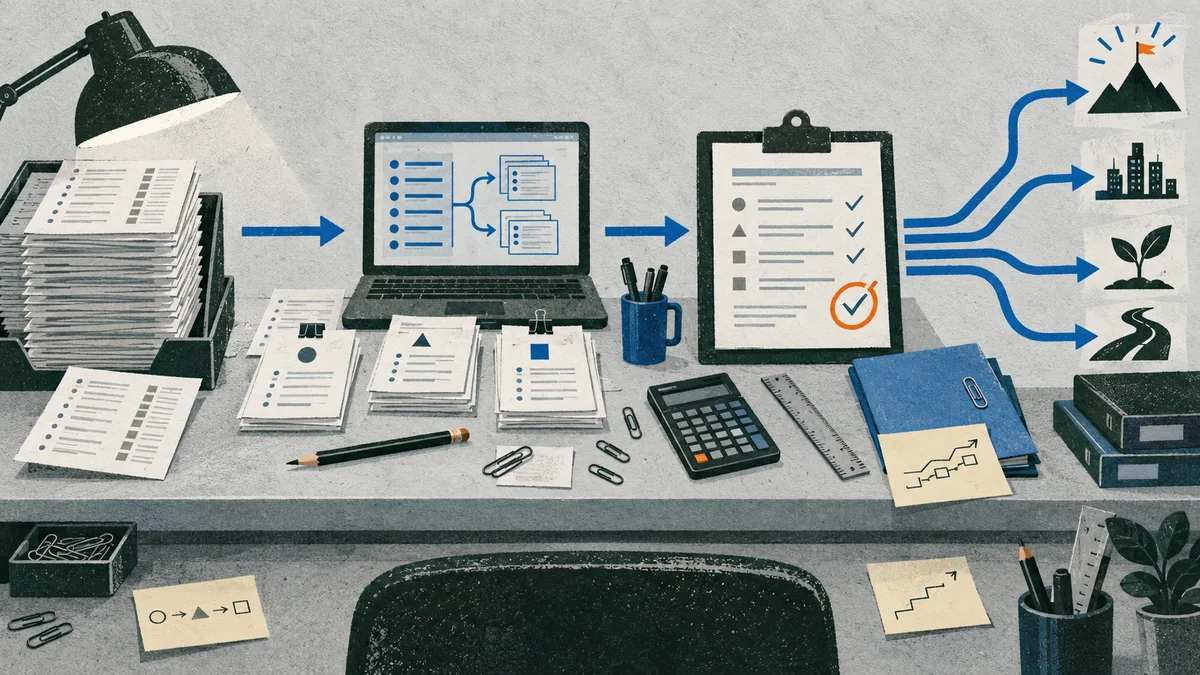
Choose one recurring report with approved inputs and checks you understand. Save the conventional version, then use an approved tool for one bounded step on the same material. Compare accuracy, completeness, usefulness, review effort, and total time. Package both versions with your checks, corrections, and decisions. The result can show what happened on this task under these conditions, not general productivity, employer adoption, or job security.
Direct answer: how can you turn one report into an AI-assisted work sample?
Choose one recurring report whose audience, inputs, definitions, and correctness checks you understand. Save a conventional version as the baseline. Then use an approved tool for one bounded step, such as drafting a summary from checked figures, while keeping the question, period, and source material constant. Compare both versions for accuracy, completeness, usefulness, correction and review effort, and total time. The result may justify keeping the step, narrowing it, or rejecting it because checking costs too much. Any outcome is useful if you show how you reached it.
Package the task definition, both versions, your checks and corrections, and a note explaining which decisions and approval remained yours. Use only data and tools your workplace permits; otherwise, label a demonstration made with public or synthetic material. The NIST AI 600-1 Generative AI Profile recommends documenting measures under relevant conditions, verifying generated claims, and avoiding broad conclusions from narrow assessments. Apply that limit: this sample can show what happened in this report with these inputs and checks. It cannot establish general productivity, employer adoption, or job safety, and no result is claimed for your workplace. This comparison lets you test one task before committing to wider redesign or retraining.
Why is one reporting task a better test than your whole job?
A job is too broad to test in one work sample. It combines tasks with different inputs, decisions, audiences, and consequences. One report is more useful when you can name who reads it, the period it covers, the records behind it, the steps that turn those records into an update, and the checks that make it trustworthy. Those boundaries give you something to compare: a defined result made under known conditions. A polished paragraph alone cannot show the work that produced it. Occupational exposure can help identify where to look, but it cannot tell you whether your workplace has adopted a tool or changed a role. The International Labour Organization’s 2025 study, “Generative AI and Jobs: A Refined Global Index of Occupational Exposure,” combined nearly 30,000 occupational tasks with expert validation, AI-assisted scoring, and harmonized labor-force data. Its estimate that 25% of global employment is in occupations potentially exposed to generative AI is an occupational-level signal. The ILO says this is potential exposure, not actual job loss; implementation also depends on infrastructure and skills. It is a reason to inspect tasks, not a forecast about your report, employer, or job. The ILO’s 2026 brief, “Workers’ exposure to AI: What indicators tell us – and what they don’t,” explains that exposure indices use static task lists, vary by method, and omit constraints such as economic feasibility and institutional barriers. They describe what AI could do under a simplified view of tasks; they do not establish whether a firm will adopt it, how a workflow will change, or what happens to employment and demand. That distinction changes the worker’s question: which repeatable part of a report is suitable to test and possible to check? Map the report as a sequence. Data gathering obtains records; calculations turn them into totals or comparisons; interpretation explains what the numbers mean; drafting makes checked evidence readable; review checks the result; delivery brings it to the audience. “Building an AI-Assisted Reporting Workflow: From Repeated Clicks to a Reviewed Update,” a practitioner example, separates collection, calculation, interpretation, review, and delivery. It notes that routines contain choices about dates, populations, and meaning. The page illustrates a method; it is not independent evidence of performance gains. The map matters because a sample changes one step while the report’s question, period, inputs, and definitions stay fixed. You might test drafting from checked aggregate figures while keeping calculations reproducible and a person responsible for interpretation and approval. If the audience is unclear, inputs cannot be used safely, or important claims have no check, the report is not ready for a fair test. Narrow it or stop there. The aim is an inspectable comparison, including one that shows the assisted step added review work or did not help. That is evidence about one bounded task under stated conditions, not evidence that a company has adopted AI or will alter staffing.
Sources: Generative AI and Jobs: A Refined Global Index of Occupational Exposure; Workers’ exposure to AI: What indicators tell us – and what they don’t; Building an AI-Assisted Reporting Workflow: From Repeated Clicks to a Reviewed Update
Which report task should you choose, and what counts as a safe test?
Choose a report that recurs often enough for its steps to be familiar, but is narrow enough to inspect. A weekly summary answering one defined question for one audience can work, such as whether service volume changed over a stated period. Frequency makes the routine recognizable; it does not make every part suitable for automation. Name the purpose, period, definitions, source records, and checks that make the answer acceptable. If these shift between runs, you will not know whether a different result came from assistance or changed rules. Ask whether you may use the information with the tool. Workplace reports can contain confidential, personal, or commercially sensitive material. Follow policy and use an approved environment for the data involved. If approval is uncertain, do not upload internal records. Instead, build a clearly labeled demonstration from public or synthetic data, if you can show the workflow and check its result. Such a sample makes your method inspectable; it cannot establish employer adoption or prove the workflow works on internal systems. Choose a task whose important claims have a dependable check. A total can be recalculated from source rows; a period comparison needs matching coverage and definitions; an interpretation may need context absent from the records. A polished paragraph does not show that all checks passed. The National Institute of Standards and Technology’s Generative Artificial Intelligence Profile describes risks including confidently stated false content and advises managing risks in context. Applied here, do not trial a consequential claim unless you can trace it to evidence and identify an error. Keep repeatable checks inspectable, and limit drafting assistance to permitted material. Missing coverage can invalidate a comparison. “Building an AI-Assisted Reporting Workflow” gives the example of an export complete only through Saturday when the period ends Sunday: comparing six days with a full prior week would not answer the intended question. It recommends holding a required full comparison until data refreshes, or labeling a partial update and omitting the ordinary full-week percentage. This is practitioner guidance, not a controlled study, but unmatched periods cannot support a like-for-like conclusion. Decide whether incomplete inputs mean stop, refresh, or report a bounded partial result. Keep consequences manageable. A draft kept private for review is a more bounded trial than a tool connected to email or publication. Sam Jolley’s “IT Operations Reporting Workflow” demonstrates a small sample using 24 service tickets and availability records for seven services, with validation, calculated totals, reconciled figures, stated limits, and human approval. It illustrates visible checks; it does not prove comparative performance or employer demand. If permissions, coverage, definitions, or verification are missing, reject the task for now. An impressive report is a poor work sample when its claims cannot be checked.
Sources: Artificial Intelligence Risk Management Framework: Generative Artificial Intelligence Profile; Building an AI-Assisted Reporting Workflow: From Repeated Clicks to a Reviewed Update; IT Operations Reporting Workflow
How do you set up a comparison that can answer a real question?
A useful comparison begins by fixing the question the report must answer, then holding its audience, period, source material, definitions, and acceptance criteria steady. Save the version produced through the usual process as the baseline. Make a second version that changes one bounded step, such as asking an approved tool to draft a short narrative from checked figures. If the assisted version also uses different records, a revised metric, and a different review standard, any difference has several possible causes.
Write down the protocol before generating the second version. Record the report question and intended reader; period covered; input files or safe data subset; metric definitions; step being changed; and what counts as an acceptable answer. Keep the versions comparable. If you clean an input, change a definition, or correct a source record, record that and apply it consistently where possible. Otherwise, the comparison may reward better inputs rather than the new step. This is a paired task check, not a laboratory experiment: narrowing what changed improves interpretability, while ordinary variation and judgment remain.
Set practical checks in advance, before a polished draft can shape your standard. For example, require totals and rates to reconcile to source data; material exceptions and incomplete coverage to remain visible; factual claims to point to supporting records; and causal explanations to be omitted unless supported. Ask whether each version answers the original reader question. These are proposed criteria for this reporting test, not a scorecard endorsed or validated by NIST. NIST AI 600-1, the Generative AI Profile, advises documenting measures under conditions relevant to intended use, reviewing generated sources and claims, and avoiding broad conclusions from narrow or anecdotal assessments. It supports disciplined limits; it does not certify a particular workflow.
Use the same review questions on both versions. Keep the original output, corrections, verification notes, and final approved version. For each path, note preparation, drafting, checking and correction time, plus total elapsed time through approval. Record material errors or omissions and whether the report was useful to its intended reader, including who judged usefulness and on what basis. The IT Operations Reporting Workflow illustrates a connection between checked inputs, calculations, narrative, and human approval; it is a practitioner example, not comparative proof. A concise log can show where assistance helped, added work, or made no visible difference.
Do not turn one paired run into a universal productivity claim. It is a descriptive comparison of one task under recorded conditions, not a statistically powered evaluation or evidence that another reporting role will see the same result. Its value is narrower: identify whether the change merits repetition, which checks caught problems, and what conditions shaped the outcome. If versions are not comparable, say what differed and treat the result as exploratory. Trace the conclusion to the question, inputs, criteria, and review record; use it to decide whether to repeat, narrow, or stop, not to infer a general effect from one report.
Sources: Artificial Intelligence Risk Management Framework: Generative Artificial Intelligence Profile; IT Operations Reporting Workflow
How should the sample separate numbers, narrative, and accountable decisions?
A useful reporting sample should make the handoffs visible: source records support calculations, calculations support statements, and a named human reviewer decides what the report means and whether it is ready to share. A polished paragraph alone hides whether its figures were checked, whether a cause was inferred from evidence, and who accepted responsibility for the final version. Start with numbers that can be reproduced. For each total, rate, or period comparison, retain a compact calculation trail: the input field or source extract, the definition used, the formula or aggregation, and the resulting figure. If a count changes because records were excluded, document the rule and its effect. Keep the calculation method outside generated narrative so that a reviewer can recalculate it directly from the permitted source material. A small table with metric, source, rule, result, and check may be enough. Narrative needs a different check. A figure can be compared with a formula or source row, but an explanation such as “the increase was caused by the new process” requires evidence that connects the change to that cause. A period comparison may show that two values differ; by itself it does not establish why they differ, whether the periods are comparable, or whether the difference matters to the report’s audience. The NIST AI 600-1 Generative AI Profile advises organizations to verify sources and citations in generated outputs. Each material sentence should point to its supporting record or calculation, or be marked as interpretation with its basis stated. If evidence only shows a change, describe the change and leave its cause open. The public IT Operations Reporting Workflow portfolio example illustrates a practical separation: it validates fields and periods, calculates totals, drafts from checked evidence, reconciles material numbers, notes limitations, and requires human approval. It is one demonstration of a workflow, not independent validation that the method will work in another organization or that AI improves a report. A simple traceability table can connect source item, calculated metric, drafted sentence, and reviewer disposition. The disposition might say “verified,” “corrected,” “removed,” or “retained as a qualified interpretation,” with a short reason. For a shareable sample, replace confidential records with public or synthetic inputs and label them accurately; retain enough structure to show how the checks operate without exposing protected details. The reviewer note should identify which decision stayed human, such as whether an exception changes the conclusion or a claim is ready for release. This is evidence of domain judgment and verification practice, not proof that the worker’s employer adopted the workflow or that the report caused a business outcome.
Sources: IT Operations Reporting Workflow; Artificial Intelligence Risk Management Framework: Generative Artificial Intelligence Profile
What should you measure besides speed?
A fair comparison needs more than a stopwatch. Record whether the report is accurate, complete, useful to its reader, and worth the effort required to prepare and check it. Count time across the whole path, from input preparation to approval. A shorter first draft may leave more work if figures need correction, exceptions disappear, or claims require extensive checking. Check accuracy and completeness separately. Accuracy asks whether material figures, dates, definitions, and statements match the approved evidence. Completeness asks whether the report covers the required period, relevant exceptions, and information needed to answer its question. Note each error or omission and its materiality: could it change the reader’s understanding or decision, or is it minor wording? A count of small edits should not conceal one serious error. Assess usefulness against the report’s purpose, rather than its polish. Could the intended reader answer the original question? Are limits and exceptions visible? If usefulness requires judgment, state the method: identify the reviewer or audience role, use the same question for both versions, and record a reason for the rating. “Building an AI-Assisted Reporting Workflow: From Repeated Clicks to a Reviewed Update” checks period, definitions, calculations, comparisons, interpretation, usefulness, and destination. This is a practical review aid, not evidence that a particular tool will pass those checks. Make the labor visible. Track time for input preparation, setup, generation, checking, corrections, and approval. Record reviewer effort as well as elapsed time: a task may finish sooner while demanding more concentrated checking. Do not turn one trial into a productivity rate. It describes those runs under those conditions; different inputs, task mix, and tool versions may change the balance. A compact record can show the result without inventing a combined score. For each version, note material errors and omissions, whether it answered its question, corrections, reviewer minutes, total time, and important exceptions. Explain what drove the verdict. NIST’s “Artificial Intelligence Risk Management Framework: Generative Artificial Intelligence Profile” recommends documenting performance measures under conditions similar to intended use, recording limits on generalization, avoiding extrapolation from narrow anecdotal assessments, and verifying sources and citations in outputs. Its relevant lesson is to state conditions and keep claims within the evidence. Use the comparison to decide whether to keep, narrow, or stop the assisted step. Keep considering it when it meets the same accuracy and completeness checks, helps the reader, and its review cost is acceptable. Narrow it if drafting helps but calculations, interpretation, or exception handling still need the existing process. Stop if material claims cannot be traced, errors persist, policy disallows the tool, or verification erases the time saved without another benefit. For example, if drafting takes less time but checking doubles because figures cannot be traced, the evidence supports narrowing or stopping, not calling the workflow faster. Report quality, effort, and limits together, even if the result is “not worth using yet.”
Sources: Artificial Intelligence Risk Management Framework: Generative Artificial Intelligence Profile; Building an AI-Assisted Reporting Workflow: From Repeated Clicks to a Reviewed Update
What do productivity experiments tell you—and what do they leave open?
Research makes it reasonable to test AI assistance in bounded writing work, but experimental gains cannot be copied into a forecast for your recurring report. The studies differ in task, setting, tool integration, and outcome. Neither measures whether a work sample helps with hiring.
In the 2023 study *Experimental Evidence on the Productivity Effects of Generative Artificial Intelligence*, 453 college-educated professionals completed occupation-specific, incentivized writing tasks in a preregistered online experiment. Half received access to ChatGPT. On average, access reduced time by 40% and raised output quality by 18%. This is evidence about structured writing assignments under the study conditions, not recurring reports, data reconciliation, or a worker's full role. Reporting may also involve calculations, evidence checks, and approvals beyond the writing measured here.
The 2025 paper *Shifting Work Patterns with Generative AI* studied work in a different setting. Across six months and 66 large firms, researchers randomly assigned access to an AI tool integrated into familiar office applications. Its dated May version reports 7,137 workers. Those who used the tool in more than half the observed weeks spent 3.6 fewer hours per week on email, or 31% less than the pre-study average; the intent-to-treat estimate was 1.3 fewer hours. Document completion was moderately faster, while meeting time did not significantly change.
That distinction complicates a simple claim that access makes every task faster. Assignment was randomized, but use intensity was not, so the frequent-user estimate is not a result every worker should expect from access. The study tracked application behavior, not report accuracy, content quality, staffing, or employment outcomes. It also involved participating large firms during an early rollout, with a tool embedded in applications already used for work.
The field paper found larger changes in behaviors workers could adjust independently than in behaviors requiring coordination. Applied to reporting, this suggests that drafting may be easier to change than shared data access, metric definitions, handoffs, or approval. That application is an inference; the study did not test reporting workflows. A report's narrative may be individually adjustable while its inputs and sign-off remain team processes.
Use the studies to justify testing one permitted step, not to claim a promised productivity rate or broad employer adoption. They offer useful context for a local experiment, not a target your own result must meet. Keep the report question, period, inputs, and checks fixed; compare the assisted step with the usual version, counting correction and verification time. Even a favorable result supports only a conclusion about that task under those conditions in this setting. It does not establish job security, labor demand, or future adoption.
Sources: Experimental Evidence on the Productivity Effects of Generative Artificial Intelligence; Shifting Work Patterns with Generative AI; Shifting Work Patterns with Generative AI
How can you package the result without overstating what it proves?
Package the work so a reader can trace the question, inputs, decisions, and checks without seeing confidential records. Include the report itself, a safe representation of its inputs, a compact workflow diagram, the corrections made, and a short contribution note. Label the piece a portfolio demonstration. It can show how you handled one reporting task under stated conditions; it cannot establish production impact, prove that an employer uses the same workflow, or predict how a particular employer will assess you.
The U.S. Office of Personnel Management’s guidance on Work Samples and Simulations describes formal work samples as tasks that mirror job activities. Keep the claim proportionate: you are demonstrating a method and the evidence behind your decisions, not presenting a certified assessment of your future performance.
A useful package can be organized as a short case file. First state the report’s audience, question, period, and acceptance criteria. Then identify the input provenance and permissions. If the data are public or synthetic, say so plainly and do not imply that the sample came from a live employer workflow. Show the conventional baseline beside the assisted version, identify the single step that changed, and include a workflow diagram separating source data, calculations, drafted text, human checks, and approval.
Next, provide a compact check log rather than only a polished final page. For each material correction, note what was checked, what changed, and why. Connect important report statements to the evidence or calculation that supports them. The NIST AI 600-1 Generative AI Profile recommends reviewing and verifying sources and citations in generated outputs, and it cautions against drawing broad conclusions from narrow assessments. The IT Operations Reporting Workflow offers an illustrative portfolio pattern: it uses synthetic-scale exports, validates fields and periods, reconciles material numbers, labels limits, and keeps human approval. It is one demonstration, not independent evidence of comparative performance or employer demand.
End with the comparison’s measures and a contribution note. Record accuracy, completeness, usefulness to the stated audience, review and correction effort, and elapsed time for both versions, describing how each was judged. State the result conditionally: for example, the assisted step was retained, narrowed, or stopped for this sample because of the checks and effort observed. Name limits such as synthetic inputs, one reporting period, or a particular tool version when they apply. If you cannot share the original records, explain what was substituted and which checks remain reproducible. Keep the artifact short enough to inspect: a clear evidence trail is more useful than a large bundle of unannotated screenshots or prompts.
Sources: Work Samples and Simulations; IT Operations Reporting Workflow; Artificial Intelligence Risk Management Framework: Generative Artificial Intelligence Profile
When should you keep, narrow, or stop the assisted step?
Keep the assisted step only when the comparison shows a meaningful benefit on a measure that matters to the report’s reader, and the work needed to check and correct it stays acceptable. Narrow it when the benefit belongs to one stage, one kind of input, or one clearly defined condition. Stop when a material claim cannot be verified, the workflow takes more effort without a compensating quality gain, policy does not permit the tool or data, or no one can say who remains accountable for release. These are decision rules for a task trial, not universal cutoffs: a minor wording error and a wrong figure with operational consequences should not carry equal weight. Start by examining the errors and omissions, not just whether the output looks polished. Record what was wrong, how important it was to the report’s purpose, whether the baseline had the same weakness, and whether the correction was straightforward. A single miss that a reliable check catches may point toward a narrower use; repeated unsupported claims in the core conclusion may make the step unsuitable. The relevant question is whether the assisted step improves the report’s usefulness or total effort after that review is counted. Then ask whether the result survives another comparable period or dataset. If practical, keep the question, definitions, acceptance criteria, and review method stable and repeat the comparison with another set of inputs. A changed reporting period, missing records, revised categories, or different audience can change the task itself, so note those changes instead of treating unlike runs as a clean replication. The NIST AI 600-1 Generative AI Profile recommends documenting measures in conditions relevant to intended use and cautions against drawing broad conclusions from narrow or anecdotal assessments. Applied here, that supports a transparent local test; it does not certify this scorecard or establish a required number of trials. The strongest objection to a keep decision is that one attractive sample may be unusually favorable. The prompt may have been tuned to those inputs, the sample may omit awkward cases, or the conventional baseline may have been weak. Preserve the inputs, definitions, prompts or instructions, outputs, edits, and review notes so another person can see what was compared. Describe the finding as a demonstration under stated conditions, even if it is repeated, rather than as proof that the process will work for every period or team. A repeat on comparable inputs reduces some uncertainty; it does not make the result universal. The ILO’s 2026 brief, “Workers’ exposure to AI: What indicators tell us – and what they don’t,” makes a related boundary clear: exposure indicators describe technological susceptibility, while feasibility, institutional constraints, adoption, and labor outcomes require other evidence. So a successful trial can justify keeping or refining one reporting step. It cannot establish that an employer has adopted the workflow, that staffing will change, or that the worker’s occupation is secure or threatened. If the result is mixed, narrow the next test to the stage with checkable outputs; if evidence is weak or authorization is unclear, stop and resolve that first. Reproducible results, acceptable review effort, and clear permission would strengthen the case to continue. A changed task, unreliable checks, or a new policy constraint could reverse it.
Sources: Artificial Intelligence Risk Management Framework: Generative Artificial Intelligence Profile; Workers’ exposure to AI: What indicators tell us – and what they don’t
What is the next move after one reporting test?
Set aside one bounded work session. Name the report’s audience, question, period, approved inputs, and checks. Save the ordinary version, then change one step in an assisted version using only material you may share. Compare both against the same criteria: figures reconcile, claims have support, exceptions remain visible, and the report answers its question. Record corrections, review effort, and total time. NIST AI 600-1 Generative AI Profile advises measuring relevant conditions and limiting conclusions. That supports a test, not certification. Package both versions with a note stating what you supplied, what the tool drafted, what you checked or changed, and which decisions remained yours. Label public or synthetic inputs and call the result a portfolio demonstration. Keep the step for another comparable run if quality improves and review cost is acceptable; narrow it if benefit appears only in specific conditions; stop if errors cannot be checked or authorization is unclear. Comparable results could change that verdict. If the test raises a wider question about task change, the free task checker offers task-level change-pressure signals, not a probability of job loss. If you need to compare career moves against salary, location, time, and other constraints, the paid roadmap can structure scenarios. It does not guarantee employment or income. Begin with the report test, and use either option only for the question it can help examine.
Questions readers ask
What makes a good reporting task for an AI-assisted work sample?
Choose a recurring, bounded report with a defined audience and question, stable inputs and definitions, permission to use the data, and checks that can verify important claims.
Should I use real workplace data in my sample?
Only if your workplace permits the data and tool use. Otherwise, use public or synthetic material, label it accurately, and avoid implying it came from a live workflow.
What should I measure besides time saved?
Compare accuracy, completeness, usefulness to the intended reader, corrections, review effort, and total time through approval. State how you judged usefulness.
Does a successful sample prove that AI will not replace my job?
No. It shows what happened on one task under stated conditions. It does not establish employer adoption, general productivity, or job security.
Sources and notes
- Artificial Intelligence Risk Management Framework: Generative Artificial Intelligence Profile
Supports documenting measures in relevant conditions, verifying generated claims and sources, and limiting conclusions from narrow assessments.
- Generative AI and Jobs: A Refined Global Index of Occupational Exposure
Supports using occupational exposure as a potential task-change signal rather than as observed adoption or an individual's job-loss probability.
- Workers’ exposure to AI: What indicators tell us – and what they don’t
Explains that exposure indicators omit feasibility and institutional constraints and do not establish adoption or labor-market outcomes.
- Building an AI-Assisted Reporting Workflow: From Repeated Clicks to a Reviewed Update
Illustrates checks for reporting periods, definitions, calculations, interpretation, incomplete coverage, and delivery.
- IT Operations Reporting Workflow
Illustrates a human-reviewed sample with synthetic-scale records, validation, reconciled figures, and stated limitations.
- Experimental Evidence on the Productivity Effects of Generative Artificial Intelligence
Reports a preregistered online experiment of incentivized writing tasks with 453 college-educated professionals; its results do not establish effects for recurring reports.
- Shifting Work Patterns with Generative AI
Supports a comparison between bounded writing tasks and workplace tool use, while distinguishing observed frequent-user patterns from effects of access.
- Shifting Work Patterns with Generative AI
The dated May 2025 paper reports a six-month randomized access study involving 7,137 workers and distinguishes frequent-user estimates from intent-to-treat results.
- Work Samples and Simulations
Describes formal job-related work samples and their relevance and assessment considerations; it does not validate a self-directed portfolio sample.
- Artificial Intelligence Risk Management Framework
Supports the plan's assigned link for the opening and closing discussion of a bounded, measured test.
Apply this to your own work
See the whole job market at once.
Explore which occupations AI may reshape, then turn the signal into a practical response.
Explore the job map