
If your work spans several job titles, do not force yourself into one title or submit every title as if they were independent jobs. Start with a recent cycle of work, rewrite it as concrete task-and-output pairs, remove duplicate activities, and group the result into a small set of representative task clusters. Use your formal titles as context and cross-checks. Then read the checker result as task-level change pressure, not as a probability that you will lose your job. A flagged task may be technically exposed but difficult to adopt because of privacy, quality, integration, accountability, or review costs. The most proportionate next move is usually to test one reversible workflow that builds on your existing domain knowledge. Consider an adjacent or larger career change only after the task evidence and your income, location, training, health, family, and credential constraints point in that direction.
What is the checker actually trying to measure when one person has several titles?
Two interpretations can sound reasonable when your work has several labels. One says you should choose the title that occupies most of your time. The other says you should enter every title so that nothing is missed. Both can mislead. The first can hide a meaningful part of your work. The second can count the same activity more than once and make a mixed role look like a collection of unrelated jobs. The more useful interpretation is narrower: the checker is a prompt for inspecting the tasks inside your work, while titles provide context for finding comparable occupational information.
That distinction matters because a job title is not a complete description of what a person does. An internal title may reflect a promotion, a team structure, a client-facing label, or a temporary assignment. Two employers can use the same title for different work. One employer can give one person a title that combines several occupational families. A checker that begins with titles can still be useful, but its result should be treated as an index into a task discussion, not as a verdict about the person carrying the title.
The structure of O*NET makes this separation visible. Its summary reports show sample reported job titles, occupation-specific tasks, technology skills, broader work activities, detailed work activities, work context, skills, knowledge, education, and related occupations as different kinds of information. The [O*NET summary documentation](https://www.onetonline.org/help/online/summary) says that tasks are specific work activities that can be unique to an occupation, while work activities and detailed work activities describe patterns that can appear across occupations. That is close to the problem faced by a mixed-role worker: the labels may differ, but some activities overlap, while other duties remain distinct.
O*NET describes its database as covering more than 900 occupation profiles and more than 55,000 jobs, with a content model that links task statements to broader activity levels. This is a standardized reference, not a mirror of your workplace. It gives you useful handles for asking, “Which parts of my work resemble this task family?” It cannot tell you whether your manager has approved a tool, whether your data can be placed into it, whether a client will accept the output, or how much checking your team requires.
A mixed-role worker should therefore separate five things before opening a checker. First is the formal label used on a contract or profile. Second is the occupational family that label may point toward. Third is the recurring task, stated as an action that produces something. Fourth is the context, including systems, stakeholders, authority, and consequences. Fifth is the possible change, which might be drafting, classification, search, comparison, scheduling, checking, or handoff rather than the removal of the whole job.
Imagine a worker whose organization calls them a program coordinator, analyst, and communications lead at different times. Those labels might conceal a weekly mixture of compiling reports, cleaning a spreadsheet, answering stakeholder questions, preparing a decision memo, coordinating a meeting, and resolving exceptions that were not covered by the process. Some preparation tasks may be more exposed to current software capability. The decision memo may still require a human to frame the issue and accept responsibility. The stakeholder conversation may depend on trust and context. The title alone cannot preserve these differences.
The opposite mistake is to invent a composite identity such as “operations-strategy-communications specialist” and treat it as a single occupation. That sounds precise but often creates a label that no occupational source or employer actually uses. It can also encourage a false composite score. The aim is not to find a perfect name for the whole person. The aim is to produce a faithful enough description of the work that the next question becomes answerable.
This is why the checker should not be understood as a test of whether you are safe or unsafe. Exposure concerns the potential for a task to be altered by a capability. Use concerns whether people are already using a tool for that activity. Adoption concerns whether an employer has integrated it into a real workflow. Redesign concerns how responsibilities and handoffs change. Labor demand concerns how many opportunities exist and what employers seek. Displacement concerns a possible employment outcome. These are related, but they are not interchangeable.
The working rule is simple: start from a recent week or work cycle, use your titles as search handles, and submit representative task groups rather than an identity label. If the checker asks for one title, choose the title that best indexes the largest or most central task group, then note the other titles in your own record. If it permits task detail, add the actual recurring work. If you can compare roles, use the comparison to investigate a possible move, not to rank your future worth.
That preparation also makes an unexpected result easier to question. If one title returns a high signal but most of your time goes to relationship management and exception handling, the mismatch is information. If a title returns a low signal but your employer is already automating the routine part of your work, the title result is incomplete. In both cases, the right response is better description and verification, not a more dramatic conclusion.
Sources: O*NET OnLine Help: Summary Report; O*NET OnLine Help: O*NET Overview; Classifications and Crosswalks, U.S. Bureau of Labor Statistics; Generative AI and Jobs: A Refined Global Index of Occupational Exposure, ILO
How do you turn several job titles into one honest task bundle?
The task bundle is a short, deduplicated description of the work that actually recurs. It is not a résumé, a complete time sheet, or a list of every tool you have touched. Its purpose is to give a checker enough context to examine the work while preserving the distinctions that determine whether a change is useful, possible, or risky. The procedure below is an editorial normalization method. It explains how to prepare an honest input; it does not claim to reproduce the checker's internal calculation.
Start with one recent work cycle. For a weekly role, use the last normal week rather than an unusually busy deadline. For a monthly or project role, use a recent completed cycle and include the handoffs around it. Write down recurring work from memory and from available records, such as a calendar, task board, deliverables, or routine reports. Do not begin with the titles on your résumé. Beginning with labels encourages you to describe the role you think you have rather than the work that consumes time and creates accountability.
Next, turn each activity into a verb-and-output pair. “Reporting” is too broad. “Combine weekly figures from three approved systems and produce a variance summary for a manager” is more useful. “Communications” is too broad. “Draft a stakeholder update from approved project facts, check the status with owners, and send it to an external group” reveals the inputs, review, and audience. “Strategy” is too broad. “Compare two implementation options, state the assumptions, and recommend a decision to a steering group” reveals judgment and consequence.
The output matters because AI capability often attaches to a part of the sequence, not to the label. A first draft, a classification, a search result, a transcription, a comparison table, or a summary may be separable from the final decision. The work may therefore be exposed in one step and still require substantial human contribution in the steps that follow. If you collapse the sequence into “prepare a report,” you lose the exact point where a tool could help and the exact point where review remains essential.
Then remove duplicates. Several titles may describe the same activity from different angles. A project manager, operations lead, and account coordinator may all say they “coordinate stakeholders,” even though the contexts differ. Keep one task group, then add the context that changes the work: internal or external audience, regulated or ordinary information, routine or exceptional cases, reversible or consequential errors, and whether the worker can authorize the outcome. Do not submit the same task three times because three titles appear beside it.
After deduplication, separate preparation from judgment, decision, explanation, and accountability. A useful bundle might contain five groups: collect and clean information; produce a first-pass draft or comparison; check facts and exceptions; explain the result to a stakeholder; and approve or own the consequence. These groups may all sit inside one deliverable, but they have different automation friction. Preparation may be easier to accelerate. A final decision may be limited by authority, evidence quality, or the cost of being wrong.
For each group, record seven details. State the input. State the output. Say how often it happens. Name the judgment that cannot be skipped. Identify who uses or receives the output. Describe how quality is checked. Note the constraint that might prevent a tool from being used. The constraint may be confidential data, a locked system, a physical setting, a contractual promise, a license, a required credential, a safety rule, or simply the absence of time to review a poor first draft.
A compact worksheet can look like this in plain language: “Every Monday, I combine approved sales and delivery records, remove obvious duplicates, calculate changes, and write a one-page explanation for the operations manager. The numbers must be checked against the source system. Errors create a follow-up decision, but the document is internal and reversible before publication.” This is a better input than “business analyst plus project coordinator,” because it exposes the sequence, standard, audience, and remaining human control.
Use titles as cross-checks after the work is written. Look up each relevant title or occupation and ask which reported tasks resemble your clusters. O*NET offers task searches and broader work activities, and its [overview of the content model](https://www.onetonline.org/help/onet/) explains that occupation information is organized at several levels of granularity. The [BLS classifications and crosswalks page](https://www.bls.gov/emp/documentation/crosswalks.htm) also shows that occupational classifications and title indexes can be related without being identical. A crosswalk helps you find neighboring language. It does not certify that the jobs are the same.
Select representative clusters rather than every micro-task. A good bundle is broad enough to reflect the role and small enough that you can say what would change. It is too broad if one paragraph contains unrelated work, such as payroll, product design, hiring, and customer escalation with no shared output. It is too narrow if it describes only the most visible digital activity and ignores the meeting, checking, exception, and accountability work that makes the deliverable usable. It is biased if it remembers only the work that leaves a file behind.
A further check is to ask what is missing when the task goes wrong. If a summary is incorrect, who notices? If a classification is ambiguous, who resolves it? If a recommendation affects a customer, who explains it? If a workflow fails, who has the authority to stop it? These questions do not make a task immune to change, and they do not make a job safe. They reveal where reliability, trust, context, and responsibility enter the workflow, which is exactly what a title-only description tends to hide.
When a checker allows only one title, submit the best index and keep the normalized bundle beside the result. When it allows a task description, submit the most representative cluster first and preserve the other clusters for a second pass or comparison. When you are comparing a current role with an adjacent role, do not compare three title labels as if they were three independent futures. Compare the overlapping task groups, the missing capabilities, and the conditions under which the new work would actually be available.
The final test is honesty under uncertainty. Do not claim that a task is automated because a tool can produce a plausible answer in a demonstration. Do not claim that it is untouched because you personally have not seen a tool in your team. Mark hypothetical access as hypothetical. Mark employer approval as unknown. Mark quality review as expensive if you have not measured it. A good bundle does not eliminate uncertainty. It makes uncertainty visible enough to investigate.
Sources: O*NET OnLine Help: Summary Report; O*NET OnLine Help: O*NET Overview; Classifications and Crosswalks, U.S. Bureau of Labor Statistics; Generative AI and Jobs: A Refined Global Index of Occupational Exposure, ILO
What does a high-pressure task result mean, and what does it not mean?
A high-pressure result should be read as a prompt to inspect a described task more closely. It means that, under the checker's assumptions, the task appears more exposed to current or emerging AI capability. It does not mean that your whole role is replaceable, that your employer will adopt a system, or that you have been given a calculable probability of losing your job. A low result does not prove immunity either. It may mean that the task is less exposed, that the description is incomplete, or that the relevant change is not captured by the tool.
The ILO's 2025 refined global index is useful here because it starts with tasks and then aggregates them into occupations. Its method combines task-level data, worker input, expert input, and model predictions. The publication says that most occupations contain tasks requiring human input and that job transformation is the more likely broad impact in its framing. That is an evidence-based reason to look inside a job. It is not a reason to turn an occupational exposure measure into an individual redundancy forecast. The [ILO study](https://www.ilo.org/publications/generative-ai-and-jobs-refined-global-index-occupational-exposure) itself is a global occupational analysis, not a measurement of your employer.
The OECD makes a related point from a different direction. Its [AI exposure measure](https://www.oecd.org/en/publications/the-oecd-ai-exposure-measure_f3da0f0a-en.html) maps multiple AI capability domains to occupational requirements, but emphasizes that practical effects also depend on adoption, regulation, organizational change, and social choices. This is the difference between technical capability and a live work process. A system may be able to draft a document, but access to the records may be restricted. It may classify cases, but the error cost may be too high. It may answer a question, but no one may have authority to rely on the answer.
Keep six signals separate when interpreting the result. Capability asks what a system can do under some conditions. Observed use asks what people have actually done with a particular system or product. Exposure asks which tasks appear close to a capability. Adoption asks whether an employer has integrated it into a workflow. Demand asks what employers or clients are seeking. Displacement asks what happens to employment after all these factors interact with budgets, strategy, regulation, bargaining, and redesign. A checker can speak most directly to the first and third signals. It cannot settle the others for you.
Observed-use evidence can help, but it must be scoped. Anthropic's [Economic Index](https://www.anthropic.com/news/the-anthropic-economic-index) analyzed anonymized conversations with its own product and mapped them to O*NET tasks. That can show patterns in how a population used one product. It cannot establish that all workers use AI in the same way, that employers have adopted the workflows, that quality improved, or that employment changed because of the observed use. A sample of conversations is not a census of work, and technical exposure is not market adoption.
Employer evidence can complicate the simple automation story as well. An OECD survey report on AI in finance and manufacturing found that reported task automation and task creation could coexist, while warning that task counts do not reveal their relative time or importance. The [OECD workplace findings](https://www.oecd.org/content/dam/oecd/en/publications/reports/2023/03/the-impact-of-ai-on-the-workplace-main-findings-from-the-oecd-ai-surveys-of-employers-and-workers_ad686e91/ea0a0fe1-en.pdf) covered selected sectors and earlier evidence, so it should not be generalized to every employer. Its value for this question is the mechanism: a task can be reduced, changed, checked, documented, or newly created as the workflow is redesigned.
This is why a flagged drafting task can coexist with more work in review. A summary may be faster to produce, but someone may now need to verify every claim, document its source, correct omissions, and explain the result to a stakeholder. That extra work may later be reduced, redistributed, or made more important. At the moment of checking, however, it is part of the task bundle. Ignoring it turns capability into a false story about autonomous performance.
Use four questions to interpret each flagged cluster. Can the system produce a useful first pass with the actual inputs, not a clean demonstration? Can the organization make the tool available and approve the workflow? Who remains accountable when the output is wrong or incomplete? How much review is required before the output becomes usable? A high-pressure signal with four unknown answers is an investigation prompt. A high-pressure signal with approved access, stable inputs, cheap review, and a clear standard is a stronger candidate for a controlled experiment.
The inverse matters too. A low-pressure task may still be changed indirectly if the surrounding workflow becomes faster, if a manager expects more output, or if a different task is removed and the role is redesigned. A person may also need to learn a tool not because their core task is highly exposed, but because the team now expects them to work with outputs created elsewhere. Low exposure is not a growth forecast and high exposure is not a job-loss forecast.
Do not let the adjective on a result outrun the evidence. Replace “high risk” in your notes with a more specific sentence such as, “This preparation task appears more susceptible to a first-pass tool, but adoption, data permission, and review cost are unknown.” Replace “safe” with, “The current description does not show a clear capability match, but the result does not establish immunity.” These formulations are less dramatic and more useful because they preserve the next question.
The practical implication is to annotate the result. Write down which task group produced it, which assumptions were made, which title was used as context, and what the result cannot establish. Then inspect the work itself. If the output is a number, check the source. If it is a recommendation, inspect the assumptions. If it is a client communication, inspect tone, facts, commitments, and escalation. The result is valuable only when it leads you back to the actual workflow.
Sources: The OECD AI Exposure Measure; Introducing the Anthropic Economic Index; The Impact of AI on the Workplace: Main Findings from OECD Surveys; AI RMF Core, National Institute of Standards and Technology; Artificial Intelligence Risk Management Framework: Generative AI Profile

Which task should become your first bounded experiment?
The first experiment should not be the task that sounds most frightening. It should be the task where you can learn something without creating an unacceptable risk. Choose one recurring, reversible activity with a clear output and a quality standard that you can inspect. A task with a modest change-pressure signal may teach you more than a highly exposed task whose data, errors, or accountability make testing impossible.
Rank your task groups on five practical dimensions. Consider how often the work occurs, how much of the process is exposed, how serious an error would be, how feasible verification is, and how much control you have over the workflow. Add a sixth dimension when useful: whether the task produces evidence that another person can understand. A small experiment is easier to learn from when you can show the input, the output, the corrections, and the decision about whether the output was usable.
Good candidates might include a first-pass summary from approved material, a routine classification that a trained worker already checks, a draft of an internal update, or a comparison table built from stable sources. These examples are not universal recommendations. They become candidates only when the employer permits the tool, the information can be handled appropriately, the output is reversible, and a person with relevant knowledge can review it. If those conditions are absent, the correct first action may be to document the constraint rather than run a test.
Avoid sensitive or high-consequence experiments until the authority and controls are clear. That includes work involving private customer information, health decisions, legal commitments, financial approvals, safety, employment decisions, or confidential strategy. A tool's ability to produce a fluent answer does not grant permission to use it. The task checker cannot decide your organization's privacy policy or professional obligations. Those boundaries are part of the task context and can outweigh a theoretical capability match.
Define the old method before changing it. Record roughly how long the task takes, what inputs it uses, what “good” looks like, where errors usually occur, and who reviews the result. You do not need to turn ordinary work into a laboratory study. A simple record is enough: time to prepare, time to check, corrections made, missing information, escalations, and whether the recipient could use the final output. This prevents a faster first draft from being mistaken for a better or cheaper finished workflow.
NIST's AI Risk Management Framework emphasizes clear governance of human and system roles, attention to limitations, and testing, evaluation, verification, and validation. Its [core guidance](https://airc.nist.gov/airmf-resources/airmf/5-sec-core/) is written for risk management rather than personal career planning, but the principle transfers: define who does what, how the system is evaluated, and what happens when it fails. NIST's [Generative AI Profile](https://nvlpubs.nist.gov/nistpubs/ai/NIST.AI.600-1.pdf) also discusses fact-checking, suitability, human responsibility, and the difference between testing a system and testing a person's proficiency.
A bounded experiment might therefore have this shape: use an approved tool to produce a draft from a limited set of non-sensitive documents; require the worker to check every factual claim against the source; record omissions and corrections; compare total time including review with the old method; and stop if the output introduces a new risk that the team cannot manage. The point is not to prove that the tool is good. The point is to learn whether this specific task can be redesigned while preserving the standard that matters.
Separate augmentation from automation in your notes. If the worker remains responsible for framing the request, selecting the source material, checking the output, handling exceptions, and approving the final result, the workflow may be augmented even if the preparation step is accelerated. If a process can run with little human intervention and a defined control catches errors, more automation may be possible. Neither label predicts a job outcome by itself. They describe how the work is being arranged.
Track failure modes rather than only time saved. Did the system omit a constraint? Did it treat an ambiguous term as obvious? Did it invent a connection between two sources? Did the worker spend so long checking that the apparent gain disappeared? Did the output change the recipient's understanding, or merely create a polished file? These observations reveal whether the exposed task is actually valuable to redesign. They also identify learning needs that a generic tool course would miss.
If the experiment works, make the contribution visible in domain terms. Do not record only that you used a tool. Record the task, the standard, the control, the exception pattern, and the part of the work that remained your responsibility. This is more durable than naming a temporary interface. If it fails, record why. A failed experiment can show that your value lies in source selection, judgment, trust, or exception handling, or that the organization is not ready for the workflow.
There is also a valid no-experiment path. You may lack permission, time, safe data, a reliable quality standard, or the authority to change the process. You may have health or family constraints that make an additional learning project unreasonable. You may need to protect income while a team decides what it will adopt. In those cases, document the result, watch the relevant task, and ask a focused question about policy, expectations, or future workflow. Proportionate action includes choosing not to run a test yet.
Sources: Artificial Intelligence Risk Management Framework: Generative AI Profile; How is AI changing the way workers perform their jobs and the skills they require?, OECD; Introducing the Anthropic Economic Index
Upgrade, adjacent move, or larger change: what does the evidence justify?
A mixed-role result should not choose a new career for you. It should help you compare three paths: upgrade the current role, move to an adjacent role, or make a larger change. These are not equally demanding responses, and none is automatically brave or cautious. The right choice depends on what the task bundle shows, what your employer or market actually needs, and what your life permits. A high-pressure task may justify a workflow upgrade. It may not justify abandoning years of domain experience.
An upgrade is the first path to test when exposed work can be redesigned around knowledge you already possess. Ask whether you can improve the task's inputs, use an approved tool for preparation, strengthen the quality check, or take responsibility for a more valuable handoff. A coordinator who can turn messy requests into a reliable brief may have more leverage after a drafting task changes. An analyst who can explain assumptions and validate a result may contribute more than someone who only knows how to produce the first table. These are possibilities to test, not promised outcomes.
For an upgrade, inspect four conditions. Is the workflow available and authorized? Can you define the quality standard? Can you learn the relevant method without sacrificing essential income or care responsibilities? Can you show the value of the redesigned task to a manager, client, or future employer? If the answer is no because the organization will not change the process, the limitation is organizational rather than a personal failure. You may then investigate an adjacent role where the same capability is recognized differently.
An adjacent move begins with overlap, not aspiration. Identify a task group that already appears in the target role and a missing capability that can be demonstrated or learned within your constraints. The gap may involve a credential, a system, a regulated process, a portfolio of work, sector knowledge, or experience with a different stakeholder. A title comparison is useful only when it reveals this overlap and gap. The [BLS crosswalk documentation](https://www.bls.gov/emp/documentation/crosswalks.htm) can help relate occupational classifications and title indexes, while O*NET can show related occupations and common activities. Neither source promises a transition or hiring result.
A larger change needs a higher burden of proof because it can consume money, time, location flexibility, and confidence built through experience. Start by naming the actual goal. Are you trying to remain in the same field with a stronger workflow? Are you seeking a role with more responsibility for implementation or governance? Are you changing sectors because the current one no longer fits your health, family, income, or location needs? Are you aiming for technical construction, where programming and mathematics may be prerequisites? Different goals require different learning paths. A broad technology label is not a goal.
This is where exposure and demand must be kept separate. A task can be technically exposed but still sit inside a growing occupation. A task can be less exposed but exist in a shrinking or geographically inaccessible market. A skill can appear in job postings without being the main hiring criterion. A certificate can show structured study without proving workplace capability. The checker can help you identify the work to investigate. It cannot establish local hiring demand, a salary floor, or the value of a particular program without separate evidence.
OECD analysis on how AI changes job performance and skill requirements illustrates the caution. Its [policy brief](https://www.oecd.org/content/dam/oecd/en/publications/reports/2024/11/how-is-ai-changing-the-way-workers-perform-their-jobs-and-the-skills-they-require_842aa075/8dc62c72-en.pdf) reports changing demand for management, business, digital, social, cognitive, and language skills in more AI-exposed occupations, while noting that broader digitalization and other factors may also explain the pattern. This supports a question about changing task composition. It does not support a universal rule that one skill becomes valuable in every occupation or that one course will create a job.
Compare learning options against the path you actually chose. If the goal is a current-role upgrade, a small work project with feedback may be more relevant than a broad degree. If the goal is a regulated profession, a recognized credential may be unavoidable. If the goal is to build AI-enabled products, deeper software and data foundations may matter. If the goal is research or machine-learning engineering, a short literacy course is not a substitute for the required mathematics, programming, experimentation, and evaluation. The task bundle should tell you which problem you are solving before you buy education.
Do not use the phrase “AI-proof” as if it names an occupation immune to change. A useful direction is to become more capable at framing problems, using evidence, selecting and checking tools, managing exceptions, explaining decisions, and owning a result. Those capabilities may travel across roles, but their labor-market value still depends on sector, location, experience, credentials, and employer demand. They are a way to preserve options, not a guarantee.
A paid roadmap is relevant when the decision is genuinely comparative. If you need to weigh staying and redesigning against an adjacent pivot and a larger change while protecting an income floor, location, training time, health, or family responsibility, a personalized scenario plan can organize that choice. It should not make the choice on the basis of a frightening score. It should make assumptions explicit, identify missing evidence, and sequence a 30/60/90-day test. No roadmap can guarantee employment, salary, timing, or professional outcomes.
The proportionate ladder is therefore: first, improve or test one exposed task inside your current experience; second, investigate an adjacent role when the overlap and gap are concrete; third, pursue a larger change only when the desired work, prerequisites, constraints, and evidence justify the cost. This ordering is not a rule that everyone must stay put. It is a way to avoid paying for a broad identity change before learning what the actual task problem is.
Sources: Classifications and Crosswalks, U.S. Bureau of Labor Statistics; Generative AI and Jobs: A Refined Global Index of Occupational Exposure, ILO; How is AI changing the way workers perform their jobs and the skills they require?, OECD; The OECD AI Exposure Measure
What should you do after the checker result?
Save the task bundle, the titles you used as context, the assumptions you made, and the result. Then make one bounded decision: test an upgrade, investigate one adjacent role, or pause because a constraint must be resolved. The checker is most useful when it shortens the distance between a vague fear and a specific next question. It is least useful when it becomes a score that you check repeatedly without changing your description of the work.
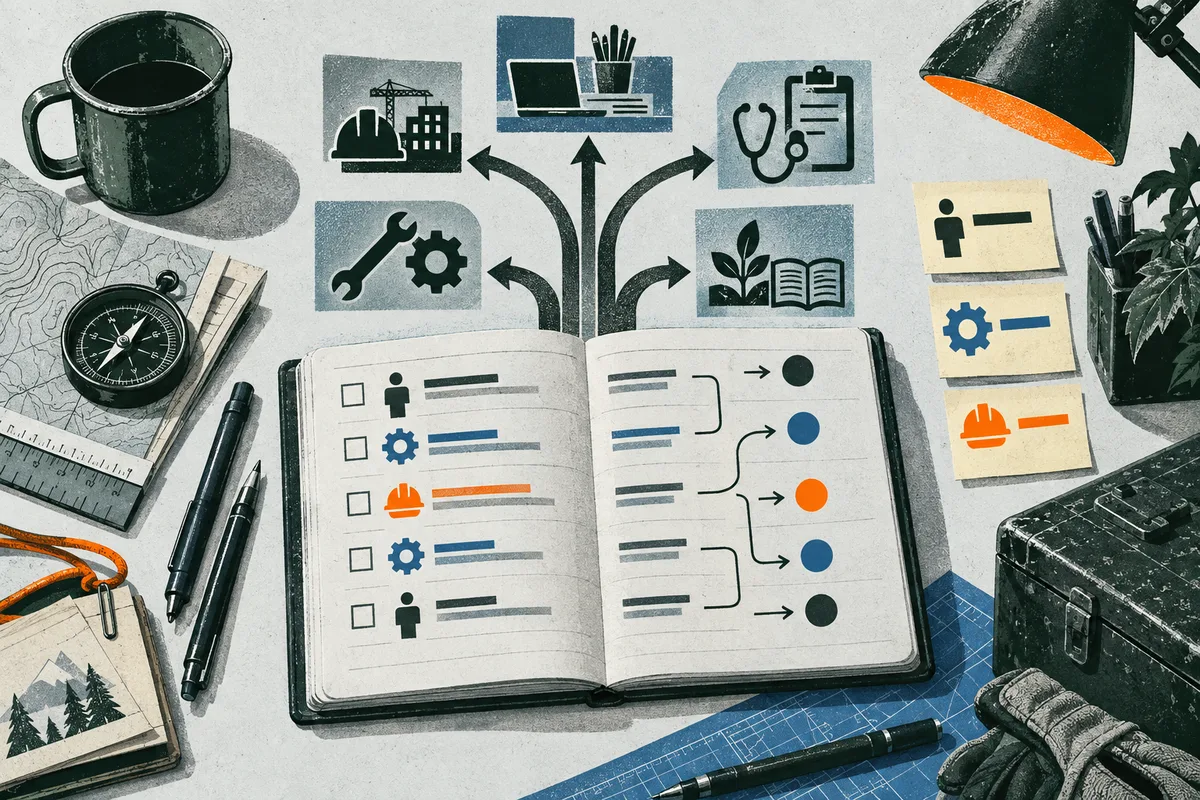
Use this result-to-action sequence. First, mark duplicate tasks and any parts of the role you may have forgotten. Second, label each cluster with the relevant capability, observed use, adoption status, verification burden, and accountability. Third, choose the smallest task that could teach you something safely. Fourth, record what happened, including review time and failure modes. Fifth, decide whether the new evidence supports an upgrade, an adjacent investigation, or no change yet. This sequence keeps the personal decision connected to the work rather than to a number.
A simple response matrix can help. High apparent pressure plus low employer adoption usually means investigate the workflow and policy, not panic. High pressure plus approved access, stable inputs, cheap verification, and a clear quality standard makes a redesign experiment more plausible. Mixed pressure across the bundle means protect the differentiated contribution and upgrade the exposed cluster. Low pressure means the current description shows no clear capability match, but it is not a forecast of demand or immunity. In every case, constraints can override the abstract ranking.
Ask what would change your conclusion. The answer might be a new tool that handles a previously difficult step, a privacy rule that blocks the proposed workflow, a quality failure that raises review cost, an employer decision to adopt the process, a change in the target role's credential requirements, or a family or health constraint that reduces the time available for retraining. Naming these conditions prevents a one-time result from becoming a permanent identity story.
The [ILO evidence on task-level exposure](https://www.ilo.org/publications/generative-ai-and-jobs-refined-global-index-occupational-exposure) can help you remember why the task description matters. The [OECD exposure measure](https://www.oecd.org/en/publications/the-oecd-ai-exposure-measure_f3da0f0a-en.html) can help you remember why adoption and organizational context matter. NIST's guidance can help you define responsibility and checking for an experiment. O*NET and BLS can help you compare occupational language. Together, these sources support a disciplined interpretation, but none of them turns a personal result into a validated employment forecast.
The free AI Proof Work checker is appropriate when you want transparent task-level change-pressure signals and first actions. Prepare the bundle before you use it. If the result is unclear because several realistic paths compete, the personalized [career roadmap](/career-roadmap) is the more relevant bridge: it compares a stay-and-redesign path, adjacent options, and a larger-change scenario against experience and stated constraints, then organizes a 30/60/90-day plan. It does not guarantee employment or income, and it does not replace professional counseling or an employer's decision process.
You can [check your task exposure](/ai-job-risk-checker) after reading this guide. The useful input is not the most alarming title. It is the smallest faithful bundle that represents the work you actually perform. Keep the free result complete in your own decision process. Do not buy training simply because a task was flagged, and do not ignore a change because another task was not. Use the result to choose what to examine next.
The answer to the opening question has therefore changed. A worker with several job titles does not need a scarier composite score. They need a more faithful description of recurring work and a smaller next decision. Titles can help locate comparable information, but task groups reveal where capability, adoption, judgment, verification, and accountability meet. Usually the first defensible move is to test one exposed workflow while preserving the domain knowledge that makes the work valuable. A broader pivot remains possible when evidence and real-life constraints make it proportionate, not because a checker has declared the current identity obsolete.
Sources: The OECD AI Exposure Measure; Artificial Intelligence Risk Management Framework: Generative AI Profile; Generative AI and Jobs: A Refined Global Index of Occupational Exposure, ILO; Classifications and Crosswalks, U.S. Bureau of Labor Statistics
Questions readers ask
Should I enter my current title or all of my job titles?
Use the title that best indexes your largest or most central task group, and keep the other titles as context. If the checker accepts task detail, add a short deduplicated bundle of recurring work. Do not submit several titles as if they were independent votes when they describe the same activity.
What if my official title does not describe what I actually do?
Treat the official title as a search handle, not a complete diagnosis of the work. Describe recurring tasks, outputs, stakeholders, judgment, and review requirements. Then use occupational references to find related task language and note where your actual role differs.
Does a high task change-pressure result mean I will lose my job?
No. It indicates that some described work may be more exposed to relevant AI capability under the checker's assumptions. It does not measure employer adoption, workflow redesign, local demand, accountability, or an individual's probability of displacement.
Can I use the checker to compare my current work with an adjacent role?
Yes, as an investigation aid. Compare overlapping task groups, missing capabilities, prerequisites, and constraints rather than treating two titles as two guaranteed futures. A comparison can suggest what to verify before making a training or career decision.
Which task should I test first after a flagged result?
Choose one frequent, reversible task with a clear output and a checkable quality standard. Confirm that the data, tool, and workflow are authorized. Track total time, corrections, review burden, failure modes, and stakeholder usefulness, not just first-draft speed.
Should a checker result make me buy an AI course?
Not by itself. First identify the actual goal, such as improving an existing workflow, building an AI-enabled product, entering a technical role, or pursuing deeper study. Match a course, certificate, degree, project, or self-study path to that goal and its prerequisites, cost, time, and feedback requirements.
When is a personalized career roadmap useful?
It is useful when you must compare several realistic scenarios against constraints such as experience, income, location, training time, health, family, or credentials. It should organize assumptions and next tests, not promise a safe career, employment, salary, or a validated displacement prediction.
Sources and notes
- O*NET OnLine Help: Summary Report
Supports the distinction between reported job titles, occupation-specific tasks, work activities, detailed activities, work context, skills, and related occupations.
- O*NET OnLine Help: O*NET Overview
Supports using a multi-level task and work-activity structure to compare work across occupational profiles without treating titles as identical.
- Classifications and Crosswalks, U.S. Bureau of Labor Statistics
Supports treating occupational crosswalks as classification aids that relate titles and systems without establishing an individualized job match.
- Generative AI and Jobs: A Refined Global Index of Occupational Exposure, ILO
Supports task-level exposure analysis and the distinction between potential job transformation and an individual's displacement outcome.
- The OECD AI Exposure Measure
Supports the view that capability proximity is only one part of practical impact, alongside adoption, regulation, organizational change, and social choices.
- Introducing the Anthropic Economic Index
Supports a scoped distinction between observed use in one product's anonymized conversations and market-wide adoption, productivity, or employment effects.
- The Impact of AI on the Workplace: Main Findings from OECD Surveys
Supports the possibility that task automation and task creation can coexist, while limiting generalization from selected sectors and an earlier observation window.
- AI RMF Core, National Institute of Standards and Technology
Supports defining human and system roles, documenting limitations, and using evaluation and verification when introducing AI into work.
- Artificial Intelligence Risk Management Framework: Generative AI Profile
Supports fact-checking, suitability review, human responsibility, and separating tests of human proficiency from tests of system capability.
- How is AI changing the way workers perform their jobs and the skills they require?, OECD
Supports cautious interpretation of changing skill demand in exposed occupations and the warning that AI is not the only explanation for observed changes.
Apply this to your own work
See the whole job market at once.
Explore which occupations AI may reshape, then turn the signal into a practical response.
Explore the job map