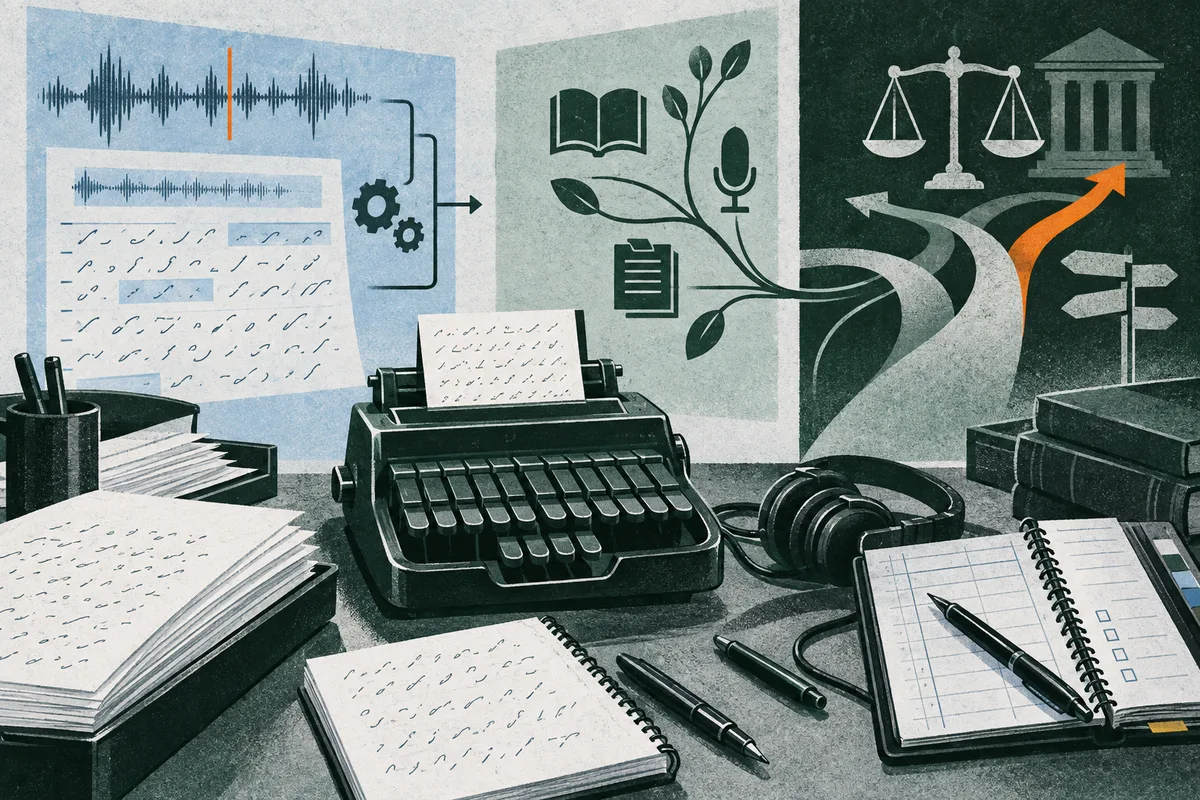
AI-use data can identify tasks worth examining, but it cannot describe court reporting as a whole or predict whether a reporter will lose work. Provider logs capture interactions visible to one service; occupational categories group varied duties; court rules define requirements without measuring AI use or performance. Check a recurring task against its workflow stage, local authorization, review burden, and accountable final output before changing tools, training, or career direction.
What does a provider's use dataset actually count?
A provider's use dataset counts interactions visible to that provider and maps them to task categories. It does not observe every worker, employer, court, or step in a court reporter's workflow. Anthropic's first Economic Index is useful as a dated example of this measurement design, not as a current census of court reporting or a measure of how many reporters use AI. A chart can point to work worth examining; it cannot, by itself, tell a reporter what is happening across the occupation. In its February 2025 account of the initial report, “The Anthropic Economic Index,” Anthropic says its analysis covered approximately one million conversations on Claude.ai Free and Pro. Its privacy-preserving analysis tool, Clio, organized conversations by the occupational task that best represented the AI's role. The researchers then grouped those tasks and occupations using the U.S. Department of Labor's O*NET classification. The reported percentages therefore describe conversations and task mappings in that sample. They are not percentages of reporters, courts, employers, or proceedings. This was provider activity analysis, not a worker survey or employer deployment study. That boundary matters for a small profession or a specialized task. The result depends on which people use the provider, which account types are included, what they bring to the service, the time window sampled, and how a classifier assigns a conversation to an O*NET task. The initial study included consumer Free and Pro conversations, not API, Team, or Enterprise use. Anthropic also cautioned that it could not always know whether a conversation concerned paid work, that some classifications could be wrong, and that users' handling of generated responses was not visible. It did not claim its uses represented AI use generally. Work that happens outside the service, or never becomes a conversation with it, cannot appear in those logs. A task category may be a reasonable match and still omit where the task occurs, who reviews its output, or what follows. The January 2026 “Anthropic Economic Index: New building blocks for understanding AI use” adds a more detailed measure. It pools data across reports and adjusts task coverage using estimated task frequency, duration, and success. In the report's account, the first report's January 2025 sample showed 36% of jobs in its sample with Claude use across at least a quarter of associated tasks; across pooled reports, that figure rose to 49%. The adjusted measure changes which occupations appear most covered, because a task's occurrence alone does not capture how often it is performed, how long it takes, or whether Claude is judged successful. This is a more informative comparison within Anthropic's data, but the provider says it still assesses only tasks performed on Claude.ai, and mapping those conversations to real-world change remains uncertain. Estimated success and time weights do not show that an employer adopted a system or that a court reporter's end-to-end work can be performed autonomously. Record the provider, sample window, task definition, and measure. Treat the signal as a prompt to inspect one local task, not as a verdict on the occupation.
Sources: The Anthropic Economic Index; Anthropic Economic Index: New building blocks for understanding AI use
Why can a correct occupation code still be too coarse?
An occupational code is a useful index, not a complete description of an individual job. The U.S. Department of Labor’s O*NET profile groups “Court Reporters and Simultaneous Captioners” under one code. It enables comparison while combining workers with different inputs, timing, audiences, and deliverables. A correct category can therefore be too coarse for deciding what a particular reporter should change. O*NET’s own description shows both the value and limit of aggregation. Its task list includes recording proceedings with stenographic or electronic equipment, providing requested transcripts, proofreading, filing, transmitting realtime feeds, and live captioning for meetings or events. These are related but not interchangeable activities. Recording a deposition, making a live feed available during a hearing, and preparing a transcript afterward differ in when words are needed, who uses them, and what form the output takes. The profile describes a broad occupation group; it does not say every worker performs every listed task. The Bureau of Labor Statistics uses the same combined label in its Occupational Outlook Handbook. The shared grouping can blur court reporting and simultaneous captioning. O*NET’s sample job titles show the range: “Deposition Reporter,” “Digital Court Reporter,” “Realtime Court Reporter,” and “Captioner” appear within one profile. The titles do not imply identical workflows or one person performing them all; the bucket spans specializations. It cannot tell a reporter how much of their week involves live capture, later transcription, correction, or other responsibilities. This matters when AI-use data is mapped onto occupations. The Anthropic Economic Index describes mapping conversations with its Claude service to O*NET tasks. A classifier can map a conversation to a listed task yet lose distinctions the profile does not encode. It may identify a request to clean transcript text without showing whether the text came from a completed recording, a draft awaiting review, or a live feed needed as speech occurs. It does not establish that a reporter, court, or production workflow used the service. It relates observed provider interactions to a standardized task category; it is not a worker time diary. Consider an explicitly editorial illustration: one prompt asks for punctuation help in a completed transcript; another asks for words to appear as a proceeding unfolds for someone relying on a live feed. Both involve speech-to-text work, but differ in timing and in what a usable result must do. This is not an observed pair of Anthropic conversations. It shows why a shared task family cannot establish equivalent suitability or impact. In reverse, little visible provider activity for a task does not show that the task is untouched by technology or that workers in the category are insulated from change. A reporter can descend one level below the code: list recurring tasks and distinguish method, timing, audience, and final product. Then compare the data label with that list. If it fits transcript editing while the reporter’s central service is live realtime provision, it is a partial signal. If it covers a recurring post-proceeding step, it may be a prompt to investigate that step. Neither finding alone establishes reliable performance, workplace adoption, or employment effects. The category should guide the next question, not answer it for an individual job.
Sources: Court Reporters and Simultaneous Captioners; Court Reporters and Simultaneous Captioners; The Anthropic Economic Index
Where does a transcript task sit in the official-record workflow?
A transcript-related task can sit at several points in the official-record workflow: capturing a proceeding, displaying words while it is happening, preparing a later transcript, correcting it, certifying it, or delivering it. In U.S. federal courts, statute and judiciary guidance describe recording methods and transcript responsibilities. The workflow begins with capture in practice. The Federal Court Reporting Program says proceedings designated for recording are recorded verbatim by shorthand, stenotype, stenomask, or electronic sound recording equipment; the district judge may elect the method. A tool receiving a completed recording does a different task from one assisting during a live proceeding, even if both outputs are eventually called text. A live display, when provided, is another stage. The federal program describes a “realtime transcript” as a draft, unedited transcript produced by a certified realtime reporter as a byproduct of realtime and delivered electronically during proceedings or immediately after an order. A live aid has to arrive while people are speaking. A later transcript can use a recording and be prepared after the event. Those timing and input conditions make “transcription” too broad to tell a reporter what a use statistic means for their work. After capture, a written transcript may be prepared when requested by a party or ordered by the court. The Federal Court Reporting Program says transcripts follow Judicial Conference guidelines for page format, rates, and delivery schedules. It also says transcripts of proceedings recorded on electronic sound equipment are produced by private transcription services designated by the court. In this federal process, the source recording passes into a production step where the responsible service and requirements matter. A dataset that records a prompt to turn audio into text may show that a text-generation interaction occurred. By itself, it cannot tell whether the input was a court-authorized recording, whether the task belonged to a designated service, or whether the result was intended as a draft or filed record. Checking and completion are distinct work too. In practical terms, a person preparing a transcript may need to resolve speaker attribution, names, technical terms, unclear speech, formatting, and discrepancies against the source. The federal program establishes formal format and delivery requirements; it does not quantify review tasks or their time, and it does not assess any tool’s error rate. An interaction dataset may record generation while leaving review, correction, rework, and responsibility outside its view. Delivery is not simply the moment text appears on a screen. In the federal process, when the original transcript is delivered to the ordering party, the reporter or transcriber must also file a certified electronic copy with the clerk. That link between delivery and filing shows why output status matters: a draft, working copy, and certified filing have different places in the process. The judiciary’s Court Reporting Guidance says federal courts administer reporting services locally while meeting requirements established by statute and the Judicial Conference, so the applicable court’s process matters. For a reporter reading AI-use data, ask where in the workflow the recorded use occurred: during capture, as a live aid, from an existing recording, during correction, or in preparing a deliverable. The federal sources map formal process and responsibilities; they do not measure AI adoption or performance. A generic task label can point to an activity worth examining, but only the applicable court or client rules and local workflow can establish which later steps remain necessary.
Sources: Federal Court Reporting Program; Court Reporting Guidance
Why do output, timing, and accountability matter more than the task label?
A readable draft, a live aid, a transcript checked against a recording, and a certified official transcript are different outputs. Federal policy makes that distinction explicit for realtime translation: it can support access during or soon after a proceeding, but it does not replace the certified transcript required for the official record. The Guide to Judiciary Policy, Volume 6 describes realtime translation as an unedited, unofficial version that may contain errors capable of changing the accuracy or meaning of testimony. It says that this translation does not satisfy the requirement to provide or file a certified transcript with the district court clerk or as the record on appeal. The same policy identifies realtime as a draft transcript service, with no certification page, while the Federal Court Reporting Program explains that when an original transcript is delivered to an ordering party, a certified electronic copy must also be filed with the clerk. These are federal process requirements, not a test of any particular AI system. Output purpose belongs in any task comparison. They establish that the immediate text and the accountable record have distinct roles. That difference is more than a label on a file. A live aid is valued for arriving while the proceeding is happening; a later transcript must be prepared for its intended use and meet the applicable rules. Timing changes the available checks. During a live feed, a reporter may be working from incoming speech and a personalized stenotype or voice dictionary while participants need rapid access. Later review can compare text with the recording, resolve uncertain passages, and apply transcript conventions. The verification questions follow from the work itself. Did the words come from overlapping speech, a name or technical term, a speaker whose identity matters, or an inaudible stretch? Can the reviewer consult the source recording and enough surrounding context? Is there time and permission to correct the draft before it is used? The federal guide’s warning that realtime errors may change meaning makes the consequence concrete: checking is not merely cosmetic proofreading when a word choice can change what testimony says. The division of responsibility also matters. In the federal program described by the guide, realtime text is not the official record, distribution is restricted, and the reporter still has a separate certified-transcript obligation. A dataset showing an interaction that generated transcript-like text cannot reveal whether someone checked it against audio, how much rework followed, whether the use was permitted, or who certified and filed the result. Those missing steps can determine whether a tool assists one task, shifts effort to review, or is unsuitable for a required output. For a reporter assessing a use-data signal, the practical test is end to end: identify the requested output, the stage and deadline, the source material available for checking, the review time and authority, the local rule on use, and the person responsible for the final record. A tool that helps prepare a draft under an authorized review process is a different proposition from one expected to produce a certified record without that process. The evidence here supports the distinction in federal practice; it does not establish what every state court, deposition client, or captioning service permits. Evaluate a tool by the complete service, review burden, authorization, and accountable output, not by its ability to produce transcript-like text.
Sources: Guide to Judiciary Policy, Volume 6; Federal Court Reporting Program
What does a task signal leave between capability and displacement?
A task signal sits near the beginning of a chain of questions. Technical capability asks whether a system can perform a defined operation under stated conditions. Observed use asks whether people sent related work to a particular service. Occupational exposure compares capabilities or observed tasks with a job description. None alone tells us whether a court, reporting firm, or client adopted a system in production, or redesigned work around it. Each step needs different evidence. A capability result is bounded by its test conditions and evaluation criteria; it does not establish reliable performance amid live speech, specialized names, interruptions, or a required official output. Provider conversation records can show activity within that service. “The Anthropic Economic Index” describes an analysis of roughly one million Claude.ai Free and Pro conversations in its initial sample, classified against U.S. O*NET tasks. Anthropic says it did not survey users or forecast the future. The records are not a census of workplaces or what users did afterward. Exposure is another kind of signal. The International Labour Organization’s 2026 brief, “Workers’ exposure to AI: What indicators tell us – and what they don’t,” explains that estimates depend on task lists, the definition of exposure, and subjective judgments. Static task descriptions can flag technical susceptibility while omitting institutional barriers, economic feasibility, and workflow change. Adoption asks whether an organization actually uses a system in a workflow and for which tasks. An isolated pilot, approved deployment, and routine use across proceedings are different states; evidence of one should not be described as evidence of another. Even confirmed adoption does not settle task redesign. A tool might produce a first draft for a reporter to check, shift effort toward review, or remove a discrete task. The January 2026 Anthropic Economic Index update adds task success and estimated frequency and duration to its effective-coverage measure. Although the added weighting makes the measure more informative than task appearances alone, it does not establish how reporters perform in a particular court. The report still assesses Claude.ai tasks and says their mapping to real-world change remains unclear. Only then can labor-demand evidence help answer whether employers are changing the amount or mix of work available. Displacement is narrower: it concerns work or jobs lost and requires evidence about employment outcomes and causes. The ILO brief cautions that exposure indicators do not account for economic feasibility, workflow changes, or adjustments in employment, wages, and demand. The counterpoint matters. Little visible provider use cannot establish that a task is unaffected: reporters may use other systems, work in restricted environments, or have activity the dataset misses. Conversely, broad task coverage does not prove replacement. Use may support a worker, and observed text generation may be followed by unrecorded review or correction. The original Economic Index notes that a conversation classified as task automation might involve a user editing the generated memo. For a reporter deciding what to do, treat a task signal as a prompt for the next evidence, not as a job-loss forecast. Check whether a system is authorized and used locally, what it produces, what verification or rework follows, and who remains accountable for the record. Seek local workload or staffing evidence before making a larger career decision. If unavailable, investigate one recurring task first.
Sources: Workers’ exposure to AI: What indicators tell us – and what they don’t; The Anthropic Economic Index; Anthropic Economic Index: New building blocks for understanding AI use
What can labor outlooks and local reporting debates add?
Labor outlooks and jurisdiction-specific reports add context about duties, demand, and contested workflow choices, but neither isolates the effect of AI on an individual court reporter. The U.S. Bureau of Labor Statistics (BLS) combines court reporters and simultaneous captioners in one occupational profile. Its discussion of AI-generated transcription concerns expected demand for simultaneous captioners; it should not be recast as a measured AI effect on court reporters alone.
BLS describes court reporters creating word-for-word records of legal proceedings, while simultaneous captioners provide text for television, public events, and communication access. BLS says technology may make transcription more efficient and reporters will continue reviewing and editing digital documentation. Its separate warning that AI-generated transcription may dampen demand for simultaneous captioners is a qualitative outlook, not a count of court reporters displaced.
BLS projects little or no employment change for the combined occupation from 2025 to 2035 and about 1,800 openings per year on average, most associated with workers transferring occupations or leaving the labor force, including retirement. This is a national projection for the combined category. They do not identify the local mix of stenographic, voice-writing, digital-recording, realtime, courtroom, deposition, and transcript-production work, nor do they isolate AI as the cause of a projected change. Openings also do not mean net growth: replacement openings can occur while total employment remains broadly level. It is broad market context, not a forecast of an individual reporter’s workload or income.
A state report can reveal a different kind of evidence: which choices are being debated under particular rules. The Louisiana Supreme Court Judicial Council’s 2026 court reporter research and recommendations report describes a sharp divide over AI or digital-only methods for the official record. It records concerns voiced by reporters about accuracy, overlapping speech, terminology, and record integrity, while also reporting that several reporters and judges were open to AI-assisted rough drafts if a certified reporter edits and manages the final transcript. A human-managed draft differs from replacing the certified reporter.
The report documents participant views and recommendations in Louisiana’s legal and certification context. It is not a controlled test of transcription accuracy, and the expressed openness or concern does not establish how widely a system is used across the state, much less across the country. “AI use” can refer to disputed arrangements with different human roles and official-record implications. Its staffing and digital-platform observations should likewise remain state-specific, not generalized into a national adoption rate.
BLS provides a standardized national outlook and broad occupational duties; the Louisiana report captures a jurisdiction-specific policy and workflow debate; official court-reporting guidance can establish rules within its scope; local workload records, court or client policies, contracts, and vacancy information are closer to an individual operational decision. A national projection cannot tell a reporter whether a court permits a tool, who reviews output, or whether local demand is changing.
Before changing a tool, training plan, or career direction, check the rules for the relevant state, court, and client, then look for local evidence such as workload, vacancies, contract terms, and the actual review and sign-off process. Use BLS as broad context and the state report as evidence of debate, not as a personal job-loss forecast. A local policy permitting a human-managed draft would support investigating that bounded workflow; it would not by itself establish reliable performance, reduced staffing, or a need to leave the occupation.
Sources: Court Reporters and Simultaneous Captioners; Integration of Technology (AI/Digital Reporting), Louisiana Supreme Court Judicial Council report; Court Reporting Guidance
How should a reporter test a use-data claim against one real task?
Take one recurring task and trace it from its first input to the final item someone relies on. A provider-use chart can show that interactions appeared in one service’s data and were assigned to a task category. It cannot establish whether your court, firm, or client permits the same use, whether the tool receives the same material, or whether its output meets the actual requirement. First, identify the source and unit: provider, sample period, population or account type if reported, task definition, and whether the measure counts interactions, task coverage, or a weighted estimate. The Anthropic Economic Index, for example, maps conversations with one provider’s service to occupational tasks. That is evidence about those conversations and that mapping, not a survey of court reporters or a count of deployed court systems. Second, place the task in the workflow and name its input and output. “Prepare a transcript” might mean turn an existing recording into draft text, clean notes, or provide live text during a proceeding. The Federal Court Reporting Program describes federal recording methods, later transcript production, and filing of a certified electronic copy. Those federal procedures do not define every state, deposition, captioning, or client workflow; check the rule or contract that governs your work. Third, seek evidence of local use instead of inferring adoption from capability or public examples. Ask the supervisor, court administrator, agency, or client which system is approved, for which task, and whether use is routine, a limited trial, or only proposed. If local evidence is unavailable, record “unknown.” The International Labour Organization’s brief on exposure indicators explains that task susceptibility does not show whether firms find automation feasible, how workflows change, or what happens to employment and demand. A task match is a lead to investigate, not evidence of a staffing decision. Fourth, measure review work and service results for that task. Compare the current process with any authorized assisted process on similar assignments. Note elapsed time, correction effort, returned work, and unresolved material issues; do not count only the first draft. Who checks names, speaker attribution, technical terms, overlap, and inaudible passages? Can the reviewer return to the authorized recording? Record task volume and who performs each review step where possible; apparent time savings may shift work to another person or stage. Federal judiciary policy distinguishes realtime translation from a certified transcript: realtime text is labeled unedited and unofficial, may contain errors that change meaning, and does not satisfy a certified-transcript requirement. This establishes a federal service distinction, not the accuracy of a generative tool. Fifth, establish permission, data handling, and accountability before a trial. Confirm whether the input may be processed, where it may be sent, who can access or retain it, and who may correct, certify, file, or deliver the final record. Federal rules do not authorize a particular product or replace local policy, contract terms, privacy obligations, or professional standards. If authority is unclear, pause and ask the responsible office; do not upload protected material to test a hypothesis. Consider an example, purely illustrative: a reporter is asked whether software could prepare a rough draft from an existing recording. The audit asks whether the use chart covers that task, whether the stage and input match, whether the organization approved the system, whether review time and corrections improve the whole process, and who remains responsible for the permitted final output. If authorized assistance lowers total review burden while preserving required checks, the task may be changing and approved workflow training could be useful. If processing is prohibited, apparent capability is operationally irrelevant. If the workflow removes paid draft work, document that local change; one task still cannot establish net demand or an individual’s future. Keep a brief record: source and date; task and stage; authorization; input and expected output; review and rework; accountable signer; and the remaining question. It can guide whether to seek approved tool training, strengthen verification, document changes in paid assignments, or wait before a larger pivot. The free task checker can organize change-pressure signals, but it does not calculate a validated displacement probability or replace this local audit.
Sources: Federal Court Reporting Program; Guide to Judiciary Policy, Volume 6; Workers’ exposure to AI: What indicators tell us – and what they don’t
What is the proportionate next move?
Treat AI-use data as a prompt to investigate one workflow, not as a verdict on court reporting. Change a tool or training plan only when task-specific evidence, rules, and review capacity support that change. A provider log or category can identify a question; it cannot show what your court, firm, or clients permit, or who remains accountable for the final record. Start with one task. Note its input, place in the reporting process, required output, and how corrections are checked. Consult the policy for your jurisdiction or client, and identify who may authorize a tool, review its work, and approve the deliverable. The Federal Court Reporting Program describes federal requirements; other arrangements may differ. The International Labour Organization’s “Workers’ exposure to AI: What indicators tell us – and what they don’t” explains why exposure measures leave implementation and labor outcomes unsettled. These sources support an inquiry, not a forecast. If the task is permitted and reviewable, gather local evidence: what is used, what checking it requires, and whether it improves the service. If those facts are unavailable, pause before spending on retraining or making a career move. The free AI Proof Work task checker can organize change-pressure signals for tasks; it does not estimate validated job-loss odds or choose a career. Escalate only when evidence from your workflow justifies it.
Sources: Federal Court Reporting Program; Workers’ exposure to AI: What indicators tell us – and what they don’t
Questions readers ask
Does AI-use data show whether court reporters will lose their jobs?
No. Provider-use data records activity visible to that service and may map it to occupational tasks. It does not establish local employer adoption, changes in staffing or labor demand, or an individual reporter’s job-loss risk.
Sources and notes
- The Anthropic Economic Index
Supports the description and limits of the initial provider conversation sample and its mapping to occupational tasks.
- Anthropic Economic Index: New building blocks for understanding AI use
Supports the updated task coverage measure and its estimated frequency, duration, and success weighting.
- Federal Court Reporting Program
Supports the description of federal recording methods, realtime service, transcript production, and certified filing requirements.
- Guide to Judiciary Policy, Volume 6
Supports the federal distinction between unedited realtime translation and a certified transcript, including its warning about errors affecting meaning.
- Court Reporters and Simultaneous Captioners
Supports the combined occupational outlook and the separate BLS discussion of AI-generated transcription and simultaneous captioning demand.
- Court Reporters and Simultaneous Captioners
Supports the standardized occupational task description and its combined grouping of court reporters and simultaneous captioners.
- Workers’ exposure to AI: What indicators tell us – and what they don’t
Supports the limits of exposure indicators and the distinction between task susceptibility and realized workplace or labor-market outcomes.
- Integration of Technology (AI/Digital Reporting), Louisiana Supreme Court Judicial Council report
Supports the Louisiana-specific account of stakeholder disagreement and conditional openness to AI-assisted drafts with reporter review.
- Court Reporting Guidance
Supports the federal scope and local administration of court reporting services under judiciary requirements.
Apply this to your own work
See the whole job market at once.
Explore which occupations AI may reshape, then turn the signal into a practical response.
Explore the job map