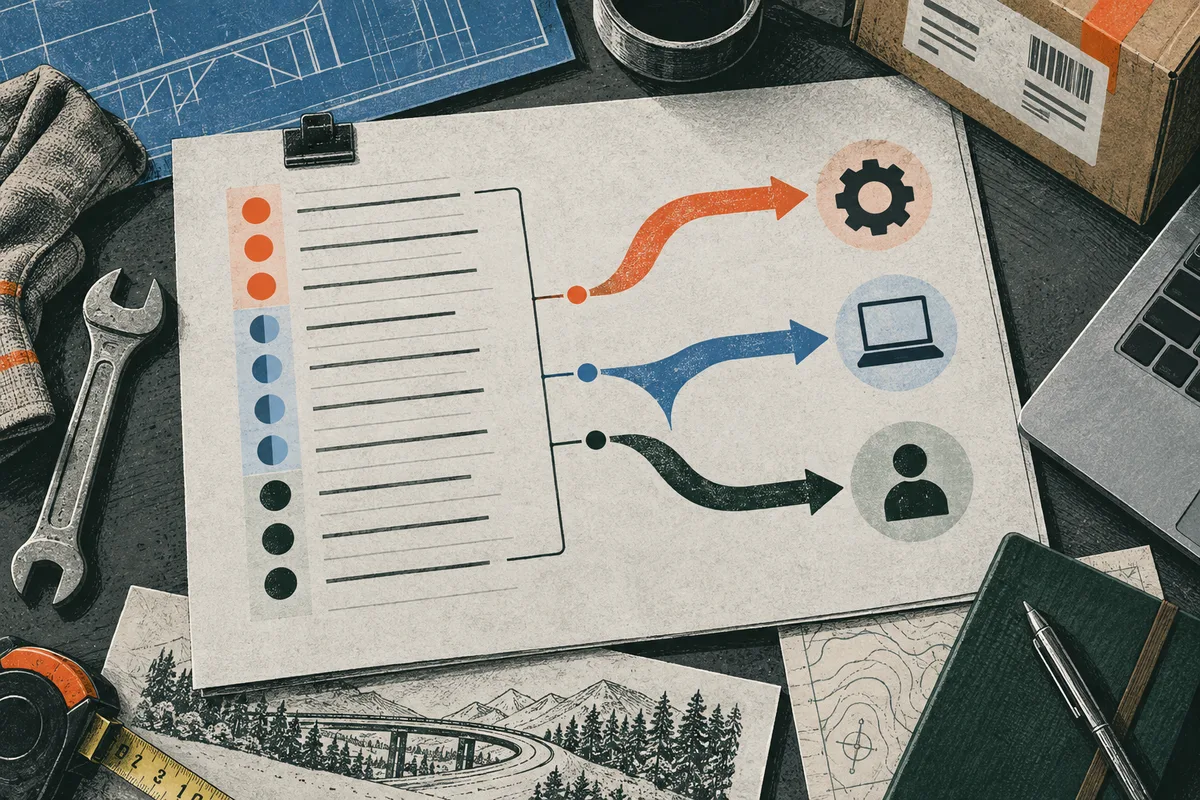
In 2026, U.S. evidence added a direct measure of reported task handoffs: one in five employed respondents in an Epoch AI and Ipsos probability-panel survey said AI now mostly or wholly handled at least one task they had previously delegated to a coworker or contractor. That is evidence of reported task reallocation, not a count of jobs lost. Other evidence measures different things, including workplace AI use, recalled time savings, projected occupational demand, and early-career hiring. Those findings do not combine into a single estimate of AI-caused job loss. To judge what the change means for you, follow one recurring task from its former owner through AI completion and human review, then look separately for persistent changes in assignments, hours, hiring, staffing, or output before changing your plans.
What changed in 2026 evidence about AI taking over work?
The 2026 evidence picture added a direct question about whether AI now handles work once passed to another person, alongside broader measures of workplace use, occupational exposure and labor-market outcomes. That makes task reallocation easier to discuss plainly, but it does not turn one survey measure into a share of jobs lost. A reported transfer of a task is evidence about a worker’s account of work changing; it is not, by itself, evidence that a position disappeared or that a former coworker was displaced.
For a worker deciding whether to act, the useful question is whether recurring tasks in their role are being reassigned, how much judgment and checking remain, and whether changes affect workload, hours or staffing. Read each instrument by what it observes: use, a reported handoff, technical exposure, or an employment outcome. A handoff report is more specific than generic AI use, but remains self-report and cannot settle employment effects. National measures locate questions worth asking; individual answers depend on which duties recur, how work is assigned, and local constraints.
What does a reported handoff measure—and what does it leave uncounted?
Epoch AI’s survey asks about a specific change in who performs a task: whether AI now does “mostly all” or “all” of something the respondent previously delegated to a coworker or contractor. This is the survey’s threshold for a reported handoff. It does not count every use of an AI assistant. Asking it to draft part of a report, suggest language, or help organize information can be assistance without meeting the threshold that AI performs most or all of the task. The distinction matters because occasional contribution and transfer of most of a defined task are different degrees of work change.
The unit is a task recalled by a worker, not an occupation, whole role or job slot. “Maintaining records,” for example, may be one bounded activity within a larger job that also involves deciding what belongs in the record, resolving exceptions and answering for its accuracy. If AI performs most of it, the report indicates that a formerly delegated task is now largely handled by AI; it does not establish that the broader role or surrounding work vanished. Nor does it show whether the coworker or contractor still performs other work for the organization or client.
The reference to a coworker or contractor identifies the reported prior recipient of delegated work; it is not an employment-record check. Epoch AI does not observe payroll hours, contract renewal, vacancies or the former recipient’s next assignment. A task may move to AI while that person’s paid hours and other duties remain unchanged. Repeated removal of paid assignments without replacement could be consequential, but the survey question cannot distinguish these situations.
It also cannot establish why the transfer happened. The respondent may describe a workflow in which AI took over a defined step, but the answer does not show whether management intended to cut labor, whether output rose, whether another person now checks the result, or whether downstream corrections absorb the apparent saving. “Mostly or all” describes the respondent’s estimate of AI’s share of that task; it is not an independent quality audit or a measure of total labor across the workflow. Assistance, substantial task completion, transfer away from a human delegate and displacement from paid work should therefore remain separate claims.
This boundary does not make a handoff trivial. Repeated removal of a paid, routine assignment could reduce practice opportunities, alter workload or affect staffing, even before a formal position is eliminated. But those are possible consequences to investigate, not outcomes encoded in the response. Epoch AI’s reported handoff is a bounded signal that work allocation changed for at least one task; deciding whether that change altered someone’s employment requires evidence about hours, assignments and staffing beyond the survey item.
Sources: One in five US workers now delegates tasks to AI instead of other humans
How broad was workplace AI use in the Census snapshot?
The Census Bureau’s “About a Third of Workers Who Used AI in the Last Week Said They Completed Tasks One to Two Hours Faster” reports that about 56% of U.S. workers used AI for at least one of eleven listed work tasks in March 2026. This broad reach measure records reported use somewhere among activities such as information search, writing, idea generation, summarizing and administration; it does not show that AI took over an assignment or that work disappeared. The menu spans ordinary knowledge-work steps, making the snapshot useful for showing use beyond one specialized function. But a single occasional activity qualifies, and the aggregate does not show how much AI performed, how often it was used through the month, or whether it became part of a stable workflow.
The eleven-task menu offers consistent activities respondents can recognize, but cannot capture every occupation’s full task mix. One worker may use AI in a specialized workflow absent from the prompts; another may count a low-stakes experiment. The figure describes participation across the menu, not depth or all AI-assisted work. It cannot distinguish brainstorming from drafting a deliverable, or show whether a manager approved, integrated or monitored the use. Broad labels such as writing may cover a supporting step or substantial recurring work, so the estimate shows reach but cannot diagnose an individual workflow.
The release uses respondents’ reports, and the Census Bureau notes sampling, nonsampling and modeling error. It revised HTOPS weights on September 24, 2026, so the March snapshot should use the updated estimates. Weighting aligns responses with the target population; it does not make recollection a direct observation of software logs, outputs or staffing. Nor does prevalence measure accuracy, review time or net productivity. The snapshot’s contribution is a wide-angle benchmark of reported use across a specified menu at that time. Claims about task ownership, completion depth or employment effects require measures that ask those questions directly.
The Census denominator is workers reporting any use across eleven prompts; Epoch AI/Ipsos asks employed respondents about at least one qualifying handoff among ten selected tasks. The use measure includes assistance that leaves most of a task with a person, while the handoff measure focuses on a more substantial reported change in allocation. Both are self-reports, not employer audits. They complement each other: Census establishes broad reported reach; Epoch asks whether a formerly delegated activity is now mostly or wholly handled by AI. Neither estimates the share of all work performed by AI, and treating broad use as proof of handoff would overread the instrument.
How much task reallocation did the direct survey report?
Epoch AI’s “One in five US workers now delegates tasks to AI instead of other humans” reports that 20% of employed U.S. respondents said AI now performed mostly all or all of at least one measured task previously delegated to a coworker or contractor. This is one in five respondents reporting a qualifying change, not one in five tasks, one fifth of work, or one in five jobs ending. It directly answers whether workers report at least one such handoff: yes, in this survey. It is respondent-level incidence, not a share of labor displaced; workplace distribution and employment consequences remain unresolved.
Epoch AI and Ipsos fielded the survey July 10–19, 2026. The analysis included 1,106 employed U.S. adults after removing three invalid responses; participants came from Ipsos KnowledgePanel’s probability-based panel using address-based sampling. Authors weighted responses and report 90% confidence intervals. This design supports population inference better than an open online poll, but intervals describe sampling uncertainty, not all nonresponse, coverage, recall or interpretation error. Report 20% as a weighted survey estimate, not a precise count of all American workers; it remains a one-time self-report.
The survey’s task set was selected rather than exhaustive. It drew on ten common knowledge-work activities based on O*NET descriptions and asked about reported handoffs within those activities. This makes the question concrete enough for respondents to consider recognizable work, but it does not make the menu representative of every occupation or sector. A job centered on physical care, on-site coordination or highly specialized judgment may have few close matches among the selected activities; even within knowledge work, a broad task label can cover different levels of complexity and consequence. As a result, the 20% estimate concerns the respondents and task opportunities the instrument captured. It cannot establish the prevalence of handoffs in every occupation, and it should not be treated as an occupation ranking. Selection can cut in either direction: the menu may miss genuine changes outside its boundaries, while common knowledge-work activities may give respondents more relevant opportunities to report a handoff. The survey answers a bounded national question, not every sector-specific one.
The explicit question and probability-based panel make this more direct evidence of reported task reallocation than a technical exposure score or a general question about whether someone has tried AI. The survey asks respondents to connect a prior human delegation to current AI handling, and its threshold focuses the estimate on cases in which AI reportedly does most or all of that task. This specificity is valuable because an exposure classification describes what technology might be applicable to, while general use can include partial help. Here, the reported change is closer to the work-allocation question people often mean when they ask whether AI is taking over work. Still, the survey has no independent view of the original assignment, the AI output, the amount of checking, or the employer’s records. It cannot confirm that the respondent’s recollection corresponds to a formal transfer, or establish what happened to the human delegate. The measure makes the claim more specific, not conclusive about the next link in the chain from task change to employment outcome.
Self-report also leaves room for differences in how people interpret a task, “mostly all,” and the counterfactual of what was previously delegated. Two workers may use AI in similar workflows but classify the work differently: one may see AI as handling a task, another as helping them complete it. Some may not know whether work was formerly done by a coworker or contractor, particularly when assignments were informal or distributed across a team. Recall can also favor changes that are recent or noticeable over routine uses that have become ordinary. These are possible measurement effects, not reasons to assume the 20% estimate is inflated or deflated; the survey does not establish the direction or size of such error. The key point is that the outcome is reported experience, elicited through a structured question, rather than a verified record of each workflow. Its design constrains ambiguity better than a vague adoption question, but it cannot remove all of it.
The 90% confidence intervals should accompany close comparisons between groups or task categories, since smaller differences may be consistent with sampling variation. They do not need to be mistaken for a promise that the true national value falls within a range under every source of error. Survey precision and construct validity are separate: an estimate can be statistically well characterized while still measuring respondents’ interpretations of a bounded question. Likewise, the panel’s probability basis supports broader inference than a convenience sample but does not provide longitudinal evidence about whether the same workers’ roles changed over time. The July field window offers a snapshot of reports, not a before-and-after test or a causal estimate of AI’s effect. It establishes what respondents said at that time; it does not show how the rate is changing, whether a handoff persisted, or whether employers reduced staffing as a result.
A weighted one-in-five estimate is too large to dismiss as anecdotal and connects more directly to reported task transfer than exposure alone. Yet its numerator is people reporting at least one qualifying event in the selected set, not transferred tasks, lost assignments or removed positions. A worker may report one handoff while continuing surrounding work and a coworker takes other duties. Establishing a job outcome would require assignment volumes, hours, staffing and evidence about work remaining around the automated step, none of which this result observes. The finding warrants attention to task reallocation without implying labor-market displacement.
The next question is not whether the 20% figure can predict an individual worker’s fate; it cannot. It is how reports vary across specific activities and what kinds of work may be more exposed to transfer. The task categories can help locate where respondents most often described handoffs, but those comparisons answer a different question from the overall respondent estimate. They remain shares of respondents reporting particular task types, not shares of all work performed or employment effects. That distinction will matter in reading the task-level pattern: category frequency can direct attention to workflows worth inspecting, while local evidence is needed to understand how much of a role those workflows occupy and what human work remains.
Sources: One in five US workers now delegates tasks to AI instead of other humans
Which task categories appeared most often in reported handoffs?
In “One in five US workers now delegates tasks to AI instead of other humans,” Epoch AI reports that respondents most often named data analysis: 7.1% said AI now performed mostly all or all of that task after they had previously delegated it to a coworker or contractor. Reading work documents followed at 5.7%, and maintaining records at 5.3%. Respondents could report more than one category. These figures are therefore proportions of respondents reporting a particular kind of handoff, not proportions of all data-analysis, reading, or recordkeeping work performed by AI. Nor are they estimates of the share of an occupation automated. The ranking identifies where reports clustered within this survey’s ten-task menu; it does not say how much work moved in each category or what happened to employment around it.
The pattern is consistent with a practical feature of these activities: their inputs and outputs can often be represented as digital information. A data summary can come from a table, a document can be searched for specified points, and records organized into fields. This may make a bounded step easier to describe, supply and inspect. It is an interpretation, not a finding Epoch measured about task design or reliability. Workflows still involve file currency, permissions, unusual entries and responsibility for what is sent onward; those activities may remain human work when AI handles the named task.
Consider an illustrative workflow, not a reported case: a system drafts a summary of figures from a spreadsheet, while a worker checks that the source data are complete, investigates an anomalous value, and signs off before the summary informs a decision. The draft may be a discrete information-processing step. Validation depends on knowing how the data were collected and whether a discrepancy matters; sign-off attaches accountability to the result. If the output is wrong, the time needed to find and repair the error belongs to the workflow too. This example helps distinguish a task label from the full chain of work. It does not establish that the surveyed respondents used AI in this particular way, or that every data summary requires the same review.
These percentages are not a job-risk scale. “Analyze data” may mean formatting a routine table or interpreting evidence with consequential assumptions; document reading may extract a standard field or reconcile conflicting terms; record maintenance may involve predictable updates or judgment about exceptions and privacy. A broad survey label compresses differences in complexity, frequency, stakes and review. The figures show which labels appeared most often, not how much work in each category AI performs.
A worker can use the ranking as a prompt to inspect a workflow rather than as a verdict about a role. Start with a recurring task in one of the named categories and note its inputs, the part AI actually completes, the conditions that make an output acceptable, and who resolves exceptions or is answerable for errors. Then ask whether the handoff changes only the production step or also changes the amount and kind of human work around it. If a routine summary is generated faster but a person still checks source quality and explains results, the task bundle has changed without showing that the whole role has been transferred. If checking and coordination grow, the apparent handoff may redistribute labor rather than remove it. These are questions for local observation; the survey does not answer them for a particular workplace.
The strongest conclusion is narrow but useful: among the measured categories, respondents most often reported handoffs involving data analysis, document reading, and record maintenance. Their prominence makes bounded information tasks sensible places to look when examining how work is changing. It does not make them universal automation targets, establish that AI can reliably perform every version of them, or show that the people previously involved lost paid work. Task labels conceal the internal steps on which reliability and responsibility depend. Reading the results at that level preserves both signals: digital information tasks recur near the top of reported handoffs, and the organizational work that frames, checks, and owns those tasks still needs to be examined separately.
Sources: One in five US workers now delegates tasks to AI instead of other humans
What did workers say about time saved, and what can that time become?
The Census Bureau’s “About a Third of Workers Who Used AI in the Last Week Said They Completed Tasks One to Two Hours Faster” asked workers who had used AI at work in the prior week to recall time saved. About 31% of that AI-using group reported saving one to two hours, while about a quarter reported less than an hour. The denominator is workers reporting workplace AI use in the preceding week, not all U.S. workers and not all tasks completed with AI. The recall window is that prior week; respondents were estimating their experience, rather than recording every task with a timer. These results describe perceived time saved among recent users. By themselves they do not establish higher measured productivity, fewer paid hours, or any particular staffing change.
A worker’s report of time saved can still describe a real experience: a first draft arrived sooner, a search required fewer steps, or a routine transformation took less hands-on effort. Recall is imperfect, but it is not meaningless. The limit is what follows from the recollection. A respondent may compare the visible time spent producing an output with how long a similar output used to take, without accounting fully for setup, review, interruptions, correction, or work shifted to another person. The Census result does not separately measure those components. It should be read as a report of perceived savings, not as a complete time-and-motion account of a process.
Faster completion of one task is not the same as net workflow throughput: the latter concerns acceptable work completed across the full process after queues, dependencies, checking, rework and demand. A quick draft may still need specialist verification and approval; short routine review may nonetheless raise completed volume, while errors can erase the initial gain. These are possibilities for interpreting reported savings, not pathways measured by the Census survey.
What happens to released time depends on choices and constraints around the task. A team might use the capacity to handle more requests, spend longer on complex cases, improve consistency, or offer service sooner. It might leave some time as slack for interruptions and unpredictable work. An employer could reduce overtime if the same workload fits into scheduled hours, or workers could finish earlier where schedules permit. In another setting, management might lower staffing needs or raise output expectations. The Census time question does not determine which path occurred, and the reported categories should not be translated into any one of these outcomes. They mark perceived room in a workflow, while allocation is a separate organizational decision.
A productivity claim needs both an input and an output. Less worker time for the same quality and quantity may indicate improved labor productivity; more comparable-quality output from the same time may also indicate a gain. If volume rises while accuracy falls or review expands, draft counts can mislead. Reported time saved supplies one side of this comparison, not the full labor input, quality measure, downstream effort or total output. The Census estimates support a claim about recalled savings among recent users, not quantified net productivity.
For an individual deciding whether AI is changing their own work, a small before-and-after record can make the distinction visible without turning a survey result into a personal forecast. For a recurring task, note the time spent preparing inputs, getting a usable result, checking it, correcting it, and completing dependent steps. Also note whether the amount or quality of finished work changed and whether another person absorbed review. Compare similar tasks rather than one unusually easy run. This observation can show whether the tool saves effort in a step, shortens the full workflow, or moves work elsewhere. It will not establish a labor-market effect, but it makes the local work change clearer than a general estimate of hours recalled by other workers.
The Census finding is best treated as evidence that many recent workplace AI users perceived some time savings, with one-to-two-hour savings the most commonly reported band in the release. It is neither proof that all of those hours became additional output nor evidence that employers removed equivalent paid time. The same reported relief can become more volume, better attention to difficult work, service capacity, schedule slack, less overtime, shorter hours, or pressure to do more with fewer people. Which outcome follows depends on demand, quality requirements, workflow design, and workplace decisions not observed by this question. Keeping those stages separate recognizes the worker’s reported experience while leaving productivity and employment claims to evidence that measures what the saved time actually became.
What changes when AI does more of the task—and what does editing tell us?
In “One in five US workers now delegates tasks to AI instead of other humans,” Epoch AI reports that respondents said they saved time on 37% of tasks where AI assisted with part of the work, compared with 53% where AI performed most or all of the task. The denominator in both figures is the reported task instances in the respective AI-contribution group, not workers, jobs, or all tasks in the economy. The same publication says 66% of AI outputs were used unchanged or after minor edits, while 5% were substantially reworked or redone; those percentages describe reported AI outputs. Together, the figures suggest a relationship in respondents’ accounts between AI doing a larger share and time savings being reported more often, alongside many outputs needing little visible revision. They do not establish that greater AI contribution caused the saving or that an unedited output was correct.
These are task-level self-assessments, not external audits of time, quality or workflow. Respondents may know whether they changed a draft, but the survey does not inspect it against source material, count missed errors or measure hidden checks such as validating figures, permissions and exceptions. Visible editing also does not show who remains accountable. A polished answer may contain a consequential error; extensive edits may reflect house style or a changed request. Edit size describes intervention, not accuracy, total review effort or responsibility.
Low editing should not be dismissed: in a well-bounded workflow with clear inputs and a stable format, a strong output may genuinely require little correction. The limitation is inferential. An unchanged output could be right, or it could simply pass without a check capable of detecting a subtle mistake. Major rework signals visible friction, but a small edit can conceal substantial checking before the user decides no changes are needed. To understand the work displaced or added, review has to include what happens before acceptance and after delivery, not only keystrokes applied to the generated text. The survey’s categories do not separate these pathways, so they cannot rank workflows by net cost or quality.
A practical verification rule can scale review to four features; this is a decision aid, not a result measured by Epoch. First, consider consequence: a reversible internal draft warrants a different threshold from a customer commitment, payment, safety decision or public claim. Second, ask whether the reviewer can reach the underlying source and reproduce the result; inaccessible or ambiguous inputs make a fluent answer harder to validate. Third, inspect exception rate: a workflow with unusual cases, conflicting records or changing rules needs a reliable route for stopping and escalating, even if ordinary cases look clean. Fourth, identify the accountable sign-off: someone with authority and enough context must own release, and the workflow should make that responsibility explicit. When consequence rises, sources are weak, exceptions are frequent or sign-off is unclear, more independent checking is prudent. When stakes are low and inputs and outputs are tightly specified, a lighter check may be proportionate.
The useful comparison is not simply “How much did I edit?” Record time spent preparing inputs, checking sources, handling exceptions and correcting downstream effects alongside visible edits. A short trial across ordinary and edge cases can show whether fewer edits reflect reliable fit or shift effort into an invisible check. Epoch’s reported time and edit patterns identify experiences worth investigating locally; they do not establish full-process speed, acceptable accuracy or cost once accountability is included. Compare the same task definition and quality threshold, and note who performs recurring checks.
Sources: One in five US workers now delegates tasks to AI instead of other humans

How does observed adoption differ from technical exposure?
“What Work Does Generative AI Do?” reports a task-linked Federal Reserve survey in which genAI use appeared across 80% of occupations and 40% of measured tasks, using a threshold of at least one in five workers reporting use. Yet adoption remained below half in most occupation and task categories, and occupational exposure explained only about half of the variation in whether individual workers reported adoption. These findings can coexist: a tool may be relevant to at least one task in a category while many people in that category do not use it. Exposure describes a potential relationship between technology and work; it does not establish routine use by every worker, much less an employer-wide workflow or a labor-market outcome.
The survey also found differences by expertise: adoption was more common among workers with greater expertise in the task. That pattern cautions against treating a task label as a uniform measure of who will use AI or how. Expertise may shape whether a worker can identify a suitable use, judge an output, or fit it into established work, but the survey’s association does not establish which mechanism caused the difference. Platform data offer another partial view. The researchers found that chat logs from AI platforms did not map neatly onto the task shares reported in the survey: platform conversations overrepresented basic, generic tasks relative to the survey’s O*NET-linked task framework. A count of prompts on one platform is therefore not a direct census of work activity across occupations; it reflects users and interactions visible to that service, categorized under a different scheme.
A useful way to interpret these gaps is a capability-to-use-to-integration chain. This is an explanatory framework, not a sequence the Federal Reserve survey tested as a causal model. Capability asks whether a system can perform or assist with some part of a task under specified conditions. Use asks whether a worker actually applies it in their work. Integration asks whether an organization has made that use part of a recurring, supported process. Labor outcomes concern what then happens to assignments, staffing, hours, output or pay. Evidence at one link cannot fill in the next: a technical capability is not observed adoption, a worker’s occasional use is not organizational integration, and integration itself does not specify whether work expands, shifts or contracts.
Between a possible use and routine integration, practical conditions may intervene. A worker may lack permission to enter confidential material, access to the necessary data, or software that fits the existing process. An employer may not provide training, a way to verify outputs, or guidance about who can approve them. These are plausible mechanisms for why potential applicability does not automatically become regular workplace use; they are not findings that this survey measured as causes of its adoption pattern. They can also operate differently within one job: a worker may use a tool for a low-stakes draft while keeping sensitive, exception-heavy or formally accountable steps outside it. Adoption can therefore be partial within a task bundle as well as uneven between workers.
Use an exposure ranking as a prompt to check what people can access and what the workplace has integrated. Look for approved access, repeated use in a workflow, a defined human review step and changes to assignments or time. These local observations speak to later links in the chain; the national survey is context, not an employer diagnosis. Low measured adoption today does not cap future diffusion, but exposure should not be narrated as present replacement. A task may be technically exposed, unused, used occasionally or embedded in a supported process; the states differ, and employment consequences require separate observation.
Sources: What Work Does Generative AI Do?
What do BLS exposure categories tell a worker?
The U.S. Bureau of Labor Statistics’ “Artificial Intelligence (AI) exposure categories” can help a worker decide which parts of an occupation to inspect, but the label is not a forecast of job loss or a personal risk score. BLS built a relative comparison across occupations from measures of potential capability and observed AI use. Its value is structured prioritization: it points toward work that merits closer examination. To decide what it means for your role, compare that occupational signal with your actual tasks, tools, review duties and workplace changes.
BLS combined five external measures covering 831 detailed occupations. Three are theoretical exposure measures: they estimate how closely AI capabilities match occupational abilities or tasks, or whether a model could reduce the time needed for work. Two are current-evidence measures: they map observed use from Anthropic’s Claude and Microsoft’s Copilot to occupational tasks or activities. “Theoretical” therefore means a modeled match between capability and work, not proof that a worker or employer uses the tool. “Observed” means interactions in the data were mapped to work; BLS says they do not directly show that people in the named occupation used AI on the job. The underlying observations also come from particular services, not a census of every AI product or workplace.
The measures do not begin on a common scale. They use different technologies, dates, units and task frameworks; some ask about abilities, while others estimate task time savings or map product interactions. BLS converted each source’s occupational scores to percentile ranks, a process it calls normalization. In plain terms, an occupation’s raw score becomes its position relative to other occupations covered by that source, on a zero-to-one scale. BLS then took the median of the three theoretical ranks and, separately, the median of the two current-evidence ranks. Keeping those dimensions separate preserves a useful distinction: a task may look technically applicable even where observed product use is limited, or appear in use data without that proving broad workplace adoption.
Coverage is incomplete, so BLS also imputed some ranks. Imputation means estimating a missing source value from the occupation’s other available source data and its two-digit occupational group. Of 4,155 possible occupation-source combinations (831 occupations across five sources), 3,944 were observed and 211 imputed; the missing-value procedure affected 75 occupations. BLS used the two median dimensions in a clustering algorithm, which grouped occupations into four categories: low, moderate, high and very high relative exposure. These are relative groupings, not thresholds for an absolute amount of work that AI can do. A “high” label means higher in comparison with other occupations under this dataset and method; it does not mean that a high share of a particular worker’s week is automated.
BLS notes that inputs conceptualize AI capability as available no later than mid-2023, while observed-use measures may reflect early adopters of specific models. Most sources focus on language models and omit image or video generation; they treat tasks and abilities separately rather than modeling how tasks complement each other or how bottlenecks shape a job. Assignment also depends on source coverage, crosswalks, imputation, normalization and clustering. BLS says the categories do not forecast employment, wages, productivity, adoption probability or worker replacement, and do not distinguish automation from augmentation.
A practical use follows from those boundaries. Treat the category as a pointer to inspect the occupation’s task bundle, then test that pointer against evidence from your own workflow: which recurring deliverables use AI now, which steps remain human-led, where exceptions arise, how much verification is required, and whether assignments, hours or staffing have changed. A gap between the map and local practice is informative too: the national category may capture potential or product interactions that your employer has not integrated, or miss work specific to your setting. This comparison rule is an editorial implication, not a test BLS performed. The map is neither a verdict to dismiss nor a diagnosis to accept; it is one structured starting point for questions that local task evidence must answer.
What can employment projections contribute to the 2026 picture?
BLS employment projections add a different question to the 2026 picture: how employment across occupations may change over a decade under stated assumptions. They do not tell a worker whether AI caused a projected increase or decline. Exposure categories compare occupations by measures of AI capability and use; projections estimate an occupational outlook. Read them as separate planning dimensions: one can prompt task inspection, while the other supplies a longer-horizon demand scenario.
The “Employment Projections and Occupational Outlook Handbook News Release - 2025–35 Results,” released August 27, 2026, presents the 2025–35 U.S. projections and AI exposure categories alongside one another. BLS’s separate “Artificial Intelligence (AI) impacts on employment projections” factsheet explains that the Employment Projections program prepares estimates annually, looking ten years ahead across about 800 detailed occupations and 300 industries. It uses historical data and relationships through a base year, then considers likely developments that could alter those patterns. The resulting outlook depends on assumptions about the labor force, the macroeconomy, industry employment and occupational employment. The release’s pairing makes it possible to see projected employment direction next to relative exposure; it does not convert the latter into a cause of the former.
BLS describes the projections as a conditional account of what would be expected under particular assumptions and circumstances, not a promise of what will happen. Actual employment can differ when assumptions do not hold. Its method assumes productivity and technological progress will generally follow historical experience, while researchers examine developments, including new technologies, that may not yet appear in historical data. The factsheet says the agency generally adjusts projections conservatively when research provides convincing evidence of a change. That approach acknowledges uncertainty without treating it as a reason to omit technology: evidence may affect projections, but an uncertain possibility is not automatically entered as a quantified employment effect.
This distinction matters when an occupation appears both highly exposed and projected to grow, or less exposed and projected to decline. Growth alongside exposure is not contradictory: the projected outlook reflects many forces, and exposure does not say how a technology changes demand, task mix or output. Decline alongside exposure is not evidence that AI caused the decline; demographics, industry demand, replacement needs and other structural factors may also matter. The official projections can support comparisons about aggregate occupational demand, but without a causal design separating AI’s contribution, juxtaposing two BLS measures cannot isolate an AI effect.
For career planning, use a projection as one scenario input. Check openings and hiring where you can work, qualifications employers request, your skills gap, and the time, cost and personal constraints of filling it. A national ten-year outlook cannot establish local vacancies or predict your employer’s next staffing decision. Exposure and projections frame different questions about changing work and demand; the next move depends on actual task changes and feasible alternatives.
Sources: Artificial Intelligence (AI) impacts on employment projections; Employment Projections and Occupational Outlook Handbook News Release - 2025–35 Results
What labor-market signals have appeared—and how do the studies disagree?
The 2026 labor-market evidence does not yet support a single estimate of AI-caused job loss. It does show several signals worth taking seriously, especially around slower hiring and entry into exposed work. These studies examine different populations and outcomes: coder employment growth, employment and hiring among young workers in more exposed industry-state cells, unemployment and transitions across occupation groups, and a multi-country synthesis of productivity and displacement research. Their results can coexist. Task handoffs can happen in particular workplaces while national unemployment remains broadly stable; fewer new hires can also emerge before an incumbent worker is laid off. None of these designs, alone, identifies the total causal effect of AI on U.S. employment.
“AI and Coder Employment: Compiling the Evidence,” a Federal Reserve staff paper, tracks U.S. employment in coding-intensive occupations defined using O*NET and measured in Current Population Survey data. Its event-study-style comparison estimates that coder employment growth slowed by about three percentage points per year after ChatGPT’s introduction relative to the pre-period, even as employment in those occupations continued to grow. The analysis controls for industry-level shocks, which helps separate some broad industry changes from the coder trend. But it remains an observational, occupation-specific comparison around a chosen November 2022 breakpoint. The paper notes that other occupation-specific shocks may remain, the breakpoint is consequential, and broad AI effects can complicate comparison groups. The estimate is a slower growth rate, not a measured fall in coder employment or proof that AI caused the change.
“You’re (not) Hired: Artificial Intelligence and Early Career Hiring in the Quarterly Workforce Indicators,” a Census working paper, studies a different margin: early-career employment and hiring in administrative employer-employee data. It reports a regression-adjusted 12% employment decline over ten quarters after ChatGPT’s release for workers ages 22–24 in the most AI-exposed industry-state quintile, and describes hiring as the primary channel. The reported rates largely recovered by early 2025, though on a smaller base. Here exposure is assigned to industry-state cells; it is not a record of each young worker’s AI use or a task-level measure. The authors discuss earlier COVID-era trend shifts and possible contributions from remote work, education and monetary policy. Because this is a working paper with timing and comparison limits, the estimate raises a concern about access to early-career jobs without showing that AI explains the entire decline.
Anthropic’s “Labor market impacts of AI: A new measure and early evidence” combines modeled capability with Claude platform use to construct an observed-exposure index, then compares U.S. labor-market data across more- and less-exposed occupations. It finds no systematic rise in unemployment among highly exposed workers since late 2022, while reporting tentative evidence of reduced hiring into highly exposed occupations for workers ages 22–25. That is not a direct contradiction of the Census result: unemployment among people already in the labor force and hiring into an occupation are different outcomes, and the analyses use different exposure measures and data. Anthropic also cautions that its platform captures one provider’s use rather than the whole market, and that CPS occupation reporting and labor-force entry can miss transitions. The hiring result is suggestive, not a settled causal estimate.
The International Labour Organization’s “The impact of GenAI on jobs, productivity and work organization: a review of the empirical evidence” supplies broader context rather than another U.S. estimate. Its June 2026 synthesis spans countries and combines experiments, firm evidence, platform studies and worker surveys. It finds early productivity gains uneven and large-scale displacement limited to date in the evidence reviewed; reported worker time savings had not yet appeared as aggregate output, earnings or employment gains in that body of research. Different methods and observation windows limit direct comparison with the U.S. studies, and a multi-country review cannot establish that displacement is absent in a particular occupation. It does, however, caution against turning reported time savings into a claim of economy-wide job reduction or productivity growth.
The key concern is that hiring and task access may weaken before incumbent unemployment rises. If AI completes routine assignments once given to junior workers, fewer entry points could matter even while current employees remain employed. Census and Anthropic early-career signals make this possibility worth monitoring. But post-ChatGPT timing, exposure correlations and provider-specific use leave room for selection, earlier trends and other shocks. Continued coder employment growth and no systematic unemployment increase among highly exposed workers are counterweights, though neither rules out localized losses. Fewer openings could narrow supervised practice, a plausible implication rather than an outcome either study measured.
A firmer conclusion would require evidence that follows workplace adoption and labor outcomes together over time, with a credible comparison that separates AI-related changes from prior trends and other economic shocks. Such evidence would need to distinguish hiring and entry from incumbent separations, and job counts from hours, task mix and output. This is an evidence threshold for stronger causal claims, not a reason to dismiss current warning signs. For now, the studies collectively establish neither a broad employment collapse nor an all-clear: they show heterogeneous signals, with the most concerning U.S. findings concentrated in growth and early-career access rather than a demonstrated aggregate wave of layoffs.
Sources: AI and Coder Employment: Compiling the Evidence; You're (not) Hired: Artificial Intelligence and Early Career Hiring in the Quarterly Workforce Indicators; Labor market impacts of AI: A new measure and early evidence; The impact of GenAI on jobs, productivity and work organization: a review of the empirical evidence
What should you do with one task signal now?
Choose one recurring deliverable that AI now assists with or may be taking over. For a normal work cycle, note who handled it before, what the tool produces, who reviews it, how exceptions are resolved, and whether the final decision still needs your judgment or sign-off. Track observable changes alongside it: assignment volume, hours, staffing, turnaround and output quality. One altered task is a reason to learn the workflow and monitor it, not by itself a reason to abandon a field. If the change is real, start with a bounded response such as improving verification, documenting the process, or building skill in the adjacent step that remains valuable.
Consider a larger move only if repeated changes affect a meaningful share of your work and a feasible alternative fits your circumstances. Compare likely salary and location, prerequisites, training time and cost, plus health and family responsibilities before committing. The free task checker at /ai-job-risk-checker can organize transparent task-level change-pressure signals and first actions; it does not estimate a validated probability that you will lose your job. The paid career roadmap compares scenarios around your preferences and constraints and provides a 30/60/90-day plan, but it cannot guarantee employment or income.
Questions readers ask
Does the 2026 survey mean one in five U.S. workers lost a job to AI?
No. One in five employed respondents reported at least one task previously delegated to a coworker or contractor was now mostly or wholly handled by AI. The survey did not count layoffs or establish that a job disappeared.
What should I check in my own work first?
Choose a recurring task. Record who handled it before, what AI does, what review remains, and whether assignments, hours, hiring, staffing, or output changed. Keep task assistance and completion separate from reductions in paid work.
Sources and notes
- One in five US workers now delegates tasks to AI instead of other humans
Epoch AI/Ipsos reports that 20% of employed U.S. respondents said AI now handled mostly all or all of at least one task previously delegated to a coworker or contractor; the survey also measures ten tasks, time savings and editing.
- About a Third of Workers Who Used AI in the Last Week Said They Completed Tasks One to Two Hours Faster
Census reports about 56% of U.S. workers used AI on at least one of eleven tasks in March 2026 HTOPS; among workers reporting workplace AI use in the last week, respondents recalled time saved without identifying task handoffs or staffing changes.
- What Work Does Generative AI Do?
A nationally representative task-linked worker survey finds genAI use in 80% of occupations and 40% of tasks at a threshold of at least one in five workers; adoption is below half in most cases and exposure explains about half of worker-level adoption variation.
- Artificial Intelligence (AI) exposure categories
BLS combines five external theoretical-capability and observed-use measures into four relative occupational exposure categories; it says categories are not forecasts of job loss, productivity, adoption, automation probability or wage effects.
- Artificial Intelligence (AI) impacts on employment projections
BLS says it adjusts projections for technology when evidence convincingly supports a change and emphasizes substantial uncertainty about AI's long-run labor effects.
- Employment Projections and Occupational Outlook Handbook News Release - 2025–35 Results
BLS's August 27, 2026 release describes 2025–35 U.S. projections and introduces AI exposure categories alongside projected employment growth, which remain separate measures.
- AI and Coder Employment: Compiling the Evidence
A Federal Reserve staff paper links O*NET coding-intensive occupations to CPS employment and estimates coder employment growth about 3% lower annually after ChatGPT introduction than pre-2022 after industry-shock controls, while coder employment continued growing.
- You're (not) Hired: Artificial Intelligence and Early Career Hiring in the Quarterly Workforce Indicators
A Census CES working paper using matched employer–employee administrative tabulations reports reduced early-career hires and employment in the most AI-exposed industry-state cells after ChatGPT's release, while acknowledging earlier trend shifts and alternative explanations.
- The impact of GenAI on jobs, productivity and work organization: a review of the empirical evidence
The ILO's June 2026 review synthesizes experiments, firm data, platform studies and worker surveys across countries; it finds productivity gains real but uneven, large-scale displacement limited to date, and reported time savings not yet reflected in measured aggregate output, earnings or employment.
- Labor market impacts of AI: A new measure and early evidence
Anthropic's March 2026 analysis combines theoretical capability with Claude platform usage to construct observed exposure and uses U.S. labor data; it finds no systematic unemployment increase among highly exposed workers since late 2022, with suggestive evidence of slower hiring into exposed occupations for ages 22–25.
Apply this to your own work
See the whole job market at once.
Explore which occupations AI may reshape, then turn the signal into a practical response.
Explore the job map