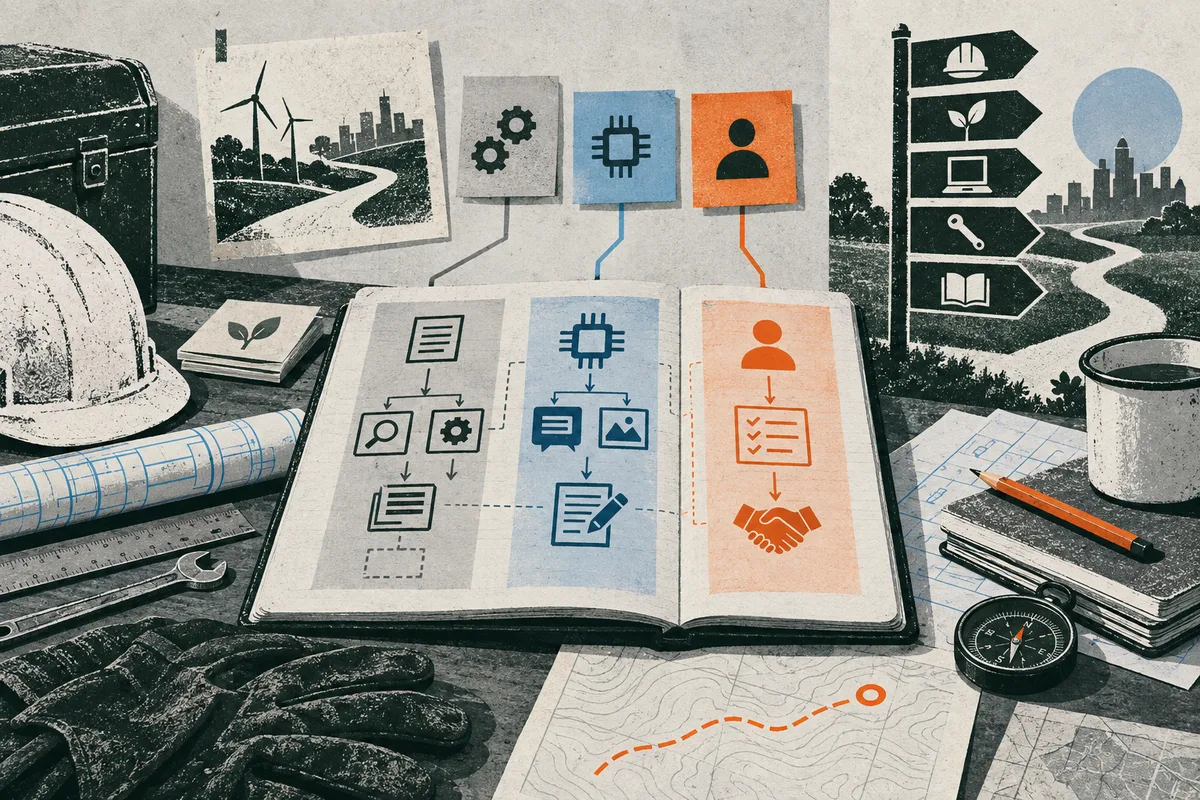
The U.S. Department of Labor's Artificial Intelligence Literacy Framework asks workers to build a usable foundation, not to become machine-learning engineers. Its five content areas are: understand AI principles, explore AI uses, direct AI effectively, evaluate AI outputs, and use AI responsibly. It also says that learning should be hands-on, tied to real work, reinforced by human skills, connected to further learning, supported by managers or trainers, and kept current. The framework is voluntary guidance for workforce and education programs, not a new federal test or a rule that every worker must complete a particular course. For an individual worker, the most sensible next move is to choose one recurring, low-consequence task and document the full loop: what the task requires, where a tool can help, how you will check the result, and what information or decisions must stay under human control. That exercise turns a broad literacy label into evidence about your own work. It also keeps exposure separate from displacement. A task may be technically suitable for assistance without an employer adopting a tool, changing staffing, or reducing demand for the occupation.
The claim under review: is this a new worker requirement?
The phrase Department of Labor AI Literacy Framework can sound more compulsory than the document is. The department issued Training and Employment Notice 07-25 to publish the framework as a resource for program design and to encourage expanded training across public workforce and education systems. The accompanying framework says it is a common foundation for workers, employers, training providers, educators, and agencies. It allows programs to adapt the content to industries, roles, and settings, and says the initial version will evolve with stakeholder input, technical change, and labor-market conditions. [The notice and framework establish its purpose and flexible status.]
That distinction matters for a worker deciding what to learn. There is no single federal exam, badge, or mandated sequence in the framework. A community college could use it to shape a short module. An employer could use it when designing onboarding. A workforce board could embed it in a workshop. A worker can use it as a checklist for a conversation about changing tasks. Those are different uses of the same reference point.
So the accurate answer to what workers are being asked to learn is narrower than the headline version. DOL is asking workforce systems to make baseline knowledge and responsible practice available across occupations. It is not declaring that a person who cannot write software is unprepared, nor is it claiming that basic tool use makes someone ready for an AI-centered occupation. The document itself separates foundational literacy from advanced capabilities such as managing or building AI systems, and says employers need to define the depth appropriate for each role.
What the five content areas mean in ordinary work
The framework's five areas form a sequence, but they are not five job titles. Understanding AI principles means learning enough vocabulary and mental models to know what a system is doing and where it can fail. DOL points to pattern-based and probabilistic outputs, different capabilities and input formats, the difference between training and inference, accuracy limits, and the human choices behind a system. A marketing coordinator does not need to train a model to understand why a plausible draft can still contain a made-up claim.
Exploring AI uses means seeing how tools fit real workflows. The examples include drafting documents, summarizing or analyzing information, creating initial creative options, transcribing, organizing schedules, and producing decision support. The word initial is important. The framework describes assistance and recommendations that can inform human decisions, not an instruction to hand over accountability.
Directing AI effectively means giving clear instructions, supplying relevant context, and iterating. It is more than memorizing prompt tricks. The worker has to specify the purpose, audience, constraints, source material, and desired form of the result, then ask useful follow-up questions. DOL explicitly says this does not require coding, although a technical role may need much more than this baseline.
Evaluating outputs means checking accuracy, relevance, completeness, bias, and fit for purpose. A result that reads smoothly is not necessarily a result that is safe to send. The framework includes comparing outputs with trusted information, identifying errors and unintended consequences, and improving results through feedback. This is where existing professional knowledge becomes operationally valuable.
Using AI responsibly means protecting sensitive information, following workplace policies, respecting privacy and intellectual property, recognizing misuse, and applying more scrutiny in higher-stakes settings. Responsibility is not a decorative ethics paragraph added after productivity practice. It changes whether a particular task is appropriate for a tool, what data may be entered, who reviews the result, and who can explain the final decision.
A worked example: turn a recurring task into a learning loop
Imagine a procurement specialist who spends part of each week turning supplier notes and internal requests into a first comparison table. The task bundle is not simply writing. It includes extracting requirements, noticing missing information, applying category knowledge, checking terms, and deciding what deserves escalation. Some portions may be suitable for a bounded experiment. The decision to approve a supplier is a separate responsibility.
Start with the task map. Write down the input, the intended output, the time spent, the sources that must be trusted, and the errors that would matter. Mark which fields contain confidential or personal information. This is the first content area in action because it defines the system's limits and the work's actual purpose.
Then test a narrow use. Provide sanitized sample material and ask for a draft table with explicit columns and a separate list of missing facts. Direct the tool by stating the audience, the source boundary, the format, and the rule that uncertain claims must be labeled for review. Do not measure success only by minutes saved. Check whether the output preserves requirements, distinguishes facts from suggestions, and makes omissions easier to spot.
Finally, evaluate and record. Compare the draft with the original documents, correct errors, note recurring failure modes, and decide whether the task should remain a draft aid, be redesigned, or be rejected for this workflow. The result is a small work sample that demonstrates literacy more credibly than a list of tool names. It shows task framing, direction, verification, and responsible handling together.
The same loop works for a project manager summarizing meeting notes, a claims analyst organizing evidence, or a researcher preparing a source brief. The content changes with the occupation. The durable pattern does not.

Why exposure is not the same as replacement
A framework that encourages workers to practice with tools can be read as evidence that jobs are about to disappear. That conclusion goes beyond what the document establishes. It describes capabilities, uses, oversight, and learning design. It does not estimate the probability that a particular person will lose a job, and it does not measure whether an employer has adopted a system or changed staffing.
The International Labour Organization's 2025 refined global index helps keep the vocabulary straight. It combines task-level data, expert input, and model predictions to study occupational exposure. Its central conclusion is that, because most occupations contain tasks requiring human input, job transformation is more likely than full replacement. That is a global research finding with methodological limits, not a forecast for one employer or one worker.
For your own decision, separate at least five questions. Can a current system perform part of the task? Are workers actually using it? Has your employer approved and integrated it? Is demand for the service changing? Has the organization redesigned roles or staffing? The answers can differ. A tool may draft a report capably while procurement rules prevent its use, a manager may allow experimentation without changing headcount, or faster production may create new review and coordination work.
This is why an exposure signal should prompt inspection, not panic. List the tasks that are digital, repeatable, and easy to check. Then list the parts that require context, trust, physical presence, negotiation, accountability, or costly verification. The second list is not automatically immune. It tells you where your domain knowledge and judgment may matter as a workflow is redesigned.
The seven delivery principles add the part workers often miss
The five content areas say what literacy covers. The seven delivery principles say how programs should make it useful. DOL emphasizes experiential learning, contextual integration, complementary human skills, inclusive design, continued-learning pathways, enabling roles, and agility. This is a stronger learning model than a one-time lecture about terminology because it links knowledge to a task, a workplace, and a next decision.
Experiential learning means practicing on real-world situations. Contextual integration means connecting instruction to an occupation or workflow. Complementary human skills include critical thinking, creativity, communication, and problem-solving. Inclusive design means adjusting for different starting points and access needs. Continued pathways recognize that baseline literacy is only a beginning. Enabling roles equip managers, trainers, mentors, and career navigators to support other learners. Agility keeps content revisable as tools and risks change. [These principles are directly stated in the framework's delivery section.]
For a worker, three implications are especially practical. First, a generic course is less useful if it never touches the documents, systems, rules, and decisions that define your job. Second, a prompt certificate is not proof that you can evaluate outputs under real constraints. Third, tool interfaces will change, so the learning asset worth keeping is a repeatable method for framing tasks, testing results, documenting limits, and asking for feedback.
The framework also leaves room for role depth. Someone using a writing assistant needs a different level of technical knowledge from someone configuring a customer-support workflow or monitoring a high-stakes model. A sensible program should therefore have a baseline and a route upward, rather than forcing every learner into the same technical curriculum.
Where responsible use becomes a real work skill
Responsible use becomes concrete when you ask who could be affected by an error and who has authority to correct it. A worker preparing an internal brainstorm can usually tolerate more uncertainty than a worker handling benefits, financial records, safety information, or a customer's personal data. The framework says scrutiny should increase in higher-stakes contexts and that users should follow organizational policies, protect critical information, and remain accountable for outcomes.
NIST's AI Risk Management Framework offers a useful companion vocabulary for teams that need more structure. Its voluntary framework organizes risk work into govern, map, measure, and manage. It calls for documenting intended use, capabilities and limits, human oversight, benefits and costs, performance, privacy, security, fairness, and incident response. It is not a personal worker syllabus and it is not a substitute for an employer's legal or operational controls. But it clarifies the kind of participation a non-engineer can provide.
A subject-matter worker can help map the task and affected users, identify what a good result means, create representative examples, flag harmful edge cases, define review points, and report failures after deployment. That work may require no model-building at all. It requires knowing the process well enough to recognize a confident wrong answer and having a clear route to stop, correct, or escalate it.
This is also the boundary on the phrase human in the loop. A person who merely clicks approve without time, information, authority, or competence to check an output is not meaningful oversight. Literacy should help workers ask whether the review step is real: what is being checked, against which source, within what time, and with what consequence when the system fails?

Choose the next learning path by the outcome you need
The right response depends on your goal. If you want to stay in your current field and use tools well, begin with a short, contextual project on one recurring task. Keep your existing domain learning and add the five-part loop: understand, explore, direct, evaluate, and use responsibly. Ask a colleague or manager to review the result against real standards.
If you want to move into an AI-enabled role adjacent to your current one, add process mapping, data literacy, evaluation, documentation, and change communication. Look at real job postings in your target geography and compare their recurring requirements with your current evidence. A project showing an improved workflow, its checks, and its limits may reveal a gap more accurately than collecting several introductory certificates.
If you intend to build software products, you may need programming, data structures, APIs, testing, security, deployment, and product judgment. A course or structured program can provide feedback and sequence. If your goal is ML engineering or research, the prerequisite burden is higher: mathematics, statistics, programming, model evaluation, and deeper theory may justify a longer degree or advanced program. DOL's literacy framework is a foundation for these paths, not proof of readiness for them.
Compare options by the constraint that can actually stop you. A degree offers depth, structured feedback, and a credential signal, but usually demands more time and money. A course can target a defined gap, though quality and workplace transfer vary. A certificate may document completion without demonstrating capability. A project can create evidence quickly, but it requires self-direction and a reviewer. Self-study is flexible and cheap in cash terms, but feedback and signaling are weaker. An apprenticeship or employer project can supply context and feedback when available, but access is uneven.
Use the framework to assess a learning offer before paying for it. Can you practice on tasks that resemble the work you want? Will someone inspect not just the final answer but your reasoning, source checks, and handling of uncertainty? Does the program explain how it will update examples and policies as tools change? Does it show a route from baseline use to the particular role you want, or does it simply rename familiar digital skills? These questions do not predict a hiring outcome. They do reveal whether the offer produces evidence that another person can evaluate.
Constraints should change the plan, not be treated as excuses. If you work full time or care for family, a small project with weekly feedback may be more viable than an intensive program. If your income cannot absorb a long transition, an upgrade or adjacent move may be worth testing before a larger change. If location limits the employers you can reach, inspect local postings and training access rather than relying on a national claim. If health or accessibility affects study time, ask providers for the actual pace, format, support, and assessment demands.
For the next two weeks, choose one low-consequence task, create a before-and-after record, and ask one trusted person: what would make this output acceptable in our actual workflow, and where must a human remain accountable? That bounded step is aligned with the framework and gives you evidence for a larger learning decision.
What to ask your manager, trainer, or career adviser
The framework's most useful ending is a conversation, because literacy depends on context that a national document cannot supply. Bring a task map rather than a vague request to become AI-ready. Name the recurring work, the desired outcome, the information involved, the checks required, and the failure that would be costly.
Ask which tools are approved, what data may be entered, who owns the final decision, and how quality will be measured. Ask whether the goal is assistance, throughput, better service, or a redesigned process. Ask what training is available and whether the role is expected to develop deeper proficiency. If your employer has no clear answer, that uncertainty is itself useful information about the maturity of adoption and the risks you would carry personally.
If you are job searching, ask a training provider to show the practice tasks, feedback method, assessment standard, update process, and next step after completion. Ask an adviser to compare the option with your salary floor, location, schedule, health, caregiving, and available study time. A learning plan that ignores those constraints is not realistic simply because its subject is current.
You can also ask for a task-level review of your role. Which parts are being automated, which are being augmented, and which new checks or exceptions are appearing? What happens when the output is wrong? Who is allowed to override it? What record is kept? Those questions move the discussion from a vague request to be more productive toward the concrete design of work. They also help distinguish a genuine development opportunity from an informal transfer of risk to the worker.
The practical verdict is modest but consequential: learn enough to inspect where AI can help, direct it toward a defined purpose, evaluate what it returns, and protect the people and decisions affected by the work. Then deepen only where your task mix and target outcome justify it.
Questions readers ask
Is the Department of Labor AI Literacy Framework mandatory?
No. DOL presents it as voluntary guidance and a resource for workforce and education program design. It does not create a universal worker exam or require completion of a particular course.
What are the five areas in the framework?
They are understanding AI principles, exploring AI uses, directing AI effectively, evaluating AI outputs, and using AI responsibly. Together they describe a baseline for practical and accountable use.
Do I need to learn programming to meet the framework?
Not for the baseline. The framework says directing AI effectively does not require coding, while also recognizing that technical roles may require deeper capabilities. Your target task and career outcome should determine the depth.
Does AI literacy mean I am ready for an AI job?
No. Literacy is a foundation. Building AI products, working in ML engineering, or pursuing research usually requires additional programming, data, statistics, evaluation, and domain-specific preparation.
How should I start learning AI literacy at work?
Choose one low-consequence recurring task, use sanitized or approved material, define the output and review standard, test the tool, compare its result with trusted sources, and record what still requires human judgment.
What is the difference between AI exposure and job displacement?
Exposure describes whether parts of a task may be technically affected. Displacement would require additional facts about adoption, workflow redesign, demand, staffing, and employer decisions. Exposure alone is not a job-loss probability.
What does responsible AI use require from a worker?
It requires following workplace rules, protecting sensitive information, checking accuracy and relevance, respecting privacy and intellectual property, recognizing misuse, and applying stronger review in higher-stakes settings.
Should I take a course, earn a certificate, or pursue a degree?
Start with your outcome and constraints. A task-specific project may be enough for current-role use; a course can close a defined gap; a degree provides greater depth and signaling for longer technical paths. Completion alone does not prove workplace capability.
Sources and notes
- The U.S. Department of Labor's Artificial Intelligence Literacy Framework
Supports the definition, five content areas, worker examples, and seven delivery principles.
- Training and Employment Notice 07-25
Supports the notice's audience, program-design purpose, and voluntary guidance context.
- U.S. Department of Labor releases AI literacy framework
Supports the publication date, five content areas, seven principles, and adaptable nationwide purpose.
- Generative AI and Jobs: A Refined Global Index of Occupational Exposure
Supports the task-level exposure method and the distinction between transformation and replacement.
- NIST AI Risk Management Framework Core
Supports the govern, map, measure, and manage vocabulary for responsible team participation.
Apply this to your own work
See the whole job market at once.
Explore which occupations AI may reshape, then turn the signal into a practical response.
Explore the job map