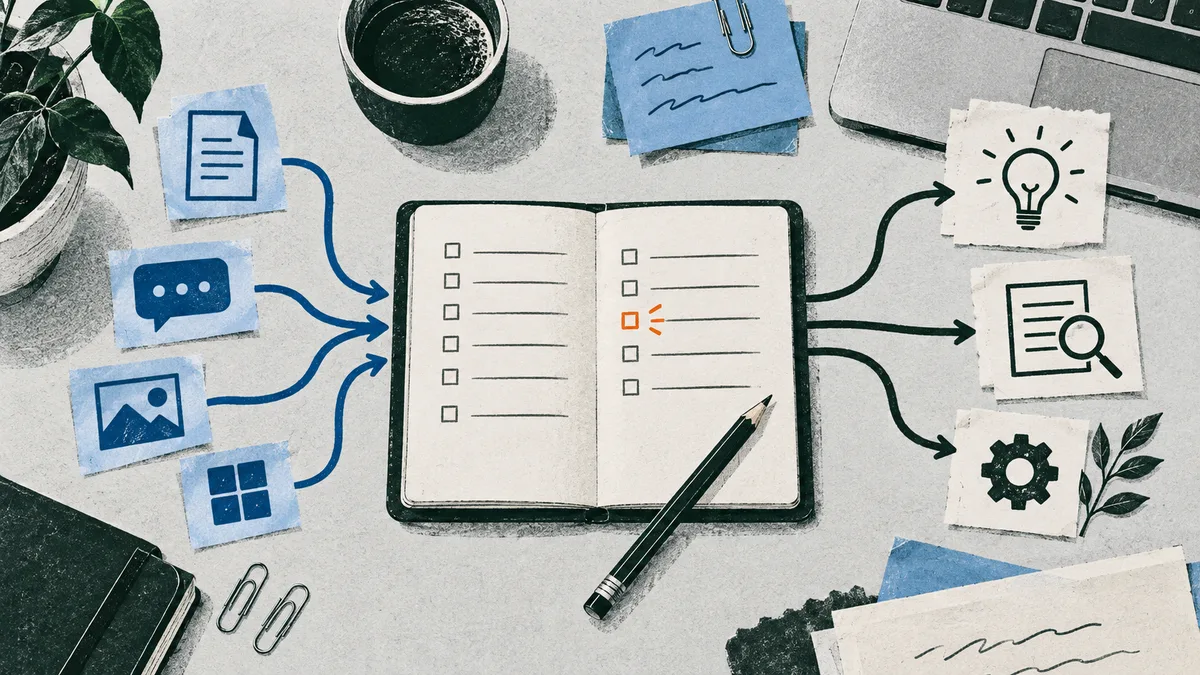
Microsoft Research’s report describes how 125 interns used Copilot during summer 2024 and how they said they learned the tool. More frequent use was associated with stronger self-reported socialization, but the study does not establish cause or test retained workplace knowledge. Learn one approved, recurring task in context, verify the output, and check whether you can explain or repeat the workflow without assistance.
What kind of study was this, and whose experience does it describe?
The report is a mixed-methods account of 125 Microsoft interns using Copilot during summer 2024. It describes what those interns tried, valued, and said they learned. It is not a randomized test of Copilot training, nor a representative survey of workers generally. The distinction matters: a detailed account can show how a workflow felt in context without establishing what would happen under a different onboarding program or for others.
In “New employee Copilot usage: Insights into productivity and socialization,” researchers collected survey responses in four waves across July and August 2024, conducted interviews with 25 interns, and analyzed 360 diary submissions . Participants worked across Microsoft organizations and roles, but the sample skewed toward engineering and had an average age of 21, reflecting the undergraduate focus of the internship program. Surveys tracked reported use and attitudes; interviews added participants’ accounts of team dynamics and perceived effects; diary entries paired screenshots with descriptions . Bringing these sources together gives a broader descriptive picture than any one method alone. It does not create a comparison group, independently score workplace learning, or test whether knowledge lasted after the internship.
The report was published in 2025; its observations concern a particular 2024 cohort, company, and onboarding environment. The authors say the interns were purposefully selected as an “extreme case” of new employees because internships create pressure to become productive quickly. They also caution that the group was not statistically representative, that Microsoft’s culture encouraged Copilot use, and that early-career interns may differ from established employees. It maps reported experience and questions worth testing elsewhere. Read it as evidence about how these interns encountered Copilot, not as a universal account of new hires or proof that today’s workers learn durable job skills by using it.
Sources: New employee Copilot usage: Insights into productivity and socialization; New employee Copilot usage: Insights into productivity and socialization - Microsoft Research
What did interns use Copilot to do as they settled into work?
The report’s clearest picture is of interns using Copilot as an entry point into unfamiliar work: finding information, getting help with writing or coding, brainstorming, and summarizing material. “New employee Copilot usage: Insights into productivity and socialization” reports that these were the five most common use cases in surveys. It also reports that 86% of survey participants used Copilot daily for at least one use case. This describes reported frequency in one Microsoft intern sample; it does not establish answer accuracy or improved independent skill. Information retrieval had a particular onboarding role. The report says 46% of diary examples served learning needs about Microsoft or open-domain information. Interns used retrieval and summaries to get oriented to unfamiliar company concepts, acronyms, and names. Information retrieval remained the most common use case throughout the internship, while reported summarization and searches about people and company norms increased. This pattern suggests that a tool available inside work applications may make it easier to start a search or catch up on material. It does not show that a summary was complete, that an answer reflected local practice, or that reading it taught the underlying subject. Writing and coding assistance helped interns begin or get unstuck on a deliverable. They described treating suggestions as starting points, including for code or test cases; some used imperfect responses to find a direction for further investigation rather than as finished solutions. A draft or code suggestion can lower the blank-page barrier while leaving the worker responsible for checking fit with the project, team conventions, and expected behavior. The report records perceived usefulness and examples of use. It does not independently score resulting work, calculate time saved after review, or test whether interns could later do the task without assistance. For a worker choosing what to learn, this is a shortlist of tasks to examine, not a recommendation to use Copilot for each one. Compare it with a recurring task you understand well enough to verify. For information retrieval, check the source and whether it answers your question. For a draft, check facts, audience, and workplace standards. For code, test it in context and inspect edge cases. Include correction time when deciding whether assistance helps. The report can suggest where a tool might fit; local quality checks determine whether it belongs in your workflow.
Sources: New employee Copilot usage: Insights into productivity and socialization
How did interns say they learned to use the tool?
The interns described three routes to learning Copilot: trying it themselves, picking up peer tips, and using documentation or training resources. The Microsoft Research report draws this account from surveys, interviews, and diary entries involving 125 Microsoft interns in summer 2024. It documents how participants said they approached the tool; it does not compare teaching methods or test what they could do later without Copilot. Experimenting with a low-stakes task can reveal what a feature accepts, where an answer needs checking, and which prompt details affect the result. It does not automatically teach the subject matter behind the task. That distinction matters when output feeds consequential work. Peers can add context a feature guide may not provide. A colleague’s example can show how a tool fits a team’s workflow, which local conventions matter, and where an answer should be checked. Documentation and training can explain capabilities, limitations, and less obvious features. Interns in the Microsoft Research report described consulting Microsoft documentation and watching official training videos and internal community posts. These are reported experiences, not evidence that one resource produced better learning. A separate interview study, “Beyond Training: How Workers Discover Value in Enterprise AI,” offers a comparison. Its authors interviewed 10 experienced U.S. professionals who actively used M365 Copilot. In this selected group, trial and error and colleague tips were common reported routes; participants also described low confidence with advanced features. The study shows that informal discovery can coexist with uncertainty, but its ten interviews cannot rank training approaches or show which method works best. Its participants also differ from interns learning a tool during onboarding. Together, the reports make informal exploration plausible for basic fluency on a reversible, low-risk task. For specialized workflows, consequential output, or uncertain data rules, team guidance and documentation matter because they supply local standards and boundaries. Match the route to the task: explore where errors are easy to catch, ask a colleague about conventions, and use approved instruction when policy or quality depends on details. Familiarity with Copilot or a peer’s successful example does not prove transferable skill; that requires checking whether the worker can explain and apply the underlying process.
Sources: New employee Copilot usage: Insights into productivity and socialization; Beyond Training: How Workers Discover Value in Enterprise AI
What does the socialization association permit us to conclude?
The result supports a narrow statement: among the interns studied, those reporting more frequent Copilot use also reported stronger workplace socialization and team identification. The Microsoft Research report describes this as an association. It does not establish that Copilot produced those feelings, taught interns how their teams work, or improved job performance. The distinction matters because a relationship between two measures can be real and useful to investigate while leaving its direction and cause unresolved.
One possibility is that using Copilot helped some interns feel more connected: easier access to workplace information could reduce friction when learning where to begin. That is a plausible mechanism, not a demonstrated explanation. The reverse direction is also plausible. Interns already comfortable asking questions, exploring internal resources, or joining team routines may have used the tool more often. Social integration could precede or encourage use rather than result from it.
Shared circumstances could contribute to both. Access to Copilot, manager guidance, team norms about experimentation, assigned tasks, and prior comfort with workplace software may vary across interns. Any could affect reported use and integration together. The observational design does not isolate Copilot from those factors through random assignment. More frequent use also does not show that an intern understood the work better: repeated interaction may reflect useful practice, a demanding task, or greater opportunity to use the tool.
The outcome needs careful reading. Socialization and team identification concern how newcomers perceive their connection and place in an organization. Organizational socialization can also mean learning role skills, standards, relationships, and expected conduct. Those ideas overlap, but are not interchangeable measures. A person may feel more familiar with a team without showing they can perform a task independently; someone can learn a procedure before feeling settled. The reported association cannot stand in for a test of job knowledge, tool competence, or lasting learning.
A causal conclusion would need a credible comparison that separates tool use from access, role, support, and prior comfort, plus outcomes measured independently of reported use. The chosen outcome would matter: evidence of improved belonging would not prove better task performance or retained knowledge. For a new hire, the practical reading is modest. The report does not show that frequent Copilot use is required for fitting in, or that the tool can replace colleagues, clear onboarding, or feedback about local standards.
Sources: New employee Copilot usage: Insights into productivity and socialization
Why is task completion not the same as retained knowledge?
A worker can finish a task with an AI assistant and still be unable to explain the method or repeat it without help. Supported performance differs from knowledge available after support is removed. A randomized BCG experiment makes that distinction visible, though it does not tell us what happened to Microsoft interns using Copilot.
In “Generative AI and the Temporary Upskilling of Knowledge Workers,” consultants were randomly assigned either ChatGPT access plus 20 minutes of training, or training in Stack Overflow and other public resources. They attempted two of three 90-minute tasks in coding, statistics, and prediction, designed to require human input and exceed a general consultant’s expected skills. Of 487 participants who submitted work, the ChatGPT group scored 49 percentage points better on coding, 20 on statistics, and 17 on prediction than controls, on scores normalized to data scientists’ average. Still, the group did not reach expert performance across the tasks.
The researchers separately tested knowledge after the tasks. Both groups answered five related technical questions without ChatGPT. There was no statistically significant treatment effect across the questions (joint test p = 0.531); the authors report moderate evidence for no difference on individual questions. This bounded result means the short intervention improved assisted task scores without a detectable advantage on these unaided questions. It does not prove nobody learned or that practice cannot build durable skill. The five questions, asked soon after the experiment, were not a delayed test of broad transfer.
A different pattern appears in “Generative AI at Work,” which studied 5,172 customer-support agents during a staggered introduction of an AI conversational assistant. The authors report a 15% average increase in issues resolved per hour and evidence that assistance facilitated learning, especially for less-experienced agents; they also report improved English fluency among international agents. Repeated recommendations during real cases may expose newer workers to effective patterns. But this customer-support deployment had different work and measures. It cannot show Copilot caused interns to learn their jobs, and its learning result is not interchangeable with the BCG study’s unaided technical questions.
The studies need not conflict: they involve different tasks, tools, workers, exposure patterns, and definitions of learning. A short set of unfamiliar technical exercises followed by unaided questions tests transfer beyond the assisted task. Repeated support during customer conversations asks whether work patterns or measured performance change over time. Neither design answers every retention question, and neither is a Copilot onboarding trial. A worker learning a workplace tool can check two outcomes separately: whether assisted work meets its quality standard, and whether they can later explain the reasoning or repeat a small part without help. If independent understanding matters, completion alone does not show that the skill transferred.
Sources: Generative AI and the Temporary Upskilling of Knowledge Workers; Generative AI at Work
What does newer early-career evidence add—and what does it not?
A 2026 field experiment adds a useful, narrower result: access to generative AI helped final-year German IT apprentices complete tasks beyond their formal training, without reducing their immediate comprehension of those tasks. It sharpens the question of whether assistance can expand what an early-career worker can do. It does not establish what the apprentices remembered later or could do without help. The study, “Task Expansion with Generative AI: Experimental Evidence on Middle-Skilled, Early-Career Workers,” was published as a working paper on October 7, 2026. Its result concerns task performance and comprehension in a defined vocational setting, not durable learning from Microsoft Copilot during onboarding.
The Stanford Digital Economy Lab reports that researchers randomly assigned access to AI while 673 apprentices at twelve German vocational schools completed occupation-specific tasks. Participants were in the final year of IT apprenticeships. The tasks included work within their curriculum and deliberately advanced work beyond it. On the latter tasks, AI access raised productivity by 26–31 percentage points; gains were also reported across task types and tended to be larger where unaided performance was lower. The researchers report no cost to immediate task comprehension. These details support a bounded conclusion: in this experiment, assistance let apprentices perform work outside the scope of their formal training without a measured immediate comprehension penalty.
The study also reports generally larger treatment effects among apprentices with above-median AI literacy. One reasonable interpretation is that some familiarity with AI may help workers make better use of assistance. That is a possible mechanism to investigate, not proof that taking a course causes higher productivity: AI literacy was not itself randomly assigned in the summary, and the result does not compare alternative training programs. Nor should the experiment be treated as a direct comparison with Microsoft interns. The participants, tasks, setting, tool access and outcomes differ; the Microsoft report describes interns’ Copilot use and self-reported learning routes, while this experiment compares task performance under randomized access.
“Immediate task comprehension” answers a different question from delayed retention. A participant may understand an answer while completing a supported task and still need help to reproduce the method later. To test that next step, researchers would need later unaided work or a related transfer task; the Stanford study page reports neither as an outcome. Its finding therefore complicates any simple claim that using AI necessarily blocks understanding, but it cannot settle whether AI-assisted practice builds independent expertise. For a worker deciding how to learn, the practical distinction is modest: task expansion is valuable evidence about present capability, while retained knowledge remains an open question to check separately.
Sources: Task Expansion with Generative AI: Experimental Evidence on Middle-Skilled, Early-Career Workers
How should productivity experiments be kept separate from learning evidence?
A productivity result tells you whether people completed a specified task faster or produced a higher-scoring result when they had access to a tool. It does not, by itself, tell you what they learned. That distinction matters when deciding whether a workplace AI tool deserves practice time: smoother completion today may be useful, but it is not proof that the underlying skill will remain available tomorrow without assistance.
The randomized online experiment reported in “Experimental Evidence on the Productivity Effects of Generative Artificial Intelligence” offers a clear example of what a bounded performance claim can establish. Researchers assigned 444 college-educated professionals occupation-specific, incentivized writing tasks, then randomly gave half access to ChatGPT for a second task. Blinded professionals rated the work. Compared with controls, participants with access spent about 10 fewer minutes on the second task, a 37% reduction from the control group’s 27-minute average, and received grades about 0.45 standard deviations higher. Random assignment makes this stronger evidence of an immediate effect on these measured tasks than a survey asking workers whether they felt more productive.
The design also sets its boundary. These were short online assignments, not months of ordinary work inside a team. Researchers measured task time and output quality, not delayed recall, later unaided performance, or transfer to a new task. The result supports a claim about performance under those experimental conditions. It does not show that participants acquired durable expertise or learned Microsoft Copilot. The product and setting differ from the Microsoft intern report, which described use and self-reported learning routes rather than randomly assigning access and testing retained knowledge.
Keep the evidence on separate rungs. A system’s capability is what it can do under defined conditions; observed use shows people tried it; task performance records what happened on a particular job with access. Learning requires a further measure, such as explaining the reasoning, repeating a task later without help, or applying the idea to a related case. Employer adoption asks whether an organization makes the tool part of work at scale. Labor demand and displacement are different outcomes; neither follows automatically from faster or better task completion.
Before using a study to choose a course, tool or career move, ask which rung its outcome actually measures. The writing experiment gives a reason to test whether a comparable, approved task benefits from assistance. It is not a reason to assume that using the tool has taught you the work, that every employer will adopt it, or that a job will disappear. If independent competence matters, pair assisted practice with a later unaided explanation or repeat task, then judge the learning question on that evidence.
Sources: Experimental Evidence on the Productivity Effects of Generative Artificial Intelligence; New employee Copilot usage: Insights into productivity and socialization
What measures would show actual learning rather than assisted performance?
Evidence of learning needs to outlast the task completed with AI. A successful answer on screen shows what a person and tool could produce together at that moment. It does not, by itself, show that the person can explain the method, catch a flawed result, repeat the work later, or adapt the idea to a related problem. Microsoft’s intern report described tool use and self-reported learning routes, but did not report delayed recall, unaided repeat tasks, or transfer tests.
A useful evidence ladder separates five questions. Usage logs and self-reports show contact with a tool and a person’s perception of it. Scored outputs show task performance under the conditions tested, including whether AI assistance was available. An immediate comprehension question can indicate whether someone followed the result in context. A delayed, unaided explanation or repeat task probes whether relevant knowledge remains available after the tool is removed. Finally, a new but related task tests transfer: can the person use the principle when details change?
The randomized BCG consultant experiment illustrates why the distinction matters. In that study, 986 consultants were assigned to conditions that included ChatGPT training and access or a control condition, then worked on discrete data-science tasks. The researchers measured task completion and scores, and separately asked technical questions without ChatGPT after the experiment. The assisted group performed better on the tasks, but the study found no credible difference in retained technical knowledge between treatment and control. Its scope remains narrow: these were highly educated consultants doing constructed tasks, not full data-science roles, and the study does not settle what repeated practice might teach.
The OECD review, “The Effects of Generative AI on Productivity, Innovation and Entrepreneurship,” likewise treats immediate performance and sustained learning as distinct questions. Reviewing experiments across varied settings, it reports that effects depend on the task and user, notes risks when people accept plausible but incorrect output without evaluation, and identifies long-term effects and workers’ understanding of limitations as research gaps. This is a synthesis, not a single workplace trial, and its education findings should not be read as direct evidence about Microsoft interns.
For a personal check, use a low-stakes, approved workflow: after practicing with the tool, explain why the result is acceptable, repeat the task later without assistance if policy and risk allow, then verify one changed example against reliable source material. Difficulty is a signal to seek practice, peer guidance, or structured instruction, not a verdict on career ability.
Sources: The Effects of Generative AI on Productivity, Innovation and Entrepreneurship; Generative AI and the Temporary Upskilling of Knowledge Workers
What is a fair takeaway for workers beyond Microsoft’s intern cohort?
The Microsoft report suggests candidate workflows and learning supports, but cannot tell a mid-career worker whether Copilot will pay off in their role or whether a credential is worthwhile. Its 125 participants were interns inside Microsoft, where leadership and culture encouraged Copilot use. The report cautions that interns may differ from other new hires and that findings should not automatically transfer to workers who are not novices. Transfer depends on whether work is repeatable, whether the tool can access relevant and permitted context, whether the employer approves it for that data, how much checking the output needs, and what mistakes would cost. Learning an interface or useful prompt pattern is also different from gaining durable expertise. Someone may become fluent at requesting a summary without learning the policy, customer history, or technical reason that makes it reliable. The report describes use and reported learning routes; it does not measure independent expertise or show improved hiring demand. Other experiments sharpen this distinction without answering the Microsoft question for every worker. In a German IT-apprentice field experiment described by the Stanford Digital Economy Lab, 673 final-year apprentices were randomly given AI access or not. The page reports better performance on tasks beyond formal training without lower immediate task comprehension. That is evidence about performance and comprehension in that setting, not delayed retention for mid-career office workers. In the randomized BCG consultant study, AI-assisted performance on selected data-science tasks improved, while later unaided technical questions showed no credible retention advantage. The populations, tools, tasks, and measures differ; neither result predicts what will happen in a particular team. A sensible first move is to upgrade one recurring task in the current role, if the tool is approved and its output can be checked against dependable material. Include review and correction time when judging whether it helps. Ask a colleague what acceptable work looks like, then see whether you can explain or repeat the process later without assistance. If policy, task risk, or a clear knowledge gap calls for structure, seek workplace instruction or a focused course tied to that need. A degree, certificate, or career pivot needs a separate case based on prerequisites, cost, location, study time, salary needs, health, and family responsibilities. The report gives no reason to discard useful experience or enroll by default; it gives a reason to test local fit before making a larger commitment.
Sources: New employee Copilot usage: Insights into productivity and socialization; Task Expansion with Generative AI: Experimental Evidence on Middle-Skilled, Early-Career Workers; Generative AI and the Temporary Upskilling of Knowledge Workers
What is a proportionate next step?
Pick one approved, low-risk task with a source you can use to check the result. Confirm your employer’s data rules and permitted tools. Note your workflow, then try the task with the tool and count time spent reviewing and correcting its output, not just generating it. Ask a colleague what acceptable quality looks like if that standard is unclear. Repeat the task or explain the steps without assistance. This is a check on your understanding, not a validated competence test. The Microsoft Research report describes interns learning Copilot through experimentation, peers, and training resources; a ten-user M365 Copilot interview study also describes trial and error and peer discussion. Neither shows that informal practice works for every task or replaces structured instruction. If an error could cause harm or the knowledge is essential, seek approved supervision or training before relying on the output.
Use what you observe to choose the next small investment: practice for a tool-use gap, a colleague or documentation for a local workflow question, or structured learning when underlying knowledge is missing. The free [task-level change-pressure checker](/ai-job-risk-checker) offers a separate view of your task mix; its signal is not a probability of job loss. The [career roadmap](/career-roadmap) can help compare constrained career scenarios, but cannot guarantee employment or income. Decide from verified task evidence, not tool familiarity alone.
Sources: New employee Copilot usage: Insights into productivity and socialization; Beyond Training: How Workers Discover Value in Enterprise AI
Questions readers ask
Does the Microsoft Research study show that Copilot helped interns learn their jobs?
No. It describes interns’ reported Copilot use, learning routes, and an association between more frequent use and self-reported socialization. It did not test delayed recall, unaided performance, or transfer of workplace knowledge.
What is a practical way to learn a workplace AI tool?
Choose one approved, low-risk recurring task with a reliable source for checking the result. Include review time, ask a colleague about local standards, and later see whether you can explain or repeat the workflow without assistance.
Sources and notes
- New employee Copilot usage: Insights into productivity and socialization
Supports the account of intern sample, reported use cases and learning routes, and the observational association with self-reported socialization.
- New employee Copilot usage: Insights into productivity and socialization - Microsoft Research
Supports the study’s reported sample, association, common use cases and informal tool-learning routes.
- Beyond Training: How Workers Discover Value in Enterprise AI
Supports reported discovery routes and advanced-feature uncertainty among ten interviewed experienced M365 Copilot users.
- Generative AI and the Temporary Upskilling of Knowledge Workers
Supports the randomized consultant experiment’s assisted task results and separate unaided technical-question findings.
- Generative AI at Work
Supports results from a customer-support deployment, including measured productivity and suggestive evidence of worker learning.
- Task Expansion with Generative AI: Experimental Evidence on Middle-Skilled, Early-Career Workers
Supports the randomized German IT-apprentice experiment’s task performance and immediate comprehension findings.
- Experimental Evidence on the Productivity Effects of Generative Artificial Intelligence
Supports measured immediate writing-task time and quality effects in a randomized experiment with ChatGPT access.
- The Effects of Generative AI on Productivity, Innovation and Entrepreneurship
Provides an evidence review distinguishing task performance from lasting learning and describing measurement limits.
Apply this to your own work
See the whole job market at once.
Explore which occupations AI may reshape, then turn the signal into a practical response.
Explore the job map