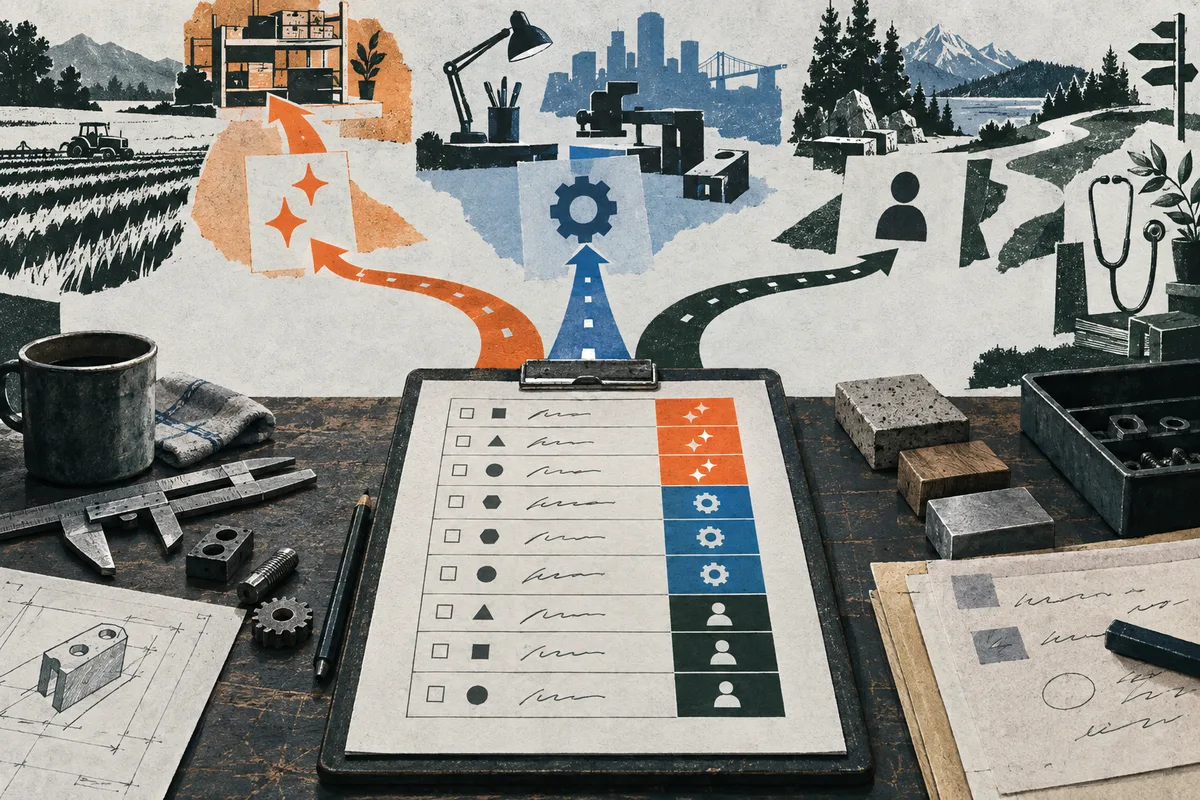
NIST AI 600-1 asks organizations to govern generative AI use across its lifecycle: define the task and context, evaluate performance under realistic conditions, assign accountable oversight, and monitor for errors and changing impacts. It offers voluntary, context-tailored guidance, not product certification, a universal checklist, or a prediction that a task or job will be displaced.
What kind of decision does NIST AI 600-1 support?
NIST-AI-600-1 supports a structured organizational decision about whether and how to use generative AI for a defined purpose. NIST released the profile on July 26, 2024, as a companion to its AI Risk Management Framework (AI RMF) 1.0. The profile identifies risks specific to generative AI and proposes actions organizations can align with their goals and priorities, as the NIST AI Risk Management Framework page explains. It is not a product certification or a forecast that a task or job will be automated. The AI RMF organizes that work through four connected functions: Govern, Map, Measure and Manage. These functions establish responsibility, describe context, evaluate risks and performance, and respond to findings. The AI RMF Core says these functions organize ongoing lifecycle work, but its actions are neither a checklist nor necessarily ordered steps. Organizations can adapt and revisit them as context changes. That makes the profile a way to frame questions and document choices, rather than a universal pass/fail test for every workplace task. For a worker, the useful unit is one named task and the handoffs around it, not a broad job title. Drafting an internal summary, sending a customer a consequential decision, and passing generated text into another system are different uses even if they rely on similar text generation. The framework can help an organization examine those uses; it does not establish that a capability is reliable in a particular workplace, that an employer has adopted it, or that labor demand or employment will change. NIST also cautions in its AI Risk Management Framework FAQs that addressing trustworthiness characteristics one by one does not ensure a trustworthy system: tradeoffs arise, and which characteristics matter depends on the setting and the perspectives of affected people. NIST currently says AI RMF 1.0 is being revised; that notice does not say AI 600-1 has been replaced. A worker can ask the process owner what use is proposed, who is accountable and how it will be evaluated, while checking workplace and legal requirements separately. It is guidance for a reasoned decision, not assurance that the decision is safe.
Sources: AI Risk Management Framework - NIST; AI Risk Management Framework FAQs; AI RMF Core
What should the organization map before a trial?
Before a trial, the organization should map a work task in its setting: purpose, users, permitted inputs, expected output, affected people and accountable owner. The AI Risk Management Framework Core says its Map function establishes context and informs an initial decision about whether an AI solution is appropriate. The question is not simply whether a model can produce text, but what task it will support and with what consequences. A job title alone cannot answer that; the map needs to describe the workflow. Connect the task’s beginning to its end. Name what enters the system, what it returns, who acts on the result and where it may be handed off. The Core asks organizations to define specific tasks, document how outputs may be used and overseen, and record knowledge limits. It also calls for understanding intended purposes, settings, user expectations, assumptions, benefits and potential negative impacts. “Draft an internal summary for a colleague to check” is narrower than “prepare information that may shape a customer’s eligibility.” The capability may be similar, but the affected person and cost of an unnoticed error differ. Mapping clarifies whether a proposed use fits before general capability is mistaken for task suitability. Context includes conditions around the task, not only its prompt. The Core identifies relevant laws, norms, privacy requirements, organizational risk tolerance and business value as matters to document. A worker can ask: Is this tool approved? Which information may be entered? Could inputs contain personal data, confidential material or content the organization lacks rights to submit? NIST AI 600-1 identifies data privacy and intellectual property among generative-AI risks; the Core also calls for mapping third-party components and risks of infringing others’ rights. Availability alone does not establish permission to use a tool or submit particular material. The map should state expected value and costs if the system makes errors. The Core calls for examining benefits and costs, including non-monetary costs, in relation to organizational risk tolerance. A task statement might specify that a system prepares a first draft to reduce formatting work, while an employee checks it against source material before sharing. That makes the benefit and boundary visible. Compare this with a narrower assist, an existing tool or a non-AI method. NIST’s framework includes viable non-AI alternatives; considering one can show whether AI addresses the task’s need or adds review burdens. Finally, anticipate foreseeable use beyond the initial description. The Core advises considering risks beyond intended use because early decisions interact with later deployment conditions. An internal summary might be copied into a record or used in another decision. The boundary and owner should be clear, with a way to notice if use expands. NIST says mapping should continue as context, capabilities, risks, benefits and impacts evolve. It also recommends relevant expertise and, where appropriate, perspectives from users or affected people. These can surface assumptions the proposing team misses. The Framework FAQ describes the framework as voluntary, so mapping is a basis for a decision, not an approval form or certification. Ask the process owner to record the task, approved inputs, output, affected people, benefit, foreseeable reuse and owner. If boundaries or data rules remain unclear, do not enter workplace material or accept responsibility for an undefined process. Mapping may support a bounded trial, further questions or a decision not to proceed; it does not establish reliable performance, which must be evaluated separately.
Sources: Artificial Intelligence Risk Management Framework: Generative Artificial Intelligence Profile (NIST AI 600-1); AI RMF Core; AI Risk Management Framework FAQs
What changes when the task can affect someone outside the team?
The consequences change when generated text can affect a person beyond the team that produced it. Before relying on the output, the organization should identify who may bear an error, how serious and reversible it would be, whether that person can see or challenge the result, and whether the output will shape a later decision. NIST’s Generative Artificial Intelligence Profile (NIST AI 600-1) says risks vary with the use case and its context; it identifies confidently presented false content, or confabulation, as a risk that can mislead users. The practical question is therefore not simply whether a model can draft the text. It is what people may do with it, and how an error could be noticed and remedied. Imagine a team uses a generative system to summarize meeting notes for internal reference. If a colleague checks the summary against the notes before using it, an omitted detail may be easy to catch and correct. Now compare an AI-drafted eligibility message that tells an applicant what information is missing or implies whether they qualify for a service. The second output reaches someone who may have limited access to the underlying record and may make decisions based on the message. An error could cost time, delay access, or shape a later review. These are illustrations, not NIST-assigned risk categories. They show why the same text-generation capability calls for different questions when the audience and consequence change. NIST AI 600-1 describes confabulation as erroneous or false content presented confidently, including content that diverges from the prompt or contradicts itself. It says such output can mislead users into acting on or promoting false information, and calls for particular attention when generative AI is integrated into consequential decisions. The NIST AI Risk Management Framework Core treats context mapping as a basis for understanding impacts, while its risk framing recognizes that likelihood and consequence both matter. The relevant boundary is the workflow as people actually use it, not merely the prompt or software feature in isolation. Applied to a work task, that suggests tracing the route from input to output to action: who supplies information, who checks the result, who receives or relies on it, and what later process may inherit it. There is also a hidden handoff. Imagine the meeting summary is copied into a customer record, forwarded as evidence in a dispute, or used to prepare a decision without returning to the original notes. Its initial purpose was internal convenience, but later users may treat it as authoritative. The profile discusses risks that can arise from human behavior and unsafe repurposing as well as from model outputs. Proportionate safeguards should account for both benefits and harms. The framework does not assign the meeting summary or eligibility message a formal tier in this comparison; this consequence-and-reversibility lens is a practical interpretation of its context and risk guidance, not a NIST classification. The useful test is whether safeguards match the people affected, the severity and reversibility of plausible errors, and how readily those errors can be detected and corrected. Where consequences are harder to reverse or less visible to the recipient, the organization has more reason to preserve a clear human decision point and an accessible path to challenge the result. Before a workflow involving outside parties is treated as routine, ask the process owner to trace where its output can travel and who can act on it. If those routes are unclear, narrow the workflow so outputs remain checked and reversible while the organization resolves the gap. Reliance should follow the actual path and consequence of the task, not the confidence or polish of generated text.
Sources: Artificial Intelligence Risk Management Framework: Generative Artificial Intelligence Profile (NIST AI 600-1); AI RMF Core; AI RMF 1.0: Risk
What counts as evidence that the task works in context?
A task works in context only when evidence addresses the work people will actually ask it to do, under conditions close to those in which its output will be used. A fluent demonstration, a provider’s general capability claim, or a strong result on a broad benchmark may justify further investigation; none establishes that a particular workplace workflow is dependable. NIST’s AI RMF Core says the Measure function uses quantitative, qualitative, or mixed methods to assess risk, and calls for testing before deployment and regularly during operation. It also asks organizations to document evaluation methods, results, and system limitations. This makes the question narrower and more useful than “Is this model accurate?”: what must this task get right, what evidence would show it, and how will errors be noticed? The distinction matters because performance is produced by a whole arrangement. A prompt may leave out a condition that a colleague normally infers; source material may be incomplete or poorly formatted; specialist terminology may be used differently in the organization; and an output may be copied into another document or passed to a later system. NIST’s AI RMF Core explains that use context and decisions elsewhere in the lifecycle shape impacts, and that Measure should follow the risks identified through Map. If the proposed use is drafting a customer reply from a policy and a case record, evaluation should include those inputs and the human check. A bounded evaluation can begin with a practical definition of a material error. For a meeting summary, it might be an invented decision, a reversed owner, or an omitted deadline that changes the follow-up. For a draft that informs a customer’s access or money, a seemingly small factual error may have a different consequence. Those are examples for framing a local test, not categories or pass thresholds prescribed by NIST. Then select ordinary cases and relevant exceptions: unclear source notes, missing fields, conflicting instructions, or cases where the system should signal uncertainty or leave a decision to a person. Compare outputs with trusted source evidence or an agreed reference, and record what was tested, how judgments were made, what the evaluation did not cover, and what errors appeared. NIST’s AI Risks and Trustworthiness guidance specifically says accuracy measurements should use clearly defined, realistic test sets representative of expected-use conditions, with test methodology included in documentation. It also notes that accuracy measures should consider human-AI teaming and external validity, not only a computational score. The evaluation should examine the workflow, not just the generated text. If the intended task includes a person checking a draft, test whether that person can find and correct the errors using the sources and time available. Where appropriate, domain users can help identify what counts as a meaningful failure; the AI RMF Core lists consultation with domain experts and users among its measurement actions. NIST does not prescribe a universal sample size, pass rate, or one test template for every task. The organization must choose measures suited to its use and risk tolerance, and should record important risks it cannot measure rather than silently treating missing evidence as success. Ask the process owner: What task and version were tested? Were the inputs, exceptions, handoffs, and review conditions representative? What counted as an error, what source was used to check it, and what limitations remain? If evidence covers only a demo or generic benchmark, the justified conclusion is limited: the system showed a capability under those test conditions. It has not yet shown that this workplace task works reliably. A proportionate next step may be a narrow, reversible trial with approved inputs and documented checks, followed by review of actual errors before routine reliance. Apparent speed or fluent wording is not evidence of correctness; evidence is the documented relationship between the intended task, realistic cases, trusted checks, reviewer capability, and observed limitations.
Sources: Artificial Intelligence Risk Management Framework: Generative Artificial Intelligence Profile (NIST AI 600-1); AI RMF 1.0: Trustworthiness Characteristics; AI RMF Core
Who checks the output, and what must that person be able to do?
The organization should assign distinct responsibilities to the people and systems involved, then make review possible in the real workflow. A human name beside an approval button is not enough. The reviewer needs relevant competence, time to do the check, access to the source material or decision criteria, and authority to reject, correct, or escalate the output. Without those conditions, oversight can be present on paper while the work still depends on unexamined generated content.
NIST’s AI Risk Management Framework describes governance as ongoing work across an AI system’s lifespan. In its Govern function, subcategory 3.2 calls for policies that define and differentiate roles and responsibilities for human-AI configurations, including oversight. Applied to a work task, that means an organization should be able to say who approves the use, who operates it, who checks outputs, who monitors how the workflow performs, and who responds when something goes wrong. Roles may overlap in a small process, but responsibilities still need to be explicit enough that an error does not disappear between handoffs.
The distinction matters because generated text can be fluent and still contain false details. NIST AI 600-1 discusses confabulation: erroneous or false output presented confidently. A reviewer who lacks the underlying notes, records, or criteria may have no reliable way to distinguish a plausible mistake from a supported statement. For example, checking a meeting summary against the source notes requires access to those notes and enough familiarity with the subject to notice a missing qualification. Reading the summary for tone alone cannot establish that its claims match the record. This illustrates a review condition; it does not imply every summary task has the same risk.
A nominal check can also fail when time is squeezed out of the process. If output volume rises but review time does not, workers may be asked to approve more material without a corresponding chance to inspect it. That is a risk to examine, not a universal finding. Similarly, automation bias is a possible human-AI interaction concern: a reviewer may give a system’s suggestion too much weight. NIST’s human-AI interaction guidance is useful for considering how people interact with system outputs, but it does not establish that every reviewer will defer to a tool. The organization should examine the actual workflow, the reviewer’s incentives and workload, and whether corrections are realistically welcomed.
Review depth should follow the task’s consequences and the chance of noticing an error before it matters. A reversible internal draft with clear source material may need a different check from output used in a customer communication or in a decision affecting access or money. That is a practical application of context-sensitive risk management, not a review tier prescribed by NIST. In either case, an organization should define what the reviewer is checking: factual support, completeness, policy fit, privacy, or another task-specific criterion. Define what happens when output fails, including whether the reviewer can stop its use and where to escalate concerns.
For a worker, the useful question is not simply, “Is there a human in the loop?” Ask who owns the final decision, what evidence the reviewer can inspect, how much checking time is included, and whether that person can reject or escalate output without being expected to repair a process outside their control. If those answers are missing, flag the gap to the process owner before accepting responsibility for the result. Review is real only when the role, evidence, time, and authority exist in the work plan.
Sources: AI RMF Core; Artificial Intelligence Risk Management Framework: Generative Artificial Intelligence Profile (NIST AI 600-1); AI RMF 1.0: Human-AI Interaction
How do privacy, vendor limits and alternatives affect reliance?
Before a work document, customer record or other organizational data enters a generative-AI workflow, the first question is permission and system boundary, not whether the tool can produce a plausible answer. NIST AI 600-1 identifies data privacy, intellectual property, information security, and value-chain and component-integration risks among those unique to or intensified by generative AI. The profile describes possible privacy impacts such as leakage or unauthorized use or disclosure of personal or sensitive data, and intellectual-property concerns including exposure of trade secrets or reproduction of protected material without authorization. These are risk categories to investigate in the proposed use; they do not establish that a particular provider retains a prompt, trains on it, or mishandles it. The practical step is to check the organization’s approved-tool list, data classification rules, contract and policy terms, and any applicable legal or sector obligations before submitting information. If those boundaries are not clear, do not test them by pasting real work material. The system boundary can extend beyond the interface a worker sees. A generative feature may rely on a third-party model, software components, datasets, cloud services or integrations, and an output may pass into another application or person’s workflow. In NIST AI 600-1, the value-chain risk includes non-transparent or untraceable upstream components, supplier-vetting issues, and conditions that can reduce downstream transparency or accountability. Ask who owns approval, what information the service receives, who can access it, what retention and deletion arrangements apply, how updates are handled, and where security or other incidents are reported. NIST’s AI Risk Management Framework FAQ explains that the framework is voluntary and its playbook suggestions can be selected to suit an organization’s use case; that flexibility does not make separate laws, contracts or internal rules optional. The comparison should be made at the task level. Consider three ways to prepare a routine internal meeting summary: a person writes it from notes; an approved AI tool drafts it from permitted notes and a colleague checks it against the source before internal circulation; or a system generates and distributes summaries automatically. Full automation may reduce manual steps, but it makes the quality of input, error detection, distribution controls and recovery more consequential. This is an illustrative comparison, not a NIST classification or a claim that one method is always preferable. A narrower use, such as asking the tool to format non-sensitive text already cleared for that purpose, may meet the goal with less data exposure than supplying a full record. A non-AI template or existing software feature may also be sufficient. The relevant question is what benefit the task needs, and whether that benefit justifies the information shared and the work required to check the result. This comparison is a practical inference from the profile’s risk categories and lifecycle approach, not a NIST requirement to choose a non-AI alternative. The balance can change if the task changes: a draft kept inside a team may later be copied into a customer file, used to justify a decision, or passed to another system. That is why the proposed workflow should state its intended use and foreseeable downstream handoffs before a trial, and why changes in data, recipients or automation should return to the responsible owner for review. If the organization cannot say which tool is approved, what data may enter it, or who handles a problem, pause data entry and ask the authorized process or security owner to clarify the boundary. Tool capability does not establish permission, and an unclear boundary is a reason to resolve the workflow conditions before relying on it.
Sources: Artificial Intelligence Risk Management Framework: Generative Artificial Intelligence Profile (NIST AI 600-1); AI RMF Core; AI Risk Management Framework FAQs
What should happen after the workflow goes live?
The organization should keep checking whether the system and its effects match the intended task, record errors and near misses, communicate incidents to the people who need to act, and maintain a way to correct, narrow, pause, or retire the use. In NIST AI 600-1, Manage is continuing risk work, not a final approval stamp. Its suggested actions include post-deployment monitoring, user input, appeals and overrides, incident response and recovery, and change management. The profile calls for procedures to track reported errors, near misses, and negative impacts. These practices are tailored to context, not a single monitoring schedule or universal stop rule. The live workflow may not remain the one that was mapped and tested. Staff can begin using an internal draft in a customer communication; an output may be copied into a record and later treated as evidence; a new system connection can move content to another step. A model, interface, source data, or procedure may also change. These are reasons to revisit the task boundary, not proof that every change causes harm. NIST’s AI RMF Core says post-deployment plans should evaluate input, include response and recovery, and account for change management. It also says responsibilities should be understood for disengaging or deactivating a system when performance conflicts with intended use. For a bounded meeting-note summary used as an internal memory aid, useful signals might include factual corrections, missing decisions, repeated edits, or a reviewer’s decision to disregard it. If those notes start feeding client commitments or another consequential process, the same errors acquire a different route and possible impact. That reuse should trigger a fresh look at context and evidence before reliance expands. This is a practical application of the lifecycle approach, not a formal NIST classification of meeting summaries. A low-consequence assist can become consequential through reuse, even if the generation feature has not changed. Monitoring becomes actionable when someone knows what to notice and where to send it. Depending on the task, an organization might track error types, corrections, overrides, complaints, sensitive-data exposure, rework, or unexpected downstream use. Signals should connect to the task’s purpose and mapped harms: a source mismatch may matter for a summary used to inform a decision; repeated rework may show that the expected benefit is not materializing; a complaint may reveal an effect that routine testing missed. NIST AI 600-1 asks organizations to evaluate monitoring processes, including for potential confabulation, and identify failures or unexpected outputs. It does not prescribe a numerical threshold for these signals. A report needs a route to action. Manage 4.3 in the profile says incidents and errors should be communicated to relevant AI actors, including affected communities, and that response and recovery processes should be followed and documented. It suggests after-action assessments and procedures for recording errors, near misses, and negative impacts. The task owner should know who can correct an output or downstream record, who decides whether the workflow continues, and how affected people can raise a concern. Reporting obligations may also exist outside the profile, so check relevant law, contracts, or sector rules separately. Before routine reliance begins, a trial needs an accountable owner, feedback route, review point, and agreed conditions for correction, narrowing, or suspension. Those conditions should fit the task: an error that is easy to catch and reverse may call for a different response from one that changes access to money, services, or an important record. NIST does not set one stop threshold for every organization. The practical question is: if this output is wrong, reused unexpectedly, or creates more rework than benefit, who will hear about it and who can carefully change the workflow? If nobody can answer, monitoring has not yet become part of the work.
Sources: Artificial Intelligence Risk Management Framework: Generative Artificial Intelligence Profile (NIST AI 600-1); AI RMF Core; AI RMF 1.0: Trustworthiness Characteristics
What does the profile not decide—and what should a worker ask next?
NIST AI 600-1 does not decide that a tool is reliable for your workflow, that your employer has adopted it, or that your job is safe or doomed. It structures organizational risk work around a defined use; it is not a product certification or displacement forecast. The NIST AI Risk Management Framework page identifies the profile as generative-AI guidance, and the NIST AI Risk Management Framework FAQs describe the framework as voluntary. Laws, contracts, sector rules and workplace policies may still apply. NIST says AI RMF 1.0 is being revised, so organizations should check current guidance and their obligations.
For a proposed workflow, ask its process owner: What task and downstream use are in scope? Which information is approved? What evidence shows it works on representative cases? Who checks the result, and can that person inspect sources, correct or reject it? What error or impact triggers a pause or fallback? These questions turn broad guidance into a bounded trial. If boundaries, evidence or recovery remain unclear, request clarification before relying on the output. Task exposure is not a job-loss probability.
To map your own work, the free task-level change-pressure checker can organize signals and possible next steps; it does not predict job loss. The separate career roadmap compares options against personal constraints without guaranteeing employment or income.
Sources: AI Risk Management Framework - NIST; AI Risk Management Framework FAQs; Artificial Intelligence Risk Management Framework: Generative Artificial Intelligence Profile (NIST AI 600-1)
Questions readers ask
Does NIST AI 600-1 require every organization to follow the same checklist?
No. The AI Risk Management Framework is voluntary, and its functions are iterative rather than a fixed sequence. Organizations tailor actions to their goals, context and capacity, while checking applicable laws, contracts, sector rules and workplace policies separately.
Does NIST AI 600-1 predict whether a job will be replaced?
No. It guides organizational risk management for generative AI use. It does not certify a product, establish that a system works reliably in a particular workplace, or predict job displacement.
Sources and notes
- Artificial Intelligence Risk Management Framework: Generative Artificial Intelligence Profile (NIST AI 600-1)
Supports the profile's generative-AI risk categories and suggested actions for measurement, oversight, privacy, monitoring and incident response.
- AI Risk Management Framework - NIST
Supports the profile's companion role, its release context, and the current notice that AI RMF 1.0 is being revised.
- AI Risk Management Framework FAQs
Supports the framework's voluntary status, tailoring of Playbook suggestions, revision context, and caveats about trustworthiness tradeoffs.
- AI RMF Core
Supports the Govern, Map, Measure and Manage functions, their iterative use, and guidance on context, roles and lifecycle decisions.
- AI RMF 1.0: Risk
Supports the framework's risk framing, including consideration of likelihood and consequence.
- AI RMF 1.0: Trustworthiness Characteristics
Supports guidance to use realistic representative test sets, document methods and consider testing limits.
- AI RMF 1.0: Human-AI Interaction
Supports consideration of human-AI interaction when evaluating how people review and use system outputs.
Apply this to your own work
See the whole job market at once.
Explore which occupations AI may reshape, then turn the signal into a practical response.
Explore the job map