
The NIST AI RMF Playbook asks teams to make responsibility visible. That means documenting who designs, develops, deploys, uses, assesses, monitors, maintains, updates, and can pause or retire an AI system; what authority each person has; which technical, domain, legal, risk, privacy, security, and user perspectives are involved; what training and proficiency are expected; and what evidence shows that the system is working within its intended context. It does not ask every worker to hold one universal AI credential, and it does not turn a list of skills into a probability that a job will disappear. The most useful reading for a worker is practical: the Playbook describes a team operating model. It asks an organization to connect task-level AI use with context, capability, limits, human review, risk response, and a record of decisions. If you are deciding what to learn, use that structure to identify the gap in your own work. You may need better evaluation and documentation skills, deeper domain knowledge, workflow automation, or enough technical understanding to challenge an output. You do not automatically need a degree, a governance certificate, or machine-learning engineering training.
The Playbook is a set of suggested actions, not a skills exam
Start with the status of the source. NIST describes the AI RMF Playbook as a companion to the AI Risk Management Framework. It offers suggested actions aligned with four functions: Govern, Map, Measure, and Manage. NIST also says the suggestions are voluntary and that the Playbook is neither a checklist nor an ordered set of steps. The online resource is living material, and its page currently notes that AI RMF 1.0 is being revised and the Playbook will be updated after that revision. [source 0, source 5]
That matters because the question can be interpreted two ways. A team leader may ask, “Which records should our AI program keep?” A worker may ask, “Which skills does NIST expect me to prove?” The first question is close to the Playbook’s purpose. The second needs a correction: NIST does not prescribe one job title, badge, or universal syllabus for every AI actor. It gives organizations a way to decide what their context requires and to show how they made that decision.
The framework’s useful unit is not the occupation in the abstract. It is the system, its intended task, the people who interact with it, the possible impacts, and the controls around it. An AI tool that drafts low-stakes internal notes has a different documentation burden from one that ranks applicants, supports a medical decision, or changes access to a service. The exposure of a worker’s task to AI capability is therefore only one input. Adoption, reliability, authority, verification cost, and consequences still shape the work.
Document the people, roles, and lines of authority
The clearest responsibility requirement appears in GOVERN 2.1: roles, responsibilities, and lines of communication for mapping, measuring, and managing AI risks should be documented and clear throughout the organization. The Playbook expands that idea by asking teams to clarify delegated authorities and the personnel involved across design, development, deployment, assessment, and monitoring. A name on a work product is not a complete governance system, but named ownership makes it easier to know who can answer a question and who must act when something goes wrong. [source 1, source 2]
A useful record can therefore identify, for each AI use case, the accountable decision owner, system or product owner, technical contributors, data owner, operational users, evaluator, risk or compliance contact, incident contact, and people representing affected users. It can state who approves the intended use, who accepts residual risk, who reviews an exception, who can override an output, and who can recommend suspension or retirement. The exact labels will differ by organization. The important feature is the chain from action to authority.
This is also where the Playbook resists the vague instruction to “keep a human in the loop.” GOVERN 3.2 asks teams to define and differentiate the human roles in using, interacting with, or monitoring AI systems. Its documentation prompts include the level of human involvement in AI-augmented decisions, the roles and delegated authorities of stakeholders, and how personnel’s skills, training, resources, and domain knowledge are assessed. A reviewer who merely clicks approve is not equivalent to a person with time, information, authority, and competence to investigate an output. [source 1]
For a worker, this turns responsibility into a skill question you can inspect. Can you explain where your judgment enters the workflow? Can you identify the person who owns the decision after the tool produces a draft? Can you record an exception and escalate it? If the answer is no, the gap may be in workflow design or organizational authority, not in your ability to write better prompts.
Document the mix of competencies and perspectives
MAP 1.2 is the most direct answer to the “AI skills” part of the question. It says that interdisciplinary AI actors, competencies, skills, and capacities used to establish context should reflect demographic diversity and broad domain and user-experience expertise, and that their participation should be documented. In other words, the team should be able to show whose knowledge shaped the understanding of the system and its setting. [source 2]
The Playbook does not reduce this to a technical staffing list. Its discussion of human-AI configurations describes value in bringing together technical, legal, compliance, social-science, human-factors, privacy, security, risk, and subject-matter expertise. It also asks whether relevant staff are trained to interpret model outputs and decisions and to detect and manage bias in data. The record is about fit for responsibility: which capabilities are needed here, who has them, where the gaps are, and how the organization will address them. [source 1]
Imagine a claims team introducing a system that extracts information from submitted documents and proposes a triage category. A responsible skills record could show that an operations specialist understands the exceptions that affect claimants, a data practitioner understands extraction errors and evaluation, a privacy contact understands the information flow, and an accountable manager can change the process. It could also record consultation with people who understand accessibility or the experience of users whose documents are harder to process. None of those contributions makes the system automatically fair or reliable. They make the assumptions and missing expertise easier to find.
This distinction is useful for career planning. “AI skills” may mean model development in one team, but output interpretation, data provenance, process mapping, incident reporting, control testing, domain review, or stakeholder communication in another. The durable question is not whether a tool appears on your CV. It is whether you can perform a named responsibility and provide evidence that you can do it under the conditions of the work. That is a capability argument, not a hiring forecast: the Playbook does not measure vacancies, and the existence of a capability does not prove that employers will pay for it in your location or sector.
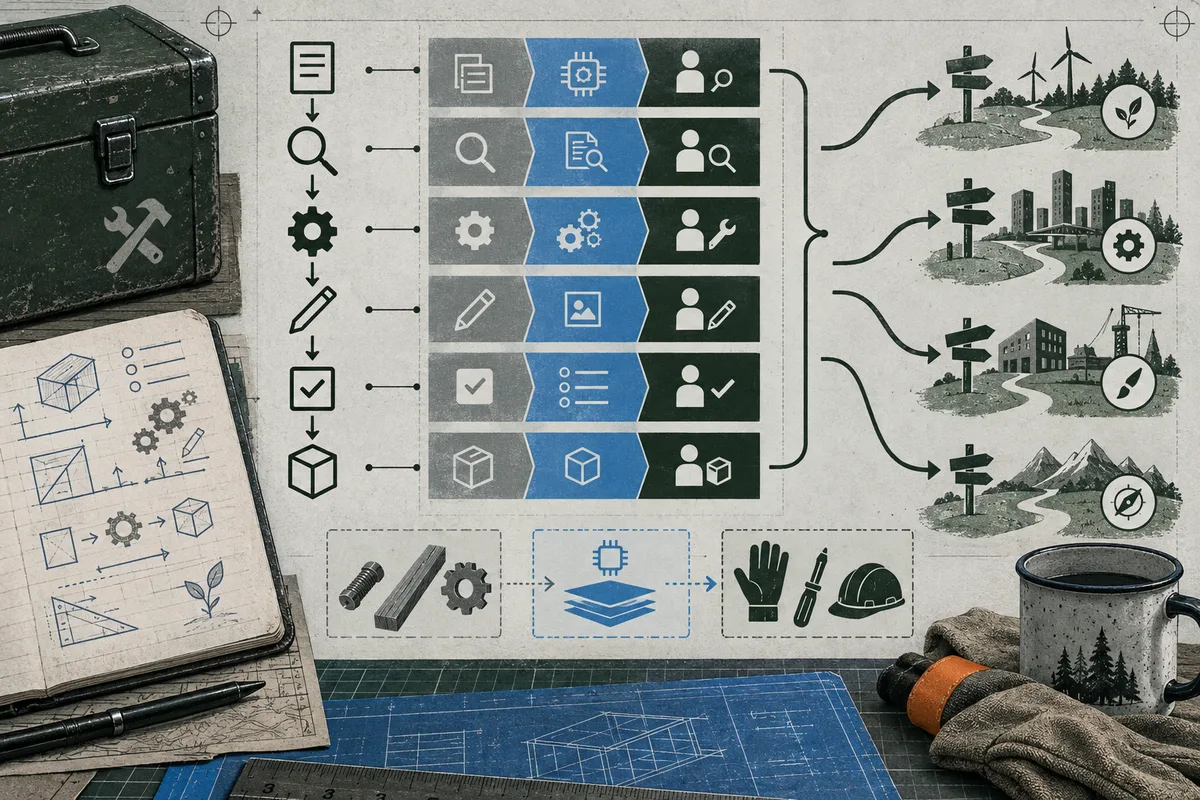
Document training, proficiency, and the limits of a certificate
GOVERN 2.2 says organizational personnel and partners should receive AI risk-management training that enables them to perform their duties consistently with relevant policies and agreements. The Playbook adds a useful distinction between training for technical actors who operate systems and training for oversight actors such as legal, compliance, and audit staff. It also suggests proficiency standards for system operation and oversight tasks, along with specified training protocols. [source 1, source 2]
That is stronger than telling everyone to attend a general awareness session, but it is not the same as requiring one commercial certificate. A team should document the role, the decisions that role makes, the knowledge needed to make them, the training or supervised practice provided, and how proficiency is checked. Depending on the task, evidence might include a completed evaluation exercise, a reviewed incident report, a tested workflow, a domain sign-off, or demonstrated ability to recognize when an output is outside the system’s limits. It should also record when that evidence will be revisited.
A certificate can be one learning artifact, especially when an employer or regulated process recognizes it. It cannot by itself show that you can evaluate a live workflow, interpret an error, protect sensitive data, or exercise authority under pressure. A short course may be the right low-cost introduction for someone learning the vocabulary of governance. A work-based project with feedback may be better for someone who already understands operations and needs proof of applied capability. A degree is a different choice again, with more depth, prerequisites, time, and cost. The right path follows the intended role, not the label “AI.”
For a nontechnical worker, a bounded sequence might be: map one AI-supported task; learn the system’s intended use, data inputs, failure modes, and review points; test a small sample against a human baseline; document exceptions and escalation; then ask a qualified colleague to challenge the record. That develops transferable evaluation and accountability habits. It also reveals whether the next gap is technical, legal, operational, or domain-specific before you pay for a larger program.
Document the system’s purpose, task, limits, and human use
Skills cannot be judged separately from the system. MAP 1.1 asks organizations to understand and document intended purposes, possible beneficial uses, relevant laws and norms, users, assumptions, limitations, impacts, and related evaluation considerations. MAP 2.1 asks them to define the specific tasks and methods the system will support. MAP 2.2 asks for information about knowledge limits and how outputs may be used and overseen by humans. [source 2]
That produces a more informative record than “we use an AI assistant.” It can say: the system drafts a first version of a weekly operations summary from specified internal records; it is not authorized to make staffing, safety, disciplinary, or customer eligibility decisions; a named reviewer checks source coverage and factual accuracy; uncertain or sensitive cases go to a specialist; and changes to the system or data source trigger review. The record should also identify what the tool does not see, what it cannot verify, and what a user must do before relying on the result.
This is the dividing line between capability and dependable work. A model may be able to generate fluent text or classify examples in a test. That does not establish that it performs reliably on your records, under your privacy constraints, with your edge cases, or at the speed and quality your process requires. NIST’s structure keeps those questions attached to the task and context.
The career implication should be stated cautiously. A worker who can translate a broad AI capability into a bounded task, a review method, and an escalation rule can produce clearer evidence of what they do than a vague claim of being “good with AI.” Whether that evidence improves a job move depends on employer demand, local opportunity, prior experience, and the quality of the work sample. It does not make the worker immune to redesign or establish a hiring advantage.
Document evidence from testing, monitoring, and incidents
The record does not end when a system is approved. The Core says ongoing monitoring and periodic review should be planned, with organizational roles and responsibilities clearly defined, including the frequency of review. The Measure function then asks for approaches, personnel, and documentation to identify and track existing, unanticipated, and emerging risks using intended and actual performance in deployed contexts. [source 2, source 4]
The Playbook’s suggested questions are operational. Teams can record performance metrics and error logs, compare results with a simpler model, human performance, or another manual benchmark, and compare user or community feedback with internal measures. They can track error-response time and response quality, note where explanations are insufficient for investigation, and record whether support staff have adequate resources. The exact metric must fit the task. A single accuracy number will not capture every meaningful failure.
Consider a document-review workflow. A useful monitoring record might include the type of document, whether key fields were extracted correctly, the rate and severity of corrections, the cases sent to manual review, the time taken to resolve an exception, and recurring patterns in the errors. It can record who reviewed the sample, what changed in the source material or system, and whether the human reviewer had enough information to disagree. The purpose is not to create a decorative dashboard. It is to support a decision about continued use, redesign, or pause.
For learning, this points toward evaluation as a durable foundation. Tool interfaces and model brands can change quickly. The ability to define a baseline, design a check, interpret limitations, preserve an audit trail, and communicate an incident can transfer across tools, but transferability is not the same as market demand. A current OECD review reports that skills shortages constrain adoption and that employers using AI often report greater need for highly educated workers, while also noting that less than 1% of workers need advanced AI-specific skills such as model development. Those findings support a broad learning question, not a promise that evaluation work is a new occupation or that a project will lead to employment. [source 7]
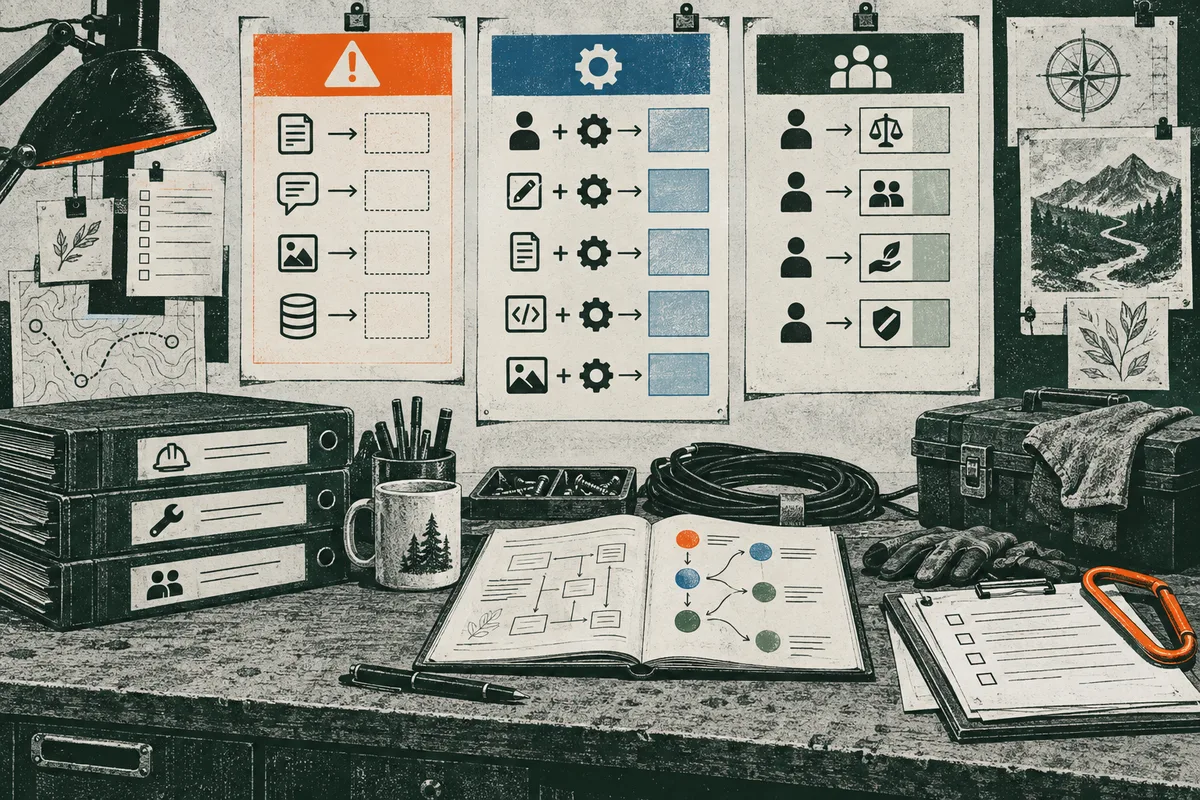
Document risk responses, updates, and the right to stop
Manage turns observations into decisions. NIST describes risk responses that can include mitigating, transferring, avoiding, or accepting risk, and the Playbook asks teams to document procedures, priorities, resources, and organizational teams for carrying out those responses. It also asks about residual risks, downstream communication, safe operation, known limitations, and the people responsible for maintenance, re-verification, monitoring, and updating after deployment. [source 3]
A complete responsibility record should answer more than “who owns the model?” It should answer who owns the surrounding process. Who confirms that the system is still used for its intended purpose? Who reviews a material update? Who tells operators what changed? Who can bypass or deactivate the system? Who preserves records for later investigation? Who decides whether a risk is accepted, reduced, transferred, or grounds for decommissioning? Those decisions may sit with different people, but the handoffs should be visible.
This is a useful correction to a common workplace pattern: a person is named as the final reviewer but has no practical power to reject the system, no access to relevant logs, and no time to investigate. Documentation cannot fix that mismatch by itself. It can expose it. A worker who raises the issue is not refusing technology; they are asking whether the assigned responsibility comes with the skills, resources, information, and authority the Playbook says teams should examine.
If your own role is changing, ask for the operating record before volunteering to own an AI-enabled process. Clarify the task boundary, review standard, training, escalation route, expected response time, and authority to pause use. That conversation protects accountability for you and gives the organization a more honest view of the work being redesigned.
Turn the framework into a proportionate next move
Use the Playbook as a diagnostic for your task bundle, not as a reason to collect credentials at random. List the recurring work you do and mark which parts are digital, repeatable, language-heavy, data-dependent, physically situated, relationship-dependent, judgment-heavy, or accountable to another person. Then identify where AI capability is relevant, where your organization has actually adopted a tool, and where verification or consequence makes automation difficult. These are separate signals. Exposure tells you where to inspect change pressure; it does not tell you that displacement will occur. Current labor evidence also needs the same discipline: an OECD 2026 review says AI uptake rose from about 7% to 20% of firms across OECD countries between 2021 and 2025, but adoption is uneven and skills shortages remain a barrier. That is evidence about reported firm adoption and constraints, not a forecast for your employer or proof of demand for a particular governance title. [source 8]
Next, choose the smallest learning or work experiment that answers a real uncertainty. If your goal is to use AI in your existing field, map and evaluate one bounded workflow. If you want to build AI-enabled products, add requirements, data, testing, and user research. If you want software practice, learn enough programming and versioned delivery to ship and maintain a small system. If you want ML engineering or research, expect deeper mathematics, statistics, computing, experimentation, and sustained feedback. A general governance overview is not a substitute for any of those paths.
Compare options against your actual constraints. A course may offer speed and structure but limited workplace signaling. A certificate may provide a shared vocabulary but not evidence of applied skill. A project can reveal capability and create a portfolio artifact but requires a credible review context. An apprenticeship or internal stretch assignment can provide feedback and domain access but may not be available or paid. A degree offers depth and a formal signal at greater time and cost. Self-study is flexible but makes feedback and proof your responsibility.
A sensible first conversation is with the person who owns the workflow: “Which task are we changing, what remains my decision, what evidence will we use to check the output, and who has authority to pause or change the process?” Then compare that internal evidence with a dated signal from the labor market in your target geography, such as current vacancies, official projections, or employer requirements. The answers may support an upgrade in the current role, an adjacent move into evaluation or operations, or a larger career change. They also give you better inputs for a task-level assessment than a job title alone.
Questions readers ask
Does the NIST AI RMF Playbook require an AI governance certificate?
No. It is voluntary guidance and does not name one universal certificate. It asks organizations to define role-appropriate training and proficiency, then document whether personnel have the skills, resources, and domain knowledge needed for their responsibilities.
What AI skills should teams document under the Playbook?
Teams should document the competencies and capacities needed for their context, including relevant technical, domain, user-experience, legal, privacy, security, compliance, risk, and oversight knowledge. The mix depends on the system and its impacts.
What does the Playbook say about human responsibility?
It asks teams to define and differentiate human roles in using, interacting with, monitoring, and overseeing AI. Records should clarify human involvement, delegated authority, escalation, and whether personnel have the skills and resources to fulfill the assigned responsibility.
Is the NIST AI RMF Playbook a compliance checklist?
No. NIST says it is neither a checklist nor an ordered set of steps. Organizations can select suggestions that fit their use case and risk priorities, while recognizing that the Playbook is not comprehensive and will evolve.
Does documenting AI skills show that a job is safe from automation?
No. Documentation shows how work, authority, capability, and controls are arranged. It does not predict employment. A task may be exposed to AI while the role is redesigned, augmented, or constrained by verification, trust, accountability, or adoption conditions.
What is a useful first project for learning AI governance?
Choose one bounded workflow, write its intended purpose and limits, identify the human decision owner, compare outputs with a human baseline, log errors and exceptions, and propose an escalation rule. Ask someone with relevant domain or risk expertise to review the record.
Sources and notes
- NIST AI RMF Playbook
Supports the Playbook’s voluntary status, four functions, living-resource description, and statement that it is not a checklist.
- NIST AI RMF Playbook: Govern
Supports documentation of roles, delegated authority, training, proficiency, human oversight, skills, resources, and multidisciplinary perspectives.
- NIST AI Risk Management Framework Core
Supports GOVERN 2.1 and 2.2, MAP 1.2, system-task and knowledge-limit documentation, proficiency, oversight, and monitoring outcomes.
- NIST AI RMF Playbook: Manage
Supports documented risk-response options, residual risks, update communication, maintenance, monitoring, re-verification, and decommissioning responsibility.
- NIST AI RMF Playbook: Measure
Supports ongoing risk tracking, documentation, training, error logging, metrics, feedback, and comparison with human or manual baselines.
- NIST AI RMF Playbook FAQs
Supports how organizations may select and repurpose suggestions and why the Playbook is not one-size-fits-all or comprehensive.
- Artificial Intelligence Risk Management Framework (AI RMF 1.0)
Supports the framework’s practical, adaptable purpose for organizations managing AI risks and potential harms.
- OECD: AI and skills
Supports the current labor signal that skills shortages constrain adoption, reported demand for highly educated workers can rise after adoption, and most workers need data and digital skills rather than advanced model-development skills.
- OECD: Skills in the AI age
Supports the dated distinction between reported firm adoption, uneven diffusion, exposure, automation risk, and displacement, including the 2021–2025 OECD-firm uptake estimate.
Apply this to your own work
See the whole job market at once.
Explore which occupations AI may reshape, then turn the signal into a practical response.
Explore the job map