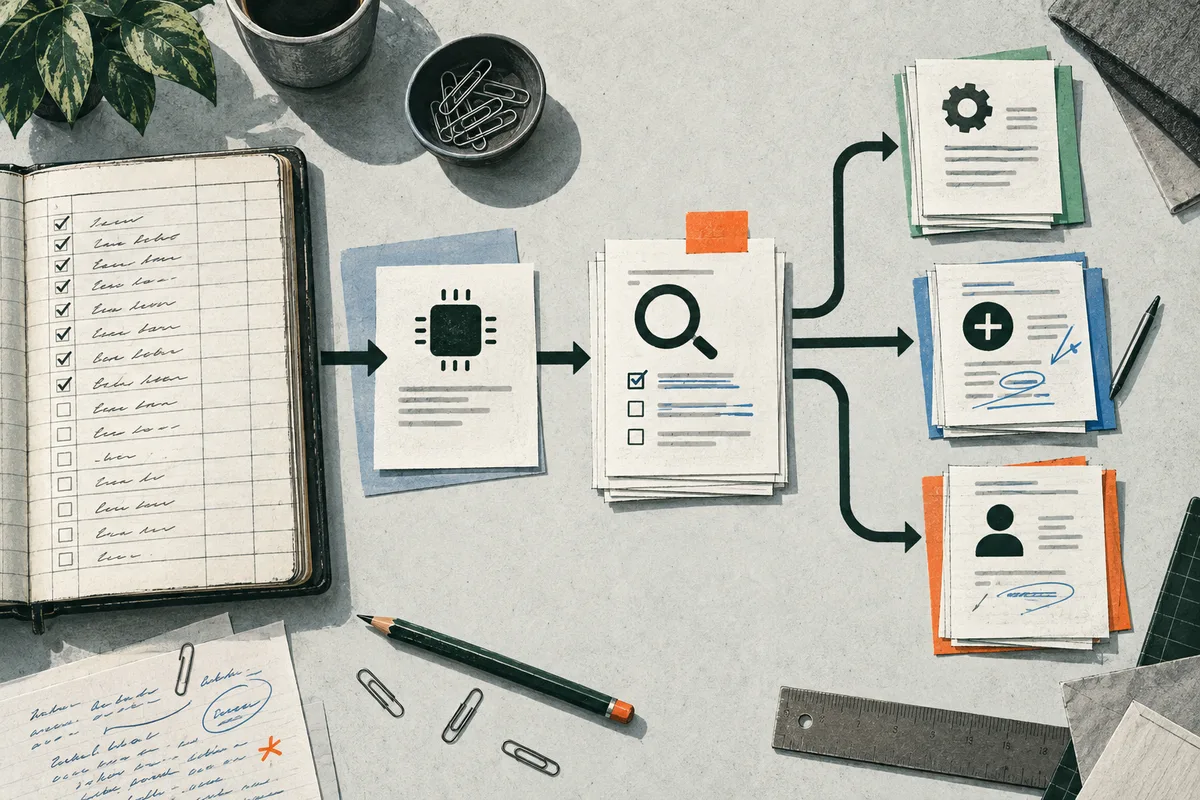
Record each case from intake to an acceptable result: case type and difficulty, workflow and feature version if known, steps taken, active effort by step, review findings, corrections or downstream rework, the acceptance standard, and who made or owned the final decision. Compare similar cases, note relevant conditions, and keep confidential information out of personal notes. Use the observations to request a specific workflow decision, not to claim proof of productivity loss or job risk.
What should you record when AI adds review work?
Record the whole case episode, from the work arriving to an acceptable result being delivered. Note the case type and difficulty, the process and feature version if known, each step before and after AI use, active effort at each step, what review found, any correction or downstream rework, the acceptance standard, and who made or owned the final decision. Compare similar cases, flag unusual conditions, and keep confidential material out of personal notes. Use this small record to ask for a specific workflow decision; it cannot establish productivity loss or job risk. For example, imagine a customer response process where a feature drafts text. The relevant observation is not how quickly the draft appeared. It is whether the response met the same standard after checking, edits, approval, and any later correction. O*NET OnLine Help: Job Duties Custom List describes occupation-specific task statements and lets people select tasks they perform, a useful reminder to start with work activities rather than an occupation label. Those generalized statements do not capture one local process. The NIST AI Risk Management Framework Core likewise emphasizes defining context, supported tasks, scope, oversight, and performance in context. It is organizational guidance, not a required employee form. The unit is the episode, including handoffs and correction, not a button click or runtime. The rest of this guide explains how to make that observation interpretable and useful without turning a few cases into a productivity study.
Sources: O*NET OnLine Help: Job Duties Custom List; NIST AI RMF Core
What counts as the work episode you need to record?
Start with the incoming case and end when an acceptable result is delivered. Between those points, map each human and AI step: preparation, finding context, entering or selecting information, generating or applying the feature’s output, checking it, correcting it, escalating an exception, handing work to someone else, and repairing any later problem. The episode is complete only when the result meets the same work standard that applied before the feature was introduced. This boundary matters because the visible AI step may be short while effort has shifted into review, exception handling, or a colleague’s queue. Recording only the feature’s runtime can make that work appear to have disappeared. O*NET OnLine’s Job Duties Custom List uses occupation-specific task statements to help people identify work they perform. Those broad descriptions can help name a task, but they do not describe the local steps or difficulty of a particular case. For this record, follow the case through the actual process rather than treating an occupation label or a button click as the unit of work.
Imagine an employee using an AI feature to draft a customer response. The manual path might include reading the request, locating the relevant account or policy information, writing a response, checking it, and submitting it. The assisted path may keep the same intake and lookup, add the feature’s draft, then require a factual check, edits, approval, and perhaps a return for more information or a later correction. These are illustrative steps, not a claim that every workplace or case follows this sequence. The useful comparison is the whole accepted response against the whole accepted response, with any extra handoff or repair made visible. If a colleague performs a check or correction, note that the work moved and who performed it by role; do not count it as saved effort merely because it left the original worker’s hands. NIST’s AI Risk Management Framework Core emphasizes defining context and documenting the tasks and human oversight involved in an AI system. That organizational guidance supports looking beyond the model interaction, but it does not prescribe this employee log or make it a formal evaluation.
Keep hands-on effort distinct from elapsed time. Active minutes cover reading, checking, editing, or resolving the case; elapsed time may include queues, approval waits, or interruptions. Keep them separate. A compact path might read: intake and lookup; draft; factual review; correction; approval; delivery; later repair, if any. Mark absent steps; they do not occur in every case. This map gives later comparisons a stable boundary: where work entered, where it moved, and what counted as completion. It also prevents a quick generated draft from being mistaken for a finished outcome when review or downstream work is still required.
Sources: O*NET OnLine Help: Job Duties Custom List; NIST AI RMF Core
What context makes the observation interpretable?
For each case, record enough context to tell whether you compared like with like: a non-sensitive case category, whether it was routine or an exception, approximate difficulty, date or shift, the process and feature version if known, the quality rule in force, and any relevant change in workload, policy, staffing, or learning. Keep the note narrow. The purpose is to interpret the work observed, not to build a file about customers or colleagues. Imagine a customer-response queue in which the AI-assisted process appears to require longer checks this week. If the queue contains more unusual requests than last week, that change in case mix could explain some of the extra review even if the feature itself has not changed. If a new reviewer is still learning the approved checks, or a policy update now requires a second source check, the review time may rise for different reasons. A feature, model, prompt, or configuration update is another context change worth noting when the information is available. A compact record might use fields such as case category, routine or exception, difficulty band, date or shift, workflow version, feature version if visible, acceptance rule, and context note. Use categories that already make sense in the work rather than inventing an elaborate scoring system. “Exception: missing source record” is more useful than “hard case, 4/5” if the number has no shared definition. Record workload spikes or learning time only when they plausibly affect the comparison; do not turn this into a diary. Occupation databases can help name work at a broad level, but they cannot supply the local context. O*NET OnLine Help: Job Duties Custom List explains that its database contains occupation-specific task statements and lets users select duties they perform to find occupations with related tasks. That helps describe task families, but cannot tell you which cases entered your queue or what rule applied on a shift. Describe this process, not an occupation label. The NIST AI RMF Core supports this emphasis on context: it calls for defining the specific tasks and methods an AI system supports, documenting its scope and human oversight, and considering the setting in which it is used. These are organizational risk-management recommendations, not a personal employee form. The fields above are a lightweight translation for a workflow conversation, not a NIST template, required record, or formal evaluation; NIST says its actions are not a checklist. Keep data minimization practical. If an approved case identifier or internal category is enough, use that instead of copying customer text, prompts, personal information, or AI outputs into private notes. Do not paste restricted material into an unapproved tool to summarize it. Follow workplace policy and approved quality or incident processes. If you cannot safely retain case details, ask the workflow owner how to document observations. More sensitive detail does not make the comparison stronger.
Sources: O*NET OnLine Help: Job Duties Custom List; NIST AI RMF Core; NIST AI RMF Playbook
How do you compare time fairly without calling it a productivity study?
Compare accepted work at the same quality standard, case by case where possible. For each reasonably similar case, record active minutes for preparation, execution, review, correction, escalation, and downstream rework. Keep waiting or queue time separate. Include routine and exception cases when they occur, and describe what you observed instead of turning a small log into a productivity percentage. The aim is to locate where work moved and what merits a workflow discussion, not prove a universal effect.
A compact record can use one row per case: path (manual or AI-assisted), category, date, version if known, stage, active minutes, wait time, outcome, and who handled the work. Apply the same acceptance rule to both paths. If you lack a baseline, say so and record prospectively; memory is not a measured before-period. An AI response is not comparable with the full manual process if checking, correction, approval, or repair remains.
Keep individual cases visible before summarizing. A difficult exception may take longer than routine work, so an average can hide the condition that matters. Show stage times by case first; then summarize by case type if useful, stating how many observations are covered. No sample count makes an informal log representative. A few observations may identify a step to investigate, but cannot establish its team-wide frequency or prove the feature caused a difference.
Separate recorded time from inferred savings. If AI takes less active time but review and correction take longer, show both and total effort for the accepted case. If a colleague checks it, the work moved rather than disappeared. Queue delay may matter to delivery, but is not hands-on labor. NIST’s AI Risk Management Framework calls for context-specific measures, benchmarks, and uncertainty. It is organizational guidance, not certification of a local comparison; it supports stating conditions and limits.
Research shows why time needs its task and outcome beside it. In a preregistered online experiment, 453 college-educated professionals received occupation-specific writing tasks, with half randomly given ChatGPT; “Experimental evidence on the productivity effects of generative artificial intelligence” reports average time 40% lower and quality 18% higher in that setting. It did not measure this workplace’s review burden. In a six-month field experiment across 66 firms and 7,137 knowledge workers, “Shifting Work Patterns with Generative AI” reports that 80% of treated workers who used the tool spent two fewer hours weekly on email in the second half, with no detected shift in task quantity or composition from individual access. That integrated tool and email outcome differs from a feature adding review. Neither result estimates your cases.
A fair summary says what was compared, which cases differed, what conditions changed, and whether quality and downstream work were observed. It can support a question about scope, review rules, or time planning. It cannot isolate cause, calculate organization-wide productivity, or predict a job outcome.
Sources: NIST AI RMF Core; Experimental evidence on the productivity effects of generative artificial intelligence; Shifting Work Patterns with Generative AI
Why must the record include quality and downstream consequences?
For each comparable case, record the outcome as well as the minutes: accepted as submitted, edited before acceptance, returned, escalated, or corrected after handoff. Note the issue found, who performed the correction, and whether it created another step for the same person or someone else. Record checks that found no issue, too. This makes the log about completed, acceptable work rather than the speed of producing a first draft. A quick output needing repair may not reduce effort; a check catching an important defect may be useful despite added time.
Keep three questions separate. Review coverage asks whether a check took place and what it examined, such as factual statements or required policy language. Review quality asks whether the process caught problems that existing standards treat as important. Review burden describes the time and attention the check required, including repeated checks or correction work. Coverage alone cannot establish quality. If an output was not checked, the entry is “not checked,” not “no issue.” If a check happened and found nothing, record that observation without claiming it was error-free. Describe only checks actually performed.
Research illustrates why speed and quality belong in the same comparison, while showing why outside results cannot settle a local question. Stanford's page for “Experimental evidence on the productivity effects of generative artificial intelligence” describes a preregistered online experiment with 453 college-educated professionals assigned occupation-specific, incentivized writing tasks; half were randomly given ChatGPT. In that setting, average task time was 40% lower and output quality 18% higher for the ChatGPT group. This measured online writing tasks, not an employee's review costs. It counters the assumption that faster AI work must mean worse quality, but does not forecast other tasks.
The American Economic Review: Insights abstract for “Shifting Work Patterns with Generative AI” reports a six-month field experiment across 66 firms and 7,137 knowledge workers. Workers received access to a tool integrated into applications used for email, meetings, and writing. In the second half, the 80% of treated workers who used it spent two fewer hours per week on email and reduced time outside regular hours; the abstract reports no detected shift in task quantity or composition from individual-level access. It does not establish whether review work erased time savings in a particular workflow. The setting differs and does not report this feature's review burden. Together, these studies support tracking time and accepted outcomes without a universal verdict.
Use existing quality categories and severity labels if the workplace has them. Record issue type, correction or escalation, owner, and downstream consequence. Do not invent a severity scale or treat a minor edit as a serious failure. NIST's “New Report: Challenges to the Monitoring of Deployed AI Systems” identifies human-system interactions and output quality as monitoring concerns, while noting feedback gathering can create overhead. Keep the record focused on a workflow question, not an employee scorecard: did similar cases meet the same acceptance standard, what checking did they require, and where did repair work land?
Sources: Experimental evidence on the productivity effects of generative artificial intelligence; Shifting Work Patterns with Generative AI; New Report: Challenges to the Monitoring of Deployed AI Systems
How should you record review burden without turning the log into surveillance?
Track only work-related observations that help explain how the process runs: active review minutes, interruptions or time needed to recover context, repeated checks, corrections, escalations, and the reason a check was needed. Keep the record tied to a workflow question, such as whether a particular case type needs a second check or whether review time fits the planned work. Do not rank coworkers, speculate about their competence, or turn a short process log into continuous monitoring of keystrokes or behavior. The aim is to make a task visible enough to discuss, not to create a personal performance file. A stopwatch can capture active minutes, but it may miss friction between steps. Separate the time spent checking from elapsed delays, and note whether an interruption or a required handoff explains the difference. For example, a reviewer may have to reopen source material after an interruption, reconstruct why a draft was changed, or repeat a check because the output does not make its basis clear. Note these as concise categories only when they help answer the workflow question. NIST’s 2026 report, “Challenges to the Monitoring of Deployed AI Systems,” describes human-factors monitoring as examining human-system interaction, including output quality and transparency. The report also identifies overhead in collecting and gauging user feedback, and lists as open questions whether monitoring should vary by risk and what cadence is appropriate. These reported challenges do not measure review minutes for a particular employee. They do support a practical restraint: feedback collection is itself work, so a record should be proportionate to the decision it is meant to inform. There is a real trade-off. Too little detail can hide recurring rechecks or the point where work moves to another person. Too much logging consumes time, collects information with no clear use, and can make a process discussion feel like individual surveillance. Before adding a field, ask what decision it could change. If the answer is unclear, leave it out. Prefer a small count or neutral category over narrative about a colleague. Keep customer, employee, confidential, and restricted information out of personal notes, and use approved systems and identifiers under workplace policy. NIST’s AI RMF Playbook says its suggestions are voluntary and that it is neither a checklist nor a sequence every organization must follow. This proposed lightweight log is an employee-side practical adaptation, not a NIST form, compliance record, or substitute for an employer’s formal quality process. If work is safety-critical, regulated, or high impact, follow the approved incident and reporting route rather than relying on an informal sample. Bring the recurring check and any unclear rule to the workflow owner.
Sources: New Report: Challenges to the Monitoring of Deployed AI Systems; NIST AI RMF Playbook
Who owns the review rule, the correction, and the final decision?
When AI changes a process, record who performed the check, who could correct or stop the work, who accepted the result, and who owned the rule defining acceptable work. If a role is unclear, ask the workflow owner to clarify review criteria, escalation authority, and how review time fits planned work. These observations describe how decisions move; they do not assign blame.
A person clicking “approve” is not, by itself, evidence of meaningful oversight. A useful check requires information, authority to question or correct, and a route to escalate. Record four observable fields: reviewer role, check performed, action taken, and decision owner. For instance, “operations reviewer; checked required fields against source; returned for correction; team lead accepted revised result” says more than a name and timestamp. Prefer role labels where possible, and follow workplace rules for formal records.
Production and accountability can diverge: a tool may prepare material while a person still judges whether it is fit for use. If the reviewer spots a problem but cannot amend the output, stop the handoff, or reach someone empowered to act, record that gap. If one person both checks and accepts the result, note both functions rather than compressing them into “human review.” This shows whether checking is a defined control or an unsupported responsibility.
The NIST AI Risk Management Framework places role clarity and human oversight within organizational governance. Its Govern function calls for clear, documented responsibilities and communication lines; Map includes documenting how outputs may be used and overseen by people, and how human oversight is defined under organizational policy. These ideas translate into the four fields above, but this is a practical adaptation, not a NIST employee form or compliance test. The framework is voluntary; it does not establish a particular employer’s policies or legal duties.
The NIST AI RMF Playbook offers suggested actions and says it is neither a checklist nor a sequence every organization must follow. The employer’s process determines who can change scope, what requires escalation, and who accepts corrected work. Avoid inferring accountability from a title or sign-off alone. Ask concrete questions about authority and decision ownership.
For routine work, a short log may show repeated corrections or an unclear acceptance rule; bring the pattern to the workflow owner and request a defined check, escalation route, or planned review time. Where errors could have serious consequences, follow the formal quality or incident process and escalate under its criteria. NIST’s “Challenges to the Monitoring of Deployed AI Systems” identifies human factors as a monitoring category and feedback collection overhead as a challenge. This supports proportionate notes, not a personal safety system. The goal is a workable match between responsibility, authority, and time.
Sources: NIST AI RMF Core; NIST AI RMF Playbook; New Report: Challenges to the Monitoring of Deployed AI Systems
What decision can this record support—and what can it never prove?
Use the record to make a bounded workflow request, not to announce that AI has made a job more or less secure. If checks find material errors, ask who defines the required review and which parts of the result need verification. If observed review and correction work absorb the apparent time saved in the cases logged, ask the workflow owner to revisit the feature’s scope or how the work is planned. If routine cases look different from exceptions, discuss limits for the case types actually observed. A serious incident or a high-stakes process belongs in the employer’s formal escalation route; a personal sample is not a substitute.
State the comparison plainly: for these cases, under the recorded conditions, this is what happened. Then name what remains uncertain. Case mix may have shifted; a worker may have been learning; workload, staffing, policy, or another process change may have affected the result. A small observational log cannot isolate the feature’s contribution or establish organization-wide productivity. Nor does a few-minute difference by itself settle whether the workflow is worthwhile: quality, risk avoided, capacity used elsewhere, and work transferred to colleagues also matter.
Research at other scales reinforces the need for that boundary, while answering a different question. In “Shifting Work Patterns with Generative AI,” a six-month field experiment across 66 firms and 7,137 knowledge workers randomly provided access to an integrated tool for email, meetings, and writing. The American Economic Review: Insights abstract reports that, in the experiment’s second half, the 80% of treated workers who used the tool spent two fewer hours a week on email, while researchers detected no shift in task quantity or composition from individual access. It does not measure a feature that adds review work, and it cannot predict the result in this employee’s process.
Likewise, the International Labour Organization’s “One in four jobs at risk of being transformed by GenAI” release describes an index combining nearly 30,000 occupational tasks, expert validation, AI-assisted scoring, and harmonized labor data. It explicitly says the estimates represent potential exposure, not actual job losses. It says nothing about a particular employer’s adoption, review burden, or staffing decisions. It is a reason to keep task exposure separate from a local workflow observation, not a personal risk score.
A stronger team evaluation could change the conclusion if it compared similar cases under a stable acceptance standard, tracked versions and downstream corrections, and accounted for staffing and workload changes. Until then, the most useful result is a specific request: clarify the feature’s intended case scope, the review rule and escalation owner, or how checking time fits the planned work.
Sources: One in four jobs at risk of being transformed by GenAI, new ILO–NASK global index shows; New Report: Challenges to the Monitoring of Deployed AI Systems; Shifting Work Patterns with Generative AI
What is the next small step?
Start with a short record of comparable cases, using a template or system your employer has approved. Keep it non-sensitive: do not copy customer details, confidential prompts, or restricted outputs into personal notes. Bring the observed pattern to the workflow owner with one request: clarify which cases the feature is meant for, what the review rule requires, who receives escalations, or how added checking fits into planned work. Choose the request that matches what your notes show.
“I compared similar cases and recorded the checking and correction steps as well as the initial draft. Can we review which cases this feature is for and who owns the quality rule?” This asks for a workflow decision without presenting a small observational sample as proof that the feature caused a change. The NIST AI Risk Management Framework Core calls for attention to task scope, human oversight, and performance in the deployment context; this employee record is a practical aid to discussion, not a NIST form or compliance assessment. If a serious incident occurs, or policy requires a report, use the formal route promptly rather than waiting to complete a sample.
Keep the conclusion at the scale of the evidence. A local record can make shifted review work visible; it cannot establish that a job is at risk. The ILO–NASK Global Index describes potential task exposure at broad labor-market level and distinguishes that from actual job losses. For a wider view, the free task checker can help organize the question; its signals do not predict redundancy.
Sources: NIST AI RMF Core; One in four jobs at risk of being transformed by GenAI, new ILO–NASK global index shows
Questions readers ask
Should I record every AI-assisted case?
Use a short set of comparable cases that can help answer a specific workflow question. Follow workplace policy and use approved systems; a small informal record is not a representative productivity study.
What if I do not have a manual baseline?
Say the baseline is missing and record prospectively. Do not treat memory as measured before-period data.
Does added review work mean my job is at risk?
No. A local workflow log can show what happened in the cases observed, but it cannot predict a job outcome or establish that the feature caused the change.
Sources and notes
- O*NET OnLine Help: Job Duties Custom List
Supports describing work through task statements while clarifying that generalized occupation tasks do not capture one local workflow.
- NIST AI RMF Core
Supports recording task context, scope, human oversight, and performance in the deployment setting.
- NIST AI RMF Playbook
Supports describing the proposed employee log as an adaptation of voluntary guidance, not a required checklist or formal record.
- Experimental evidence on the productivity effects of generative artificial intelligence
Reports a preregistered online experiment with 453 college-educated professionals, where the ChatGPT group had lower average time and higher output quality on assigned writing tasks; the setting does not establish local review costs.
- Shifting Work Patterns with Generative AI
Its abstract reports a six-month field experiment across 66 firms and 7,137 knowledge workers, with email-time changes among tool users and no detected task quantity or composition shift from individual access.
- New Report: Challenges to the Monitoring of Deployed AI Systems
Identifies human-factors monitoring and feedback-collection overhead as monitoring challenges, without measuring review burden for an individual employee.
- One in four jobs at risk of being transformed by GenAI, new ILO–NASK global index shows
Describes a broad task-exposure index and explicitly distinguishes potential exposure from actual job losses.
Apply this to your own work
See the whole job market at once.
Explore which occupations AI may reshape, then turn the signal into a practical response.
Explore the job map