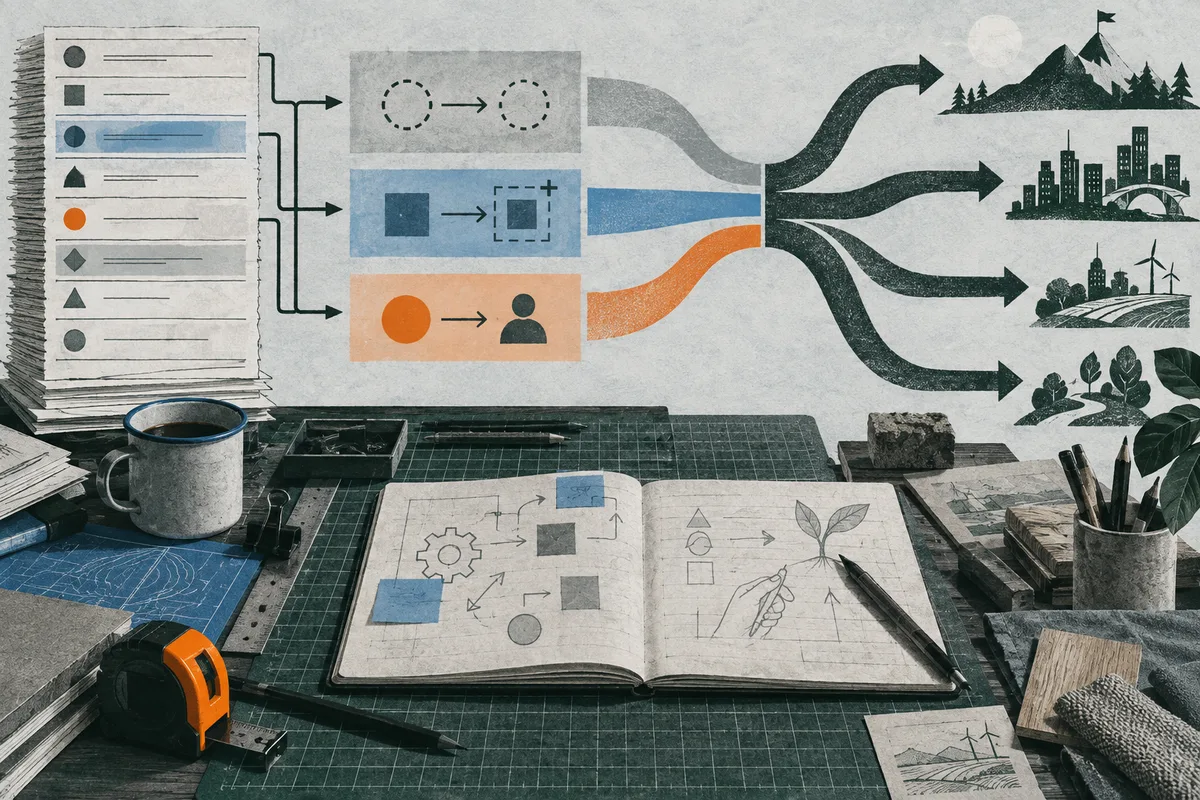
Skills become more valuable when they help you own a reliable result, not merely produce a faster draft. Build tool fluency around one real task, then strengthen problem framing, domain knowledge, data literacy, verification, and communication. Map your task bundle to see what is repeatable, what needs judgment or trust, and what capability to build next.
The valuable skill is not AI enthusiasm. It is better control of the work.
Two interpretations of the same trend can both sound plausible. One says the winning skill is prompt writing because a new tool can produce a first draft in seconds. The other says the winning skill is judgment because a fast draft is useful only when someone can set the right brief, spot the wrong assumption, and decide whether the answer can be used. The second interpretation is closer to a durable career move. Tool interfaces change quickly. Control over a consequential workflow is harder to replace.
The International Labour Organization's 2025 index is a helpful starting point because it studies tasks inside occupations. It combines task data, worker input, expert discussion, and model predictions. It estimates that one in four workers are in an occupation with some potential generative AI exposure, but it also says that transformation of jobs is the most likely effect because most occupations contain tasks requiring human input. Exposure therefore tells you where to inspect your work. It does not tell you that you will lose your job, nor does it measure whether your employer has adopted a system. [The ILO source](https://www.ilo.org/publications/generative-ai-and-jobs-refined-global-index-occupational-exposure) supports that distinction.
A useful working definition is this: a skill gains value when it helps a person move from producing an isolated output to owning a reliable result. A claims worker who can summarize a file is more useful when they can also identify missing evidence, apply the policy rule, explain an exception, and document the decision. A marketer who can generate copy is more useful when they can define the audience, test the claim, protect the brand, and connect the work to a measurable business question. A software practitioner who can produce code is more useful when they can specify behavior, test edge cases, review dependencies, and operate the change safely.
This is not an argument that human abilities are automatically protected. Employers can redesign work, narrow entry-level tasks, or demand more output. It is an argument for choosing a capability that sits close to value, risk, or coordination. Ask which part of your work still needs a person to make a defensible choice. That is the first place to examine change pressure and the first place to develop evidence of your contribution.
What becomes more valuable: six connected capabilities
There is no universal list of safe skills. There is, however, a recurring pattern across current research and work design. The strongest bundle combines six capabilities that reinforce one another.
First is problem framing. This means turning a vague request into a defined outcome, audience, constraint, source of truth, and decision rule. A tool can help answer a clear question. It cannot reliably decide which question your team should answer or what trade-off the client has actually accepted. Problem framing becomes visible in a good brief, a clean acceptance test, or a short explanation of what is out of scope.
Second is verification. Verification is more than proofreading. It includes checking facts against authoritative records, testing calculations, comparing a result with the governing policy, examining unusual cases, and knowing when evidence is too weak to support a conclusion. As routine production becomes cheaper, the ability to prevent plausible but wrong output matters more. Verification also creates accountability because it leaves a trace of what was checked and why.
Third is domain judgment. A general tool may know common patterns, but a worker with context knows which detail changes the decision. Domain knowledge does not have to mean a long academic credential. It can be the accumulated understanding of customers, regulations, materials, workflows, failure modes, or institutional history. The point is not to preserve every old task. It is to connect tool output to consequences in a real setting.
Fourth is data literacy. You do not need to become a statistician to ask whether a sample is biased, a measure is a proxy, a comparison is fair, or a dashboard hides missing cases. You do need enough numeracy to inspect inputs, understand uncertainty, and challenge a confident claim. Data literacy is especially important when a generated summary makes a process look more certain than the underlying records justify.
Fifth is workflow and tool fluency. This is practical, not theatrical. It means knowing which step is worth assisting, how to provide usable context without exposing restricted information, how to compare outputs, and how to keep a human approval step where it belongs. It may include spreadsheets, scripting, search, structured templates, or a company-approved assistant. The transferable skill is selecting and controlling a method for a named task, not memorizing one product's buttons.
Sixth is coordination and explanation. Work changes through people, not just software. Someone must negotiate a new process, teach a colleague, explain a limitation to a customer, resolve disagreement, and decide who owns the final call. The World Economic Forum's 2025 employer survey ranks analytical thinking as its leading core skill and also places resilience, leadership, creative thinking, technological literacy, and curiosity among the important capabilities. This is a survey of employer expectations, not proof of future hiring outcomes, but it points toward a combined bundle rather than a choice between technical and human skills. [The WEF skills outlook](https://www.weforum.org/publications/the-future-of-jobs-report-2025/in-full/3-skills-outlook/) supports this interpretation.
The practical conclusion is not to collect six certificates. Pick one recurring task and strengthen the smallest bundle that improves its result. A procurement analyst might combine data checks, supplier context, and exception handling. A project coordinator might combine workflow mapping, status synthesis, and stakeholder communication. A teacher might combine lesson design, source checking, and feedback. The bundle should be demonstrated through work, not merely listed in a profile.
A task ledger shows where to build value
Job titles are too blunt for a useful decision. Make a task ledger for one normal week. Write down the recurring outputs, not just the name of the role. For each task, record the input, the output, how often it happens, who relies on it, what can go wrong, and how the result is checked. Then classify the task into three working categories: exposed, augmented, or human-accountable.
Exposed tasks are often digital, repeatable, and judged mainly by speed or surface form. Examples include turning a known set of notes into a standard summary, reformatting information, drafting routine variations, or locating passages in a defined document set. Exposure means a tool may perform part of the task or reduce the time required. It does not mean the whole role is exposed in the same way.
Augmented tasks are those where assistance can reduce effort while the worker still sets the direction and checks the result. Consider an unnamed operations team preparing a weekly performance review. A tool may group comments, flag changes, and propose a first narrative. The analyst still needs to define the comparison period, test whether the data is complete, investigate an apparent change, and explain what action follows. The valuable skill moves upward from copying numbers into interpreting a decision.
Human-accountable tasks contain a stronger dependence on trust, physical context, negotiation, regulated judgment, or consequences that cannot be cheaply reversed. A generated recommendation may support a case review, but someone may still need to gather missing facts, speak with a customer, inspect a site, obtain consent, or sign off on the decision. These tasks are not immune to redesign. They often become more demanding because the person is expected to manage more cases with better tools.
A task can move between categories as the system, data, policy, and employer process change. That is why a fixed occupation score is less useful than an explicit ledger. The ILO's method is also a reminder that exposure is assessed at task level and differs across occupations and countries. Your own process may have more friction than a benchmark assumes because records are incomplete, exceptions are common, or approval cannot be delegated.
For each exposed task, ask whether you should learn to supervise it, combine it with a higher-value task, or stop spending scarce time on it. For each augmented task, ask what new judgment becomes visible when the routine part is faster. For each accountable task, ask what evidence, communication, or domain depth would make you more reliable. This turns a vague fear into a set of testable observations.
The evidence is mixed because the work is mixed
Current evidence does not support a single story in which technology either replaces everyone or helps everyone. The result depends on the task, the worker's experience, the quality of the process, and what the organization does with the time saved.
A field study of 5,179 customer-support agents found that access to an assistive conversational system increased issues resolved per hour by 14% on average. The reported gain was larger for novice and lower-skilled agents, while the effect was small for the most experienced and highly skilled agents. The study also found suggestive evidence of learning and improved customer sentiment. It was one company, one occupation, and one deployment context. It shows heterogeneous productivity effects, not a general employment forecast. [The NBER working paper](https://www.nber.org/papers/w31161) supports that bounded example.
A preregistered MIT experiment with 444 college-educated professionals examined mid-level writing tasks. The assistive chatbot reduced time and increased judged output quality, while changing the shape of the work toward idea generation and editing rather than rough drafting. The participants and tasks were not a whole labor market, and the paper was a working paper at the time of publication. The useful lesson is narrower: when a routine production step becomes cheaper, upstream framing and downstream editing may take a larger share of the work. [The MIT paper](https://economics.mit.edu/sites/default/files/inline-files/Noy_Zhang_1.pdf) supports that task-level interpretation.
The OECD's 2025 skills analysis makes the broader point carefully. Language systems can substitute for some labor in writing and translation, complement workers in other settings, and create new tasks. It reports evidence that negotiated adoption with worker consultation and training is associated with better outcomes, while also noting that the long-term labor effects remain uncertain. Its conclusion is consistent with a strategy of building complementary skills, but it is not a promise that complementarity will protect every worker or every employer relationship. [The OECD analysis](https://www.oecd.org/en/publications/oecd-skills-outlook-2025_26163cd3-en/full-report/widening-opportunities-by-investing-in-21st-century-skills_762bbcca.html) supports this boundary.
This is why attention to detail alone is not enough, and why simply becoming faster at producing drafts may not be a durable advantage. If a system can generate ten plausible options, the scarce contribution may become knowing which option fits the purpose, proving that it meets the standard, and changing the process when it does not. In some roles, that contribution is technical. In others, it is operational, relational, physical, or regulatory.
Treat evidence about skill demand as directional. Employer surveys describe expectations. Experiments reveal effects in defined tasks. Occupational indices estimate potential exposure. None of them can calculate a personal probability of redundancy. Your decision should therefore be based on observations you can gather: which tasks are being assisted, who reviews the result, what quality standard is used, what new work appears, and whether your contribution is visible in the final outcome.

Choose a move that fits your actual goal
The right learning path depends on what you want to do next. If your goal is to use digital assistance in your existing field, start with a bounded workflow project. Learn the relevant data and privacy rules, map the current process, test one approved tool, measure a useful quality or time outcome, and document the checks. A short course can help with structure, but the project is what shows whether you can work responsibly in context.
If your goal is to build AI-enabled products, you need more than tool fluency. Add software fundamentals, data handling, evaluation, user research, and deployment or operations. A portfolio project that lets another person use the result is stronger evidence than a collection of screenshots. A course may provide feedback and sequence; self-study can be cheaper and flexible; an apprenticeship or work-based project can provide context and review. Compare them by the feedback you will receive, the prerequisites, the time you can sustain, and the kind of signal your target role actually recognizes.
If you want to become a software practitioner, study programming, version control, testing, debugging, systems basics, and how to read existing code. Assisted coding can speed up syntax and exploration, but it can also hide a dependency or produce a change you cannot maintain. Build small software that you can explain line by line, test with failure cases, and revise after feedback. A certificate may organize learning, but it does not replace demonstrated capability.
If you want machine-learning engineering or research, the path is different again. Expect deeper mathematics, statistics, algorithms, data structures, model evaluation, and substantial programming. A degree may be sensible when you need structured depth, research access, or a formal prerequisite. It is excessive as a reflex for someone who only wants to improve a workflow in an existing occupation. Conversely, a short course is unlikely to substitute for the depth demanded by research or advanced engineering work.
Constraints belong in the decision, not in a footnote. A parent with two hours a week, a worker who cannot relocate, a person protecting health, and someone who needs to preserve a salary floor do not have the same feasible plan. An adjacent move may reuse domain knowledge and require a smaller learning investment than a full career change. A larger change may still be right, but it should be tested against prerequisites, financing, location, care duties, and the time before the new path can produce credible work.
A practical sequence is: choose the task, learn the minimum durable concepts, complete one real project, obtain review, and then decide whether deeper training is justified. The durable concepts are problem framing, data literacy, evaluation, domain knowledge, verification, and basic automation. Interfaces and brand-specific tactics can be learned when a named workflow requires them.
Your next move is a conversation, not a prediction
After the ledger and the first project, you will still have uncertainty. You may not know whether your manager plans to redesign the process, whether the organization will provide approved tools, or whether the work that remains will be rewarded. Do not fill those gaps with a dramatic score or a generic list of occupations. Ask a concrete question of someone who owns the workflow.
A useful conversation sounds like this: Which part of this process should we expect to change in the next six months, what quality standard must not change, and which new responsibility would be valuable for me to take on? Bring one example of a task you can now complete more efficiently and one example of an error or exception that still needs human judgment. Ask what evidence would make the proposed change safe enough to try and who will review it.
The answer helps you choose among three proportional moves. Upgrade means staying in the role while taking ownership of a changed workflow. An adjacent move means carrying your domain knowledge into a nearby function where your judgment, verification, or coordination is useful. A larger change means accepting a longer learning path because the current task bundle has weak prospects or no longer fits your constraints. You can compare these paths without pretending to know the future precisely.
If you want a first task-level view, the free [AI task exposure checker](/ai-job-risk-checker) can help organize which parts of your work are more changeable and suggest first actions. Its result is a transparent change-pressure signal, not a validated probability that you will be displaced. If the decision involves salary floor, geography, learning time, or family and health constraints, the [career roadmap](/career-roadmap) can compare a stay-and-redesign path, an adjacent pivot, and a larger-change scenario in a 30/60/90-day plan. It does not guarantee employment or income and should not replace professional advice for high-stakes decisions.
The skill that becomes more valuable is the one you can connect to a real result. Start with the task that matters, make the change observable, protect the quality boundary, and have the conversation that reveals what your team actually needs next.
Questions readers ask
Are human skills more valuable than technical skills as AI changes work?
The strongest evidence points to combinations, not a simple human-versus-technical trade-off. Practical tool fluency helps with a workflow, while problem framing, domain judgment, verification, and communication determine whether the result is useful and responsible. The right mix depends on the task and sector.
Does AI exposure mean my job will disappear?
No. Exposure indicates that some tasks may be performed with assistance or redesigned. The ILO's task-based research says job transformation is the most likely overall effect because occupations contain many tasks that still require human input. Exposure is not a personal job-loss probability.
Should I learn prompting as a career skill?
Learn how to give a tool clear context and constraints when a named workflow benefits from it, but do not make prompt wording your whole plan. Pair tool use with source checking, evaluation, domain knowledge, privacy awareness, and a clear acceptance standard. Those capabilities travel better when interfaces change.
Do I need a degree to work with AI?
Not for every goal. Improving an existing workflow may call for a small project and targeted course. Building software requires deeper programming and testing. Machine-learning engineering and research usually require much more mathematical and technical depth, where a degree can be useful or necessary for some roles. Choose by the outcome and prerequisites, not by trend pressure.
What should I do if I have little time or money for training?
Choose one recurring task tied to your current work, study the minimum concepts needed to improve it, and make a small project you can show and get reviewed. An adjacent move may preserve more of your existing domain value than a full retraining plan. Include location, care, health, and income constraints when comparing options.
What is the first skill I should build?
Start with problem framing and verification around your most important exposed task. Write the intended outcome, trusted inputs, failure cases, reviewer, and decision rule. Then test whether an approved tool can reduce routine effort without lowering the quality standard. This gives you evidence for the next learning choice.
Sources and notes
- Generative AI and Jobs: A Refined Global Index of Occupational Exposure
Supports the task-level distinction between occupational exposure, transformation, and displacement, including the limits of global exposure estimates.
- The Future of Jobs Report 2025: Skills outlook
Supports the employer-survey evidence on analytical thinking, technological literacy, AI and big data, creativity, adaptability, leadership, and lifelong learning.
- OECD Skills Outlook 2025: Widening opportunities by investing in 21st-century skills
Supports the mixed evidence on substitution, complementarity, experience, negotiated adoption, and the need for complementary skills.
- Generative AI at Work
Supports the bounded field evidence that an assistive system affected customer-support productivity differently by experience and prior skill.
- Experimental Evidence on the Productivity Effects of Generative Artificial Intelligence
Supports the controlled evidence that assistance changed speed, judged quality, and the task mix in mid-level professional writing work.
Apply this to your own work
See the whole job market at once.
Explore which occupations AI may reshape, then turn the signal into a practical response.
Explore the job map