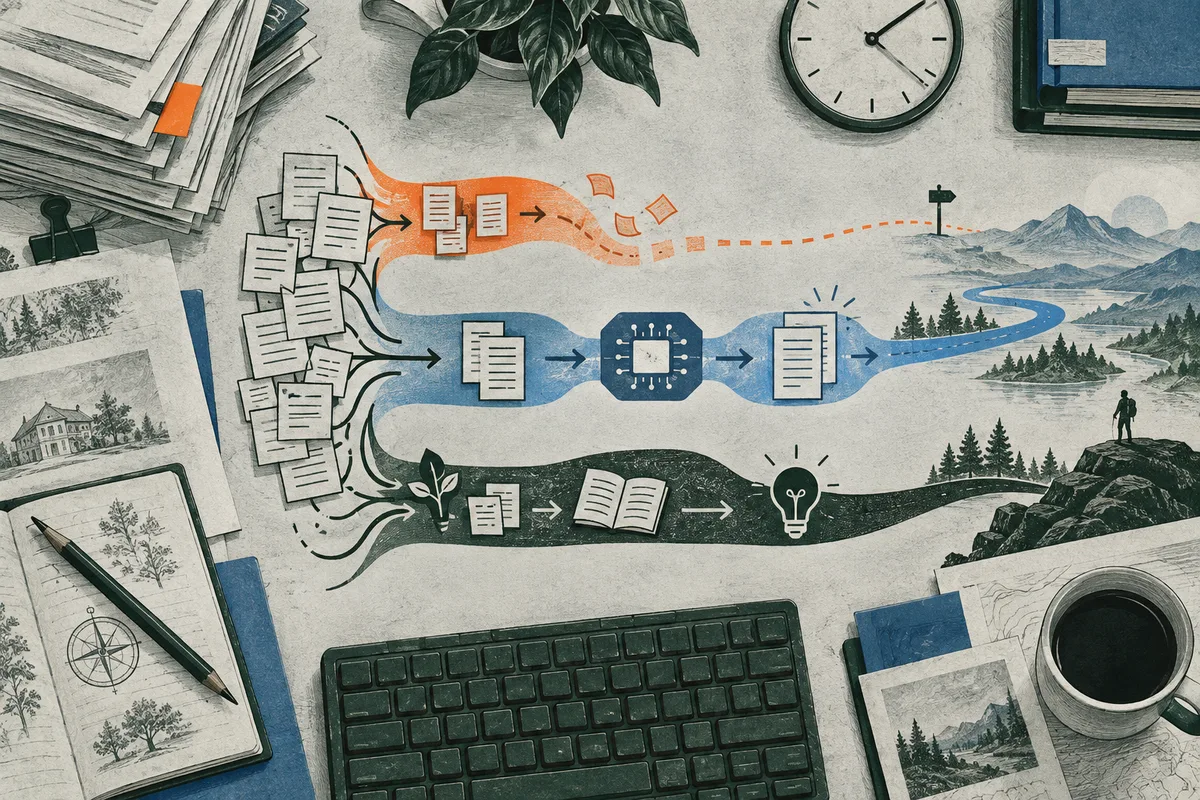
The strongest direct test found that individual workplace AI access changed some knowledge workers’ time use over six months, but detected no change in task quantity or composition. Other evidence shows AI can expand the tasks someone can perform and that some AI-assisted activities recur. Neither alone proves that job duties were reassigned. Look for repeated changes in activities, output or ownership across ordinary work cycles.
Does workplace AI change the work itself, or first change how long it takes?
Individual access can change how long work takes before it changes the mix of work a person owns. Shifting Work Patterns with Generative AI reports a six-month randomized experiment across 66 firms and 7,137 knowledge workers. Of those offered the tool, 80% used it; in the second half, users spent two fewer hours on email and less time working outside regular hours. Researchers detected no change in task quantity or composition. This is evidence about one intervention and period, not proof that duties never change. A separate study, Task Expansion with Generative AI: Experimental Evidence on Middle-Skilled, Early-Career Workers, found access raised German IT apprentices’ productivity by 26–31 percentage points on assigned tasks beyond formal training. Someone may become able to do more kinds of work under test conditions, but that does not show those tasks became recurring job duties. These are different outcomes: time saved, capability gained, and responsibility reassigned are not interchangeable. If AI drafts a report faster, the method or time may change while the deliverable and ownership stay the same. Conclude that a role is changing when new activities recur or ownership shifts across cycles. Availability and speed alone do not establish that shift.
Sources: Shifting Work Patterns with Generative AI — American Economic Review: Insights; Task Expansion with Generative AI: Experimental Evidence on Middle-Skilled, Early-Career Workers
What did the strongest direct access test actually measure?
The strongest direct test of individual workplace access followed 7,137 knowledge workers across 66 firms for six months. In “Shifting Work Patterns with Generative AI,” workers were randomly selected to receive access to a generative AI tool integrated into applications they already used for email, meetings, and writing. Among treated workers, 80% used it. In the second half of the experiment, those users spent two fewer hours per week on email and reduced work outside regular hours. The researchers detected no shift in the quantity or composition of tasks from individual-level AI provision. The pattern is therefore specific: access changed some workers’ use of time, while the study found no corresponding change in what tasks they did or how those tasks were composed. Random selection matters because it gives this study a stronger basis for attributing differences to access than a survey asking workers whether AI helped them. The comparison began with workers selected for access and those not selected, rather than relying only on people who chose to use a tool describing their own experience. The distinction between provision and use still matters: the headline time result concerns the 80% of treated workers who used the tool, while the experiment’s assignment concerns being offered access. This does not mean that every user saved the same amount, or that every email task became faster. It establishes an average pattern in this study’s setting, not a personal forecast. The result also has a clear boundary. The experiment tested individual access to one integrated tool over six months; it did not test every AI product, every occupation, longer periods, or a coordinated redesign in which a team changes handoffs, staffing, targets, or task ownership. “No detected shift” is not proof that no small or delayed change occurred. The Microsoft Research summary describes the same randomized field experiment and adds that access primarily affected behaviors workers could change independently, such as email time, rather than behaviors requiring coordination, such as meeting time. That helps explain why a faster method can affect an individual’s day without rearranging a team’s division of labor. For a knowledge worker with similar individual access, this is the best anchor for what to expect: time-use effects may appear before a measurable change in task mix. It cannot settle whether a particular person’s role has changed. To make that judgment, look for repeated changes in the tasks performed or their ownership, and distinguish those from finishing familiar work sooner. The experiment supports caution in both directions: do not infer role redesign from access alone, and do not generalize its six-month finding into a claim that task mixes never change.
Sources: Shifting Work Patterns with Generative AI — American Economic Review: Insights; Shifting Work Patterns with Generative AI — Microsoft Research
Why can saved time leave the task mix unchanged?
Saved time is an input to a work change, not proof that the work itself changed. A person can complete the same report, reply to the same questions, or prepare the same analysis more quickly and still hold the same responsibilities. Recovered minutes might become a shorter workday, a pause between assignments, extra checks on the same output, or more of the same kind of work. Only one possible path is reassignment to a different activity. Without observing which path occurred, “time saved” cannot tell us whether a worker’s task mix shifted. The St. Louis Fed’s “The Impact of Generative AI on Work Productivity” makes this distinction visible in its November 2024 U.S. survey. Respondents who had used generative AI for work were asked how many additional hours they would have needed to complete the same amount of work in the previous week without access. On that counterfactual question, users reported savings averaging 5.4% of their work hours; across users and nonusers, the estimate was 1.4% of total hours. These are reported estimates, not clocked comparisons of the same worker’s week with and without AI. The question holds the amount of work constant, so it measures perceived time needed for that output, not whether output improved, more work was completed, or duties were reassigned. A quicker draft can produce several workplace outcomes. The worker might deliver the same document sooner, spend the recovered time checking its claims, or turn out more documents of the same kind. A manager might set a higher volume expectation. A team might transfer a step to another role, or leave the saved minutes as slack. The survey does not sort these outcomes for each respondent. The authors say that translating reported savings into measured productivity remains uncertain: if workers use time saved on the same tasks as on-the-job leisure without employers knowing, aggregate output statistics may not register a productivity gain. The later St. Louis Fed discussion, “Generative AI, Productivity and the Future of Work,” explains that a worker survey captures worker-side actions, not firms’ separate decisions to automate or reorganize work. Its interview examples clarify what the survey cannot see; they are not estimates of how often any path occurs. For an individual, record time and work separately. For a recurring task, note the deliverable, approximate time, volume, revisions or verification, and any new or removed step across comparable cycles. If deliverable and responsibility remain the same while completion gets faster, that is a time-use change. If more of the same deliverable is expected, output changed. If a new activity recurs or ownership moves, there is evidence of a task-mix change. This comparison is a practical rule, not a validated instrument; workload peaks, quality requirements, and changed instructions can also explain differences. A survey average can suggest why time savings are worth noticing, but only the pattern in actual duties can show what changed for one worker.
Sources: The Impact of Generative AI on Work Productivity; Generative AI, Productivity, and the Future of Work
Can access broaden what a worker is able to do?
Access can broaden what someone is able to do, at least under the conditions of a specific experiment. The October 7, 2026 working paper “Task Expansion with Generative AI: Experimental Evidence on Middle-Skilled, Early-Career Workers” describes a field experiment with 673 final-year IT apprentices at twelve German vocational schools. Researchers randomly assigned AI access while apprentices completed occupation-specific tasks, some within their curriculum and others deliberately beyond their formal training. On the beyond-curriculum tasks, access raised measured productivity by 26–31 percentage points. This is evidence of expanded capability on assigned tasks, not evidence that every worker gains the same ability or that employers have changed anyone’s job. “Can do” and “now responsible for” describe different changes. In the experiment, apprentices were asked to attempt advanced tasks; the outcome was their performance in that setting. The result does not show that participants later performed those tasks repeatedly in paid roles, that managers reassigned them, or that another duty disappeared. Capability expansion can create a route to task-mix change, but someone must identify the newly feasible work, decide it belongs in the role, integrate it into a workflow, and sustain the assignment. The experiment supports the first step more directly than the later ones. The contrast with “Shifting Work Patterns with Generative AI” clarifies what the findings do and do not conflict about. That separate randomized study provided an integrated AI tool to knowledge workers in participating firms and tracked outcomes for six months. It found changes in some measures of time use, but no detectable shift in task quantity or composition from individual-level provision. The apprentice experiment tested performance on selected tasks, including work outside prior training; the workplace study asked whether individual access changed patterns of work over time. Greater ability on a test task can coexist with no detectable change in recurring job duties during a six-month access intervention. They measure different outcomes in different settings. The apprentice result counters the claim that access only makes existing duties faster. AI may help a less experienced worker cross a skill boundary on a particular task. The paper reports generally larger effects among apprentices with above-median AI literacy, suggesting that access and skill in using it were not interchangeable in this setting. This does not establish that a course or certificate would produce the same result; it points to task-specific AI use and assessment. For a knowledge worker, the practical test remains recurrence and responsibility. If AI helps you complete an unfamiliar analysis once, that is a new capability or experiment. If the analysis returns in ordinary work cycles, takes a meaningful share of your time, and becomes an expected deliverable you own, the task mix may be changing. Until then, examine the task and its verification needs without treating one successful attempt as proof of reassignment. The study shows that access can widen the feasible task set; it leaves workplace adoption and durable job redesign open.
Sources: Task Expansion with Generative AI: Experimental Evidence on Middle-Skilled, Early-Career Workers
What evidence suggests that new activities can stick?
A new activity can become part of a worker’s AI-assisted routine, but repeated use inside a tool is an early signal, not proof that the job itself has been reassigned. OpenAI Economic Research’s September 2026 analysis of more than 1.5 million work-related ChatGPT messages from April through July reports that workers returned to some AI-supported tasks associated with occupations other than their own. In a consistently observed group of roughly 6,200 users, previously used cross-occupation tasks rose from 13.1% of occupation-specific AI activity in April to 25.9% in July. The measure is a share of observed AI activity, not a share of total work hours or duties. A separate matched follow-up comparison asks whether workers came back to a task in the next month. They did so for 23.6% of cross-occupation tasks used in the prior month, compared with 8.4% use of the same task among comparable workers without observed use in the previous month. The comparison does not show that first use caused return use: workers who tried a task may differ in their needs, access, or work context. Nor does a return in sampled messages establish how much time the activity took or whether someone else stopped doing it. Recurrence also varied by activity. The analysis reports next-month return rates of 54% for discussing goods or services with customers, 44% for advertising or promotional writing, and 37% for creating marketing materials; explaining financial information was 15%, while the average across cross-occupation tasks was 18.5%. These differences make a useful point: “new work” is not one uniform category. Some activities appear more compatible with repeated workflows than others, though the analysis does not establish why. Frequency alone cannot tell whether the work is consequential, properly verified, or recognized in a job description. The evidence has a defined boundary. The source analyzes a sample of ChatGPT Business conversations, with occupational information based on role or department supplied during onboarding; it excludes messages that could not be classified and analyzes aggregated, anonymized data. This gives a view of activity among sampled product users, not a representative census of workers or an independent audit of their complete jobs. The researchers report message patterns, not employer adoption rates, formal assignment records, total task shares, or displacement. So repeated use is worth checking against ordinary work. If an activity appears across normal cycles, ask whether it is now expected, who reviews it, what work it replaces or adds, and who is accountable for the result. Until that evidence exists, call it recurring AI-assisted activity—not a confirmed change in task mix. This threshold is a practical interpretation of the evidence, not a validated measurement rule.
Why individual access and coordinated redesign are different treatments
Individual access and organizational redesign answer different questions. A worker may use an available tool to draft, summarize, or check part of an existing assignment, changing the method or pace of that activity. Redesign reaches beyond one person’s screen: it can alter who prepares an input, who approves an output, which exceptions go to a specialist, what the team must deliver, or who is accountable. Those arrangements involve shared rules and other people. A study that gives tools to individuals estimates effects of access under its conditions; it does not estimate what happens when a firm reorganizes the workflow around AI.
The randomized study reported in “Shifting Work Patterns with Generative AI” gave individual access across participating firms. Over six months, it studied 7,137 knowledge workers in 66 firms. Most treated workers used the integrated tool; in the second half, users spent about two fewer hours per week on email and did less work outside regular hours. The abstract reports no detected shift in task quantity or composition from individual provision. That is evidence about access in those settings, not about firms changing staffing, approvals, or targets. The undetected task-mix shift cannot establish that coordinated redesign has no effect.
The Federal Reserve Bank of St. Louis’s “Generative AI, Productivity, and the Future of Work” explains a measurement boundary: worker surveys about tool use do not reveal what a firm decides to automate, reassign, or change in staffing and workflow. A worker might use saved minutes to finish the same deliverable earlier, check it longer, handle more work of the same kind, or have less visible slack. A manager might instead change a queue, divide a task between roles, or remove a handoff. These are possible destinations, not outcomes established by self-reported savings. Worker-side time use and firm-side redesign require separate evidence.
Consider the possible sequence without assuming it is automatic: access makes use possible; repeated use can make a method routine; integration can connect it to team systems and handoffs; an organization might then reassign duties or expectations. Each transition needs evidence. Access does not prove use; repeated use does not prove a new job duty; integration does not prove that responsibility shifted. A reassignment alone also says nothing about total workload, staffing, or demand. The field experiment supports a limited conclusion about individual access over six months, but does not test every later step.
To assess a role, ask who initiated the change and what observable rule moved. Personally using a tool to finish the same report sooner is a method or time-use change. A new team review step, changed approval responsibility, or recurring transfer of work between roles points to workflow or ownership change. Note the task, handoff, and whether the arrangement persists across ordinary cycles. Improve and verify a personal workflow when only the method changed; clarify priorities and accountability when the team changed the process. A career decision about the role needs evidence of that process, not access alone.
Sources: Shifting Work Patterns with Generative AI — Microsoft Research; Generative AI, Productivity, and the Future of Work; Shifting Work Patterns with Generative AI — American Economic Review: Insights
Why an exposure score cannot settle whether your work changed
An exposure measure can tell you where a task might be technically affected by AI. It cannot establish that you personally use a tool, that your employer has adopted it, or that your weekly responsibilities have changed. Those are separate steps in a chain: a capability may apply to a task; a worker may try it; an organization may incorporate it into a workflow; managers may then change who does what. Effects on staffing or labor demand require evidence of their own. An exposure score is not a personal forecast. The International Labour Organization’s April 2026 brief, “Workers’ exposure to AI: what indicators tell us – and what they don’t,” explains why exposure estimates have boundaries. Measures often map capabilities against task lists, and results can vary with the tasks included and the method used. A static description of an occupation may miss how work is organized in a particular firm. The brief also points to economic and institutional constraints on adoption: technical applicability alone does not tell us whether an employer will implement a system or redesign a process. This methodological review does not measure an individual worker’s hours or changed duties. The OECD’s 2026 working paper, “The OECD AI Exposure Measure,” makes a related distinction in its design. It maps capability indicators across cognitive, social and physical domains to occupational requirements, while noting that actual impacts depend on adoption, regulation, organizational change and social choice. The measure is forward-looking, intended to analyze potential effects over a five-to-ten-year horizon. It is not an observation that access has already changed a worker’s task mix. A high applicability signal does not say whether work will be automated, augmented, reorganized, or left alone. That boundary matters when interpreting a role-level result. A high score can be a useful prompt to inspect the underlying tasks: Which outputs are digital and repeatable? Where does the work depend on context, verification, relationships, physical action, or accountable judgment? But the score does not answer those questions for your specific job, and it does not indicate the share of your week that has shifted. A low score is not a guarantee of stability either; an organization can change workflows for reasons an exposure index does not measure. For the question of whether your work has changed, look for workplace evidence: repeated new activities, a changed division of responsibility, altered review or handoffs, or a different mix of outputs across ordinary work cycles. Treat exposure as a map of possible contact between capability and tasks, then check whether that contact appears in your actual work. Until those observable changes emerge, describe the score as potential applicability—not adoption, redesign, labor demand, or a probability that you will lose your job.
Sources: Workers’ exposure to AI: what indicators tell us – and what they don’t; The OECD AI Exposure Measure
What would count as a real task-mix change in your own week?
Look for a repeated change in what work you do, how much of each activity recurs, or who owns a step. A faster route to the same deliverable is evidence about time use; it does not, by itself, show that your task mix changed. Compare several ordinary cycles of one recurring task bundle, recording the work that enters, the output, and the steps between. This is a practical decision rule synthesized from the evidence, not a validated measurement instrument. Choose a bounded bundle you can describe without relying on a job title: for example, preparing a weekly report from incoming data, reviewing it, resolving exceptions, and sending it onward. Treat this as a map of steps, not a claim about every analyst. Note what arrives, what you must deliver, and which checks or approvals are required. Track comparable cycles before and after a tool or instruction changes. A deadline week, unusual client request, or workload peak is a poor standalone comparison; record those conditions rather than treating them as an AI effect. For each cycle, separate time spent, output volume, revisions or corrections, verification and exception handling, and responsibility or handoff. If a draft now takes less time but keeps the same scope, reviewer, and destination, that points to a method or time-use change. If more reports are expected, output has changed, but ask whether this is a temporary surge or a lasting expectation. If you now decide which anomalies matter, resolve cases once handled elsewhere, or own a step another team handled, responsibility may have shifted. Note who requested the change and whether it recurs. Quality belongs in the record because speed alone can hide extra checking. Count revisions consistently, note when a result needs verification, and capture how often unusual cases require escalation. A task may become quicker yet need more review; a new activity may appear only during experimentation. “Shifting Work Patterns with Generative AI” found individual time savings but no detected shift in task quantity or composition over six months. That makes it useful to keep these observations distinct, but does not set a universal threshold or rule out smaller or later changes. Use a simple log and keep units stable: minutes per cycle, items completed, revisions, exceptions, approver, and receiving role. “The Impact of Generative AI on Work Productivity” reports respondents’ counterfactual estimate of time needed for the same work without AI. That informs perceived time savings, not observed duty changes. “How workers are unlocking new ways of working” reports recurrence in sampled work-related messages. Repeated AI activity can prompt a question about whether a duty is becoming regular, but does not verify formal ownership or the full task mix. Call it a likely task-mix change when a different activity, quantity, or owner appears across normal cycles and is confirmed in instructions, handoffs, or expectations. If evidence is mixed, extend the log or ask what is now expected before paying for training or making a career decision. The result may be narrower: your method, output target, or responsibility changed. Keeping these findings separate gives you a clearer basis for feedback or learning without treating a tool’s presence as a conclusion about your role.
Sources: Shifting Work Patterns with Generative AI — American Economic Review: Insights; The Impact of Generative AI on Work Productivity; How workers are unlocking new ways of working
Which response is proportionate to the evidence you find?
Choose a response that matches the change you can observe. If the same deliverable still belongs to you and AI has mostly changed the method or minutes required, improve the workflow and its checks before treating it as a career warning. If a different activity recurs, learn the knowledge needed to perform or verify it. If ownership, workload or expectations have shifted, clarify what now counts as your responsibility and compare options within constraints. Access alone does not tell you which decision applies.
Start with an upgrade to existing work when the evidence is a faster or altered process. Define the expected result and checks that protect quality. Identify where the tool helps and where a person must judge the result, handle exceptions or take responsibility. Useful learning might mean framing a task, checking sources or explaining an output, not enrolling in a broad AI course. Ask whether a small improvement helps you deliver work your role already requires, within your constraints.
A recurring task beyond your previous remit calls for a bounded skill step, not an automatic pivot. The Stanford Digital Economy Lab’s experiment with 673 final-year IT apprentices in twelve German vocational schools found that AI access raised performance by 26–31 percentage points on assigned tasks beyond formal training. This shows expanded capability for this group in a task experiment. It does not show the tasks became regular workplace duties, that every worker can do them reliably, or that local demand exists. Name the recurring activity, then learn enough to do or check it. A guided project, colleague feedback, targeted course or self-study may fit different goals; choose by prerequisites, practice, feedback, time and cost, not the word “AI” on a credential.
Consider an adjacent or larger move only when responsibility, workload or required capability has changed persistently and the move fits your income floor, location, training time, health and family commitments. Ask a manager or team lead what work has moved, what should stop, who reviews the output and how success is judged. Compare staying and redesigning the role with an adjacent move before considering a larger change. The International Labour Organization’s 2026 brief explains that exposure indicators use static task lists, vary by method and omit adoption constraints; they describe possible technological susceptibility, not whether firms change workflows or employment outcomes. An exposure score cannot establish what changed in your responsibilities.
Keep capability and demand separate. Completing a new task is not the same as being assigned it repeatedly; repeated use does not prove an employer will fund or recognize the work. Before substantial training or giving up accumulated experience, look for ordinary-cycle evidence: the task returns, its owner is clear, expectations changed and someone values the result. If those signals are absent, make a reversible improvement and keep observing. If present, ask what skill or role requirement they imply, then compare practical paths against your constraints. Exposure alone is not a reason to abandon useful experience.
Sources: Task Expansion with Generative AI: Experimental Evidence on Middle-Skilled, Early-Career Workers; Workers’ exposure to AI: what indicators tell us – and what they don’t
What should you do next?
Choose one recurring task and compare several ordinary cycles. Note time spent, output completed, revisions or checks required, who held responsibility, and whether a handoff moved. A changed deadline or instruction can also alter the work. “Shifting Work Patterns with Generative AI” reports time-use changes without detected shifts in task quantity or composition, so faster completion alone is not enough to call a task-mix change.
Match your response to the pattern. If the same duty takes less time, refine the workflow and keep checking quality. If a new activity recurs, identify the knowledge needed to perform or verify it and choose a bounded learning step tied to that work. If responsibility, workload, or expectations shift across cycles, clarify priorities and consider whether an upgrade or adjacent move fits your salary floor, location, time, health, and family commitments. Exposure describes possible applicability; it does not forecast job loss.
The free task checker at /ai-job-risk-checker can organize task-level change-pressure signals and first actions; its result is not a validated displacement probability. If sustained changes leave several paths to compare, the paid roadmap at /career-roadmap can structure scenarios, but cannot guarantee employment or income. Start with your task record, then decide whether to improve the workflow, learn a focused skill, or assess a broader career move.
Sources: Shifting Work Patterns with Generative AI — American Economic Review: Insights
Sources and notes
- Shifting Work Patterns with Generative AI — American Economic Review: Insights
Supports the six-month randomized access study findings on time use and the absence of detected task quantity or composition shifts.
- Shifting Work Patterns with Generative AI — Microsoft Research
Provides a research summary of the randomized field experiment and its distinction between individual behaviors and coordinated work.
- The Impact of Generative AI on Work Productivity
Supports reported counterfactual time savings in a U.S. survey, not observed task reassignment or measured productivity.
- Generative AI, Productivity, and the Future of Work
Supports the distinction between worker-side tool-use reports and firm-side decisions about work redesign.
- Task Expansion with Generative AI: Experimental Evidence on Middle-Skilled, Early-Career Workers
Supports the task experiment findings for German IT apprentices while bounding them to assigned tasks beyond formal training.
- How workers are unlocking new ways of working
Supports reported recurrence of cross-occupation tasks in sampled ChatGPT Business messages, not formal duty reassignment.
- Workers’ exposure to AI: what indicators tell us – and what they don’t
Supports the limits of exposure indicators, including task-list and adoption constraints.
- The OECD AI Exposure Measure
Supports the distinction between occupational capability exposure and impacts dependent on adoption and organizational change.
Apply this to your own work
See the whole job market at once.
Explore which occupations AI may reshape, then turn the signal into a practical response.
Explore the job map